
Cells are the fundamental building blocks of all living organisms,... Mostrar más
 Science
 Irish
Irish English
Inscríbete para ver los apuntes¡Es gratis!
Acceso a todos los documentos
Mejora tus notas
Únete a millones de estudiantes
Knowunity AI
Asignaturas
Triangle Congruence and Similarity Theorems
Triangle Properties and Classification
Linear Equations and Graphs
Geometric Angle Relationships
Trigonometric Functions and Identities
Equation Solving Techniques
Circle Geometry Fundamentals
Division Operations and Methods
Basic Differentiation Rules
Exponent and Logarithm Properties
Mostrar todos los temas
Human Organ Systems
Reproductive Cell Cycles
Biological Sciences Subdisciplines
Cellular Energy Metabolism
Autotrophic Energy Processes
Inheritance Patterns and Principles
Biomolecular Structure and Organization
Cell Cycle and Division Mechanics
Cellular Organization and Development
Biological Structural Organization
Mostrar todos los temas
Chemical Sciences and Applications
Atomic Structure and Composition
Molecular Electron Structure Representation
Atomic Electron Behavior
Matter Properties and Water
Mole Concept and Calculations
Gas Laws and Behavior
Periodic Table Organization
Chemical Thermodynamics Fundamentals
Chemical Bond Types and Properties
Mostrar todos los temas
European Renaissance and Enlightenment
European Cultural Movements 800-1920
American Revolution Era 1763-1797
American Civil War 1861-1865
Global Imperial Systems
Mongol and Chinese Dynasties
U.S. Presidents and World Leaders
Historical Sources and Documentation
World Wars Era and Impact
World Religious Systems
Mostrar todos los temas
Classic and Contemporary Novels
Literary Character Analysis
Rhetorical Theory and Practice
Classic Literary Narratives
Reading Analysis and Interpretation
Narrative Structure and Techniques
English Language Components
Influential English-Language Authors
Basic Sentence Structure
Narrative Voice and Perspective
Mostrar todos los temas
1
•
Actualizado May 4, 2026
•
Cells are the fundamental building blocks of all living organisms,... Mostrar más

Ever wondered what makes something "alive"? It all comes down to cells! These microscopic structures are the foundation of all living organisms, from bacteria to humans.
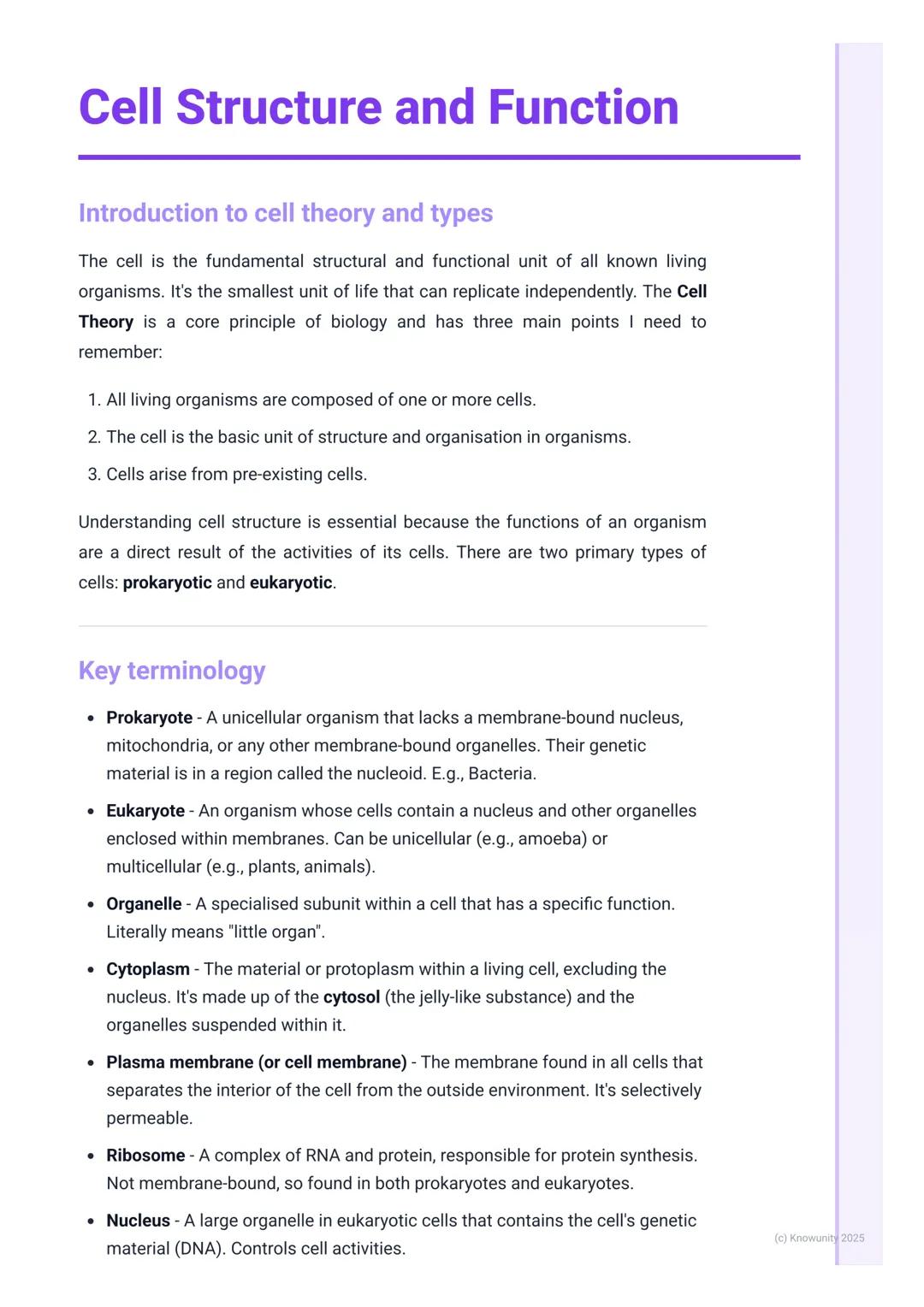
The cell theory has three key principles you need to remember: all living things are made of one or more cells, cells are the basic structural and functional units of life, and all cells come from pre-existing cells. This theory is fundamental to understanding biology.
There are two main types of cells: prokaryotic cells (like bacteria) which are simpler and lack membrane-bound organelles, and eukaryotic cells (like those in plants and animals) which are more complex and contain a true nucleus and various organelles.
Quick Tip: Think of cells as tiny factories, with each organelle being a department that performs a specific job. Together, they keep the "business" of life running smoothly!
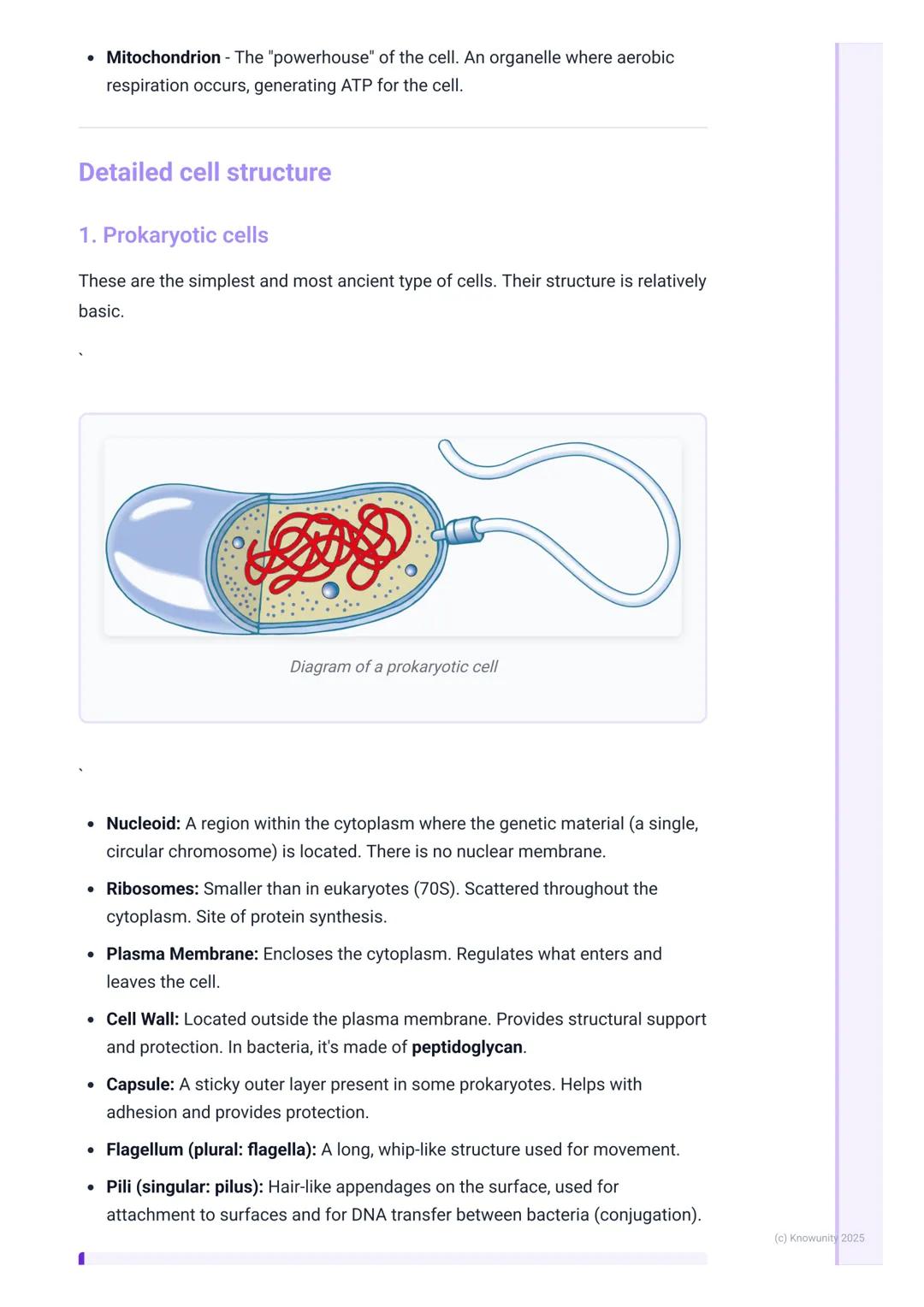
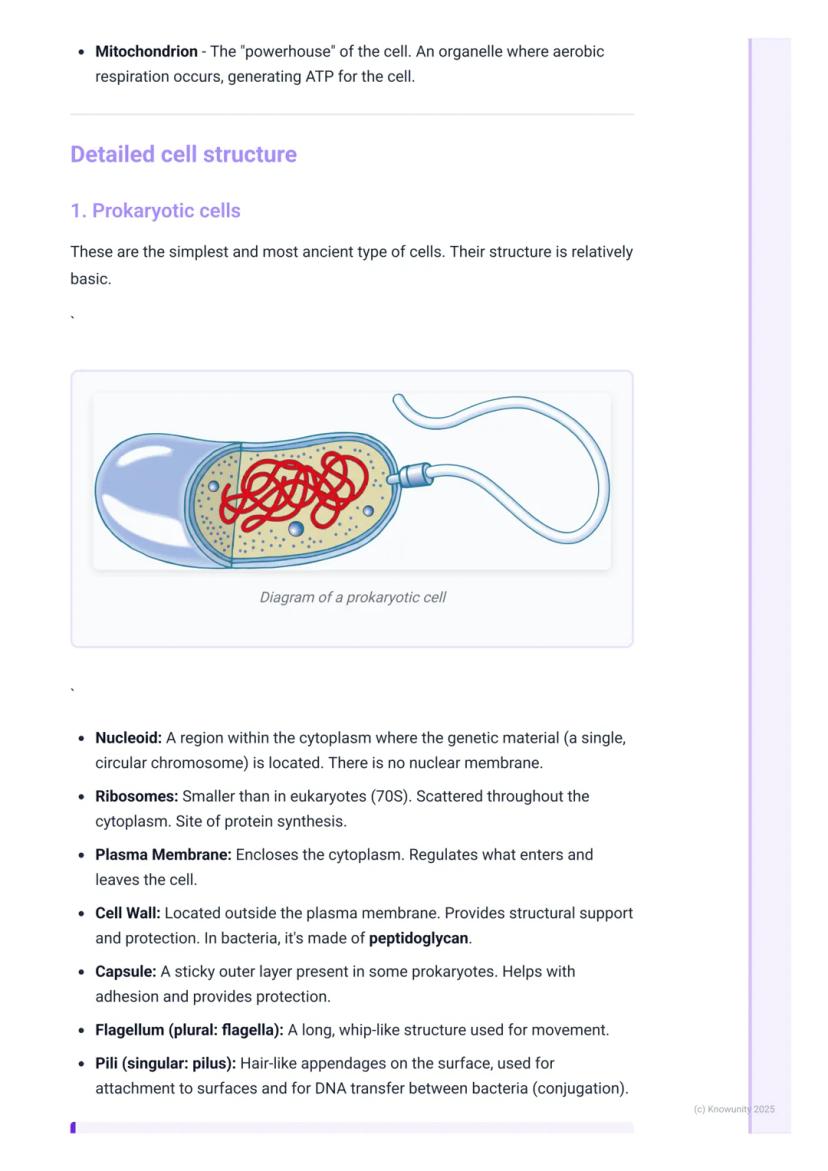
Prokaryotic cells are like the original "no-frills" version of cells - simple but incredibly effective. These ancient cells have survived billions of years with their basic design.
The genetic material in prokaryotes isn't housed in a nucleus but instead floats in a region called the nucleoid. They have smaller ribosomes (70S) scattered throughout their cytoplasm that manufacture proteins. The plasma membrane surrounds the cell contents and controls what enters and exits.
Most prokaryotes have a cell wall made of peptidoglycan that provides structural support and protection. Many also have additional features like a sticky capsule for protection and adhesion, flagella for movement, and pili for attachment and DNA transfer between cells.
Remember This: The key defining feature of prokaryotic cells is the absence of membrane-bound organelles - no nucleus, no mitochondria, no chloroplasts!
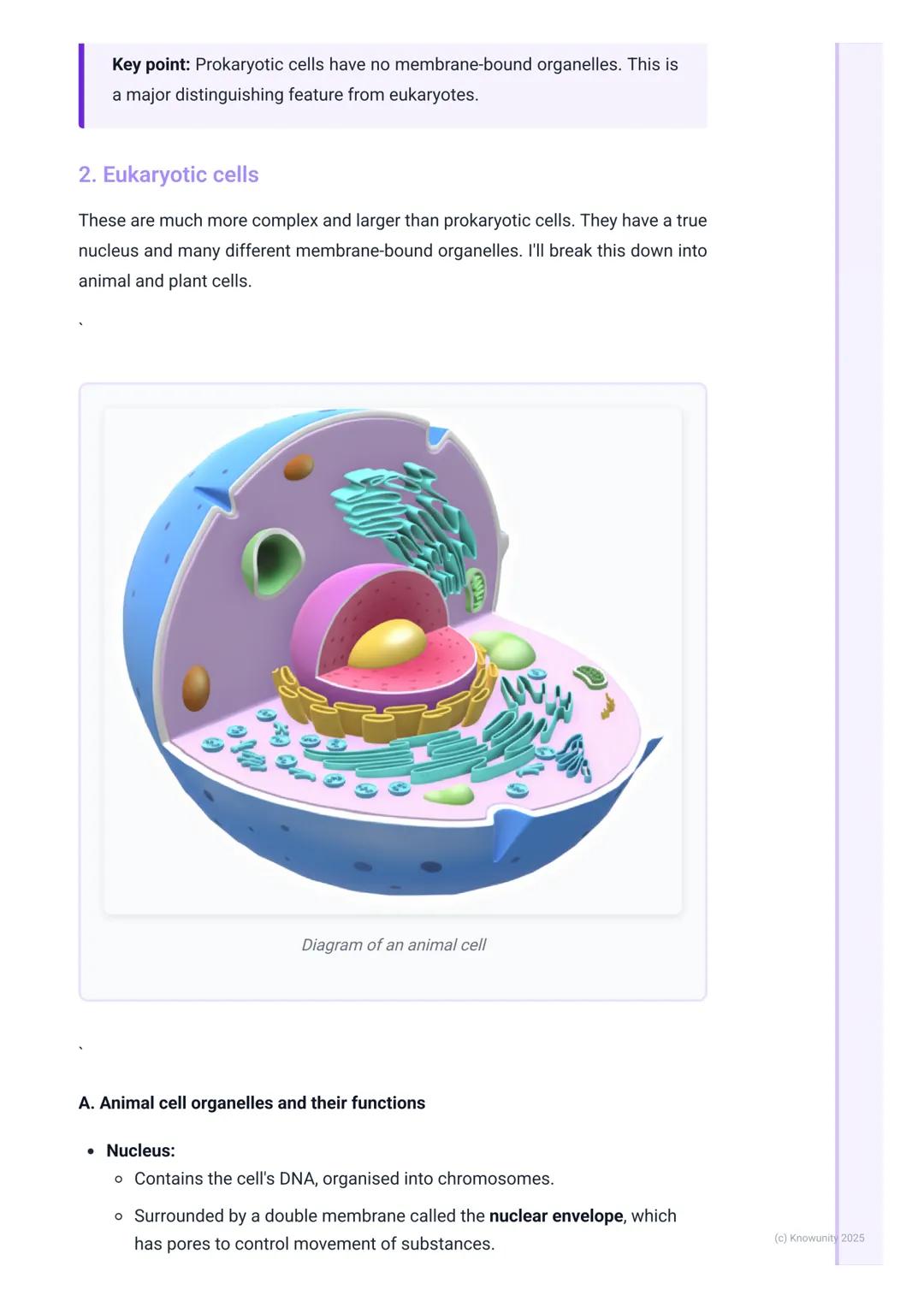
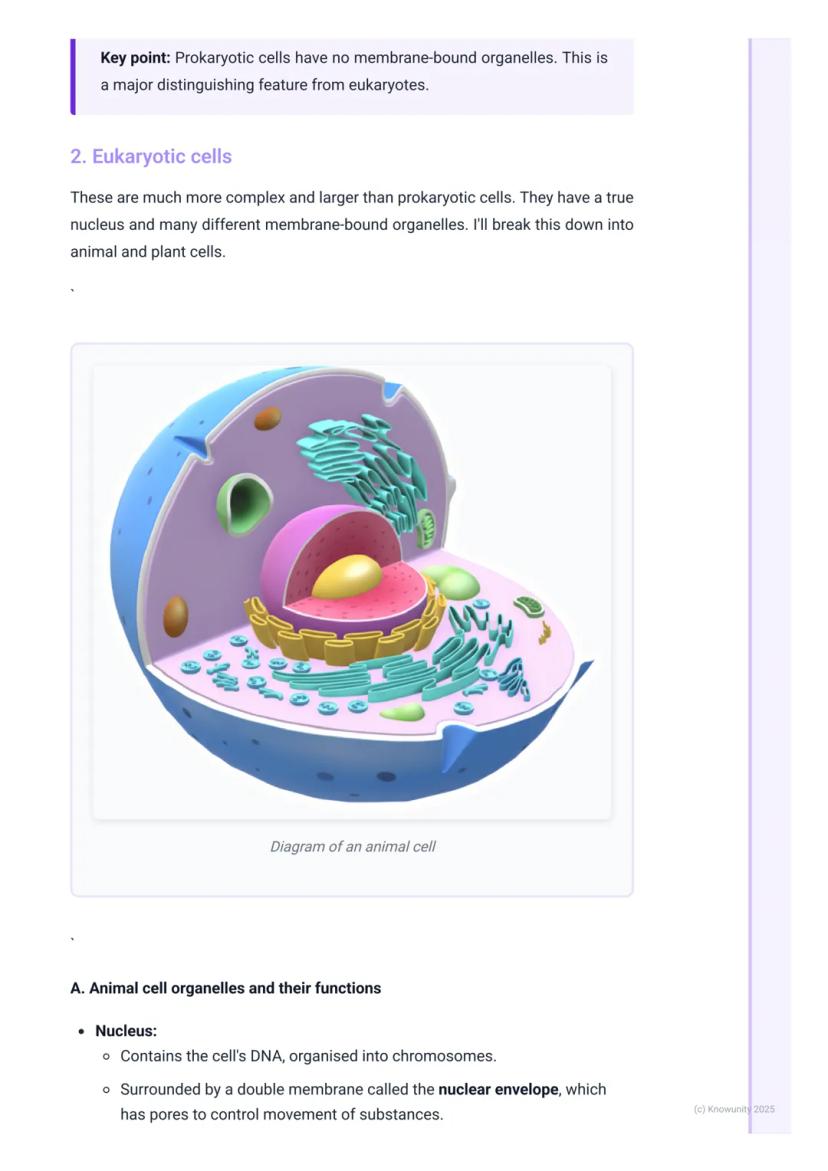
Eukaryotic cells are like high-tech upgrades of prokaryotes - larger, more complex, and with specialized compartments for different functions. These cells make up your body and those of all plants, animals, and fungi.
The hallmark of eukaryotic cells is the nucleus - a control center surrounded by a double membrane that houses DNA organized into chromosomes. The nuclear envelope has pores that regulate what moves in and out. Inside the nucleus is the nucleolus, where ribosomes are manufactured.
Animal cell organelles include mitochondria (the powerhouse that produces ATP through aerobic respiration), ribosomes (protein factories), and the endoplasmic reticulum (ER) which processes proteins and lipids. The Golgi apparatus acts like the cell's post office, packaging and directing molecules to their destinations.
Exam Alert: Remember that eukaryotic cells are typically 10-100 times larger than prokaryotic cells and contain many more components - this complexity allows for the specialization needed in multicellular organisms!
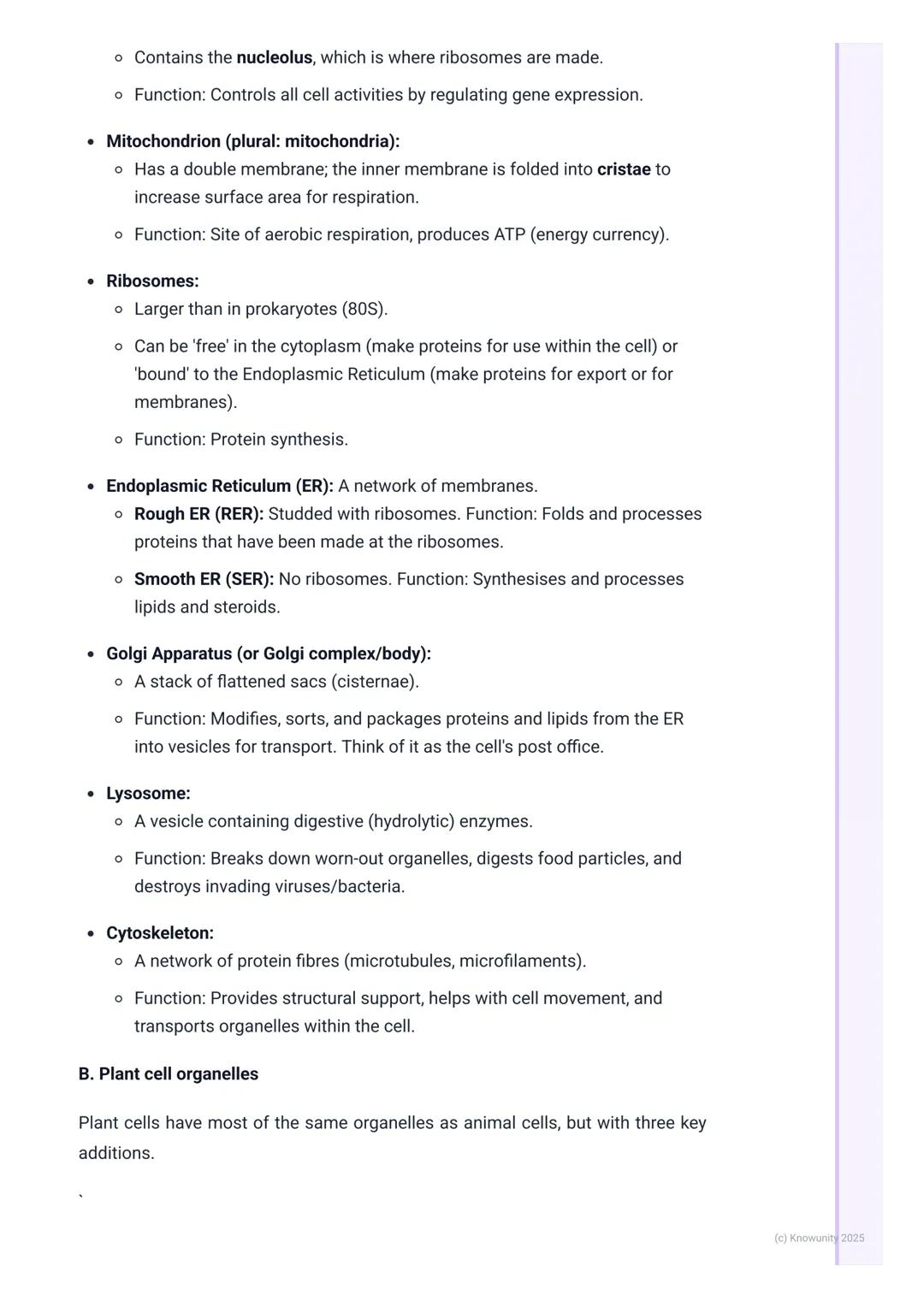
Animal cells contain a fascinating array of specialized structures that work together like a well-oiled machine. Understanding their functions helps explain how our bodies operate at the cellular level.
The mitochondria have a distinctive double membrane structure with the inner membrane folded into cristae to increase surface area for ATP production. Ribosomes can be free-floating in the cytoplasm or attached to the rough ER, determining whether the proteins they produce stay within the cell or are exported. The endoplasmic reticulum comes in two types: rough ER (studded with ribosomes) processes proteins, while smooth ER handles lipids and steroids.
Other crucial organelles include the Golgi apparatus, which modifies and packages molecules, lysosomes containing digestive enzymes that break down cellular waste and invaders, and the cytoskeleton, a network of protein fibers that provides structure and facilitates movement within the cell.
Study Tip: When learning about organelles, associate each with a real-world equivalent - the nucleus is like a manager, mitochondria are power plants, the ER is a manufacturing facility, and the Golgi apparatus is a packaging and shipping center!
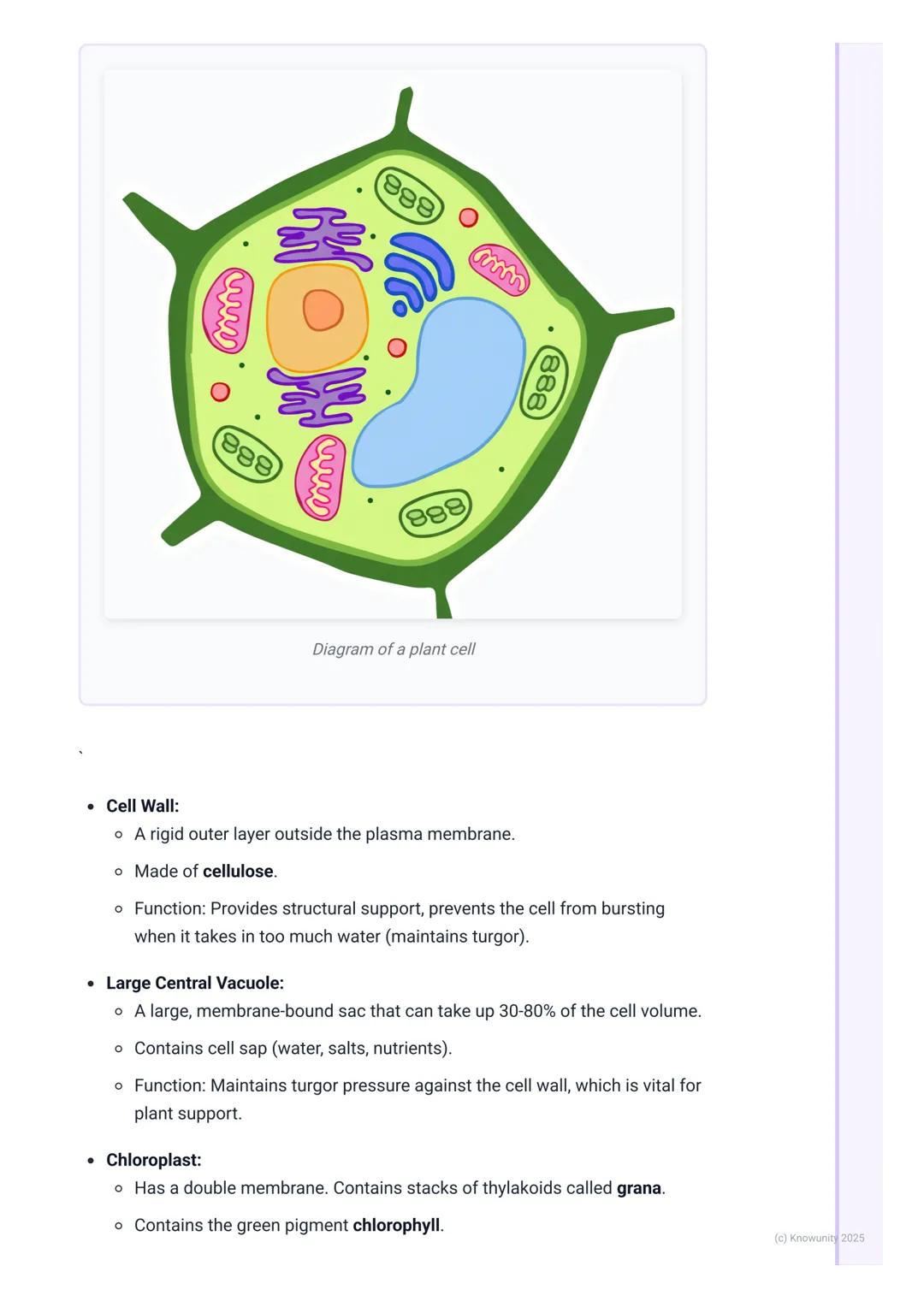
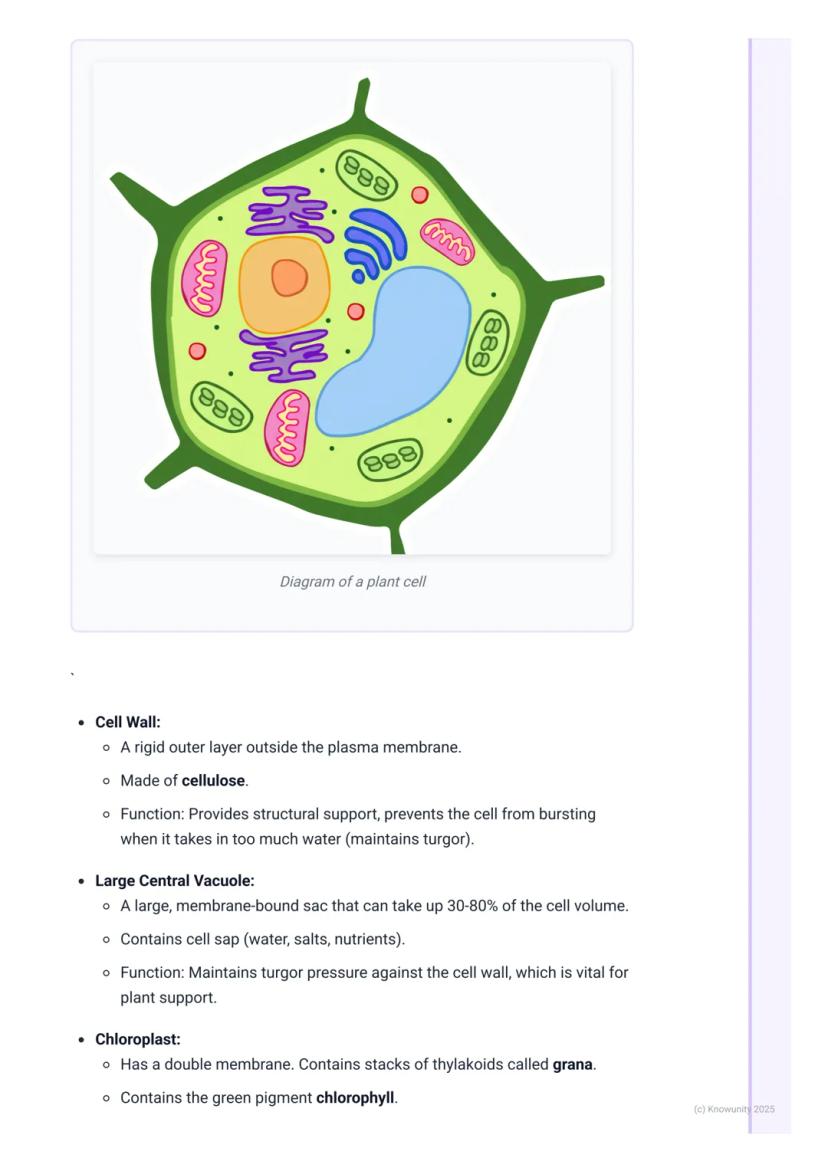
Plant cells share many features with animal cells but have evolved unique structures that enable them to harness sunlight and maintain rigidity. These specialized components explain how plants can stand tall and produce their own food.
The cell wall, composed primarily of cellulose, surrounds the cell membrane and provides structural support. This rigid layer prevents the cell from bursting when it absorbs water and helps plants maintain their shape. Unlike the bacterial cell wall, plant cell walls are made of cellulose rather than peptidoglycan.
The large central vacuole can occupy up to 80% of a plant cell's volume and stores water, nutrients, and waste products. It plays a crucial role in maintaining turgor pressure - the outward pressure against the cell wall that gives plants their rigidity.
Perhaps most importantly, plant cells contain chloroplasts - remarkable organelles with double membranes housing stacks of thylakoids called grana. These structures contain the green pigment chlorophyll, which captures sunlight and converts it into chemical energy during photosynthesis.
Connection Point: Notice how plant cell specializations reflect their lifestyle - they need to stand upright (cell wall), store resources (large vacuole), and make their own food (chloroplasts)!
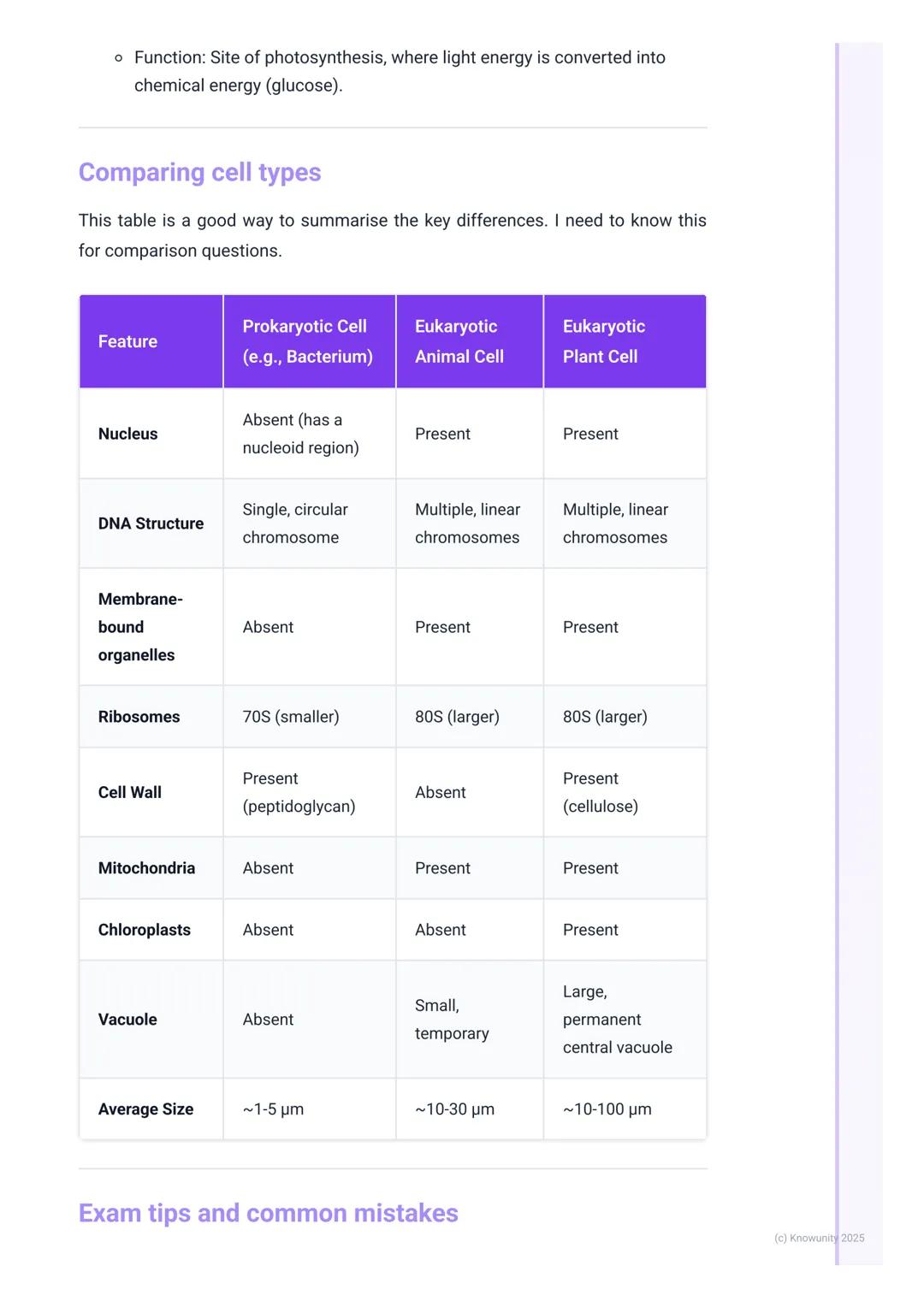
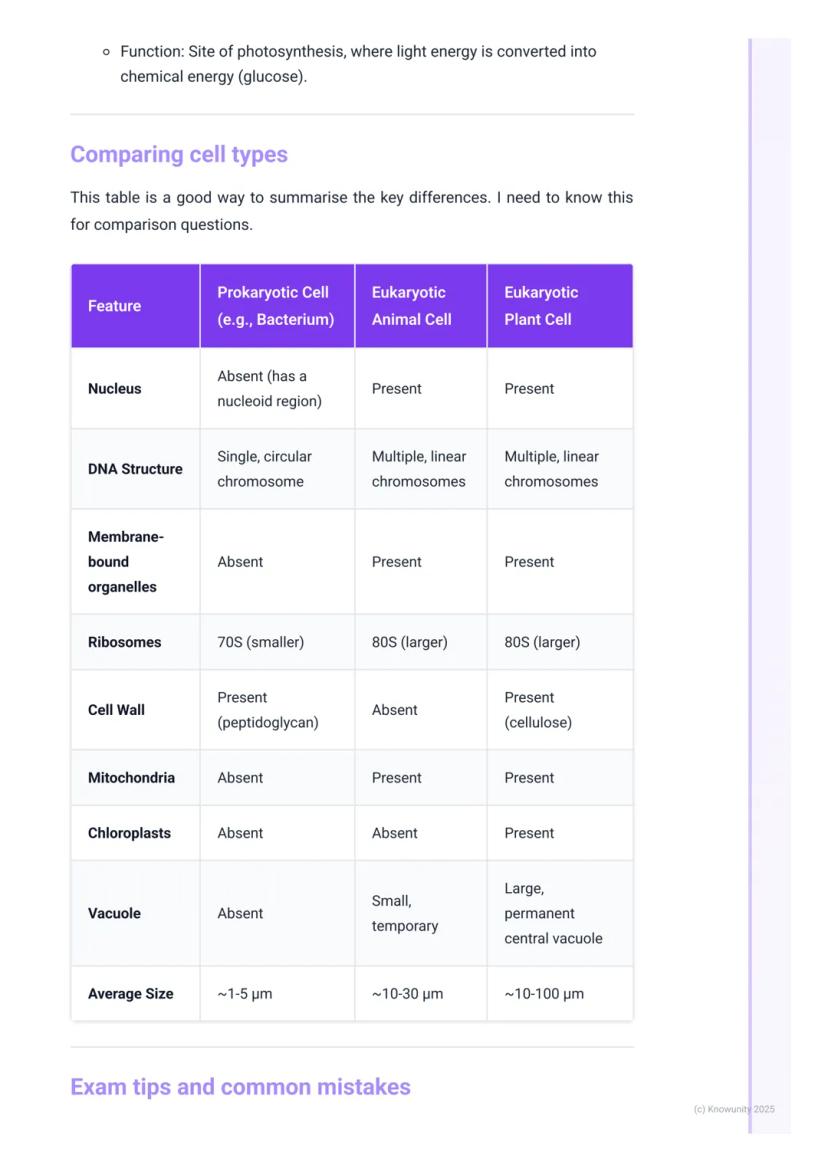
Understanding the differences between cell types is essential for biology exams and builds your foundation for more advanced concepts. Being able to compare and contrast them shows a deeper understanding of cell biology.
Prokaryotic cells are smaller and simpler, with a single circular chromosome in the nucleoid region rather than a true nucleus. They lack membrane-bound organelles but do have smaller ribosomes (70S) and a peptidoglycan cell wall. These ancient cells represent the earliest forms of life on Earth.
Eukaryotic animal cells are larger with multiple linear chromosomes housed in a true nucleus. They contain various membrane-bound organelles including mitochondria, but lack cell walls, chloroplasts, and large central vacuoles. Instead, they have small, temporary vacuoles and specialized lysosomes for digestion.
Eukaryotic plant cells combine features of animal cells with their own specializations. They have a nucleus and mitochondria like animal cells, but also contain chloroplasts for photosynthesis, a cellulose cell wall for support, and a large central vacuole for maintaining turgor pressure.
Exam Focus: Remember that all cells have a plasma membrane, cytoplasm, and genetic material, but the packaging and additional structures differ significantly between types!
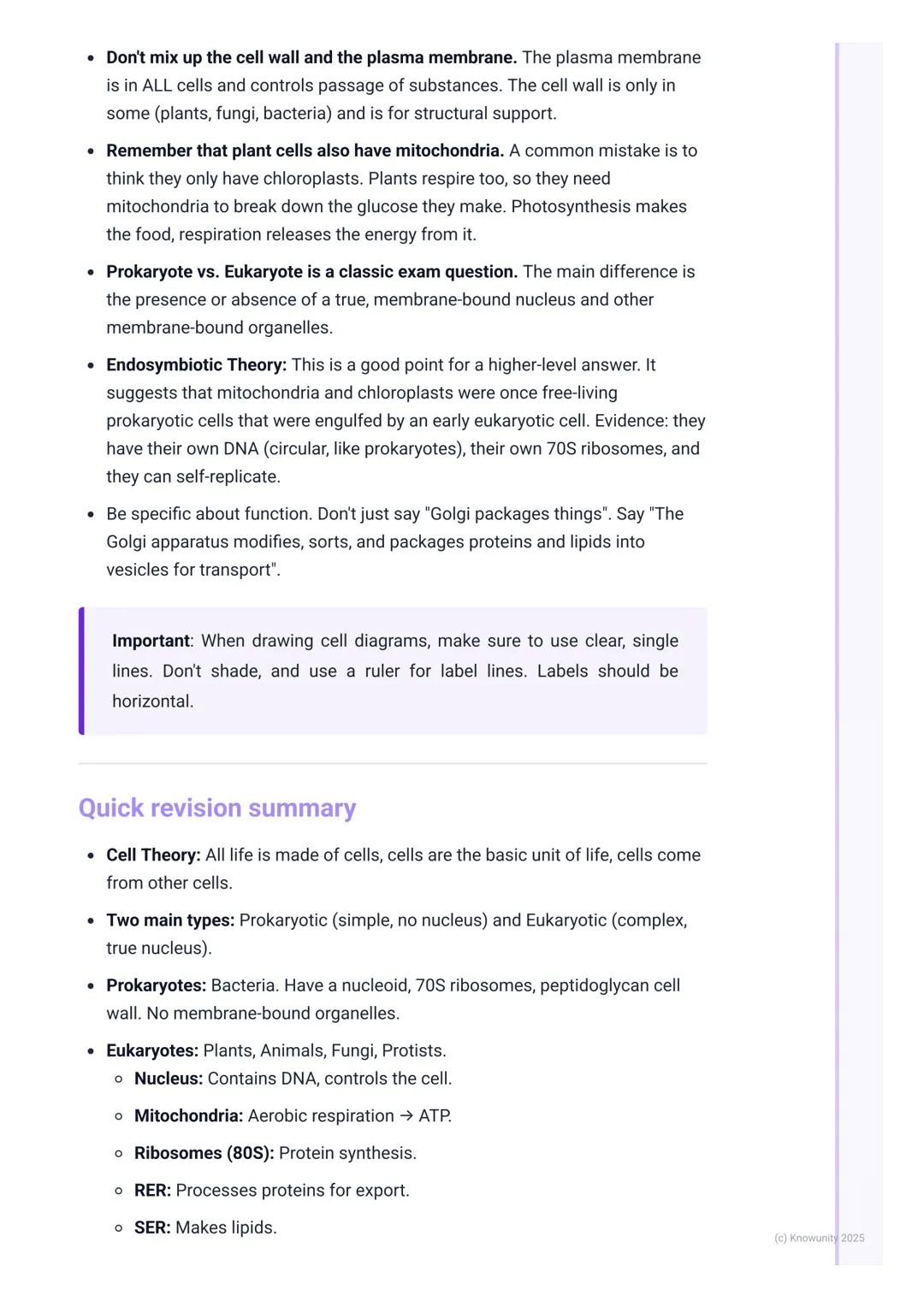
Avoid these common pitfalls when studying cell biology to secure those top marks in your exams. Being aware of typical mistakes can help you focus your revision effectively.
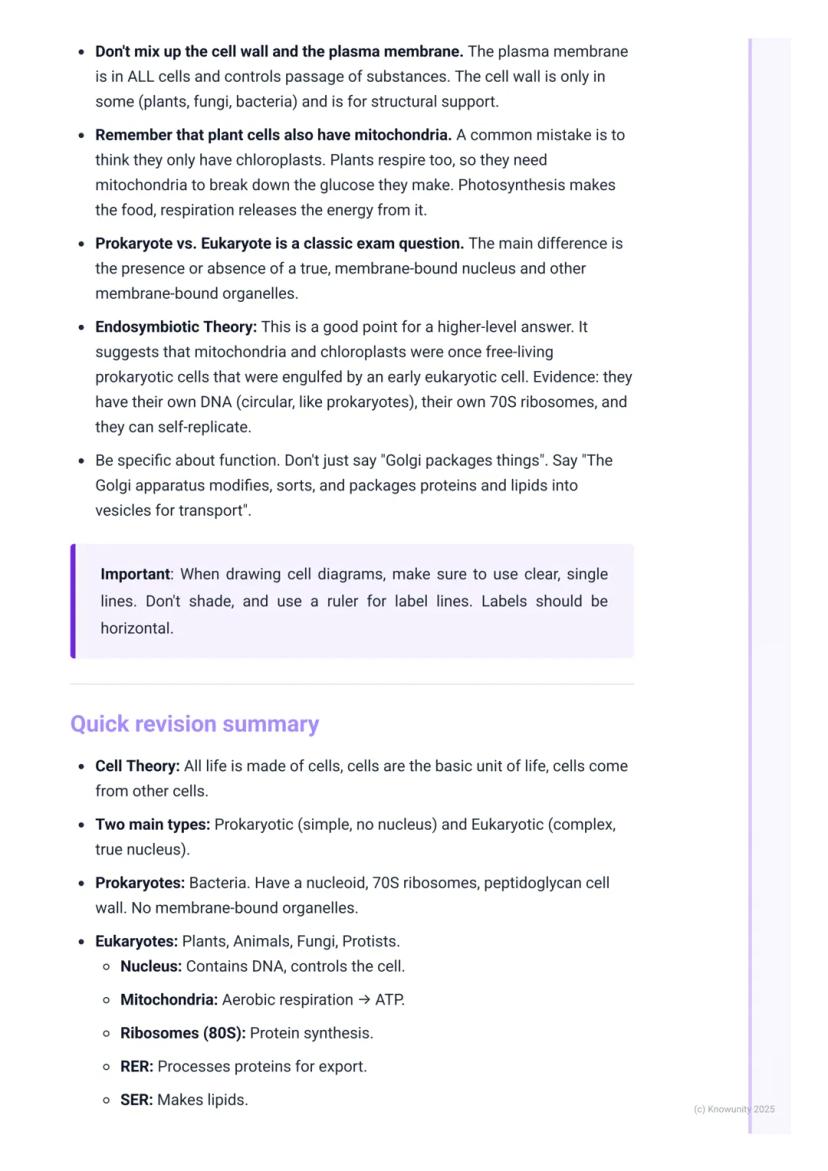
Don't confuse the plasma membrane (present in ALL cells and controlling substance passage) with the cell wall (only in plants, fungi, and bacteria for structural support). Another common error is forgetting that plant cells have mitochondria in addition to chloroplasts - plants need both photosynthesis to make glucose AND respiration to release energy from it.
The endosymbiotic theory is worth mentioning in higher-level answers. It proposes that mitochondria and chloroplasts were once free-living prokaryotes that were engulfed by early eukaryotic cells. Evidence includes their own circular DNA, 70S ribosomes, and ability to self-replicate - all prokaryotic characteristics.
When describing organelle functions, be specific. Instead of saying "the Golgi packages things," write that "the Golgi apparatus modifies, sorts, and packages proteins and lipids into vesicles for transport." For cell diagrams, use clear single lines, horizontal labels, and avoid shading.
Confidence Booster: If you can explain why cellular structures evolved as they did, you're thinking like a biologist! Understanding the relationship between structure and function is key to mastering cell biology.

Let's pull everything together into a concise overview that highlights the most essential points you need to remember about cells. These are your go-to facts for quick revision before an exam.
The cell theory establishes that all living things are made of cells, cells are the basic units of life, and all cells come from pre-existing cells. The two main cell types are prokaryotic (simple, no nucleus) and eukaryotic (complex, true nucleus).
Prokaryotes like bacteria have a nucleoid region with a circular chromosome, 70S ribosomes, and a peptidoglycan cell wall, but no membrane-bound organelles. Eukaryotes include plants, animals, fungi, and protists, all with a nucleus containing DNA, mitochondria for energy production, 80S ribosomes for protein synthesis, and various specialized organelles like the ER and Golgi apparatus.
Plant cells have unique structures including a cellulose cell wall for support, a large central vacuole for maintaining turgor pressure, and chloroplasts for photosynthesis. Animal cells lack these plant-specific features but have lysosomes for intracellular digestion.
Final Tip: Understanding cells is like learning a new language - once you grasp the vocabulary of organelles and their functions, you'll be able to "read" the complex processes of life at the cellular level!
Nuestro compañero de IA está específicamente adaptado a las necesidades de los estudiantes. Basándonos en los millones de contenidos que tenemos en la plataforma, podemos dar a los estudiantes respuestas realmente significativas y relevantes. Pero no se trata solo de respuestas, el compañero también guía a los estudiantes a través de sus retos de aprendizaje diarios, con planes de aprendizaje personalizados, cuestionarios o contenidos en el chat y una personalización del 100% basada en las habilidades y el desarrollo de los estudiantes.
Puedes descargar la app en Google Play Store y Apple App Store.
Sí, tienes acceso gratuito a los contenidos de la aplicación y a nuestro compañero de IA. Para desbloquear determinadas funciones de la aplicación, puedes adquirir Knowunity Pro.
App Store
Google Play
La app es muy fácil de usar y está muy bien diseñada. Hasta ahora he encontrado todo lo que estaba buscando y he podido aprender mucho de las presentaciones. Definitivamente utilizaré la aplicación para un examen de clase. Y, por supuesto, también me sirve mucho de inspiración.
Pablo
usuario de iOS
Esta app es realmente genial. Hay tantos apuntes de clase y ayuda [...]. Tengo problemas con matemáticas, por ejemplo, y la aplicación tiene muchas opciones de ayuda. Gracias a Knowunity, he mejorado en mates. Se la recomiendo a todo el mundo.
Elena
usuaria de Android
Vaya, estoy realmente sorprendida. Acabo de probar la app porque la he visto anunciada muchas veces y me he quedado absolutamente alucinada. Esta app es LA AYUDA que quieres para el insti y, sobre todo, ofrece muchísimas cosas, como ejercicios y hojas informativas, que a mí personalmente me han sido MUY útiles.
Ana
usuaria de iOS
Está app es muy buena, tiene apuntes que son de mucha ayuda y su IA es fantástica, te explica a la perfección y muy fácil de entender lo que necesites, te ayuda con los deberes, te hace esquemas... en definitiva es una muy buena opción!
Sophia
usuario de Android
Me encanta!!! Me resuelve todo con detalle y me da la explicación correcta. Tiene un montón de funciones, ami me ha ido genial!! Os la recomiendo!!!
Marta
usuaria de Android
La uso casi diariamente, sirve para todas las asignaturas. Yo, por ejemplo la utilizo más en inglés porque se me da bastante mal, ¡Todas las respuestas están correctas! Consta con personas reales que suben sus apuntes y IA para que puedas hacer los deberes muchísimo más fácil, la recomiendo.
Izan
usuario de iOS
¡La app es buenísima! Sólo tengo que introducir el tema en la barra de búsqueda y recibo la respuesta muy rápido. No tengo que ver 10 vídeos de YouTube para entender algo, así que me ahorro tiempo. ¡Muy recomendable!
Sara
usuaria de Android
En el instituto era muy malo en matemáticas, pero gracias a la app, ahora saco mejores notas. Os agradezco mucho que hayáis creado la aplicación.
Roberto
usuario de Android
Esto no es como Chatgpt, es MUCHISMO MEJOR, te hace unos resúmenes espectaculares y gracias a esta app pase de sacar 5-6 a sacar 8-9.
Julyana
usuaria de Android
Es la mejor aplicación del mundo, la uso para revisar los deberes a mi hijo.
Javier
usuario de Android
LOS QUIZ Y FLASHCARDS SON SÚPER ÚTILES Y ME ENCANTA Knowunity IA. ADEMÁS ES LITERALMENTE COMO CHATGPT PERO MÁS LISTO!! ME AYUDÓ TAMBIÉN CON MIS PROBLEMAS DE MÁSCARA!! Y CON MIS ASIGNATURAS DE VERDAD! OBVIO 😍😁😲🤑💗✨🎀😮
Erick
usuario de Android
Me me encanta esta app, todo lo que tiene es de calidad ya que antes de ser publicado es revisado por un equipo de profesionales. Me ha ido genial esta aplicación ya que gracias a ella puedo estudiar mucho mejor, sin tener que agobiarme porque mi profesor no ha hecho teoría o porque no entiendo su teoría. Le doy un 10 de 10!
Mar
usuaria de iOS
La app es muy fácil de usar y está muy bien diseñada. Hasta ahora he encontrado todo lo que estaba buscando y he podido aprender mucho de las presentaciones. Definitivamente utilizaré la aplicación para un examen de clase. Y, por supuesto, también me sirve mucho de inspiración.
Pablo
usuario de iOS
Esta app es realmente genial. Hay tantos apuntes de clase y ayuda [...]. Tengo problemas con matemáticas, por ejemplo, y la aplicación tiene muchas opciones de ayuda. Gracias a Knowunity, he mejorado en mates. Se la recomiendo a todo el mundo.
Elena
usuaria de Android
Vaya, estoy realmente sorprendida. Acabo de probar la app porque la he visto anunciada muchas veces y me he quedado absolutamente alucinada. Esta app es LA AYUDA que quieres para el insti y, sobre todo, ofrece muchísimas cosas, como ejercicios y hojas informativas, que a mí personalmente me han sido MUY útiles.
Ana
usuaria de iOS
Está app es muy buena, tiene apuntes que son de mucha ayuda y su IA es fantástica, te explica a la perfección y muy fácil de entender lo que necesites, te ayuda con los deberes, te hace esquemas... en definitiva es una muy buena opción!
Sophia
usuario de Android
Me encanta!!! Me resuelve todo con detalle y me da la explicación correcta. Tiene un montón de funciones, ami me ha ido genial!! Os la recomiendo!!!
Marta
usuaria de Android
La uso casi diariamente, sirve para todas las asignaturas. Yo, por ejemplo la utilizo más en inglés porque se me da bastante mal, ¡Todas las respuestas están correctas! Consta con personas reales que suben sus apuntes y IA para que puedas hacer los deberes muchísimo más fácil, la recomiendo.
Izan
usuario de iOS
¡La app es buenísima! Sólo tengo que introducir el tema en la barra de búsqueda y recibo la respuesta muy rápido. No tengo que ver 10 vídeos de YouTube para entender algo, así que me ahorro tiempo. ¡Muy recomendable!
Sara
usuaria de Android
En el instituto era muy malo en matemáticas, pero gracias a la app, ahora saco mejores notas. Os agradezco mucho que hayáis creado la aplicación.
Roberto
usuario de Android
Esto no es como Chatgpt, es MUCHISMO MEJOR, te hace unos resúmenes espectaculares y gracias a esta app pase de sacar 5-6 a sacar 8-9.
Julyana
usuaria de Android
Es la mejor aplicación del mundo, la uso para revisar los deberes a mi hijo.
Javier
usuario de Android
LOS QUIZ Y FLASHCARDS SON SÚPER ÚTILES Y ME ENCANTA Knowunity IA. ADEMÁS ES LITERALMENTE COMO CHATGPT PERO MÁS LISTO!! ME AYUDÓ TAMBIÉN CON MIS PROBLEMAS DE MÁSCARA!! Y CON MIS ASIGNATURAS DE VERDAD! OBVIO 😍😁😲🤑💗✨🎀😮
Erick
usuario de Android
Me me encanta esta app, todo lo que tiene es de calidad ya que antes de ser publicado es revisado por un equipo de profesionales. Me ha ido genial esta aplicación ya que gracias a ella puedo estudiar mucho mejor, sin tener que agobiarme porque mi profesor no ha hecho teoría o porque no entiendo su teoría. Le doy un 10 de 10!
Mar
usuaria de iOS
Cells are the fundamental building blocks of all living organisms, serving as the basic units of life capable of independent replication. Understanding their structure and function is essential to biology as it explains how organisms carry out life processes. The... Mostrar más
Acceso a todos los documentos
Mejora tus notas
Únete a millones de estudiantes
Ever wondered what makes something "alive"? It all comes down to cells! These microscopic structures are the foundation of all living organisms, from bacteria to humans.
The cell theory has three key principles you need to remember: all living things are made of one or more cells, cells are the basic structural and functional units of life, and all cells come from pre-existing cells. This theory is fundamental to understanding biology.
There are two main types of cells: prokaryotic cells (like bacteria) which are simpler and lack membrane-bound organelles, and eukaryotic cells (like those in plants and animals) which are more complex and contain a true nucleus and various organelles.
Quick Tip: Think of cells as tiny factories, with each organelle being a department that performs a specific job. Together, they keep the "business" of life running smoothly!
Acceso a todos los documentos
Mejora tus notas
Únete a millones de estudiantes
Prokaryotic cells are like the original "no-frills" version of cells - simple but incredibly effective. These ancient cells have survived billions of years with their basic design.
The genetic material in prokaryotes isn't housed in a nucleus but instead floats in a region called the nucleoid. They have smaller ribosomes (70S) scattered throughout their cytoplasm that manufacture proteins. The plasma membrane surrounds the cell contents and controls what enters and exits.
Most prokaryotes have a cell wall made of peptidoglycan that provides structural support and protection. Many also have additional features like a sticky capsule for protection and adhesion, flagella for movement, and pili for attachment and DNA transfer between cells.
Remember This: The key defining feature of prokaryotic cells is the absence of membrane-bound organelles - no nucleus, no mitochondria, no chloroplasts!
Acceso a todos los documentos
Mejora tus notas
Únete a millones de estudiantes
Eukaryotic cells are like high-tech upgrades of prokaryotes - larger, more complex, and with specialized compartments for different functions. These cells make up your body and those of all plants, animals, and fungi.
The hallmark of eukaryotic cells is the nucleus - a control center surrounded by a double membrane that houses DNA organized into chromosomes. The nuclear envelope has pores that regulate what moves in and out. Inside the nucleus is the nucleolus, where ribosomes are manufactured.
Animal cell organelles include mitochondria (the powerhouse that produces ATP through aerobic respiration), ribosomes (protein factories), and the endoplasmic reticulum (ER) which processes proteins and lipids. The Golgi apparatus acts like the cell's post office, packaging and directing molecules to their destinations.
Exam Alert: Remember that eukaryotic cells are typically 10-100 times larger than prokaryotic cells and contain many more components - this complexity allows for the specialization needed in multicellular organisms!
Acceso a todos los documentos
Mejora tus notas
Únete a millones de estudiantes
Animal cells contain a fascinating array of specialized structures that work together like a well-oiled machine. Understanding their functions helps explain how our bodies operate at the cellular level.
The mitochondria have a distinctive double membrane structure with the inner membrane folded into cristae to increase surface area for ATP production. Ribosomes can be free-floating in the cytoplasm or attached to the rough ER, determining whether the proteins they produce stay within the cell or are exported. The endoplasmic reticulum comes in two types: rough ER (studded with ribosomes) processes proteins, while smooth ER handles lipids and steroids.
Other crucial organelles include the Golgi apparatus, which modifies and packages molecules, lysosomes containing digestive enzymes that break down cellular waste and invaders, and the cytoskeleton, a network of protein fibers that provides structure and facilitates movement within the cell.
Study Tip: When learning about organelles, associate each with a real-world equivalent - the nucleus is like a manager, mitochondria are power plants, the ER is a manufacturing facility, and the Golgi apparatus is a packaging and shipping center!
Acceso a todos los documentos
Mejora tus notas
Únete a millones de estudiantes
Plant cells share many features with animal cells but have evolved unique structures that enable them to harness sunlight and maintain rigidity. These specialized components explain how plants can stand tall and produce their own food.
The cell wall, composed primarily of cellulose, surrounds the cell membrane and provides structural support. This rigid layer prevents the cell from bursting when it absorbs water and helps plants maintain their shape. Unlike the bacterial cell wall, plant cell walls are made of cellulose rather than peptidoglycan.
The large central vacuole can occupy up to 80% of a plant cell's volume and stores water, nutrients, and waste products. It plays a crucial role in maintaining turgor pressure - the outward pressure against the cell wall that gives plants their rigidity.
Perhaps most importantly, plant cells contain chloroplasts - remarkable organelles with double membranes housing stacks of thylakoids called grana. These structures contain the green pigment chlorophyll, which captures sunlight and converts it into chemical energy during photosynthesis.
Connection Point: Notice how plant cell specializations reflect their lifestyle - they need to stand upright (cell wall), store resources (large vacuole), and make their own food (chloroplasts)!
Acceso a todos los documentos
Mejora tus notas
Únete a millones de estudiantes
Understanding the differences between cell types is essential for biology exams and builds your foundation for more advanced concepts. Being able to compare and contrast them shows a deeper understanding of cell biology.
Prokaryotic cells are smaller and simpler, with a single circular chromosome in the nucleoid region rather than a true nucleus. They lack membrane-bound organelles but do have smaller ribosomes (70S) and a peptidoglycan cell wall. These ancient cells represent the earliest forms of life on Earth.
Eukaryotic animal cells are larger with multiple linear chromosomes housed in a true nucleus. They contain various membrane-bound organelles including mitochondria, but lack cell walls, chloroplasts, and large central vacuoles. Instead, they have small, temporary vacuoles and specialized lysosomes for digestion.
Eukaryotic plant cells combine features of animal cells with their own specializations. They have a nucleus and mitochondria like animal cells, but also contain chloroplasts for photosynthesis, a cellulose cell wall for support, and a large central vacuole for maintaining turgor pressure.
Exam Focus: Remember that all cells have a plasma membrane, cytoplasm, and genetic material, but the packaging and additional structures differ significantly between types!
Acceso a todos los documentos
Mejora tus notas
Únete a millones de estudiantes
Avoid these common pitfalls when studying cell biology to secure those top marks in your exams. Being aware of typical mistakes can help you focus your revision effectively.
Don't confuse the plasma membrane (present in ALL cells and controlling substance passage) with the cell wall (only in plants, fungi, and bacteria for structural support). Another common error is forgetting that plant cells have mitochondria in addition to chloroplasts - plants need both photosynthesis to make glucose AND respiration to release energy from it.
The endosymbiotic theory is worth mentioning in higher-level answers. It proposes that mitochondria and chloroplasts were once free-living prokaryotes that were engulfed by early eukaryotic cells. Evidence includes their own circular DNA, 70S ribosomes, and ability to self-replicate - all prokaryotic characteristics.
When describing organelle functions, be specific. Instead of saying "the Golgi packages things," write that "the Golgi apparatus modifies, sorts, and packages proteins and lipids into vesicles for transport." For cell diagrams, use clear single lines, horizontal labels, and avoid shading.
Confidence Booster: If you can explain why cellular structures evolved as they did, you're thinking like a biologist! Understanding the relationship between structure and function is key to mastering cell biology.
Acceso a todos los documentos
Mejora tus notas
Únete a millones de estudiantes
Let's pull everything together into a concise overview that highlights the most essential points you need to remember about cells. These are your go-to facts for quick revision before an exam.
The cell theory establishes that all living things are made of cells, cells are the basic units of life, and all cells come from pre-existing cells. The two main cell types are prokaryotic (simple, no nucleus) and eukaryotic (complex, true nucleus).
Prokaryotes like bacteria have a nucleoid region with a circular chromosome, 70S ribosomes, and a peptidoglycan cell wall, but no membrane-bound organelles. Eukaryotes include plants, animals, fungi, and protists, all with a nucleus containing DNA, mitochondria for energy production, 80S ribosomes for protein synthesis, and various specialized organelles like the ER and Golgi apparatus.
Plant cells have unique structures including a cellulose cell wall for support, a large central vacuole for maintaining turgor pressure, and chloroplasts for photosynthesis. Animal cells lack these plant-specific features but have lysosomes for intracellular digestion.
Final Tip: Understanding cells is like learning a new language - once you grasp the vocabulary of organelles and their functions, you'll be able to "read" the complex processes of life at the cellular level!
Nuestro compañero de IA está específicamente adaptado a las necesidades de los estudiantes. Basándonos en los millones de contenidos que tenemos en la plataforma, podemos dar a los estudiantes respuestas realmente significativas y relevantes. Pero no se trata solo de respuestas, el compañero también guía a los estudiantes a través de sus retos de aprendizaje diarios, con planes de aprendizaje personalizados, cuestionarios o contenidos en el chat y una personalización del 100% basada en las habilidades y el desarrollo de los estudiantes.
Puedes descargar la app en Google Play Store y Apple App Store.
Sí, tienes acceso gratuito a los contenidos de la aplicación y a nuestro compañero de IA. Para desbloquear determinadas funciones de la aplicación, puedes adquirir Knowunity Pro.
0
Herramientas Inteligentes NUEVO
Transforma estos apuntes en: ✓ 50+ Preguntas de Práctica ✓ Flashcards Interactivas ✓ Examen Completo de Práctica ✓ Esquemas de Ensayo
App Store
Google Play
La app es muy fácil de usar y está muy bien diseñada. Hasta ahora he encontrado todo lo que estaba buscando y he podido aprender mucho de las presentaciones. Definitivamente utilizaré la aplicación para un examen de clase. Y, por supuesto, también me sirve mucho de inspiración.
Pablo
usuario de iOS
Esta app es realmente genial. Hay tantos apuntes de clase y ayuda [...]. Tengo problemas con matemáticas, por ejemplo, y la aplicación tiene muchas opciones de ayuda. Gracias a Knowunity, he mejorado en mates. Se la recomiendo a todo el mundo.
Elena
usuaria de Android
Vaya, estoy realmente sorprendida. Acabo de probar la app porque la he visto anunciada muchas veces y me he quedado absolutamente alucinada. Esta app es LA AYUDA que quieres para el insti y, sobre todo, ofrece muchísimas cosas, como ejercicios y hojas informativas, que a mí personalmente me han sido MUY útiles.
Ana
usuaria de iOS
Está app es muy buena, tiene apuntes que son de mucha ayuda y su IA es fantástica, te explica a la perfección y muy fácil de entender lo que necesites, te ayuda con los deberes, te hace esquemas... en definitiva es una muy buena opción!
Sophia
usuario de Android
Me encanta!!! Me resuelve todo con detalle y me da la explicación correcta. Tiene un montón de funciones, ami me ha ido genial!! Os la recomiendo!!!
Marta
usuaria de Android
La uso casi diariamente, sirve para todas las asignaturas. Yo, por ejemplo la utilizo más en inglés porque se me da bastante mal, ¡Todas las respuestas están correctas! Consta con personas reales que suben sus apuntes y IA para que puedas hacer los deberes muchísimo más fácil, la recomiendo.
Izan
usuario de iOS
¡La app es buenísima! Sólo tengo que introducir el tema en la barra de búsqueda y recibo la respuesta muy rápido. No tengo que ver 10 vídeos de YouTube para entender algo, así que me ahorro tiempo. ¡Muy recomendable!
Sara
usuaria de Android
En el instituto era muy malo en matemáticas, pero gracias a la app, ahora saco mejores notas. Os agradezco mucho que hayáis creado la aplicación.
Roberto
usuario de Android
Esto no es como Chatgpt, es MUCHISMO MEJOR, te hace unos resúmenes espectaculares y gracias a esta app pase de sacar 5-6 a sacar 8-9.
Julyana
usuaria de Android
Es la mejor aplicación del mundo, la uso para revisar los deberes a mi hijo.
Javier
usuario de Android
LOS QUIZ Y FLASHCARDS SON SÚPER ÚTILES Y ME ENCANTA Knowunity IA. ADEMÁS ES LITERALMENTE COMO CHATGPT PERO MÁS LISTO!! ME AYUDÓ TAMBIÉN CON MIS PROBLEMAS DE MÁSCARA!! Y CON MIS ASIGNATURAS DE VERDAD! OBVIO 😍😁😲🤑💗✨🎀😮
Erick
usuario de Android
Me me encanta esta app, todo lo que tiene es de calidad ya que antes de ser publicado es revisado por un equipo de profesionales. Me ha ido genial esta aplicación ya que gracias a ella puedo estudiar mucho mejor, sin tener que agobiarme porque mi profesor no ha hecho teoría o porque no entiendo su teoría. Le doy un 10 de 10!
Mar
usuaria de iOS
La app es muy fácil de usar y está muy bien diseñada. Hasta ahora he encontrado todo lo que estaba buscando y he podido aprender mucho de las presentaciones. Definitivamente utilizaré la aplicación para un examen de clase. Y, por supuesto, también me sirve mucho de inspiración.
Pablo
usuario de iOS
Esta app es realmente genial. Hay tantos apuntes de clase y ayuda [...]. Tengo problemas con matemáticas, por ejemplo, y la aplicación tiene muchas opciones de ayuda. Gracias a Knowunity, he mejorado en mates. Se la recomiendo a todo el mundo.
Elena
usuaria de Android
Vaya, estoy realmente sorprendida. Acabo de probar la app porque la he visto anunciada muchas veces y me he quedado absolutamente alucinada. Esta app es LA AYUDA que quieres para el insti y, sobre todo, ofrece muchísimas cosas, como ejercicios y hojas informativas, que a mí personalmente me han sido MUY útiles.
Ana
usuaria de iOS
Está app es muy buena, tiene apuntes que son de mucha ayuda y su IA es fantástica, te explica a la perfección y muy fácil de entender lo que necesites, te ayuda con los deberes, te hace esquemas... en definitiva es una muy buena opción!
Sophia
usuario de Android
Me encanta!!! Me resuelve todo con detalle y me da la explicación correcta. Tiene un montón de funciones, ami me ha ido genial!! Os la recomiendo!!!
Marta
usuaria de Android
La uso casi diariamente, sirve para todas las asignaturas. Yo, por ejemplo la utilizo más en inglés porque se me da bastante mal, ¡Todas las respuestas están correctas! Consta con personas reales que suben sus apuntes y IA para que puedas hacer los deberes muchísimo más fácil, la recomiendo.
Izan
usuario de iOS
¡La app es buenísima! Sólo tengo que introducir el tema en la barra de búsqueda y recibo la respuesta muy rápido. No tengo que ver 10 vídeos de YouTube para entender algo, así que me ahorro tiempo. ¡Muy recomendable!
Sara
usuaria de Android
En el instituto era muy malo en matemáticas, pero gracias a la app, ahora saco mejores notas. Os agradezco mucho que hayáis creado la aplicación.
Roberto
usuario de Android
Esto no es como Chatgpt, es MUCHISMO MEJOR, te hace unos resúmenes espectaculares y gracias a esta app pase de sacar 5-6 a sacar 8-9.
Julyana
usuaria de Android
Es la mejor aplicación del mundo, la uso para revisar los deberes a mi hijo.
Javier
usuario de Android
LOS QUIZ Y FLASHCARDS SON SÚPER ÚTILES Y ME ENCANTA Knowunity IA. ADEMÁS ES LITERALMENTE COMO CHATGPT PERO MÁS LISTO!! ME AYUDÓ TAMBIÉN CON MIS PROBLEMAS DE MÁSCARA!! Y CON MIS ASIGNATURAS DE VERDAD! OBVIO 😍😁😲🤑💗✨🎀😮
Erick
usuario de Android
Me me encanta esta app, todo lo que tiene es de calidad ya que antes de ser publicado es revisado por un equipo de profesionales. Me ha ido genial esta aplicación ya que gracias a ella puedo estudiar mucho mejor, sin tener que agobiarme porque mi profesor no ha hecho teoría o porque no entiendo su teoría. Le doy un 10 de 10!
Mar
usuaria de iOS