
We've all wondered about the big stuff - why we're... Mostrar más
 Religious Education
 Irish
Irish English
 Biology
Inscríbete para ver los apuntes¡Es gratis!
Acceso a todos los documentos
Mejora tus notas
Únete a millones de estudiantes
Knowunity AI
Asignaturas
Triangle Congruence and Similarity Theorems
Triangle Properties and Classification
Linear Equations and Graphs
Geometric Angle Relationships
Trigonometric Functions and Identities
Equation Solving Techniques
Circle Geometry Fundamentals
Division Operations and Methods
Basic Differentiation Rules
Exponent and Logarithm Properties
Mostrar todos los temas
Human Organ Systems
Reproductive Cell Cycles
Biological Sciences Subdisciplines
Cellular Energy Metabolism
Autotrophic Energy Processes
Inheritance Patterns and Principles
Biomolecular Structure and Organization
Cell Cycle and Division Mechanics
Cellular Organization and Development
Biological Structural Organization
Mostrar todos los temas
Chemical Sciences and Applications
Atomic Structure and Composition
Molecular Electron Structure Representation
Atomic Electron Behavior
Matter Properties and Water
Mole Concept and Calculations
Gas Laws and Behavior
Periodic Table Organization
Chemical Thermodynamics Fundamentals
Chemical Bond Types and Properties
Mostrar todos los temas
European Renaissance and Enlightenment
European Cultural Movements 800-1920
American Revolution Era 1763-1797
American Civil War 1861-1865
Global Imperial Systems
Mongol and Chinese Dynasties
U.S. Presidents and World Leaders
Historical Sources and Documentation
World Wars Era and Impact
World Religious Systems
Mostrar todos los temas
Classic and Contemporary Novels
Literary Character Analysis
Rhetorical Theory and Practice
Classic Literary Narratives
Reading Analysis and Interpretation
Narrative Structure and Techniques
English Language Components
Influential English-Language Authors
Basic Sentence Structure
Narrative Voice and Perspective
Mostrar todos los temas
1
•
Actualizado Apr 15, 2026
•
We've all wondered about the big stuff - why we're... Mostrar más

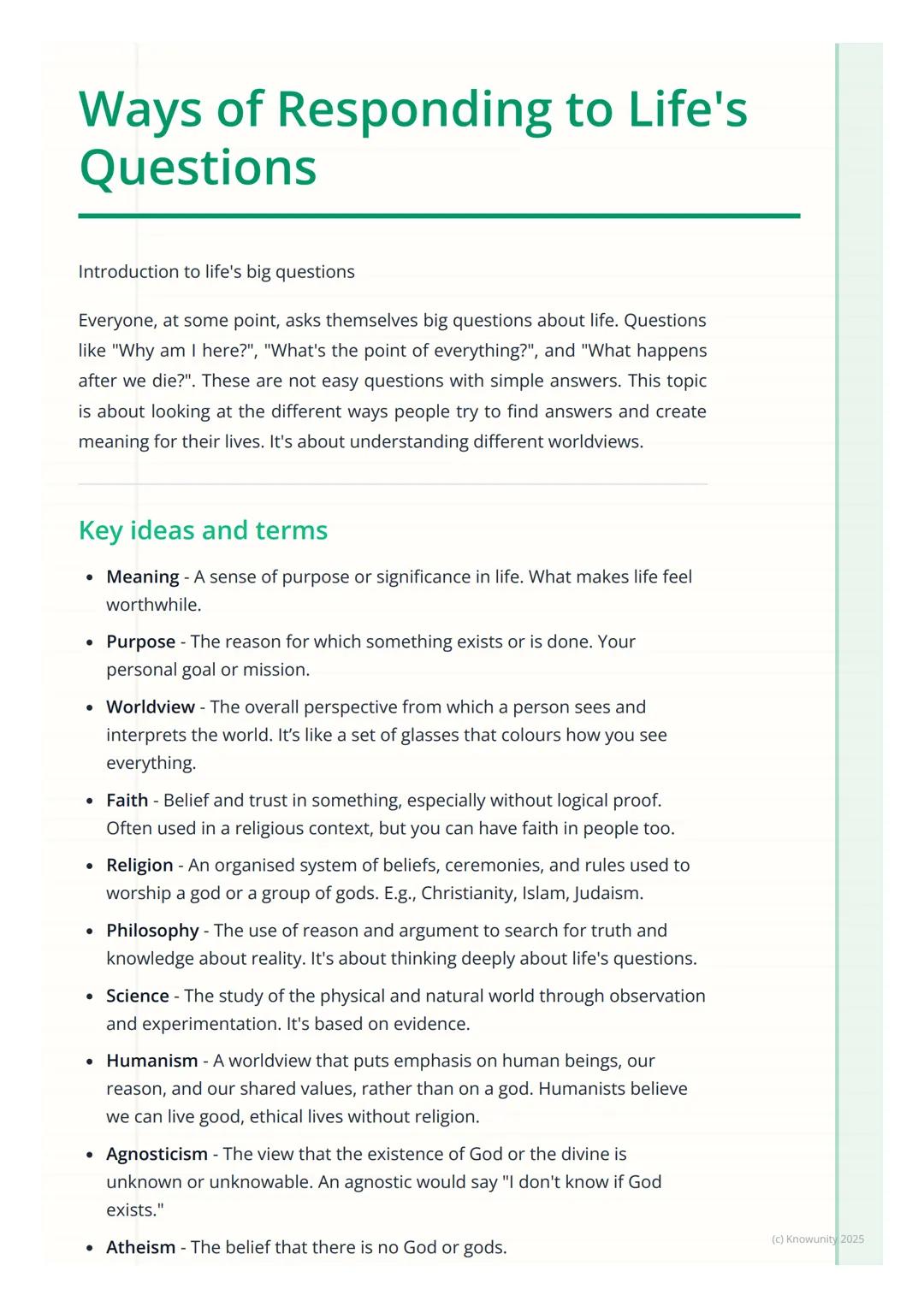
Ever found yourself staring at the ceiling at night wondering what the point of everything is? You're definitely not alone in asking these questions.
When we talk about meaning, we're looking for what makes life feel worthwhile - that sense of purpose that gets you out of bed in the morning. Your worldview is basically like a pair of glasses that colours how you see everything around you. It's your overall perspective on life, death, right, wrong, and everything in between.
Different people use different approaches to find answers. Some turn to religion - organised systems of beliefs about God or gods that come with rules and ceremonies. Others prefer philosophy, which uses pure reasoning and logic to work things out. Then there's science, which focuses on evidence and observation of the natural world.
Remember: There's no single "right" way to find meaning - most people actually mix and match these approaches throughout their lives.
You've also got humanism (focusing on human reason and shared values rather than God), agnosticism (admitting we can't know if God exists), and atheism (believing there's no God at all).
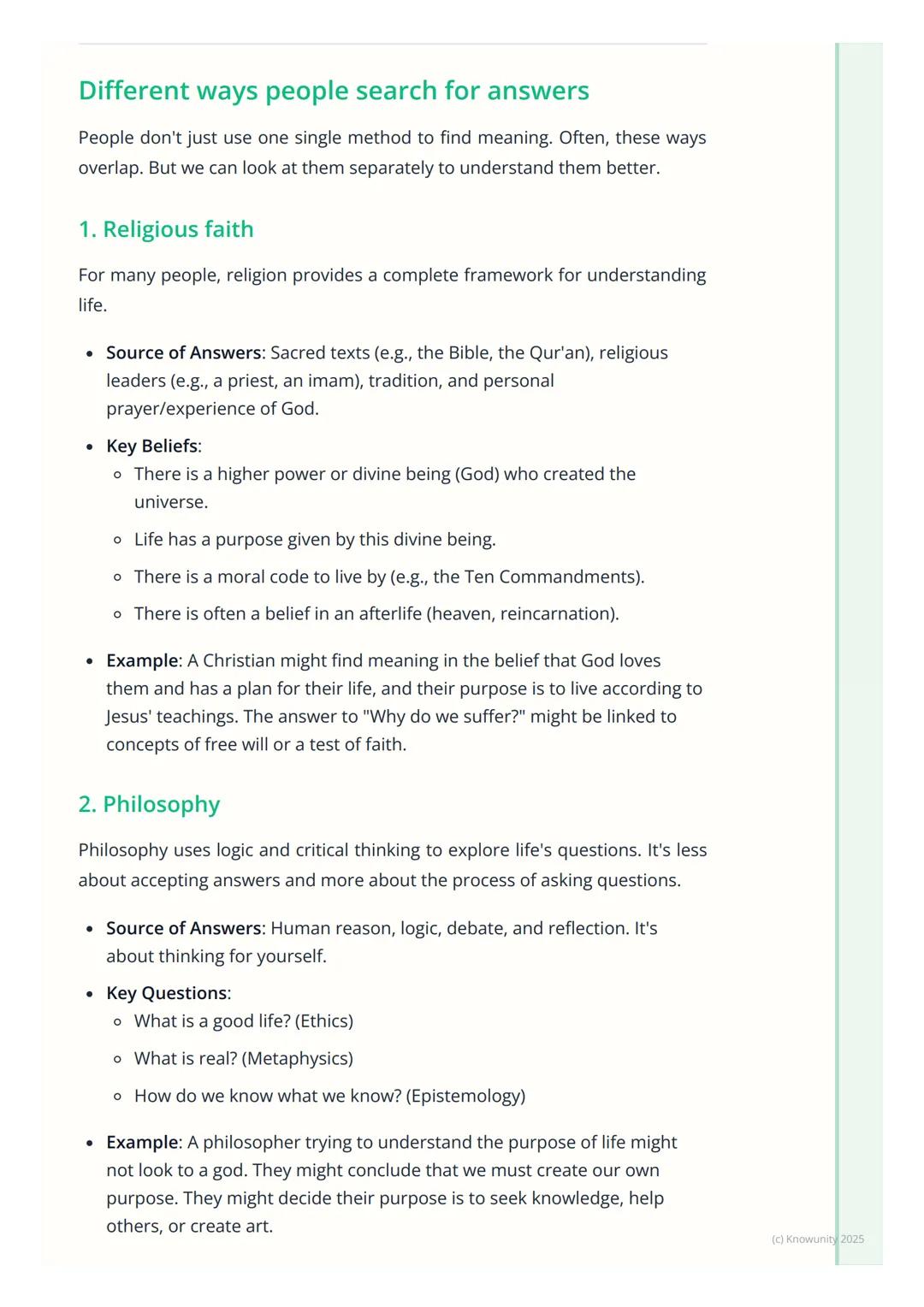
For millions of people worldwide, religious faith provides a complete roadmap for understanding life's mysteries.
Religious believers find their answers in sacred texts like the Bible or Qur'an, guidance from religious leaders, and personal prayer or spiritual experiences. They typically believe in a higher power who created everything, that life has a divine purpose, and that there's some form of afterlife waiting. A Christian, for example, might find meaning in believing God loves them and has a specific plan for their life.
Philosophy takes a completely different approach - it's all about using your brain to think deeply about life's questions. Instead of accepting ready-made answers, philosophers prefer the process of questioning everything. They tackle big topics like what makes a good life, what's actually real, and how we can know anything for certain.
Think about it: A philosopher facing the question "What's my purpose?" might conclude that humans must create their own purpose rather than receive it from a divine source.
The key difference? Religious faith often starts with belief and builds from there, while philosophy starts with doubt and uses logic to work towards possible answers.
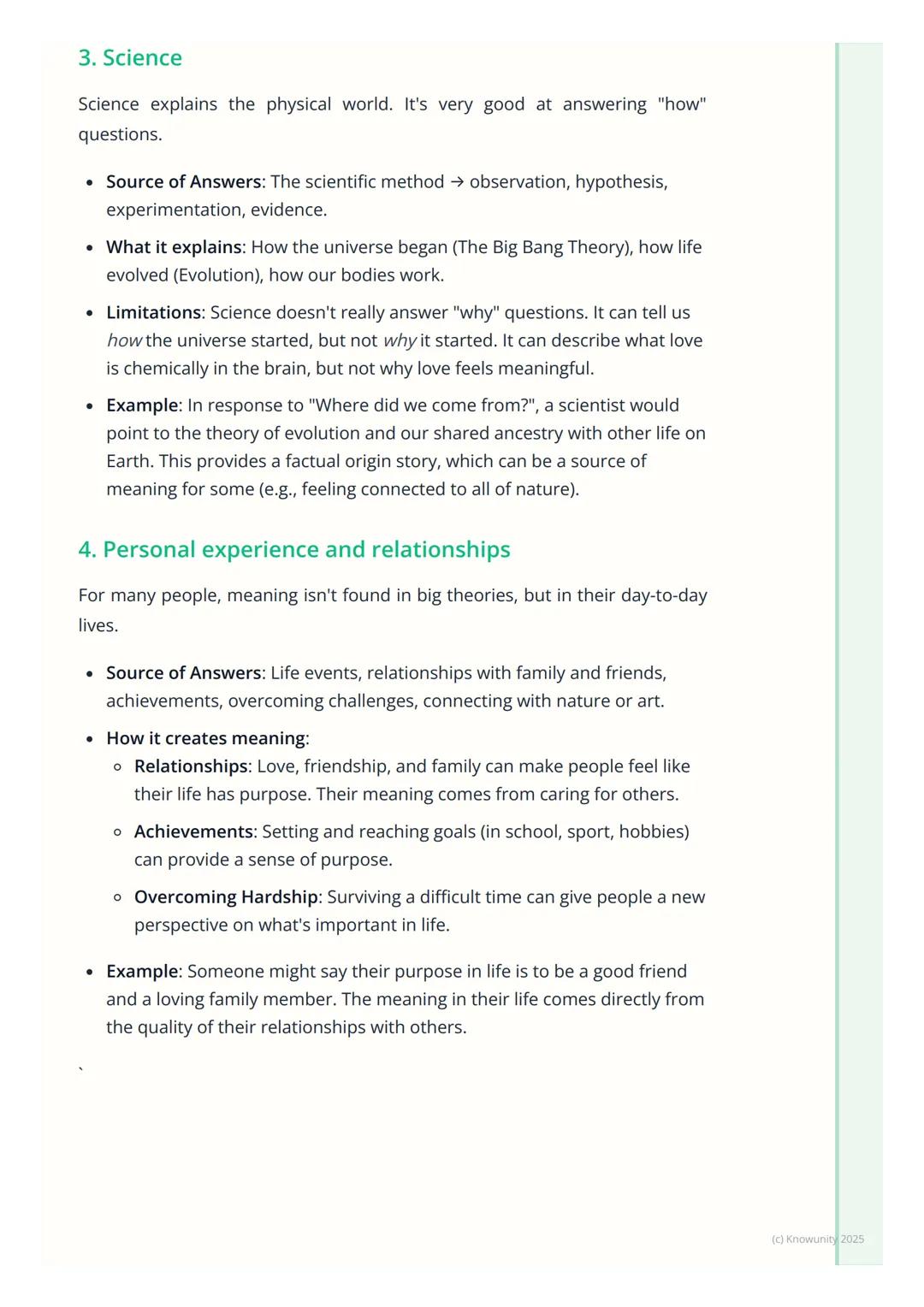
Science is brilliant at explaining the "how" but struggles with the "why" questions that keep us up at night.
Through observation and experimentation, science can tell us how the universe began with the Big Bang, how life evolved over millions of years, and how our brains work. But it can't really explain why the universe bothered to exist in the first place or why love feels so meaningful to us. A scientist answering "Where did we come from?" would point to evolution and our connection to all life on Earth - which some people find deeply meaningful.
Many people find their answers not in grand theories but in their everyday experiences and relationships. Personal experience as a source of meaning comes from the people we love, the goals we achieve, and the challenges we overcome.
Your purpose might be as simple as being a good friend or family member. The meaning in your life could come from getting better at guitar, helping your little sister with homework, or just making people laugh. Sometimes surviving something really tough gives people a completely new perspective on what actually matters.
Real talk: This approach to meaning is probably the most relatable - it's about finding significance in the life you're actually living right now.
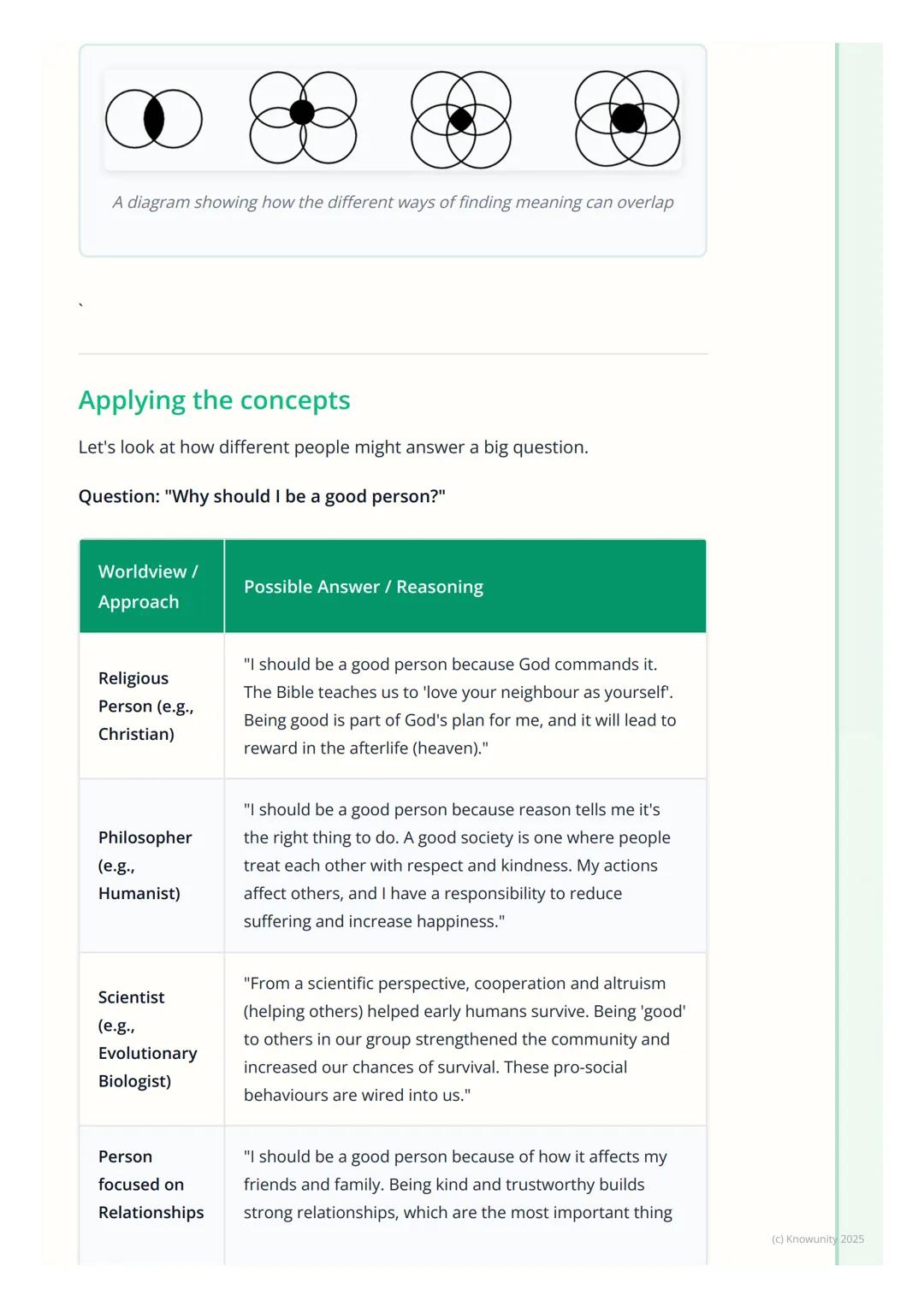
Let's see how these different worldviews would tackle a practical question: "Why should I be a good person?"
A religious person might say they should be good because God commands it - the Bible teaches "love your neighbour as yourself," and being good leads to rewards in the afterlife. It's part of following a divine plan that's bigger than themselves.
A philosopher with a humanist worldview would argue that reason tells us being good is right. They'd say we have a responsibility to reduce suffering and increase happiness because our actions affect others, and a good society needs people who treat each other with respect.
A scientist might explain that cooperation and helping others (altruism) helped early humans survive. Being good to people in our group made the whole community stronger, so these helpful behaviours got wired into our brains through evolution.
Someone focused on personal relationships would say being good matters because of how it affects their friends and family. Being kind and trustworthy builds strong relationships, which are what make life worth living.
Exam tip: Remember these approaches aren't mutually exclusive - a scientist can be deeply religious, and a philosopher can find meaning in family relationships.
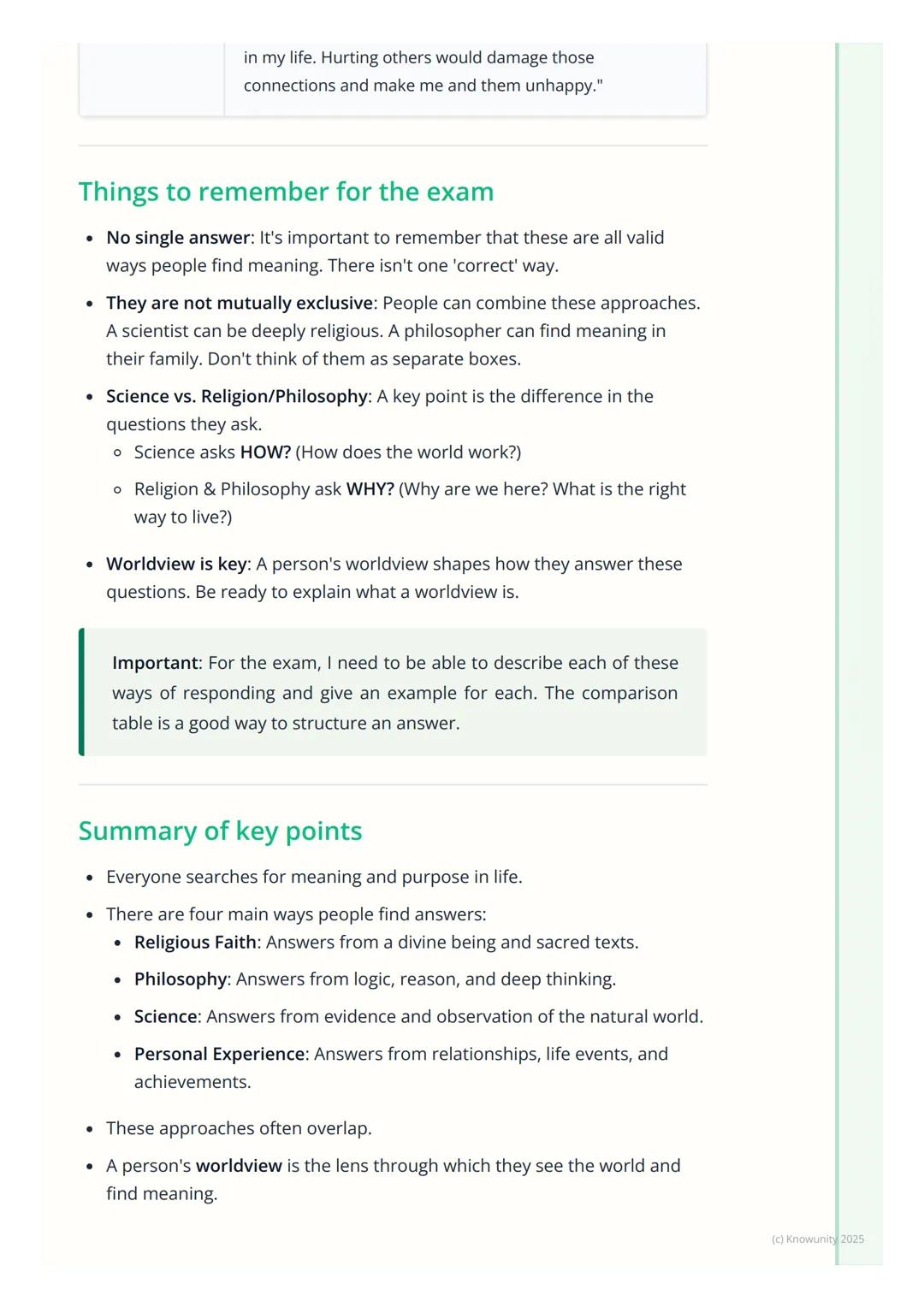
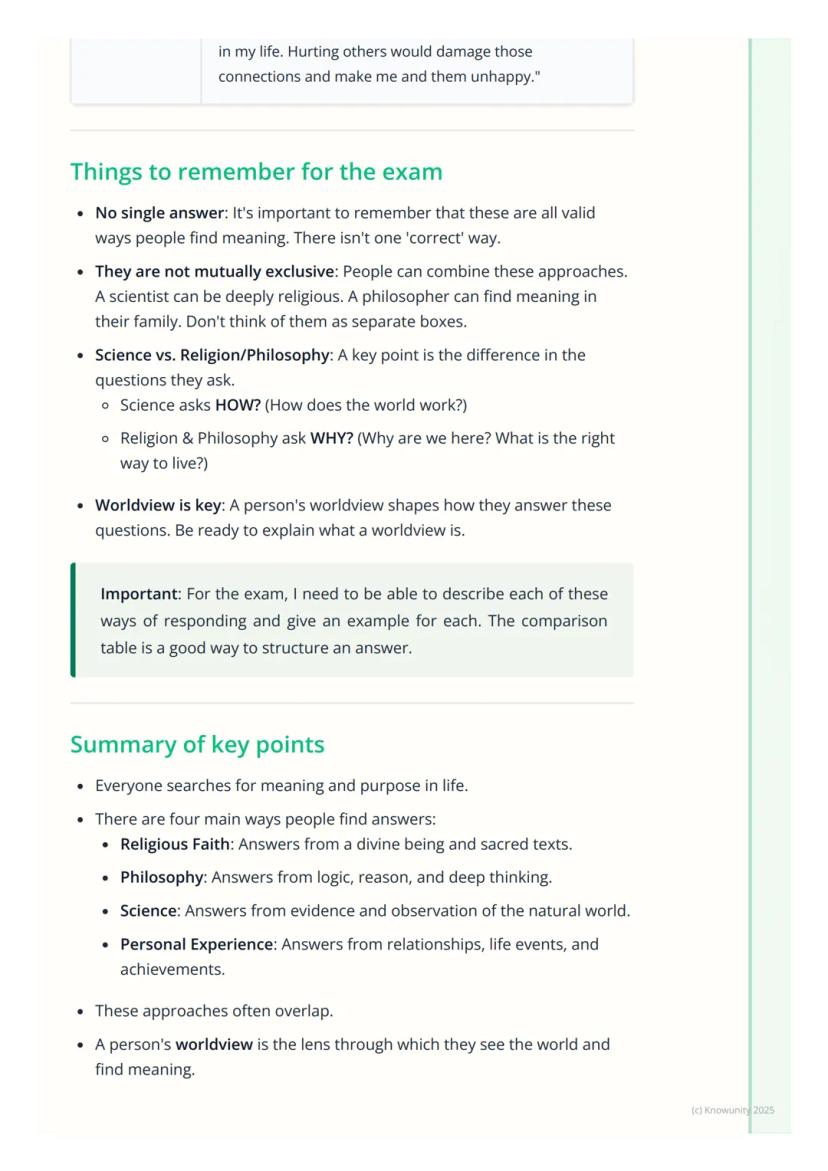
Here's what you absolutely need to remember: there's no single "correct" way to find meaning and purpose in life.
The four main approaches are religious faith (answers from divine sources), philosophy (answers from reason and logic), science (answers from evidence and observation), and personal experience (answers from relationships and life events). People often combine these approaches rather than sticking to just one.
Understanding the difference between "how" and "why" questions is crucial. Science excels at explaining how things work - how the universe formed, how evolution happened, how our bodies function. But religion and philosophy focus more on why questions - why we're here, what the right way to live is, what our ultimate purpose should be.
Your worldview is the lens through which you interpret everything around you. It shapes how you answer life's big questions and what you consider meaningful. Someone with a religious worldview will approach the question "What happens after death?" very differently from someone with a scientific worldview.
Exam strategy: Practice explaining each approach with a clear example, and remember that comparing them in a table format often works well for structured answers.
Most importantly, recognise that everyone's search for meaning is valid, even if their conclusions are completely different from yours.

Nuestro compañero de IA está específicamente adaptado a las necesidades de los estudiantes. Basándonos en los millones de contenidos que tenemos en la plataforma, podemos dar a los estudiantes respuestas realmente significativas y relevantes. Pero no se trata solo de respuestas, el compañero también guía a los estudiantes a través de sus retos de aprendizaje diarios, con planes de aprendizaje personalizados, cuestionarios o contenidos en el chat y una personalización del 100% basada en las habilidades y el desarrollo de los estudiantes.
Puedes descargar la app en Google Play Store y Apple App Store.
Sí, tienes acceso gratuito a los contenidos de la aplicación y a nuestro compañero de IA. Para desbloquear determinadas funciones de la aplicación, puedes adquirir Knowunity Pro.
App Store
Google Play
La app es muy fácil de usar y está muy bien diseñada. Hasta ahora he encontrado todo lo que estaba buscando y he podido aprender mucho de las presentaciones. Definitivamente utilizaré la aplicación para un examen de clase. Y, por supuesto, también me sirve mucho de inspiración.
Pablo
usuario de iOS
Esta app es realmente genial. Hay tantos apuntes de clase y ayuda [...]. Tengo problemas con matemáticas, por ejemplo, y la aplicación tiene muchas opciones de ayuda. Gracias a Knowunity, he mejorado en mates. Se la recomiendo a todo el mundo.
Elena
usuaria de Android
Vaya, estoy realmente sorprendida. Acabo de probar la app porque la he visto anunciada muchas veces y me he quedado absolutamente alucinada. Esta app es LA AYUDA que quieres para el insti y, sobre todo, ofrece muchísimas cosas, como ejercicios y hojas informativas, que a mí personalmente me han sido MUY útiles.
Ana
usuaria de iOS
Está app es muy buena, tiene apuntes que son de mucha ayuda y su IA es fantástica, te explica a la perfección y muy fácil de entender lo que necesites, te ayuda con los deberes, te hace esquemas... en definitiva es una muy buena opción!
Sophia
usuario de Android
Me encanta!!! Me resuelve todo con detalle y me da la explicación correcta. Tiene un montón de funciones, ami me ha ido genial!! Os la recomiendo!!!
Marta
usuaria de Android
La uso casi diariamente, sirve para todas las asignaturas. Yo, por ejemplo la utilizo más en inglés porque se me da bastante mal, ¡Todas las respuestas están correctas! Consta con personas reales que suben sus apuntes y IA para que puedas hacer los deberes muchísimo más fácil, la recomiendo.
Izan
usuario de iOS
¡La app es buenísima! Sólo tengo que introducir el tema en la barra de búsqueda y recibo la respuesta muy rápido. No tengo que ver 10 vídeos de YouTube para entender algo, así que me ahorro tiempo. ¡Muy recomendable!
Sara
usuaria de Android
En el instituto era muy malo en matemáticas, pero gracias a la app, ahora saco mejores notas. Os agradezco mucho que hayáis creado la aplicación.
Roberto
usuario de Android
Esto no es como Chatgpt, es MUCHISMO MEJOR, te hace unos resúmenes espectaculares y gracias a esta app pase de sacar 5-6 a sacar 8-9.
Julyana
usuaria de Android
Es la mejor aplicación del mundo, la uso para revisar los deberes a mi hijo.
Javier
usuario de Android
LOS QUIZ Y FLASHCARDS SON SÚPER ÚTILES Y ME ENCANTA Knowunity IA. ADEMÁS ES LITERALMENTE COMO CHATGPT PERO MÁS LISTO!! ME AYUDÓ TAMBIÉN CON MIS PROBLEMAS DE MÁSCARA!! Y CON MIS ASIGNATURAS DE VERDAD! OBVIO 😍😁😲🤑💗✨🎀😮
Erick
usuario de Android
Me me encanta esta app, todo lo que tiene es de calidad ya que antes de ser publicado es revisado por un equipo de profesionales. Me ha ido genial esta aplicación ya que gracias a ella puedo estudiar mucho mejor, sin tener que agobiarme porque mi profesor no ha hecho teoría o porque no entiendo su teoría. Le doy un 10 de 10!
Mar
usuaria de iOS
La app es muy fácil de usar y está muy bien diseñada. Hasta ahora he encontrado todo lo que estaba buscando y he podido aprender mucho de las presentaciones. Definitivamente utilizaré la aplicación para un examen de clase. Y, por supuesto, también me sirve mucho de inspiración.
Pablo
usuario de iOS
Esta app es realmente genial. Hay tantos apuntes de clase y ayuda [...]. Tengo problemas con matemáticas, por ejemplo, y la aplicación tiene muchas opciones de ayuda. Gracias a Knowunity, he mejorado en mates. Se la recomiendo a todo el mundo.
Elena
usuaria de Android
Vaya, estoy realmente sorprendida. Acabo de probar la app porque la he visto anunciada muchas veces y me he quedado absolutamente alucinada. Esta app es LA AYUDA que quieres para el insti y, sobre todo, ofrece muchísimas cosas, como ejercicios y hojas informativas, que a mí personalmente me han sido MUY útiles.
Ana
usuaria de iOS
Está app es muy buena, tiene apuntes que son de mucha ayuda y su IA es fantástica, te explica a la perfección y muy fácil de entender lo que necesites, te ayuda con los deberes, te hace esquemas... en definitiva es una muy buena opción!
Sophia
usuario de Android
Me encanta!!! Me resuelve todo con detalle y me da la explicación correcta. Tiene un montón de funciones, ami me ha ido genial!! Os la recomiendo!!!
Marta
usuaria de Android
La uso casi diariamente, sirve para todas las asignaturas. Yo, por ejemplo la utilizo más en inglés porque se me da bastante mal, ¡Todas las respuestas están correctas! Consta con personas reales que suben sus apuntes y IA para que puedas hacer los deberes muchísimo más fácil, la recomiendo.
Izan
usuario de iOS
¡La app es buenísima! Sólo tengo que introducir el tema en la barra de búsqueda y recibo la respuesta muy rápido. No tengo que ver 10 vídeos de YouTube para entender algo, así que me ahorro tiempo. ¡Muy recomendable!
Sara
usuaria de Android
En el instituto era muy malo en matemáticas, pero gracias a la app, ahora saco mejores notas. Os agradezco mucho que hayáis creado la aplicación.
Roberto
usuario de Android
Esto no es como Chatgpt, es MUCHISMO MEJOR, te hace unos resúmenes espectaculares y gracias a esta app pase de sacar 5-6 a sacar 8-9.
Julyana
usuaria de Android
Es la mejor aplicación del mundo, la uso para revisar los deberes a mi hijo.
Javier
usuario de Android
LOS QUIZ Y FLASHCARDS SON SÚPER ÚTILES Y ME ENCANTA Knowunity IA. ADEMÁS ES LITERALMENTE COMO CHATGPT PERO MÁS LISTO!! ME AYUDÓ TAMBIÉN CON MIS PROBLEMAS DE MÁSCARA!! Y CON MIS ASIGNATURAS DE VERDAD! OBVIO 😍😁😲🤑💗✨🎀😮
Erick
usuario de Android
Me me encanta esta app, todo lo que tiene es de calidad ya que antes de ser publicado es revisado por un equipo de profesionales. Me ha ido genial esta aplicación ya que gracias a ella puedo estudiar mucho mejor, sin tener que agobiarme porque mi profesor no ha hecho teoría o porque no entiendo su teoría. Le doy un 10 de 10!
Mar
usuaria de iOS
We've all wondered about the big stuff - why we're here, what's the point of it all, and what happens when we die. These massive questions don't have simple answers, but people have developed different ways to search for meaning... Mostrar más
Acceso a todos los documentos
Mejora tus notas
Únete a millones de estudiantes
Ever found yourself staring at the ceiling at night wondering what the point of everything is? You're definitely not alone in asking these questions.
When we talk about meaning, we're looking for what makes life feel worthwhile - that sense of purpose that gets you out of bed in the morning. Your worldview is basically like a pair of glasses that colours how you see everything around you. It's your overall perspective on life, death, right, wrong, and everything in between.
Different people use different approaches to find answers. Some turn to religion - organised systems of beliefs about God or gods that come with rules and ceremonies. Others prefer philosophy, which uses pure reasoning and logic to work things out. Then there's science, which focuses on evidence and observation of the natural world.
Remember: There's no single "right" way to find meaning - most people actually mix and match these approaches throughout their lives.
You've also got humanism (focusing on human reason and shared values rather than God), agnosticism (admitting we can't know if God exists), and atheism (believing there's no God at all).
Acceso a todos los documentos
Mejora tus notas
Únete a millones de estudiantes
For millions of people worldwide, religious faith provides a complete roadmap for understanding life's mysteries.
Religious believers find their answers in sacred texts like the Bible or Qur'an, guidance from religious leaders, and personal prayer or spiritual experiences. They typically believe in a higher power who created everything, that life has a divine purpose, and that there's some form of afterlife waiting. A Christian, for example, might find meaning in believing God loves them and has a specific plan for their life.
Philosophy takes a completely different approach - it's all about using your brain to think deeply about life's questions. Instead of accepting ready-made answers, philosophers prefer the process of questioning everything. They tackle big topics like what makes a good life, what's actually real, and how we can know anything for certain.
Think about it: A philosopher facing the question "What's my purpose?" might conclude that humans must create their own purpose rather than receive it from a divine source.
The key difference? Religious faith often starts with belief and builds from there, while philosophy starts with doubt and uses logic to work towards possible answers.
Acceso a todos los documentos
Mejora tus notas
Únete a millones de estudiantes
Science is brilliant at explaining the "how" but struggles with the "why" questions that keep us up at night.
Through observation and experimentation, science can tell us how the universe began with the Big Bang, how life evolved over millions of years, and how our brains work. But it can't really explain why the universe bothered to exist in the first place or why love feels so meaningful to us. A scientist answering "Where did we come from?" would point to evolution and our connection to all life on Earth - which some people find deeply meaningful.
Many people find their answers not in grand theories but in their everyday experiences and relationships. Personal experience as a source of meaning comes from the people we love, the goals we achieve, and the challenges we overcome.
Your purpose might be as simple as being a good friend or family member. The meaning in your life could come from getting better at guitar, helping your little sister with homework, or just making people laugh. Sometimes surviving something really tough gives people a completely new perspective on what actually matters.
Real talk: This approach to meaning is probably the most relatable - it's about finding significance in the life you're actually living right now.
Acceso a todos los documentos
Mejora tus notas
Únete a millones de estudiantes
Let's see how these different worldviews would tackle a practical question: "Why should I be a good person?"
A religious person might say they should be good because God commands it - the Bible teaches "love your neighbour as yourself," and being good leads to rewards in the afterlife. It's part of following a divine plan that's bigger than themselves.
A philosopher with a humanist worldview would argue that reason tells us being good is right. They'd say we have a responsibility to reduce suffering and increase happiness because our actions affect others, and a good society needs people who treat each other with respect.
A scientist might explain that cooperation and helping others (altruism) helped early humans survive. Being good to people in our group made the whole community stronger, so these helpful behaviours got wired into our brains through evolution.
Someone focused on personal relationships would say being good matters because of how it affects their friends and family. Being kind and trustworthy builds strong relationships, which are what make life worth living.
Exam tip: Remember these approaches aren't mutually exclusive - a scientist can be deeply religious, and a philosopher can find meaning in family relationships.
Acceso a todos los documentos
Mejora tus notas
Únete a millones de estudiantes
Here's what you absolutely need to remember: there's no single "correct" way to find meaning and purpose in life.
The four main approaches are religious faith (answers from divine sources), philosophy (answers from reason and logic), science (answers from evidence and observation), and personal experience (answers from relationships and life events). People often combine these approaches rather than sticking to just one.
Understanding the difference between "how" and "why" questions is crucial. Science excels at explaining how things work - how the universe formed, how evolution happened, how our bodies function. But religion and philosophy focus more on why questions - why we're here, what the right way to live is, what our ultimate purpose should be.
Your worldview is the lens through which you interpret everything around you. It shapes how you answer life's big questions and what you consider meaningful. Someone with a religious worldview will approach the question "What happens after death?" very differently from someone with a scientific worldview.
Exam strategy: Practice explaining each approach with a clear example, and remember that comparing them in a table format often works well for structured answers.
Most importantly, recognise that everyone's search for meaning is valid, even if their conclusions are completely different from yours.
Acceso a todos los documentos
Mejora tus notas
Únete a millones de estudiantes
Nuestro compañero de IA está específicamente adaptado a las necesidades de los estudiantes. Basándonos en los millones de contenidos que tenemos en la plataforma, podemos dar a los estudiantes respuestas realmente significativas y relevantes. Pero no se trata solo de respuestas, el compañero también guía a los estudiantes a través de sus retos de aprendizaje diarios, con planes de aprendizaje personalizados, cuestionarios o contenidos en el chat y una personalización del 100% basada en las habilidades y el desarrollo de los estudiantes.
Puedes descargar la app en Google Play Store y Apple App Store.
Sí, tienes acceso gratuito a los contenidos de la aplicación y a nuestro compañero de IA. Para desbloquear determinadas funciones de la aplicación, puedes adquirir Knowunity Pro.
0
Herramientas Inteligentes NUEVO
Transforma estos apuntes en: ✓ 50+ Preguntas de Práctica ✓ Flashcards Interactivas ✓ Examen Completo de Práctica ✓ Esquemas de Ensayo
App Store
Google Play
La app es muy fácil de usar y está muy bien diseñada. Hasta ahora he encontrado todo lo que estaba buscando y he podido aprender mucho de las presentaciones. Definitivamente utilizaré la aplicación para un examen de clase. Y, por supuesto, también me sirve mucho de inspiración.
Pablo
usuario de iOS
Esta app es realmente genial. Hay tantos apuntes de clase y ayuda [...]. Tengo problemas con matemáticas, por ejemplo, y la aplicación tiene muchas opciones de ayuda. Gracias a Knowunity, he mejorado en mates. Se la recomiendo a todo el mundo.
Elena
usuaria de Android
Vaya, estoy realmente sorprendida. Acabo de probar la app porque la he visto anunciada muchas veces y me he quedado absolutamente alucinada. Esta app es LA AYUDA que quieres para el insti y, sobre todo, ofrece muchísimas cosas, como ejercicios y hojas informativas, que a mí personalmente me han sido MUY útiles.
Ana
usuaria de iOS
Está app es muy buena, tiene apuntes que son de mucha ayuda y su IA es fantástica, te explica a la perfección y muy fácil de entender lo que necesites, te ayuda con los deberes, te hace esquemas... en definitiva es una muy buena opción!
Sophia
usuario de Android
Me encanta!!! Me resuelve todo con detalle y me da la explicación correcta. Tiene un montón de funciones, ami me ha ido genial!! Os la recomiendo!!!
Marta
usuaria de Android
La uso casi diariamente, sirve para todas las asignaturas. Yo, por ejemplo la utilizo más en inglés porque se me da bastante mal, ¡Todas las respuestas están correctas! Consta con personas reales que suben sus apuntes y IA para que puedas hacer los deberes muchísimo más fácil, la recomiendo.
Izan
usuario de iOS
¡La app es buenísima! Sólo tengo que introducir el tema en la barra de búsqueda y recibo la respuesta muy rápido. No tengo que ver 10 vídeos de YouTube para entender algo, así que me ahorro tiempo. ¡Muy recomendable!
Sara
usuaria de Android
En el instituto era muy malo en matemáticas, pero gracias a la app, ahora saco mejores notas. Os agradezco mucho que hayáis creado la aplicación.
Roberto
usuario de Android
Esto no es como Chatgpt, es MUCHISMO MEJOR, te hace unos resúmenes espectaculares y gracias a esta app pase de sacar 5-6 a sacar 8-9.
Julyana
usuaria de Android
Es la mejor aplicación del mundo, la uso para revisar los deberes a mi hijo.
Javier
usuario de Android
LOS QUIZ Y FLASHCARDS SON SÚPER ÚTILES Y ME ENCANTA Knowunity IA. ADEMÁS ES LITERALMENTE COMO CHATGPT PERO MÁS LISTO!! ME AYUDÓ TAMBIÉN CON MIS PROBLEMAS DE MÁSCARA!! Y CON MIS ASIGNATURAS DE VERDAD! OBVIO 😍😁😲🤑💗✨🎀😮
Erick
usuario de Android
Me me encanta esta app, todo lo que tiene es de calidad ya que antes de ser publicado es revisado por un equipo de profesionales. Me ha ido genial esta aplicación ya que gracias a ella puedo estudiar mucho mejor, sin tener que agobiarme porque mi profesor no ha hecho teoría o porque no entiendo su teoría. Le doy un 10 de 10!
Mar
usuaria de iOS
La app es muy fácil de usar y está muy bien diseñada. Hasta ahora he encontrado todo lo que estaba buscando y he podido aprender mucho de las presentaciones. Definitivamente utilizaré la aplicación para un examen de clase. Y, por supuesto, también me sirve mucho de inspiración.
Pablo
usuario de iOS
Esta app es realmente genial. Hay tantos apuntes de clase y ayuda [...]. Tengo problemas con matemáticas, por ejemplo, y la aplicación tiene muchas opciones de ayuda. Gracias a Knowunity, he mejorado en mates. Se la recomiendo a todo el mundo.
Elena
usuaria de Android
Vaya, estoy realmente sorprendida. Acabo de probar la app porque la he visto anunciada muchas veces y me he quedado absolutamente alucinada. Esta app es LA AYUDA que quieres para el insti y, sobre todo, ofrece muchísimas cosas, como ejercicios y hojas informativas, que a mí personalmente me han sido MUY útiles.
Ana
usuaria de iOS
Está app es muy buena, tiene apuntes que son de mucha ayuda y su IA es fantástica, te explica a la perfección y muy fácil de entender lo que necesites, te ayuda con los deberes, te hace esquemas... en definitiva es una muy buena opción!
Sophia
usuario de Android
Me encanta!!! Me resuelve todo con detalle y me da la explicación correcta. Tiene un montón de funciones, ami me ha ido genial!! Os la recomiendo!!!
Marta
usuaria de Android
La uso casi diariamente, sirve para todas las asignaturas. Yo, por ejemplo la utilizo más en inglés porque se me da bastante mal, ¡Todas las respuestas están correctas! Consta con personas reales que suben sus apuntes y IA para que puedas hacer los deberes muchísimo más fácil, la recomiendo.
Izan
usuario de iOS
¡La app es buenísima! Sólo tengo que introducir el tema en la barra de búsqueda y recibo la respuesta muy rápido. No tengo que ver 10 vídeos de YouTube para entender algo, así que me ahorro tiempo. ¡Muy recomendable!
Sara
usuaria de Android
En el instituto era muy malo en matemáticas, pero gracias a la app, ahora saco mejores notas. Os agradezco mucho que hayáis creado la aplicación.
Roberto
usuario de Android
Esto no es como Chatgpt, es MUCHISMO MEJOR, te hace unos resúmenes espectaculares y gracias a esta app pase de sacar 5-6 a sacar 8-9.
Julyana
usuaria de Android
Es la mejor aplicación del mundo, la uso para revisar los deberes a mi hijo.
Javier
usuario de Android
LOS QUIZ Y FLASHCARDS SON SÚPER ÚTILES Y ME ENCANTA Knowunity IA. ADEMÁS ES LITERALMENTE COMO CHATGPT PERO MÁS LISTO!! ME AYUDÓ TAMBIÉN CON MIS PROBLEMAS DE MÁSCARA!! Y CON MIS ASIGNATURAS DE VERDAD! OBVIO 😍😁😲🤑💗✨🎀😮
Erick
usuario de Android
Me me encanta esta app, todo lo que tiene es de calidad ya que antes de ser publicado es revisado por un equipo de profesionales. Me ha ido genial esta aplicación ya que gracias a ella puedo estudiar mucho mejor, sin tener que agobiarme porque mi profesor no ha hecho teoría o porque no entiendo su teoría. Le doy un 10 de 10!
Mar
usuaria de iOS