
Ever wonder why things fall down instead of up, or...
 Physics56 visualizaciones·Actualizado Jun 8, 2026·5 páginas
Understanding Different Types of Forces
1 / 5
1
of 5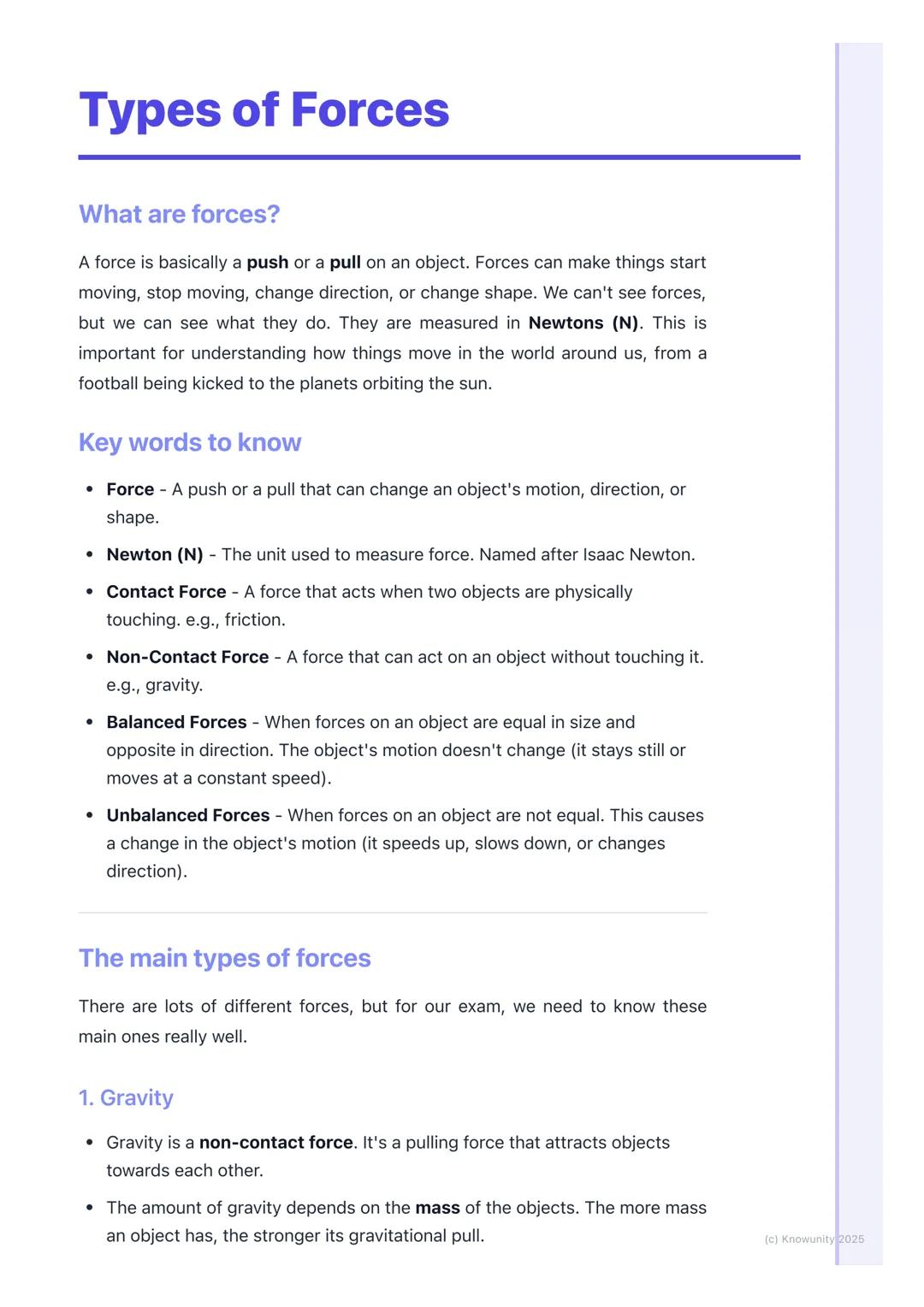
What Are Forces?
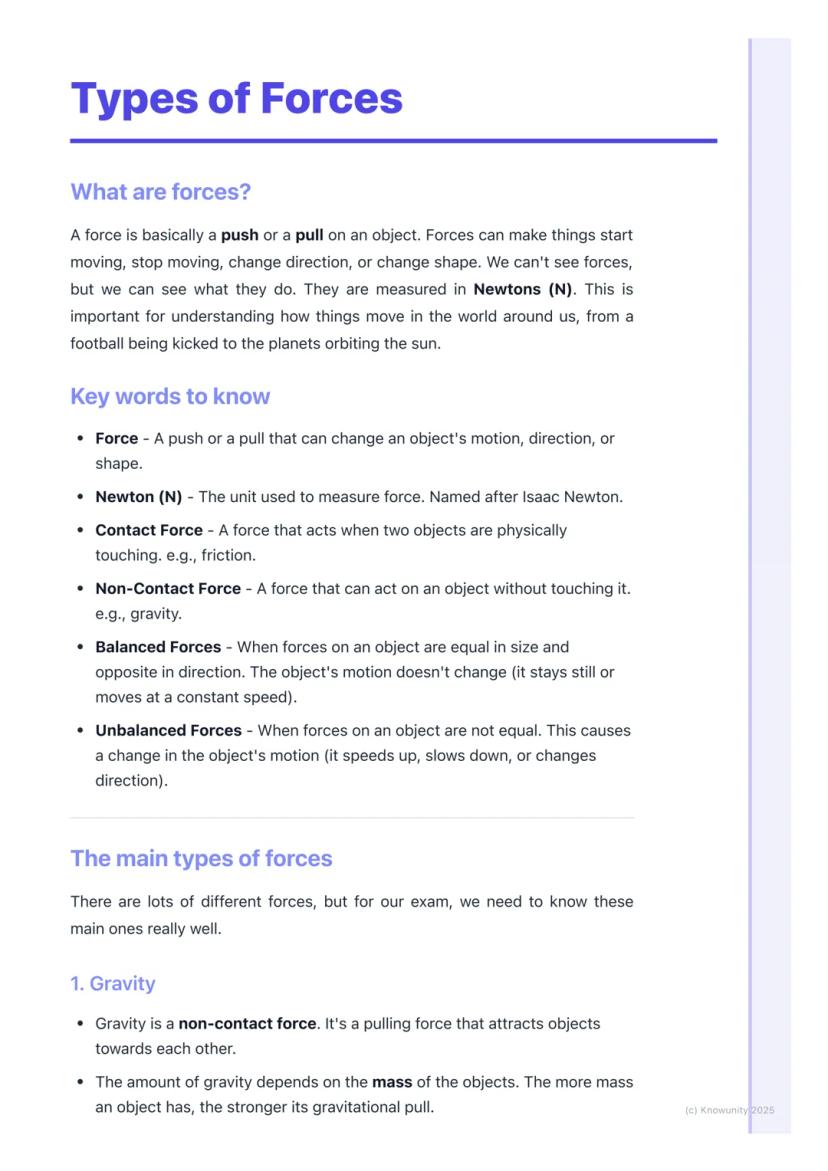
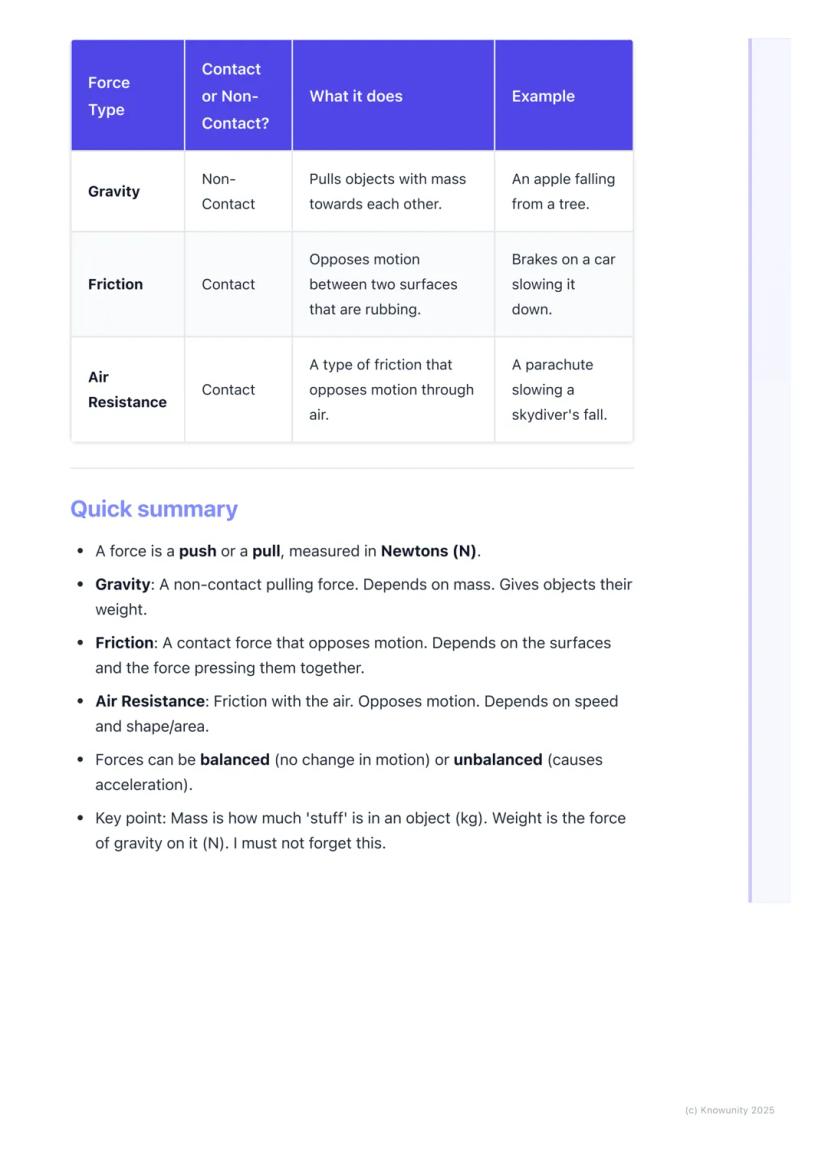
Think of forces as the invisible hands of physics - you can't see them, but you definitely see what they do! A force is simply a push or a pull that can make objects start moving, stop moving, change direction, or even change shape. We measure forces in Newtons (N), named after the famous scientist Isaac Newton.
Forces come in two main types. Contact forces happen when objects are actually touching each other, like when you push a door or rub your hands together. Non-contact forces can affect objects without touching them - gravity pulling on you right now is a perfect example.
Here's something crucial for your exams: forces can be balanced or unbalanced. When forces are balanced (equal in size but opposite in direction), nothing changes - objects stay still or keep moving at the same speed. When forces are unbalanced, that's when the action happens - things speed up, slow down, or change direction.
Remember: You experience hundreds of forces every day - from gravity keeping your feet on the ground to friction helping you walk without slipping!
2
of 5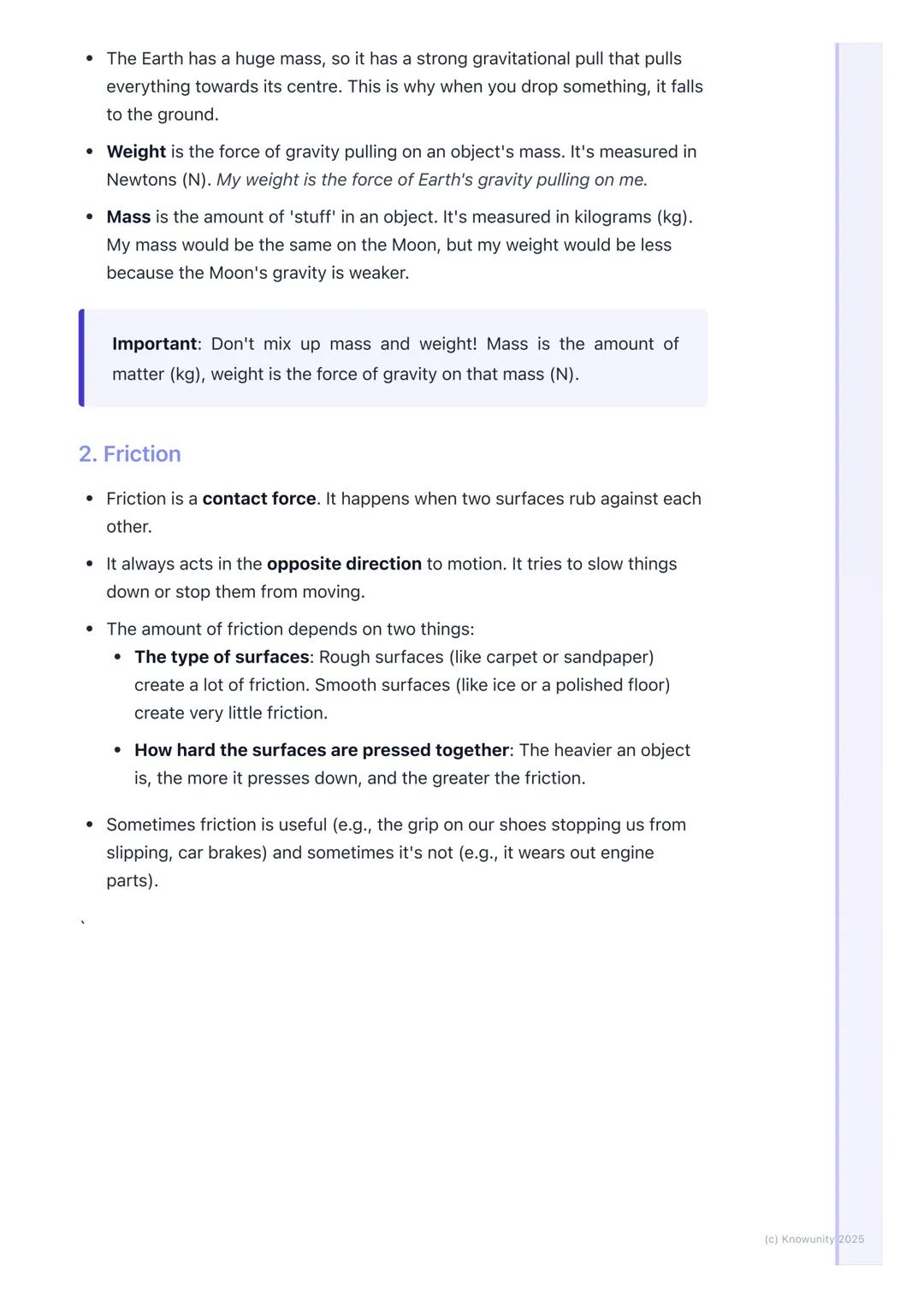
Gravity - The Ultimate Pulling Force
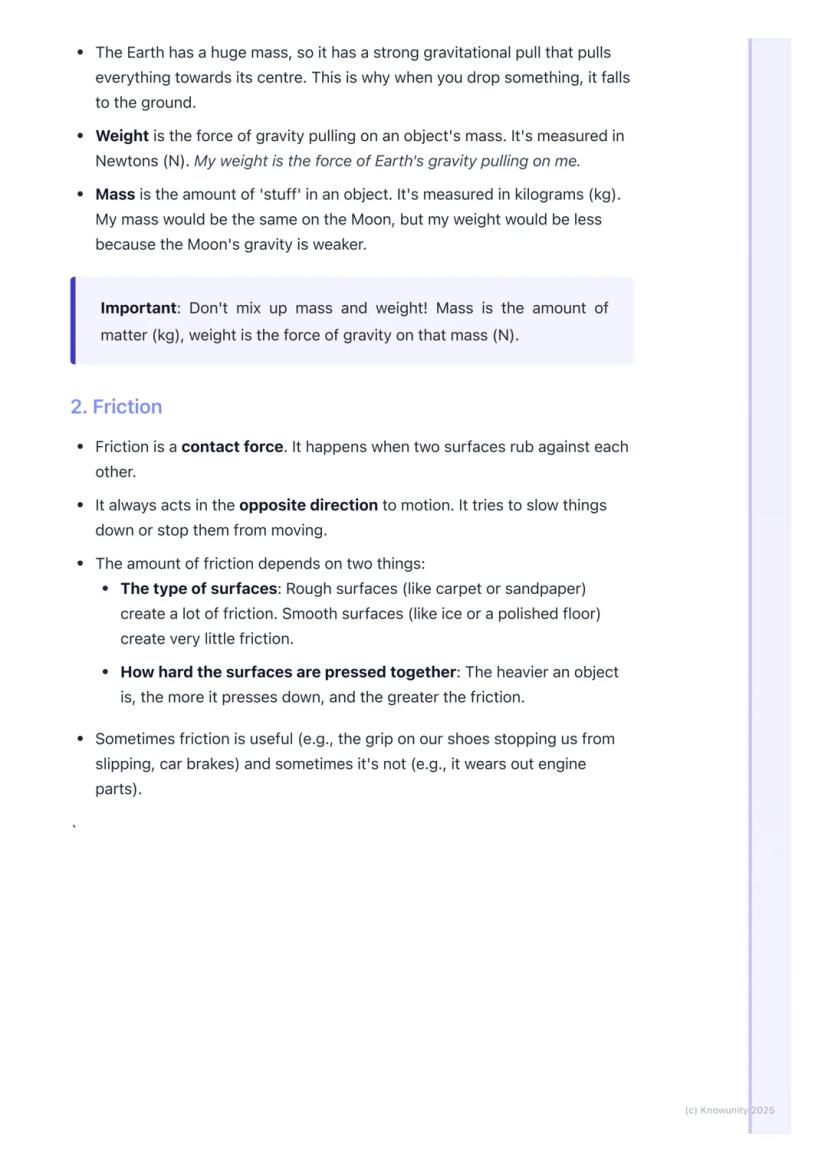
Gravity is probably the most important force you'll ever encounter - it's literally keeping you grounded right now! This non-contact force pulls objects towards each other, and the stronger the mass of an object, the stronger its gravitational pull. Earth has massive mass, so it pulls everything towards its centre.
Here's where students often get confused: mass and weight are completely different things. Your mass (measured in kg) is the amount of 'stuff' you're made of - it stays the same whether you're on Earth, the Moon, or floating in space. Your weight (measured in Newtons) is the force of gravity pulling on your mass, and it changes depending on where you are.
Think about it this way: if you went to the Moon, you'd have the same mass but weigh much less because the Moon's gravity is weaker than Earth's. That's why astronauts can bounce around so easily up there!
Exam Tip: Questions about mass vs weight are guaranteed to appear - mass is in kg, weight is the gravitational force in Newtons!
3
of 5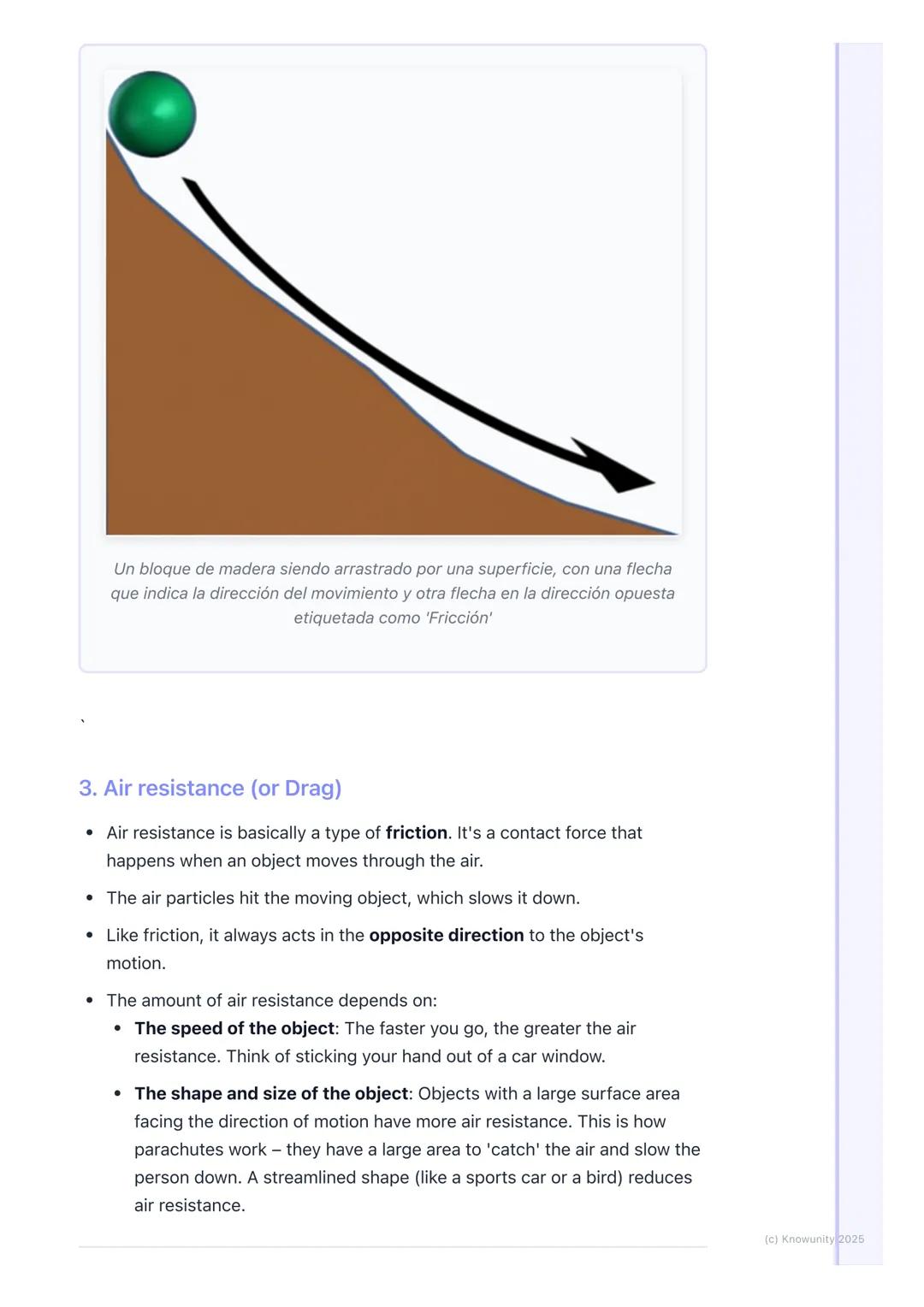
Friction - The Force That Fights Movement
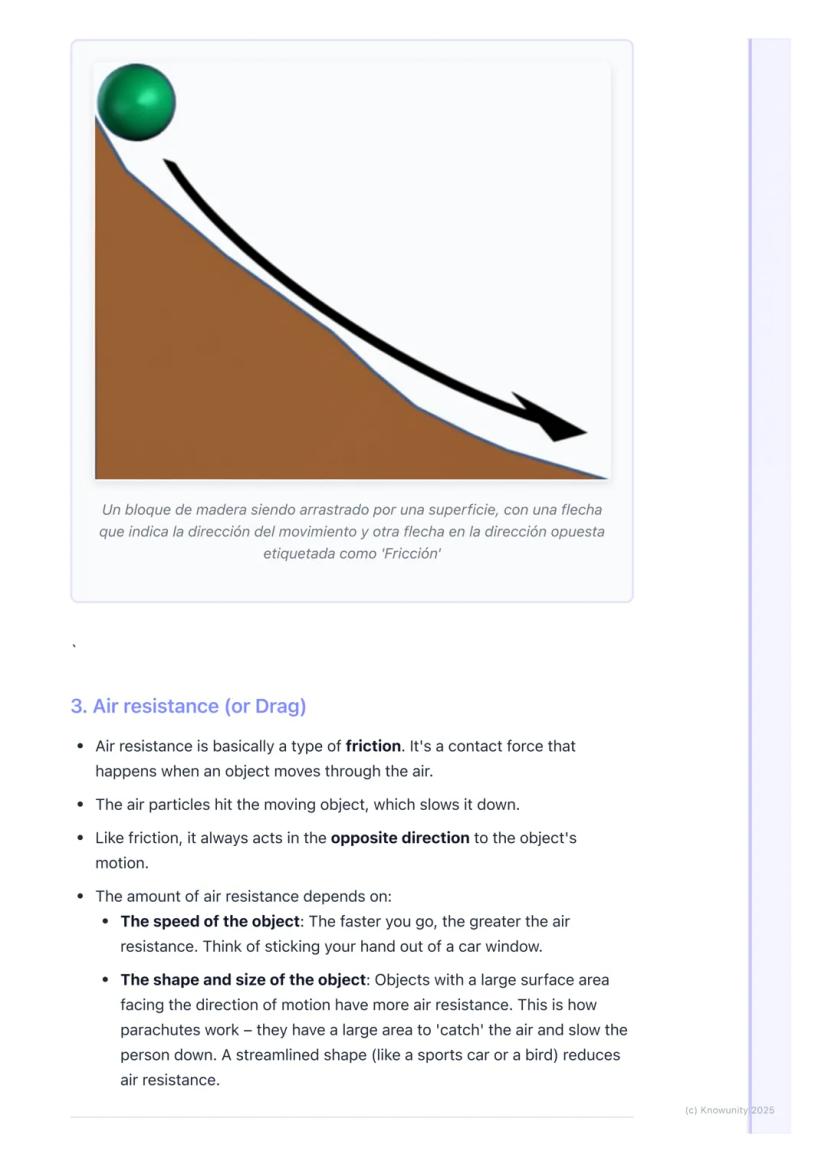
Friction is the rebel of the force world - it always tries to oppose motion! This contact force happens when two surfaces rub against each other, and it always acts in the opposite direction to movement. Without friction, you'd slide helplessly across the floor like you're on ice.
The amount of friction depends on two key things. First, the type of surfaces involved - rough surfaces like sandpaper create loads of friction, while smooth surfaces like polished floors create very little. Second, how hard the surfaces press together - heavier objects create more friction because they press down harder.
Friction can be your best friend or your worst enemy. It's brilliant when you need grip (like football boots on grass or car brakes stopping you safely), but it's annoying when it wears out moving parts in engines or makes it harder to push heavy objects.
Real-world Connection: Next time you're walking, think about how friction between your shoes and the ground stops you from slipping with every step!
4
of 5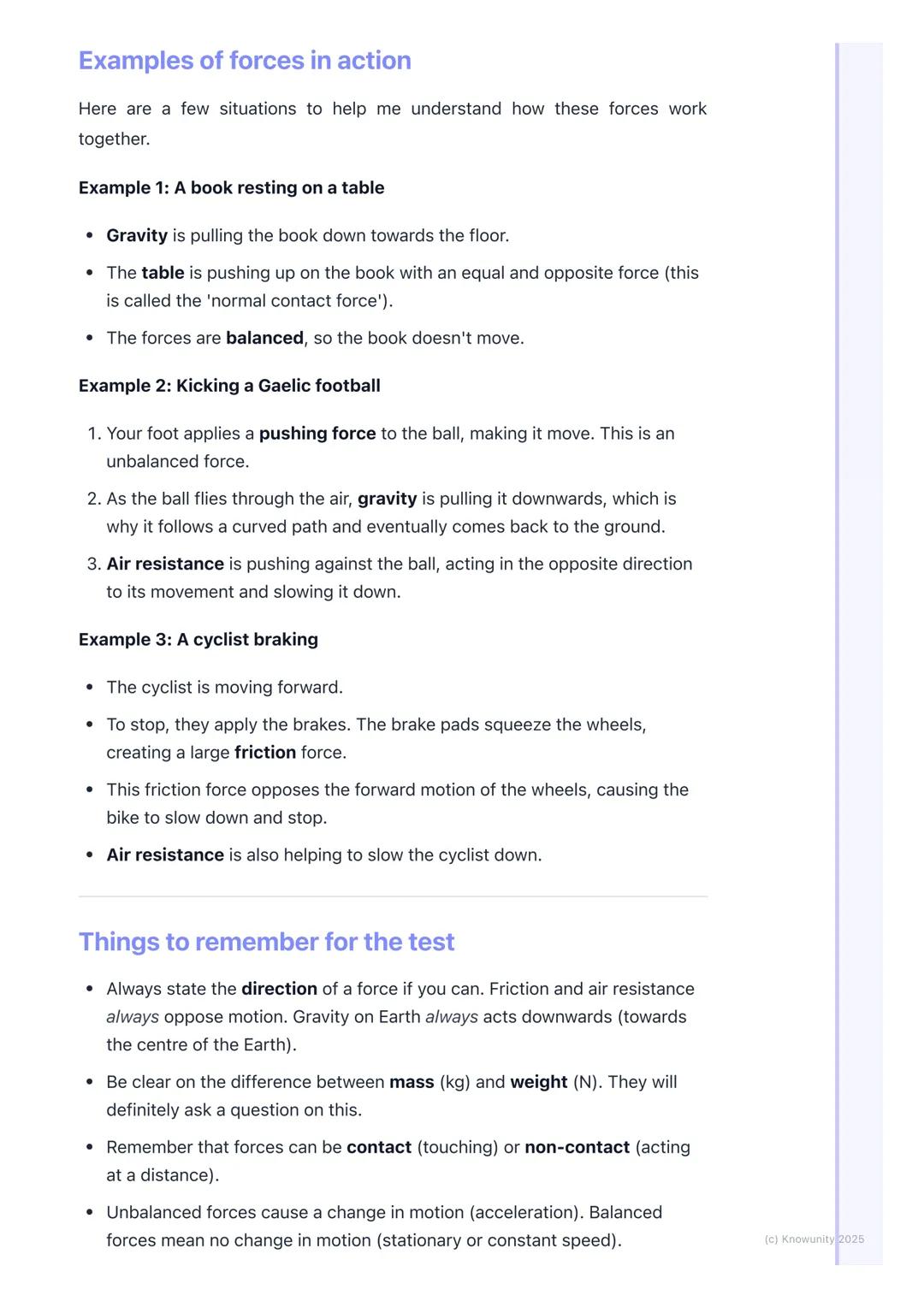
Air Resistance - Friction's Flying Cousin
Air resistance (also called drag) is basically friction's cousin that works in the air. When objects move through air, tiny air particles bash into them, creating a contact force that opposes the motion. It's like trying to run through water - the faster you go, the harder it pushes back.
Two main factors affect how much air resistance you experience. Speed is the big one - stick your hand out of a car window and you'll feel how air resistance increases with speed. The shape and size of the object matter too - that's why parachutes work so well with their huge surface area catching air, while sports cars are streamlined to slice through air easily.
Air resistance explains why feathers fall slowly while stones drop quickly, and why cyclists crouch down to go faster. It's constantly working against moving objects, gradually slowing them down unless another force keeps pushing them forward.
Think About It: Birds have naturally streamlined shapes to reduce air resistance - evolution's way of making flight more efficient!
5
of 5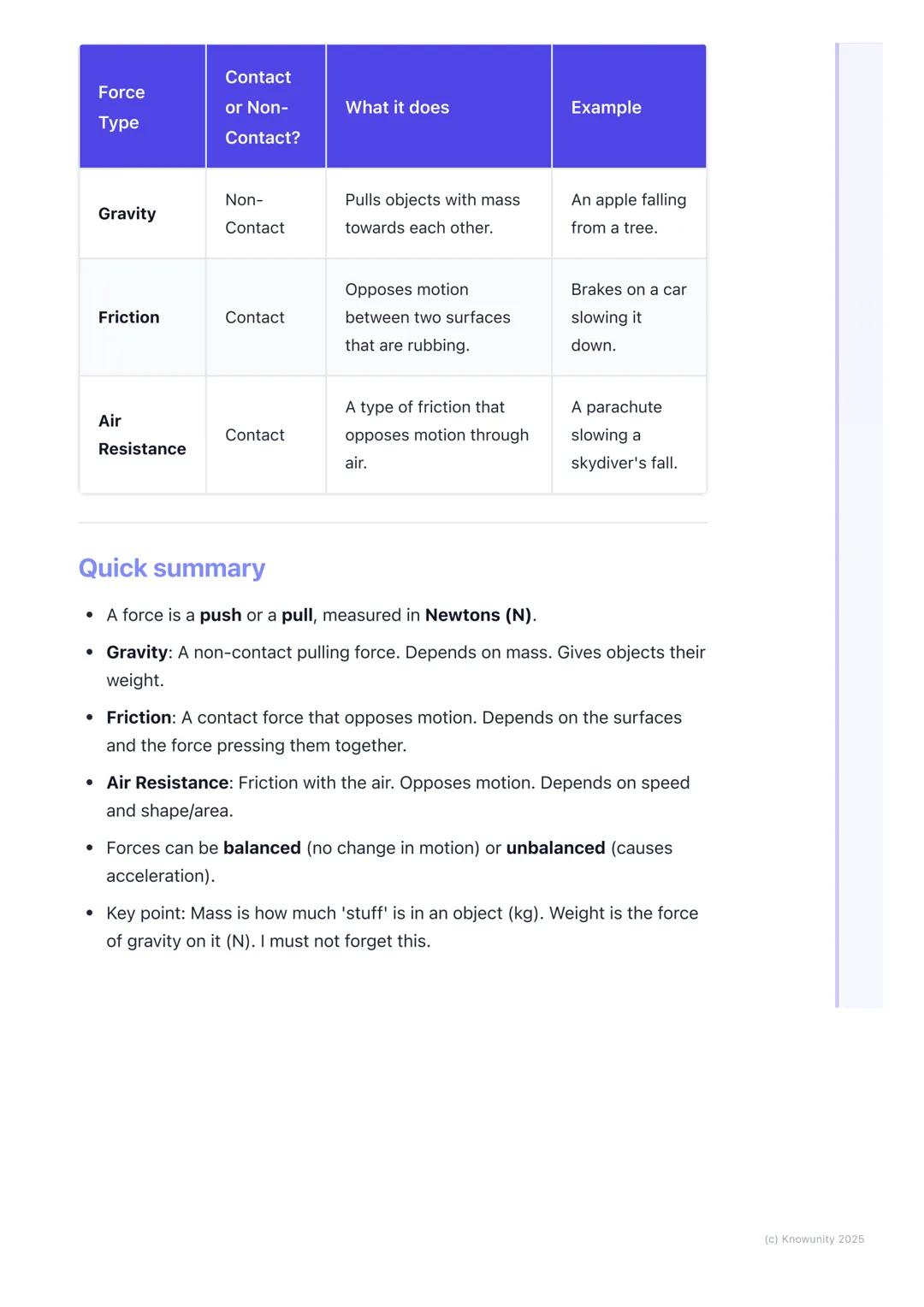
Forces Working Together - Real Examples
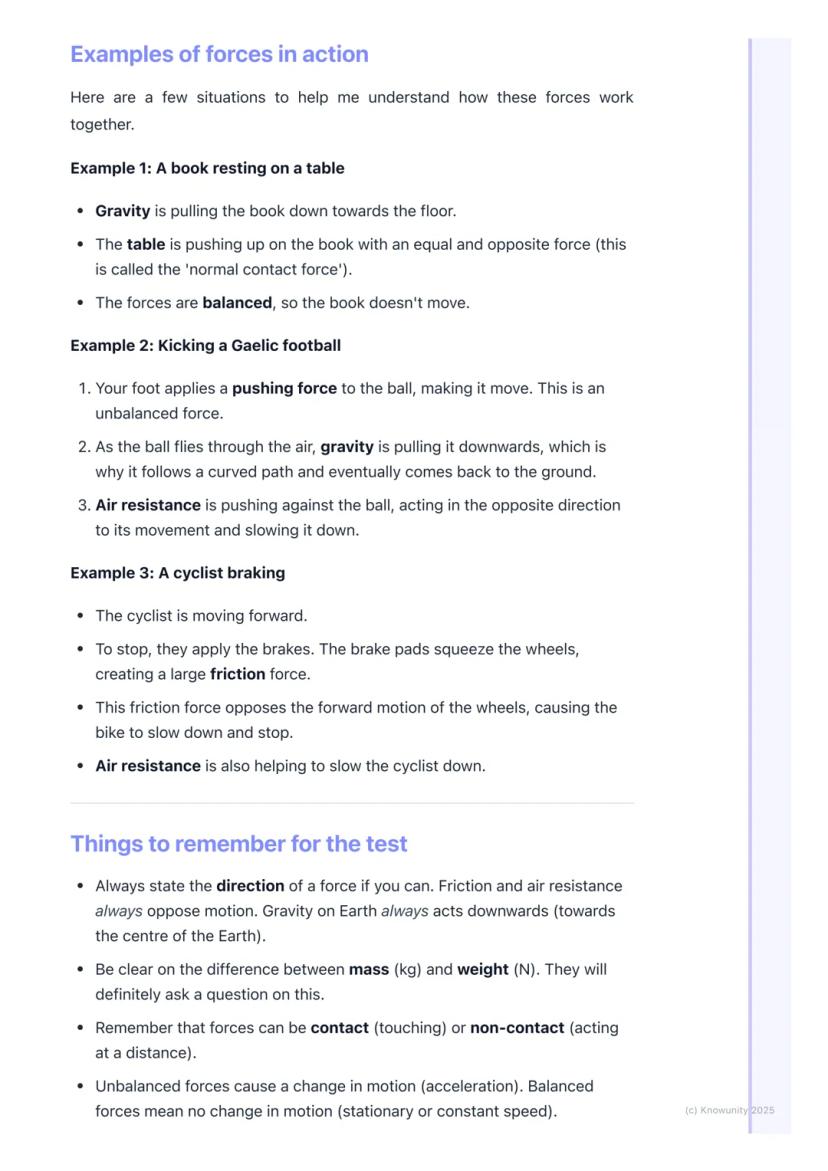
Let's see how these forces team up in everyday situations you'll recognise. When a book sits on your desk, gravity pulls it downward while the table pushes up with equal force - these balanced forces keep the book perfectly still.
Kicking a football shows unbalanced forces in action. Your foot applies a pushing force that gets the ball moving, gravity curves its path downward, and air resistance gradually slows it down. All three forces work together to create that familiar arc through the air.
When you're cycling and need to brake, friction becomes the hero. The brake pads squeeze your wheels, creating friction that opposes your forward motion. Combined with air resistance, these forces bring you safely to a stop.
Exam Success: Always remember to state the direction of forces - gravity pulls down, friction opposes motion, and air resistance works against the direction you're moving!
Pensamos que nunca lo preguntarías...
¿Qué es Knowunity AI companion?
Nuestro compañero de IA está específicamente adaptado a las necesidades de los estudiantes. Basándonos en los millones de contenidos que tenemos en la plataforma, podemos dar a los estudiantes respuestas realmente significativas y relevantes. Pero no se trata solo de respuestas, el compañero también guía a los estudiantes a través de sus retos de aprendizaje diarios, con planes de aprendizaje personalizados, cuestionarios o contenidos en el chat y una personalización del 100% basada en las habilidades y el desarrollo de los estudiantes.
¿Dónde puedo descargar la app Knowunity?
Puedes descargar la app en Google Play Store y Apple App Store.
¿Knowunity es totalmente gratuito?
Sí, tienes acceso gratuito a los contenidos de la aplicación y a nuestro compañero de IA. Para desbloquear determinadas funciones de la aplicación, puedes adquirir Knowunity Pro.
Contenidos más populares de Physics
2 Science
Contenidos más populares
9 English
Key Quotes : Sive
Key Quotes and explanations: Sive
6th Year2842
 Irish
IrishIrish oral questions and answers
Questions and answers for the leaving cert oral
5th Year4264
PhysicsBalanced and Unbalanced Forces
Students will explore how balanced forces result in no change in motion, while unbalanced forces cause an object to accelerate or change direction.
2nd Year522
IrishIníon- le hÁine Durkin
Aine Durkin’s poem, Iníon: Themes & summary
5th Year890
EnglishCultural Context : Shawshank Redemption : Sive : Small Things Like These
Comparative Study : Cultural Context : Shawshank Redemption, Sive and Small Things Like These
6th Year1430
IrishLC HL notes- Iníon (poem)
Includes poem in English and Irish, theme, key words & phrases
5th Year2304
IrishIrish oral questions
Outline of oral questions
5th Year2055
IrishMo Ghrá-sa (Idir Lúibíní)
Notes on mo ghrá-sa
5th Year380
IrishAn Gaeilge Aiste
Irish Language essay
6th Year1320
¿No encuentras lo que buscas? Explora otros temas.
Mira lo que dicen nuestros usuarios. Les encanta - y a tí también.
4.6/5App Store
4.7/5Google Play
La app es muy fácil de usar y está muy bien diseñada. Hasta ahora he encontrado todo lo que estaba buscando y he podido aprender mucho de las presentaciones. Definitivamente utilizaré la aplicación para un examen de clase. Y, por supuesto, también me sirve mucho de inspiración.
Pablousuario de iOS
Esta app es realmente genial. Hay tantos apuntes de clase y ayuda [...]. Tengo problemas con matemáticas, por ejemplo, y la aplicación tiene muchas opciones de ayuda. Gracias a Knowunity, he mejorado en mates. Se la recomiendo a todo el mundo.
Elenausuaria de Android
Vaya, estoy realmente sorprendida. Acabo de probar la app porque la he visto anunciada muchas veces y me he quedado absolutamente alucinada. Esta app es LA AYUDA que quieres para el insti y, sobre todo, ofrece muchísimas cosas, como ejercicios y hojas informativas, que a mí personalmente me han sido MUY útiles.
Anausuaria de iOS
Physics56 visualizaciones·Actualizado Jun 8, 2026·5 páginasUnderstanding Different Types of Forces
Ever wonder why things fall down instead of up, or why you can't slide forever on a smooth floor? Forces are everywhere around us - they're the invisible pushes and pulls that make everything move, stop, or change direction. Understanding...
1
of 5
Inscríbete para ver los apuntes. ¡Es gratis!
- Acceso a todos los documentos
- Mejora tus notas
- Únete a millones de estudiantes
What Are Forces?
Think of forces as the invisible hands of physics - you can't see them, but you definitely see what they do! A force is simply a push or a pull that can make objects start moving, stop moving, change direction, or even change shape. We measure forces in Newtons (N), named after the famous scientist Isaac Newton.
Forces come in two main types. Contact forces happen when objects are actually touching each other, like when you push a door or rub your hands together. Non-contact forces can affect objects without touching them - gravity pulling on you right now is a perfect example.
Here's something crucial for your exams: forces can be balanced or unbalanced. When forces are balanced (equal in size but opposite in direction), nothing changes - objects stay still or keep moving at the same speed. When forces are unbalanced, that's when the action happens - things speed up, slow down, or change direction.
Remember: You experience hundreds of forces every day - from gravity keeping your feet on the ground to friction helping you walk without slipping!
2
of 5Inscríbete para ver los apuntes. ¡Es gratis!
- Acceso a todos los documentos
- Mejora tus notas
- Únete a millones de estudiantes
Gravity - The Ultimate Pulling Force
Gravity is probably the most important force you'll ever encounter - it's literally keeping you grounded right now! This non-contact force pulls objects towards each other, and the stronger the mass of an object, the stronger its gravitational pull. Earth has massive mass, so it pulls everything towards its centre.
Here's where students often get confused: mass and weight are completely different things. Your mass (measured in kg) is the amount of 'stuff' you're made of - it stays the same whether you're on Earth, the Moon, or floating in space. Your weight (measured in Newtons) is the force of gravity pulling on your mass, and it changes depending on where you are.
Think about it this way: if you went to the Moon, you'd have the same mass but weigh much less because the Moon's gravity is weaker than Earth's. That's why astronauts can bounce around so easily up there!
Exam Tip: Questions about mass vs weight are guaranteed to appear - mass is in kg, weight is the gravitational force in Newtons!
3
of 5Inscríbete para ver los apuntes. ¡Es gratis!
- Acceso a todos los documentos
- Mejora tus notas
- Únete a millones de estudiantes
Friction - The Force That Fights Movement
Friction is the rebel of the force world - it always tries to oppose motion! This contact force happens when two surfaces rub against each other, and it always acts in the opposite direction to movement. Without friction, you'd slide helplessly across the floor like you're on ice.
The amount of friction depends on two key things. First, the type of surfaces involved - rough surfaces like sandpaper create loads of friction, while smooth surfaces like polished floors create very little. Second, how hard the surfaces press together - heavier objects create more friction because they press down harder.
Friction can be your best friend or your worst enemy. It's brilliant when you need grip (like football boots on grass or car brakes stopping you safely), but it's annoying when it wears out moving parts in engines or makes it harder to push heavy objects.
Real-world Connection: Next time you're walking, think about how friction between your shoes and the ground stops you from slipping with every step!
4
of 5Inscríbete para ver los apuntes. ¡Es gratis!
- Acceso a todos los documentos
- Mejora tus notas
- Únete a millones de estudiantes
Air Resistance - Friction's Flying Cousin
Air resistance (also called drag) is basically friction's cousin that works in the air. When objects move through air, tiny air particles bash into them, creating a contact force that opposes the motion. It's like trying to run through water - the faster you go, the harder it pushes back.
Two main factors affect how much air resistance you experience. Speed is the big one - stick your hand out of a car window and you'll feel how air resistance increases with speed. The shape and size of the object matter too - that's why parachutes work so well with their huge surface area catching air, while sports cars are streamlined to slice through air easily.
Air resistance explains why feathers fall slowly while stones drop quickly, and why cyclists crouch down to go faster. It's constantly working against moving objects, gradually slowing them down unless another force keeps pushing them forward.
Think About It: Birds have naturally streamlined shapes to reduce air resistance - evolution's way of making flight more efficient!
5
of 5Inscríbete para ver los apuntes. ¡Es gratis!
- Acceso a todos los documentos
- Mejora tus notas
- Únete a millones de estudiantes
Forces Working Together - Real Examples
Let's see how these forces team up in everyday situations you'll recognise. When a book sits on your desk, gravity pulls it downward while the table pushes up with equal force - these balanced forces keep the book perfectly still.
Kicking a football shows unbalanced forces in action. Your foot applies a pushing force that gets the ball moving, gravity curves its path downward, and air resistance gradually slows it down. All three forces work together to create that familiar arc through the air.
When you're cycling and need to brake, friction becomes the hero. The brake pads squeeze your wheels, creating friction that opposes your forward motion. Combined with air resistance, these forces bring you safely to a stop.
Exam Success: Always remember to state the direction of forces - gravity pulls down, friction opposes motion, and air resistance works against the direction you're moving!
Pensamos que nunca lo preguntarías...
¿Qué es Knowunity AI companion?
Nuestro compañero de IA está específicamente adaptado a las necesidades de los estudiantes. Basándonos en los millones de contenidos que tenemos en la plataforma, podemos dar a los estudiantes respuestas realmente significativas y relevantes. Pero no se trata solo de respuestas, el compañero también guía a los estudiantes a través de sus retos de aprendizaje diarios, con planes de aprendizaje personalizados, cuestionarios o contenidos en el chat y una personalización del 100% basada en las habilidades y el desarrollo de los estudiantes.
¿Dónde puedo descargar la app Knowunity?
Puedes descargar la app en Google Play Store y Apple App Store.
¿Knowunity es totalmente gratuito?
Sí, tienes acceso gratuito a los contenidos de la aplicación y a nuestro compañero de IA. Para desbloquear determinadas funciones de la aplicación, puedes adquirir Knowunity Pro.
Contenidos más populares de Physics
2Contenidos más populares
9EnglishKey Quotes : Sive
Key Quotes and explanations: Sive
6th Year2842
IrishIrish oral questions and answers
Questions and answers for the leaving cert oral
5th Year4264
PhysicsBalanced and Unbalanced Forces
Students will explore how balanced forces result in no change in motion, while unbalanced forces cause an object to accelerate or change direction.
2nd Year522
IrishIníon- le hÁine Durkin
Aine Durkin’s poem, Iníon: Themes & summary
5th Year890
EnglishCultural Context : Shawshank Redemption : Sive : Small Things Like These
Comparative Study : Cultural Context : Shawshank Redemption, Sive and Small Things Like These
6th Year1430
IrishLC HL notes- Iníon (poem)
Includes poem in English and Irish, theme, key words & phrases
5th Year2304
IrishIrish oral questions
Outline of oral questions
5th Year2055
IrishMo Ghrá-sa (Idir Lúibíní)
Notes on mo ghrá-sa
5th Year380
IrishAn Gaeilge Aiste
Irish Language essay
6th Year1320
¿No encuentras lo que buscas? Explora otros temas.
Mira lo que dicen nuestros usuarios. Les encanta - y a tí también.
4.6/5App Store
4.7/5Google Play
La app es muy fácil de usar y está muy bien diseñada. Hasta ahora he encontrado todo lo que estaba buscando y he podido aprender mucho de las presentaciones. Definitivamente utilizaré la aplicación para un examen de clase. Y, por supuesto, también me sirve mucho de inspiración.
Pablousuario de iOS
Esta app es realmente genial. Hay tantos apuntes de clase y ayuda [...]. Tengo problemas con matemáticas, por ejemplo, y la aplicación tiene muchas opciones de ayuda. Gracias a Knowunity, he mejorado en mates. Se la recomiendo a todo el mundo.
Elenausuaria de Android
Vaya, estoy realmente sorprendida. Acabo de probar la app porque la he visto anunciada muchas veces y me he quedado absolutamente alucinada. Esta app es LA AYUDA que quieres para el insti y, sobre todo, ofrece muchísimas cosas, como ejercicios y hojas informativas, que a mí personalmente me han sido MUY útiles.
Anausuaria de iOS