
Ever wonder why a metal spoon gets hot in your...
 Physics2 visualizaciones·Actualizado Jun 5, 2026·6 páginas
Understanding Heat Transfer: Conduction, Convection, and Radiation

1 / 6
1
of 6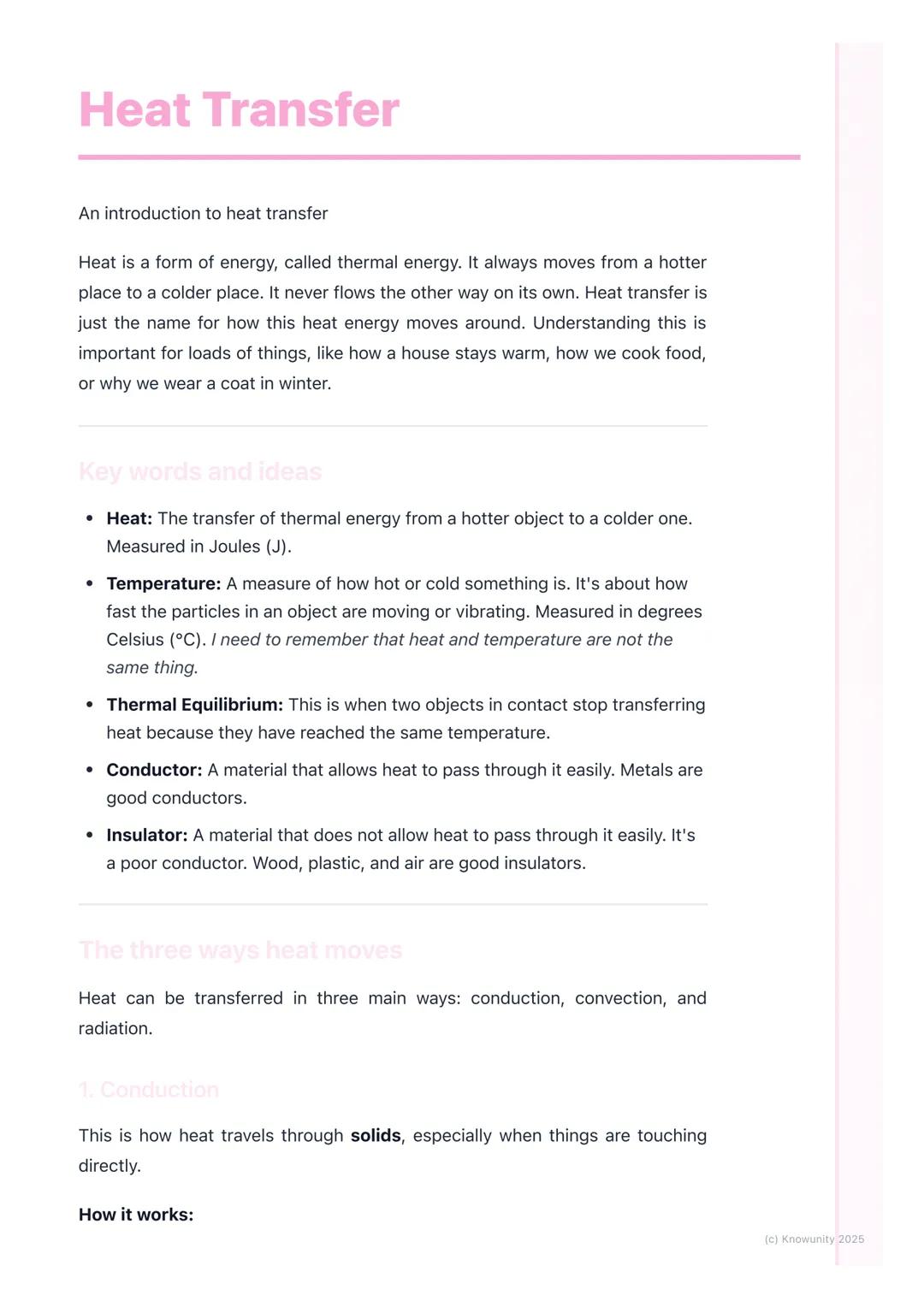
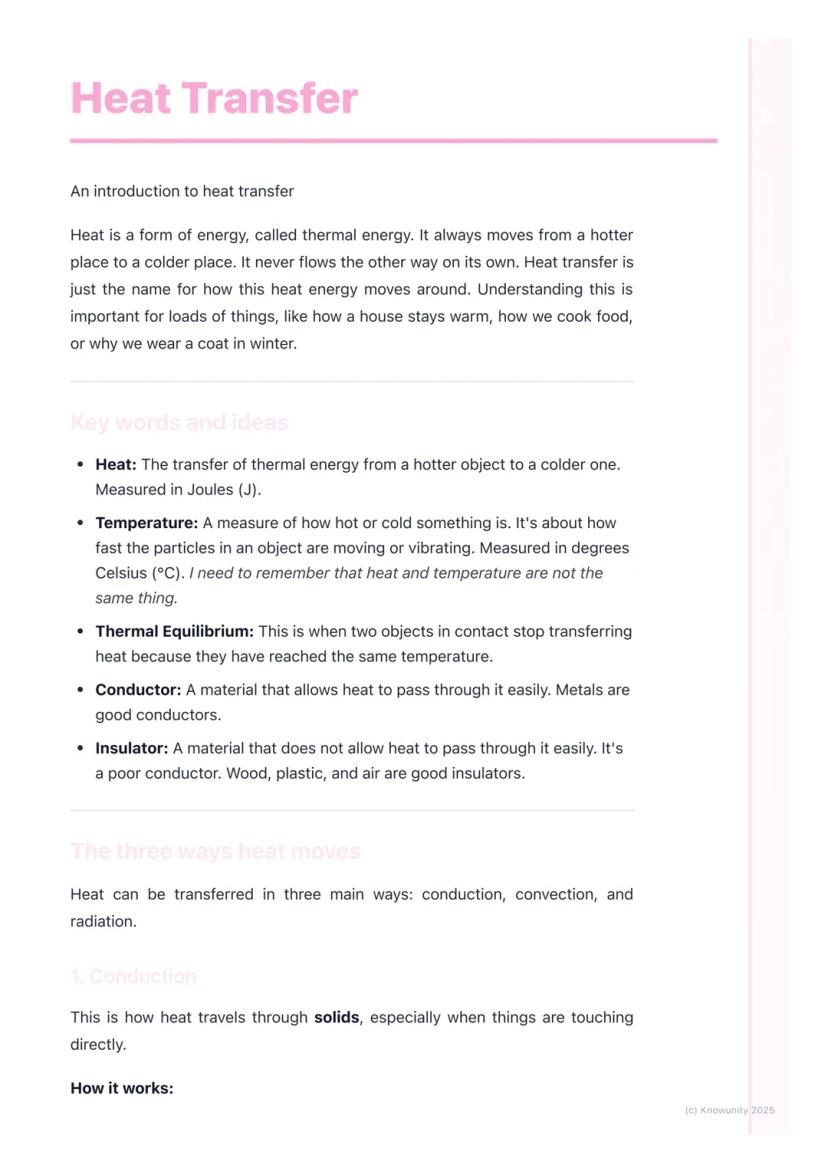
What is Heat Transfer?
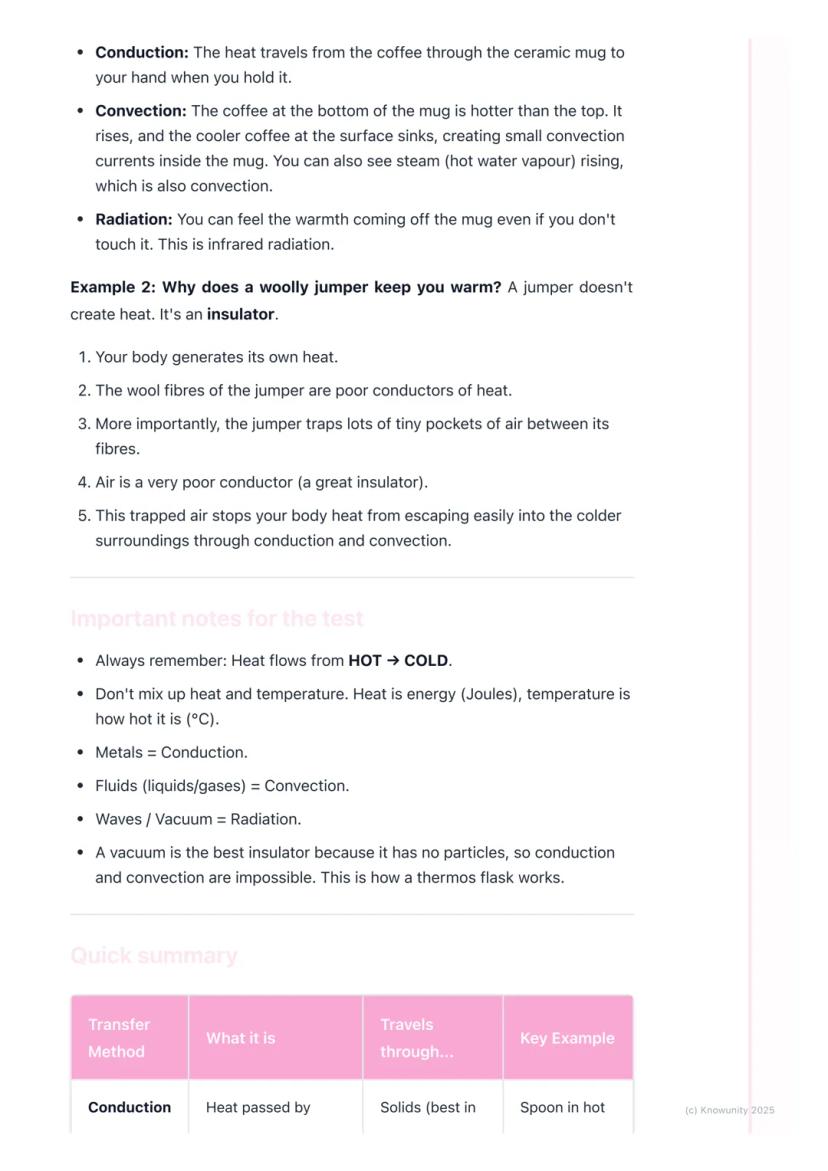
Your body naturally understands that heat always moves from hot things to cold things - never the other way around. This movement of thermal energy is called heat transfer, and it's happening constantly around you.
Don't get confused between heat and temperature - they're different! Temperature measures how hot something is (in °C), whilst heat is the actual energy being transferred (measured in Joules). Think of it this way: temperature tells you how fast particles are jiggling about, but heat is the energy that gets passed along.
When two objects touch and stop transferring heat, they've reached thermal equilibrium - basically, they're the same temperature. Materials that let heat pass through easily are called conductors (like metals), whilst insulators (like wood or plastic) block heat transfer really well.
Quick Tip: Remember that heat and temperature aren't the same thing - this is a common test mistake!
2
of 6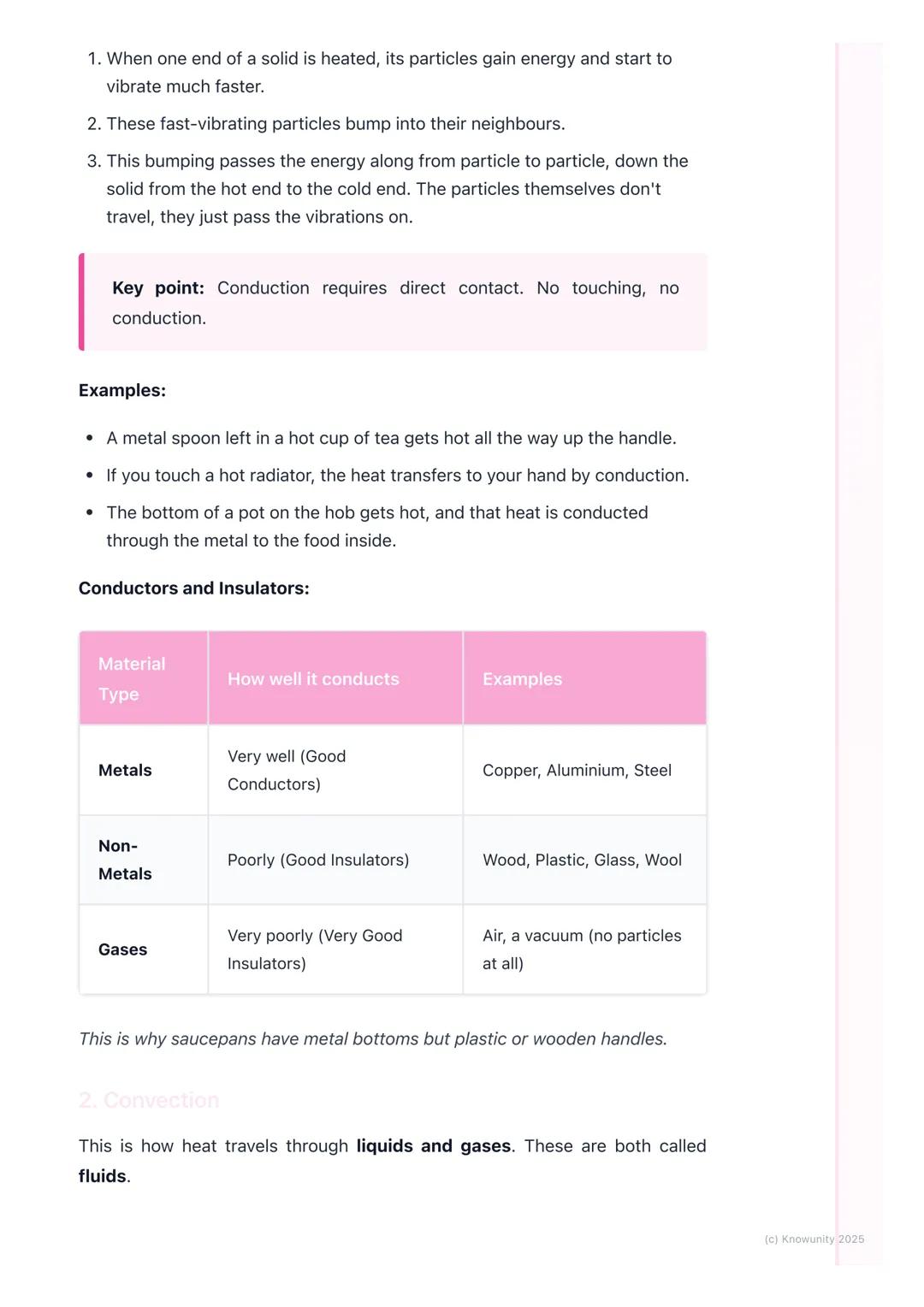
Conduction - Heat Through Touch
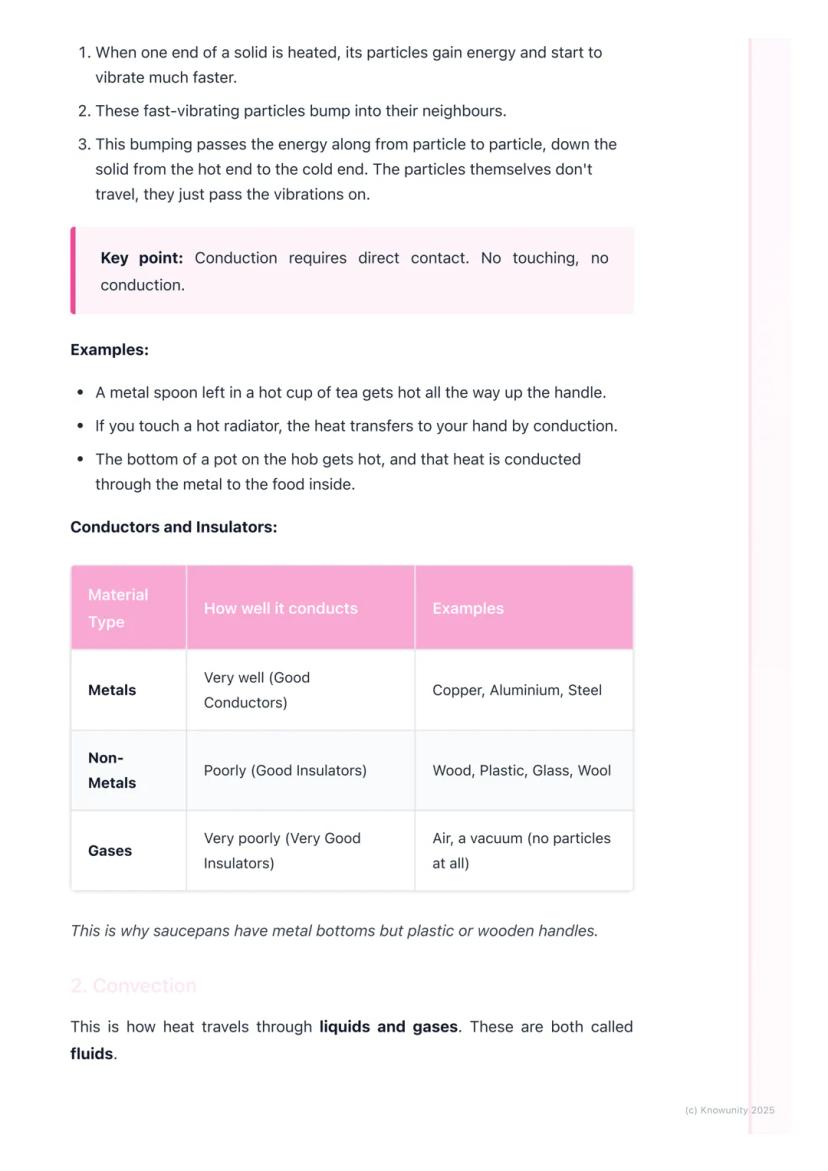
Conduction happens when heat travels through solids, especially when things are touching directly. Picture this: when you heat one end of a metal spoon, the particles start vibrating faster and bump into their neighbours, passing the energy along like a relay race.
The particles themselves don't actually travel - they just pass on their vibrations from the hot end to the cold end. This is why that spoon in your hot chocolate eventually burns your fingers!
Metals are brilliant conductors because their particles are packed tightly and can pass energy along quickly. That's why saucepans have metal bottoms but wooden or plastic handles - the metal conducts heat from the hob to your food, whilst the plastic handle stays cool enough to grab.
Air and other gases are terrible conductors (which makes them great insulators). This is exactly why your winter coat works - it traps air between its fibres to stop your body heat escaping.
Remember: No touching means no conduction - the particles need direct contact to pass energy along.
3
of 6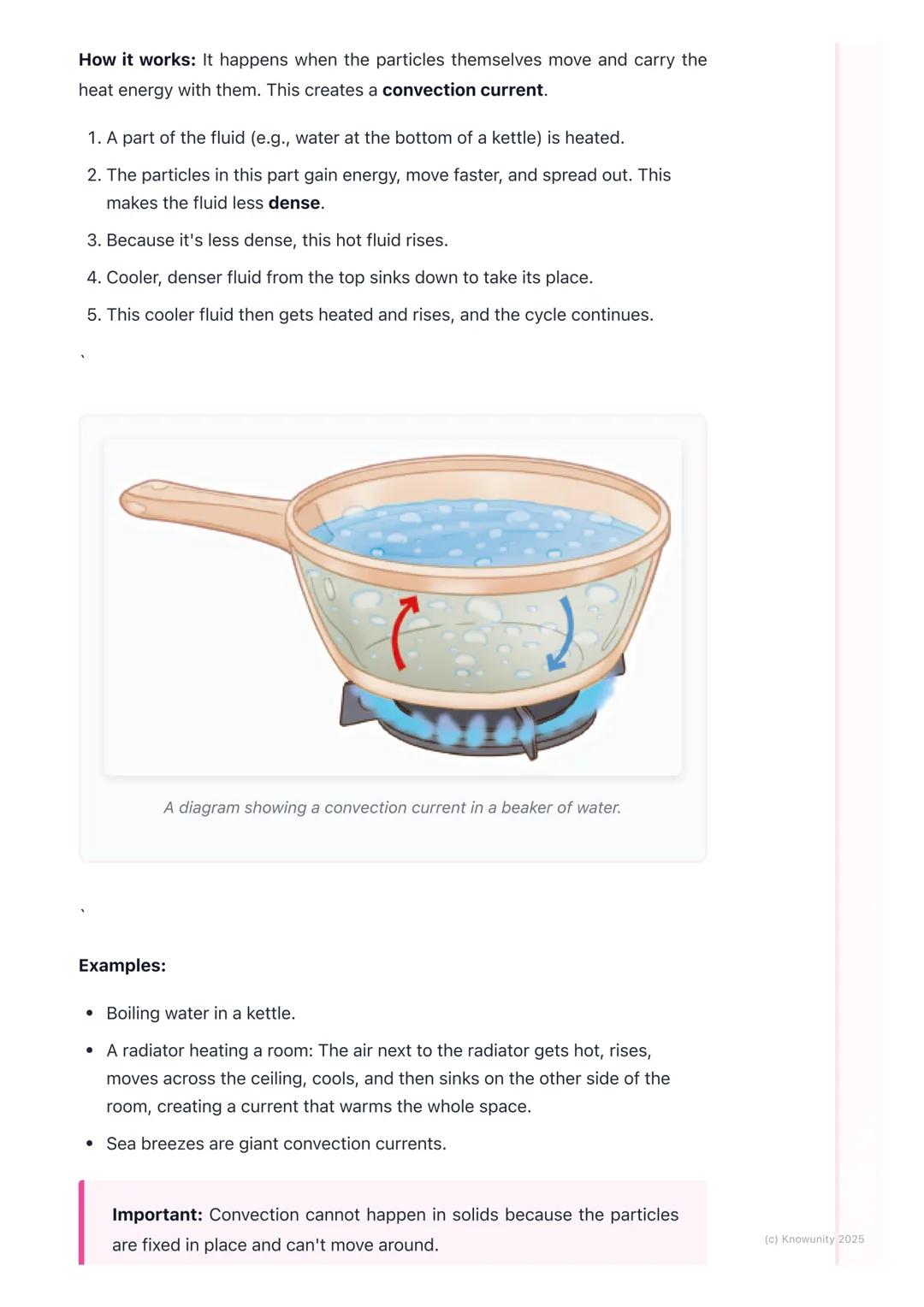
Convection - Heat on the Move
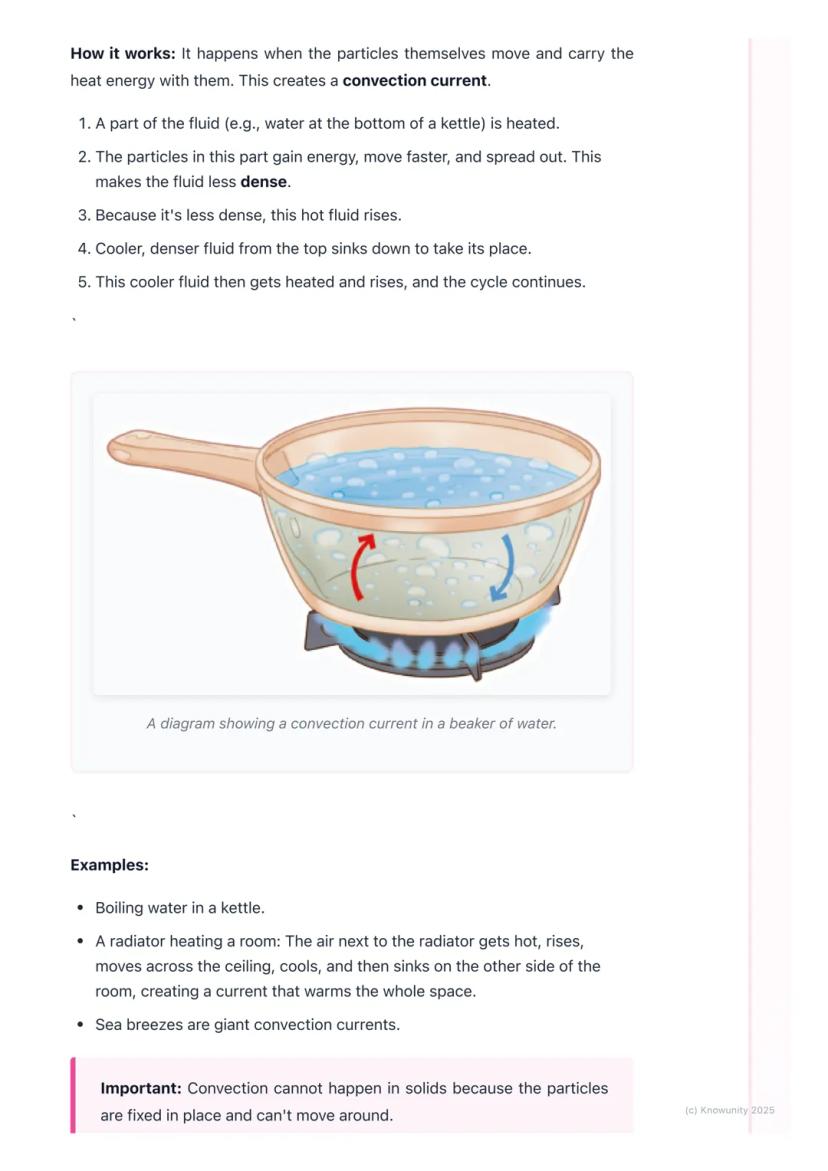
Convection is how heat travels through fluids (that's liquids and gases). Unlike conduction, the actual particles move around and carry the heat energy with them, creating convection currents.
Here's how it works: when you heat water in a kettle, the hot water at the bottom becomes less dense and rises upwards. Meanwhile, cooler, denser water sinks down to replace it. This creates a circular current that heats the whole kettle.
You see convection everywhere - it's how radiators heat your room and why hot air balloons float. The air next to a radiator gets warm, rises to the ceiling, cools down, then sinks on the other side of the room.
Convection can't happen in solids because the particles are stuck in fixed positions - they can't move around to carry heat energy with them.
Key Point: Fluids = moving particles = convection. Solids = fixed particles = no convection possible.
4
of 6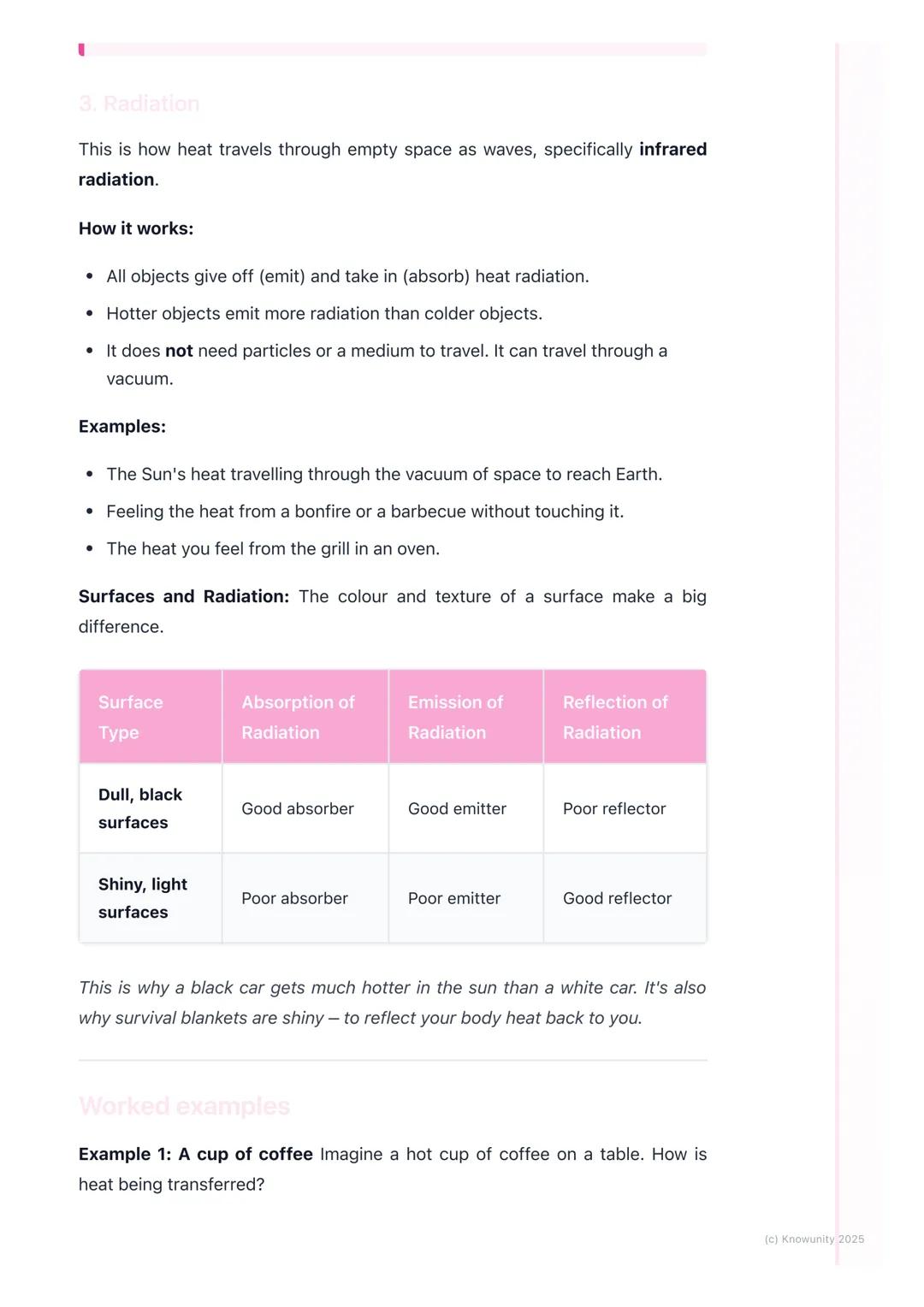
Radiation - Heat Through Space
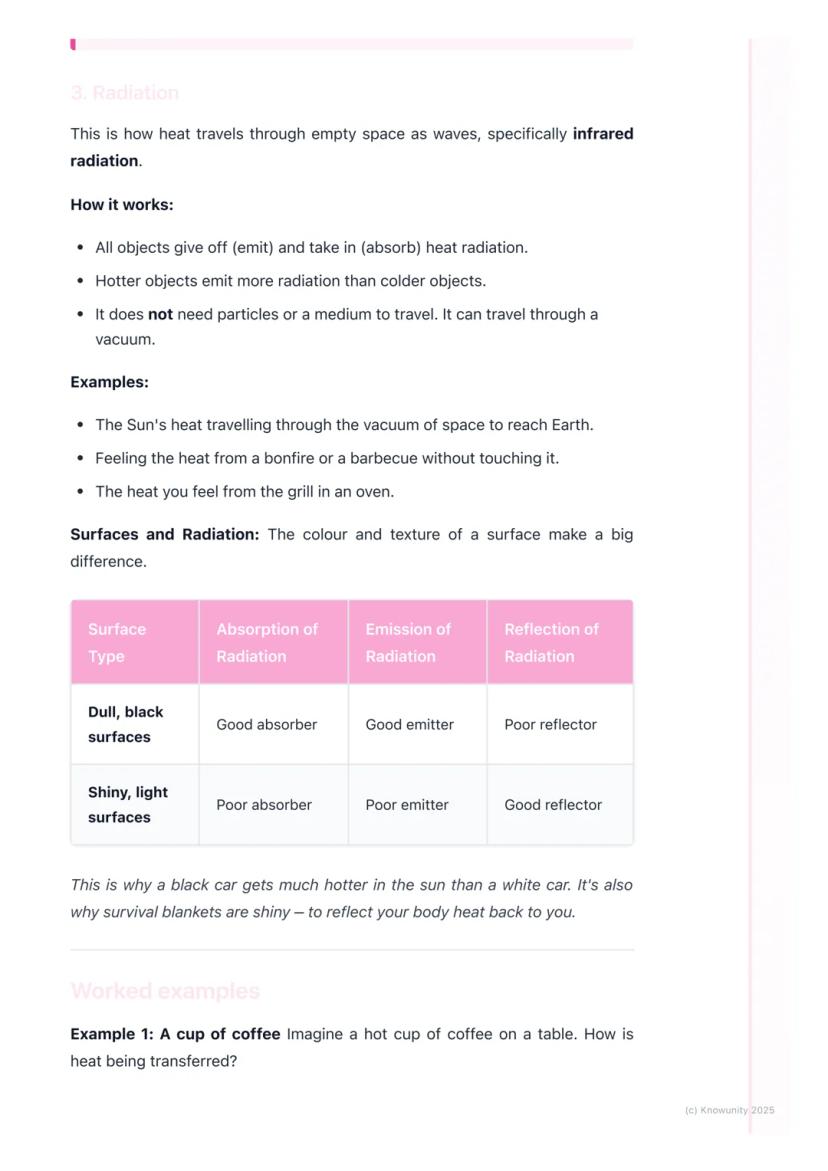
Radiation is the coolest type of heat transfer because it doesn't need any particles at all - heat travels as infrared waves that can even cross empty space. That's how the Sun's heat reaches Earth through the vacuum of space!
All objects give off and absorb heat radiation, but hotter objects emit much more than colder ones. You can feel this when you stand near a bonfire - that warmth hitting your face is infrared radiation.
Surface colour makes a huge difference with radiation. Dark, dull surfaces are brilliant at absorbing and emitting heat radiation, whilst shiny, light surfaces reflect most of it away. This is why black cars get scorching hot in summer, but white cars stay relatively cool.
Survival blankets are shiny for exactly this reason - they reflect your body heat back to you instead of letting it escape.
Think About It: A vacuum is the perfect insulator because there are no particles for conduction or convection, and you can reflect radiation with shiny surfaces.
5
of 6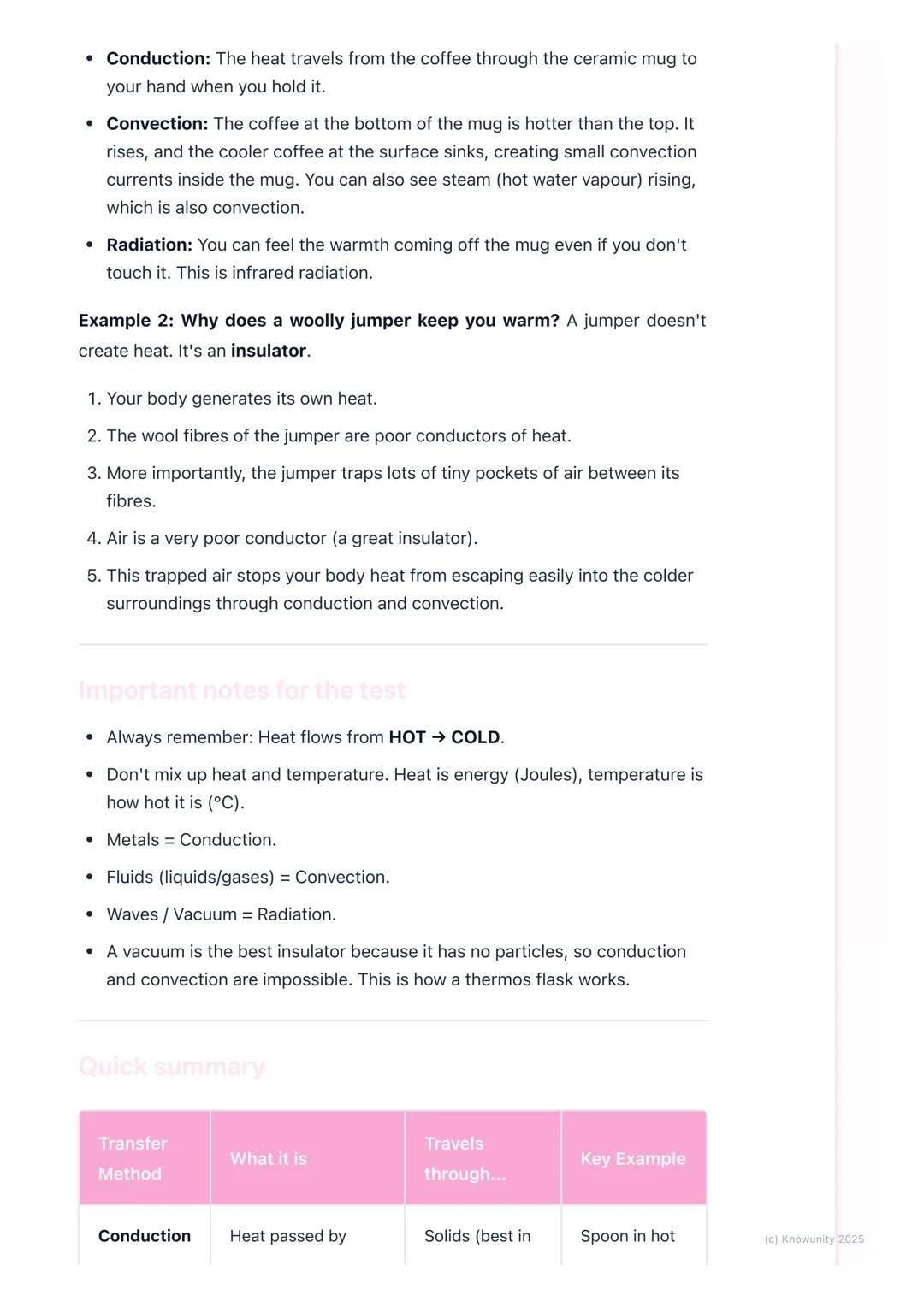
Putting It All Together
Let's look at a hot cup of tea to see all three types of heat transfer happening at once. Conduction moves heat from the tea through the ceramic mug to your hands. Convection creates tiny currents inside the tea as hot liquid rises and cool liquid sinks. Radiation lets you feel warmth from the mug even before you touch it.
Your winter jumper doesn't actually create heat - it's just a brilliant insulator. The wool fibres trap thousands of tiny air pockets, and since air is a terrible conductor, your body heat can't escape easily. That's why loose, fluffy jumpers often work better than tight ones.
Remember the golden rule: heat always flows from hot to cold, never the other way around. For your exams, think metals for conduction, fluids for convection, and waves for radiation.
The best insulator in the universe is actually a vacuum - no particles means no conduction or convection possible. That's the secret behind thermos flasks!
Exam Success: Always check whether the question is asking about heat (energy in Joules) or temperature (hotness in °C) - they're completely different!
6
of 6
Pensamos que nunca lo preguntarías...
¿Qué es Knowunity AI companion?
Nuestro compañero de IA está específicamente adaptado a las necesidades de los estudiantes. Basándonos en los millones de contenidos que tenemos en la plataforma, podemos dar a los estudiantes respuestas realmente significativas y relevantes. Pero no se trata solo de respuestas, el compañero también guía a los estudiantes a través de sus retos de aprendizaje diarios, con planes de aprendizaje personalizados, cuestionarios o contenidos en el chat y una personalización del 100% basada en las habilidades y el desarrollo de los estudiantes.
¿Dónde puedo descargar la app Knowunity?
Puedes descargar la app en Google Play Store y Apple App Store.
¿Knowunity es totalmente gratuito?
Sí, tienes acceso gratuito a los contenidos de la aplicación y a nuestro compañero de IA. Para desbloquear determinadas funciones de la aplicación, puedes adquirir Knowunity Pro.
Contenidos más populares de Physics
3PhysicsBalanced and Unbalanced Forces
Students will explore how balanced forces result in no change in motion, while unbalanced forces cause an object to accelerate or change direction.
2nd Year522
PhysicsTypes of Forces
Students will identify common forces such as gravity (pulling objects down), friction (opposing motion), and air resistance (slowing objects in the air).
2nd Year550
 Science
Science/Physics notes - Speed, density, work
Speed density work formulas
3rd Year81
Contenidos más populares
9 Irish
IrishIrish oral questions and answers
Questions and answers for the leaving cert oral
5th Year4264
 English
Key Quotes : Sive
Key Quotes and explanations: Sive
6th Year2842
IrishIrish oral questions
Outline of oral questions
5th Year2055
IrishIníon- le hÁine Durkin
Aine Durkin’s poem, Iníon: Themes & summary
5th Year850
IrishIrish poetry 2027
Iníon + Dínit an Bhróin
5th Year1133
IrishLC HL notes- Iníon (poem)
Includes poem in English and Irish, theme, key words & phrases
5th Year2284
EnglishCultural Context : Shawshank Redemption : Sive : Small Things Like These
Comparative Study : Cultural Context : Shawshank Redemption, Sive and Small Things Like These
6th Year1430
IrishMo Ghrá-sa (Idir Lúibíní)
Notes on mo ghrá-sa
5th Year380
IrishAn Gaeilge Aiste
Irish Language essay
6th Year1320
¿No encuentras lo que buscas? Explora otros temas.
Mira lo que dicen nuestros usuarios. Les encanta - y a tí también.
4.6/5App Store
4.7/5Google Play
La app es muy fácil de usar y está muy bien diseñada. Hasta ahora he encontrado todo lo que estaba buscando y he podido aprender mucho de las presentaciones. Definitivamente utilizaré la aplicación para un examen de clase. Y, por supuesto, también me sirve mucho de inspiración.
Pablousuario de iOS
Esta app es realmente genial. Hay tantos apuntes de clase y ayuda [...]. Tengo problemas con matemáticas, por ejemplo, y la aplicación tiene muchas opciones de ayuda. Gracias a Knowunity, he mejorado en mates. Se la recomiendo a todo el mundo.
Elenausuaria de Android
Vaya, estoy realmente sorprendida. Acabo de probar la app porque la he visto anunciada muchas veces y me he quedado absolutamente alucinada. Esta app es LA AYUDA que quieres para el insti y, sobre todo, ofrece muchísimas cosas, como ejercicios y hojas informativas, que a mí personalmente me han sido MUY útiles.
Anausuaria de iOS
Physics2 visualizaciones·Actualizado Jun 5, 2026·6 páginasUnderstanding Heat Transfer: Conduction, Convection, and Radiation
Ever wonder why a metal spoon gets hot in your tea or how the Sun warms Earth through empty space? Heat transfer is everywhere around you, and understanding how thermal energy moves will help you make sense of loads of...
1
of 6
Inscríbete para ver los apuntes. ¡Es gratis!
- Acceso a todos los documentos
- Mejora tus notas
- Únete a millones de estudiantes
What is Heat Transfer?
Your body naturally understands that heat always moves from hot things to cold things - never the other way around. This movement of thermal energy is called heat transfer, and it's happening constantly around you.
Don't get confused between heat and temperature - they're different! Temperature measures how hot something is (in °C), whilst heat is the actual energy being transferred (measured in Joules). Think of it this way: temperature tells you how fast particles are jiggling about, but heat is the energy that gets passed along.
When two objects touch and stop transferring heat, they've reached thermal equilibrium - basically, they're the same temperature. Materials that let heat pass through easily are called conductors (like metals), whilst insulators (like wood or plastic) block heat transfer really well.
Quick Tip: Remember that heat and temperature aren't the same thing - this is a common test mistake!
2
of 6Inscríbete para ver los apuntes. ¡Es gratis!
- Acceso a todos los documentos
- Mejora tus notas
- Únete a millones de estudiantes
Conduction - Heat Through Touch
Conduction happens when heat travels through solids, especially when things are touching directly. Picture this: when you heat one end of a metal spoon, the particles start vibrating faster and bump into their neighbours, passing the energy along like a relay race.
The particles themselves don't actually travel - they just pass on their vibrations from the hot end to the cold end. This is why that spoon in your hot chocolate eventually burns your fingers!
Metals are brilliant conductors because their particles are packed tightly and can pass energy along quickly. That's why saucepans have metal bottoms but wooden or plastic handles - the metal conducts heat from the hob to your food, whilst the plastic handle stays cool enough to grab.
Air and other gases are terrible conductors (which makes them great insulators). This is exactly why your winter coat works - it traps air between its fibres to stop your body heat escaping.
Remember: No touching means no conduction - the particles need direct contact to pass energy along.
3
of 6Inscríbete para ver los apuntes. ¡Es gratis!
- Acceso a todos los documentos
- Mejora tus notas
- Únete a millones de estudiantes
Convection - Heat on the Move
Convection is how heat travels through fluids (that's liquids and gases). Unlike conduction, the actual particles move around and carry the heat energy with them, creating convection currents.
Here's how it works: when you heat water in a kettle, the hot water at the bottom becomes less dense and rises upwards. Meanwhile, cooler, denser water sinks down to replace it. This creates a circular current that heats the whole kettle.
You see convection everywhere - it's how radiators heat your room and why hot air balloons float. The air next to a radiator gets warm, rises to the ceiling, cools down, then sinks on the other side of the room.
Convection can't happen in solids because the particles are stuck in fixed positions - they can't move around to carry heat energy with them.
Key Point: Fluids = moving particles = convection. Solids = fixed particles = no convection possible.
4
of 6Inscríbete para ver los apuntes. ¡Es gratis!
- Acceso a todos los documentos
- Mejora tus notas
- Únete a millones de estudiantes
Radiation - Heat Through Space
Radiation is the coolest type of heat transfer because it doesn't need any particles at all - heat travels as infrared waves that can even cross empty space. That's how the Sun's heat reaches Earth through the vacuum of space!
All objects give off and absorb heat radiation, but hotter objects emit much more than colder ones. You can feel this when you stand near a bonfire - that warmth hitting your face is infrared radiation.
Surface colour makes a huge difference with radiation. Dark, dull surfaces are brilliant at absorbing and emitting heat radiation, whilst shiny, light surfaces reflect most of it away. This is why black cars get scorching hot in summer, but white cars stay relatively cool.
Survival blankets are shiny for exactly this reason - they reflect your body heat back to you instead of letting it escape.
Think About It: A vacuum is the perfect insulator because there are no particles for conduction or convection, and you can reflect radiation with shiny surfaces.
5
of 6Inscríbete para ver los apuntes. ¡Es gratis!
- Acceso a todos los documentos
- Mejora tus notas
- Únete a millones de estudiantes
Putting It All Together
Let's look at a hot cup of tea to see all three types of heat transfer happening at once. Conduction moves heat from the tea through the ceramic mug to your hands. Convection creates tiny currents inside the tea as hot liquid rises and cool liquid sinks. Radiation lets you feel warmth from the mug even before you touch it.
Your winter jumper doesn't actually create heat - it's just a brilliant insulator. The wool fibres trap thousands of tiny air pockets, and since air is a terrible conductor, your body heat can't escape easily. That's why loose, fluffy jumpers often work better than tight ones.
Remember the golden rule: heat always flows from hot to cold, never the other way around. For your exams, think metals for conduction, fluids for convection, and waves for radiation.
The best insulator in the universe is actually a vacuum - no particles means no conduction or convection possible. That's the secret behind thermos flasks!
Exam Success: Always check whether the question is asking about heat (energy in Joules) or temperature (hotness in °C) - they're completely different!
6
of 6Inscríbete para ver los apuntes. ¡Es gratis!
- Acceso a todos los documentos
- Mejora tus notas
- Únete a millones de estudiantes
Pensamos que nunca lo preguntarías...
¿Qué es Knowunity AI companion?
Nuestro compañero de IA está específicamente adaptado a las necesidades de los estudiantes. Basándonos en los millones de contenidos que tenemos en la plataforma, podemos dar a los estudiantes respuestas realmente significativas y relevantes. Pero no se trata solo de respuestas, el compañero también guía a los estudiantes a través de sus retos de aprendizaje diarios, con planes de aprendizaje personalizados, cuestionarios o contenidos en el chat y una personalización del 100% basada en las habilidades y el desarrollo de los estudiantes.
¿Dónde puedo descargar la app Knowunity?
Puedes descargar la app en Google Play Store y Apple App Store.
¿Knowunity es totalmente gratuito?
Sí, tienes acceso gratuito a los contenidos de la aplicación y a nuestro compañero de IA. Para desbloquear determinadas funciones de la aplicación, puedes adquirir Knowunity Pro.
Contenidos más populares de Physics
3PhysicsBalanced and Unbalanced Forces
Students will explore how balanced forces result in no change in motion, while unbalanced forces cause an object to accelerate or change direction.
2nd Year522
PhysicsTypes of Forces
Students will identify common forces such as gravity (pulling objects down), friction (opposing motion), and air resistance (slowing objects in the air).
2nd Year550
ScienceScience/Physics notes - Speed, density, work
Speed density work formulas
3rd Year81
Contenidos más populares
9IrishIrish oral questions and answers
Questions and answers for the leaving cert oral
5th Year4264
EnglishKey Quotes : Sive
Key Quotes and explanations: Sive
6th Year2842
IrishIrish oral questions
Outline of oral questions
5th Year2055
IrishIníon- le hÁine Durkin
Aine Durkin’s poem, Iníon: Themes & summary
5th Year850
IrishIrish poetry 2027
Iníon + Dínit an Bhróin
5th Year1133
IrishLC HL notes- Iníon (poem)
Includes poem in English and Irish, theme, key words & phrases
5th Year2284
EnglishCultural Context : Shawshank Redemption : Sive : Small Things Like These
Comparative Study : Cultural Context : Shawshank Redemption, Sive and Small Things Like These
6th Year1430
IrishMo Ghrá-sa (Idir Lúibíní)
Notes on mo ghrá-sa
5th Year380
IrishAn Gaeilge Aiste
Irish Language essay
6th Year1320
¿No encuentras lo que buscas? Explora otros temas.
Mira lo que dicen nuestros usuarios. Les encanta - y a tí también.
4.6/5App Store
4.7/5Google Play
La app es muy fácil de usar y está muy bien diseñada. Hasta ahora he encontrado todo lo que estaba buscando y he podido aprender mucho de las presentaciones. Definitivamente utilizaré la aplicación para un examen de clase. Y, por supuesto, también me sirve mucho de inspiración.
Pablousuario de iOS
Esta app es realmente genial. Hay tantos apuntes de clase y ayuda [...]. Tengo problemas con matemáticas, por ejemplo, y la aplicación tiene muchas opciones de ayuda. Gracias a Knowunity, he mejorado en mates. Se la recomiendo a todo el mundo.
Elenausuaria de Android
Vaya, estoy realmente sorprendida. Acabo de probar la app porque la he visto anunciada muchas veces y me he quedado absolutamente alucinada. Esta app es LA AYUDA que quieres para el insti y, sobre todo, ofrece muchísimas cosas, como ejercicios y hojas informativas, que a mí personalmente me han sido MUY útiles.
Anausuaria de iOS