
Ever wondered how musicians can look at squiggly lines and... Mostrar más
 Music3 visualizaciones·Actualizado Jun 6, 2026·6 páginas
Understanding the Staff, Lines, and Clefs
1 / 6
1
of 6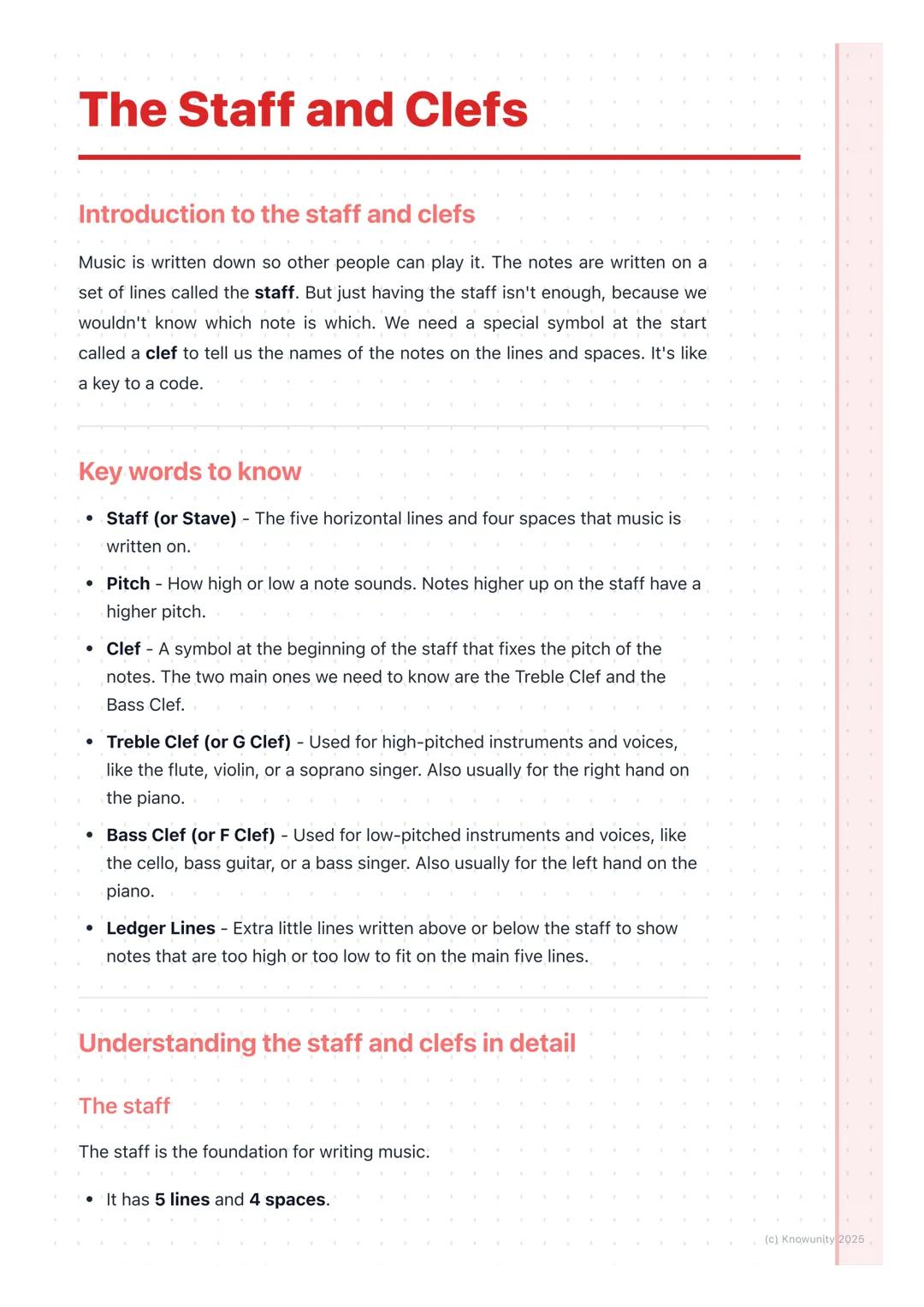
The Staff and Clefs Basics
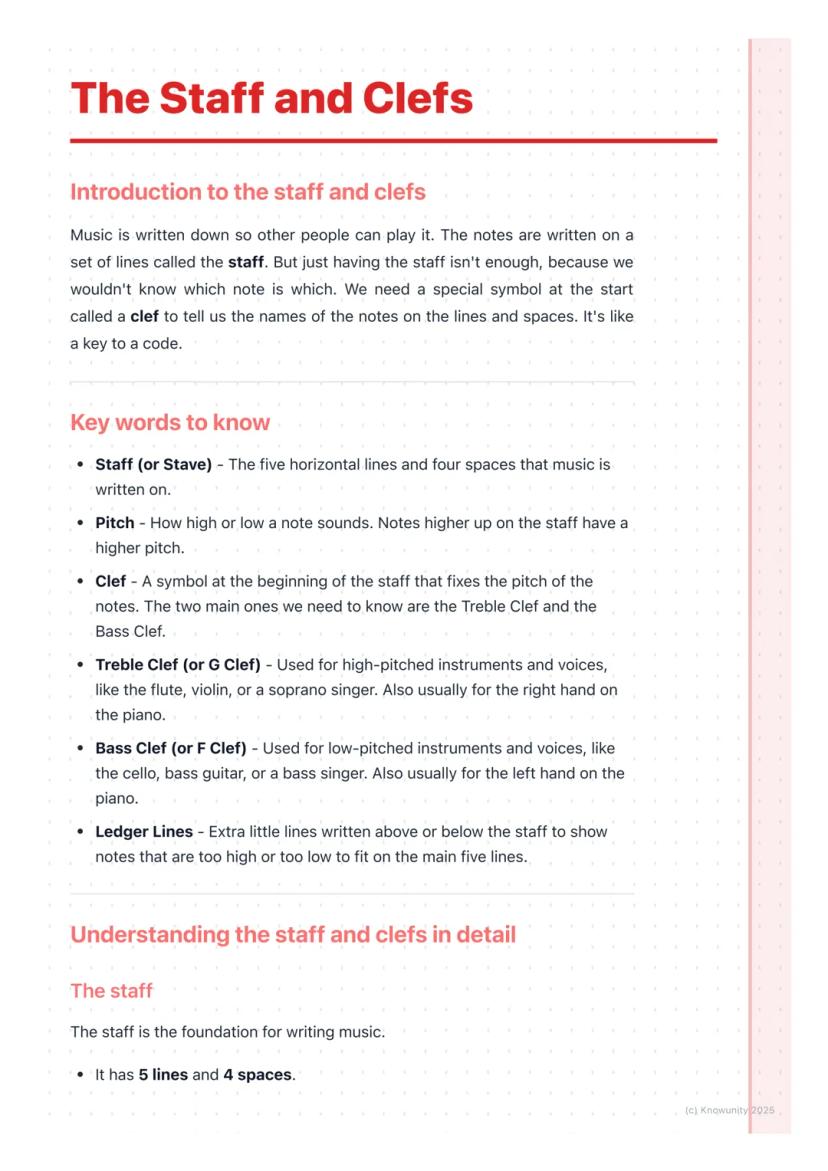
Think of the staff as music's address system - without it, notes would be homeless! The staff is made up of 5 horizontal lines and 4 spaces where all musical notes live. But here's the thing: those lines and spaces mean nothing without a special symbol at the beginning called a clef.
A clef is like a musical GPS - it tells you exactly which note is which. The pitch (how high or low a note sounds) depends on where it sits on the staff and which clef you're using. Notes higher up on the staff have a higher pitch than notes lower down.
There are two main clefs you need to master: the treble clef (for high sounds like flutes and sopranos) and the bass clef (for low sounds like cellos and bass guitars). Most piano music uses both - treble for the right hand, bass for the left.
Quick Tip: Always count lines and spaces from bottom to top - line 1 is at the bottom, line 5 is at the top!
2
of 6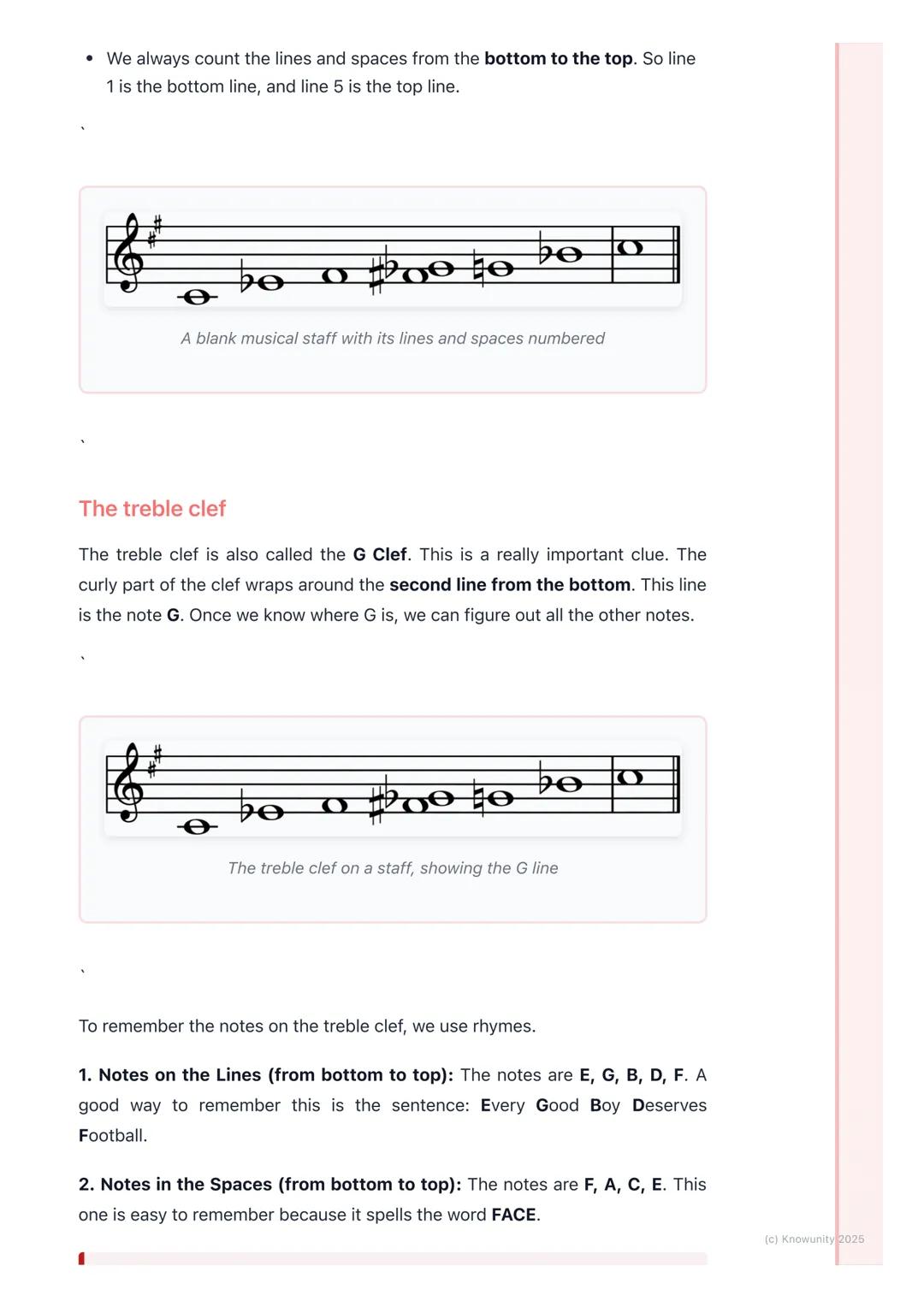
The Treble Clef (G Clef)
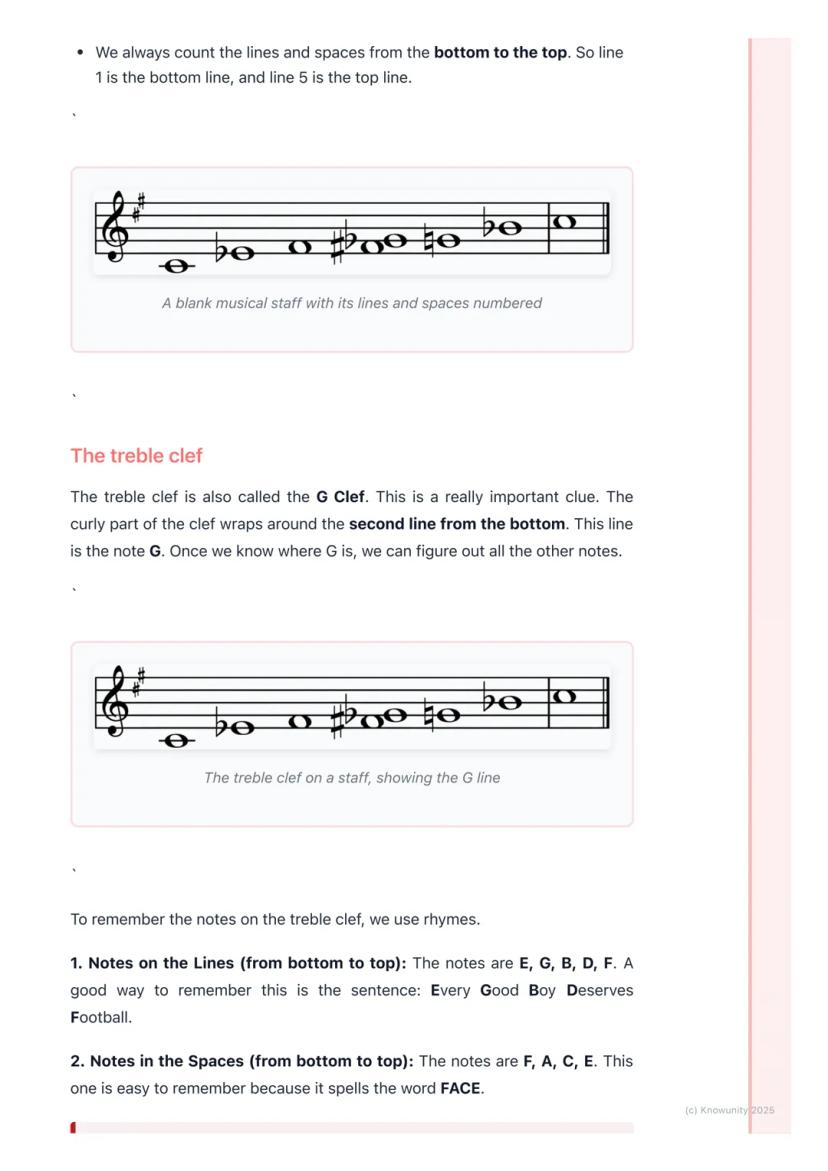
The treble clef is your best mate for reading high-pitched music. Here's a clever trick: it's also called the G clef because that curly bit wraps around the second line, marking where G lives. Once you know where G is, you can work out everything else!
For the lines (from bottom to top), the notes are E, G, B, D, F. Remember this with: "Every Good Boy Deserves Football". For the spaces (from bottom to top), you get F, A, C, E - which simply spells "FACE"!
The beauty of music is that notes follow alphabetical order: A, B, C, D, E, F, G, then back to A again. So if you know one note, just count up or down the alphabet to find the next one.
Memory Hack: FACE is super easy because it's actually a word - no complicated sentences to remember!
3
of 6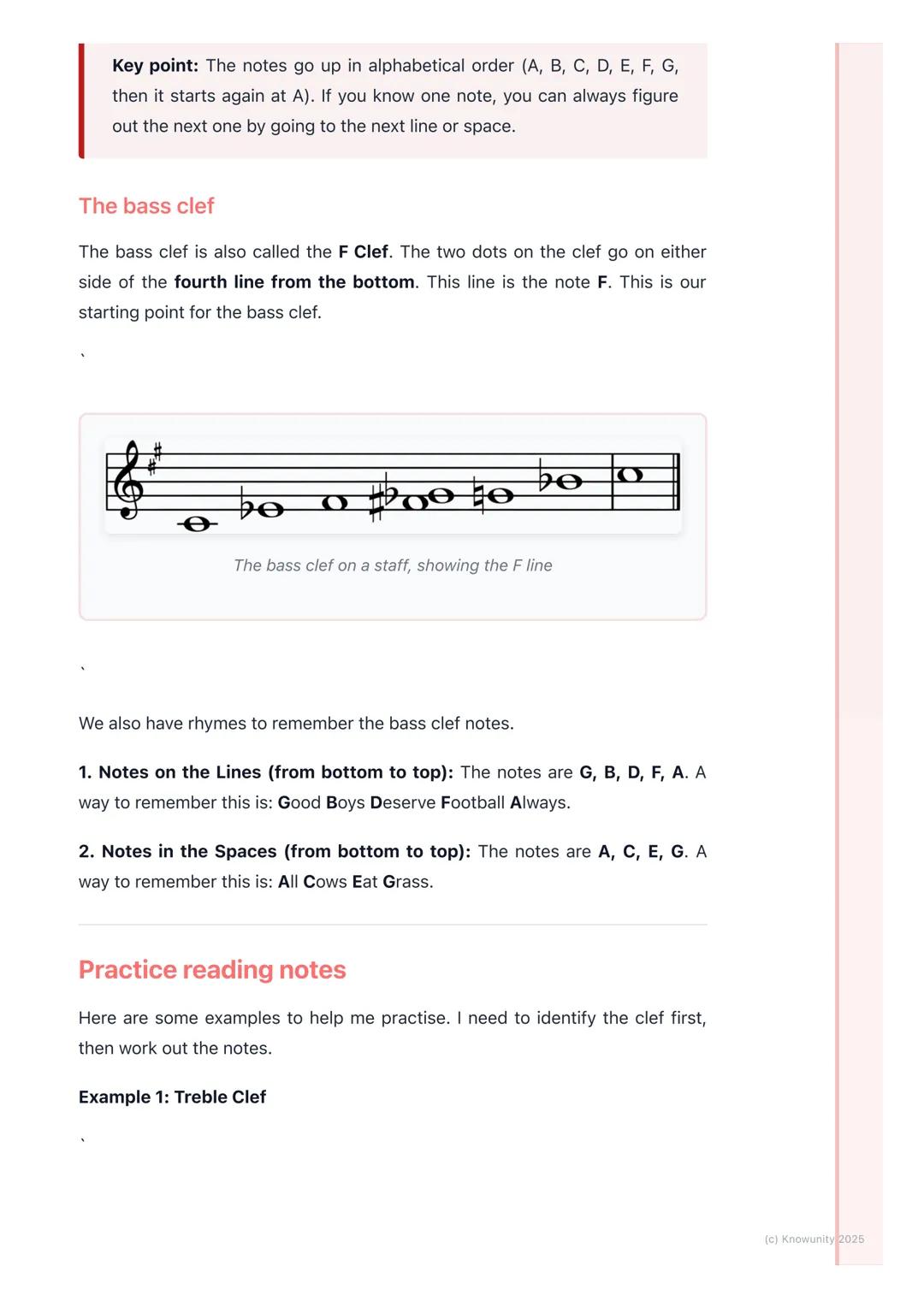
The Bass Clef (F Clef)
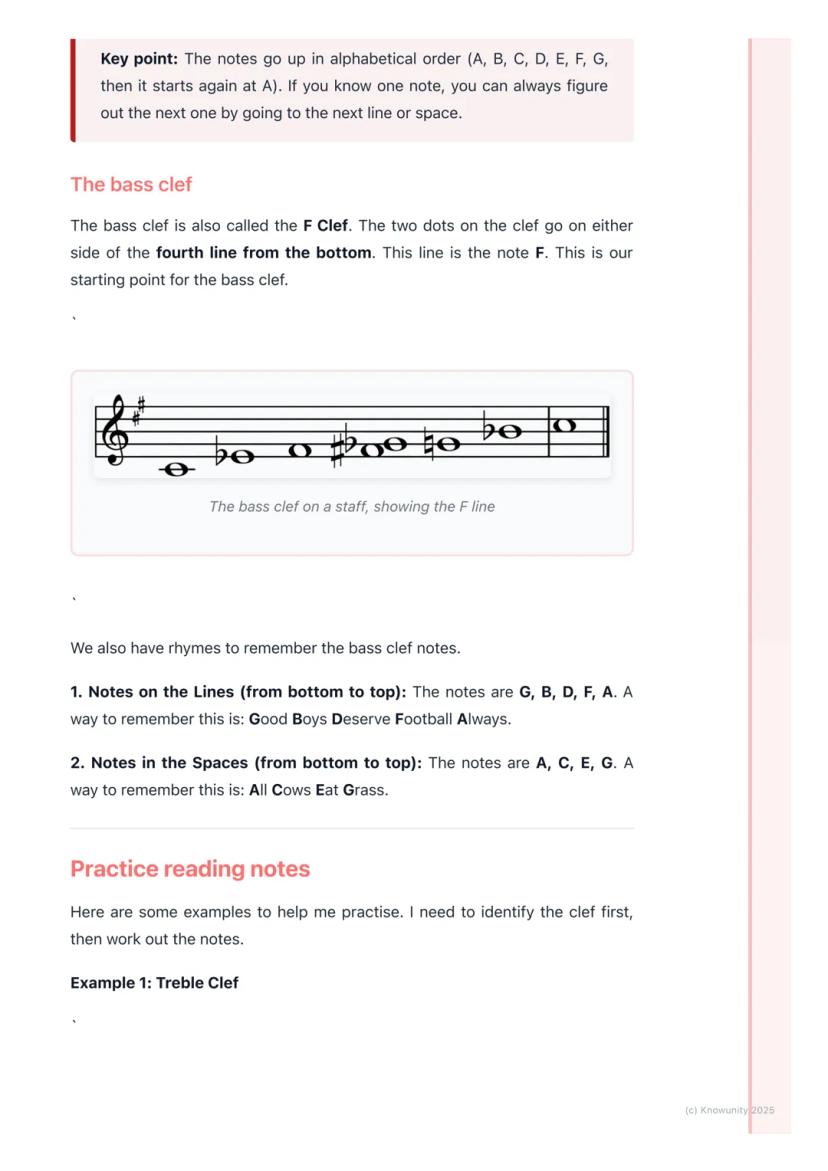
Now let's tackle the bass clef, also known as the F clef. Those two little dots sit on either side of the fourth line, marking where F lives. This is your starting point for reading bass clef notes.
For the lines in bass clef (bottom to top), you get G, B, D, F, A. Remember this with: "Good Boys Deserve Football Always". For the spaces, it's A, C, E, G - try "All Cows Eat Grass" to remember this one!
Notice how the bass clef rhymes are similar to treble clef but slightly different? That's because bass clef notes are positioned differently on the staff. The same line that's a B in treble clef is actually a D in bass clef!
Warning: Always check your clef first! This is the most common mistake students make - reading a note in the wrong clef.
4
of 6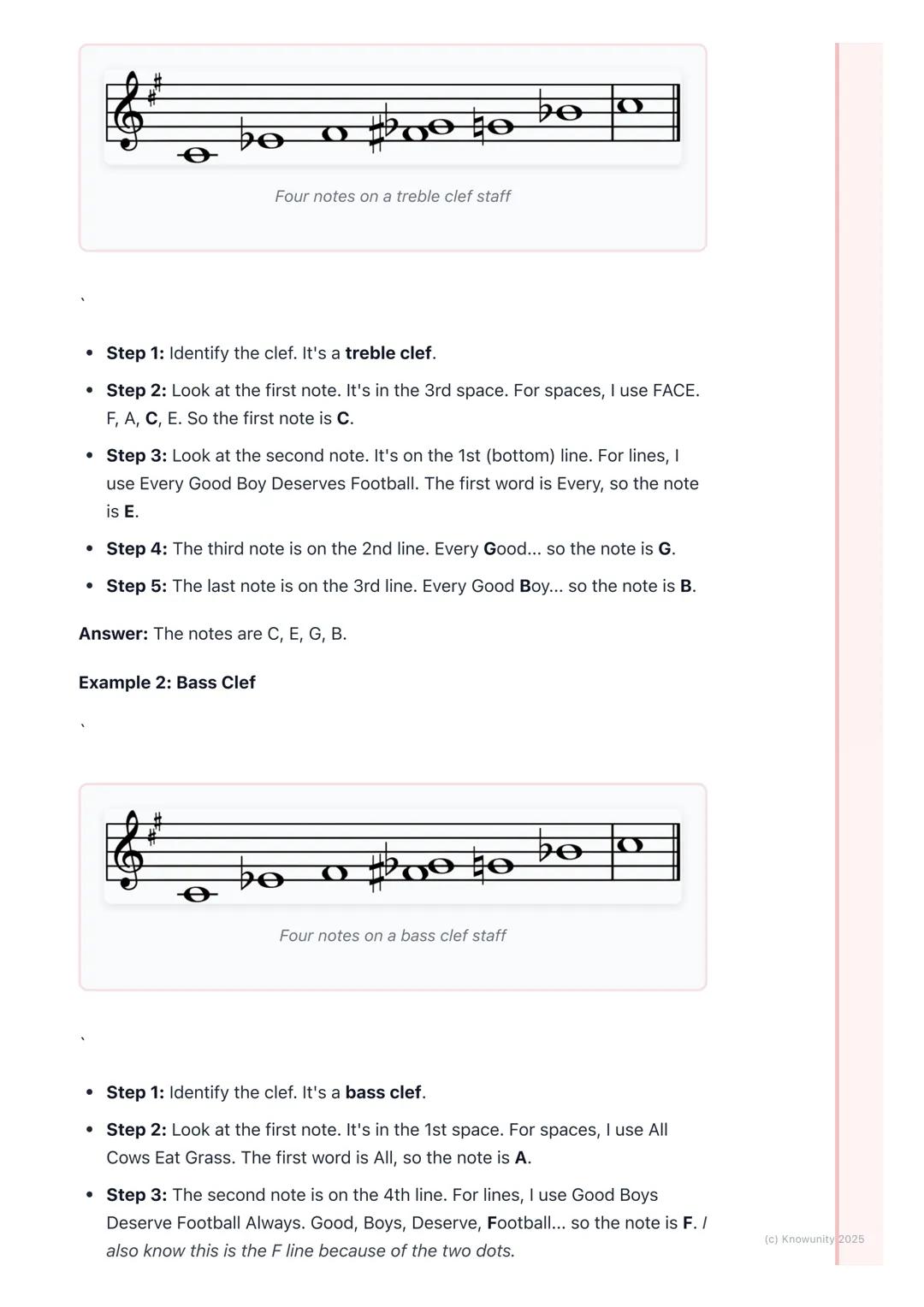
Reading Notes Step by Step
Let's put this into practice! When you see notes on a staff, follow these simple steps: identify the clef first, then use your rhymes to work out each note.
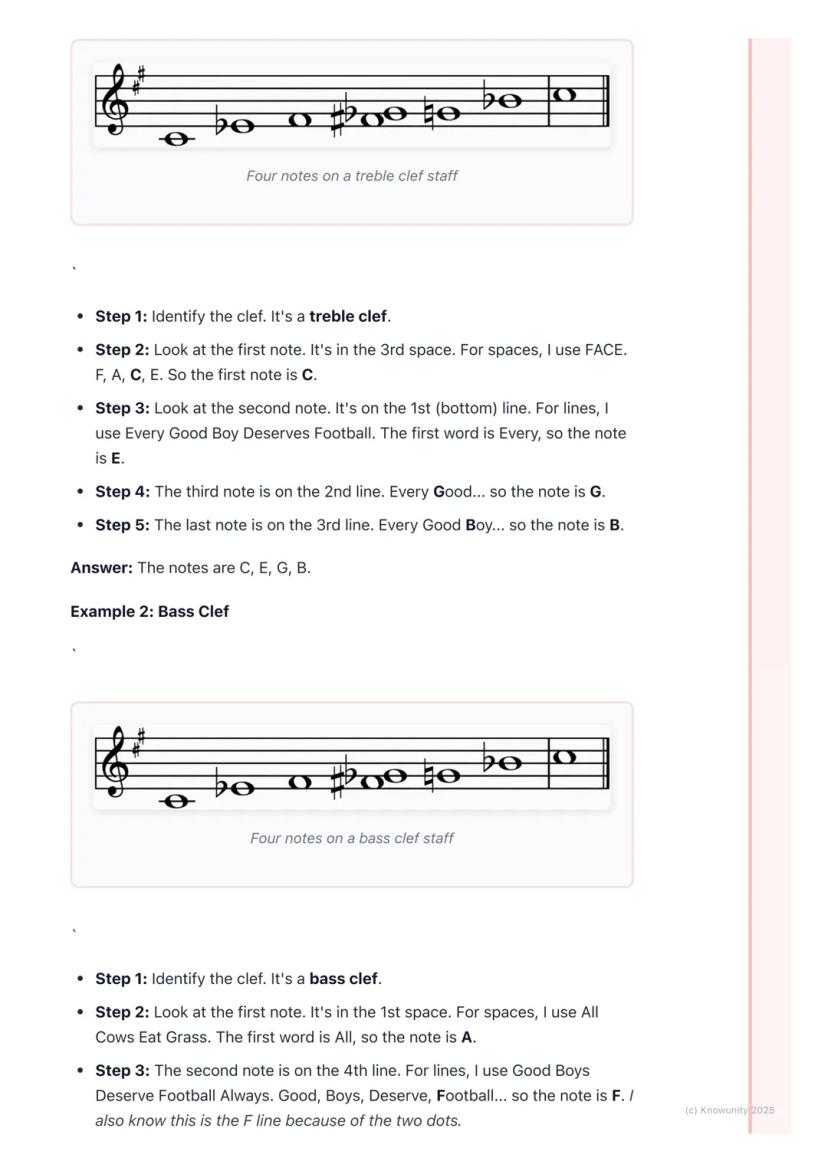
For treble clef example: If you see a note in the third space, think "FACE" - F, A, C... so it's C. If there's a note on the bottom line, think "Every Good Boy..." - the first word is Every, so it's E.
For bass clef example: A note in the first space means "All Cows Eat Grass" - All comes first, so it's A. A note on the fourth line (where the dots are) is always F in bass clef.
Pro Tip: The rhymes work like counting - use them in order from bottom to top, just like counting from 1 to 5!
5
of 6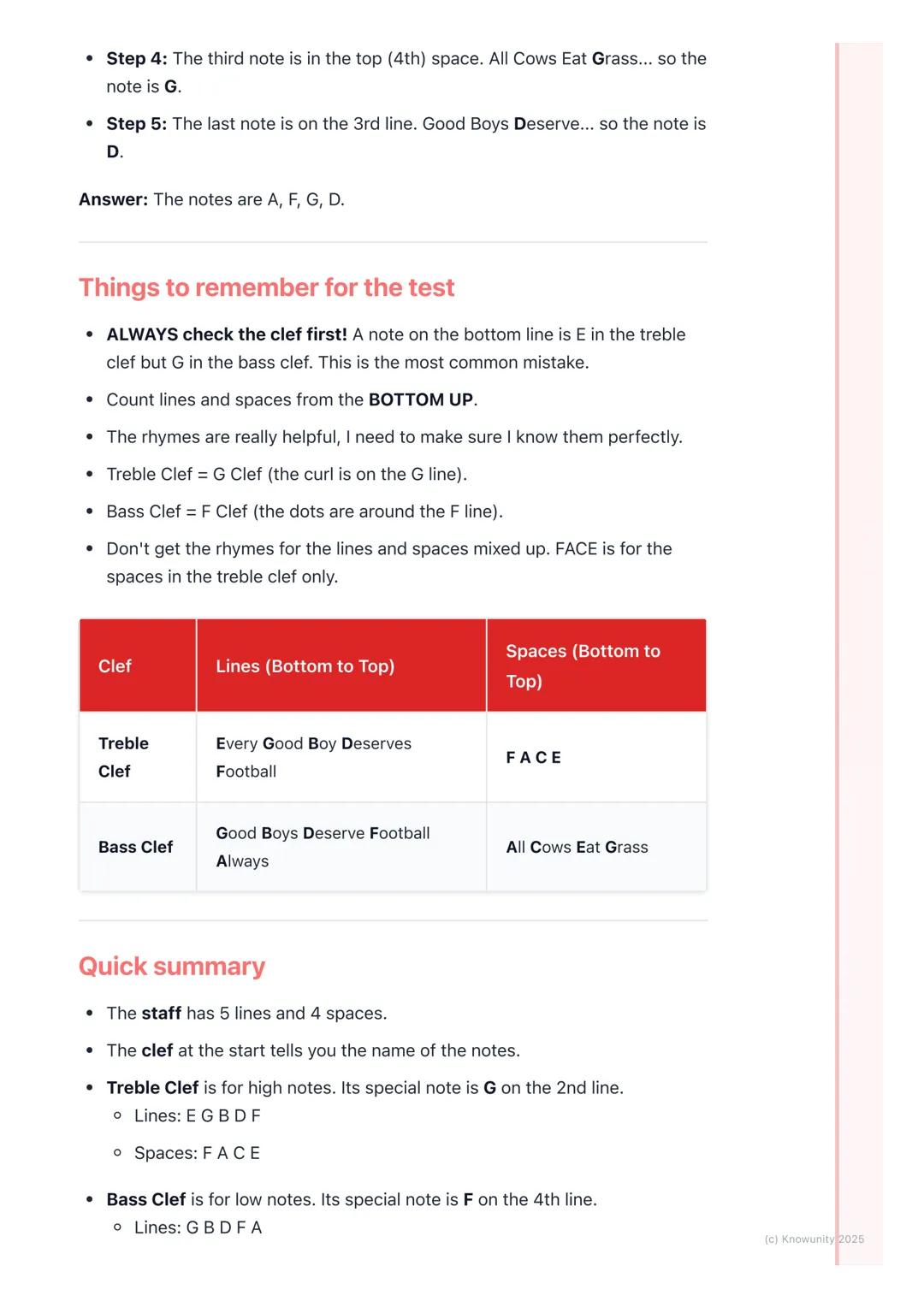
Test Preparation Essentials
Here's what you absolutely must remember for your test: always identify the clef before reading any notes! The same line can be completely different notes depending on the clef - E in treble becomes G in bass.
Your treble clef memory tools: Lines = "Every Good Boy Deserves Football" (EGBDF), Spaces = "FACE". Your bass clef memory tools: Lines = "Good Boys Deserve Football Always" (GBDFA), Spaces = "All Cows Eat Grass" (ACEG).
Remember that treble clef = G clef (the curl marks the G line) and bass clef = F clef (the dots mark the F line). Don't mix up the rhymes between clefs - FACE only works for treble clef spaces!
Exam Success: Practice identifying the clef first, then count from bottom to top using your rhymes - this method never fails!
6
of 6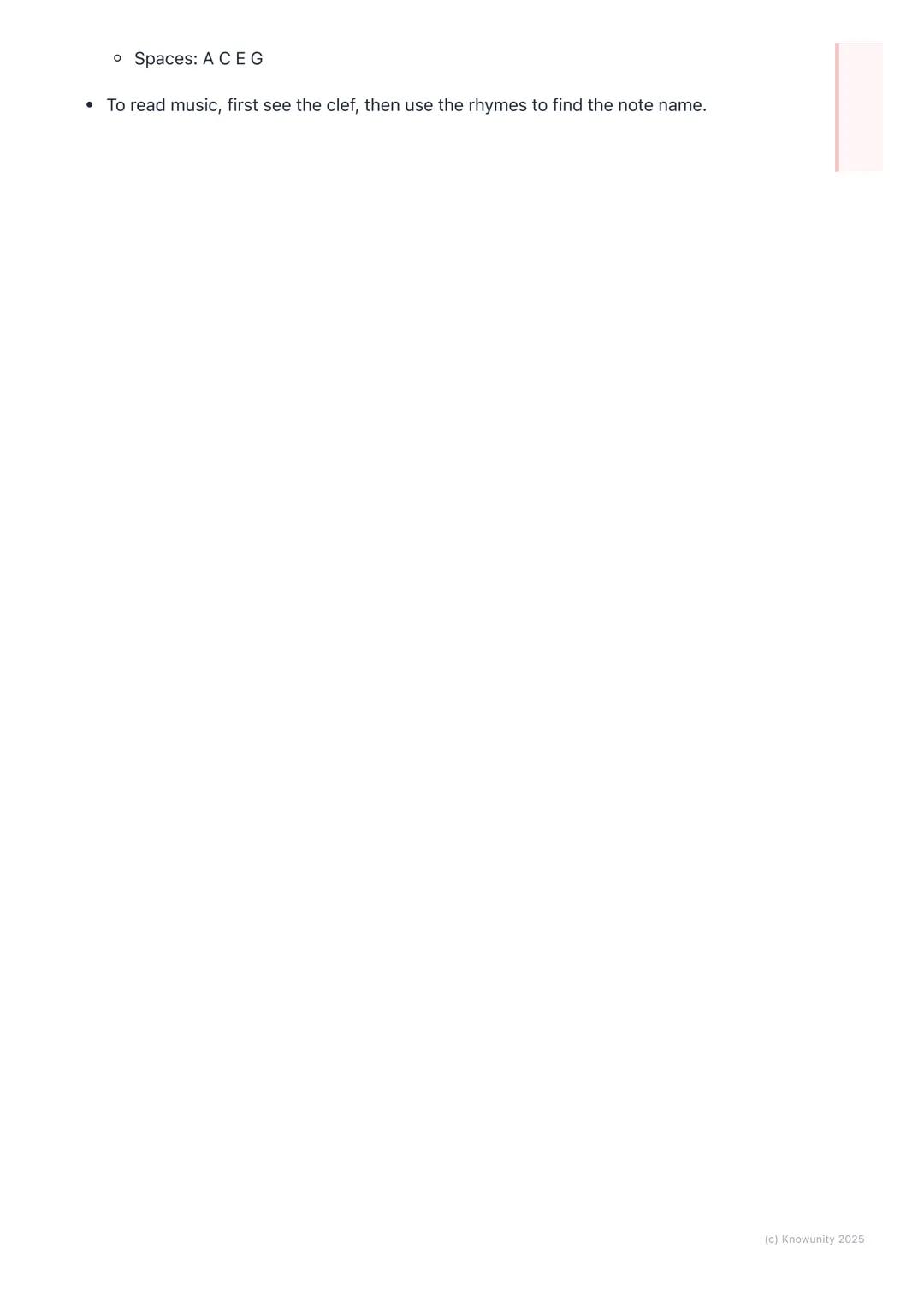
Quick Reference Summary
You've now got all the tools to read basic music notation! The staff gives notes their home, the clef tells you their names, and your rhymes help you remember everything.
Treble clef handles the high stuff (think violins and sopranos) with EGBDF for lines and FACE for spaces. Bass clef covers the low end (think cellos and bass guitars) with GBDFA for lines and ACEG for spaces. When in doubt, always check that clef symbol first - it's your musical compass that points you in the right direction every time!
Final Reminder: Master these rhymes and you'll never struggle with note reading again - it's like having a cheat code for music!
Pensamos que nunca lo preguntarías...
¿Qué es Knowunity AI companion?
Nuestro compañero de IA está específicamente adaptado a las necesidades de los estudiantes. Basándonos en los millones de contenidos que tenemos en la plataforma, podemos dar a los estudiantes respuestas realmente significativas y relevantes. Pero no se trata solo de respuestas, el compañero también guía a los estudiantes a través de sus retos de aprendizaje diarios, con planes de aprendizaje personalizados, cuestionarios o contenidos en el chat y una personalización del 100% basada en las habilidades y el desarrollo de los estudiantes.
¿Dónde puedo descargar la app Knowunity?
Puedes descargar la app en Google Play Store y Apple App Store.
¿Knowunity es totalmente gratuito?
Sí, tienes acceso gratuito a los contenidos de la aplicación y a nuestro compañero de IA. Para desbloquear determinadas funciones de la aplicación, puedes adquirir Knowunity Pro.
Contenidos más populares de Music
2Contenidos más populares
9¿No encuentras lo que buscas? Explora otros temas.
Mira lo que dicen nuestros usuarios. Les encanta - y a tí también.
4.6/5App Store
4.7/5Google Play
La app es muy fácil de usar y está muy bien diseñada. Hasta ahora he encontrado todo lo que estaba buscando y he podido aprender mucho de las presentaciones. Definitivamente utilizaré la aplicación para un examen de clase. Y, por supuesto, también me sirve mucho de inspiración.
Pablousuario de iOS
Esta app es realmente genial. Hay tantos apuntes de clase y ayuda [...]. Tengo problemas con matemáticas, por ejemplo, y la aplicación tiene muchas opciones de ayuda. Gracias a Knowunity, he mejorado en mates. Se la recomiendo a todo el mundo.
Elenausuaria de Android
Vaya, estoy realmente sorprendida. Acabo de probar la app porque la he visto anunciada muchas veces y me he quedado absolutamente alucinada. Esta app es LA AYUDA que quieres para el insti y, sobre todo, ofrece muchísimas cosas, como ejercicios y hojas informativas, que a mí personalmente me han sido MUY útiles.
Anausuaria de iOS
Music3 visualizaciones·Actualizado Jun 6, 2026·6 páginasUnderstanding the Staff, Lines, and Clefs
Ever wondered how musicians can look at squiggly lines and turn them into beautiful music? It all starts with understanding the staff and clefs- the basic code that makes reading music possible. Once you crack this code, you'll be... Mostrar más
1
of 6Inscríbete para ver los apuntes. ¡Es gratis!
- Acceso a todos los documentos
- Mejora tus notas
- Únete a millones de estudiantes
The Staff and Clefs Basics
Think of the staff as music's address system - without it, notes would be homeless! The staff is made up of 5 horizontal lines and 4 spaces where all musical notes live. But here's the thing: those lines and spaces mean nothing without a special symbol at the beginning called a clef.
A clef is like a musical GPS - it tells you exactly which note is which. The pitch (how high or low a note sounds) depends on where it sits on the staff and which clef you're using. Notes higher up on the staff have a higher pitch than notes lower down.
There are two main clefs you need to master: the treble clef (for high sounds like flutes and sopranos) and the bass clef (for low sounds like cellos and bass guitars). Most piano music uses both - treble for the right hand, bass for the left.
Quick Tip: Always count lines and spaces from bottom to top - line 1 is at the bottom, line 5 is at the top!
2
of 6Inscríbete para ver los apuntes. ¡Es gratis!
- Acceso a todos los documentos
- Mejora tus notas
- Únete a millones de estudiantes
The Treble Clef (G Clef)
The treble clef is your best mate for reading high-pitched music. Here's a clever trick: it's also called the G clef because that curly bit wraps around the second line, marking where G lives. Once you know where G is, you can work out everything else!
For the lines (from bottom to top), the notes are E, G, B, D, F. Remember this with: "Every Good Boy Deserves Football". For the spaces (from bottom to top), you get F, A, C, E - which simply spells "FACE"!
The beauty of music is that notes follow alphabetical order: A, B, C, D, E, F, G, then back to A again. So if you know one note, just count up or down the alphabet to find the next one.
Memory Hack: FACE is super easy because it's actually a word - no complicated sentences to remember!
3
of 6Inscríbete para ver los apuntes. ¡Es gratis!
- Acceso a todos los documentos
- Mejora tus notas
- Únete a millones de estudiantes
The Bass Clef (F Clef)
Now let's tackle the bass clef, also known as the F clef. Those two little dots sit on either side of the fourth line, marking where F lives. This is your starting point for reading bass clef notes.
For the lines in bass clef (bottom to top), you get G, B, D, F, A. Remember this with: "Good Boys Deserve Football Always". For the spaces, it's A, C, E, G - try "All Cows Eat Grass" to remember this one!
Notice how the bass clef rhymes are similar to treble clef but slightly different? That's because bass clef notes are positioned differently on the staff. The same line that's a B in treble clef is actually a D in bass clef!
Warning: Always check your clef first! This is the most common mistake students make - reading a note in the wrong clef.
4
of 6Inscríbete para ver los apuntes. ¡Es gratis!
- Acceso a todos los documentos
- Mejora tus notas
- Únete a millones de estudiantes
Reading Notes Step by Step
Let's put this into practice! When you see notes on a staff, follow these simple steps: identify the clef first, then use your rhymes to work out each note.
For treble clef example: If you see a note in the third space, think "FACE" - F, A, C... so it's C. If there's a note on the bottom line, think "Every Good Boy..." - the first word is Every, so it's E.
For bass clef example: A note in the first space means "All Cows Eat Grass" - All comes first, so it's A. A note on the fourth line (where the dots are) is always F in bass clef.
Pro Tip: The rhymes work like counting - use them in order from bottom to top, just like counting from 1 to 5!
5
of 6Inscríbete para ver los apuntes. ¡Es gratis!
- Acceso a todos los documentos
- Mejora tus notas
- Únete a millones de estudiantes
Test Preparation Essentials
Here's what you absolutely must remember for your test: always identify the clef before reading any notes! The same line can be completely different notes depending on the clef - E in treble becomes G in bass.
Your treble clef memory tools: Lines = "Every Good Boy Deserves Football" (EGBDF), Spaces = "FACE". Your bass clef memory tools: Lines = "Good Boys Deserve Football Always" (GBDFA), Spaces = "All Cows Eat Grass" (ACEG).
Remember that treble clef = G clef (the curl marks the G line) and bass clef = F clef (the dots mark the F line). Don't mix up the rhymes between clefs - FACE only works for treble clef spaces!
Exam Success: Practice identifying the clef first, then count from bottom to top using your rhymes - this method never fails!
6
of 6Inscríbete para ver los apuntes. ¡Es gratis!
- Acceso a todos los documentos
- Mejora tus notas
- Únete a millones de estudiantes
Quick Reference Summary
You've now got all the tools to read basic music notation! The staff gives notes their home, the clef tells you their names, and your rhymes help you remember everything.
Treble clef handles the high stuff (think violins and sopranos) with EGBDF for lines and FACE for spaces. Bass clef covers the low end (think cellos and bass guitars) with GBDFA for lines and ACEG for spaces. When in doubt, always check that clef symbol first - it's your musical compass that points you in the right direction every time!
Final Reminder: Master these rhymes and you'll never struggle with note reading again - it's like having a cheat code for music!
Pensamos que nunca lo preguntarías...
¿Qué es Knowunity AI companion?
Nuestro compañero de IA está específicamente adaptado a las necesidades de los estudiantes. Basándonos en los millones de contenidos que tenemos en la plataforma, podemos dar a los estudiantes respuestas realmente significativas y relevantes. Pero no se trata solo de respuestas, el compañero también guía a los estudiantes a través de sus retos de aprendizaje diarios, con planes de aprendizaje personalizados, cuestionarios o contenidos en el chat y una personalización del 100% basada en las habilidades y el desarrollo de los estudiantes.
¿Dónde puedo descargar la app Knowunity?
Puedes descargar la app en Google Play Store y Apple App Store.
¿Knowunity es totalmente gratuito?
Sí, tienes acceso gratuito a los contenidos de la aplicación y a nuestro compañero de IA. Para desbloquear determinadas funciones de la aplicación, puedes adquirir Knowunity Pro.
Contenidos más populares de Music
2Contenidos más populares
9¿No encuentras lo que buscas? Explora otros temas.
Mira lo que dicen nuestros usuarios. Les encanta - y a tí también.
4.6/5App Store
4.7/5Google Play
La app es muy fácil de usar y está muy bien diseñada. Hasta ahora he encontrado todo lo que estaba buscando y he podido aprender mucho de las presentaciones. Definitivamente utilizaré la aplicación para un examen de clase. Y, por supuesto, también me sirve mucho de inspiración.
Pablousuario de iOS
Esta app es realmente genial. Hay tantos apuntes de clase y ayuda [...]. Tengo problemas con matemáticas, por ejemplo, y la aplicación tiene muchas opciones de ayuda. Gracias a Knowunity, he mejorado en mates. Se la recomiendo a todo el mundo.
Elenausuaria de Android
Vaya, estoy realmente sorprendida. Acabo de probar la app porque la he visto anunciada muchas veces y me he quedado absolutamente alucinada. Esta app es LA AYUDA que quieres para el insti y, sobre todo, ofrece muchísimas cosas, como ejercicios y hojas informativas, que a mí personalmente me han sido MUY útiles.
Anausuaria de iOS