
Ever wonder why some songs make you feel happy whilst... Mostrar más
 Irish
Irish English
 Mathematics
Inscríbete para ver los apuntes¡Es gratis!
Acceso a todos los documentos
Mejora tus notas
Únete a millones de estudiantes
Knowunity AI
Asignaturas
Triangle Congruence and Similarity Theorems
Triangle Properties and Classification
Linear Equations and Graphs
Geometric Angle Relationships
Trigonometric Functions and Identities
Equation Solving Techniques
Circle Geometry Fundamentals
Division Operations and Methods
Basic Differentiation Rules
Exponent and Logarithm Properties
Mostrar todos los temas
Human Organ Systems
Reproductive Cell Cycles
Biological Sciences Subdisciplines
Cellular Energy Metabolism
Autotrophic Energy Processes
Inheritance Patterns and Principles
Biomolecular Structure and Organization
Cell Cycle and Division Mechanics
Cellular Organization and Development
Biological Structural Organization
Mostrar todos los temas
Chemical Sciences and Applications
Atomic Structure and Composition
Molecular Electron Structure Representation
Atomic Electron Behavior
Matter Properties and Water
Mole Concept and Calculations
Gas Laws and Behavior
Periodic Table Organization
Chemical Thermodynamics Fundamentals
Chemical Bond Types and Properties
Mostrar todos los temas
European Renaissance and Enlightenment
European Cultural Movements 800-1920
American Revolution Era 1763-1797
American Civil War 1861-1865
Global Imperial Systems
Mongol and Chinese Dynasties
U.S. Presidents and World Leaders
Historical Sources and Documentation
World Wars Era and Impact
World Religious Systems
Mostrar todos los temas
Classic and Contemporary Novels
Literary Character Analysis
Rhetorical Theory and Practice
Classic Literary Narratives
Reading Analysis and Interpretation
Narrative Structure and Techniques
English Language Components
Influential English-Language Authors
Basic Sentence Structure
Narrative Voice and Perspective
Mostrar todos los temas
1
•
Actualizado Mar 12, 2026
•
Ever wonder why some songs make you feel happy whilst... Mostrar más
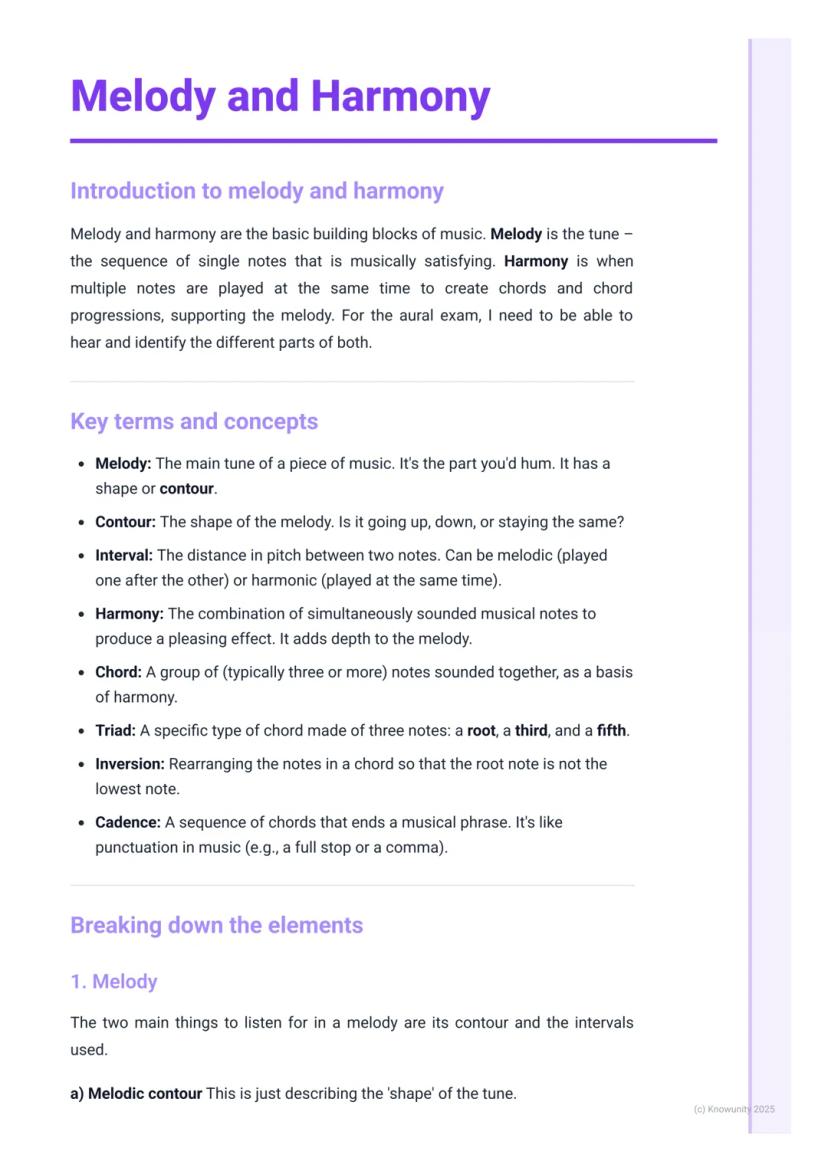
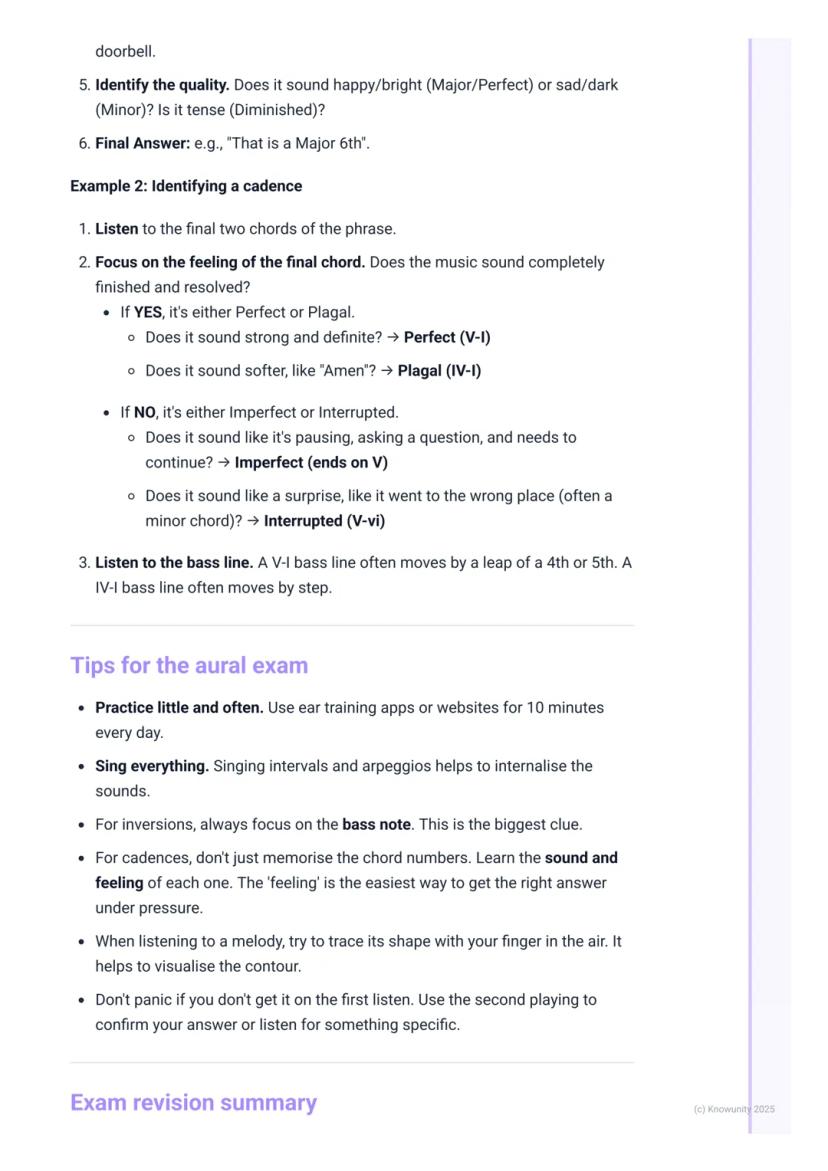
Music is basically made up of two main elements that work together. Melody is the tune you'd hum along to - that sequence of single notes that gets stuck in your head. Harmony happens when multiple notes are played simultaneously to create chords that support and enhance the melody.
Think of melody as the main character in a film, whilst harmony is the supporting cast that makes the story richer. For your aural exam, you'll need to identify different parts of both by ear.
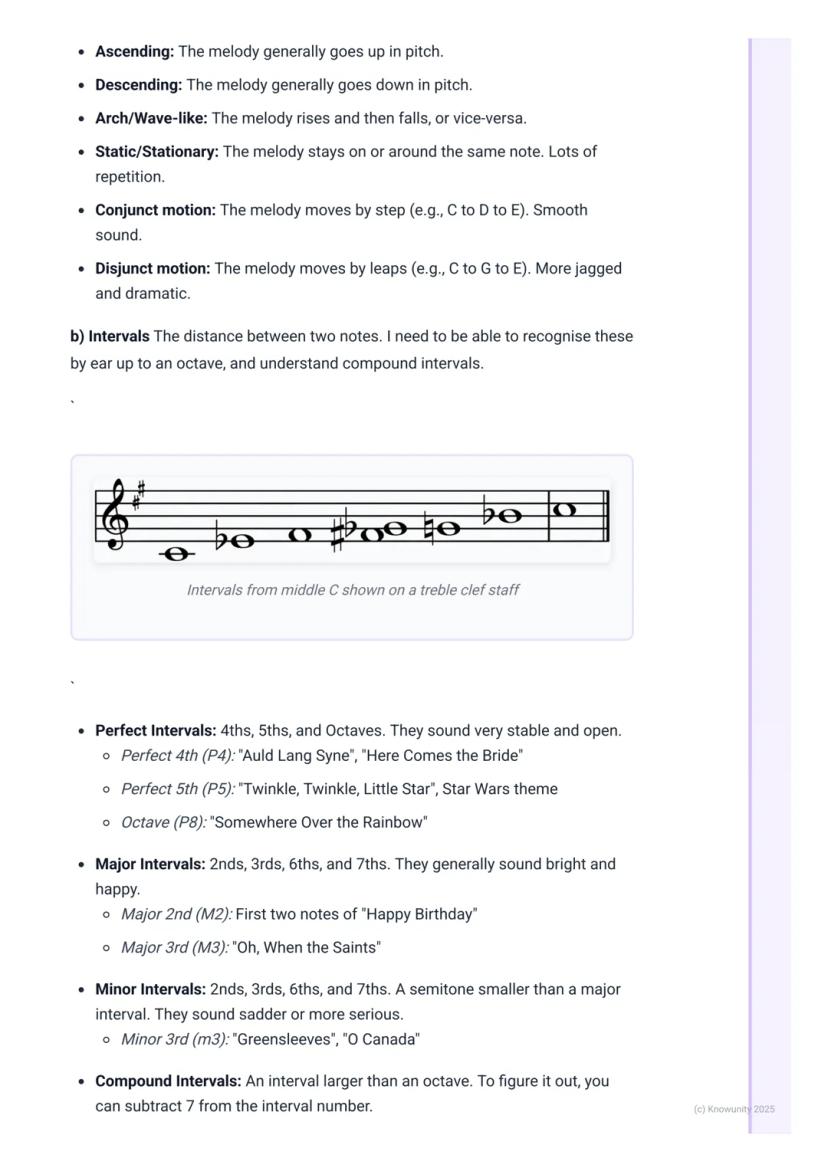
Melody has a shape called contour - it can go up, down, or stay roughly the same. The distance between any two notes is called an interval, and these can be played one after another (melodic) or at the same time (harmonic).
Exam Tip: The contour is often the easiest thing to identify first - just trace the shape with your finger in the air as you listen!
Your melody can move in several different ways, and each creates a distinct sound. Ascending melodies go up in pitch, whilst descending ones go down. Some melodies create an arch shape - rising then falling like a wave.
Conjunct motion means the melody moves by step (like C to D to E), creating a smooth, flowing sound. Disjunct motion involves leaps between notes (like C to G to E), which sounds more dramatic and jagged.
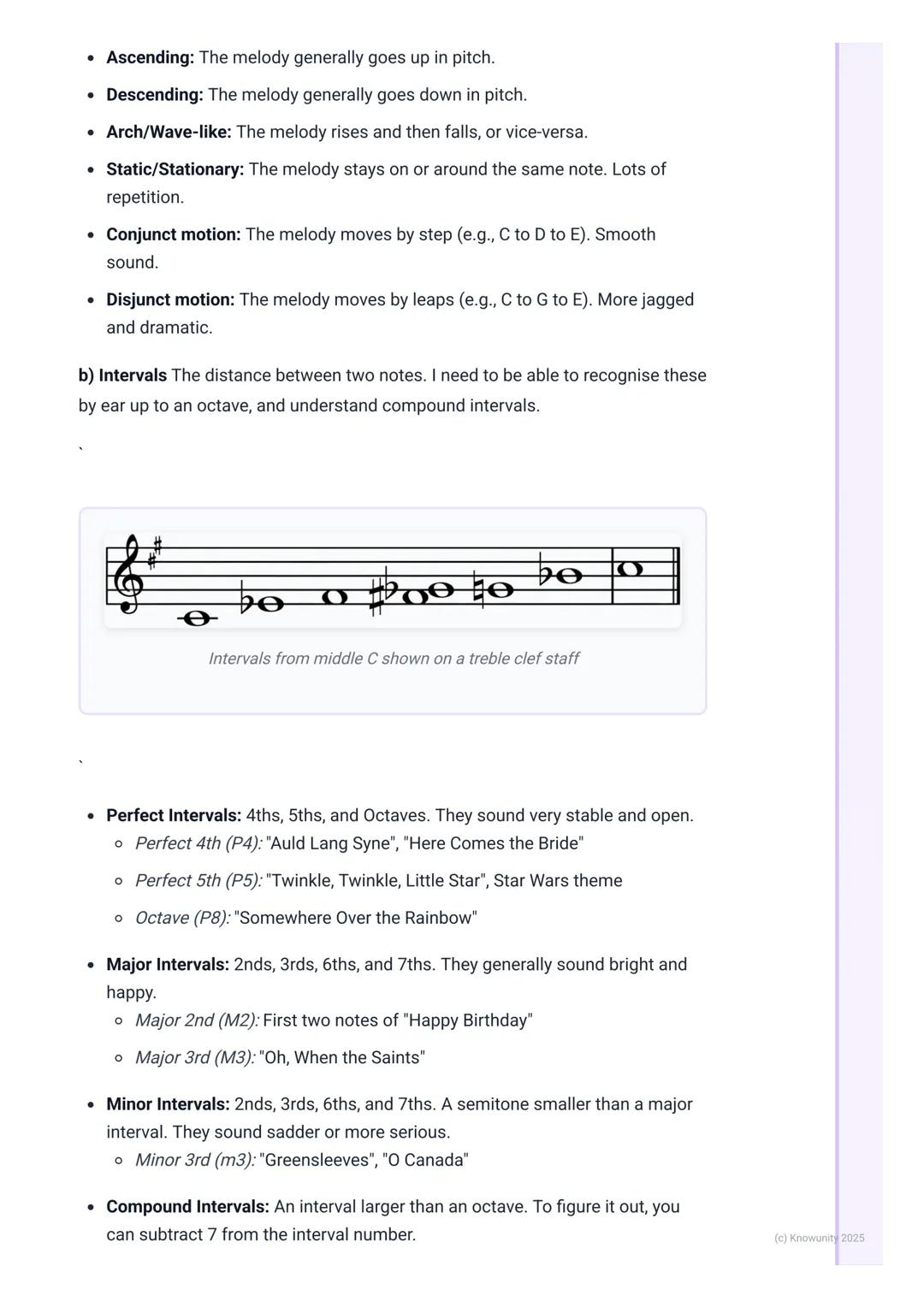
Intervals are crucial for aural recognition. Perfect intervals (4ths, 5ths, and octaves) sound very stable and open. Think "Here Comes the Bride" for a perfect 4th, or the Star Wars theme for a perfect 5th. Major intervals generally sound bright and happy, whilst minor intervals are a semitone smaller and sound sadder.
Compound intervals are simply intervals larger than an octave. To work them out, subtract 7 from the interval number - so a major 9th is really just a major 2nd played much further apart.
Memory Trick: Use familiar songs as references - "Somewhere Over the Rainbow" starts with an octave leap!
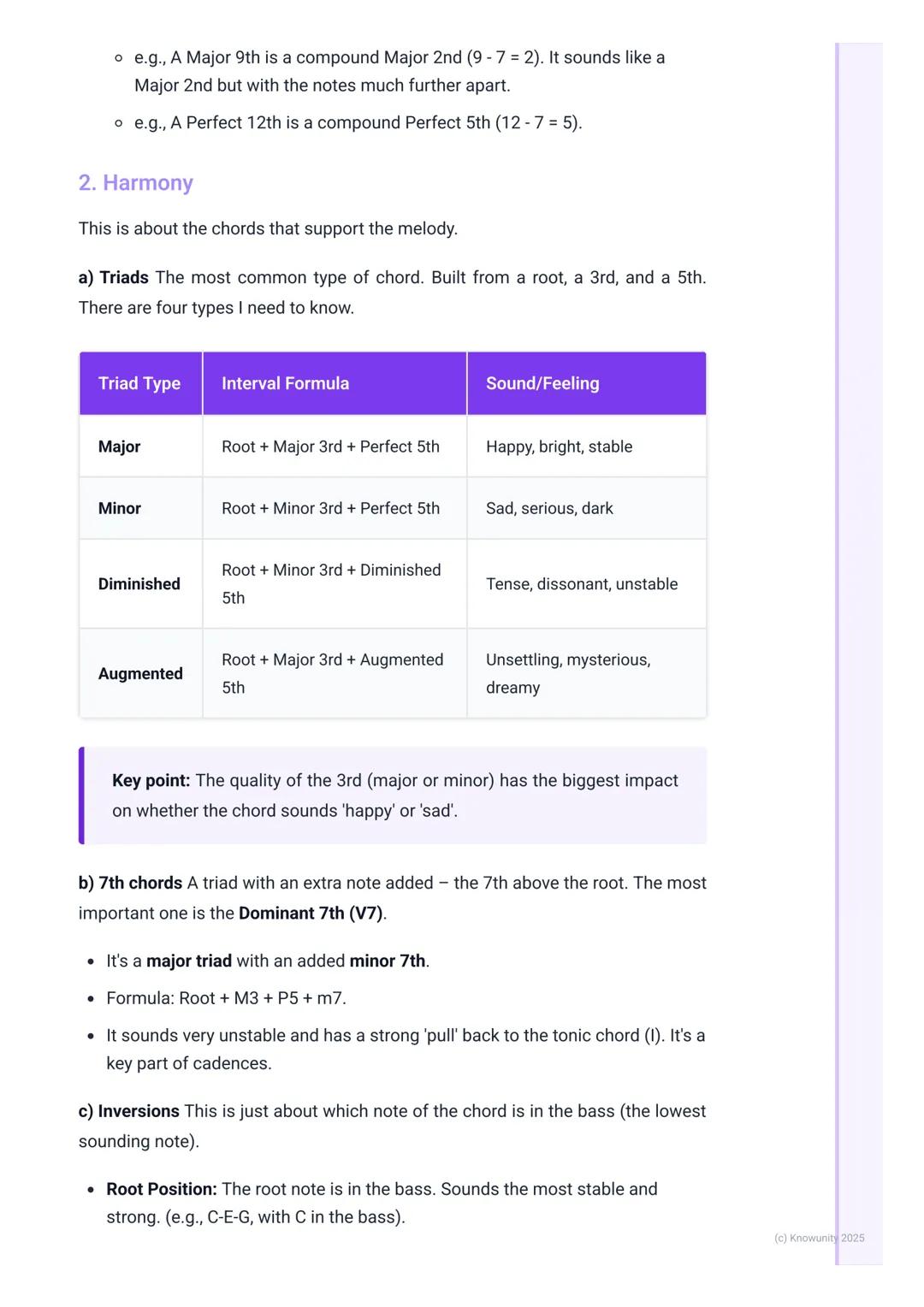
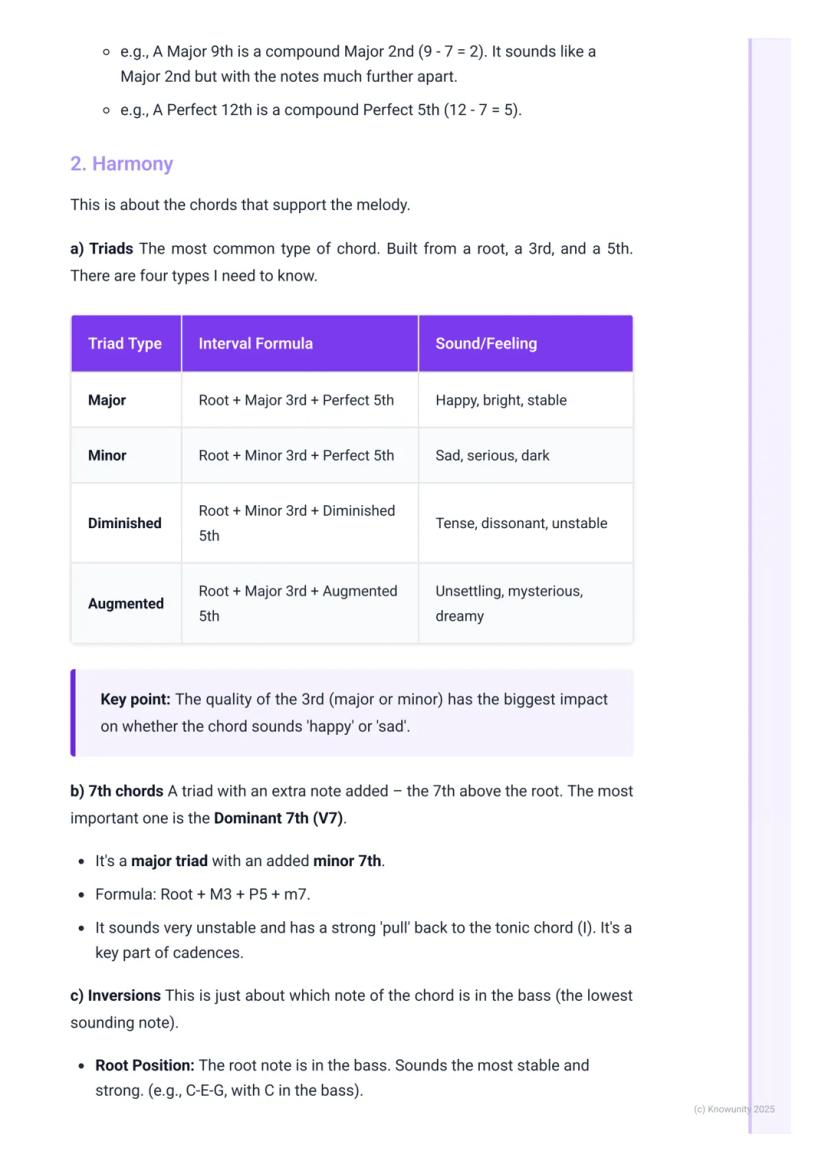
Triads are the most common chords you'll encounter, built from three notes: a root, a 3rd, and a 5th. There are four main types you need to recognise by ear.
Major triads sound happy, bright, and stable. Minor triads use a minor 3rd instead, creating that sad or serious feeling. Diminished triads sound tense and unstable, whilst augmented triads have an unsettling, mysterious quality.
The secret is that the quality of the 3rd (major or minor) has the biggest impact on whether a chord sounds happy or sad. This makes it the most important note to focus on when identifying triads.
Seventh chords add an extra layer of complexity. The most important is the dominant 7th (V7), which creates a strong pull back to the home chord. It's built from a major triad with an added minor 7th, giving it that distinctive "needs to resolve" sound.
Quick Check: If a chord sounds like it desperately wants to go somewhere else, it's probably a dominant 7th!
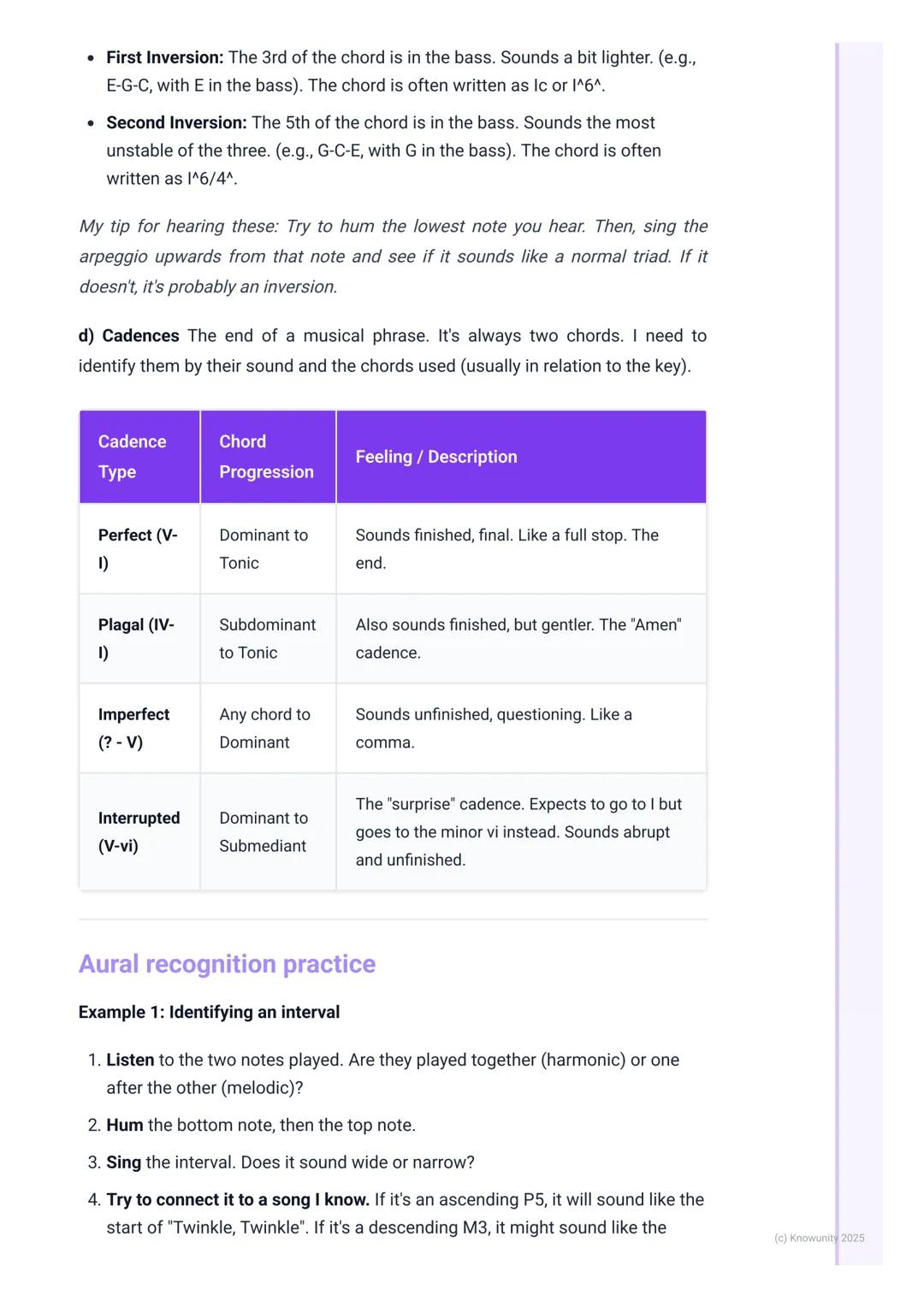
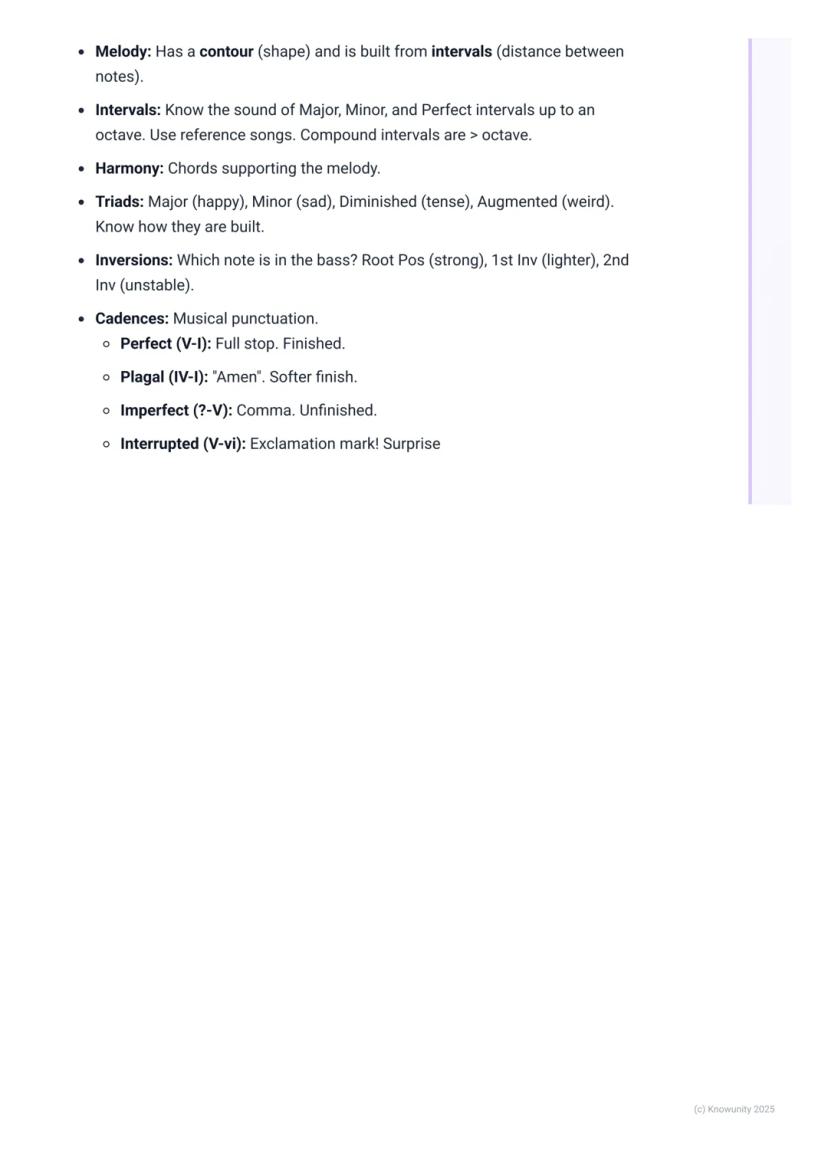
Inversions simply refer to which note of the chord is in the bass (lowest part). Root position has the root note in the bass and sounds most stable. First inversion puts the 3rd in the bass, creating a lighter feel, whilst second inversion has the 5th in the bass and sounds the most unstable.
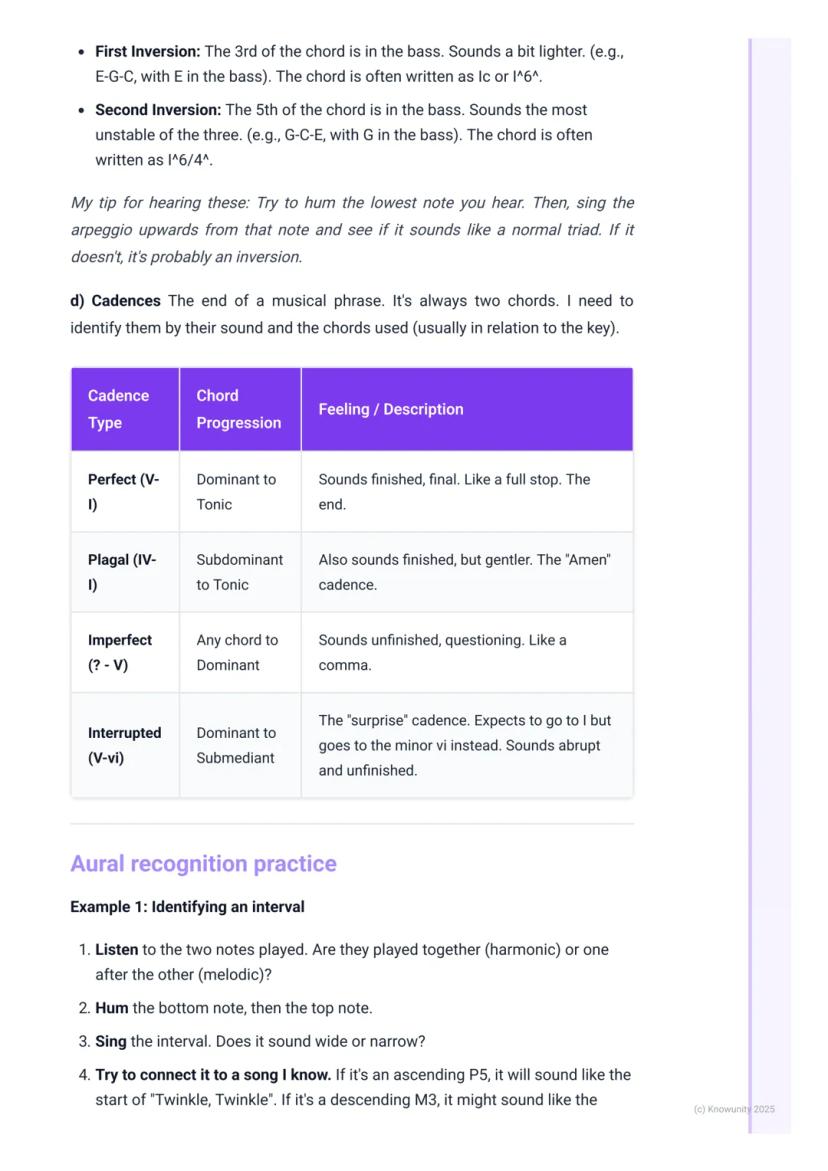
Cadences are like punctuation marks in music - they're always two chords that end a musical phrase. Perfect cadences sound completely finished, like a full stop. Plagal cadences also sound finished but gentler, often called the "Amen" cadence.
Imperfect cadences end on the dominant chord and sound unfinished, like a comma asking a question. Interrupted cadences are the surprise ending - they trick your ear by going to the minor vi chord instead of the expected I.
For your exam, don't just memorise chord numbers - learn how each cadence feels. Under pressure, recognising the emotional effect is much more reliable than trying to analyse chord progressions.
Exam Strategy: Always listen to the bass line first when identifying inversions - it's your biggest clue!
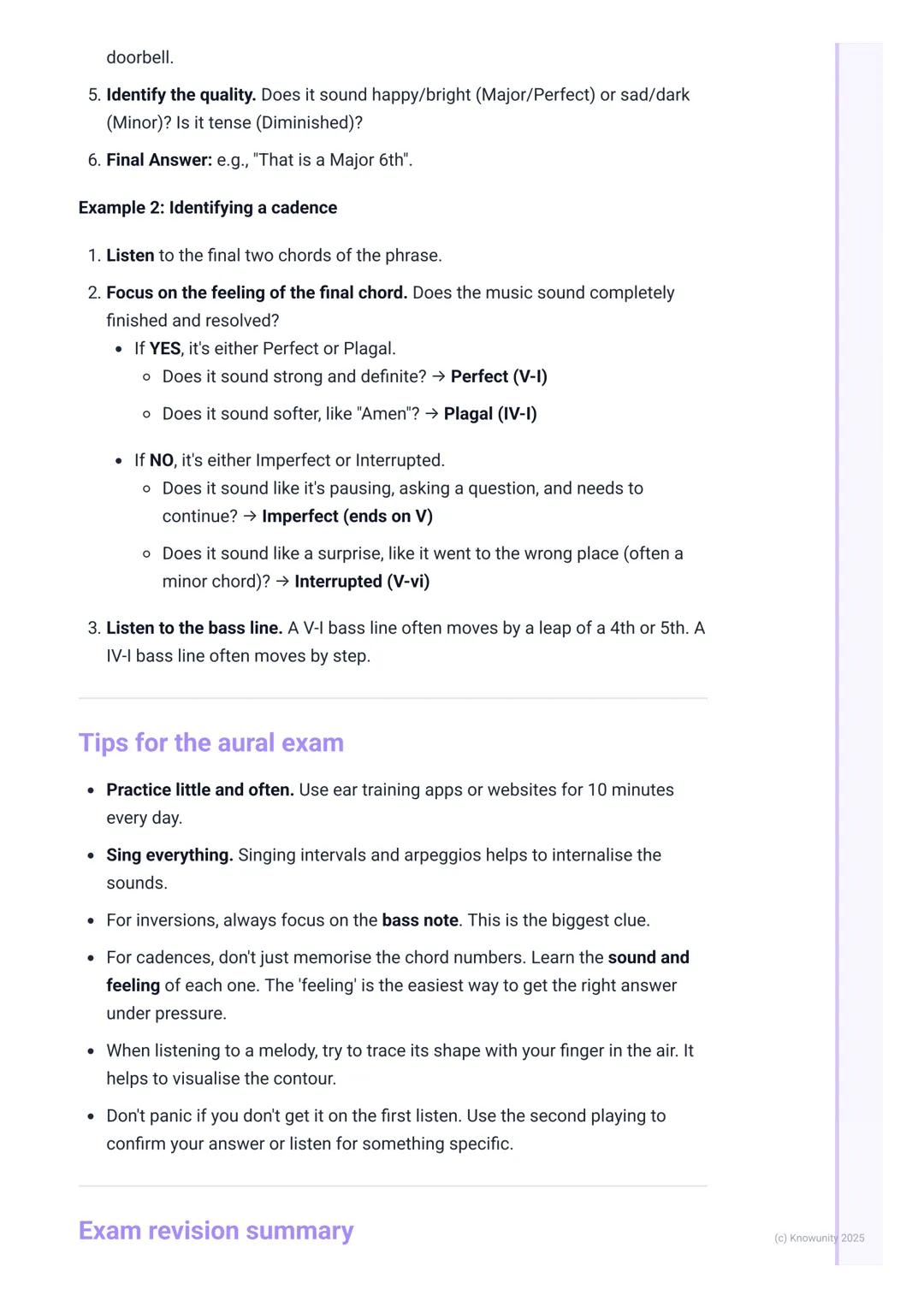
When identifying intervals in your exam, start by determining if they're played together (harmonic) or separately (melodic). Hum both notes, then connect the sound to a song you know - this reference method is incredibly reliable under exam pressure.
For cadences, focus on the feeling of the final chord first. Does the music sound completely resolved and finished? If yes, it's either perfect or plagal. If it sounds unfinished or questioning, it's either imperfect or interrupted.
The bass line movement gives you additional clues. A V-I progression often moves by a leap of a 4th or 5th, whilst a IV-I progression typically moves by step.
Singing everything helps massively with internalising these sounds. Spend just 10 minutes daily with ear training apps, and always sing intervals and arpeggios rather than just listening passively.
Golden Rule: Don't panic if you don't get it on first listen - use the second playing to confirm your answer or focus on one specific element!
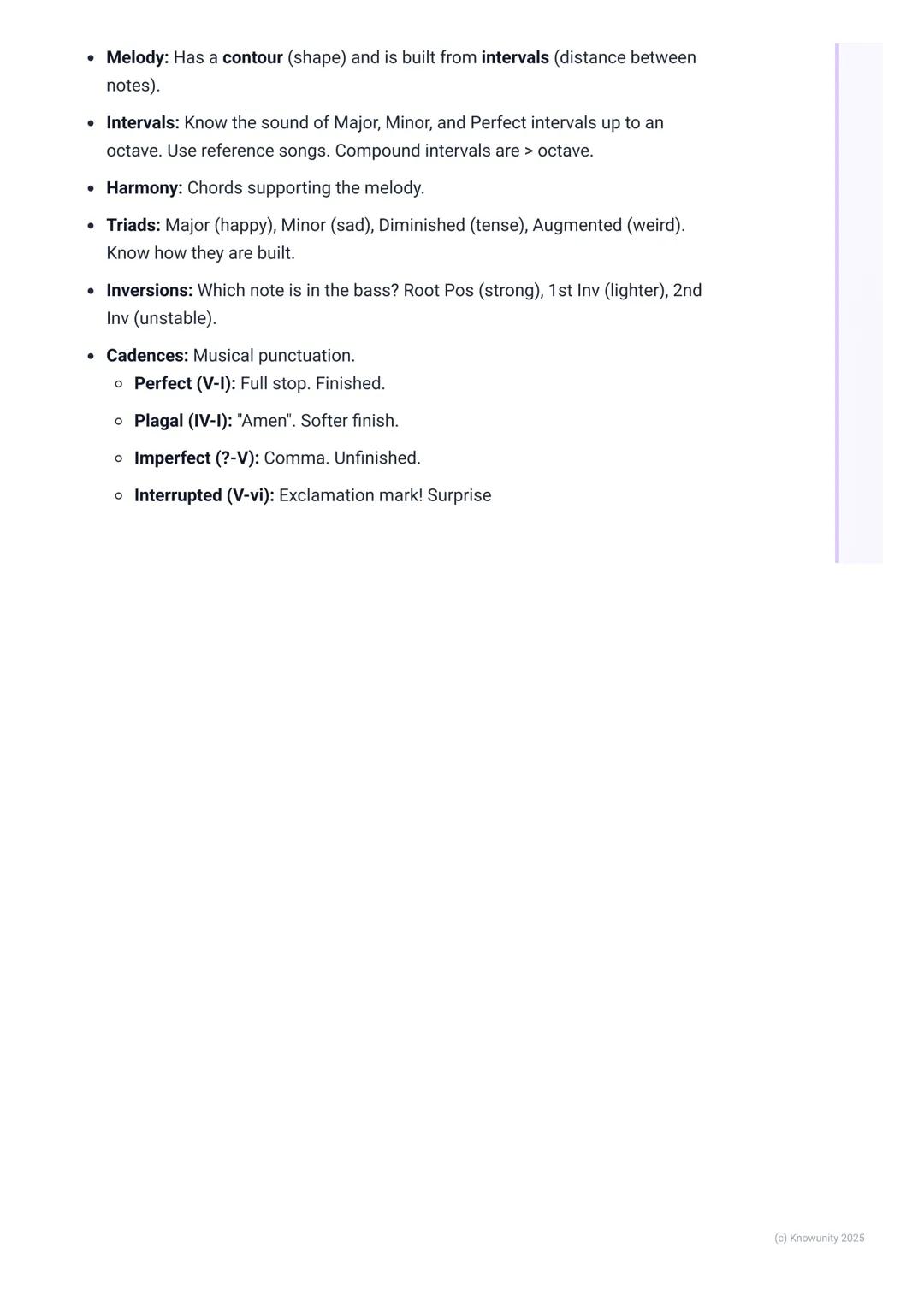
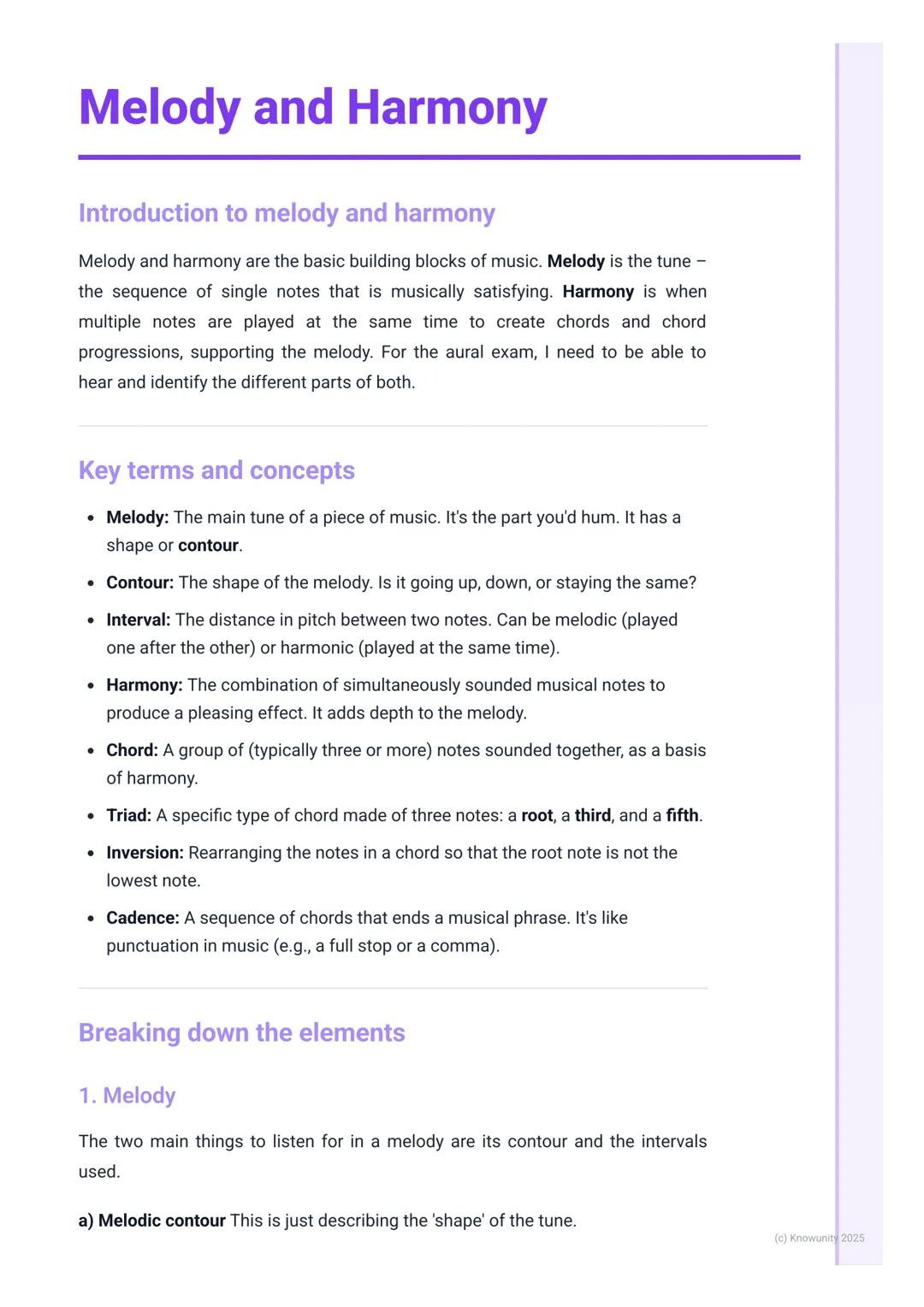
Melody is all about contour (shape) and intervals (distances between notes). Know your major, minor, and perfect intervals up to an octave, and remember that compound intervals are just regular intervals played more than an octave apart.
Harmony centres on chords supporting the melody. Master your triad recognition: major sounds happy, minor sounds sad, diminished sounds tense, and augmented sounds mysterious.
Inversions depend on which note is in the bass - root position sounds strongest, first inversion lighter, and second inversion most unstable.
Cadences are musical punctuation: perfect is a full stop, plagal is a gentle "Amen," imperfect ending on V is a questioning comma, and interrupted is a surprise exclamation mark.
Remember, the feeling of the music is often more reliable than technical analysis during exams. Trust your ears and the emotional responses these musical elements create.
Final Tip: Practice tracing melodic contours with your finger in the air - it helps visualise what you're hearing!
Nuestro compañero de IA está específicamente adaptado a las necesidades de los estudiantes. Basándonos en los millones de contenidos que tenemos en la plataforma, podemos dar a los estudiantes respuestas realmente significativas y relevantes. Pero no se trata solo de respuestas, el compañero también guía a los estudiantes a través de sus retos de aprendizaje diarios, con planes de aprendizaje personalizados, cuestionarios o contenidos en el chat y una personalización del 100% basada en las habilidades y el desarrollo de los estudiantes.
Puedes descargar la app en Google Play Store y Apple App Store.
Sí, tienes acceso gratuito a los contenidos de la aplicación y a nuestro compañero de IA. Para desbloquear determinadas funciones de la aplicación, puedes adquirir Knowunity Pro.
App Store
Google Play
La app es muy fácil de usar y está muy bien diseñada. Hasta ahora he encontrado todo lo que estaba buscando y he podido aprender mucho de las presentaciones. Definitivamente utilizaré la aplicación para un examen de clase. Y, por supuesto, también me sirve mucho de inspiración.
Pablo
usuario de iOS
Esta app es realmente genial. Hay tantos apuntes de clase y ayuda [...]. Tengo problemas con matemáticas, por ejemplo, y la aplicación tiene muchas opciones de ayuda. Gracias a Knowunity, he mejorado en mates. Se la recomiendo a todo el mundo.
Elena
usuaria de Android
Vaya, estoy realmente sorprendida. Acabo de probar la app porque la he visto anunciada muchas veces y me he quedado absolutamente alucinada. Esta app es LA AYUDA que quieres para el insti y, sobre todo, ofrece muchísimas cosas, como ejercicios y hojas informativas, que a mí personalmente me han sido MUY útiles.
Ana
usuaria de iOS
Está app es muy buena, tiene apuntes que son de mucha ayuda y su IA es fantástica, te explica a la perfección y muy fácil de entender lo que necesites, te ayuda con los deberes, te hace esquemas... en definitiva es una muy buena opción!
Sophia
usuario de Android
Me encanta!!! Me resuelve todo con detalle y me da la explicación correcta. Tiene un montón de funciones, ami me ha ido genial!! Os la recomiendo!!!
Marta
usuaria de Android
La uso casi diariamente, sirve para todas las asignaturas. Yo, por ejemplo la utilizo más en inglés porque se me da bastante mal, ¡Todas las respuestas están correctas! Consta con personas reales que suben sus apuntes y IA para que puedas hacer los deberes muchísimo más fácil, la recomiendo.
Izan
usuario de iOS
¡La app es buenísima! Sólo tengo que introducir el tema en la barra de búsqueda y recibo la respuesta muy rápido. No tengo que ver 10 vídeos de YouTube para entender algo, así que me ahorro tiempo. ¡Muy recomendable!
Sara
usuaria de Android
En el instituto era muy malo en matemáticas, pero gracias a la app, ahora saco mejores notas. Os agradezco mucho que hayáis creado la aplicación.
Roberto
usuario de Android
Esto no es como Chatgpt, es MUCHISMO MEJOR, te hace unos resúmenes espectaculares y gracias a esta app pase de sacar 5-6 a sacar 8-9.
Julyana
usuaria de Android
Es la mejor aplicación del mundo, la uso para revisar los deberes a mi hijo.
Javier
usuario de Android
LOS QUIZ Y FLASHCARDS SON SÚPER ÚTILES Y ME ENCANTA Knowunity IA. ADEMÁS ES LITERALMENTE COMO CHATGPT PERO MÁS LISTO!! ME AYUDÓ TAMBIÉN CON MIS PROBLEMAS DE MÁSCARA!! Y CON MIS ASIGNATURAS DE VERDAD! OBVIO 😍😁😲🤑💗✨🎀😮
Erick
usuario de Android
Me me encanta esta app, todo lo que tiene es de calidad ya que antes de ser publicado es revisado por un equipo de profesionales. Me ha ido genial esta aplicación ya que gracias a ella puedo estudiar mucho mejor, sin tener que agobiarme porque mi profesor no ha hecho teoría o porque no entiendo su teoría. Le doy un 10 de 10!
Mar
usuaria de iOS
La app es muy fácil de usar y está muy bien diseñada. Hasta ahora he encontrado todo lo que estaba buscando y he podido aprender mucho de las presentaciones. Definitivamente utilizaré la aplicación para un examen de clase. Y, por supuesto, también me sirve mucho de inspiración.
Pablo
usuario de iOS
Esta app es realmente genial. Hay tantos apuntes de clase y ayuda [...]. Tengo problemas con matemáticas, por ejemplo, y la aplicación tiene muchas opciones de ayuda. Gracias a Knowunity, he mejorado en mates. Se la recomiendo a todo el mundo.
Elena
usuaria de Android
Vaya, estoy realmente sorprendida. Acabo de probar la app porque la he visto anunciada muchas veces y me he quedado absolutamente alucinada. Esta app es LA AYUDA que quieres para el insti y, sobre todo, ofrece muchísimas cosas, como ejercicios y hojas informativas, que a mí personalmente me han sido MUY útiles.
Ana
usuaria de iOS
Está app es muy buena, tiene apuntes que son de mucha ayuda y su IA es fantástica, te explica a la perfección y muy fácil de entender lo que necesites, te ayuda con los deberes, te hace esquemas... en definitiva es una muy buena opción!
Sophia
usuario de Android
Me encanta!!! Me resuelve todo con detalle y me da la explicación correcta. Tiene un montón de funciones, ami me ha ido genial!! Os la recomiendo!!!
Marta
usuaria de Android
La uso casi diariamente, sirve para todas las asignaturas. Yo, por ejemplo la utilizo más en inglés porque se me da bastante mal, ¡Todas las respuestas están correctas! Consta con personas reales que suben sus apuntes y IA para que puedas hacer los deberes muchísimo más fácil, la recomiendo.
Izan
usuario de iOS
¡La app es buenísima! Sólo tengo que introducir el tema en la barra de búsqueda y recibo la respuesta muy rápido. No tengo que ver 10 vídeos de YouTube para entender algo, así que me ahorro tiempo. ¡Muy recomendable!
Sara
usuaria de Android
En el instituto era muy malo en matemáticas, pero gracias a la app, ahora saco mejores notas. Os agradezco mucho que hayáis creado la aplicación.
Roberto
usuario de Android
Esto no es como Chatgpt, es MUCHISMO MEJOR, te hace unos resúmenes espectaculares y gracias a esta app pase de sacar 5-6 a sacar 8-9.
Julyana
usuaria de Android
Es la mejor aplicación del mundo, la uso para revisar los deberes a mi hijo.
Javier
usuario de Android
LOS QUIZ Y FLASHCARDS SON SÚPER ÚTILES Y ME ENCANTA Knowunity IA. ADEMÁS ES LITERALMENTE COMO CHATGPT PERO MÁS LISTO!! ME AYUDÓ TAMBIÉN CON MIS PROBLEMAS DE MÁSCARA!! Y CON MIS ASIGNATURAS DE VERDAD! OBVIO 😍😁😲🤑💗✨🎀😮
Erick
usuario de Android
Me me encanta esta app, todo lo que tiene es de calidad ya que antes de ser publicado es revisado por un equipo de profesionales. Me ha ido genial esta aplicación ya que gracias a ella puedo estudiar mucho mejor, sin tener que agobiarme porque mi profesor no ha hecho teoría o porque no entiendo su teoría. Le doy un 10 de 10!
Mar
usuaria de iOS
Ever wonder why some songs make you feel happy whilst others sound sad, or how musicians know when a song is "finished"? It all comes down to melody and harmony- the fundamental building blocks that create every piece of... Mostrar más
Acceso a todos los documentos
Mejora tus notas
Únete a millones de estudiantes
Music is basically made up of two main elements that work together. Melody is the tune you'd hum along to - that sequence of single notes that gets stuck in your head. Harmony happens when multiple notes are played simultaneously to create chords that support and enhance the melody.
Think of melody as the main character in a film, whilst harmony is the supporting cast that makes the story richer. For your aural exam, you'll need to identify different parts of both by ear.
Melody has a shape called contour - it can go up, down, or stay roughly the same. The distance between any two notes is called an interval, and these can be played one after another (melodic) or at the same time (harmonic).
Exam Tip: The contour is often the easiest thing to identify first - just trace the shape with your finger in the air as you listen!
Acceso a todos los documentos
Mejora tus notas
Únete a millones de estudiantes
Your melody can move in several different ways, and each creates a distinct sound. Ascending melodies go up in pitch, whilst descending ones go down. Some melodies create an arch shape - rising then falling like a wave.
Conjunct motion means the melody moves by step (like C to D to E), creating a smooth, flowing sound. Disjunct motion involves leaps between notes (like C to G to E), which sounds more dramatic and jagged.
Intervals are crucial for aural recognition. Perfect intervals (4ths, 5ths, and octaves) sound very stable and open. Think "Here Comes the Bride" for a perfect 4th, or the Star Wars theme for a perfect 5th. Major intervals generally sound bright and happy, whilst minor intervals are a semitone smaller and sound sadder.
Compound intervals are simply intervals larger than an octave. To work them out, subtract 7 from the interval number - so a major 9th is really just a major 2nd played much further apart.
Memory Trick: Use familiar songs as references - "Somewhere Over the Rainbow" starts with an octave leap!
Acceso a todos los documentos
Mejora tus notas
Únete a millones de estudiantes
Triads are the most common chords you'll encounter, built from three notes: a root, a 3rd, and a 5th. There are four main types you need to recognise by ear.
Major triads sound happy, bright, and stable. Minor triads use a minor 3rd instead, creating that sad or serious feeling. Diminished triads sound tense and unstable, whilst augmented triads have an unsettling, mysterious quality.
The secret is that the quality of the 3rd (major or minor) has the biggest impact on whether a chord sounds happy or sad. This makes it the most important note to focus on when identifying triads.
Seventh chords add an extra layer of complexity. The most important is the dominant 7th (V7), which creates a strong pull back to the home chord. It's built from a major triad with an added minor 7th, giving it that distinctive "needs to resolve" sound.
Quick Check: If a chord sounds like it desperately wants to go somewhere else, it's probably a dominant 7th!
Acceso a todos los documentos
Mejora tus notas
Únete a millones de estudiantes
Inversions simply refer to which note of the chord is in the bass (lowest part). Root position has the root note in the bass and sounds most stable. First inversion puts the 3rd in the bass, creating a lighter feel, whilst second inversion has the 5th in the bass and sounds the most unstable.
Cadences are like punctuation marks in music - they're always two chords that end a musical phrase. Perfect cadences sound completely finished, like a full stop. Plagal cadences also sound finished but gentler, often called the "Amen" cadence.
Imperfect cadences end on the dominant chord and sound unfinished, like a comma asking a question. Interrupted cadences are the surprise ending - they trick your ear by going to the minor vi chord instead of the expected I.
For your exam, don't just memorise chord numbers - learn how each cadence feels. Under pressure, recognising the emotional effect is much more reliable than trying to analyse chord progressions.
Exam Strategy: Always listen to the bass line first when identifying inversions - it's your biggest clue!
Acceso a todos los documentos
Mejora tus notas
Únete a millones de estudiantes
When identifying intervals in your exam, start by determining if they're played together (harmonic) or separately (melodic). Hum both notes, then connect the sound to a song you know - this reference method is incredibly reliable under exam pressure.
For cadences, focus on the feeling of the final chord first. Does the music sound completely resolved and finished? If yes, it's either perfect or plagal. If it sounds unfinished or questioning, it's either imperfect or interrupted.
The bass line movement gives you additional clues. A V-I progression often moves by a leap of a 4th or 5th, whilst a IV-I progression typically moves by step.
Singing everything helps massively with internalising these sounds. Spend just 10 minutes daily with ear training apps, and always sing intervals and arpeggios rather than just listening passively.
Golden Rule: Don't panic if you don't get it on first listen - use the second playing to confirm your answer or focus on one specific element!
Acceso a todos los documentos
Mejora tus notas
Únete a millones de estudiantes
Melody is all about contour (shape) and intervals (distances between notes). Know your major, minor, and perfect intervals up to an octave, and remember that compound intervals are just regular intervals played more than an octave apart.
Harmony centres on chords supporting the melody. Master your triad recognition: major sounds happy, minor sounds sad, diminished sounds tense, and augmented sounds mysterious.
Inversions depend on which note is in the bass - root position sounds strongest, first inversion lighter, and second inversion most unstable.
Cadences are musical punctuation: perfect is a full stop, plagal is a gentle "Amen," imperfect ending on V is a questioning comma, and interrupted is a surprise exclamation mark.
Remember, the feeling of the music is often more reliable than technical analysis during exams. Trust your ears and the emotional responses these musical elements create.
Final Tip: Practice tracing melodic contours with your finger in the air - it helps visualise what you're hearing!
Nuestro compañero de IA está específicamente adaptado a las necesidades de los estudiantes. Basándonos en los millones de contenidos que tenemos en la plataforma, podemos dar a los estudiantes respuestas realmente significativas y relevantes. Pero no se trata solo de respuestas, el compañero también guía a los estudiantes a través de sus retos de aprendizaje diarios, con planes de aprendizaje personalizados, cuestionarios o contenidos en el chat y una personalización del 100% basada en las habilidades y el desarrollo de los estudiantes.
Puedes descargar la app en Google Play Store y Apple App Store.
Sí, tienes acceso gratuito a los contenidos de la aplicación y a nuestro compañero de IA. Para desbloquear determinadas funciones de la aplicación, puedes adquirir Knowunity Pro.
0
Herramientas Inteligentes NUEVO
Transforma estos apuntes en: ✓ 50+ Preguntas de Práctica ✓ Flashcards Interactivas ✓ Examen Completo de Práctica ✓ Esquemas de Ensayo
App Store
Google Play
La app es muy fácil de usar y está muy bien diseñada. Hasta ahora he encontrado todo lo que estaba buscando y he podido aprender mucho de las presentaciones. Definitivamente utilizaré la aplicación para un examen de clase. Y, por supuesto, también me sirve mucho de inspiración.
Pablo
usuario de iOS
Esta app es realmente genial. Hay tantos apuntes de clase y ayuda [...]. Tengo problemas con matemáticas, por ejemplo, y la aplicación tiene muchas opciones de ayuda. Gracias a Knowunity, he mejorado en mates. Se la recomiendo a todo el mundo.
Elena
usuaria de Android
Vaya, estoy realmente sorprendida. Acabo de probar la app porque la he visto anunciada muchas veces y me he quedado absolutamente alucinada. Esta app es LA AYUDA que quieres para el insti y, sobre todo, ofrece muchísimas cosas, como ejercicios y hojas informativas, que a mí personalmente me han sido MUY útiles.
Ana
usuaria de iOS
Está app es muy buena, tiene apuntes que son de mucha ayuda y su IA es fantástica, te explica a la perfección y muy fácil de entender lo que necesites, te ayuda con los deberes, te hace esquemas... en definitiva es una muy buena opción!
Sophia
usuario de Android
Me encanta!!! Me resuelve todo con detalle y me da la explicación correcta. Tiene un montón de funciones, ami me ha ido genial!! Os la recomiendo!!!
Marta
usuaria de Android
La uso casi diariamente, sirve para todas las asignaturas. Yo, por ejemplo la utilizo más en inglés porque se me da bastante mal, ¡Todas las respuestas están correctas! Consta con personas reales que suben sus apuntes y IA para que puedas hacer los deberes muchísimo más fácil, la recomiendo.
Izan
usuario de iOS
¡La app es buenísima! Sólo tengo que introducir el tema en la barra de búsqueda y recibo la respuesta muy rápido. No tengo que ver 10 vídeos de YouTube para entender algo, así que me ahorro tiempo. ¡Muy recomendable!
Sara
usuaria de Android
En el instituto era muy malo en matemáticas, pero gracias a la app, ahora saco mejores notas. Os agradezco mucho que hayáis creado la aplicación.
Roberto
usuario de Android
Esto no es como Chatgpt, es MUCHISMO MEJOR, te hace unos resúmenes espectaculares y gracias a esta app pase de sacar 5-6 a sacar 8-9.
Julyana
usuaria de Android
Es la mejor aplicación del mundo, la uso para revisar los deberes a mi hijo.
Javier
usuario de Android
LOS QUIZ Y FLASHCARDS SON SÚPER ÚTILES Y ME ENCANTA Knowunity IA. ADEMÁS ES LITERALMENTE COMO CHATGPT PERO MÁS LISTO!! ME AYUDÓ TAMBIÉN CON MIS PROBLEMAS DE MÁSCARA!! Y CON MIS ASIGNATURAS DE VERDAD! OBVIO 😍😁😲🤑💗✨🎀😮
Erick
usuario de Android
Me me encanta esta app, todo lo que tiene es de calidad ya que antes de ser publicado es revisado por un equipo de profesionales. Me ha ido genial esta aplicación ya que gracias a ella puedo estudiar mucho mejor, sin tener que agobiarme porque mi profesor no ha hecho teoría o porque no entiendo su teoría. Le doy un 10 de 10!
Mar
usuaria de iOS
La app es muy fácil de usar y está muy bien diseñada. Hasta ahora he encontrado todo lo que estaba buscando y he podido aprender mucho de las presentaciones. Definitivamente utilizaré la aplicación para un examen de clase. Y, por supuesto, también me sirve mucho de inspiración.
Pablo
usuario de iOS
Esta app es realmente genial. Hay tantos apuntes de clase y ayuda [...]. Tengo problemas con matemáticas, por ejemplo, y la aplicación tiene muchas opciones de ayuda. Gracias a Knowunity, he mejorado en mates. Se la recomiendo a todo el mundo.
Elena
usuaria de Android
Vaya, estoy realmente sorprendida. Acabo de probar la app porque la he visto anunciada muchas veces y me he quedado absolutamente alucinada. Esta app es LA AYUDA que quieres para el insti y, sobre todo, ofrece muchísimas cosas, como ejercicios y hojas informativas, que a mí personalmente me han sido MUY útiles.
Ana
usuaria de iOS
Está app es muy buena, tiene apuntes que son de mucha ayuda y su IA es fantástica, te explica a la perfección y muy fácil de entender lo que necesites, te ayuda con los deberes, te hace esquemas... en definitiva es una muy buena opción!
Sophia
usuario de Android
Me encanta!!! Me resuelve todo con detalle y me da la explicación correcta. Tiene un montón de funciones, ami me ha ido genial!! Os la recomiendo!!!
Marta
usuaria de Android
La uso casi diariamente, sirve para todas las asignaturas. Yo, por ejemplo la utilizo más en inglés porque se me da bastante mal, ¡Todas las respuestas están correctas! Consta con personas reales que suben sus apuntes y IA para que puedas hacer los deberes muchísimo más fácil, la recomiendo.
Izan
usuario de iOS
¡La app es buenísima! Sólo tengo que introducir el tema en la barra de búsqueda y recibo la respuesta muy rápido. No tengo que ver 10 vídeos de YouTube para entender algo, así que me ahorro tiempo. ¡Muy recomendable!
Sara
usuaria de Android
En el instituto era muy malo en matemáticas, pero gracias a la app, ahora saco mejores notas. Os agradezco mucho que hayáis creado la aplicación.
Roberto
usuario de Android
Esto no es como Chatgpt, es MUCHISMO MEJOR, te hace unos resúmenes espectaculares y gracias a esta app pase de sacar 5-6 a sacar 8-9.
Julyana
usuaria de Android
Es la mejor aplicación del mundo, la uso para revisar los deberes a mi hijo.
Javier
usuario de Android
LOS QUIZ Y FLASHCARDS SON SÚPER ÚTILES Y ME ENCANTA Knowunity IA. ADEMÁS ES LITERALMENTE COMO CHATGPT PERO MÁS LISTO!! ME AYUDÓ TAMBIÉN CON MIS PROBLEMAS DE MÁSCARA!! Y CON MIS ASIGNATURAS DE VERDAD! OBVIO 😍😁😲🤑💗✨🎀😮
Erick
usuario de Android
Me me encanta esta app, todo lo que tiene es de calidad ya que antes de ser publicado es revisado por un equipo de profesionales. Me ha ido genial esta aplicación ya que gracias a ella puedo estudiar mucho mejor, sin tener que agobiarme porque mi profesor no ha hecho teoría o porque no entiendo su teoría. Le doy un 10 de 10!
Mar
usuaria de iOS