
Solving equations is like being a detective - you're hunting... Mostrar más
 Mathematics13 visualizaciones·Actualizado May 27, 2026·5 páginas
Mastering Linear Equations: Solve Like a Pro
1 / 5
1
of 5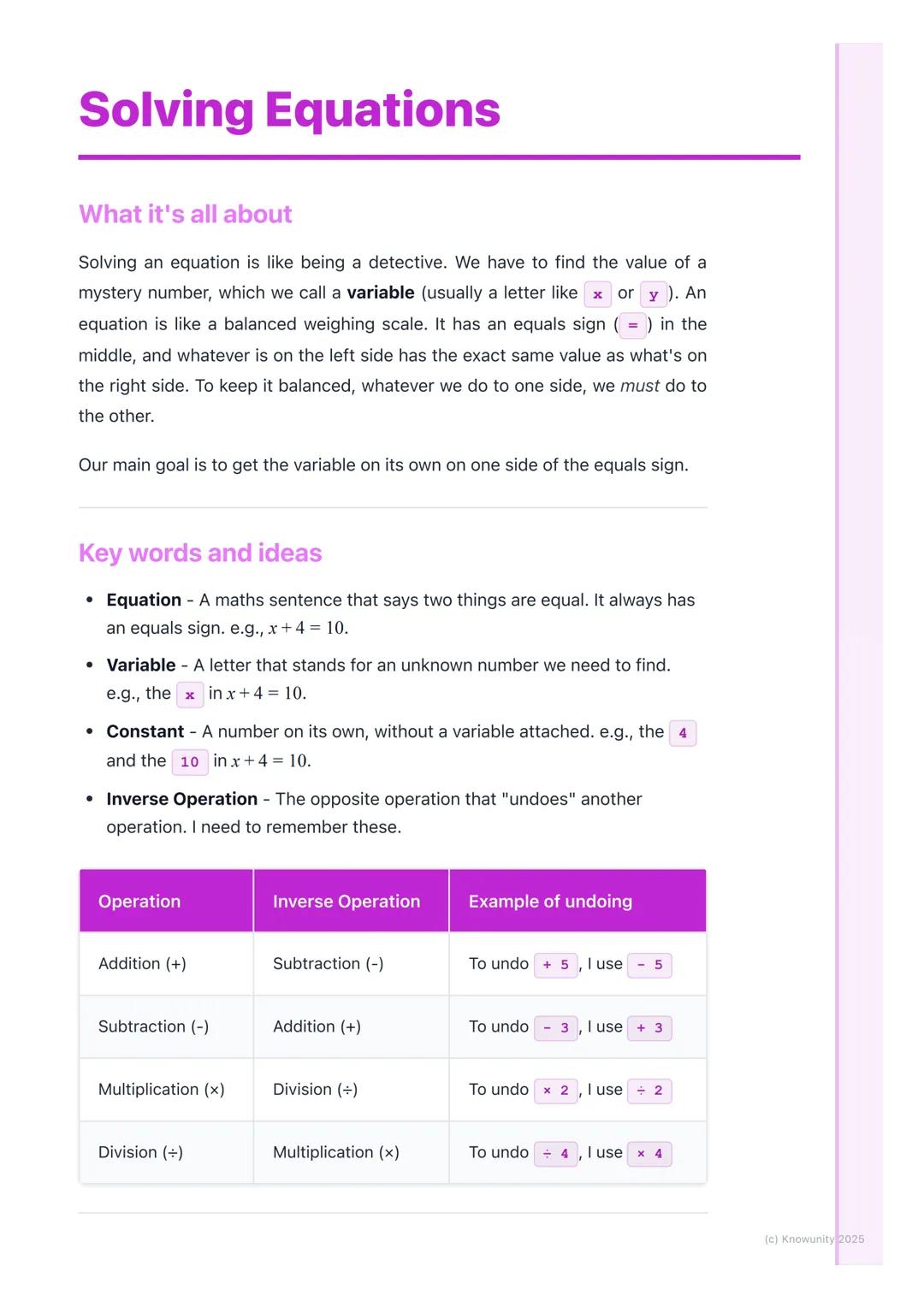
What's All This About?
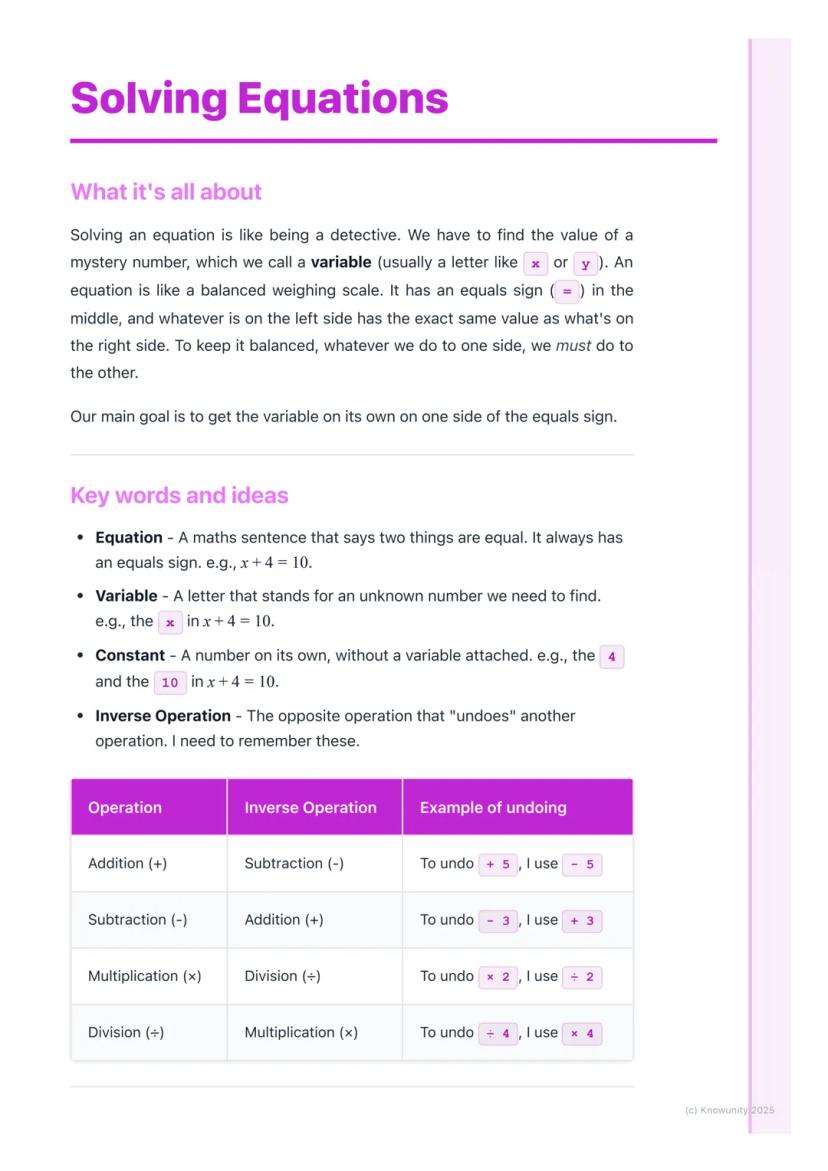
Solving equations means finding the value of an unknown number, called a variable. Your main mission is simple: get that variable all by itself on one side of the equals sign.
An equation is just a maths sentence saying two things are equal - it always has that equals sign in the middle. The variable is the mystery letter (like x or y) you need to find, while constants are just regular numbers hanging about.
Here's your secret weapon: inverse operations. These are opposite operations that undo each other - addition undoes subtraction, multiplication undoes division, and so on.
Remember: Addition ↔ Subtraction and Multiplication ↔ Division are perfect pairs!
2
of 5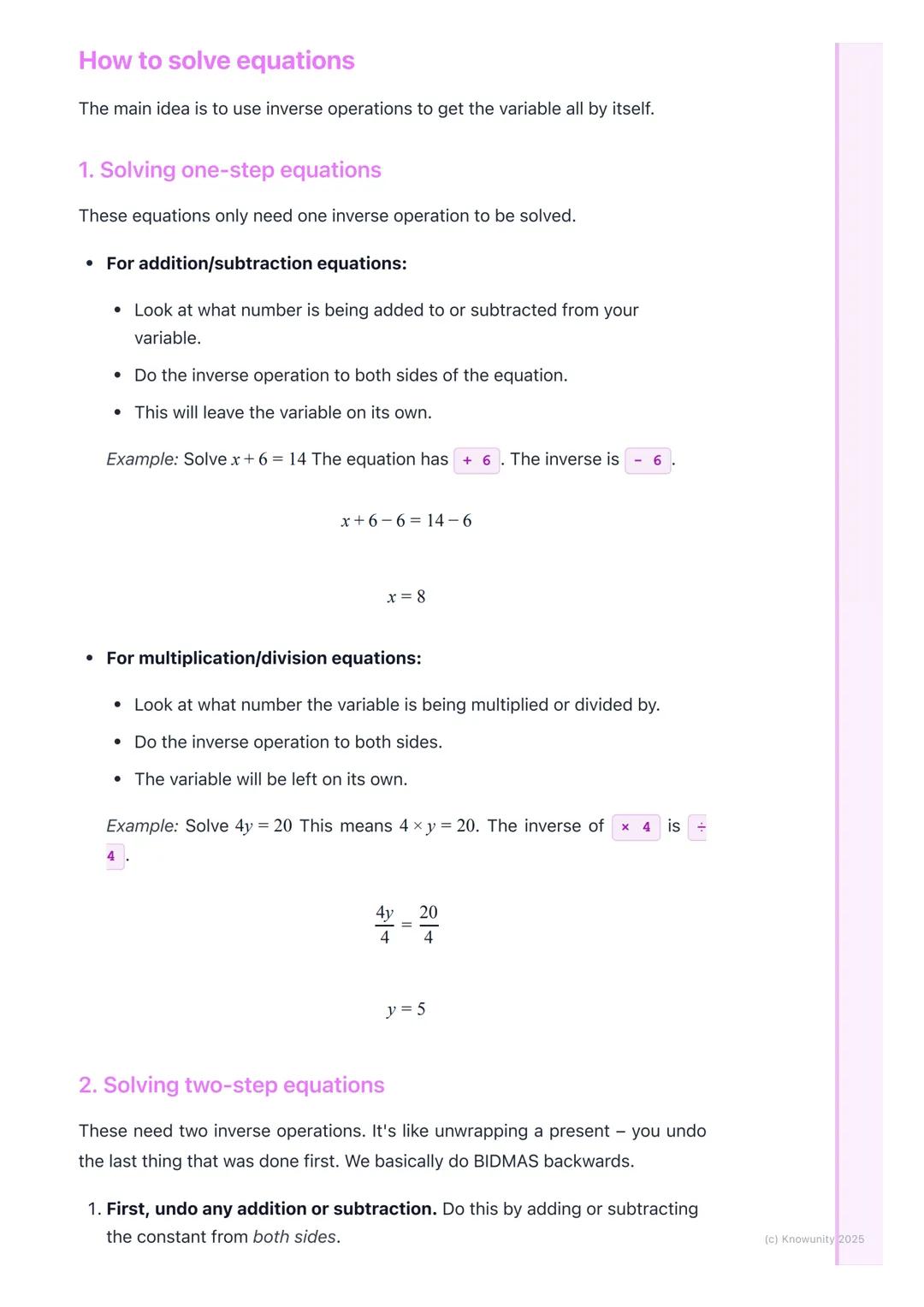
Cracking One-Step Equations
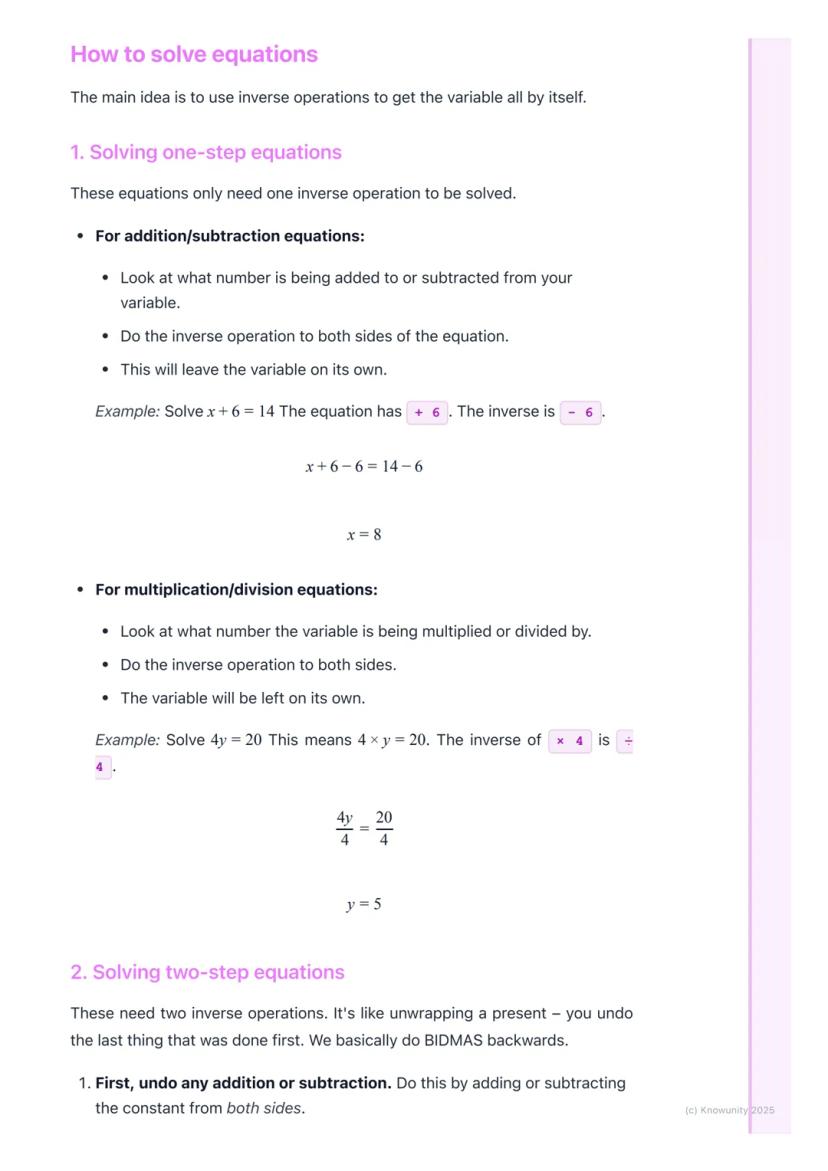
These are the easiest equations because they only need one inverse operation to solve. You've basically got two types to deal with.
For addition and subtraction equations, spot what number is being added or subtracted from your variable. Then do the opposite to both sides. If you see x + 6 = 14, subtract 6 from both sides to get x = 8.
For multiplication and division equations, look at what number your variable is being multiplied or divided by. Then do the reverse to both sides. If you have 4y = 20, divide both sides by 4 to get y = 5.
Top Tip: Always do the same operation to both sides - this keeps your equation balanced like a perfect seesaw!
3
of 5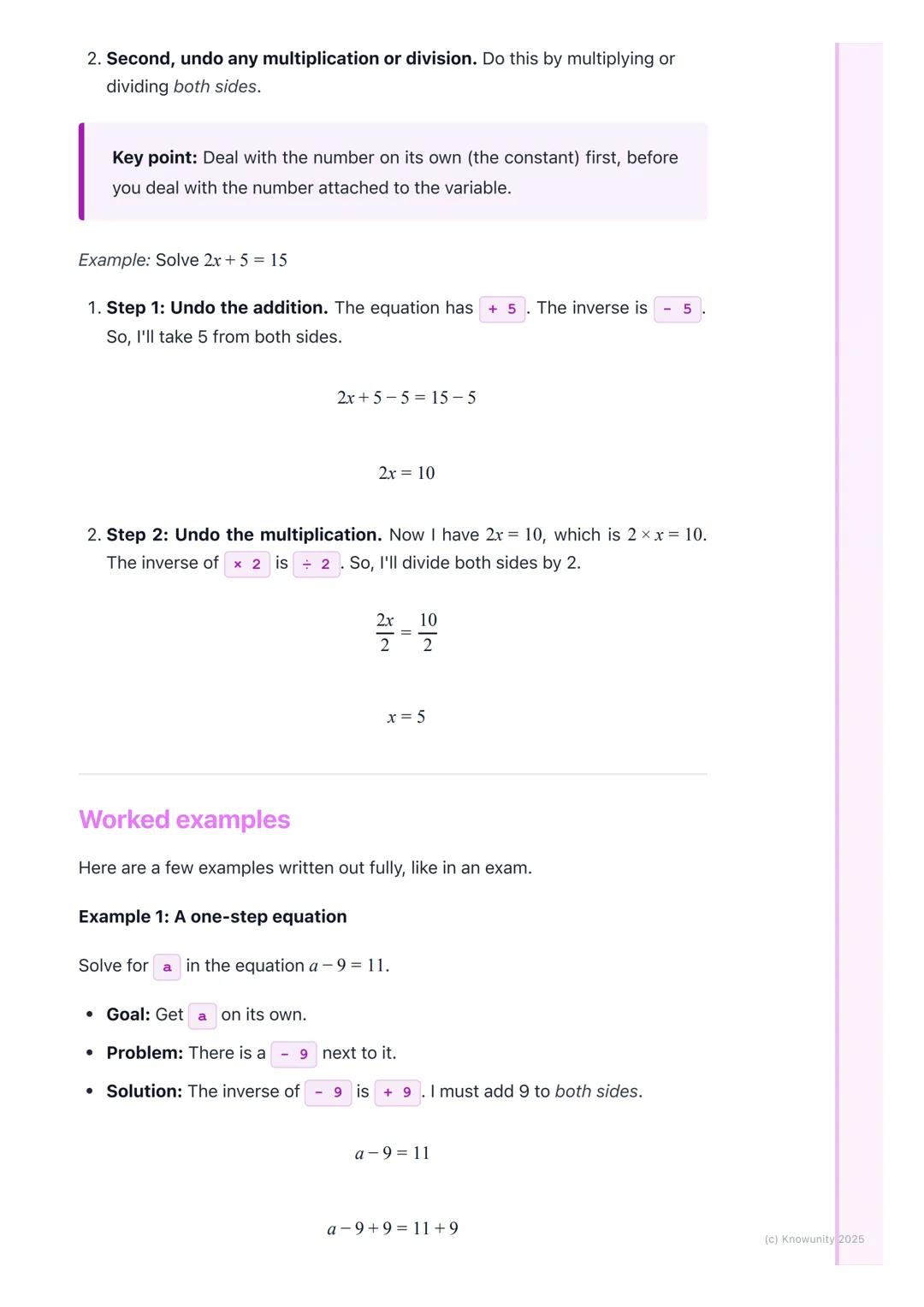
Tackling Two-Step Equations
Two-step equations need two moves to solve, and here's the clever bit - you work backwards through BIDMAS. Think of it like unwrapping a present where you undo the last thing that was done first.
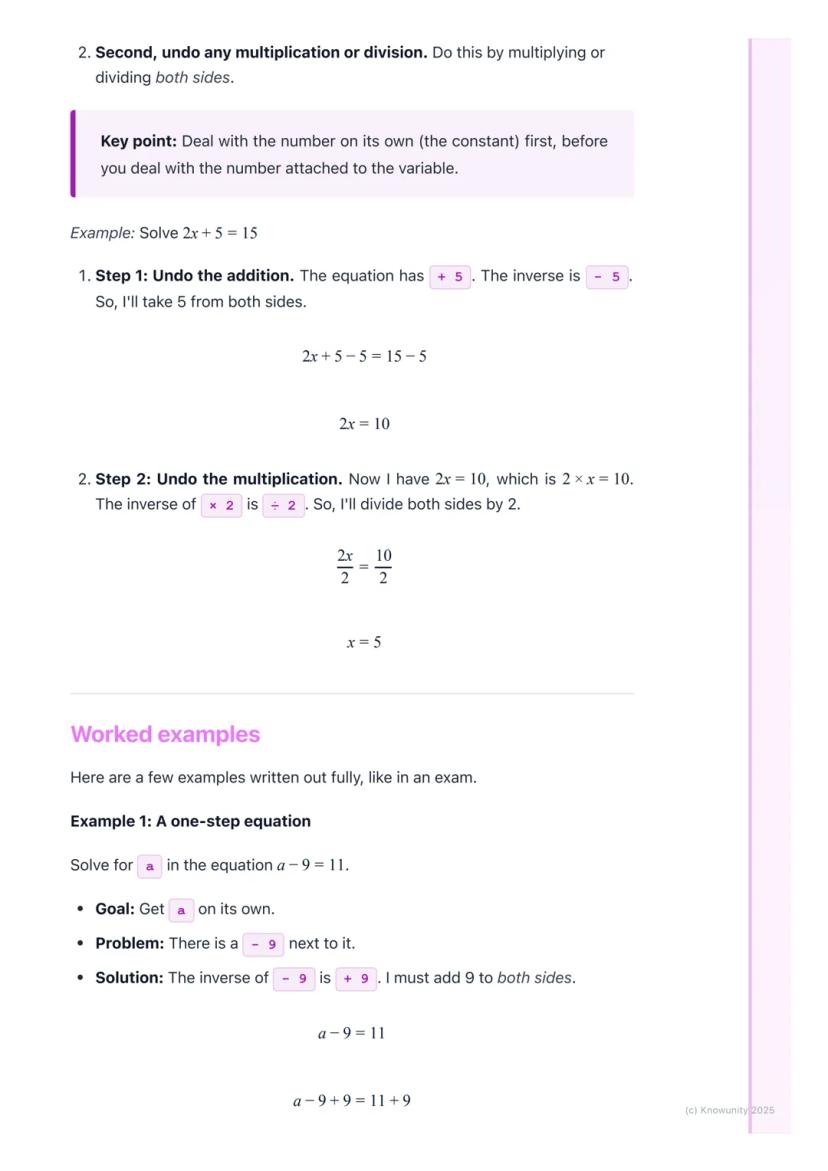
Step 1: Deal with any addition or subtraction first. Get rid of the constant (the number on its own) by doing the opposite operation to both sides.
Step 2: Then handle any multiplication or division. Work on the number attached to your variable by using its inverse operation.
For example, with 2x + 5 = 15, first subtract 5 from both sides , then divide both sides by 2 .
Golden Rule: Always tackle the lone number first, then deal with whatever's attached to your variable!
4
of 5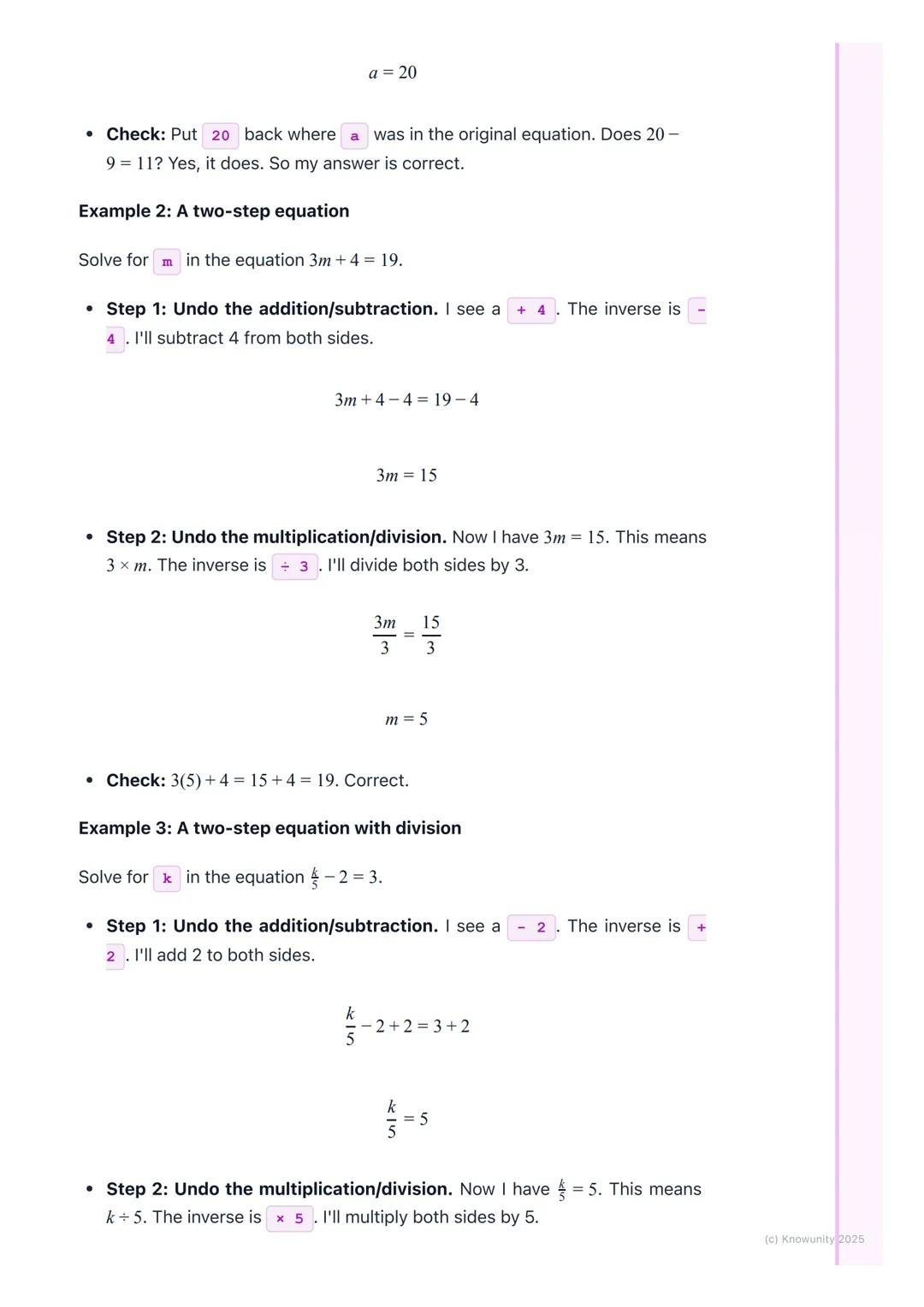
Working Through Real Examples
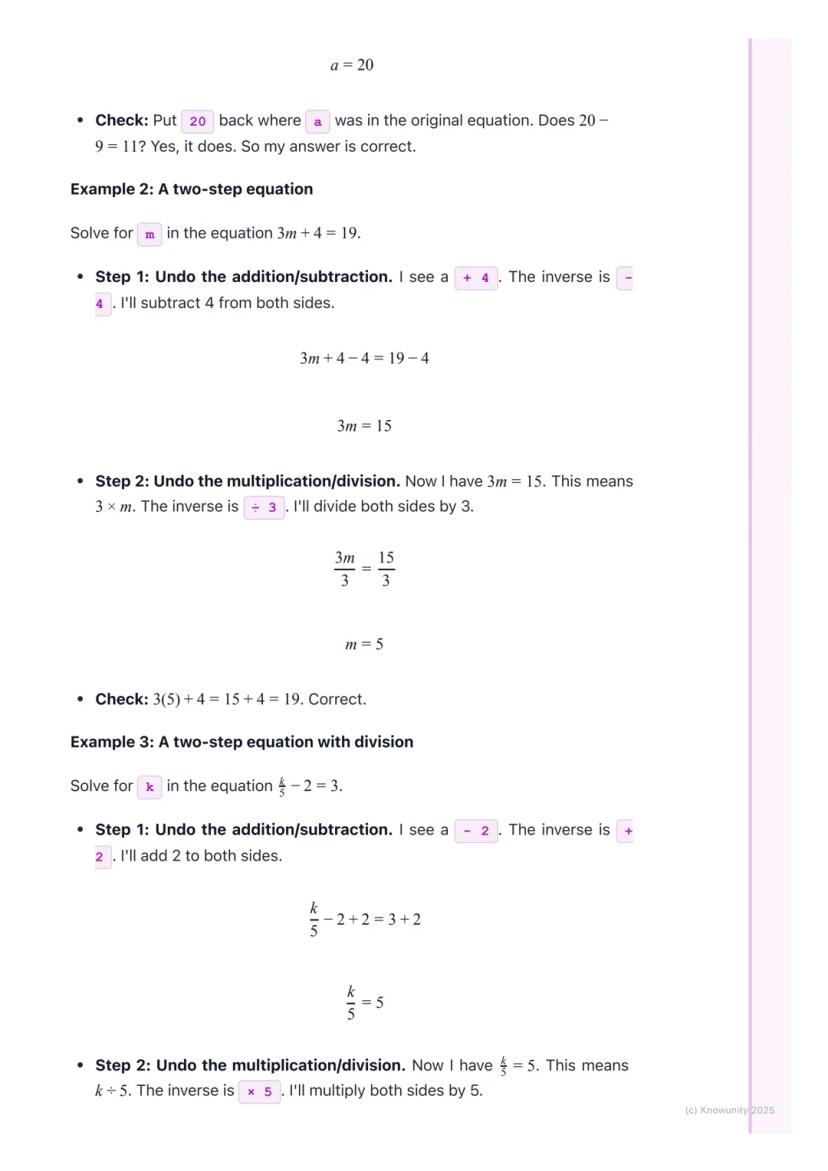
Let's see how this works with proper exam-style examples. For a simple equation like a - 9 = 11, you add 9 to both sides to get a = 20.
With two-step equations like 3m + 4 = 19, first subtract 4 from both sides , then divide both sides by 3 . Easy when you know the steps!
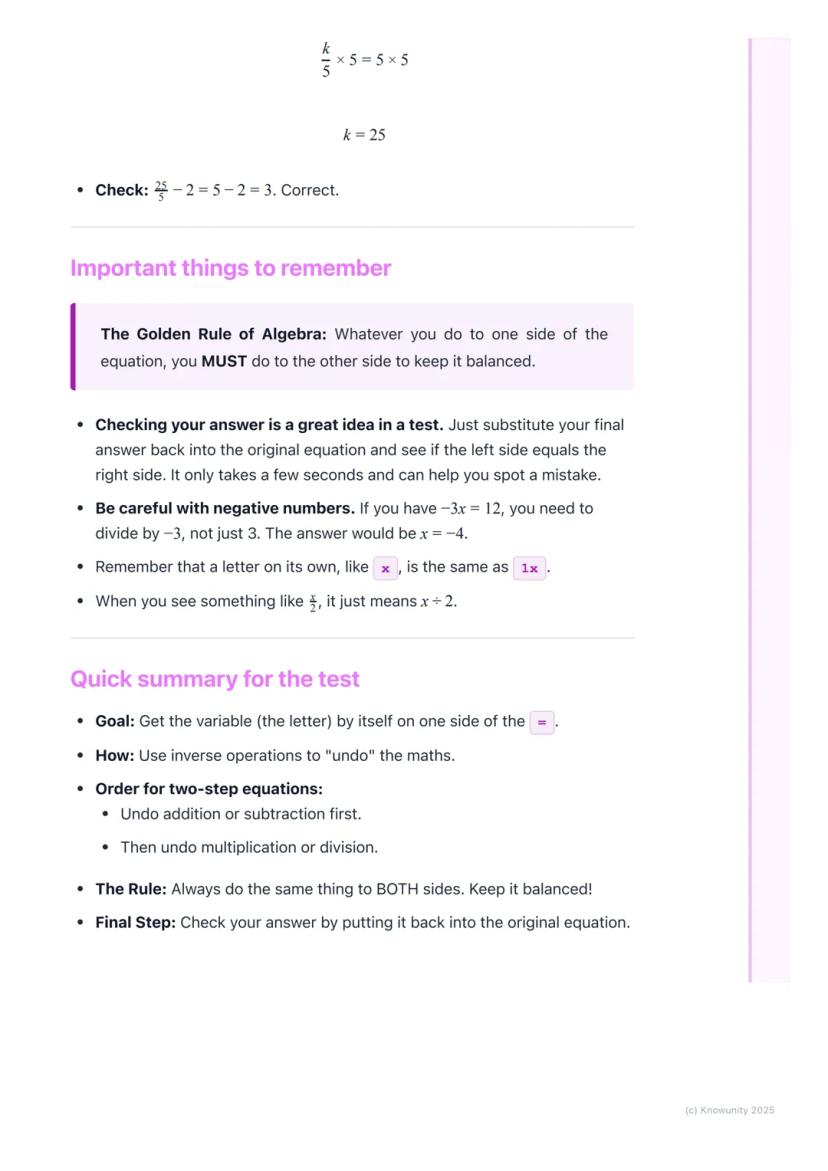
Even trickier ones like k/5 - 2 = 3 follow the same pattern. Add 2 to both sides first , then multiply both sides by 5 .
Always check your answer by popping it back into the original equation. It takes seconds and can save you marks in a test!
Pro Move: Checking your answer is like having a safety net - it catches mistakes before they cost you points!
5
of 5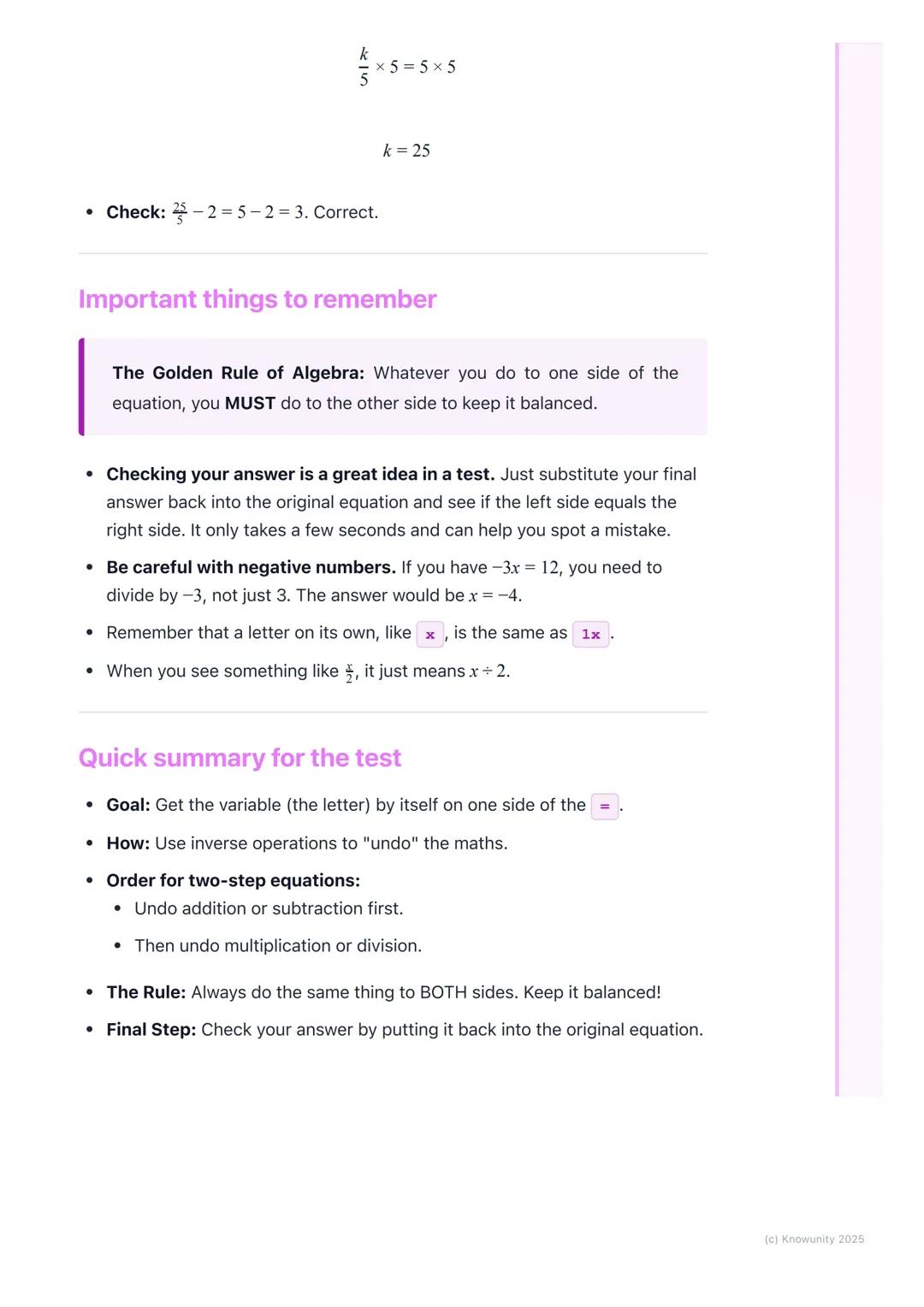
Key Things to Remember
The golden rule of algebra is sacred: whatever you do to one side, you absolutely must do to the other. No exceptions, ever!
Watch out for negative numbers - if you have -3x = 12, you divide by -3 (not just 3) to get x = -4. Also remember that x on its own is really 1x, and x/2 just means x ÷ 2.
For two-step equations, your order of attack is: undo addition or subtraction first, then tackle multiplication or division. Keep everything balanced and always check your final answer.
Test Strategy: Goal → Get the variable alone. Method → Use inverse operations. Rule → Do the same to both sides. Check → Put your answer back in!
Pensamos que nunca lo preguntarías...
¿Qué es Knowunity AI companion?
Nuestro compañero de IA está específicamente adaptado a las necesidades de los estudiantes. Basándonos en los millones de contenidos que tenemos en la plataforma, podemos dar a los estudiantes respuestas realmente significativas y relevantes. Pero no se trata solo de respuestas, el compañero también guía a los estudiantes a través de sus retos de aprendizaje diarios, con planes de aprendizaje personalizados, cuestionarios o contenidos en el chat y una personalización del 100% basada en las habilidades y el desarrollo de los estudiantes.
¿Dónde puedo descargar la app Knowunity?
Puedes descargar la app en Google Play Store y Apple App Store.
¿Knowunity es totalmente gratuito?
Sí, tienes acceso gratuito a los contenidos de la aplicación y a nuestro compañero de IA. Para desbloquear determinadas funciones de la aplicación, puedes adquirir Knowunity Pro.
Contenidos más populares de Mathematics
7Contenidos más populares
9¿No encuentras lo que buscas? Explora otros temas.
Mira lo que dicen nuestros usuarios. Les encanta - y a tí también.
4.6/5App Store
4.7/5Google Play
La app es muy fácil de usar y está muy bien diseñada. Hasta ahora he encontrado todo lo que estaba buscando y he podido aprender mucho de las presentaciones. Definitivamente utilizaré la aplicación para un examen de clase. Y, por supuesto, también me sirve mucho de inspiración.
Pablousuario de iOS
Esta app es realmente genial. Hay tantos apuntes de clase y ayuda [...]. Tengo problemas con matemáticas, por ejemplo, y la aplicación tiene muchas opciones de ayuda. Gracias a Knowunity, he mejorado en mates. Se la recomiendo a todo el mundo.
Elenausuaria de Android
Vaya, estoy realmente sorprendida. Acabo de probar la app porque la he visto anunciada muchas veces y me he quedado absolutamente alucinada. Esta app es LA AYUDA que quieres para el insti y, sobre todo, ofrece muchísimas cosas, como ejercicios y hojas informativas, que a mí personalmente me han sido MUY útiles.
Anausuaria de iOS
Mathematics13 visualizaciones·Actualizado May 27, 2026·5 páginasMastering Linear Equations: Solve Like a Pro
Solving equations is like being a detective - you're hunting for the mystery value of a variable (usually x or y). Think of an equation as a perfectly balanced weighing scale, where whatever you do to one side, you must... Mostrar más
1
of 5Inscríbete para ver los apuntes. ¡Es gratis!
- Acceso a todos los documentos
- Mejora tus notas
- Únete a millones de estudiantes
What's All This About?
Solving equations means finding the value of an unknown number, called a variable. Your main mission is simple: get that variable all by itself on one side of the equals sign.
An equation is just a maths sentence saying two things are equal - it always has that equals sign in the middle. The variable is the mystery letter (like x or y) you need to find, while constants are just regular numbers hanging about.
Here's your secret weapon: inverse operations. These are opposite operations that undo each other - addition undoes subtraction, multiplication undoes division, and so on.
Remember: Addition ↔ Subtraction and Multiplication ↔ Division are perfect pairs!
2
of 5Inscríbete para ver los apuntes. ¡Es gratis!
- Acceso a todos los documentos
- Mejora tus notas
- Únete a millones de estudiantes
Cracking One-Step Equations
These are the easiest equations because they only need one inverse operation to solve. You've basically got two types to deal with.
For addition and subtraction equations, spot what number is being added or subtracted from your variable. Then do the opposite to both sides. If you see x + 6 = 14, subtract 6 from both sides to get x = 8.
For multiplication and division equations, look at what number your variable is being multiplied or divided by. Then do the reverse to both sides. If you have 4y = 20, divide both sides by 4 to get y = 5.
Top Tip: Always do the same operation to both sides - this keeps your equation balanced like a perfect seesaw!
3
of 5Inscríbete para ver los apuntes. ¡Es gratis!
- Acceso a todos los documentos
- Mejora tus notas
- Únete a millones de estudiantes
Tackling Two-Step Equations
Two-step equations need two moves to solve, and here's the clever bit - you work backwards through BIDMAS. Think of it like unwrapping a present where you undo the last thing that was done first.
Step 1: Deal with any addition or subtraction first. Get rid of the constant (the number on its own) by doing the opposite operation to both sides.
Step 2: Then handle any multiplication or division. Work on the number attached to your variable by using its inverse operation.
For example, with 2x + 5 = 15, first subtract 5 from both sides , then divide both sides by 2 .
Golden Rule: Always tackle the lone number first, then deal with whatever's attached to your variable!
4
of 5Inscríbete para ver los apuntes. ¡Es gratis!
- Acceso a todos los documentos
- Mejora tus notas
- Únete a millones de estudiantes
Working Through Real Examples
Let's see how this works with proper exam-style examples. For a simple equation like a - 9 = 11, you add 9 to both sides to get a = 20.
With two-step equations like 3m + 4 = 19, first subtract 4 from both sides , then divide both sides by 3 . Easy when you know the steps!
Even trickier ones like k/5 - 2 = 3 follow the same pattern. Add 2 to both sides first , then multiply both sides by 5 .
Always check your answer by popping it back into the original equation. It takes seconds and can save you marks in a test!
Pro Move: Checking your answer is like having a safety net - it catches mistakes before they cost you points!
5
of 5Inscríbete para ver los apuntes. ¡Es gratis!
- Acceso a todos los documentos
- Mejora tus notas
- Únete a millones de estudiantes
Key Things to Remember
The golden rule of algebra is sacred: whatever you do to one side, you absolutely must do to the other. No exceptions, ever!
Watch out for negative numbers - if you have -3x = 12, you divide by -3 (not just 3) to get x = -4. Also remember that x on its own is really 1x, and x/2 just means x ÷ 2.
For two-step equations, your order of attack is: undo addition or subtraction first, then tackle multiplication or division. Keep everything balanced and always check your final answer.
Test Strategy: Goal → Get the variable alone. Method → Use inverse operations. Rule → Do the same to both sides. Check → Put your answer back in!
Pensamos que nunca lo preguntarías...
¿Qué es Knowunity AI companion?
Nuestro compañero de IA está específicamente adaptado a las necesidades de los estudiantes. Basándonos en los millones de contenidos que tenemos en la plataforma, podemos dar a los estudiantes respuestas realmente significativas y relevantes. Pero no se trata solo de respuestas, el compañero también guía a los estudiantes a través de sus retos de aprendizaje diarios, con planes de aprendizaje personalizados, cuestionarios o contenidos en el chat y una personalización del 100% basada en las habilidades y el desarrollo de los estudiantes.
¿Dónde puedo descargar la app Knowunity?
Puedes descargar la app en Google Play Store y Apple App Store.
¿Knowunity es totalmente gratuito?
Sí, tienes acceso gratuito a los contenidos de la aplicación y a nuestro compañero de IA. Para desbloquear determinadas funciones de la aplicación, puedes adquirir Knowunity Pro.
Contenidos más populares de Mathematics
7Contenidos más populares
9¿No encuentras lo que buscas? Explora otros temas.
Mira lo que dicen nuestros usuarios. Les encanta - y a tí también.
4.6/5App Store
4.7/5Google Play
La app es muy fácil de usar y está muy bien diseñada. Hasta ahora he encontrado todo lo que estaba buscando y he podido aprender mucho de las presentaciones. Definitivamente utilizaré la aplicación para un examen de clase. Y, por supuesto, también me sirve mucho de inspiración.
Pablousuario de iOS
Esta app es realmente genial. Hay tantos apuntes de clase y ayuda [...]. Tengo problemas con matemáticas, por ejemplo, y la aplicación tiene muchas opciones de ayuda. Gracias a Knowunity, he mejorado en mates. Se la recomiendo a todo el mundo.
Elenausuaria de Android
Vaya, estoy realmente sorprendida. Acabo de probar la app porque la he visto anunciada muchas veces y me he quedado absolutamente alucinada. Esta app es LA AYUDA que quieres para el insti y, sobre todo, ofrece muchísimas cosas, como ejercicios y hojas informativas, que a mí personalmente me han sido MUY útiles.
Anausuaria de iOS