
Probability is everywhere in your life - from the chance... Mostrar más
 Mathematics8 visualizaciones·Actualizado May 29, 2026·5 páginas
Understanding Basic Probability Concepts
1 / 5
1
of 5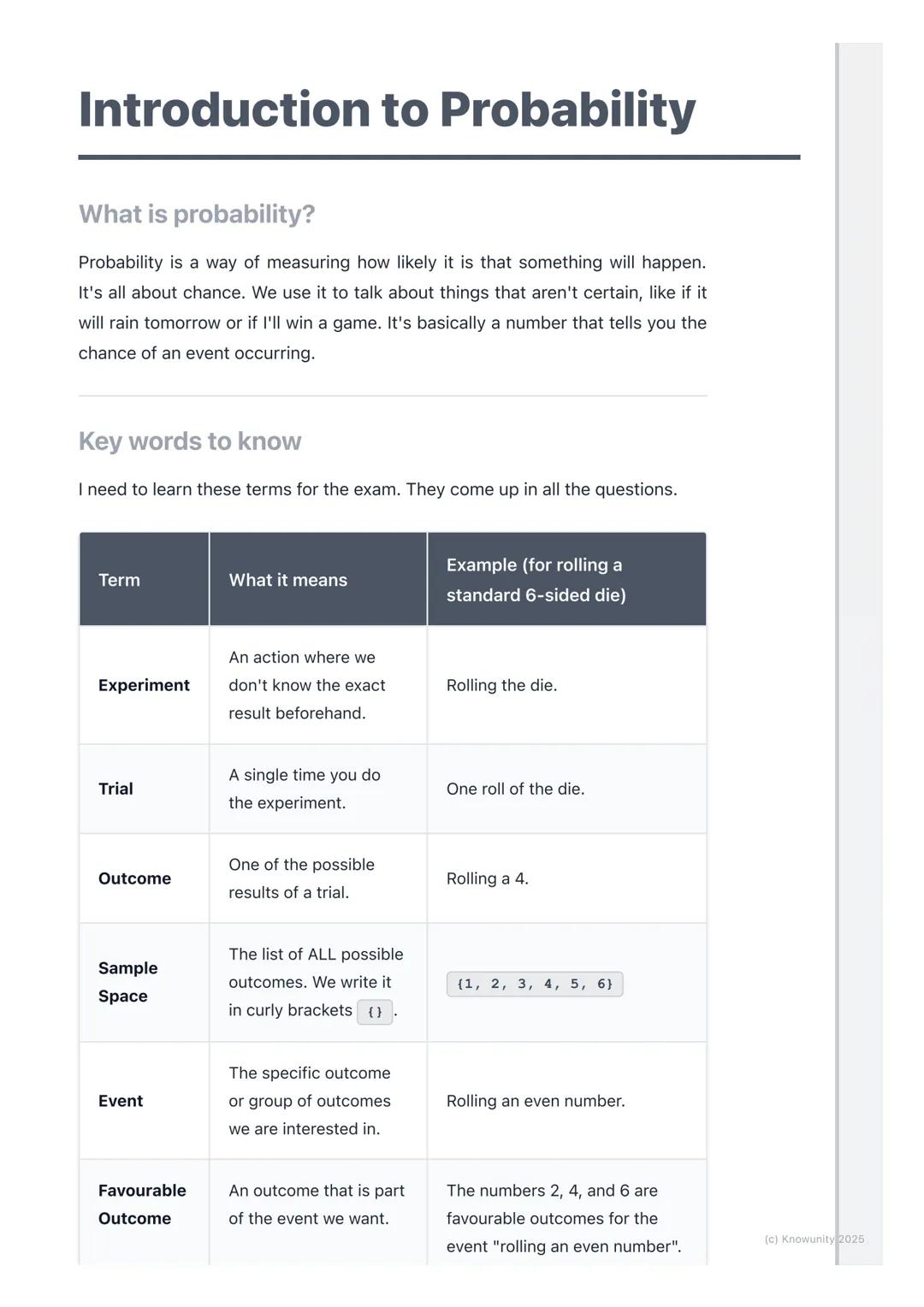
What is Probability?
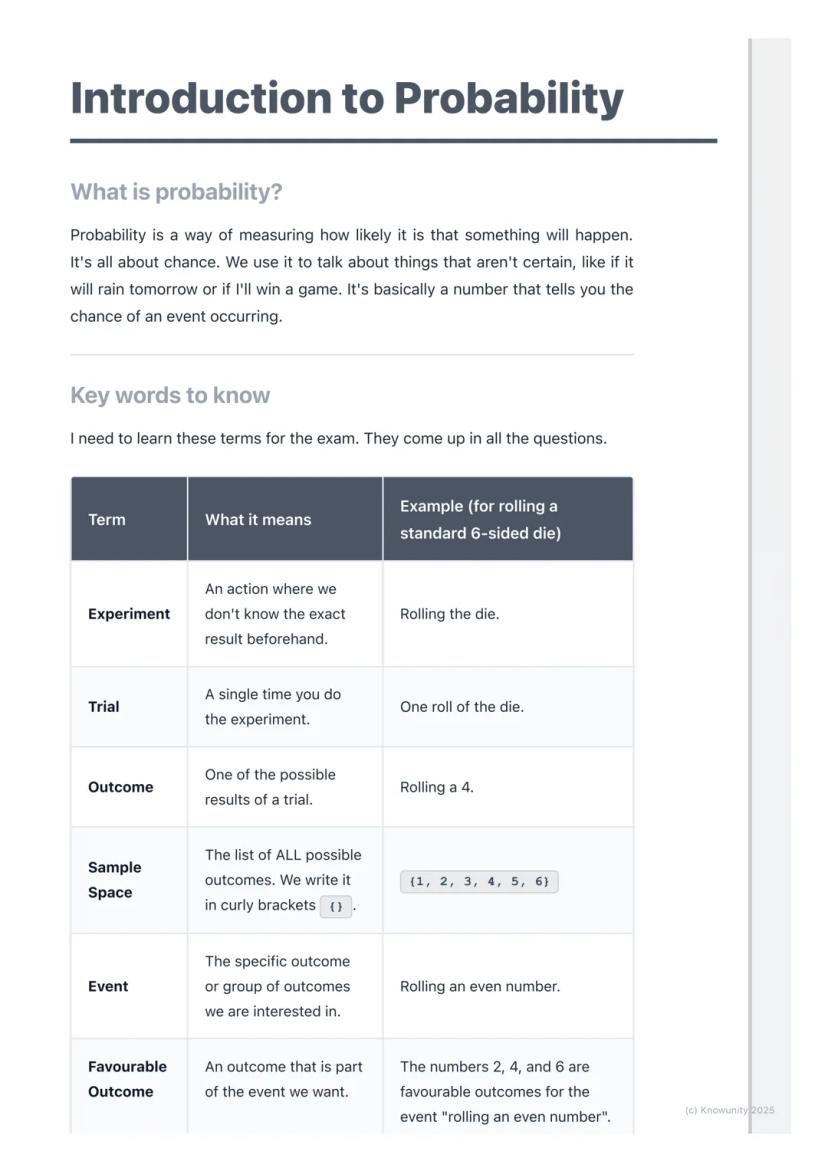
Ever wondered how to work out if something will actually happen? Probability gives you the answer by measuring chance using numbers. It's perfect for situations where you can't be 100% certain of the outcome.
Before diving into calculations, you need to master some key terms that'll pop up in every exam question. An experiment is any action where you don't know the exact result beforehand, like rolling a die. Each single attempt is called a trial.
The sample space lists every possible result in curly brackets - for a standard die, that's {1, 2, 3, 4, 5, 6}. An outcome is just one specific result, whilst an event is what you're actually interested in finding out about.
Quick Tip: Always start by writing down your sample space - it helps you spot all the possibilities and avoid missing any!
2
of 5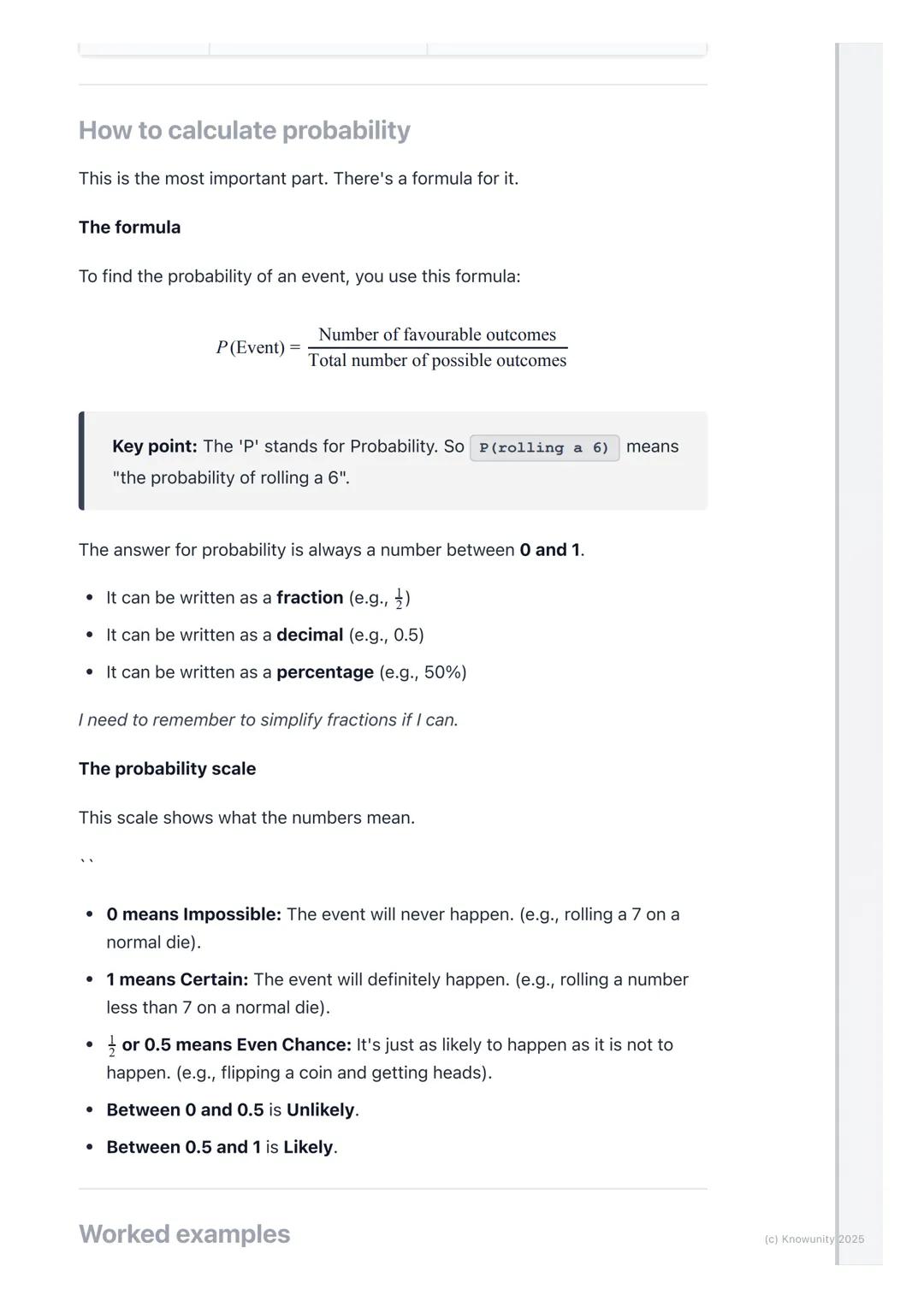
The Probability Formula
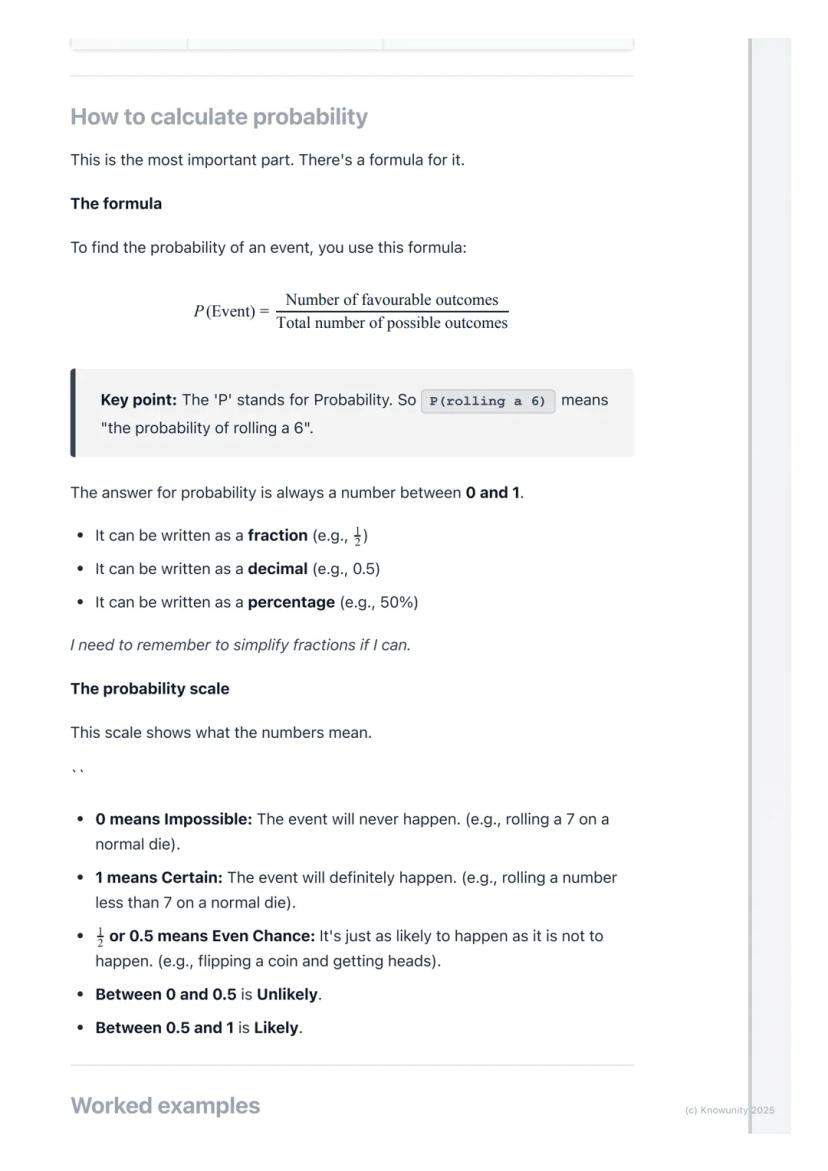
Here's the formula that'll solve every probability problem you'll face: P(Event) = Number of favourable outcomes ÷ Total number of possible outcomes. The 'P' simply stands for probability, so P(rolling a 6) means "the probability of rolling a 6".
Your answer will always be a number between 0 and 1. You can write it as a fraction, decimal, or percentage - just remember to simplify fractions when possible.
The probability scale is dead useful for understanding what your answers mean. 0 means impossible (like rolling a 7 on a normal die), whilst 1 means certain (like rolling less than 7). If you get 0.5, that's an even chance - exactly like flipping a coin.
Remember: Numbers between 0 and 0.5 are unlikely, whilst numbers between 0.5 and 1 are likely to happen.
3
of 5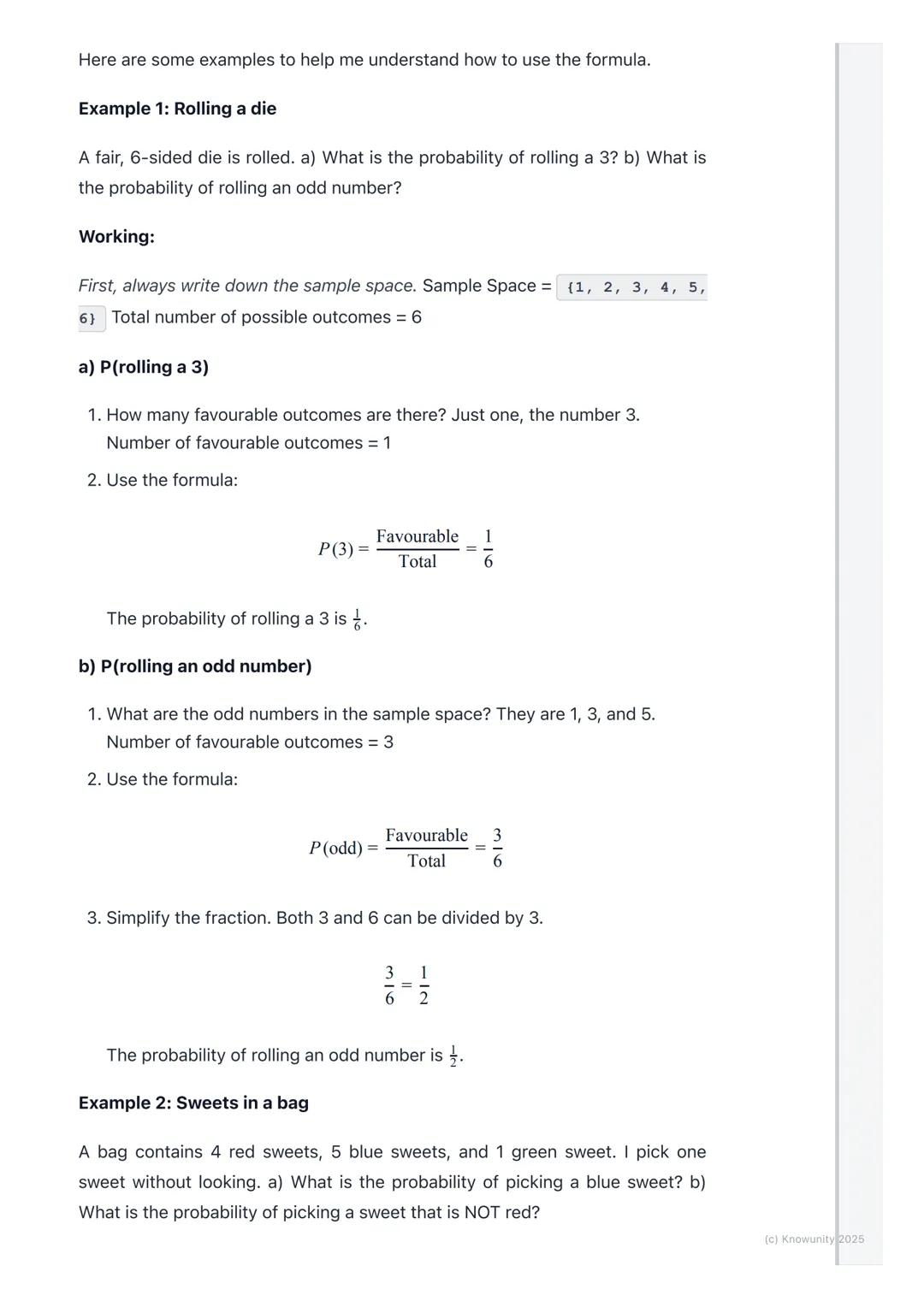
Working Through Examples
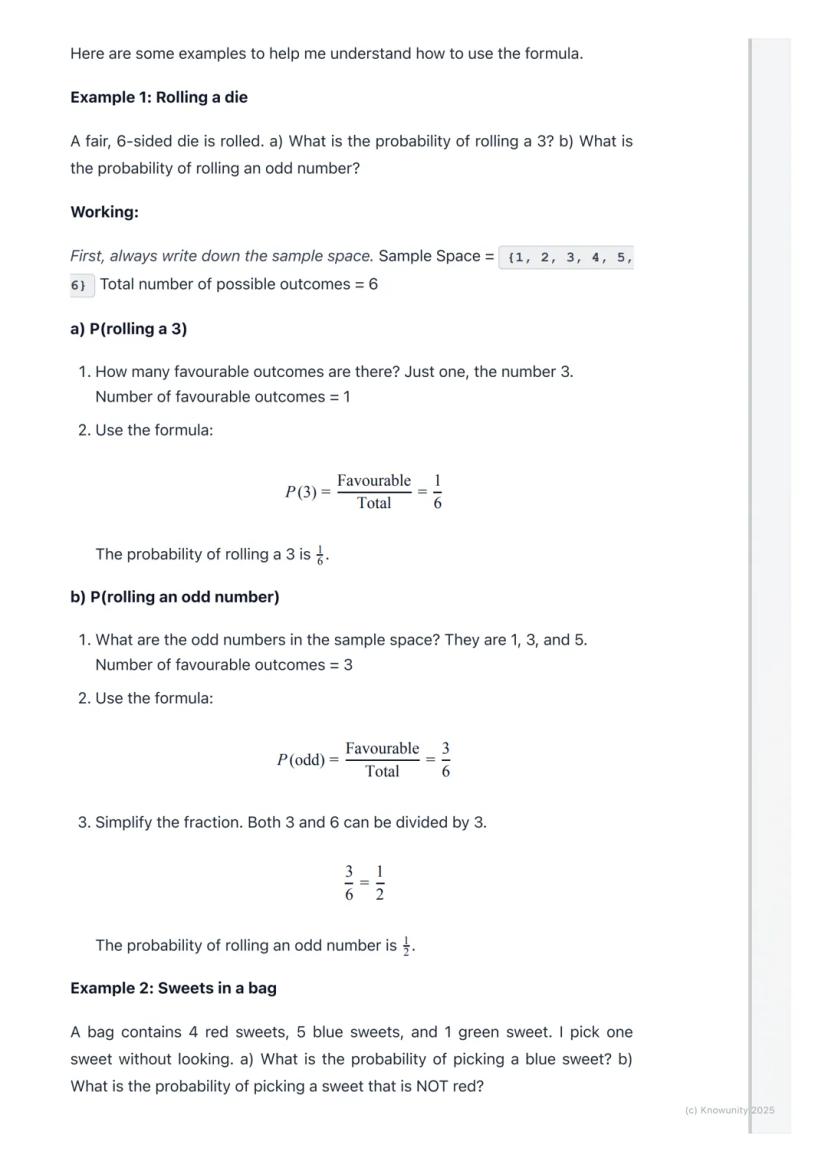
Let's tackle a classic die problem to see the formula in action. When rolling a fair 6-sided die, always start by writing your sample space: {1, 2, 3, 4, 5, 6}, giving you 6 total possible outcomes.
For finding P(rolling a 3), there's only one favourable outcome (the number 3), so you get 1÷6 = 1/6. For P(rolling an odd number), count the odd numbers: 1, 3, and 5 give you 3 favourable outcomes, so 3÷6 = 1/2 after simplifying.
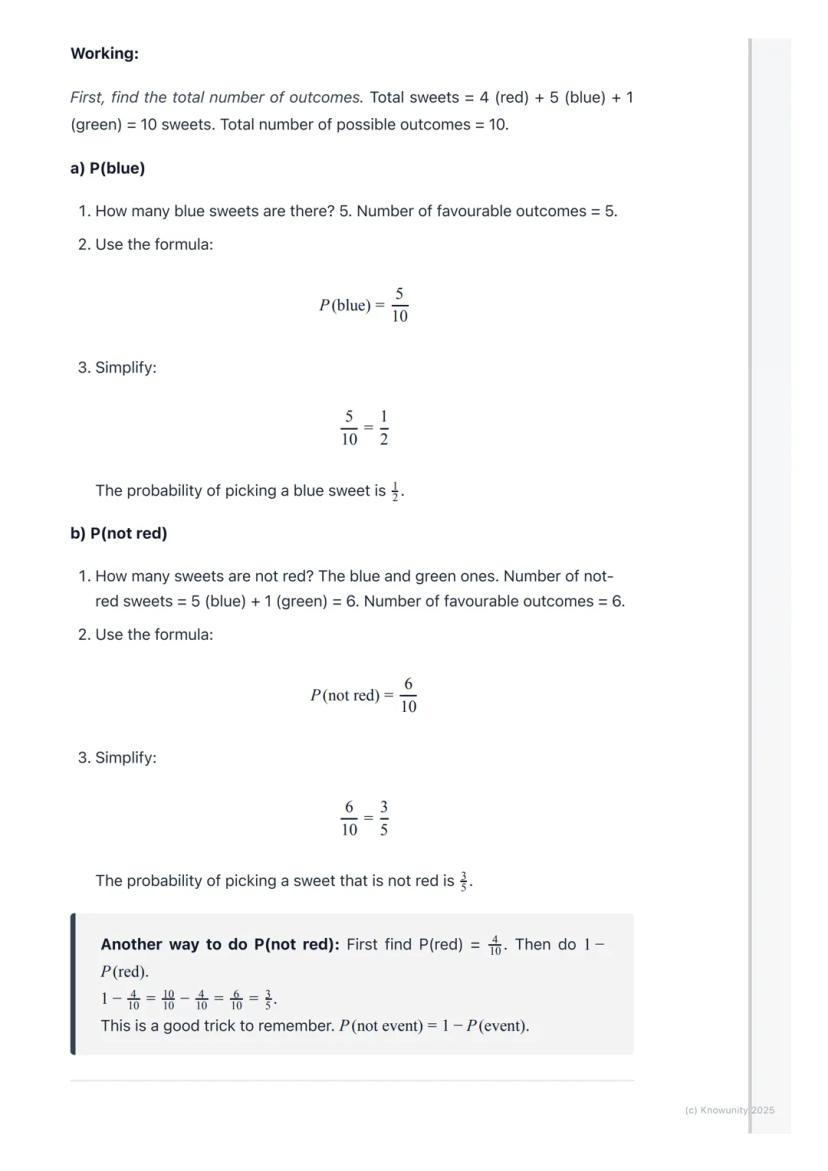
Sweet problems work exactly the same way. With 4 red, 5 blue, and 1 green sweet (10 total), P(blue) = 5÷10 = 1/2. The key is always counting your total first, then identifying what counts as "favourable" for your specific question.
Pro Tip: For "not red" events, you can either count non-red sweets directly, or use the shortcut: 1 - P(red) = 1 - 4/10 = 6/10 = 3/5.
4
of 5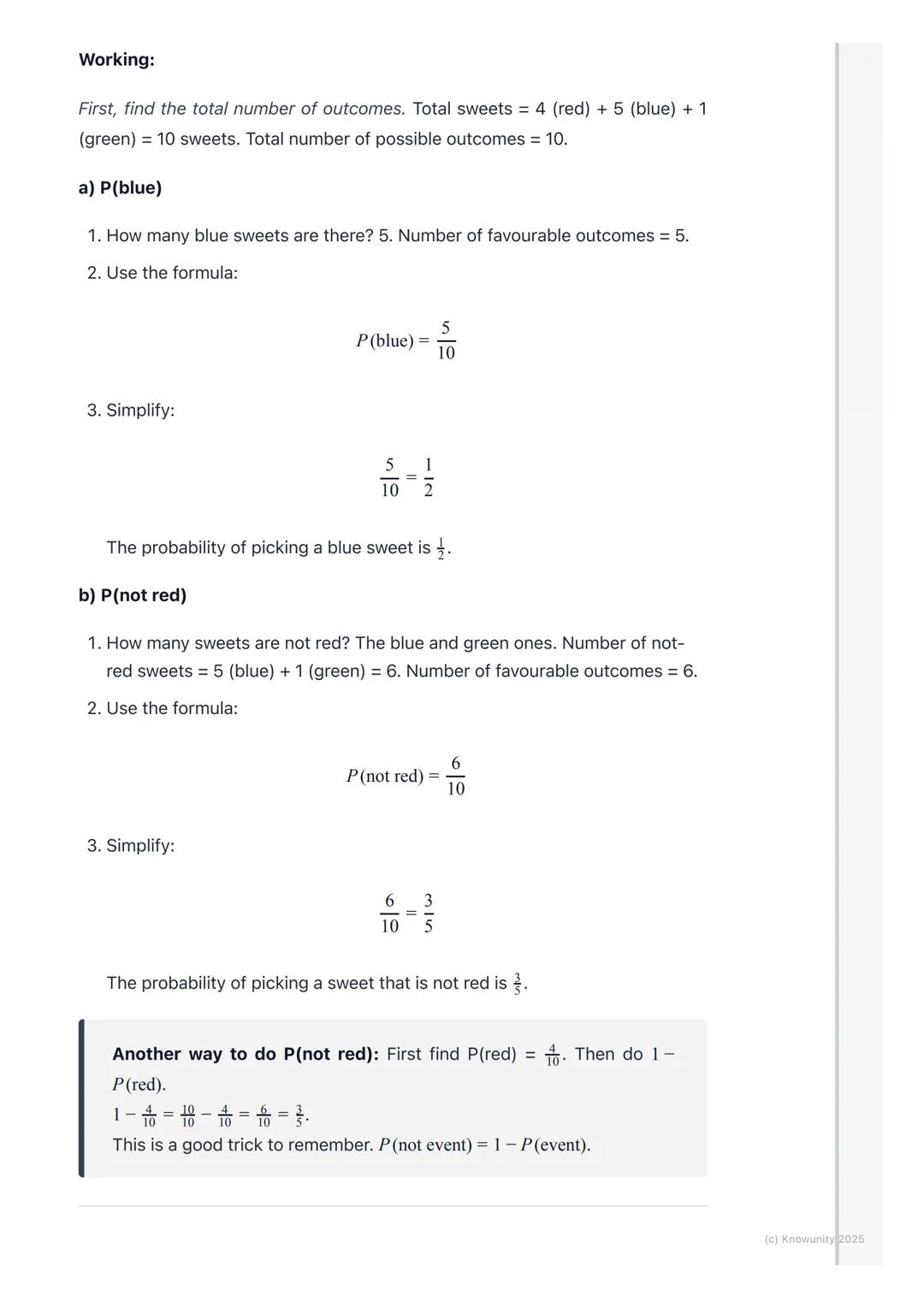
Advanced Techniques and Shortcuts
The "1 minus" trick is brilliant for complementary events. Instead of counting everything that's "not red", just work out P(red) first, then subtract from 1. This method often saves time and reduces mistakes.
Watch out for tricky wording in questions. "At least 3" includes 3, 4, 5, and 6, whilst "more than 3" only includes 4, 5, and 6. These small differences can completely change your answer.
Here's a clever way to check your work: all probabilities for every possible outcome must add up to 1. For a die, P(1) + P(2) + P(3) + P(4) + P(5) + P(6) = 6 × 1/6 = 1. If your total doesn't equal 1, you've made an error somewhere.
Check Yourself: Always verify that your fraction is the right way up - total outcomes go on the bottom, favourable outcomes on top!
5
of 5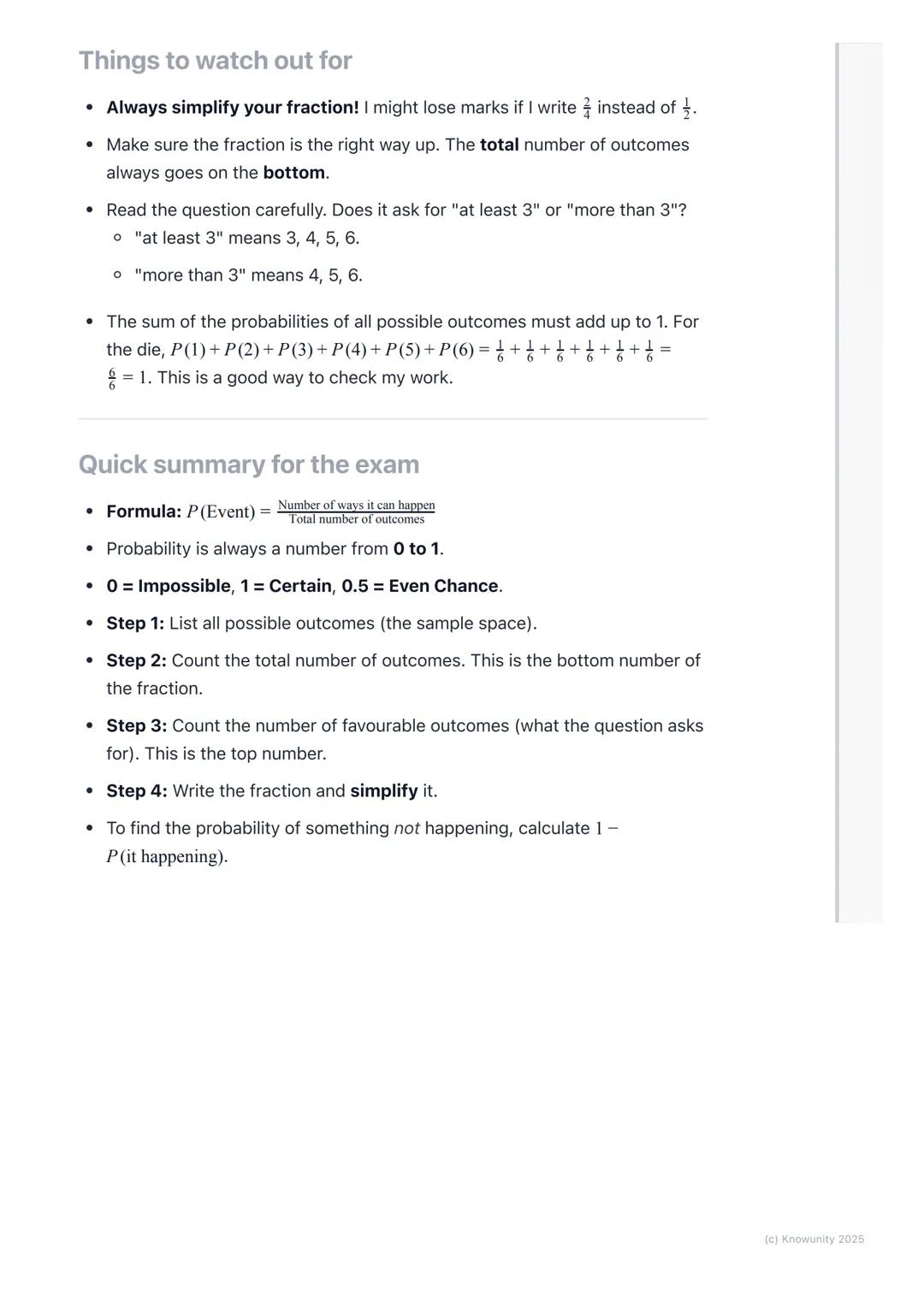
Exam Success Tips
Your step-by-step method should become automatic: list the sample space, count total outcomes (bottom of fraction), count favourable outcomes (top of fraction), then write and simplify your fraction.
Common mistakes to avoid include forgetting to simplify fractions and misreading questions. Always double-check whether the question asks for "at least" or "more than" - they're not the same thing.
Remember that probability always ranges from 0 to 1. If you get a number outside this range, you've definitely made an error. The formula P(Event) = Favourable outcomes ÷ Total outcomes will solve any basic probability problem you encounter.
Final Reminder: Take your time reading questions carefully - most mistakes happen from rushing, not from lack of understanding!
Pensamos que nunca lo preguntarías...
¿Qué es Knowunity AI companion?
Nuestro compañero de IA está específicamente adaptado a las necesidades de los estudiantes. Basándonos en los millones de contenidos que tenemos en la plataforma, podemos dar a los estudiantes respuestas realmente significativas y relevantes. Pero no se trata solo de respuestas, el compañero también guía a los estudiantes a través de sus retos de aprendizaje diarios, con planes de aprendizaje personalizados, cuestionarios o contenidos en el chat y una personalización del 100% basada en las habilidades y el desarrollo de los estudiantes.
¿Dónde puedo descargar la app Knowunity?
Puedes descargar la app en Google Play Store y Apple App Store.
¿Knowunity es totalmente gratuito?
Sí, tienes acceso gratuito a los contenidos de la aplicación y a nuestro compañero de IA. Para desbloquear determinadas funciones de la aplicación, puedes adquirir Knowunity Pro.
Contenidos más populares de Mathematics
7Contenidos más populares
9¿No encuentras lo que buscas? Explora otros temas.
Mira lo que dicen nuestros usuarios. Les encanta - y a tí también.
4.6/5App Store
4.7/5Google Play
La app es muy fácil de usar y está muy bien diseñada. Hasta ahora he encontrado todo lo que estaba buscando y he podido aprender mucho de las presentaciones. Definitivamente utilizaré la aplicación para un examen de clase. Y, por supuesto, también me sirve mucho de inspiración.
Pablousuario de iOS
Esta app es realmente genial. Hay tantos apuntes de clase y ayuda [...]. Tengo problemas con matemáticas, por ejemplo, y la aplicación tiene muchas opciones de ayuda. Gracias a Knowunity, he mejorado en mates. Se la recomiendo a todo el mundo.
Elenausuaria de Android
Vaya, estoy realmente sorprendida. Acabo de probar la app porque la he visto anunciada muchas veces y me he quedado absolutamente alucinada. Esta app es LA AYUDA que quieres para el insti y, sobre todo, ofrece muchísimas cosas, como ejercicios y hojas informativas, que a mí personalmente me han sido MUY útiles.
Anausuaria de iOS
Mathematics8 visualizaciones·Actualizado May 29, 2026·5 páginasUnderstanding Basic Probability Concepts
Probability is everywhere in your life - from the chance of rain to winning a game or picking your favourite sweet from a bag. It's simply a way to measure how likely something is to happen, using numbers between 0... Mostrar más
1
of 5Inscríbete para ver los apuntes. ¡Es gratis!
- Acceso a todos los documentos
- Mejora tus notas
- Únete a millones de estudiantes
What is Probability?
Ever wondered how to work out if something will actually happen? Probability gives you the answer by measuring chance using numbers. It's perfect for situations where you can't be 100% certain of the outcome.
Before diving into calculations, you need to master some key terms that'll pop up in every exam question. An experiment is any action where you don't know the exact result beforehand, like rolling a die. Each single attempt is called a trial.
The sample space lists every possible result in curly brackets - for a standard die, that's {1, 2, 3, 4, 5, 6}. An outcome is just one specific result, whilst an event is what you're actually interested in finding out about.
Quick Tip: Always start by writing down your sample space - it helps you spot all the possibilities and avoid missing any!
2
of 5Inscríbete para ver los apuntes. ¡Es gratis!
- Acceso a todos los documentos
- Mejora tus notas
- Únete a millones de estudiantes
The Probability Formula
Here's the formula that'll solve every probability problem you'll face: P(Event) = Number of favourable outcomes ÷ Total number of possible outcomes. The 'P' simply stands for probability, so P(rolling a 6) means "the probability of rolling a 6".
Your answer will always be a number between 0 and 1. You can write it as a fraction, decimal, or percentage - just remember to simplify fractions when possible.
The probability scale is dead useful for understanding what your answers mean. 0 means impossible (like rolling a 7 on a normal die), whilst 1 means certain (like rolling less than 7). If you get 0.5, that's an even chance - exactly like flipping a coin.
Remember: Numbers between 0 and 0.5 are unlikely, whilst numbers between 0.5 and 1 are likely to happen.
3
of 5Inscríbete para ver los apuntes. ¡Es gratis!
- Acceso a todos los documentos
- Mejora tus notas
- Únete a millones de estudiantes
Working Through Examples
Let's tackle a classic die problem to see the formula in action. When rolling a fair 6-sided die, always start by writing your sample space: {1, 2, 3, 4, 5, 6}, giving you 6 total possible outcomes.
For finding P(rolling a 3), there's only one favourable outcome (the number 3), so you get 1÷6 = 1/6. For P(rolling an odd number), count the odd numbers: 1, 3, and 5 give you 3 favourable outcomes, so 3÷6 = 1/2 after simplifying.
Sweet problems work exactly the same way. With 4 red, 5 blue, and 1 green sweet (10 total), P(blue) = 5÷10 = 1/2. The key is always counting your total first, then identifying what counts as "favourable" for your specific question.
Pro Tip: For "not red" events, you can either count non-red sweets directly, or use the shortcut: 1 - P(red) = 1 - 4/10 = 6/10 = 3/5.
4
of 5Inscríbete para ver los apuntes. ¡Es gratis!
- Acceso a todos los documentos
- Mejora tus notas
- Únete a millones de estudiantes
Advanced Techniques and Shortcuts
The "1 minus" trick is brilliant for complementary events. Instead of counting everything that's "not red", just work out P(red) first, then subtract from 1. This method often saves time and reduces mistakes.
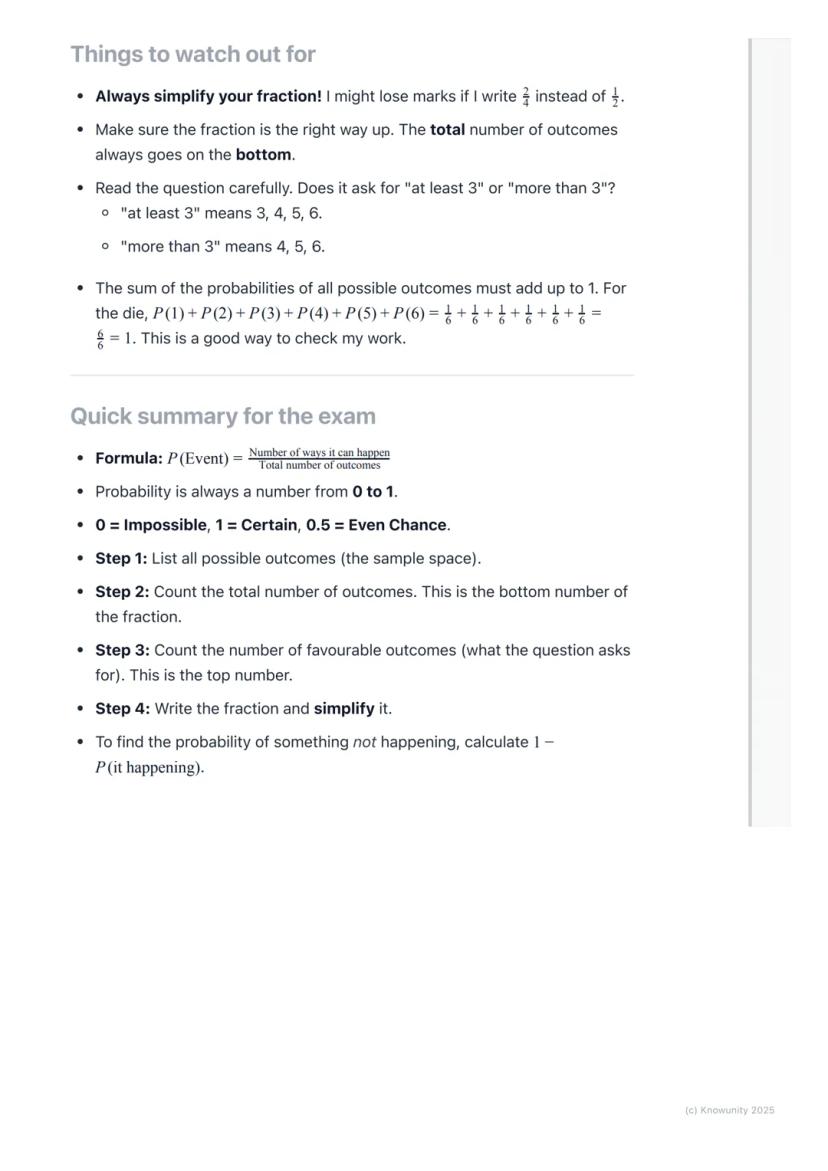
Watch out for tricky wording in questions. "At least 3" includes 3, 4, 5, and 6, whilst "more than 3" only includes 4, 5, and 6. These small differences can completely change your answer.
Here's a clever way to check your work: all probabilities for every possible outcome must add up to 1. For a die, P(1) + P(2) + P(3) + P(4) + P(5) + P(6) = 6 × 1/6 = 1. If your total doesn't equal 1, you've made an error somewhere.
Check Yourself: Always verify that your fraction is the right way up - total outcomes go on the bottom, favourable outcomes on top!
5
of 5Inscríbete para ver los apuntes. ¡Es gratis!
- Acceso a todos los documentos
- Mejora tus notas
- Únete a millones de estudiantes
Exam Success Tips
Your step-by-step method should become automatic: list the sample space, count total outcomes (bottom of fraction), count favourable outcomes (top of fraction), then write and simplify your fraction.
Common mistakes to avoid include forgetting to simplify fractions and misreading questions. Always double-check whether the question asks for "at least" or "more than" - they're not the same thing.
Remember that probability always ranges from 0 to 1. If you get a number outside this range, you've definitely made an error. The formula P(Event) = Favourable outcomes ÷ Total outcomes will solve any basic probability problem you encounter.
Final Reminder: Take your time reading questions carefully - most mistakes happen from rushing, not from lack of understanding!
Pensamos que nunca lo preguntarías...
¿Qué es Knowunity AI companion?
Nuestro compañero de IA está específicamente adaptado a las necesidades de los estudiantes. Basándonos en los millones de contenidos que tenemos en la plataforma, podemos dar a los estudiantes respuestas realmente significativas y relevantes. Pero no se trata solo de respuestas, el compañero también guía a los estudiantes a través de sus retos de aprendizaje diarios, con planes de aprendizaje personalizados, cuestionarios o contenidos en el chat y una personalización del 100% basada en las habilidades y el desarrollo de los estudiantes.
¿Dónde puedo descargar la app Knowunity?
Puedes descargar la app en Google Play Store y Apple App Store.
¿Knowunity es totalmente gratuito?
Sí, tienes acceso gratuito a los contenidos de la aplicación y a nuestro compañero de IA. Para desbloquear determinadas funciones de la aplicación, puedes adquirir Knowunity Pro.
Contenidos más populares de Mathematics
7Contenidos más populares
9¿No encuentras lo que buscas? Explora otros temas.
Mira lo que dicen nuestros usuarios. Les encanta - y a tí también.
4.6/5App Store
4.7/5Google Play
La app es muy fácil de usar y está muy bien diseñada. Hasta ahora he encontrado todo lo que estaba buscando y he podido aprender mucho de las presentaciones. Definitivamente utilizaré la aplicación para un examen de clase. Y, por supuesto, también me sirve mucho de inspiración.
Pablousuario de iOS
Esta app es realmente genial. Hay tantos apuntes de clase y ayuda [...]. Tengo problemas con matemáticas, por ejemplo, y la aplicación tiene muchas opciones de ayuda. Gracias a Knowunity, he mejorado en mates. Se la recomiendo a todo el mundo.
Elenausuaria de Android
Vaya, estoy realmente sorprendida. Acabo de probar la app porque la he visto anunciada muchas veces y me he quedado absolutamente alucinada. Esta app es LA AYUDA que quieres para el insti y, sobre todo, ofrece muchísimas cosas, como ejercicios y hojas informativas, que a mí personalmente me han sido MUY útiles.
Anausuaria de iOS