
Ever wondered why we use letters in maths? Algebraic expressions... Mostrar más
 Mathematics13 visualizaciones·Actualizado Jun 2, 2026·5 páginas
Understanding and Simplifying Algebraic Expressions
1 / 5
1
of 5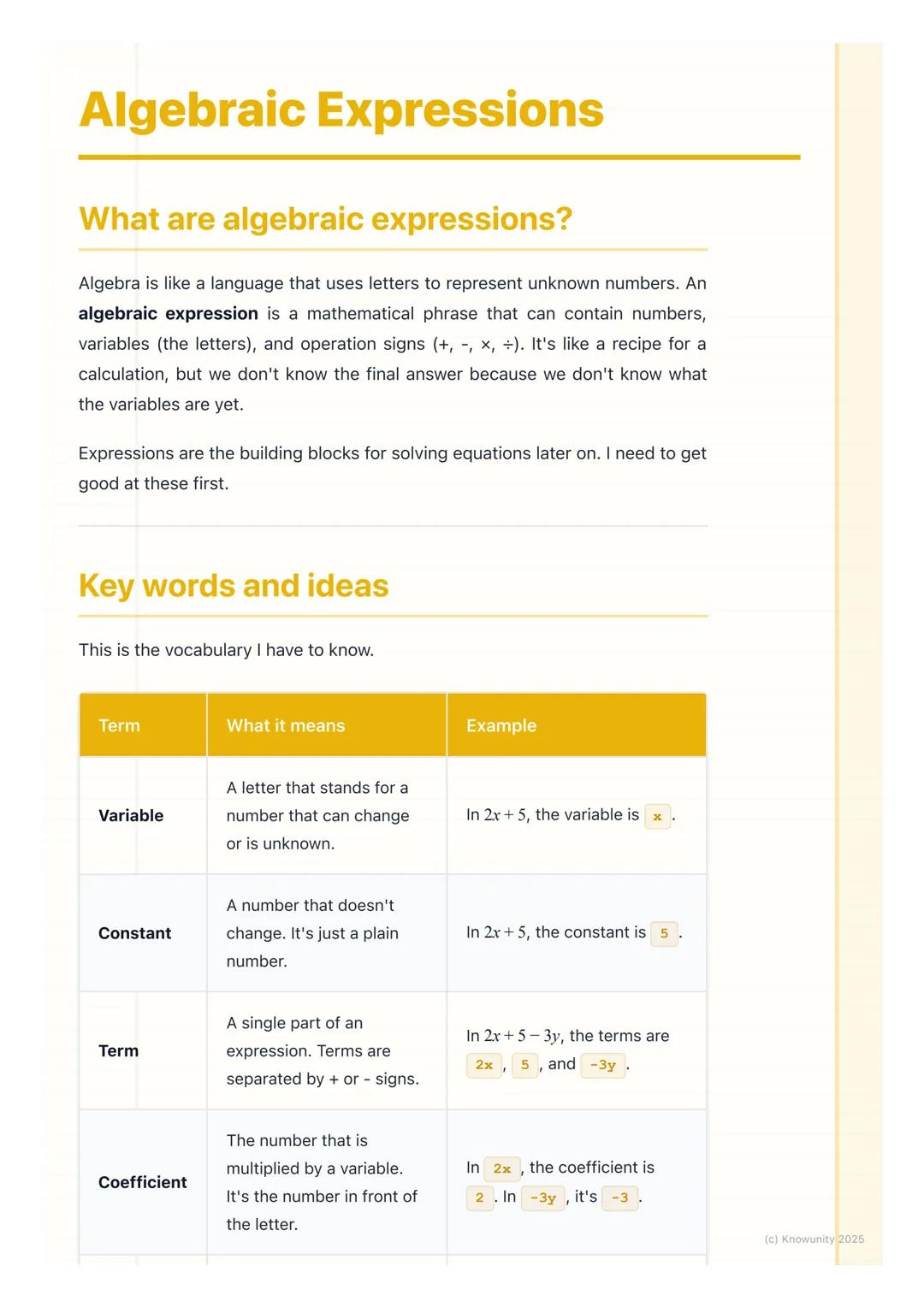
What are Algebraic Expressions?
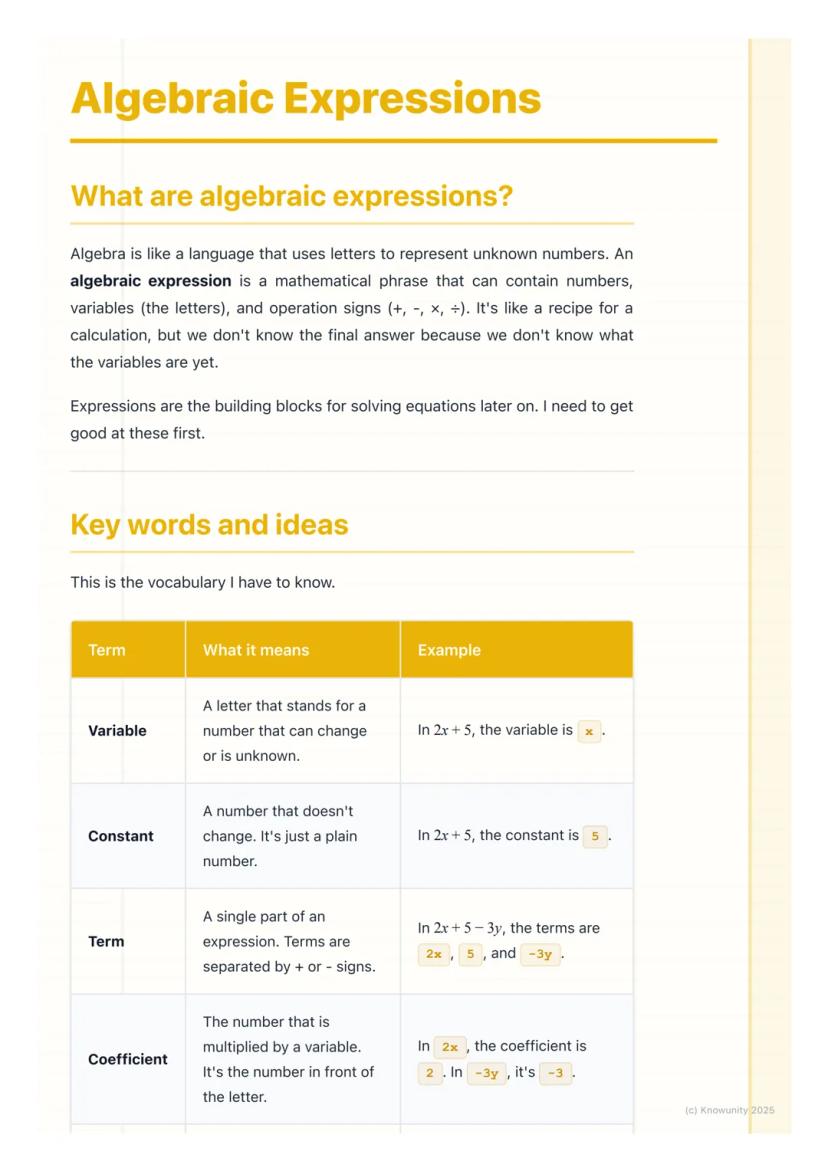
Think of algebraic expressions as mathematical phrases that mix numbers, letters, and operation signs (+, -, ×, ÷). Unlike equations, expressions don't have an equals sign - they're just a collection of mathematical terms waiting to be worked with.
The letters in expressions are called variables, and they represent unknown numbers. A term is each separate part of an expression, like 4x, -5y, or just 8 on its own.
Like terms are terms that have exactly the same variable part, including any powers. For example, 3x and -5x are like terms because they both have just 'x'. However, 3x and 3x² are NOT like terms because one has x and the other has x².
Remember: Expressions are the foundation for solving equations later, so getting comfortable with these basics now will make your life much easier!
2
of 5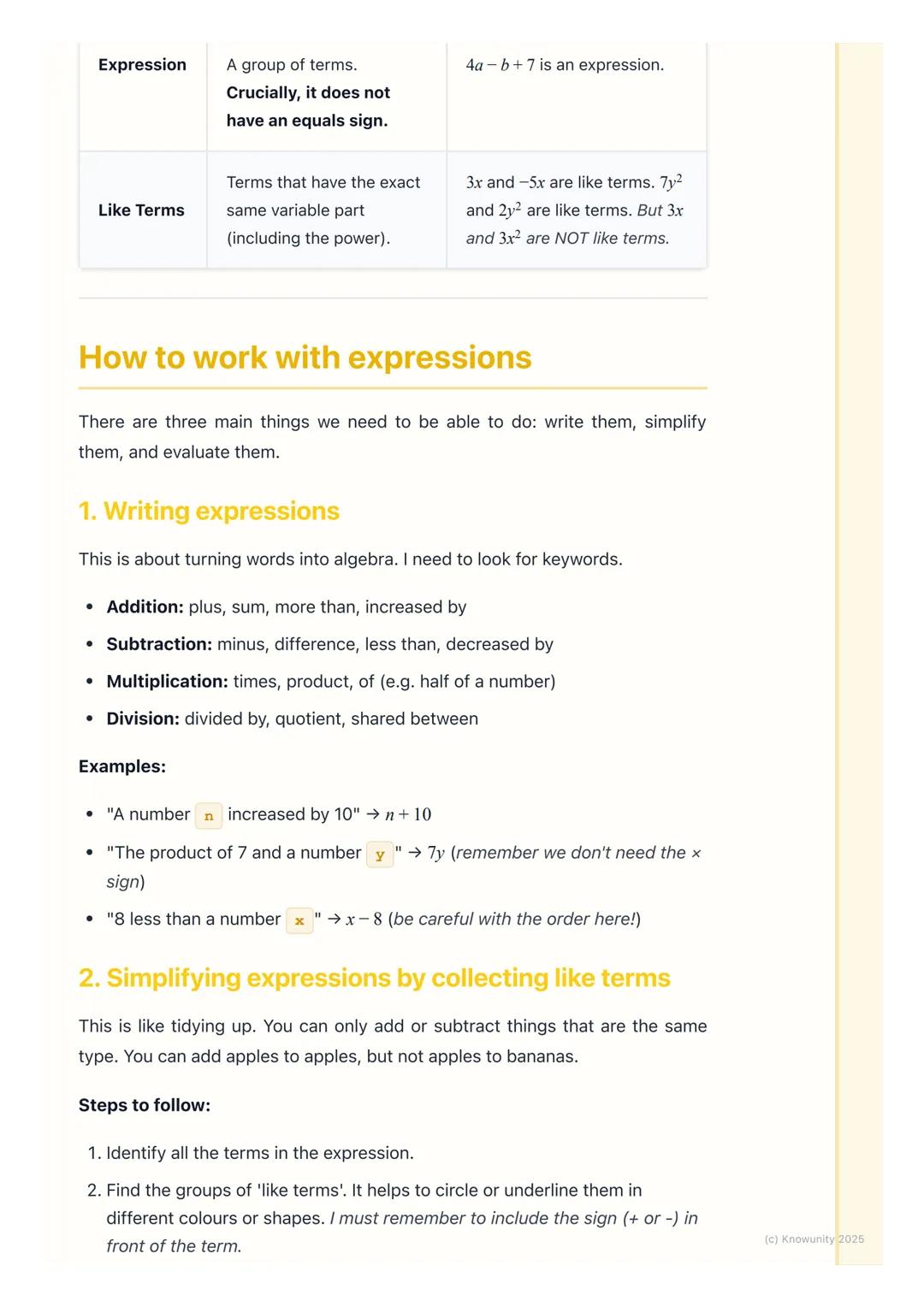
Writing Expressions from Words
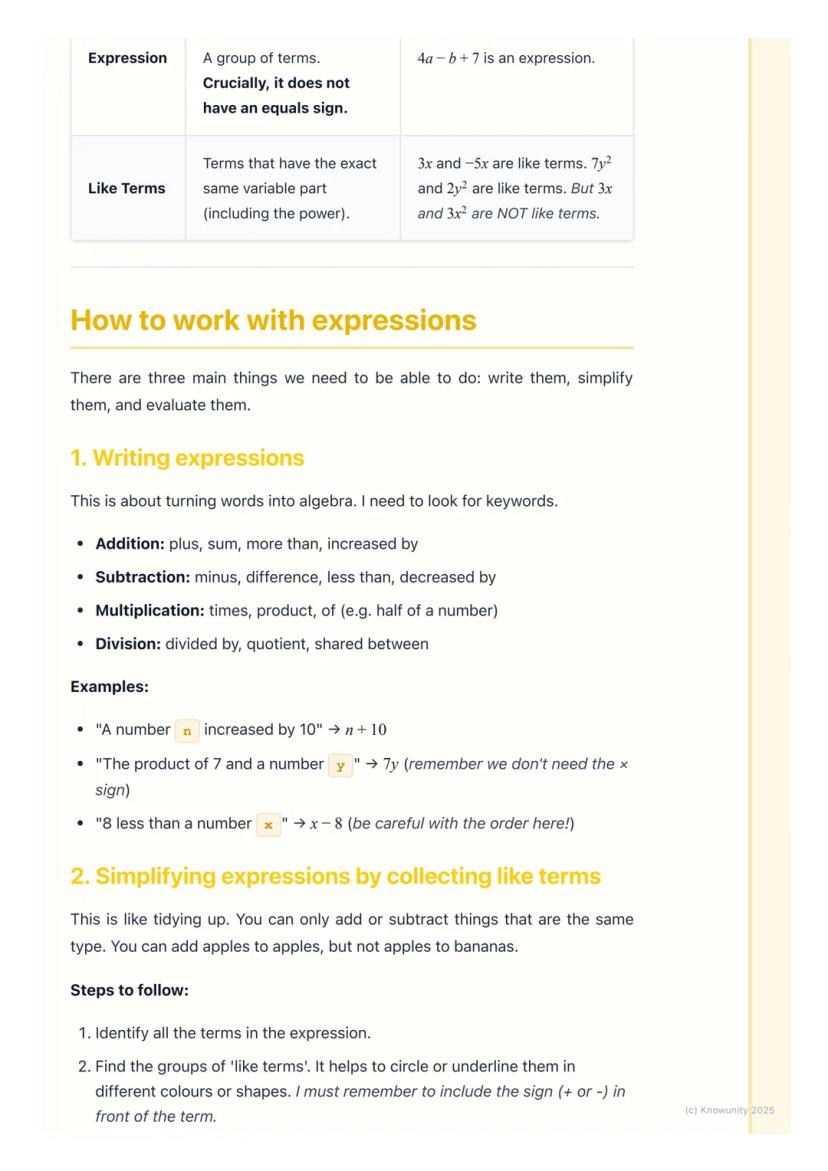
Converting word problems into algebraic expressions is all about spotting the right keywords. Once you know what to look for, it becomes like translating from English to maths.
Addition keywords: plus, sum, more than, increased by
Subtraction keywords: minus, difference, less than, decreased by
Multiplication keywords: times, product, of (like "half of a number")
Division keywords: divided by, quotient, shared between
Watch out for tricky phrases like "8 less than a number x" - this becomes x - 8, not 8 - x. The order matters! "A number n increased by 10" simply becomes n + 10, while "the product of 7 and a number y" becomes 7y (no multiplication sign needed).
Top tip: Always double-check the order, especially with subtraction. "Less than" flips the order around!
3
of 5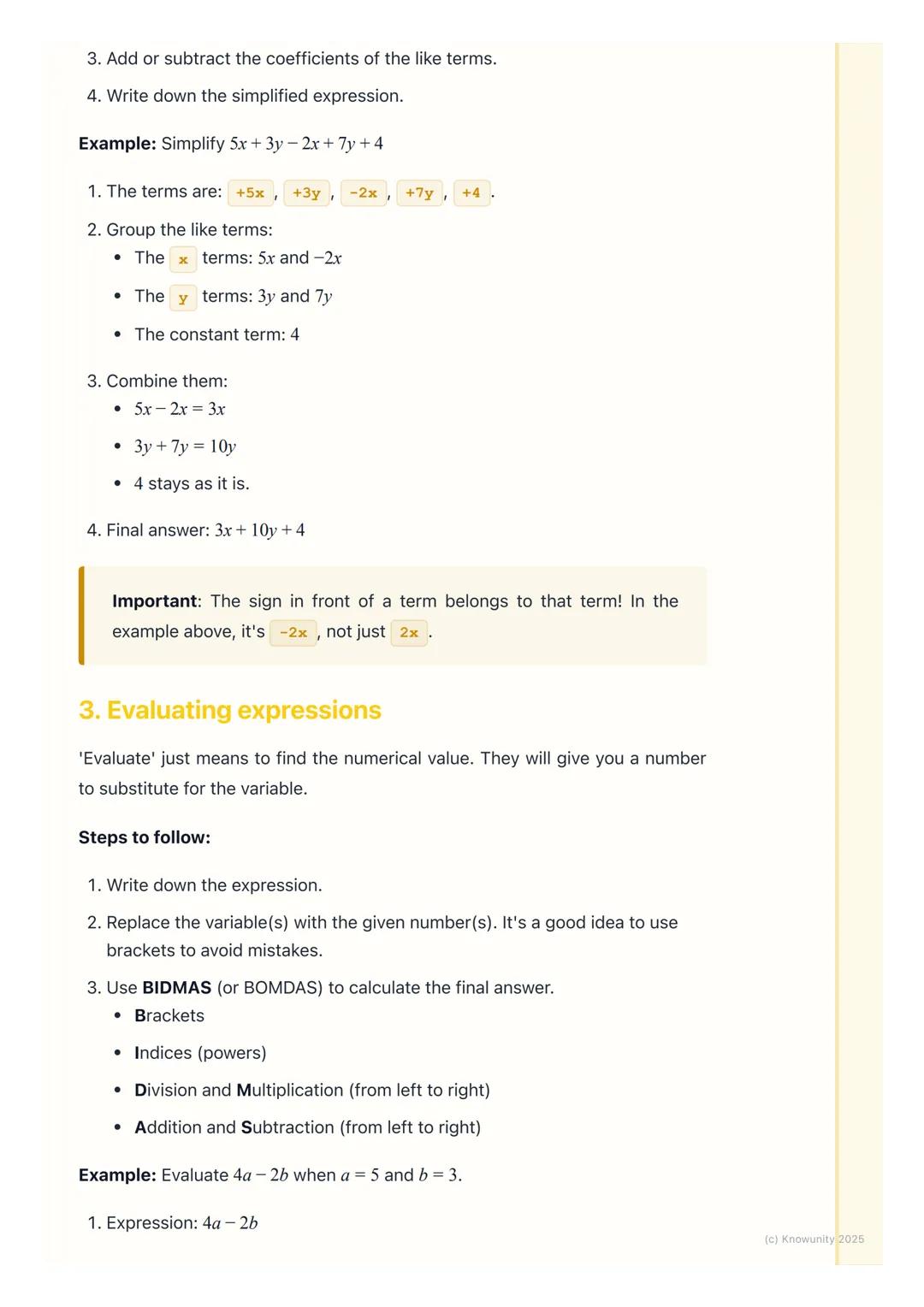
Simplifying by Collecting Like Terms
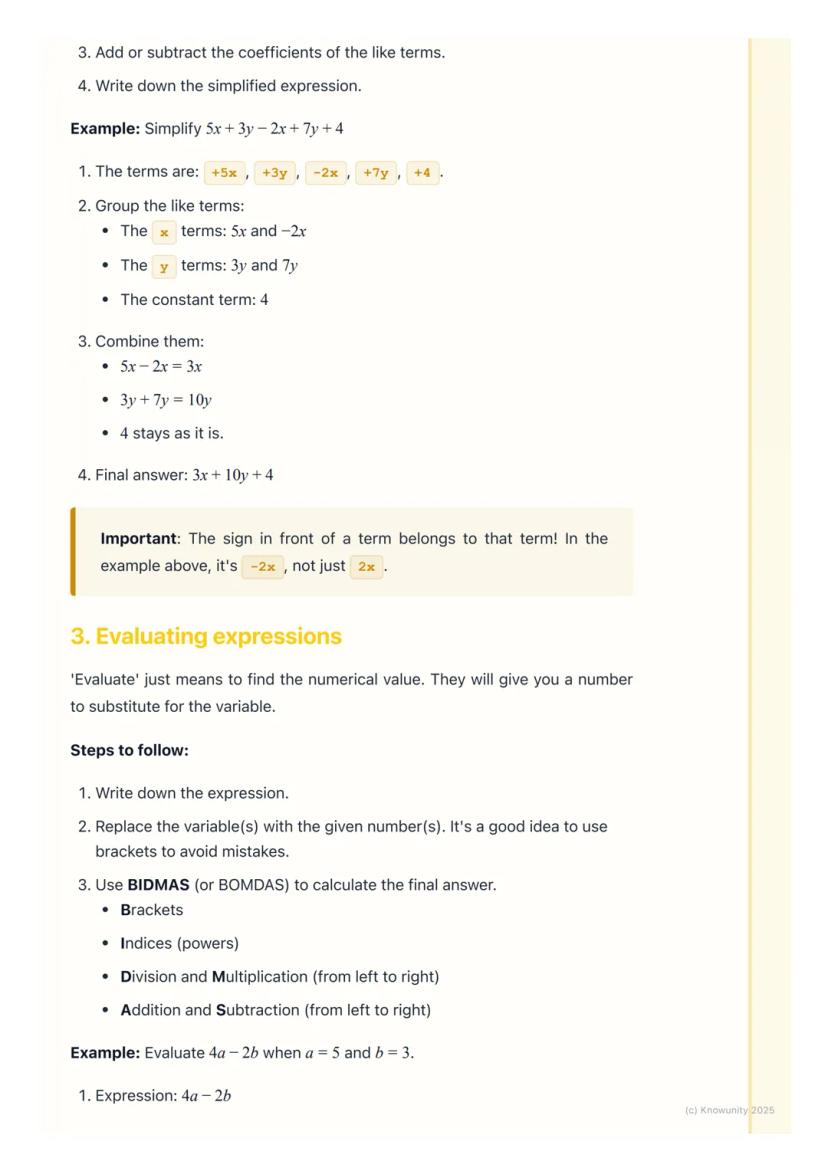
Simplifying expressions is like tidying your room - you group similar things together. You can only combine terms that are exactly the same type, just like you can add apples to apples but not apples to oranges.
Here's your step-by-step process: First, identify all the terms in the expression. Next, find groups of like terms - it helps to circle them in different colours. Remember to include the + or - sign with each term!
Then add or subtract the coefficients (the numbers in front) of like terms. Finally, write your simplified expression.
Let's try: 5x + 3y - 2x + 7y + 4. Group the x terms , the y terms (3y and 7y), and the constant (4). Combine: 5x - 2x = 3x, 3y + 7y = 10y, and 4 stays as is. Your answer: 3x + 10y + 4.
Watch out: The sign in front of a term belongs to that term! So -2x means negative 2x, not positive 2x that you subtract later.
4
of 5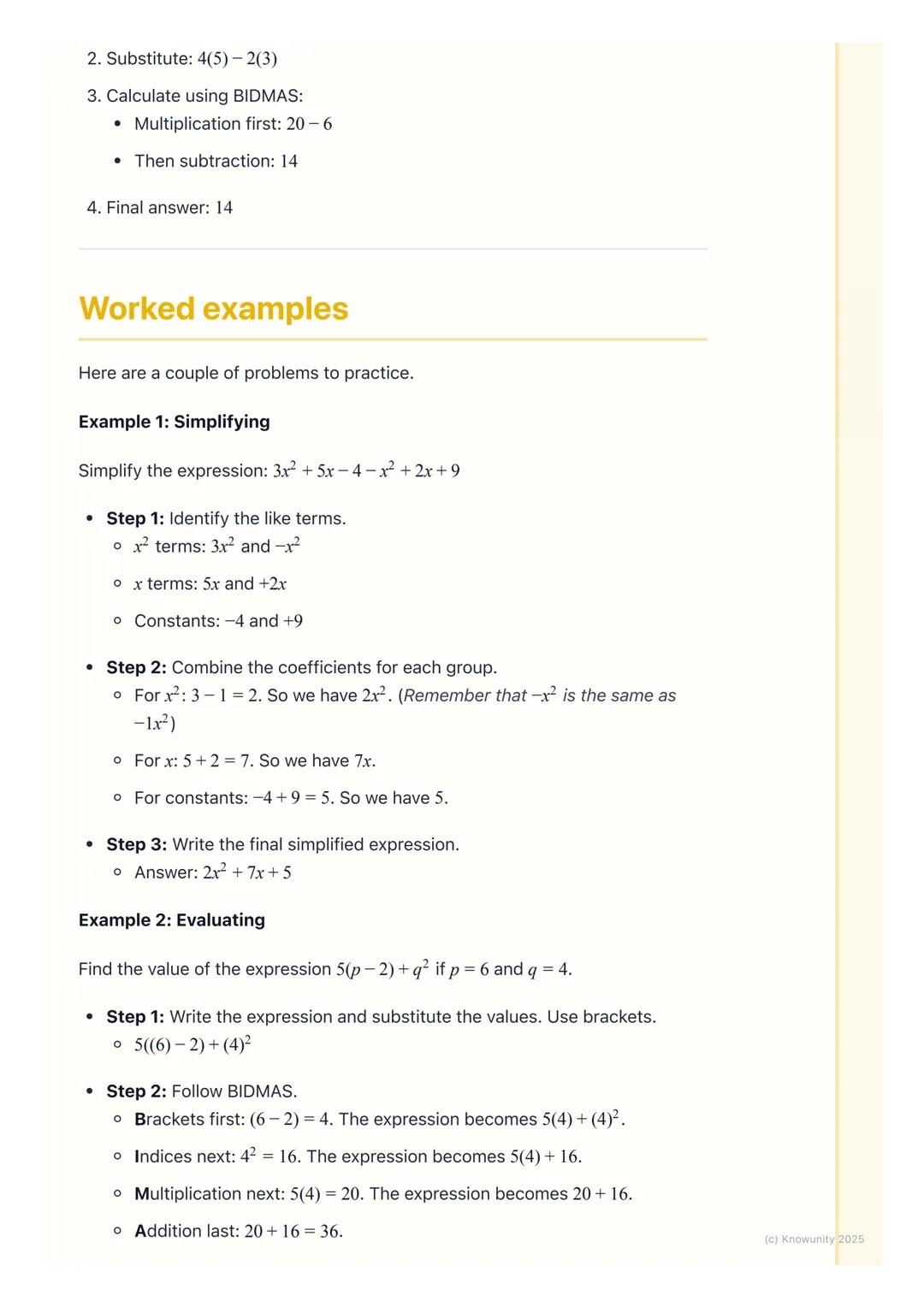
Evaluating Expressions
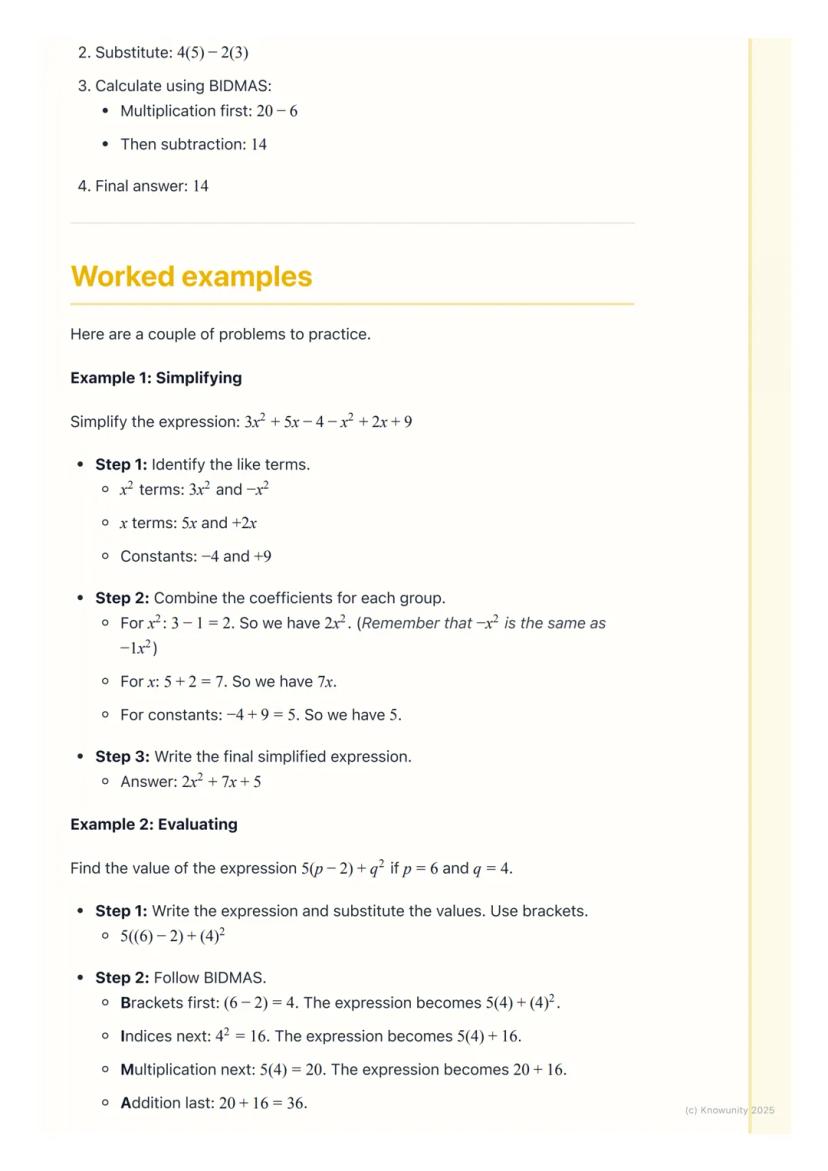
Evaluating expressions means finding the actual number value when you're given specific values for the variables. It's like following a recipe when you finally know all the ingredients.
Your method is simple: write the expression, replace each variable with its given number (use brackets to avoid mistakes!), then use BIDMAS to calculate your final answer.
BIDMAS stands for: Brackets, Indices (powers), Division and Multiplication (left to right), Addition and Subtraction (left to right).
Example: Evaluate 4a - 2b when a = 5 and b = 3. Substitute: 4(5) - 2(3). Calculate: 20 - 6 = 14.
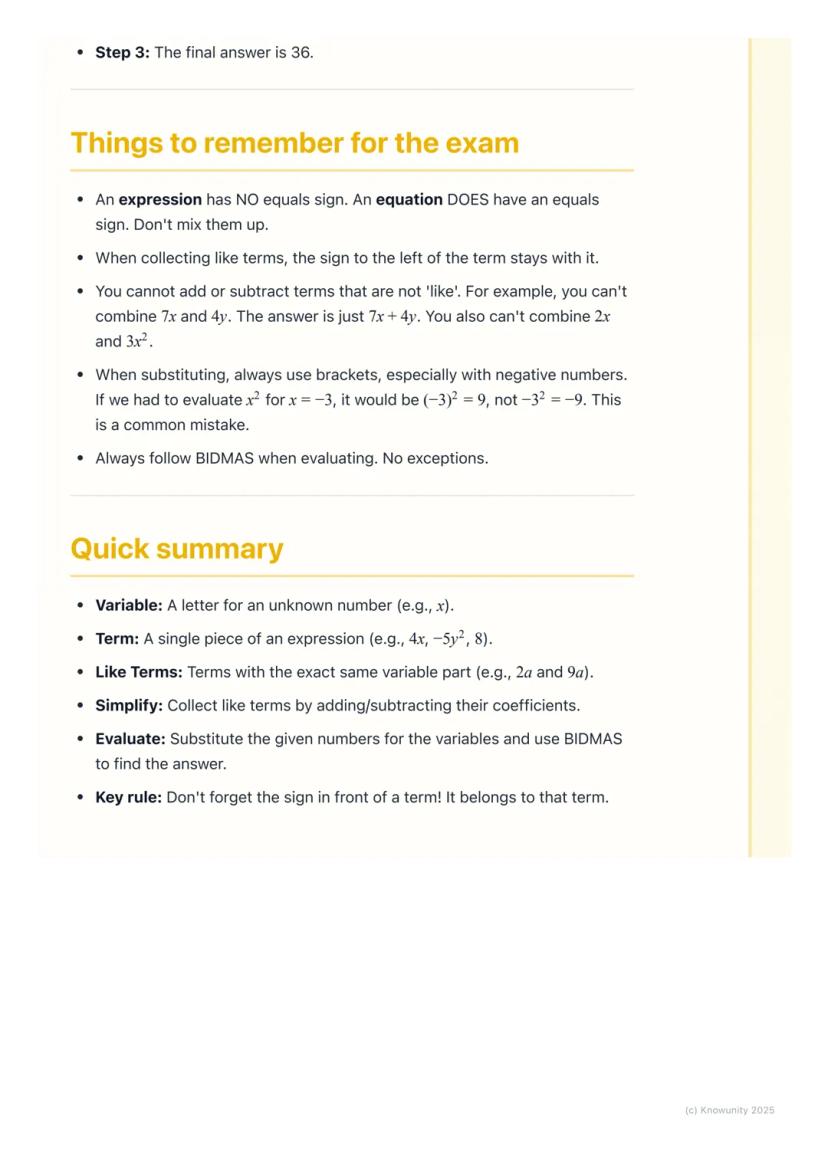
Pro tip: Always use brackets when substituting, especially with negative numbers. If x = -3, then x² = (-3)² = 9, not -3² = -9!
5
of 5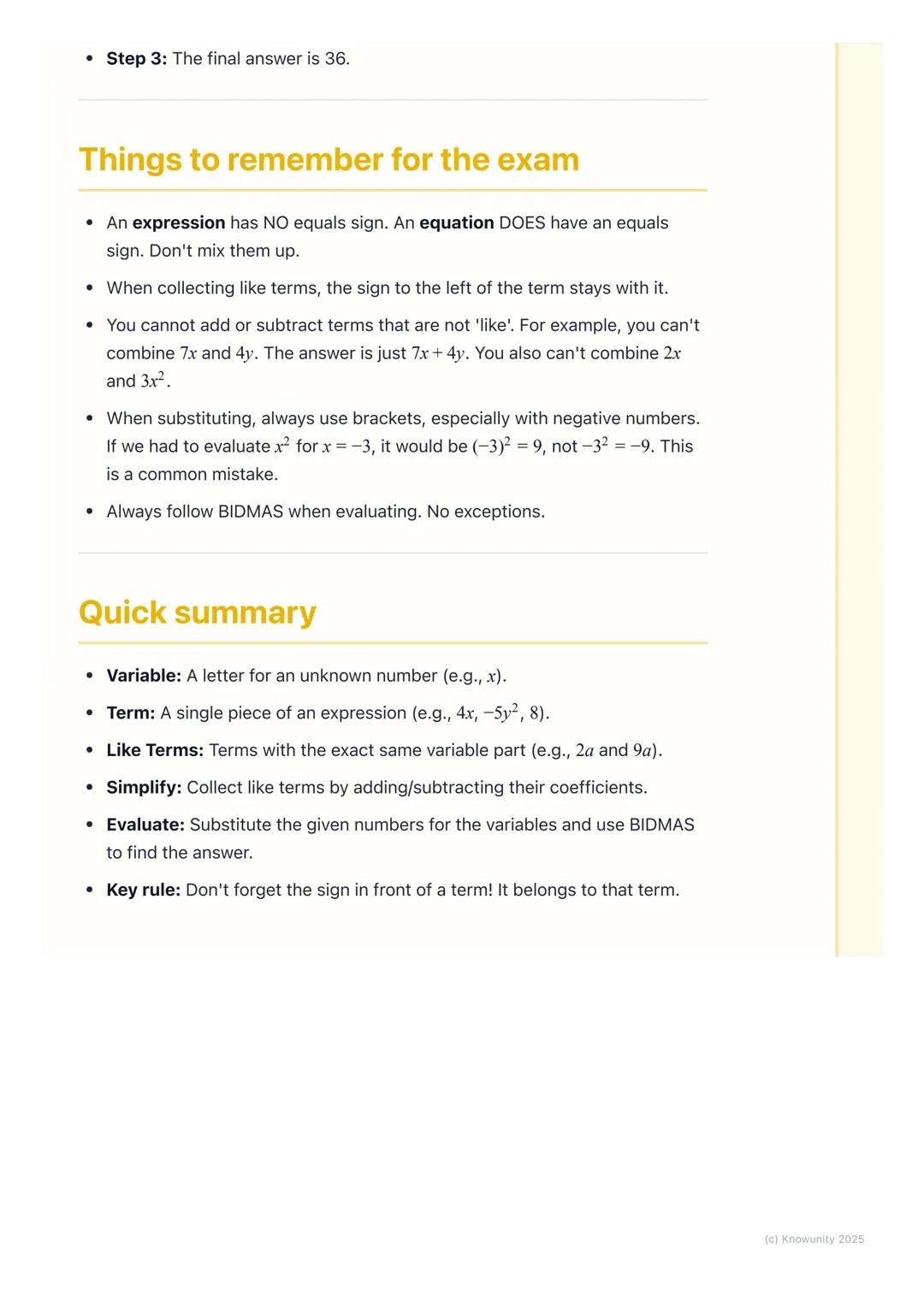
Key Points for Success
The most important thing to remember is that expressions have no equals sign, while equations do. Don't mix them up in exams!
When collecting like terms, that + or - sign stays with its term. You can't combine terms that aren't alike - 7x and 4y stay as 7x + 4y, and 2x and 3x² can't be combined either.
Always use brackets when substituting values, and never skip BIDMAS when evaluating. These simple rules will save you from most common mistakes.
Quick recap: Variables are letters for unknown numbers, terms are the separate parts of expressions, like terms have identical variable parts, simplifying means collecting like terms, and evaluating means substituting numbers and calculating.
Exam success: Master these basics now, and algebraic expressions will become your mathematical superpower for tackling more complex problems later!
Pensamos que nunca lo preguntarías...
¿Qué es Knowunity AI companion?
Nuestro compañero de IA está específicamente adaptado a las necesidades de los estudiantes. Basándonos en los millones de contenidos que tenemos en la plataforma, podemos dar a los estudiantes respuestas realmente significativas y relevantes. Pero no se trata solo de respuestas, el compañero también guía a los estudiantes a través de sus retos de aprendizaje diarios, con planes de aprendizaje personalizados, cuestionarios o contenidos en el chat y una personalización del 100% basada en las habilidades y el desarrollo de los estudiantes.
¿Dónde puedo descargar la app Knowunity?
Puedes descargar la app en Google Play Store y Apple App Store.
¿Knowunity es totalmente gratuito?
Sí, tienes acceso gratuito a los contenidos de la aplicación y a nuestro compañero de IA. Para desbloquear determinadas funciones de la aplicación, puedes adquirir Knowunity Pro.
Contenidos más populares de Mathematics
8Contenidos más populares
9¿No encuentras lo que buscas? Explora otros temas.
Mira lo que dicen nuestros usuarios. Les encanta - y a tí también.
4.6/5App Store
4.7/5Google Play
La app es muy fácil de usar y está muy bien diseñada. Hasta ahora he encontrado todo lo que estaba buscando y he podido aprender mucho de las presentaciones. Definitivamente utilizaré la aplicación para un examen de clase. Y, por supuesto, también me sirve mucho de inspiración.
Pablousuario de iOS
Esta app es realmente genial. Hay tantos apuntes de clase y ayuda [...]. Tengo problemas con matemáticas, por ejemplo, y la aplicación tiene muchas opciones de ayuda. Gracias a Knowunity, he mejorado en mates. Se la recomiendo a todo el mundo.
Elenausuaria de Android
Vaya, estoy realmente sorprendida. Acabo de probar la app porque la he visto anunciada muchas veces y me he quedado absolutamente alucinada. Esta app es LA AYUDA que quieres para el insti y, sobre todo, ofrece muchísimas cosas, como ejercicios y hojas informativas, que a mí personalmente me han sido MUY útiles.
Anausuaria de iOS
Mathematics13 visualizaciones·Actualizado Jun 2, 2026·5 páginasUnderstanding and Simplifying Algebraic Expressions
Ever wondered why we use letters in maths? Algebraic expressions are like mathematical recipes that use letters (called variables) to represent unknown numbers. They're the building blocks you'll need to master before tackling equations, and once you get the hang... Mostrar más
1
of 5Inscríbete para ver los apuntes. ¡Es gratis!
- Acceso a todos los documentos
- Mejora tus notas
- Únete a millones de estudiantes
What are Algebraic Expressions?
Think of algebraic expressions as mathematical phrases that mix numbers, letters, and operation signs (+, -, ×, ÷). Unlike equations, expressions don't have an equals sign - they're just a collection of mathematical terms waiting to be worked with.
The letters in expressions are called variables, and they represent unknown numbers. A term is each separate part of an expression, like 4x, -5y, or just 8 on its own.
Like terms are terms that have exactly the same variable part, including any powers. For example, 3x and -5x are like terms because they both have just 'x'. However, 3x and 3x² are NOT like terms because one has x and the other has x².
Remember: Expressions are the foundation for solving equations later, so getting comfortable with these basics now will make your life much easier!
2
of 5Inscríbete para ver los apuntes. ¡Es gratis!
- Acceso a todos los documentos
- Mejora tus notas
- Únete a millones de estudiantes
Writing Expressions from Words
Converting word problems into algebraic expressions is all about spotting the right keywords. Once you know what to look for, it becomes like translating from English to maths.
Addition keywords: plus, sum, more than, increased by
Subtraction keywords: minus, difference, less than, decreased by
Multiplication keywords: times, product, of (like "half of a number")
Division keywords: divided by, quotient, shared between
Watch out for tricky phrases like "8 less than a number x" - this becomes x - 8, not 8 - x. The order matters! "A number n increased by 10" simply becomes n + 10, while "the product of 7 and a number y" becomes 7y (no multiplication sign needed).
Top tip: Always double-check the order, especially with subtraction. "Less than" flips the order around!
3
of 5Inscríbete para ver los apuntes. ¡Es gratis!
- Acceso a todos los documentos
- Mejora tus notas
- Únete a millones de estudiantes
Simplifying by Collecting Like Terms
Simplifying expressions is like tidying your room - you group similar things together. You can only combine terms that are exactly the same type, just like you can add apples to apples but not apples to oranges.
Here's your step-by-step process: First, identify all the terms in the expression. Next, find groups of like terms - it helps to circle them in different colours. Remember to include the + or - sign with each term!
Then add or subtract the coefficients (the numbers in front) of like terms. Finally, write your simplified expression.
Let's try: 5x + 3y - 2x + 7y + 4. Group the x terms , the y terms (3y and 7y), and the constant (4). Combine: 5x - 2x = 3x, 3y + 7y = 10y, and 4 stays as is. Your answer: 3x + 10y + 4.
Watch out: The sign in front of a term belongs to that term! So -2x means negative 2x, not positive 2x that you subtract later.
4
of 5Inscríbete para ver los apuntes. ¡Es gratis!
- Acceso a todos los documentos
- Mejora tus notas
- Únete a millones de estudiantes
Evaluating Expressions
Evaluating expressions means finding the actual number value when you're given specific values for the variables. It's like following a recipe when you finally know all the ingredients.
Your method is simple: write the expression, replace each variable with its given number (use brackets to avoid mistakes!), then use BIDMAS to calculate your final answer.
BIDMAS stands for: Brackets, Indices (powers), Division and Multiplication (left to right), Addition and Subtraction (left to right).
Example: Evaluate 4a - 2b when a = 5 and b = 3. Substitute: 4(5) - 2(3). Calculate: 20 - 6 = 14.
Pro tip: Always use brackets when substituting, especially with negative numbers. If x = -3, then x² = (-3)² = 9, not -3² = -9!
5
of 5Inscríbete para ver los apuntes. ¡Es gratis!
- Acceso a todos los documentos
- Mejora tus notas
- Únete a millones de estudiantes
Key Points for Success
The most important thing to remember is that expressions have no equals sign, while equations do. Don't mix them up in exams!
When collecting like terms, that + or - sign stays with its term. You can't combine terms that aren't alike - 7x and 4y stay as 7x + 4y, and 2x and 3x² can't be combined either.
Always use brackets when substituting values, and never skip BIDMAS when evaluating. These simple rules will save you from most common mistakes.
Quick recap: Variables are letters for unknown numbers, terms are the separate parts of expressions, like terms have identical variable parts, simplifying means collecting like terms, and evaluating means substituting numbers and calculating.
Exam success: Master these basics now, and algebraic expressions will become your mathematical superpower for tackling more complex problems later!
Pensamos que nunca lo preguntarías...
¿Qué es Knowunity AI companion?
Nuestro compañero de IA está específicamente adaptado a las necesidades de los estudiantes. Basándonos en los millones de contenidos que tenemos en la plataforma, podemos dar a los estudiantes respuestas realmente significativas y relevantes. Pero no se trata solo de respuestas, el compañero también guía a los estudiantes a través de sus retos de aprendizaje diarios, con planes de aprendizaje personalizados, cuestionarios o contenidos en el chat y una personalización del 100% basada en las habilidades y el desarrollo de los estudiantes.
¿Dónde puedo descargar la app Knowunity?
Puedes descargar la app en Google Play Store y Apple App Store.
¿Knowunity es totalmente gratuito?
Sí, tienes acceso gratuito a los contenidos de la aplicación y a nuestro compañero de IA. Para desbloquear determinadas funciones de la aplicación, puedes adquirir Knowunity Pro.
Contenidos más populares de Mathematics
8Contenidos más populares
9¿No encuentras lo que buscas? Explora otros temas.
Mira lo que dicen nuestros usuarios. Les encanta - y a tí también.
4.6/5App Store
4.7/5Google Play
La app es muy fácil de usar y está muy bien diseñada. Hasta ahora he encontrado todo lo que estaba buscando y he podido aprender mucho de las presentaciones. Definitivamente utilizaré la aplicación para un examen de clase. Y, por supuesto, también me sirve mucho de inspiración.
Pablousuario de iOS
Esta app es realmente genial. Hay tantos apuntes de clase y ayuda [...]. Tengo problemas con matemáticas, por ejemplo, y la aplicación tiene muchas opciones de ayuda. Gracias a Knowunity, he mejorado en mates. Se la recomiendo a todo el mundo.
Elenausuaria de Android
Vaya, estoy realmente sorprendida. Acabo de probar la app porque la he visto anunciada muchas veces y me he quedado absolutamente alucinada. Esta app es LA AYUDA que quieres para el insti y, sobre todo, ofrece muchísimas cosas, como ejercicios y hojas informativas, que a mí personalmente me han sido MUY útiles.
Anausuaria de iOS