
Ever wondered why footballers curve their shots or why basketball...
 LCPE3 visualizaciones·Actualizado Jun 9, 2026·5 páginas
Understanding the Basics of Projectile Motion

1 / 5
1
of 5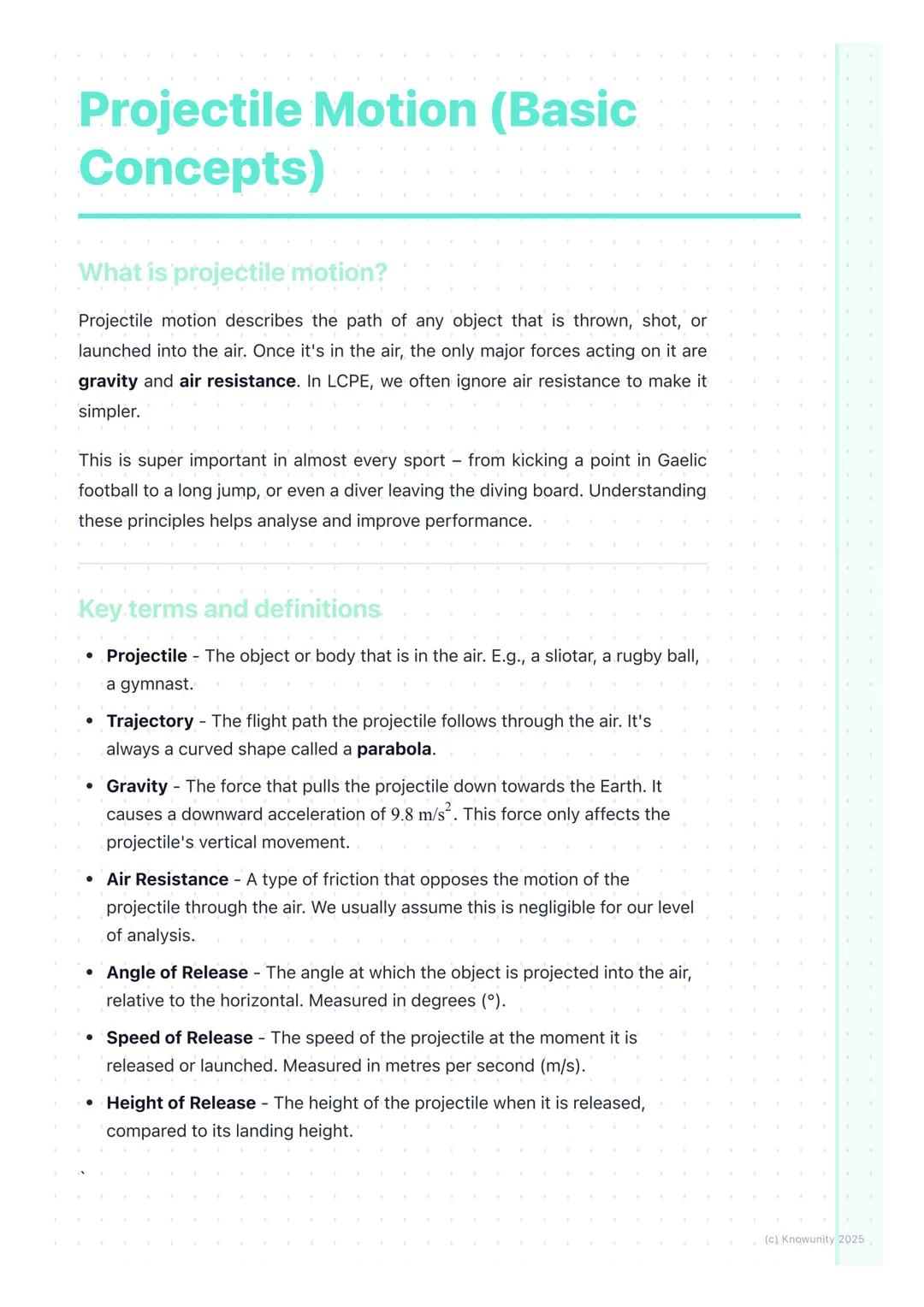
What is Projectile Motion?
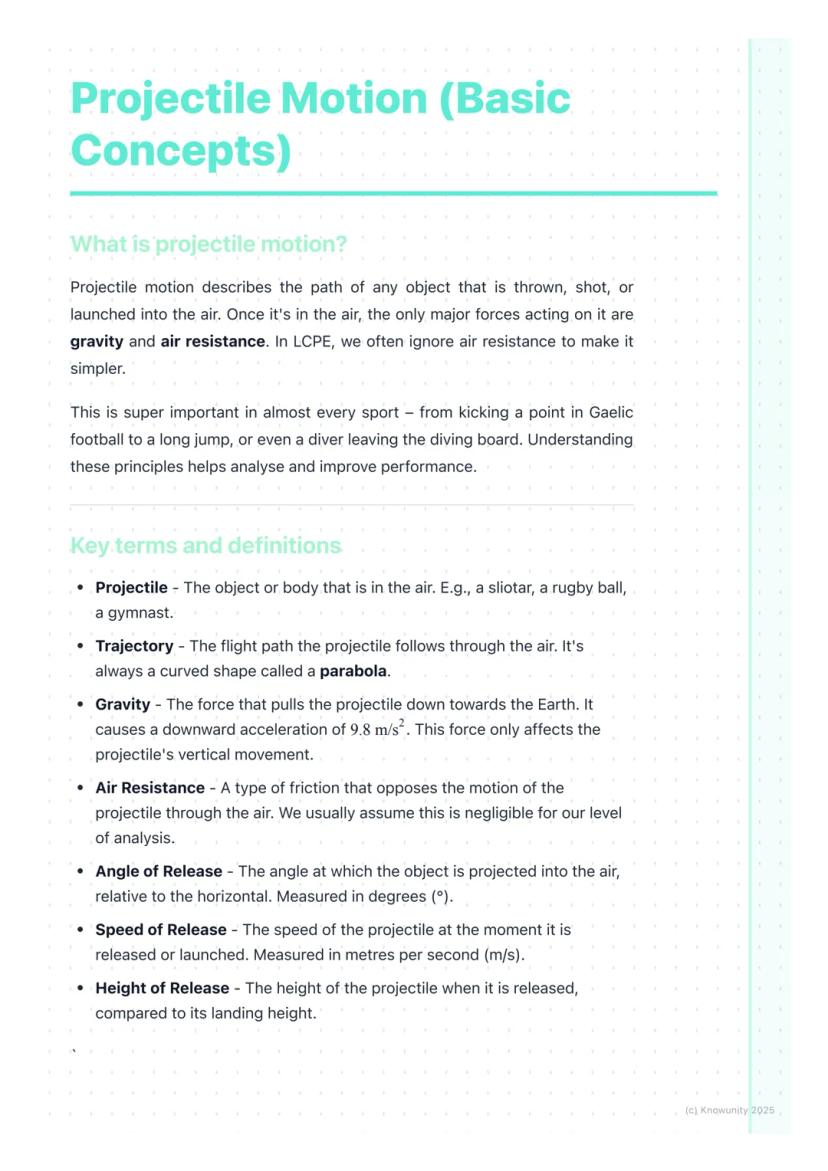
Think about every time you've kicked a football or thrown something - you've created projectile motion. This describes how objects move through the air once they've been launched, with only gravity pulling them down.
The most important thing to remember? Once an object is airborne, gravity is the main force affecting it (we'll ignore air resistance to keep things simple). This creates that curved path you always see when balls fly through the air.
Key terms you absolutely need to know:
- Projectile - the object in the air (could be a ball, or even a person jumping)
- Trajectory - the curved flight path, always shaped like a parabola
- Gravity - pulls everything down at 9.8 m/s², but only affects vertical movement
- Angle of release - the direction you launch the object (measured in degrees from horizontal)
Remember: Air resistance exists in real life, but we usually ignore it in physics problems to make calculations easier!
2
of 5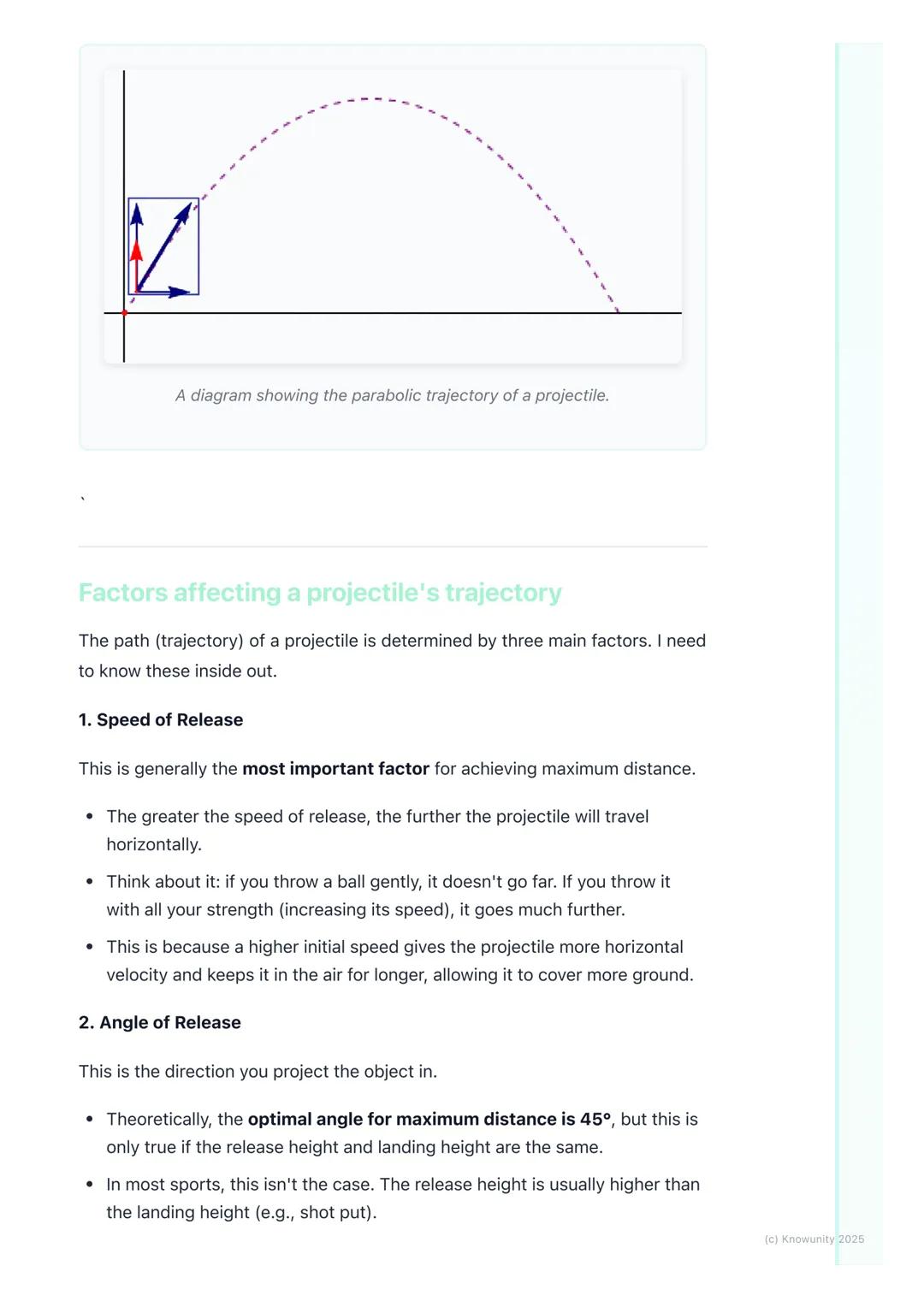
The Three Key Factors
Your projectile's path depends on three main factors that you need to master. Get these right and you'll ace any exam question about projectile motion.
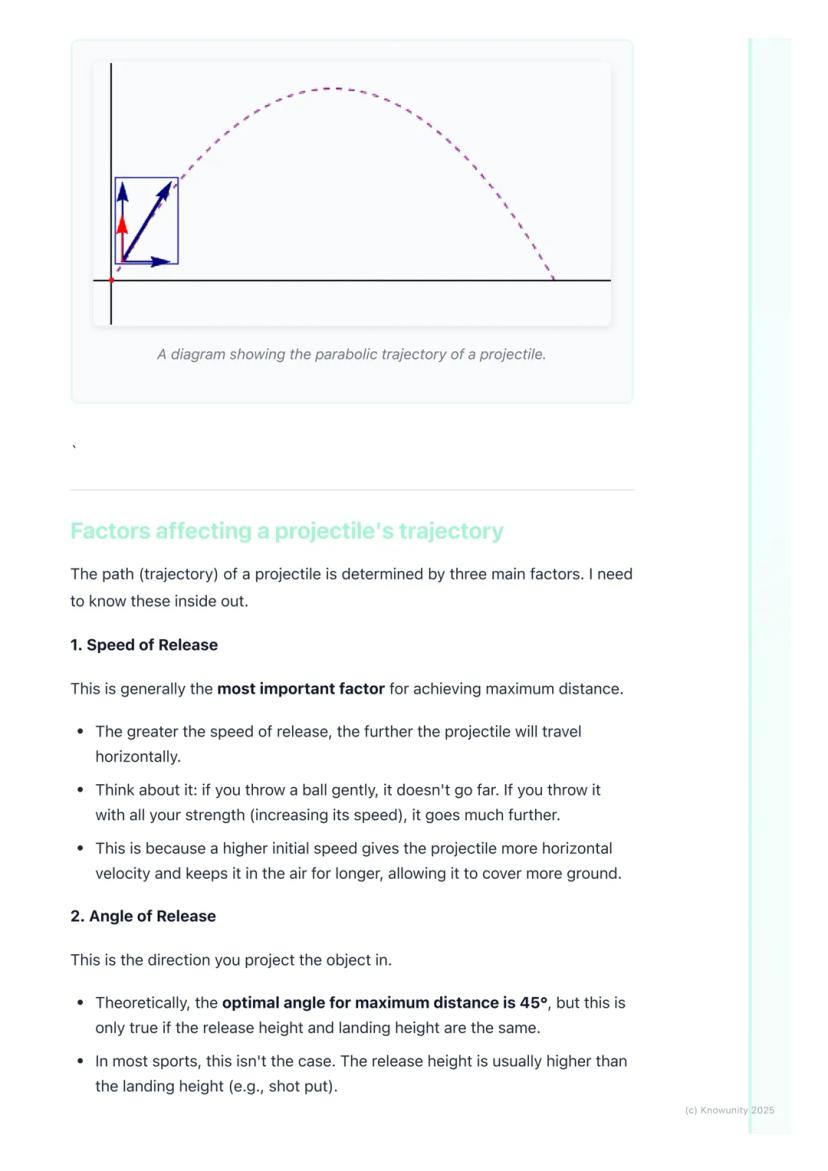
Speed of release is usually the most important factor. Launch something faster and it travels further horizontally - simple as that. It's like the difference between gently tossing a ball versus hurling it with all your strength.
Angle of release determines the direction. Here's the crucial bit: whilst 45° gives maximum distance in theory, this only works when you're launching and landing at the same height. In most sports, you're releasing from a different height than where it lands.
If you're releasing higher than the landing point (like shot put), aim slightly lower than 45°. If you're aiming upwards (like chipping a football over a goalkeeper), go slightly higher than 45°.
Top tip: Don't just memorise "45° is optimal" - explain why it changes in real sports situations!
3
of 5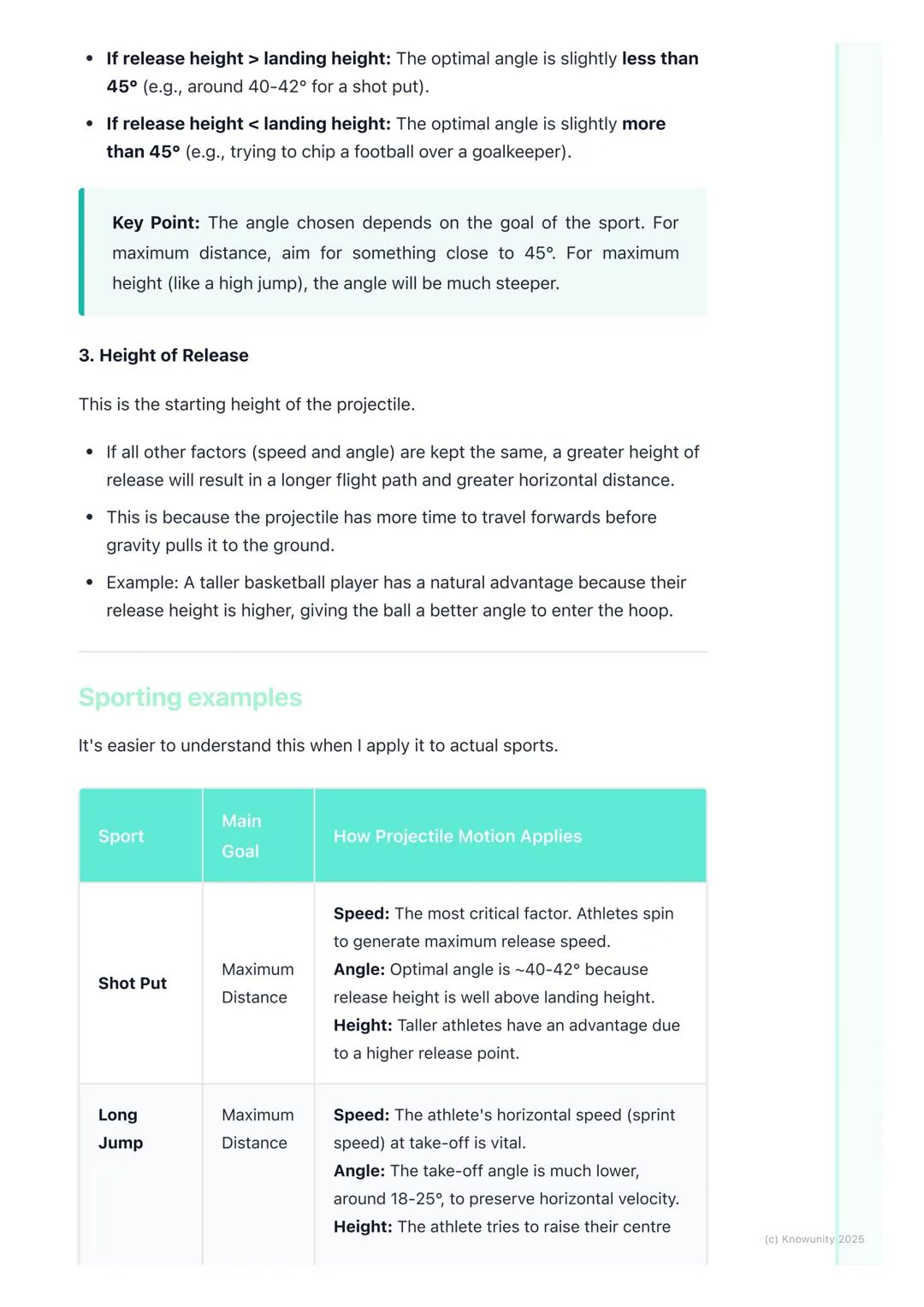
Height of Release Matters
Height of release gives you a massive advantage in many sports. Release something from higher up, and it has more time to travel forward before gravity brings it down to earth.
This explains why taller basketball players have natural advantages - their higher release point gives the ball a better angle into the hoop. It's also why shot putters try to release the shot as high as possible during their throw.
Real sporting examples make this clearer:
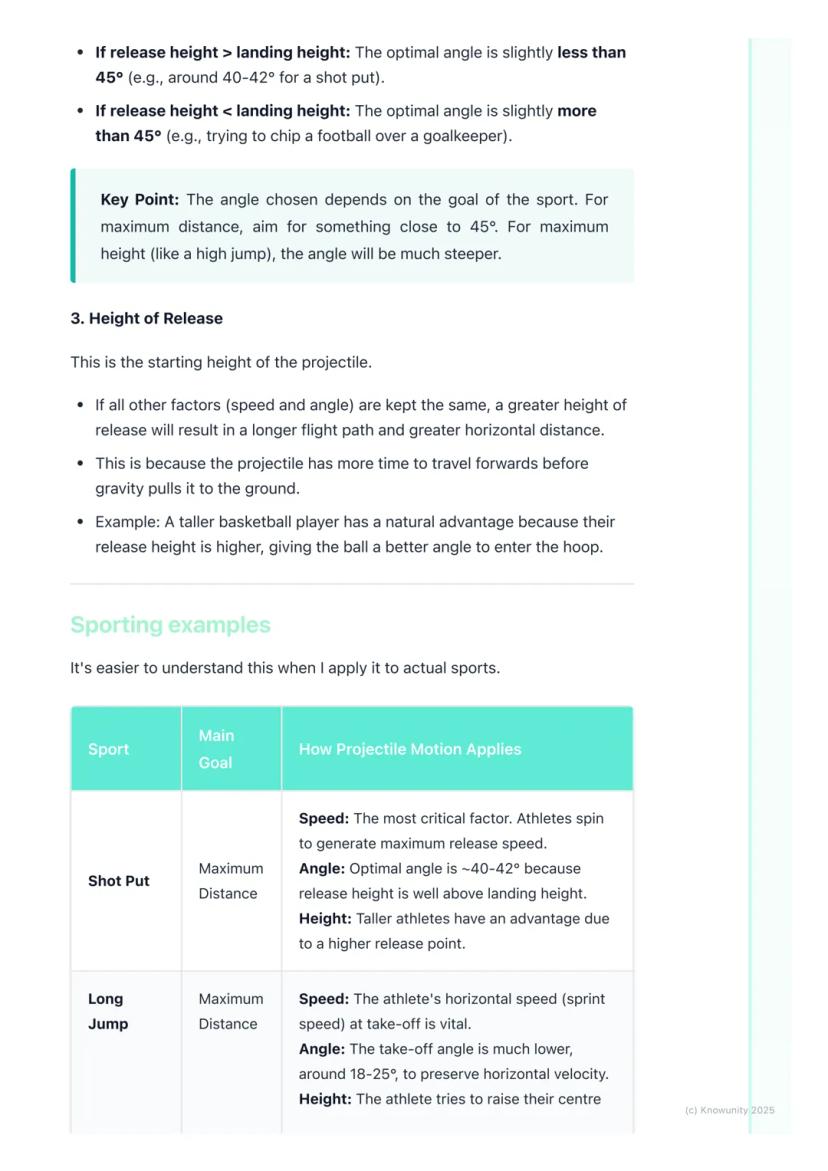
- Basketball shots need controlled speed, high angles (50-55°), and maximum release height
- Shot put requires maximum speed, optimal angles around 40-42°, and releasing as high as possible
- Long jump focuses on speed and getting your centre of mass as high as possible at take-off
The beauty of projectile motion is that you can split it into two parts: horizontal movement (constant speed) and vertical movement (constantly changing due to gravity).
Exam gold: Always mention that you're ignoring air resistance - it shows you understand the assumptions we make!
4
of 5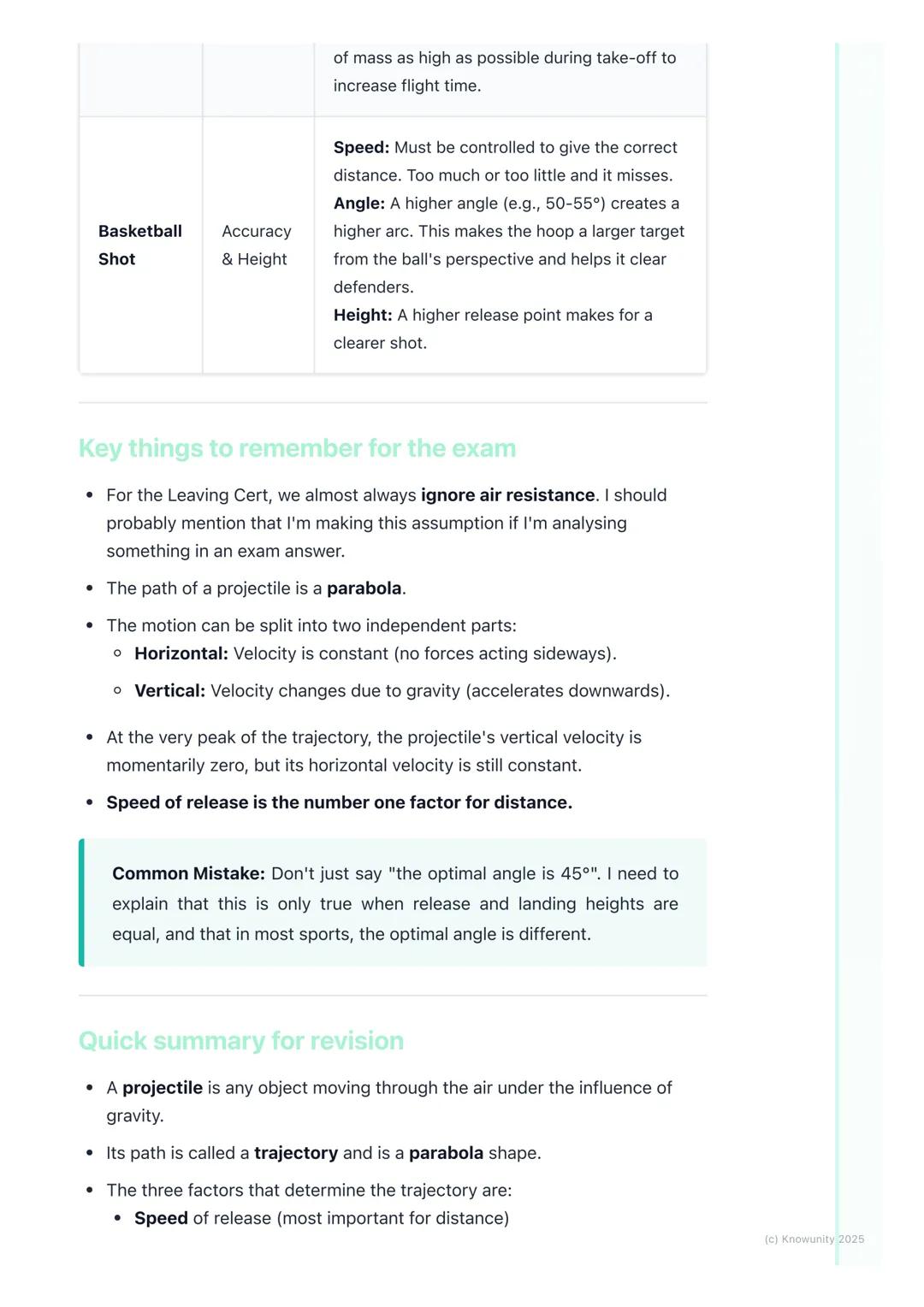
Essential Points for Success
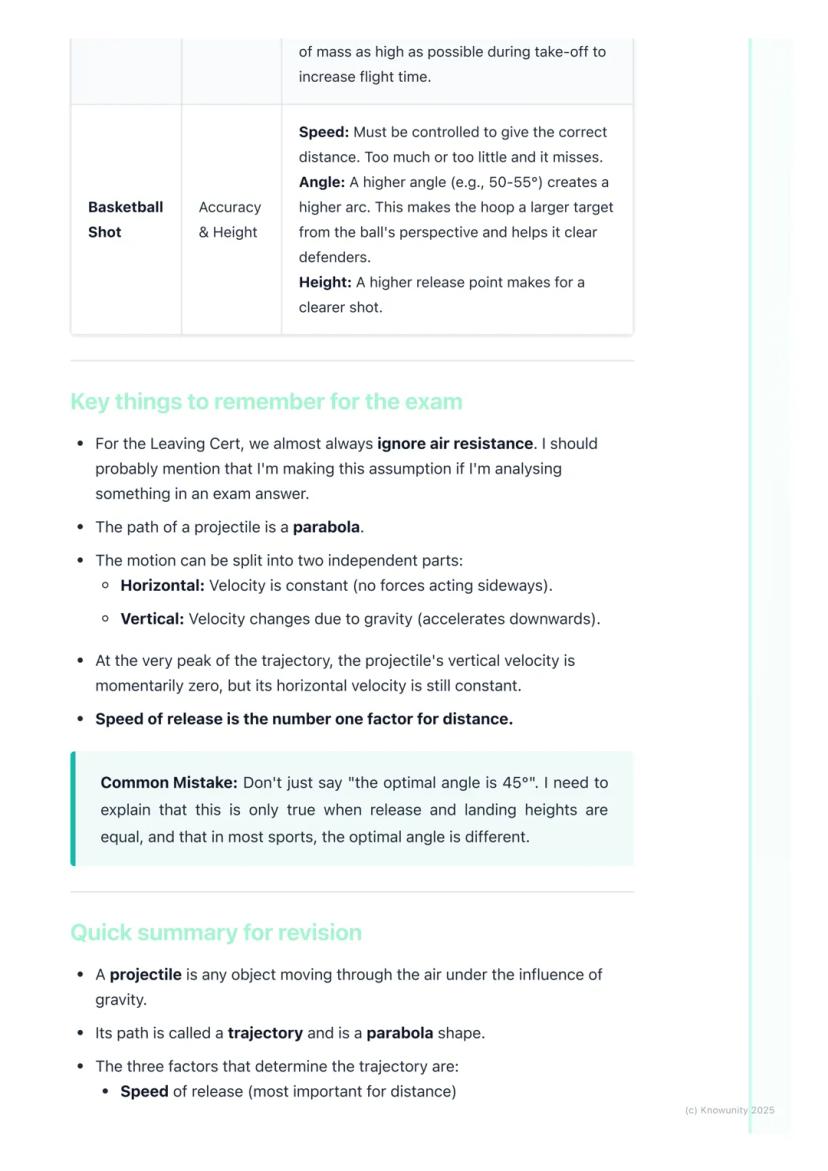
At the peak of any trajectory, something interesting happens - the vertical speed becomes zero for a split second, but horizontal speed stays constant throughout the entire flight.
Gravity only affects the up-and-down motion, never the side-to-side movement. This is why projectiles follow that characteristic parabola shape every single time.
For your exams, remember that speed of release trumps everything else when you want maximum distance. Angle and height matter, but getting that initial speed right is crucial.
Don't fall into the common trap of saying "45° is always optimal" without explaining the conditions. Show you understand that real sports rarely have equal release and landing heights.
Quick revision checklist:
- Projectile = object in air under gravity's influence
- Trajectory = parabola-shaped flight path
- Three factors: speed (most important), angle, and height of release
- Horizontal motion = constant velocity
- Vertical motion = changes due to gravity
Confidence booster: You've got this! These concepts appear everywhere in sport, so you already have intuitive understanding from watching games.
5
of 5
Pensamos que nunca lo preguntarías...
¿Qué es Knowunity AI companion?
Nuestro compañero de IA está específicamente adaptado a las necesidades de los estudiantes. Basándonos en los millones de contenidos que tenemos en la plataforma, podemos dar a los estudiantes respuestas realmente significativas y relevantes. Pero no se trata solo de respuestas, el compañero también guía a los estudiantes a través de sus retos de aprendizaje diarios, con planes de aprendizaje personalizados, cuestionarios o contenidos en el chat y una personalización del 100% basada en las habilidades y el desarrollo de los estudiantes.
¿Dónde puedo descargar la app Knowunity?
Puedes descargar la app en Google Play Store y Apple App Store.
¿Knowunity es totalmente gratuito?
Sí, tienes acceso gratuito a los contenidos de la aplicación y a nuestro compañero de IA. Para desbloquear determinadas funciones de la aplicación, puedes adquirir Knowunity Pro.
Contenidos más populares de LCPE
4Contenidos más populares
9¿No encuentras lo que buscas? Explora otros temas.
Mira lo que dicen nuestros usuarios. Les encanta - y a tí también.
4.6/5App Store
4.7/5Google Play
La app es muy fácil de usar y está muy bien diseñada. Hasta ahora he encontrado todo lo que estaba buscando y he podido aprender mucho de las presentaciones. Definitivamente utilizaré la aplicación para un examen de clase. Y, por supuesto, también me sirve mucho de inspiración.
Pablousuario de iOS
Esta app es realmente genial. Hay tantos apuntes de clase y ayuda [...]. Tengo problemas con matemáticas, por ejemplo, y la aplicación tiene muchas opciones de ayuda. Gracias a Knowunity, he mejorado en mates. Se la recomiendo a todo el mundo.
Elenausuaria de Android
Vaya, estoy realmente sorprendida. Acabo de probar la app porque la he visto anunciada muchas veces y me he quedado absolutamente alucinada. Esta app es LA AYUDA que quieres para el insti y, sobre todo, ofrece muchísimas cosas, como ejercicios y hojas informativas, que a mí personalmente me han sido MUY útiles.
Anausuaria de iOS
LCPE3 visualizaciones·Actualizado Jun 9, 2026·5 páginasUnderstanding the Basics of Projectile Motion
Ever wondered why footballers curve their shots or why basketball players aim high? Projectile motionexplains the path of any object flying through the air - from a sliotar in hurling to a long jumper soaring through the air. Once...
1
of 5
Inscríbete para ver los apuntes. ¡Es gratis!
- Acceso a todos los documentos
- Mejora tus notas
- Únete a millones de estudiantes
What is Projectile Motion?
Think about every time you've kicked a football or thrown something - you've created projectile motion. This describes how objects move through the air once they've been launched, with only gravity pulling them down.
The most important thing to remember? Once an object is airborne, gravity is the main force affecting it (we'll ignore air resistance to keep things simple). This creates that curved path you always see when balls fly through the air.
Key terms you absolutely need to know:
- Projectile - the object in the air (could be a ball, or even a person jumping)
- Trajectory - the curved flight path, always shaped like a parabola
- Gravity - pulls everything down at 9.8 m/s², but only affects vertical movement
- Angle of release - the direction you launch the object (measured in degrees from horizontal)
Remember: Air resistance exists in real life, but we usually ignore it in physics problems to make calculations easier!
2
of 5Inscríbete para ver los apuntes. ¡Es gratis!
- Acceso a todos los documentos
- Mejora tus notas
- Únete a millones de estudiantes
The Three Key Factors
Your projectile's path depends on three main factors that you need to master. Get these right and you'll ace any exam question about projectile motion.
Speed of release is usually the most important factor. Launch something faster and it travels further horizontally - simple as that. It's like the difference between gently tossing a ball versus hurling it with all your strength.
Angle of release determines the direction. Here's the crucial bit: whilst 45° gives maximum distance in theory, this only works when you're launching and landing at the same height. In most sports, you're releasing from a different height than where it lands.
If you're releasing higher than the landing point (like shot put), aim slightly lower than 45°. If you're aiming upwards (like chipping a football over a goalkeeper), go slightly higher than 45°.
Top tip: Don't just memorise "45° is optimal" - explain why it changes in real sports situations!
3
of 5Inscríbete para ver los apuntes. ¡Es gratis!
- Acceso a todos los documentos
- Mejora tus notas
- Únete a millones de estudiantes
Height of Release Matters
Height of release gives you a massive advantage in many sports. Release something from higher up, and it has more time to travel forward before gravity brings it down to earth.
This explains why taller basketball players have natural advantages - their higher release point gives the ball a better angle into the hoop. It's also why shot putters try to release the shot as high as possible during their throw.
Real sporting examples make this clearer:
- Basketball shots need controlled speed, high angles (50-55°), and maximum release height
- Shot put requires maximum speed, optimal angles around 40-42°, and releasing as high as possible
- Long jump focuses on speed and getting your centre of mass as high as possible at take-off
The beauty of projectile motion is that you can split it into two parts: horizontal movement (constant speed) and vertical movement (constantly changing due to gravity).
Exam gold: Always mention that you're ignoring air resistance - it shows you understand the assumptions we make!
4
of 5Inscríbete para ver los apuntes. ¡Es gratis!
- Acceso a todos los documentos
- Mejora tus notas
- Únete a millones de estudiantes
Essential Points for Success
At the peak of any trajectory, something interesting happens - the vertical speed becomes zero for a split second, but horizontal speed stays constant throughout the entire flight.
Gravity only affects the up-and-down motion, never the side-to-side movement. This is why projectiles follow that characteristic parabola shape every single time.
For your exams, remember that speed of release trumps everything else when you want maximum distance. Angle and height matter, but getting that initial speed right is crucial.
Don't fall into the common trap of saying "45° is always optimal" without explaining the conditions. Show you understand that real sports rarely have equal release and landing heights.
Quick revision checklist:
- Projectile = object in air under gravity's influence
- Trajectory = parabola-shaped flight path
- Three factors: speed (most important), angle, and height of release
- Horizontal motion = constant velocity
- Vertical motion = changes due to gravity
Confidence booster: You've got this! These concepts appear everywhere in sport, so you already have intuitive understanding from watching games.
5
of 5Inscríbete para ver los apuntes. ¡Es gratis!
- Acceso a todos los documentos
- Mejora tus notas
- Únete a millones de estudiantes
Pensamos que nunca lo preguntarías...
¿Qué es Knowunity AI companion?
Nuestro compañero de IA está específicamente adaptado a las necesidades de los estudiantes. Basándonos en los millones de contenidos que tenemos en la plataforma, podemos dar a los estudiantes respuestas realmente significativas y relevantes. Pero no se trata solo de respuestas, el compañero también guía a los estudiantes a través de sus retos de aprendizaje diarios, con planes de aprendizaje personalizados, cuestionarios o contenidos en el chat y una personalización del 100% basada en las habilidades y el desarrollo de los estudiantes.
¿Dónde puedo descargar la app Knowunity?
Puedes descargar la app en Google Play Store y Apple App Store.
¿Knowunity es totalmente gratuito?
Sí, tienes acceso gratuito a los contenidos de la aplicación y a nuestro compañero de IA. Para desbloquear determinadas funciones de la aplicación, puedes adquirir Knowunity Pro.
Contenidos más populares de LCPE
4Contenidos más populares
9¿No encuentras lo que buscas? Explora otros temas.
Mira lo que dicen nuestros usuarios. Les encanta - y a tí también.
4.6/5App Store
4.7/5Google Play
La app es muy fácil de usar y está muy bien diseñada. Hasta ahora he encontrado todo lo que estaba buscando y he podido aprender mucho de las presentaciones. Definitivamente utilizaré la aplicación para un examen de clase. Y, por supuesto, también me sirve mucho de inspiración.
Pablousuario de iOS
Esta app es realmente genial. Hay tantos apuntes de clase y ayuda [...]. Tengo problemas con matemáticas, por ejemplo, y la aplicación tiene muchas opciones de ayuda. Gracias a Knowunity, he mejorado en mates. Se la recomiendo a todo el mundo.
Elenausuaria de Android
Vaya, estoy realmente sorprendida. Acabo de probar la app porque la he visto anunciada muchas veces y me he quedado absolutamente alucinada. Esta app es LA AYUDA que quieres para el insti y, sobre todo, ofrece muchísimas cosas, como ejercicios y hojas informativas, que a mí personalmente me han sido MUY útiles.
Anausuaria de iOS