
Sports and physical activity should be for everyone, but the...
 LCPE2 visualizaciones·Actualizado Jun 17, 2026·7 páginas
Promoting Inclusion and Equity in Sports and Activities
1 / 7
1
of 7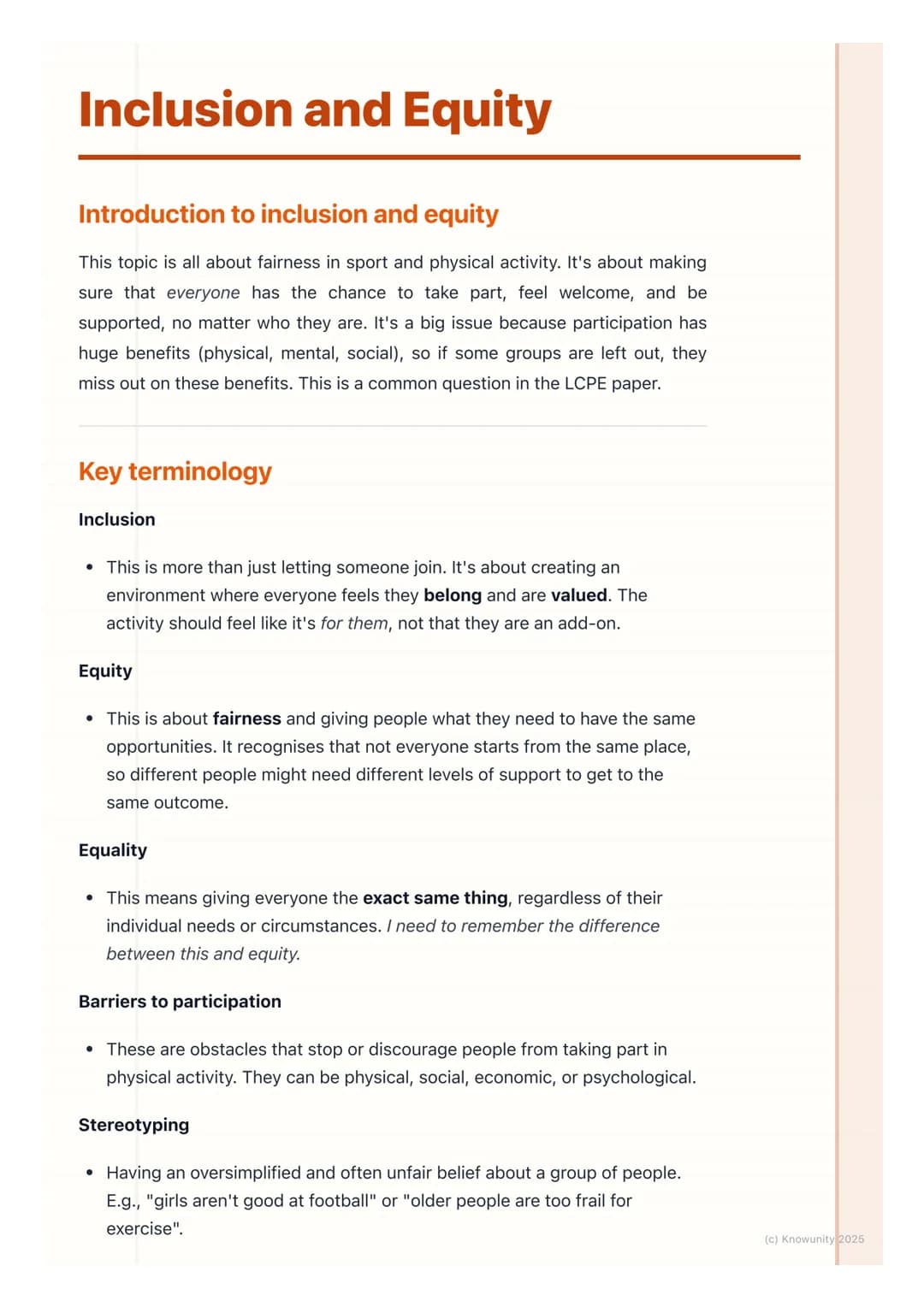
Understanding Inclusion and Equity
Think about your PE class - does everyone feel like they truly belong, or are some students just "getting by"? Inclusion goes way beyond just letting someone join in. It's about creating an environment where everyone feels valued and like the activity is genuinely designed for them too.
Here's where it gets interesting: equity and equality aren't the same thing. Equality means giving everyone identical treatment, whilst equity recognises that people start from different places and might need different support to reach the same outcome. Picture three people of different heights trying to watch over a fence - equality gives them all the same box to stand on, but equity gives them whatever they need to actually see.
Barriers to participation are the obstacles that stop people getting involved in sport. These might be obvious (like expensive equipment) or hidden (like feeling judged). Stereotyping creates some of the toughest barriers - those oversimplified beliefs like "girls aren't good at football" or "older people are too frail for exercise."
Remember: Equity leads to equal outcomes, whilst equal treatment doesn't always work when people have different starting points.
2
of 7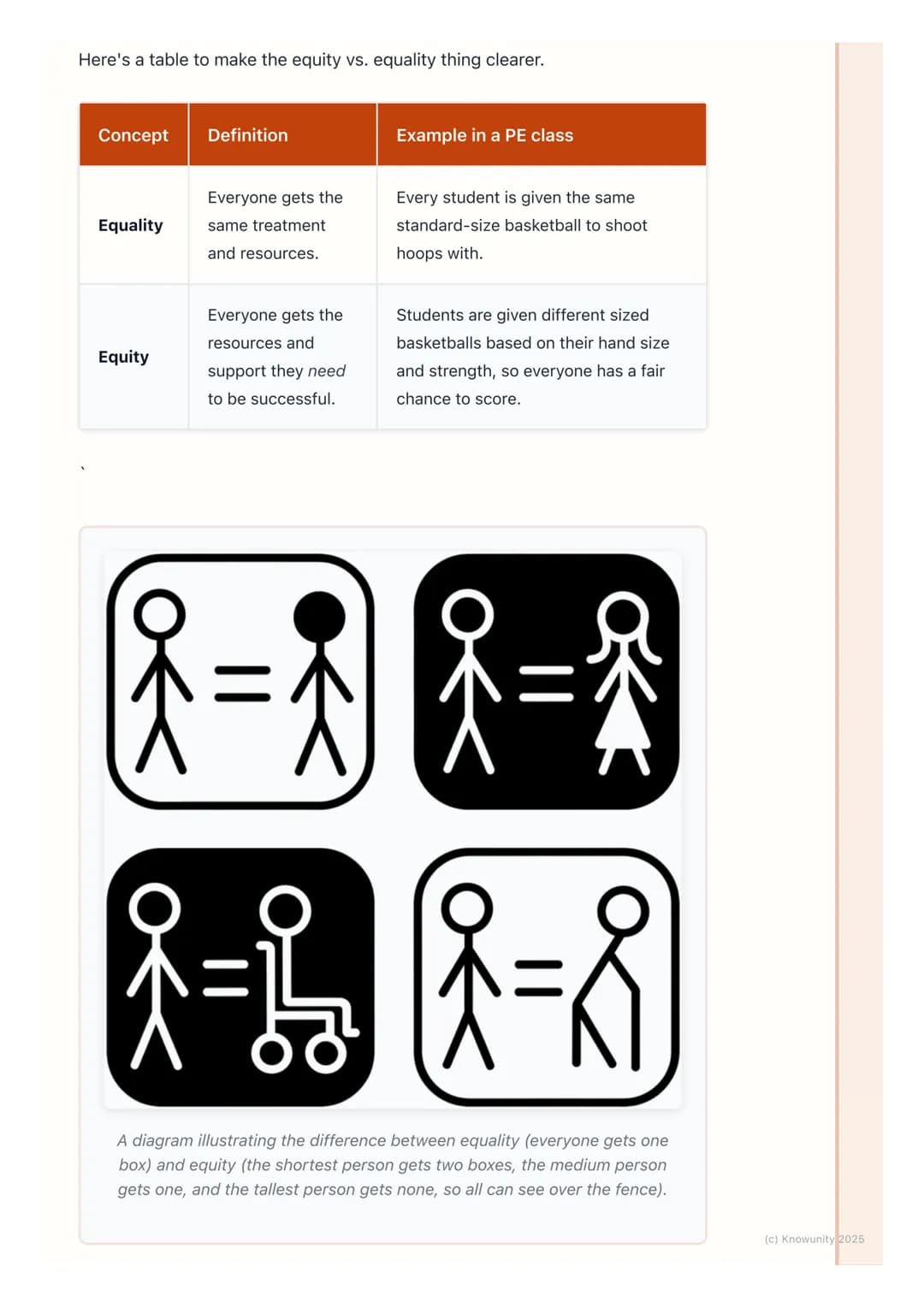
Gender Barriers and Solutions
Ever notice how men's sports dominate the headlines whilst women's achievements get barely a mention? This media coverage gap creates a serious problem - if girls can't see female role models in sport, they're less likely to see themselves as athletes.
Stereotyping hits hard here too. Certain sports get labelled as "masculine" (rugby, weightlifting) or "feminine" (dance, gymnastics), which puts pressure on young people to stick to what's "expected." Schools might offer fewer opportunities for girls' teams, and facilities often aren't designed with female athletes in mind.
The 20x20 campaign in Ireland tackled this head-on with the slogan "If she can't see it, she can't be it." The campaign pushed for more media coverage, better attendance at women's events, and increased participation. Schools are also stepping up by offering mixed-gender sports and more flexible uniform policies.
Investment is key - more funding for female sports at every level, from grassroots clubs to elite competition. Getting more women into coaching roles creates those vital role models that young girls need to see.
Key insight: Representation matters - seeing someone like yourself succeeding in sport makes participation feel possible and worthwhile.
3
of 7
Disability and Accessibility Challenges
Imagine wanting to join your local gym but finding steps at the entrance and no accessible changing rooms. For people with disabilities, these physical barriers are just the start of the challenges they face in sport and physical activity.
The financial side hits differently too. Specialised equipment costs a fortune, and transport to accessible facilities can be a major expense. Then there are the psychological barriers - lack of confidence, fear of judgment, or simply not seeing yourself as "sporty" because of your disability.
Many people just don't know what's available. Adapted sports like wheelchair basketball and boccia offer brilliant opportunities, but awareness is often low. Coaches might want to help but lack the training to adapt activities effectively.
Paralympics Ireland promotes elite sport whilst the Cara Centre works nationally to make sport more inclusive. Their disability inclusion training gives coaches the skills to adapt activities for everyone. The push for universal design in new facilities and retrofitting older ones means accessibility is becoming the standard, not an afterthought.
Game changer: Universal design benefits everyone - ramps help wheelchair users, parents with buggies, and people with mobility aids alike.
4
of 7
Socio-economic Barriers
Let's be honest - sport can be expensive, and for families on tight budgets, those costs can be a real barrier. Club membership fees, expensive equipment, and travel costs for training and matches add up quickly. A hurling helmet, hockey stick, or riding boots can cost more than some families have spare.
Time becomes a barrier when parents work long hours and can't provide transport, or when teenagers need part-time jobs themselves. Disadvantaged areas often lack quality, safe, and free facilities like parks and sports courts.
Some sports carry a "posh" image - golf, sailing, and polo can feel exclusive and unwelcoming. This cultural barrier creates a sense of not belonging before people even try to participate.
Smart solutions are making a difference though. Subsidies help reduce costs for low-income families, whilst school-based programmes remove the need for expensive club fees. The GAA model shows how community-rooted sports with volunteer leadership and low fees can stay accessible. Local councils investing in free facilities like outdoor gyms and well-lit walking paths opens up opportunities for everyone.
Reality check: The GAA's success comes from being genuinely community-based - local volunteers, affordable fees, and facilities that belong to the people who use them.
5
of 7
Real-world Applications
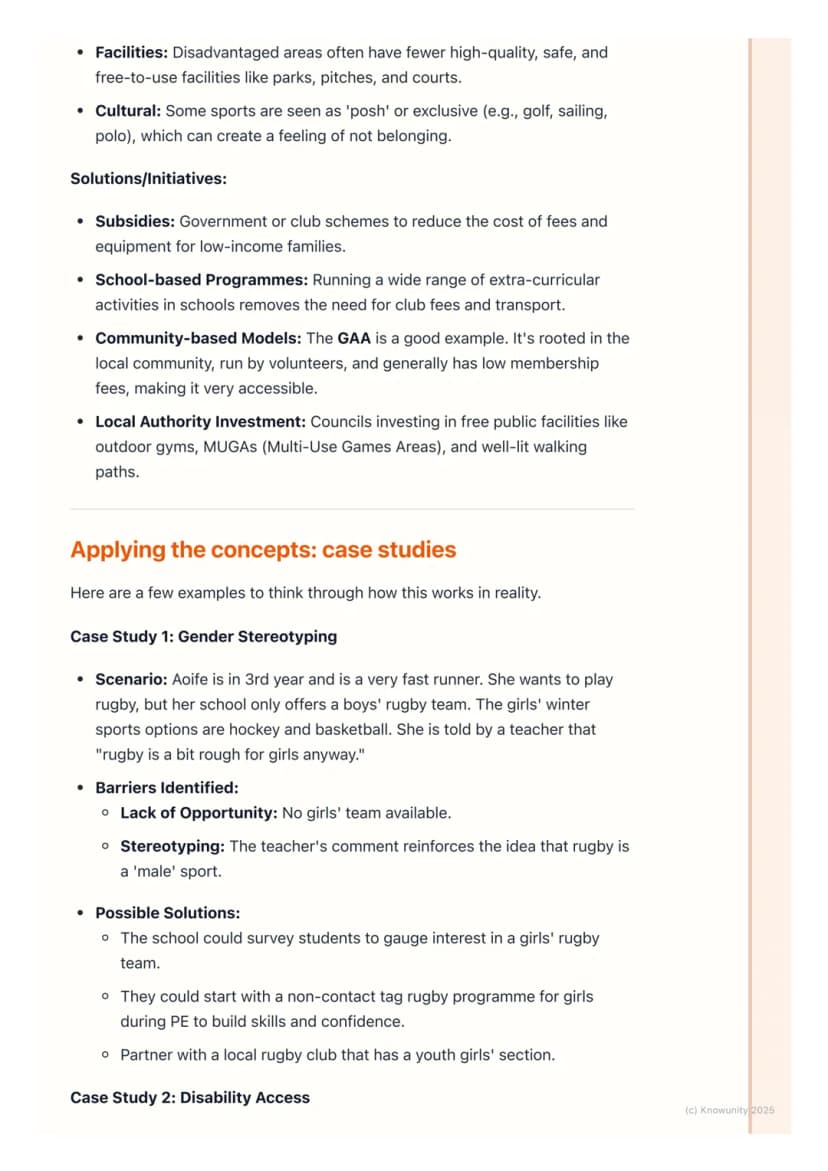
Picture Aoife, a fast 3rd year who wants to play rugby, but her school only offers boys' rugby. When she asks about it, a teacher says "rugby's a bit rough for girls anyway." She's facing both lack of opportunity and gender stereotyping. The school could survey students about interest in girls' rugby, start with tag rugby in PE, or partner with local clubs.
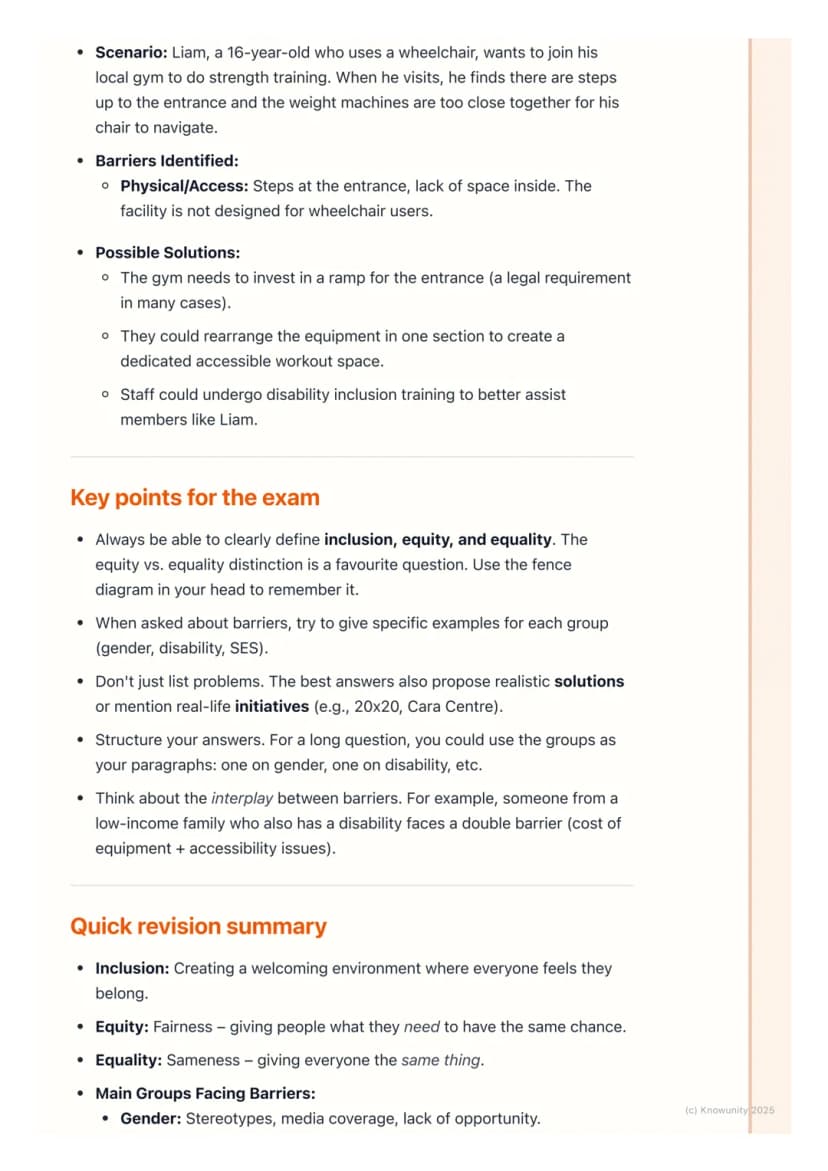
Now think about Liam, who uses a wheelchair and wants to join his local gym for strength training. He finds steps at the entrance and weight machines too close together for navigation. These accessibility barriers need practical solutions - a ramp (which is often legally required anyway), rearranged equipment to create accessible workout space, and staff training.
These examples show how multiple barriers can overlap. Someone from a low-income family who also has a disability faces doubled challenges - both cost issues and accessibility problems. The best solutions recognise these intersections and address them together.
For your exam, always define terms clearly (especially equity vs equality), give specific examples for each group, and propose realistic solutions. Structure answers using the main groups as paragraphs, and remember to mention real initiatives like 20x20 and the Cara Centre.
Exam tip: Don't just list problems - the strongest answers combine barrier identification with practical, realistic solutions and real-world examples.
6
of 7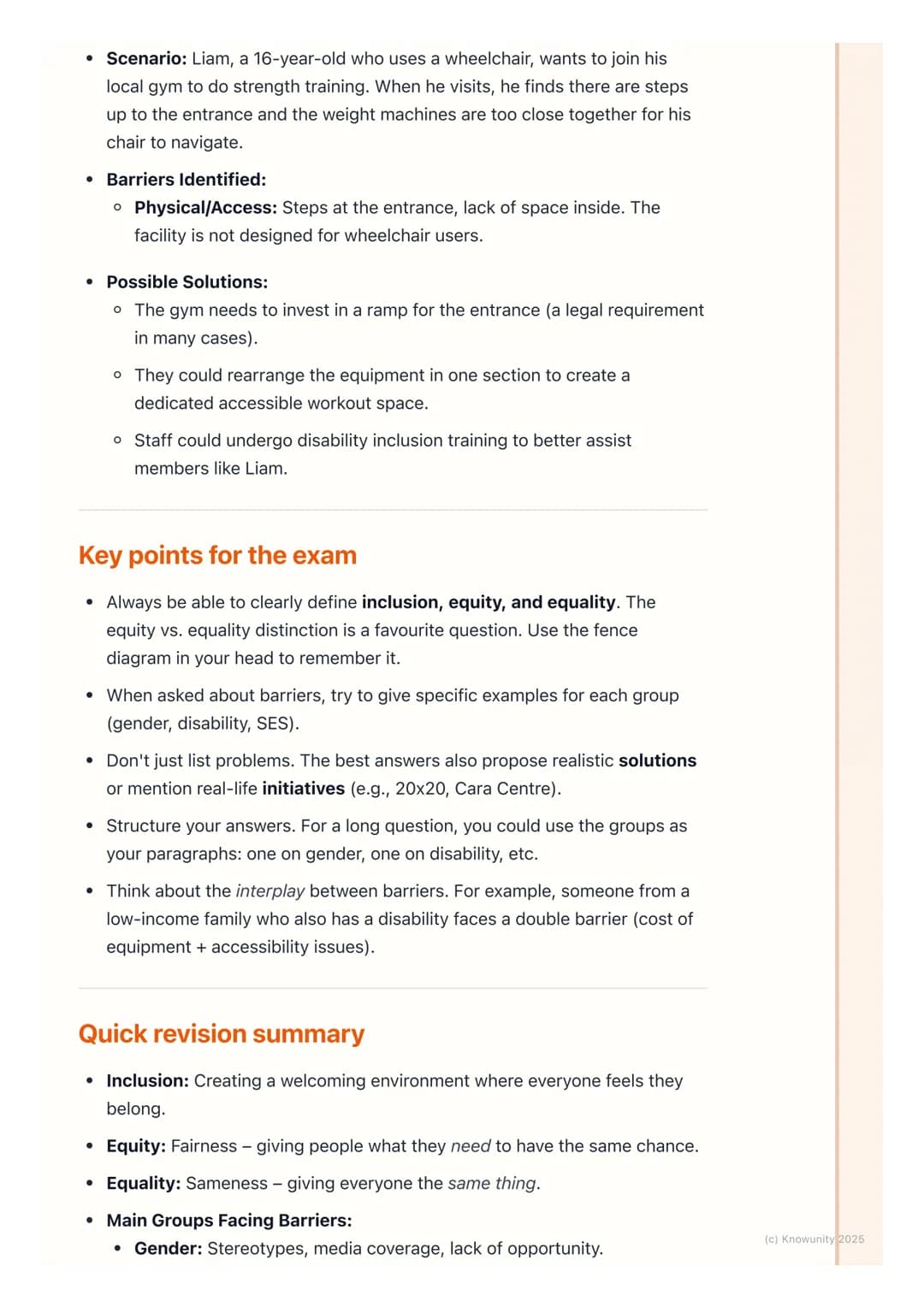
Quick Revision Summary
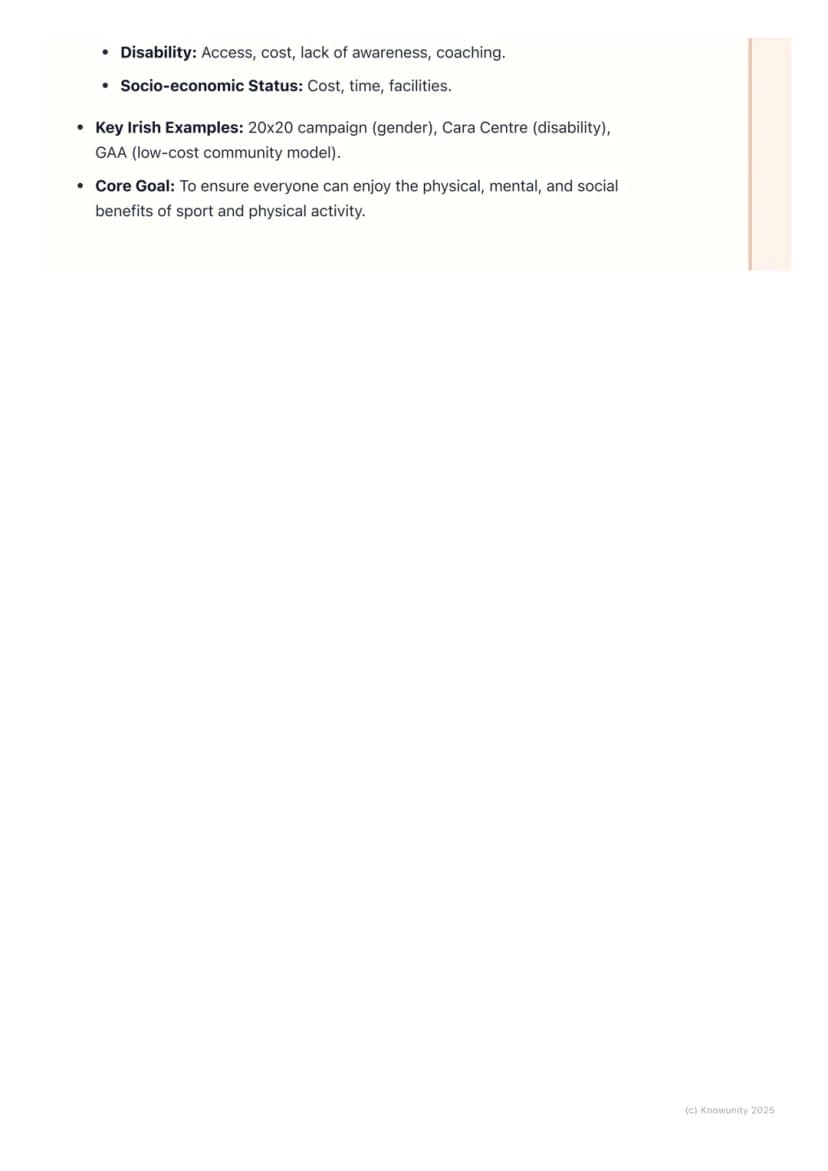
Core definitions: Inclusion creates belonging, equity provides fairness through different support levels, equality gives identical treatment. The goal is ensuring everyone can access the physical, mental, and social benefits of sport.
Gender barriers include stereotyping, poor media coverage, and limited opportunities. Solutions involve campaigns like 20x20, school policy changes, increased investment, and more female coaches.
Disability barriers encompass physical access, high costs, lack of awareness, and coaching gaps. The Cara Centre and Paralympics Ireland lead inclusion efforts through training, adapted sports, and facility improvements.
Socio-economic barriers centre on cost, time constraints, and facility access in disadvantaged areas. The GAA community model shows how volunteer-led, affordable sport can stay accessible whilst government subsidies and school programmes help bridge gaps.
Bottom line: True inclusion means everyone can participate fully, feel valued, and access sport's benefits regardless of gender, ability, or economic background.
7
of 7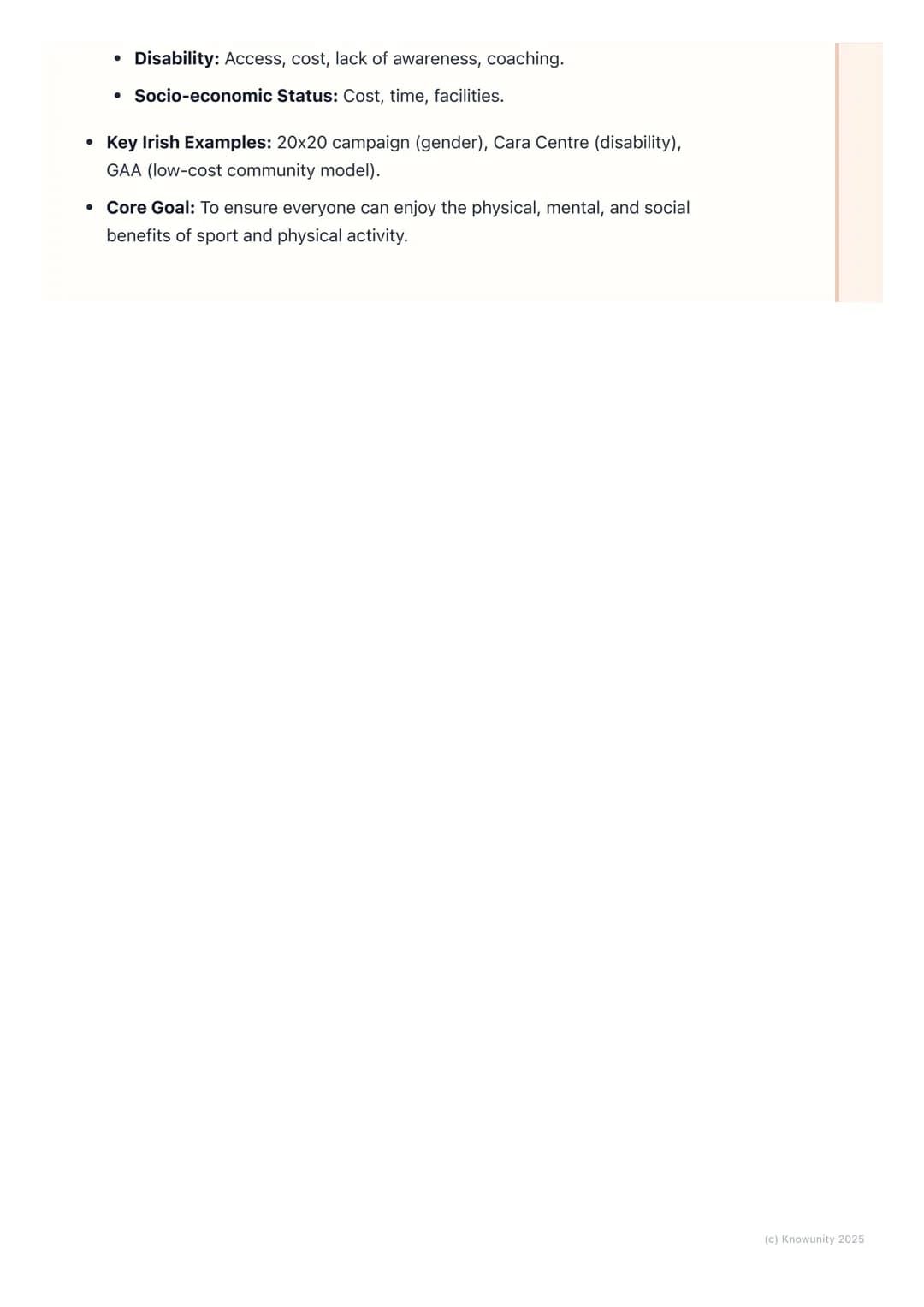
Pensamos que nunca lo preguntarías...
¿Qué es Knowunity AI companion?
Nuestro compañero de IA está específicamente adaptado a las necesidades de los estudiantes. Basándonos en los millones de contenidos que tenemos en la plataforma, podemos dar a los estudiantes respuestas realmente significativas y relevantes. Pero no se trata solo de respuestas, el compañero también guía a los estudiantes a través de sus retos de aprendizaje diarios, con planes de aprendizaje personalizados, cuestionarios o contenidos en el chat y una personalización del 100% basada en las habilidades y el desarrollo de los estudiantes.
¿Dónde puedo descargar la app Knowunity?
Puedes descargar la app en Google Play Store y Apple App Store.
¿Knowunity es totalmente gratuito?
Sí, tienes acceso gratuito a los contenidos de la aplicación y a nuestro compañero de IA. Para desbloquear determinadas funciones de la aplicación, puedes adquirir Knowunity Pro.
Contenidos más populares de LCPE
4LCPEHealthy Eating Guidelines
This section explores national healthy eating guidelines, such as the food pyramid or healthy eating plate, to promote balanced dietary choices.
5th Year50
LCPEBiomechanics of Movement
Applying fundamental biomechanical principles such as force, motion, levers, and stability to analyse and improve human movement efficiency and performance in sport.
6th Year200
LCPEFactors effecting sports psychology ( confidence and self efficacy)
Higher Level LCPE psychological preprration notes
5th Year230
LCPETechnology in Sport
Investigating how technology is used in areas such as performance analysis, equipment design, officiating, and athlete monitoring to enhance training and competition.
6th Year50
Contenidos más populares
9 Irish
IrishIrish oral questions and answers
Questions and answers for the leaving cert oral
5th Year4264
 English
Key Quotes : Sive
Key Quotes and explanations: Sive
6th Year2842
IrishIrish oral questions
Outline of oral questions
5th Year2055
IrishIníon- le hÁine Durkin
Aine Durkin’s poem, Iníon: Themes & summary
5th Year890
IrishIrish poetry 2027
Iníon + Dínit an Bhróin
5th Year1153
IrishLC HL notes- Iníon (poem)
Includes poem in English and Irish, theme, key words & phrases
5th Year2304
EnglishCultural Context : Shawshank Redemption : Sive : Small Things Like These
Comparative Study : Cultural Context : Shawshank Redemption, Sive and Small Things Like These
6th Year1430
IrishMo Ghrá-sa (Idir Lúibíní)
Notes on mo ghrá-sa
5th Year380
IrishAn Gaeilge Aiste
Irish Language essay
6th Year1320
¿No encuentras lo que buscas? Explora otros temas.
Mira lo que dicen nuestros usuarios. Les encanta - y a tí también.
4.6/5App Store
4.7/5Google Play
La app es muy fácil de usar y está muy bien diseñada. Hasta ahora he encontrado todo lo que estaba buscando y he podido aprender mucho de las presentaciones. Definitivamente utilizaré la aplicación para un examen de clase. Y, por supuesto, también me sirve mucho de inspiración.
Pablousuario de iOS
Esta app es realmente genial. Hay tantos apuntes de clase y ayuda [...]. Tengo problemas con matemáticas, por ejemplo, y la aplicación tiene muchas opciones de ayuda. Gracias a Knowunity, he mejorado en mates. Se la recomiendo a todo el mundo.
Elenausuaria de Android
Vaya, estoy realmente sorprendida. Acabo de probar la app porque la he visto anunciada muchas veces y me he quedado absolutamente alucinada. Esta app es LA AYUDA que quieres para el insti y, sobre todo, ofrece muchísimas cosas, como ejercicios y hojas informativas, que a mí personalmente me han sido MUY útiles.
Anausuaria de iOS
LCPE2 visualizaciones·Actualizado Jun 17, 2026·7 páginasPromoting Inclusion and Equity in Sports and Activities
Sports and physical activity should be for everyone, but the reality is that many people face barriers that keep them from participating. This topic explores how we can create truly inclusive environments where everyone feels they belong and has fair...
1
of 7
Inscríbete para ver los apuntes. ¡Es gratis!
- Acceso a todos los documentos
- Mejora tus notas
- Únete a millones de estudiantes
Understanding Inclusion and Equity
Think about your PE class - does everyone feel like they truly belong, or are some students just "getting by"? Inclusion goes way beyond just letting someone join in. It's about creating an environment where everyone feels valued and like the activity is genuinely designed for them too.
Here's where it gets interesting: equity and equality aren't the same thing. Equality means giving everyone identical treatment, whilst equity recognises that people start from different places and might need different support to reach the same outcome. Picture three people of different heights trying to watch over a fence - equality gives them all the same box to stand on, but equity gives them whatever they need to actually see.
Barriers to participation are the obstacles that stop people getting involved in sport. These might be obvious (like expensive equipment) or hidden (like feeling judged). Stereotyping creates some of the toughest barriers - those oversimplified beliefs like "girls aren't good at football" or "older people are too frail for exercise."
Remember: Equity leads to equal outcomes, whilst equal treatment doesn't always work when people have different starting points.
2
of 7Inscríbete para ver los apuntes. ¡Es gratis!
- Acceso a todos los documentos
- Mejora tus notas
- Únete a millones de estudiantes
Gender Barriers and Solutions
Ever notice how men's sports dominate the headlines whilst women's achievements get barely a mention? This media coverage gap creates a serious problem - if girls can't see female role models in sport, they're less likely to see themselves as athletes.
Stereotyping hits hard here too. Certain sports get labelled as "masculine" (rugby, weightlifting) or "feminine" (dance, gymnastics), which puts pressure on young people to stick to what's "expected." Schools might offer fewer opportunities for girls' teams, and facilities often aren't designed with female athletes in mind.
The 20x20 campaign in Ireland tackled this head-on with the slogan "If she can't see it, she can't be it." The campaign pushed for more media coverage, better attendance at women's events, and increased participation. Schools are also stepping up by offering mixed-gender sports and more flexible uniform policies.
Investment is key - more funding for female sports at every level, from grassroots clubs to elite competition. Getting more women into coaching roles creates those vital role models that young girls need to see.
Key insight: Representation matters - seeing someone like yourself succeeding in sport makes participation feel possible and worthwhile.
3
of 7Inscríbete para ver los apuntes. ¡Es gratis!
- Acceso a todos los documentos
- Mejora tus notas
- Únete a millones de estudiantes
Disability and Accessibility Challenges
Imagine wanting to join your local gym but finding steps at the entrance and no accessible changing rooms. For people with disabilities, these physical barriers are just the start of the challenges they face in sport and physical activity.
The financial side hits differently too. Specialised equipment costs a fortune, and transport to accessible facilities can be a major expense. Then there are the psychological barriers - lack of confidence, fear of judgment, or simply not seeing yourself as "sporty" because of your disability.
Many people just don't know what's available. Adapted sports like wheelchair basketball and boccia offer brilliant opportunities, but awareness is often low. Coaches might want to help but lack the training to adapt activities effectively.
Paralympics Ireland promotes elite sport whilst the Cara Centre works nationally to make sport more inclusive. Their disability inclusion training gives coaches the skills to adapt activities for everyone. The push for universal design in new facilities and retrofitting older ones means accessibility is becoming the standard, not an afterthought.
Game changer: Universal design benefits everyone - ramps help wheelchair users, parents with buggies, and people with mobility aids alike.
4
of 7Inscríbete para ver los apuntes. ¡Es gratis!
- Acceso a todos los documentos
- Mejora tus notas
- Únete a millones de estudiantes
Socio-economic Barriers
Let's be honest - sport can be expensive, and for families on tight budgets, those costs can be a real barrier. Club membership fees, expensive equipment, and travel costs for training and matches add up quickly. A hurling helmet, hockey stick, or riding boots can cost more than some families have spare.
Time becomes a barrier when parents work long hours and can't provide transport, or when teenagers need part-time jobs themselves. Disadvantaged areas often lack quality, safe, and free facilities like parks and sports courts.
Some sports carry a "posh" image - golf, sailing, and polo can feel exclusive and unwelcoming. This cultural barrier creates a sense of not belonging before people even try to participate.
Smart solutions are making a difference though. Subsidies help reduce costs for low-income families, whilst school-based programmes remove the need for expensive club fees. The GAA model shows how community-rooted sports with volunteer leadership and low fees can stay accessible. Local councils investing in free facilities like outdoor gyms and well-lit walking paths opens up opportunities for everyone.
Reality check: The GAA's success comes from being genuinely community-based - local volunteers, affordable fees, and facilities that belong to the people who use them.
5
of 7Inscríbete para ver los apuntes. ¡Es gratis!
- Acceso a todos los documentos
- Mejora tus notas
- Únete a millones de estudiantes
Real-world Applications
Picture Aoife, a fast 3rd year who wants to play rugby, but her school only offers boys' rugby. When she asks about it, a teacher says "rugby's a bit rough for girls anyway." She's facing both lack of opportunity and gender stereotyping. The school could survey students about interest in girls' rugby, start with tag rugby in PE, or partner with local clubs.
Now think about Liam, who uses a wheelchair and wants to join his local gym for strength training. He finds steps at the entrance and weight machines too close together for navigation. These accessibility barriers need practical solutions - a ramp (which is often legally required anyway), rearranged equipment to create accessible workout space, and staff training.
These examples show how multiple barriers can overlap. Someone from a low-income family who also has a disability faces doubled challenges - both cost issues and accessibility problems. The best solutions recognise these intersections and address them together.
For your exam, always define terms clearly (especially equity vs equality), give specific examples for each group, and propose realistic solutions. Structure answers using the main groups as paragraphs, and remember to mention real initiatives like 20x20 and the Cara Centre.
Exam tip: Don't just list problems - the strongest answers combine barrier identification with practical, realistic solutions and real-world examples.
6
of 7Inscríbete para ver los apuntes. ¡Es gratis!
- Acceso a todos los documentos
- Mejora tus notas
- Únete a millones de estudiantes
Quick Revision Summary
Core definitions: Inclusion creates belonging, equity provides fairness through different support levels, equality gives identical treatment. The goal is ensuring everyone can access the physical, mental, and social benefits of sport.
Gender barriers include stereotyping, poor media coverage, and limited opportunities. Solutions involve campaigns like 20x20, school policy changes, increased investment, and more female coaches.
Disability barriers encompass physical access, high costs, lack of awareness, and coaching gaps. The Cara Centre and Paralympics Ireland lead inclusion efforts through training, adapted sports, and facility improvements.
Socio-economic barriers centre on cost, time constraints, and facility access in disadvantaged areas. The GAA community model shows how volunteer-led, affordable sport can stay accessible whilst government subsidies and school programmes help bridge gaps.
Bottom line: True inclusion means everyone can participate fully, feel valued, and access sport's benefits regardless of gender, ability, or economic background.
7
of 7Inscríbete para ver los apuntes. ¡Es gratis!
- Acceso a todos los documentos
- Mejora tus notas
- Únete a millones de estudiantes
Pensamos que nunca lo preguntarías...
¿Qué es Knowunity AI companion?
Nuestro compañero de IA está específicamente adaptado a las necesidades de los estudiantes. Basándonos en los millones de contenidos que tenemos en la plataforma, podemos dar a los estudiantes respuestas realmente significativas y relevantes. Pero no se trata solo de respuestas, el compañero también guía a los estudiantes a través de sus retos de aprendizaje diarios, con planes de aprendizaje personalizados, cuestionarios o contenidos en el chat y una personalización del 100% basada en las habilidades y el desarrollo de los estudiantes.
¿Dónde puedo descargar la app Knowunity?
Puedes descargar la app en Google Play Store y Apple App Store.
¿Knowunity es totalmente gratuito?
Sí, tienes acceso gratuito a los contenidos de la aplicación y a nuestro compañero de IA. Para desbloquear determinadas funciones de la aplicación, puedes adquirir Knowunity Pro.
Contenidos más populares de LCPE
4LCPEHealthy Eating Guidelines
This section explores national healthy eating guidelines, such as the food pyramid or healthy eating plate, to promote balanced dietary choices.
5th Year50
LCPEBiomechanics of Movement
Applying fundamental biomechanical principles such as force, motion, levers, and stability to analyse and improve human movement efficiency and performance in sport.
6th Year200
LCPEFactors effecting sports psychology ( confidence and self efficacy)
Higher Level LCPE psychological preprration notes
5th Year230
LCPETechnology in Sport
Investigating how technology is used in areas such as performance analysis, equipment design, officiating, and athlete monitoring to enhance training and competition.
6th Year50
Contenidos más populares
9IrishIrish oral questions and answers
Questions and answers for the leaving cert oral
5th Year4264
EnglishKey Quotes : Sive
Key Quotes and explanations: Sive
6th Year2842
IrishIrish oral questions
Outline of oral questions
5th Year2055
IrishIníon- le hÁine Durkin
Aine Durkin’s poem, Iníon: Themes & summary
5th Year890
IrishIrish poetry 2027
Iníon + Dínit an Bhróin
5th Year1153
IrishLC HL notes- Iníon (poem)
Includes poem in English and Irish, theme, key words & phrases
5th Year2304
EnglishCultural Context : Shawshank Redemption : Sive : Small Things Like These
Comparative Study : Cultural Context : Shawshank Redemption, Sive and Small Things Like These
6th Year1430
IrishMo Ghrá-sa (Idir Lúibíní)
Notes on mo ghrá-sa
5th Year380
IrishAn Gaeilge Aiste
Irish Language essay
6th Year1320
¿No encuentras lo que buscas? Explora otros temas.
Mira lo que dicen nuestros usuarios. Les encanta - y a tí también.
4.6/5App Store
4.7/5Google Play
La app es muy fácil de usar y está muy bien diseñada. Hasta ahora he encontrado todo lo que estaba buscando y he podido aprender mucho de las presentaciones. Definitivamente utilizaré la aplicación para un examen de clase. Y, por supuesto, también me sirve mucho de inspiración.
Pablousuario de iOS
Esta app es realmente genial. Hay tantos apuntes de clase y ayuda [...]. Tengo problemas con matemáticas, por ejemplo, y la aplicación tiene muchas opciones de ayuda. Gracias a Knowunity, he mejorado en mates. Se la recomiendo a todo el mundo.
Elenausuaria de Android
Vaya, estoy realmente sorprendida. Acabo de probar la app porque la he visto anunciada muchas veces y me he quedado absolutamente alucinada. Esta app es LA AYUDA que quieres para el insti y, sobre todo, ofrece muchísimas cosas, como ejercicios y hojas informativas, que a mí personalmente me han sido MUY útiles.
Anausuaria de iOS