
Ever wondered how to talk about your school day in...
 Irish4 visualizaciones·Actualizado Jun 11, 2026·5 páginas
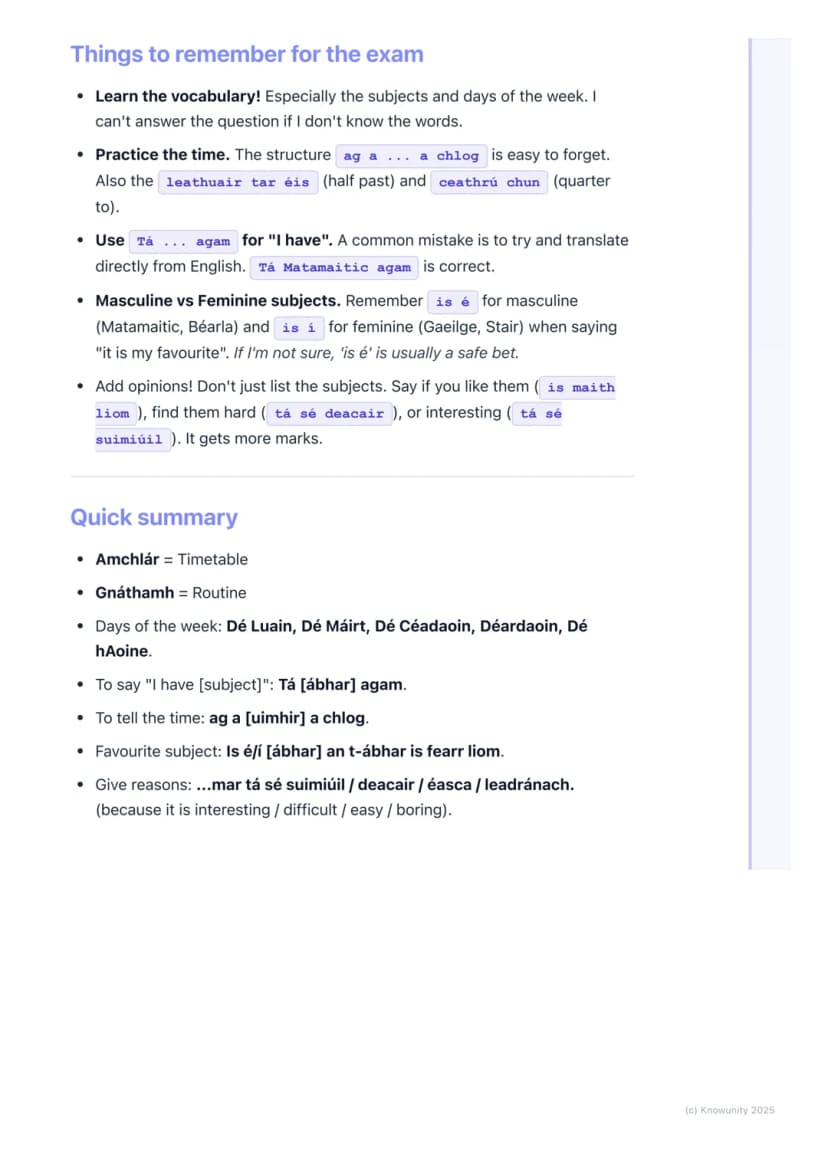
Amchlár agus Gnáthaimh Laethúla na Scoile
1 / 5
1
of 5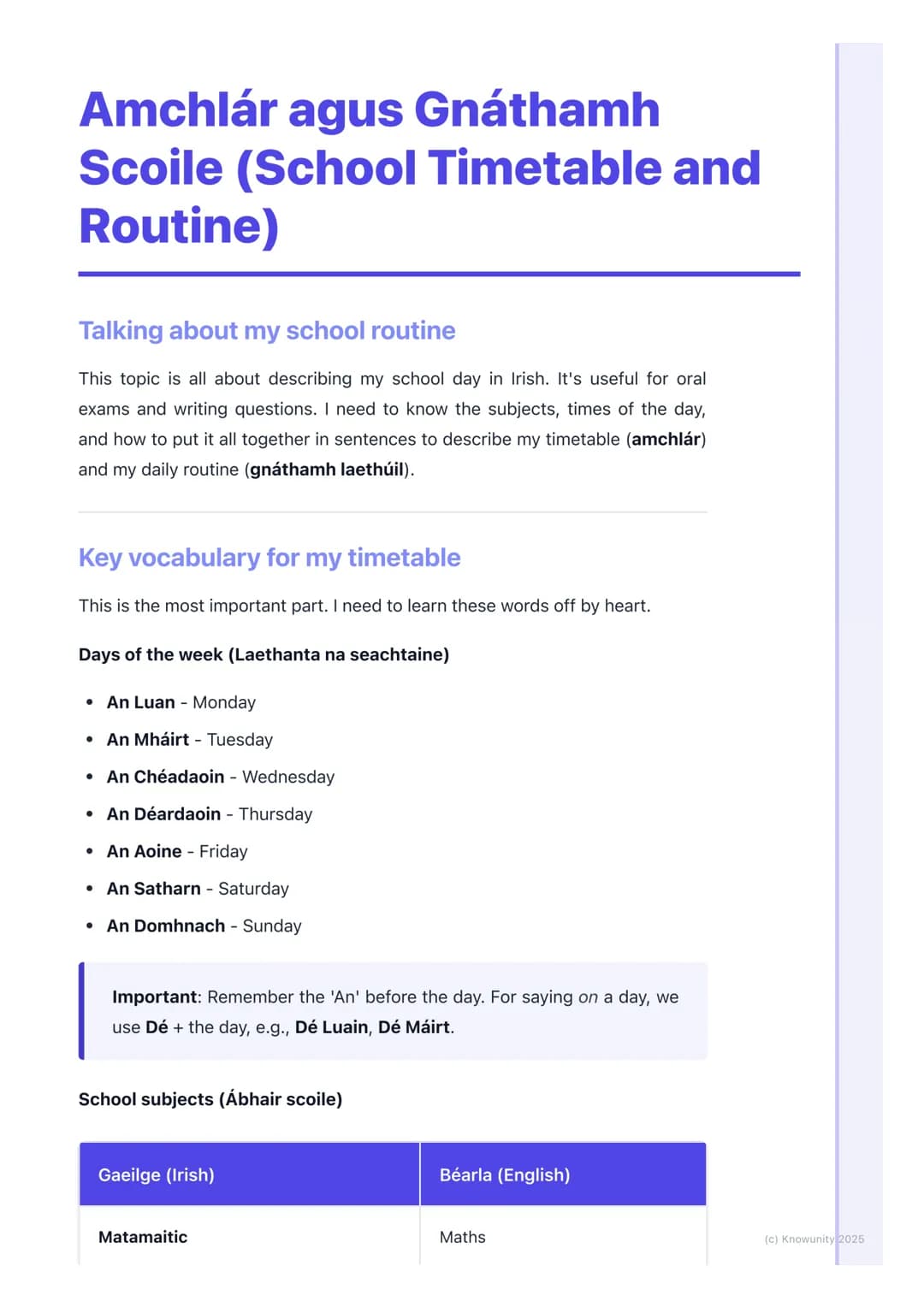
School Timetable and Routine Basics
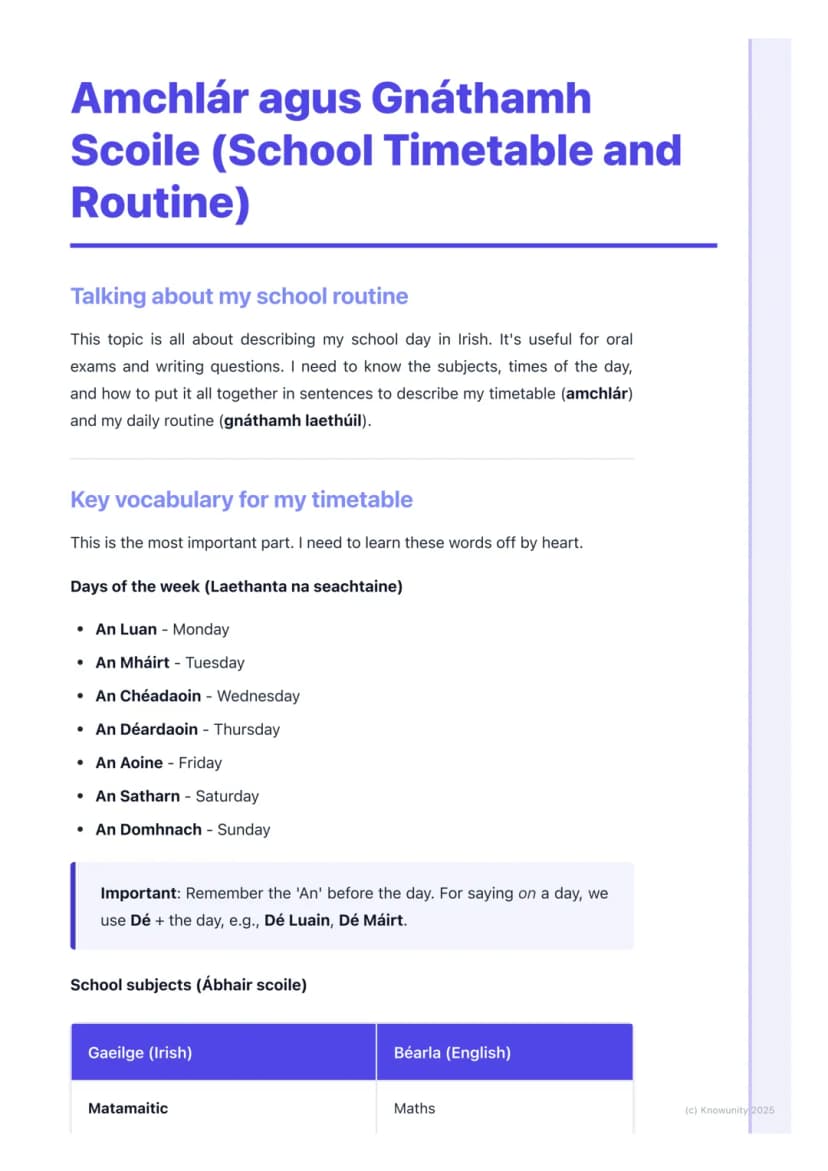
Learning to describe your school day in Irish is actually quite straightforward once you get the hang of it. You'll need this for both oral exams and written work, so it's definitely worth mastering.
The key is building up your vocabulary first - days of the week and school subjects are absolutely essential. Without these basic words, you'll struggle to put together proper sentences about your routine.
Days of the week always have 'An' in front of them normally, but when you're saying "on Monday", you use Dé Luain, Dé Máirt, and so on. It's a bit different from English, but you'll get used to it.
Quick Tip: Practice saying the days with 'Dé' - this is how you'll actually use them when describing your timetable!
2
of 5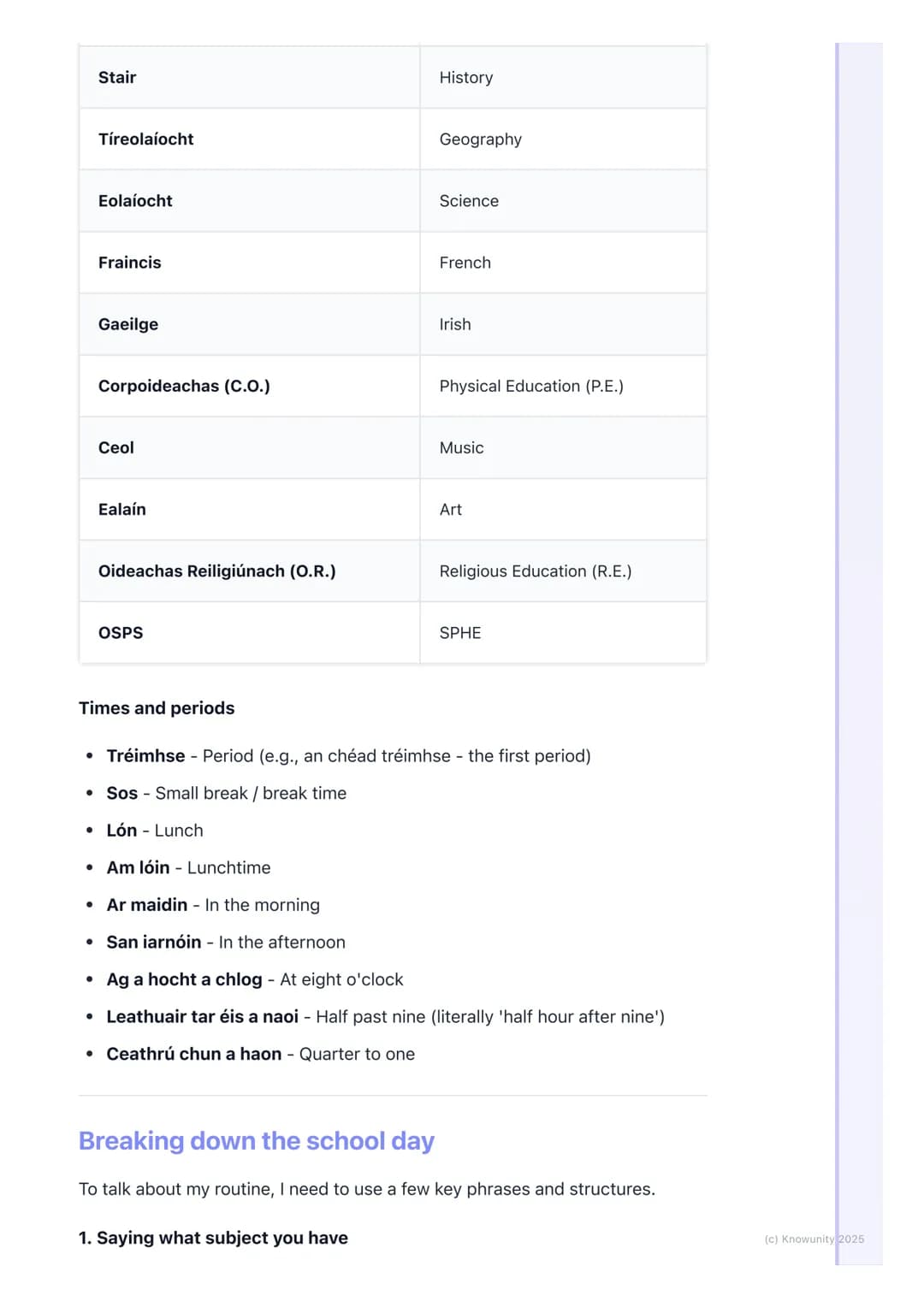
Essential School Vocabulary
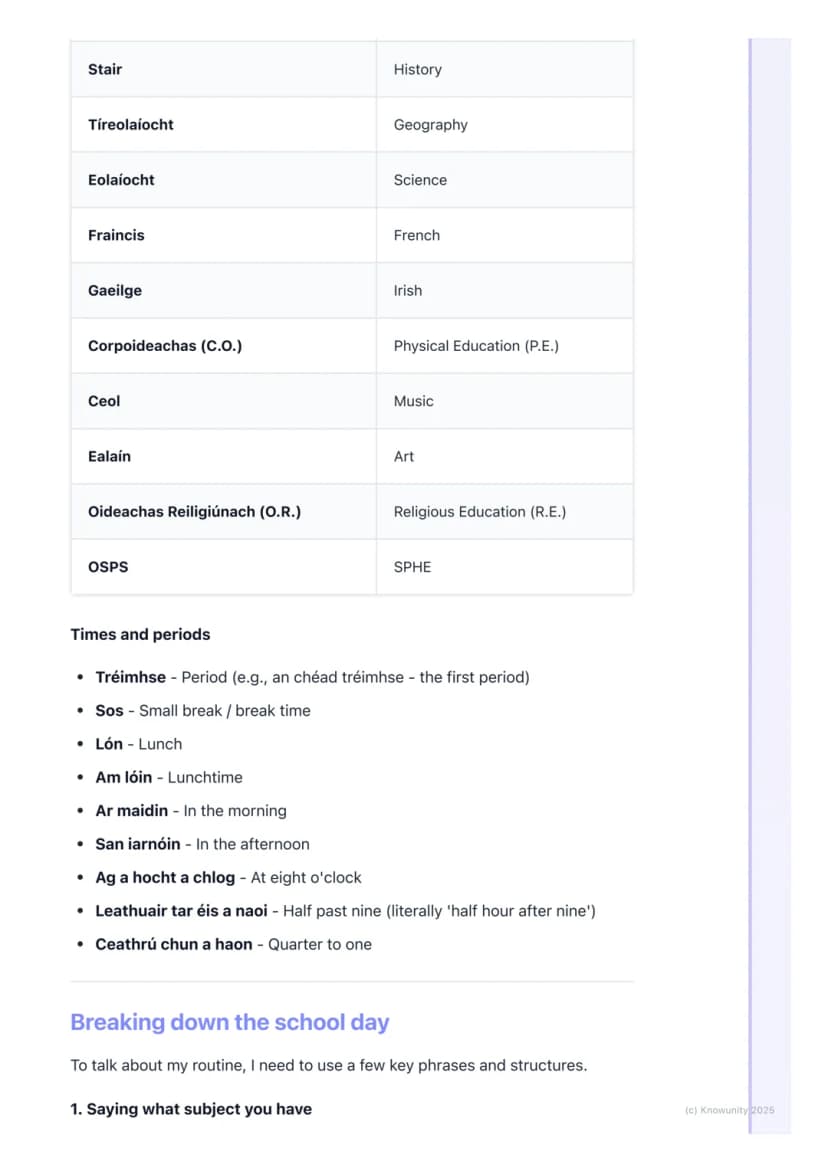
Right, here's where the real work begins - memorising your school subjects and time expressions. You absolutely must know these off by heart for any exam.
Key subjects include Matamaitic (Maths), Stair (History), Tíreolaíocht (Geography), and Eolaíocht (Science). Don't forget Corpoideachas (P.E.) and Oideachas Reiligiúnach (R.E.) - these come up loads in exam questions.
For talking about periods and times, you'll need tréimhse (period), sos (break), and lón (lunch). Time expressions like ag a hocht a chlog (at eight o'clock) and leathuair tar éis a naoi (half past nine) are crucial for describing your daily routine.
Remember: The structure "ag a [number] a chlog" is your go-to for telling time - don't try to translate directly from English!
3
of 5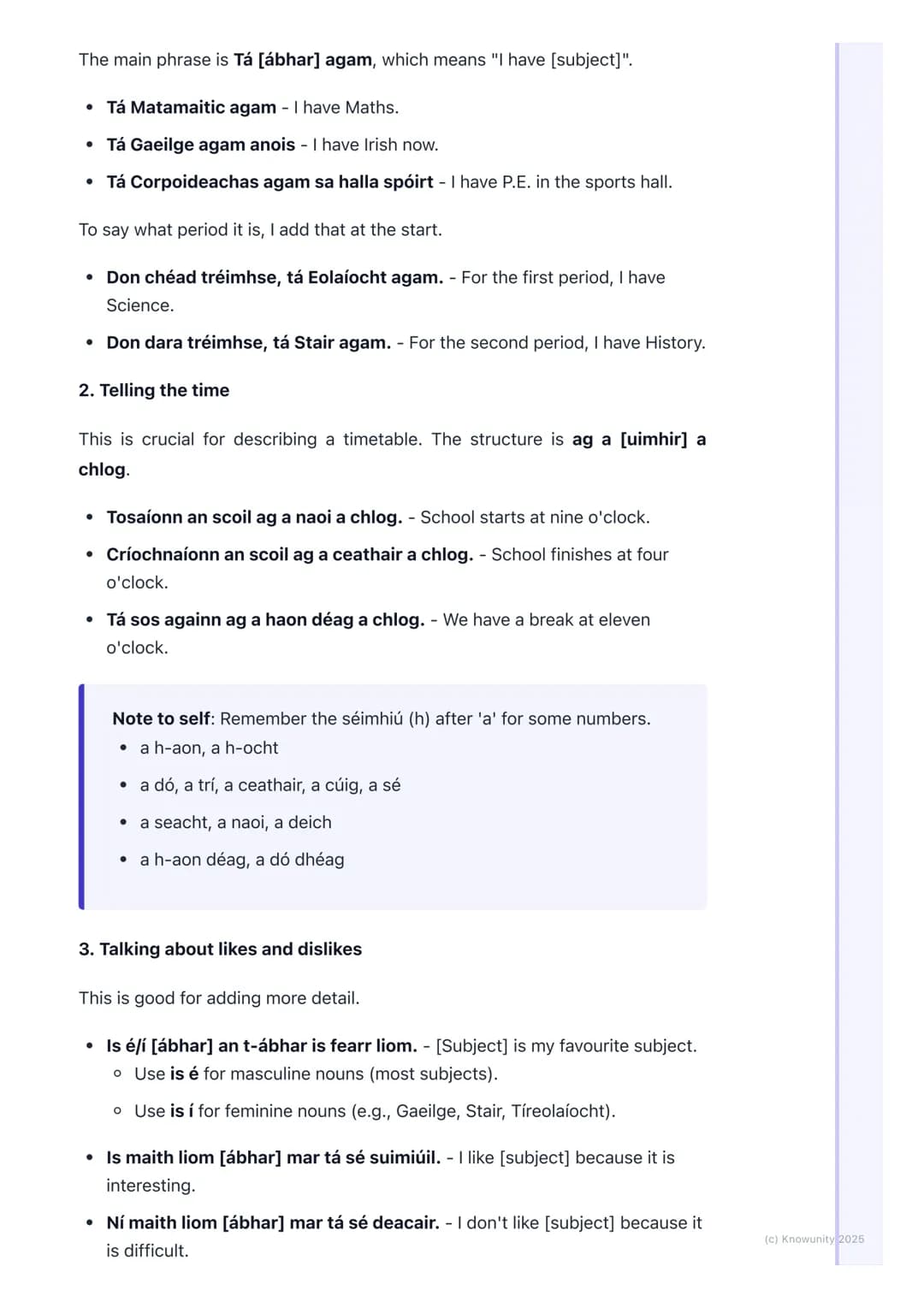
Building Your School Day Description
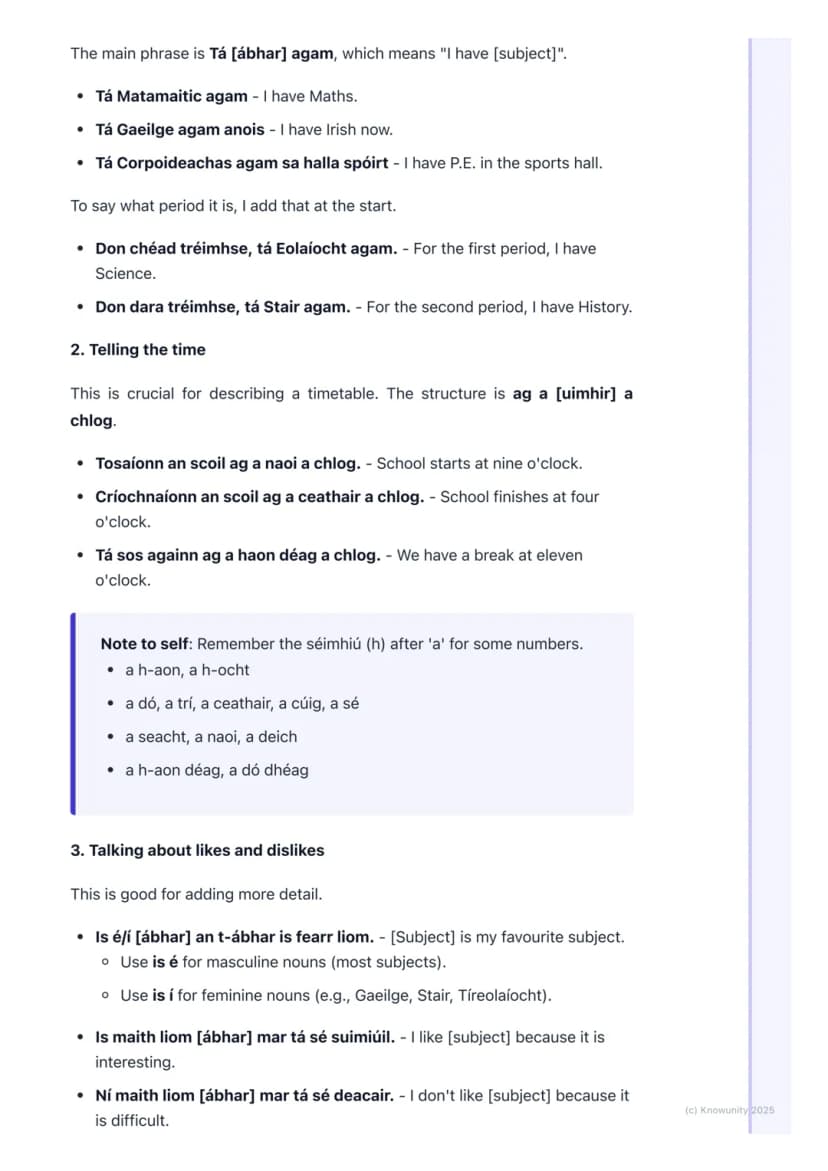
Now you can start putting proper sentences together! The magic phrase is Tá [ábhar] agam, which means "I have [subject]". It's not a direct translation from English, but it's the correct Irish way to say it.
For describing your timetable structure, use phrases like "Don chéad tréimhse" (for the first period) and "Don dara tréimhse" (for the second period). This makes your Irish sound much more natural and structured.
Time expressions follow the pattern "ag a [number] a chlog" - but watch out for the séimhiú (the 'h' sound) after 'a' with certain numbers. For example, it's "a h-aon" (one o'clock) and "a h-ocht" (eight o'clock).
Adding opinions about subjects will boost your marks significantly. Use "Is maith liom" (I like) or "Ní maith liom" (I don't like) followed by reasons like "mar tá sé suimiúil" (because it's interesting).
Pro Tip: Connect your sentences with words like "ar dtús" (firstly), "ansin" (then), and "faoi dheireadh" (finally) to make your description flow better!
4
of 5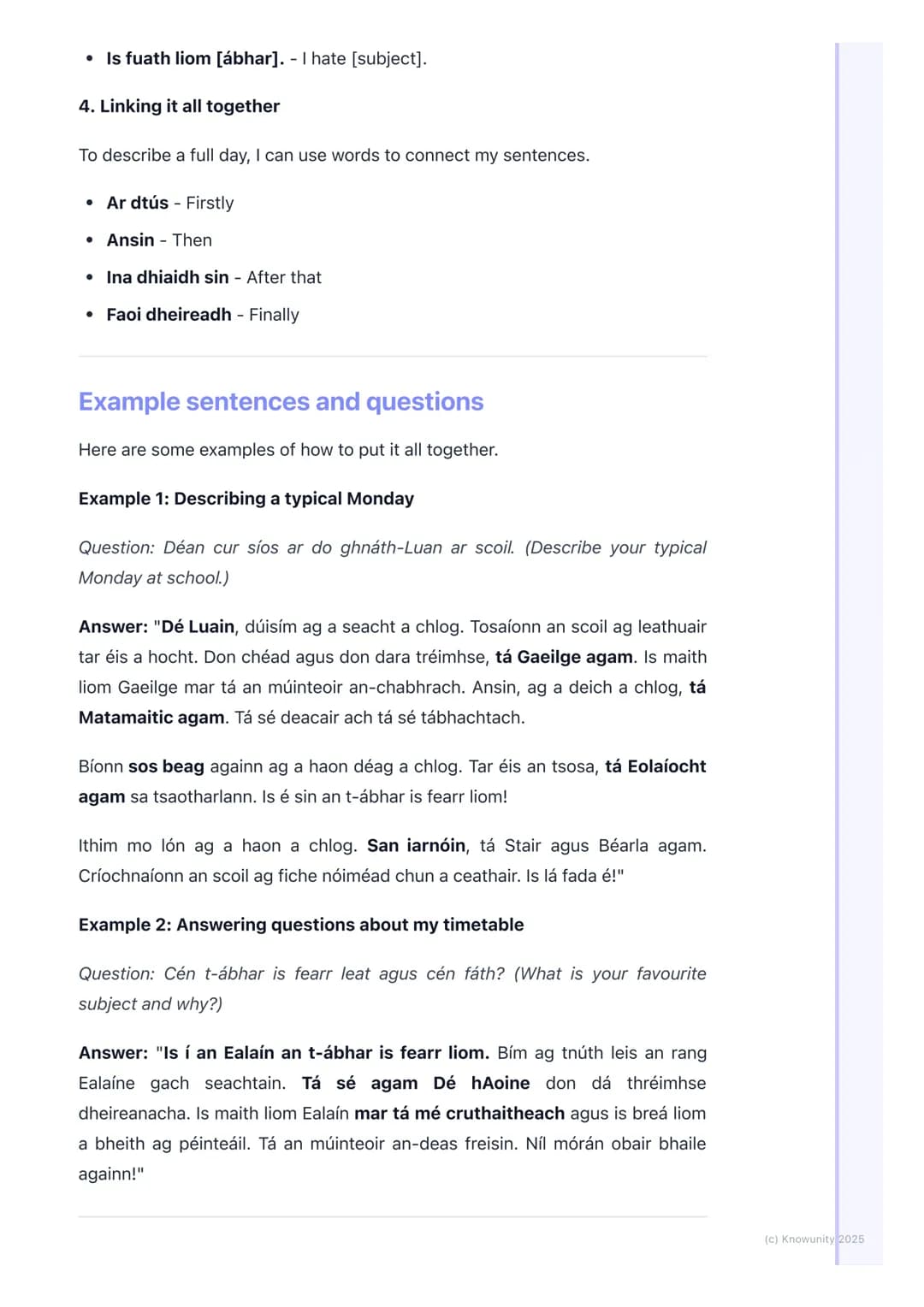
Sample Answers and Exam Techniques
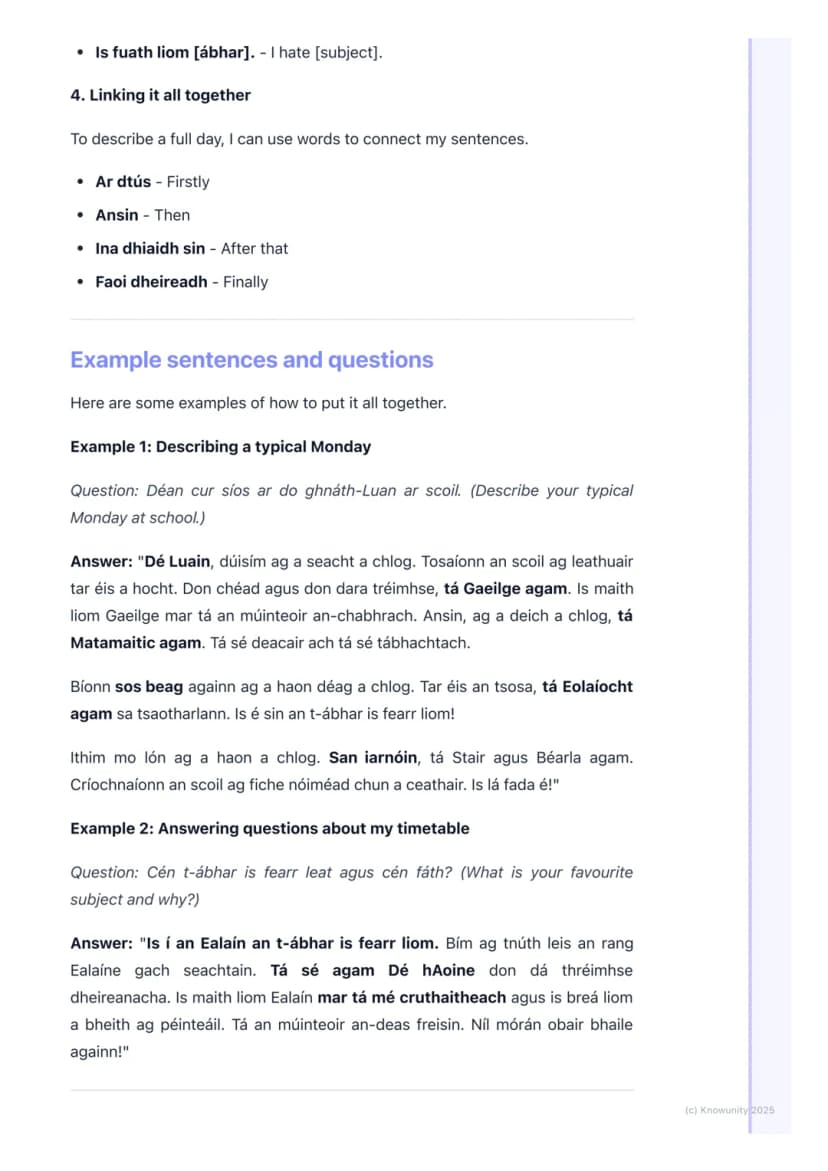
Here's where it all comes together - creating full routine descriptions that will impress examiners. Start with when you wake up, then work through your school day systematically.
A strong answer includes specific times, subject names, and personal opinions. For example: "Dé Luain, tá Gaeilge agam don chéad tréimhse. Is maith liom Gaeilge mar tá an múinteoir an-chabhrach." This shows vocabulary, structure, and personal engagement.
When talking about your favourite subject, remember the gender rules - "Is é" for masculine subjects (most of them) and "Is í" for feminine ones like Gaeilge and Stair. If you're unsure, "Is é" is usually your safest bet.
Question types you'll face include describing typical school days, explaining your favourite subjects, and discussing your weekly timetable. Practice these formats until they become second nature.
Exam Strategy: Always add reasons for your opinions using "mar" (because) - it shows deeper thinking and gets you extra marks!
5
of 5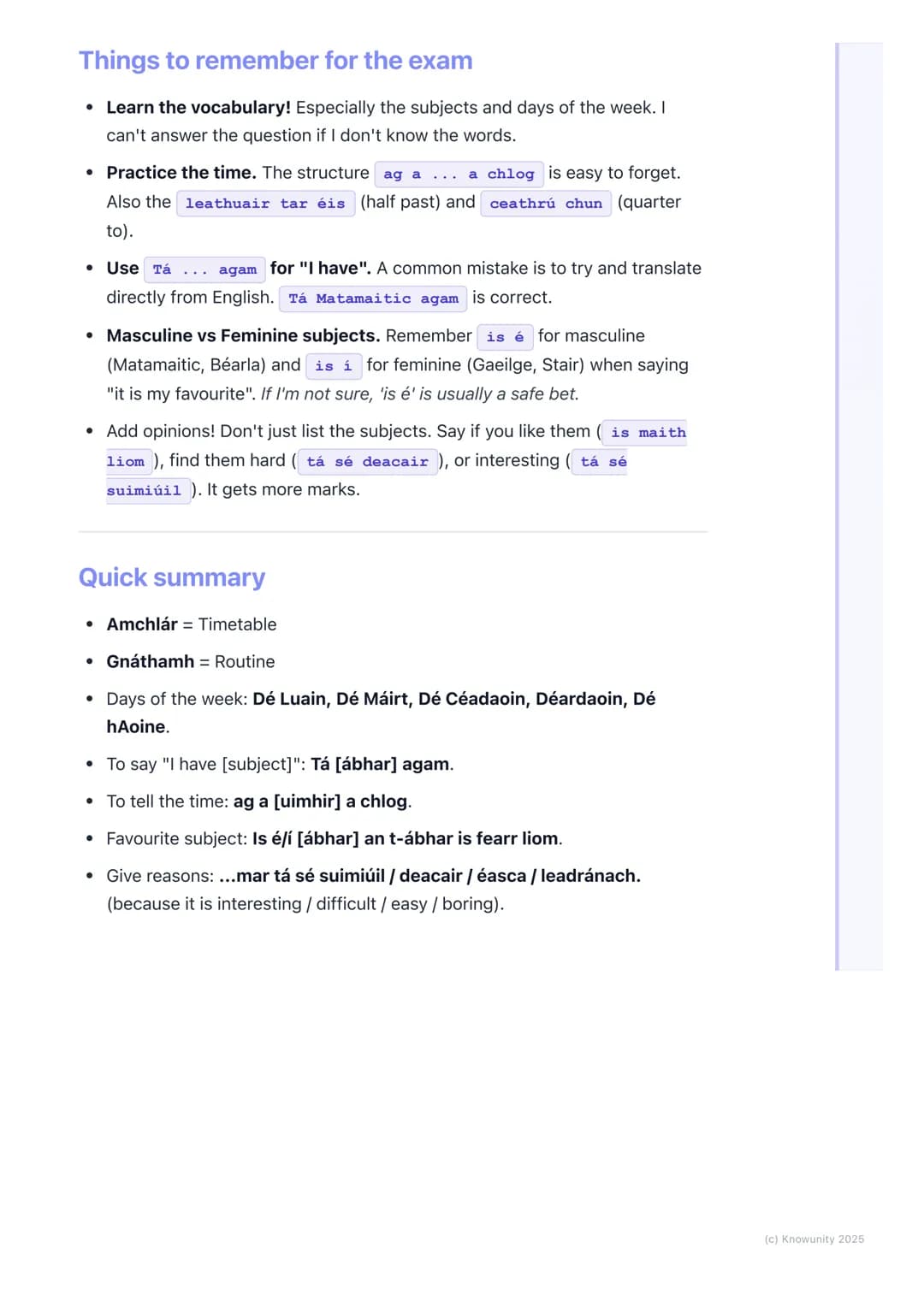
Key Points for Success
Vocabulary mastery is non-negotiable - you simply can't wing this topic without knowing your subjects and days of the week. Make flashcards and test yourself regularly until they're automatic.
The time structure "ag a ... a chlog" trips up loads of students, so practice it loads. Don't forget expressions like "leathuair tar éis" (half past) and "ceathrú chun" (quarter to) for more natural-sounding Irish.
Grammar accuracy matters - use "Tá ... agam" for "I have" rather than trying to translate word-for-word from English. This construction is fundamental to describing your routine properly.
Remember to include personal opinions and reasons in every answer. Phrases like "tá sé suimiúil" (it's interesting), "tá sé deacair" (it's difficult), and "tá sé leadránach" (it's boring) will make your Irish much more engaging and exam-ready.
Final Reminder: Practice describing different days of the week - don't just memorise one day's routine, as exam questions can ask about any day!
Pensamos que nunca lo preguntarías...
¿Qué es Knowunity AI companion?
Nuestro compañero de IA está específicamente adaptado a las necesidades de los estudiantes. Basándonos en los millones de contenidos que tenemos en la plataforma, podemos dar a los estudiantes respuestas realmente significativas y relevantes. Pero no se trata solo de respuestas, el compañero también guía a los estudiantes a través de sus retos de aprendizaje diarios, con planes de aprendizaje personalizados, cuestionarios o contenidos en el chat y una personalización del 100% basada en las habilidades y el desarrollo de los estudiantes.
¿Dónde puedo descargar la app Knowunity?
Puedes descargar la app en Google Play Store y Apple App Store.
¿Knowunity es totalmente gratuito?
Sí, tienes acceso gratuito a los contenidos de la aplicación y a nuestro compañero de IA. Para desbloquear determinadas funciones de la aplicación, puedes adquirir Knowunity Pro.
Contenidos más populares de Irish
9IrishIrish oral questions and answers
Questions and answers for the leaving cert oral
5th Year4264
IrishIrish oral questions
Outline of oral questions
5th Year2055
IrishIrish poetry 2027
Iníon + Dínit an Bhróin
5th Year1133
IrishIníon- le hÁine Durkin
Aine Durkin’s poem, Iníon: Themes & summary
5th Year850
IrishLC HL notes- Iníon (poem)
Includes poem in English and Irish, theme, key words & phrases
5th Year2284
IrishMo Ghrá-sa (Idir Lúibíní)
Notes on mo ghrá-sa
5th Year380
IrishGaeilge Grammar Office
All the basics you need to know on Irish grammar.
6th Year1063
IrishAn Gaeilge Aiste
Irish Language essay
6th Year1320
IrishMé Féin & Mo Chlann (Myself & My Family)
Students will learn vocabulary to describe themselves, their family members, and daily routines. This helps in personal introductions and discussions.
TY291
Contenidos más populares
9IrishIrish oral questions and answers
Questions and answers for the leaving cert oral
5th Year4264
 English
Key Quotes : Sive
Key Quotes and explanations: Sive
6th Year2842
IrishIrish oral questions
Outline of oral questions
5th Year2055
IrishIníon- le hÁine Durkin
Aine Durkin’s poem, Iníon: Themes & summary
5th Year850
IrishIrish poetry 2027
Iníon + Dínit an Bhróin
5th Year1133
IrishLC HL notes- Iníon (poem)
Includes poem in English and Irish, theme, key words & phrases
5th Year2284
EnglishCultural Context : Shawshank Redemption : Sive : Small Things Like These
Comparative Study : Cultural Context : Shawshank Redemption, Sive and Small Things Like These
6th Year1430
IrishMo Ghrá-sa (Idir Lúibíní)
Notes on mo ghrá-sa
5th Year380
IrishAn Gaeilge Aiste
Irish Language essay
6th Year1320
¿No encuentras lo que buscas? Explora otros temas.
Mira lo que dicen nuestros usuarios. Les encanta - y a tí también.
4.6/5App Store
4.7/5Google Play
La app es muy fácil de usar y está muy bien diseñada. Hasta ahora he encontrado todo lo que estaba buscando y he podido aprender mucho de las presentaciones. Definitivamente utilizaré la aplicación para un examen de clase. Y, por supuesto, también me sirve mucho de inspiración.
Pablousuario de iOS
Esta app es realmente genial. Hay tantos apuntes de clase y ayuda [...]. Tengo problemas con matemáticas, por ejemplo, y la aplicación tiene muchas opciones de ayuda. Gracias a Knowunity, he mejorado en mates. Se la recomiendo a todo el mundo.
Elenausuaria de Android
Vaya, estoy realmente sorprendida. Acabo de probar la app porque la he visto anunciada muchas veces y me he quedado absolutamente alucinada. Esta app es LA AYUDA que quieres para el insti y, sobre todo, ofrece muchísimas cosas, como ejercicios y hojas informativas, que a mí personalmente me han sido MUY útiles.
Anausuaria de iOS
Irish4 visualizaciones·Actualizado Jun 11, 2026·5 páginasAmchlár agus Gnáthaimh Laethúla na Scoile
Ever wondered how to talk about your school day in Irish? This topic covers everything you need to describe your timetable (amchlár) and daily routine (gnáthamh laethúil) - perfect for oral exams and writing tasks.
1
of 5
Inscríbete para ver los apuntes. ¡Es gratis!
- Acceso a todos los documentos
- Mejora tus notas
- Únete a millones de estudiantes
School Timetable and Routine Basics
Learning to describe your school day in Irish is actually quite straightforward once you get the hang of it. You'll need this for both oral exams and written work, so it's definitely worth mastering.
The key is building up your vocabulary first - days of the week and school subjects are absolutely essential. Without these basic words, you'll struggle to put together proper sentences about your routine.
Days of the week always have 'An' in front of them normally, but when you're saying "on Monday", you use Dé Luain, Dé Máirt, and so on. It's a bit different from English, but you'll get used to it.
Quick Tip: Practice saying the days with 'Dé' - this is how you'll actually use them when describing your timetable!
2
of 5Inscríbete para ver los apuntes. ¡Es gratis!
- Acceso a todos los documentos
- Mejora tus notas
- Únete a millones de estudiantes
Essential School Vocabulary
Right, here's where the real work begins - memorising your school subjects and time expressions. You absolutely must know these off by heart for any exam.
Key subjects include Matamaitic (Maths), Stair (History), Tíreolaíocht (Geography), and Eolaíocht (Science). Don't forget Corpoideachas (P.E.) and Oideachas Reiligiúnach (R.E.) - these come up loads in exam questions.
For talking about periods and times, you'll need tréimhse (period), sos (break), and lón (lunch). Time expressions like ag a hocht a chlog (at eight o'clock) and leathuair tar éis a naoi (half past nine) are crucial for describing your daily routine.
Remember: The structure "ag a [number] a chlog" is your go-to for telling time - don't try to translate directly from English!
3
of 5Inscríbete para ver los apuntes. ¡Es gratis!
- Acceso a todos los documentos
- Mejora tus notas
- Únete a millones de estudiantes
Building Your School Day Description
Now you can start putting proper sentences together! The magic phrase is Tá [ábhar] agam, which means "I have [subject]". It's not a direct translation from English, but it's the correct Irish way to say it.
For describing your timetable structure, use phrases like "Don chéad tréimhse" (for the first period) and "Don dara tréimhse" (for the second period). This makes your Irish sound much more natural and structured.
Time expressions follow the pattern "ag a [number] a chlog" - but watch out for the séimhiú (the 'h' sound) after 'a' with certain numbers. For example, it's "a h-aon" (one o'clock) and "a h-ocht" (eight o'clock).
Adding opinions about subjects will boost your marks significantly. Use "Is maith liom" (I like) or "Ní maith liom" (I don't like) followed by reasons like "mar tá sé suimiúil" (because it's interesting).
Pro Tip: Connect your sentences with words like "ar dtús" (firstly), "ansin" (then), and "faoi dheireadh" (finally) to make your description flow better!
4
of 5Inscríbete para ver los apuntes. ¡Es gratis!
- Acceso a todos los documentos
- Mejora tus notas
- Únete a millones de estudiantes
Sample Answers and Exam Techniques
Here's where it all comes together - creating full routine descriptions that will impress examiners. Start with when you wake up, then work through your school day systematically.
A strong answer includes specific times, subject names, and personal opinions. For example: "Dé Luain, tá Gaeilge agam don chéad tréimhse. Is maith liom Gaeilge mar tá an múinteoir an-chabhrach." This shows vocabulary, structure, and personal engagement.
When talking about your favourite subject, remember the gender rules - "Is é" for masculine subjects (most of them) and "Is í" for feminine ones like Gaeilge and Stair. If you're unsure, "Is é" is usually your safest bet.
Question types you'll face include describing typical school days, explaining your favourite subjects, and discussing your weekly timetable. Practice these formats until they become second nature.
Exam Strategy: Always add reasons for your opinions using "mar" (because) - it shows deeper thinking and gets you extra marks!
5
of 5Inscríbete para ver los apuntes. ¡Es gratis!
- Acceso a todos los documentos
- Mejora tus notas
- Únete a millones de estudiantes
Key Points for Success
Vocabulary mastery is non-negotiable - you simply can't wing this topic without knowing your subjects and days of the week. Make flashcards and test yourself regularly until they're automatic.
The time structure "ag a ... a chlog" trips up loads of students, so practice it loads. Don't forget expressions like "leathuair tar éis" (half past) and "ceathrú chun" (quarter to) for more natural-sounding Irish.
Grammar accuracy matters - use "Tá ... agam" for "I have" rather than trying to translate word-for-word from English. This construction is fundamental to describing your routine properly.
Remember to include personal opinions and reasons in every answer. Phrases like "tá sé suimiúil" (it's interesting), "tá sé deacair" (it's difficult), and "tá sé leadránach" (it's boring) will make your Irish much more engaging and exam-ready.
Final Reminder: Practice describing different days of the week - don't just memorise one day's routine, as exam questions can ask about any day!
Pensamos que nunca lo preguntarías...
¿Qué es Knowunity AI companion?
Nuestro compañero de IA está específicamente adaptado a las necesidades de los estudiantes. Basándonos en los millones de contenidos que tenemos en la plataforma, podemos dar a los estudiantes respuestas realmente significativas y relevantes. Pero no se trata solo de respuestas, el compañero también guía a los estudiantes a través de sus retos de aprendizaje diarios, con planes de aprendizaje personalizados, cuestionarios o contenidos en el chat y una personalización del 100% basada en las habilidades y el desarrollo de los estudiantes.
¿Dónde puedo descargar la app Knowunity?
Puedes descargar la app en Google Play Store y Apple App Store.
¿Knowunity es totalmente gratuito?
Sí, tienes acceso gratuito a los contenidos de la aplicación y a nuestro compañero de IA. Para desbloquear determinadas funciones de la aplicación, puedes adquirir Knowunity Pro.
Contenidos más populares de Irish
9IrishIrish oral questions and answers
Questions and answers for the leaving cert oral
5th Year4264
IrishIrish oral questions
Outline of oral questions
5th Year2055
IrishIrish poetry 2027
Iníon + Dínit an Bhróin
5th Year1133
IrishIníon- le hÁine Durkin
Aine Durkin’s poem, Iníon: Themes & summary
5th Year850
IrishLC HL notes- Iníon (poem)
Includes poem in English and Irish, theme, key words & phrases
5th Year2284
IrishMo Ghrá-sa (Idir Lúibíní)
Notes on mo ghrá-sa
5th Year380
IrishGaeilge Grammar Office
All the basics you need to know on Irish grammar.
6th Year1063
IrishAn Gaeilge Aiste
Irish Language essay
6th Year1320
IrishMé Féin & Mo Chlann (Myself & My Family)
Students will learn vocabulary to describe themselves, their family members, and daily routines. This helps in personal introductions and discussions.
TY291
Contenidos más populares
9IrishIrish oral questions and answers
Questions and answers for the leaving cert oral
5th Year4264
EnglishKey Quotes : Sive
Key Quotes and explanations: Sive
6th Year2842
IrishIrish oral questions
Outline of oral questions
5th Year2055
IrishIníon- le hÁine Durkin
Aine Durkin’s poem, Iníon: Themes & summary
5th Year850
IrishIrish poetry 2027
Iníon + Dínit an Bhróin
5th Year1133
IrishLC HL notes- Iníon (poem)
Includes poem in English and Irish, theme, key words & phrases
5th Year2284
EnglishCultural Context : Shawshank Redemption : Sive : Small Things Like These
Comparative Study : Cultural Context : Shawshank Redemption, Sive and Small Things Like These
6th Year1430
IrishMo Ghrá-sa (Idir Lúibíní)
Notes on mo ghrá-sa
5th Year380
IrishAn Gaeilge Aiste
Irish Language essay
6th Year1320
¿No encuentras lo que buscas? Explora otros temas.
Mira lo que dicen nuestros usuarios. Les encanta - y a tí también.
4.6/5App Store
4.7/5Google Play
La app es muy fácil de usar y está muy bien diseñada. Hasta ahora he encontrado todo lo que estaba buscando y he podido aprender mucho de las presentaciones. Definitivamente utilizaré la aplicación para un examen de clase. Y, por supuesto, también me sirve mucho de inspiración.
Pablousuario de iOS
Esta app es realmente genial. Hay tantos apuntes de clase y ayuda [...]. Tengo problemas con matemáticas, por ejemplo, y la aplicación tiene muchas opciones de ayuda. Gracias a Knowunity, he mejorado en mates. Se la recomiendo a todo el mundo.
Elenausuaria de Android
Vaya, estoy realmente sorprendida. Acabo de probar la app porque la he visto anunciada muchas veces y me he quedado absolutamente alucinada. Esta app es LA AYUDA que quieres para el insti y, sobre todo, ofrece muchísimas cosas, como ejercicios y hojas informativas, que a mí personalmente me han sido MUY útiles.
Anausuaria de iOS