
The Act of Union 1801 was one of the most...
 History3 visualizaciones·Actualizado Jun 3, 2026·5 páginas
The Union of Ireland and Britain in 1801
1 / 5
1
of 5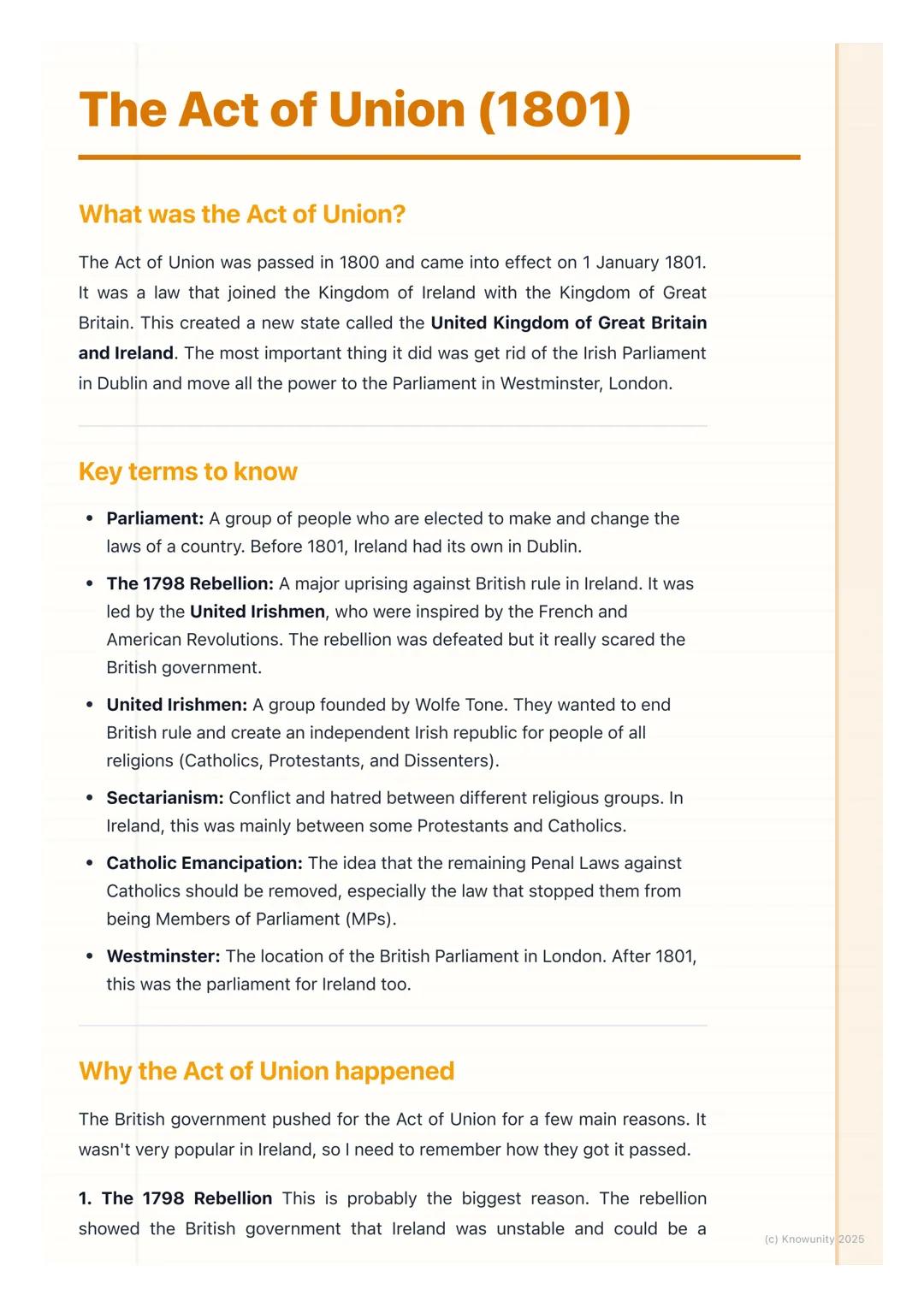
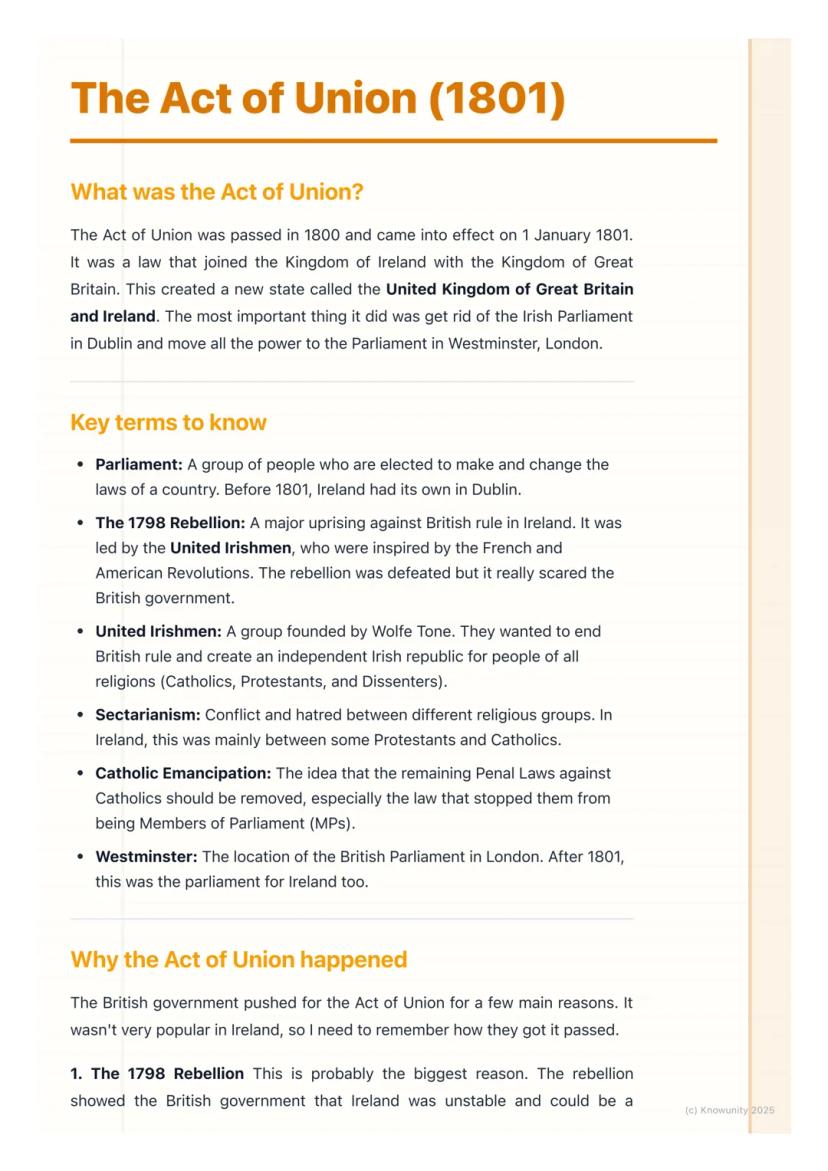
What Was the Act of Union?
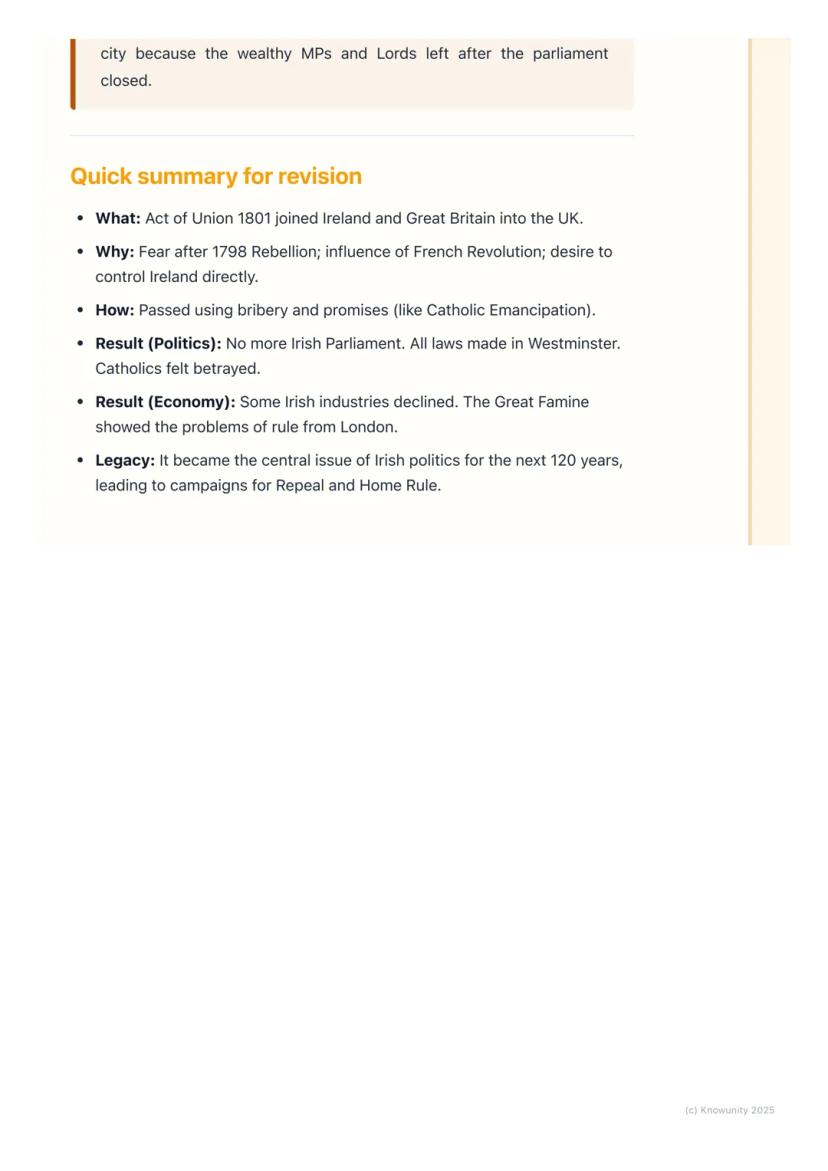
Ever wondered why Ireland became part of the UK? The Act of Union in 1801 created the United Kingdom of Great Britain and Ireland by merging the Irish and British kingdoms.
The biggest change was shutting down Ireland's parliament in Dublin and moving all decision-making power to Westminster in London. Imagine if the Dáil was suddenly closed and all Irish laws were made in another country - that's exactly what happened.
You'll need to know some key players here. The United Irishmen, led by Wolfe Tone, wanted an independent Irish republic for all religions. The 1798 Rebellion was their failed attempt to kick out the British, but it absolutely terrified the British government.
Remember This: Before 1801, Ireland actually had its own parliament in Dublin. The Act of Union completely destroyed Irish political independence.
Catholic Emancipation was the big promise used to sell the Union - basically allowing Catholics to become MPs. This promise would later be broken, causing massive problems.
2
of 5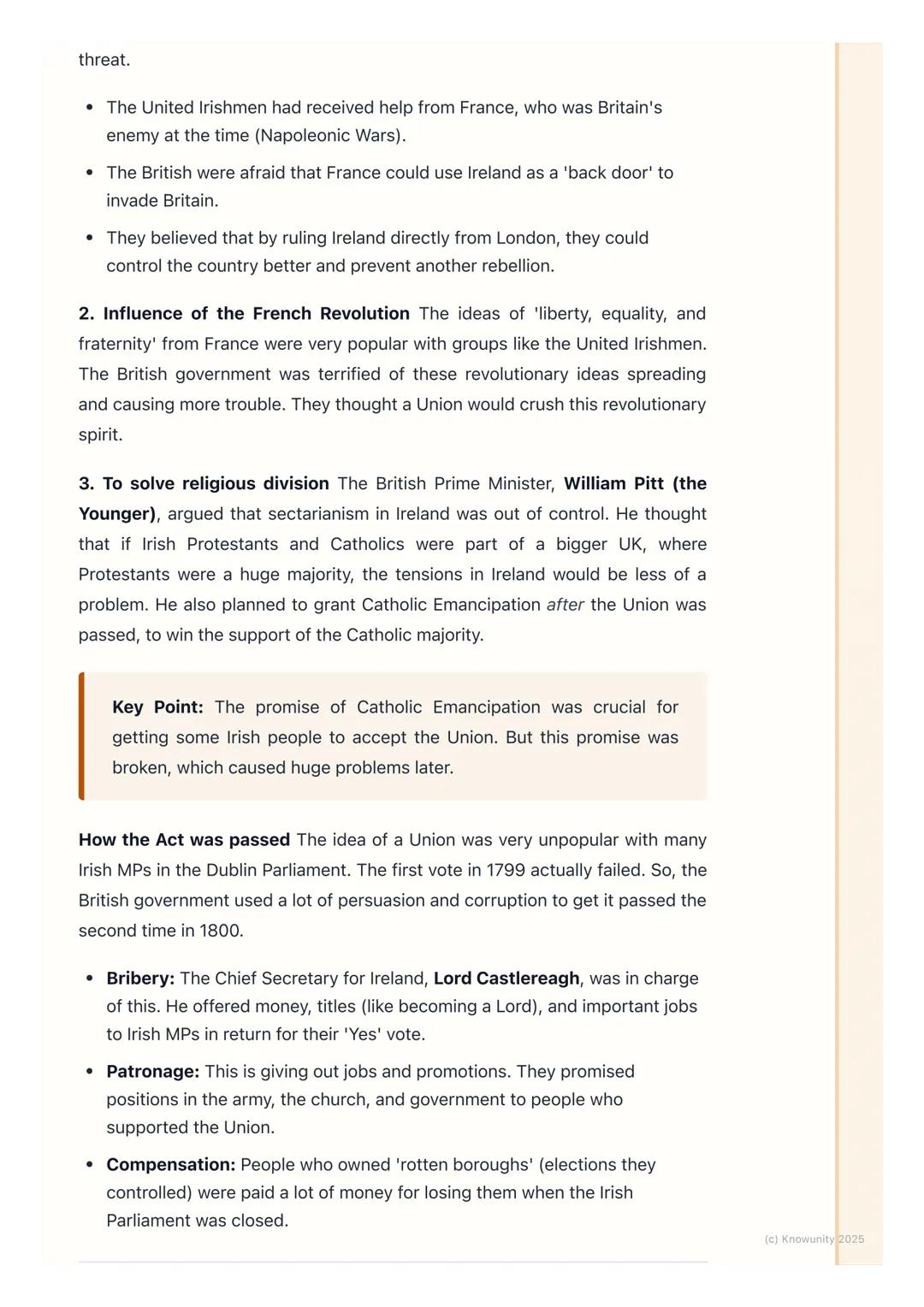
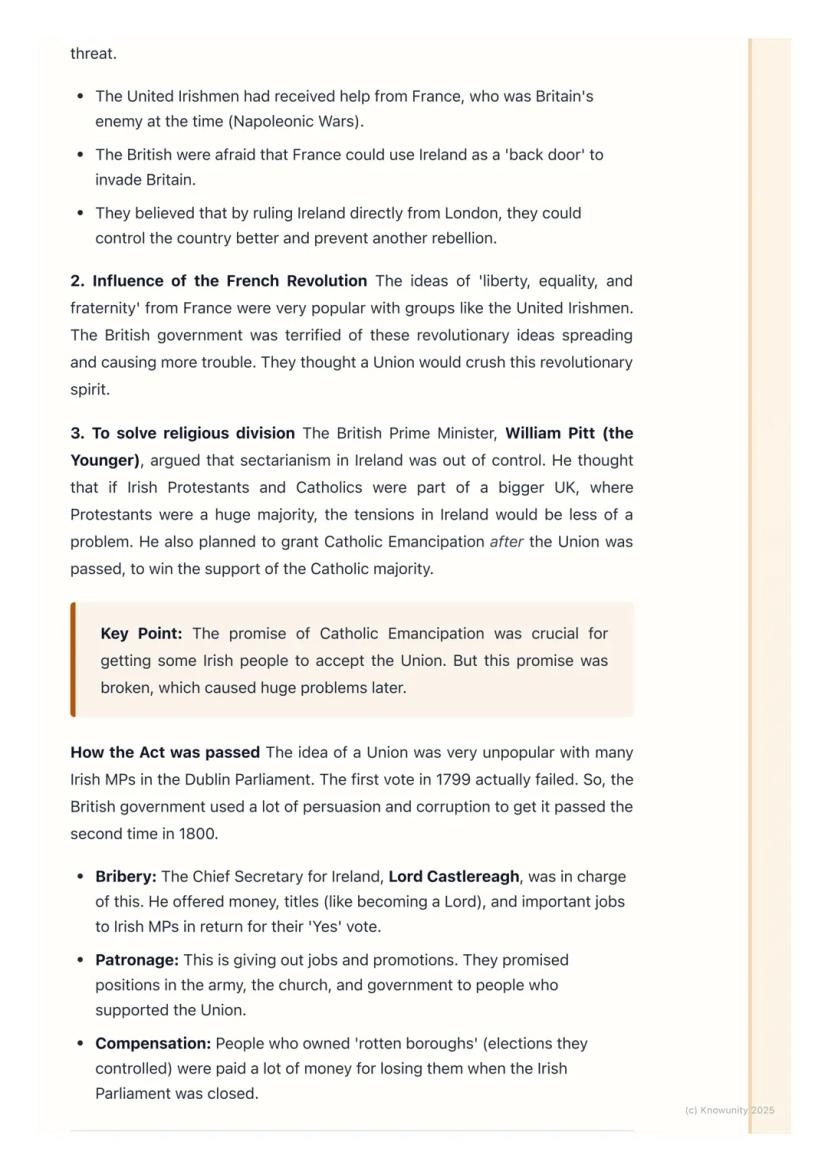
Why Did the British Force the Union?
The British government had three main reasons for pushing through the Union, and none of them were really about helping Ireland.
The 1798 Rebellion was the biggest factor. The United Irishmen had received help from France (Britain's enemy), and this scared the British government senseless. They realised Ireland could be used as a 'back door' for French invasion attempts during the Napoleonic Wars.
The French Revolution's ideas about liberty and equality were spreading to Ireland, and the British were terrified of more revolutionary uprisings. They thought direct control from London would crush this revolutionary spirit.
William Pitt the Younger (the British Prime Minister) also argued that religious tensions between Protestants and Catholics were getting out of hand. His plan was to make these Irish divisions less important by absorbing Ireland into a much larger Protestant-majority UK.
Key Point: The promise of Catholic Emancipation was crucial for getting support, but this promise was broken by King George III - remember this betrayal!
3
of 5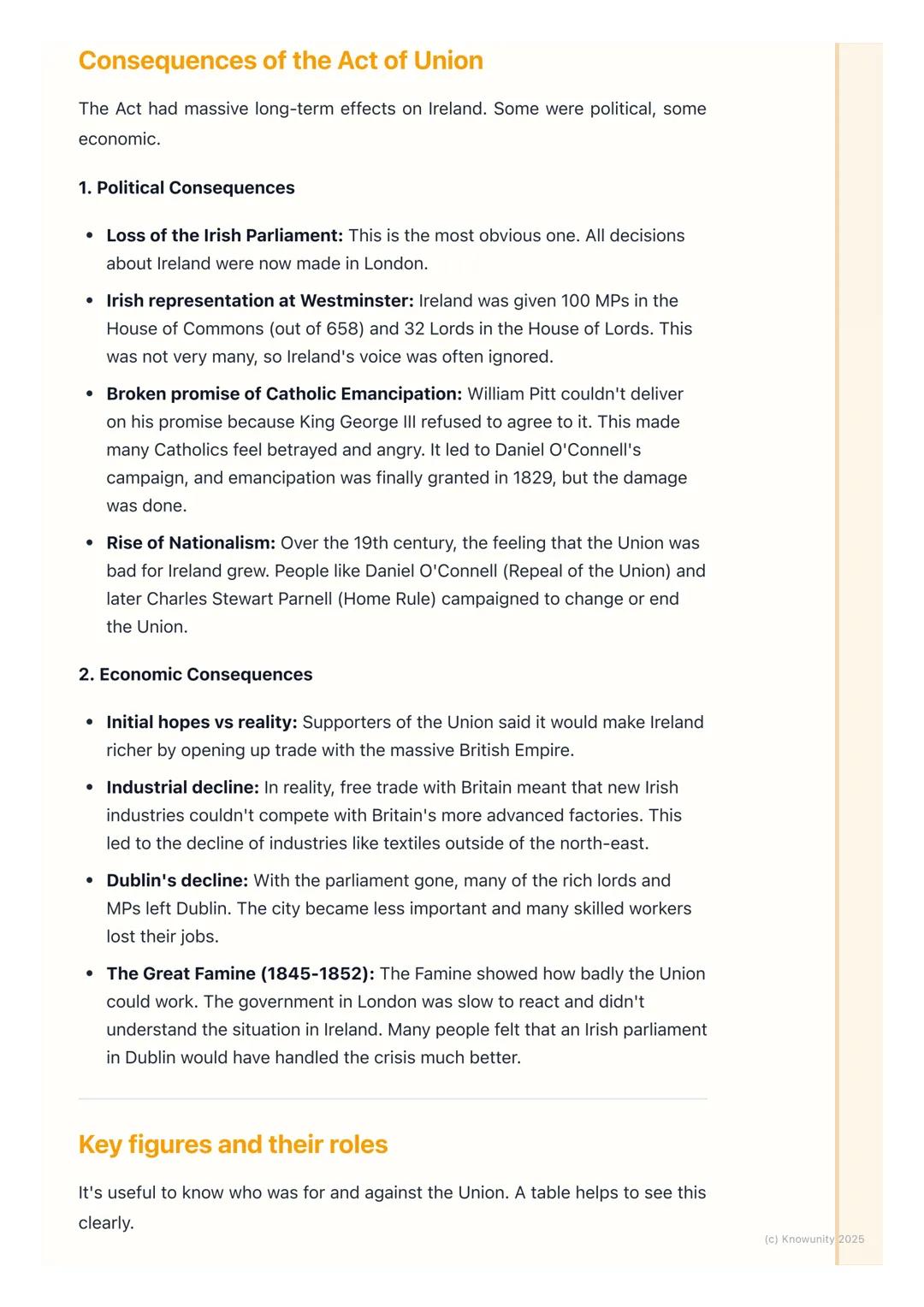
How They Actually Got It Passed
Here's where it gets properly dodgy - the Act of Union was massively unpopular in Ireland, so the British had to use bribery and corruption to get it through.
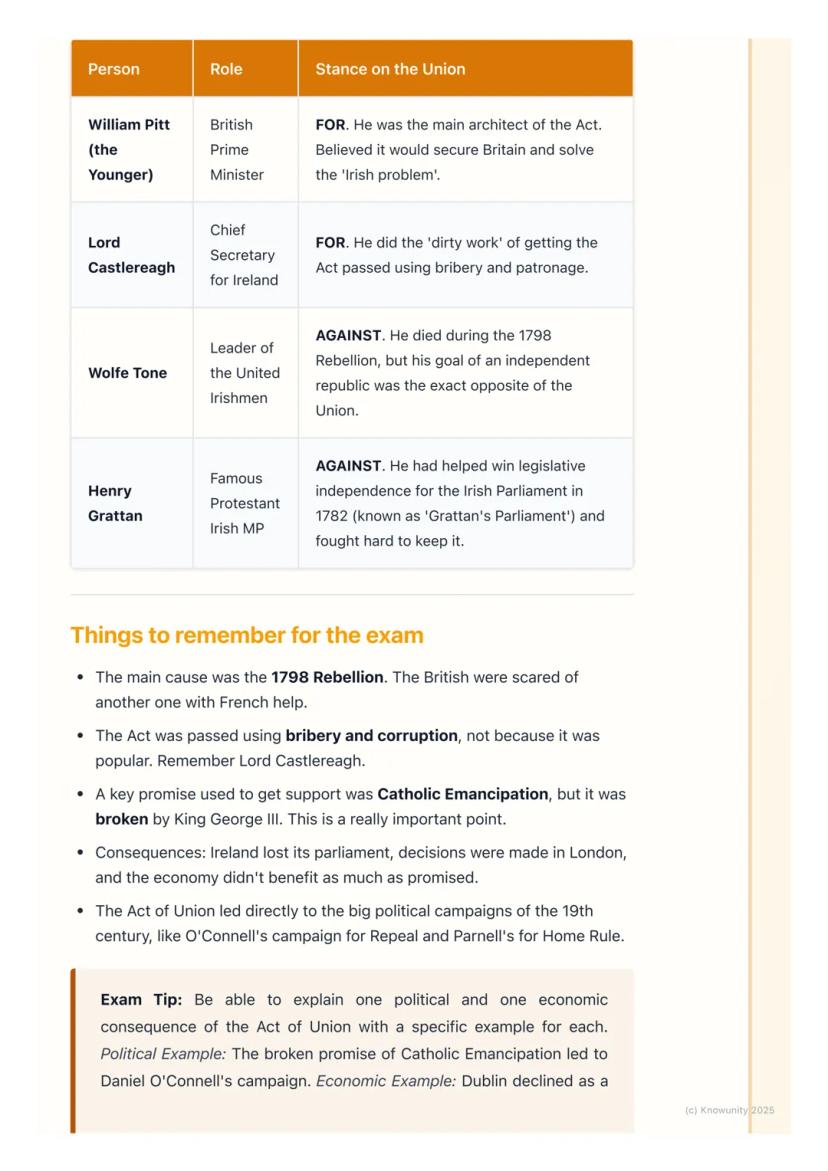
The first vote in 1799 actually failed! Lord Castlereagh (Chief Secretary for Ireland) then organised one of the most corrupt campaigns in political history. He offered Irish MPs money, fancy titles like becoming a Lord, and important government jobs in exchange for their 'Yes' votes.
They also used patronage - promising positions in the army, church, and government to anyone who supported the Union. People who owned 'rotten boroughs' (basically controlled elections) were paid massive compensation for losing this power when the Irish Parliament closed.
Think about it - if your idea is so good, why do you need to bribe people to accept it? The British knew the Union wasn't popular, so they bought their way to victory.
Exam Tip: Remember Lord Castlereagh's name - he's the guy who organised all the bribery and corruption that got the Act passed.
4
of 5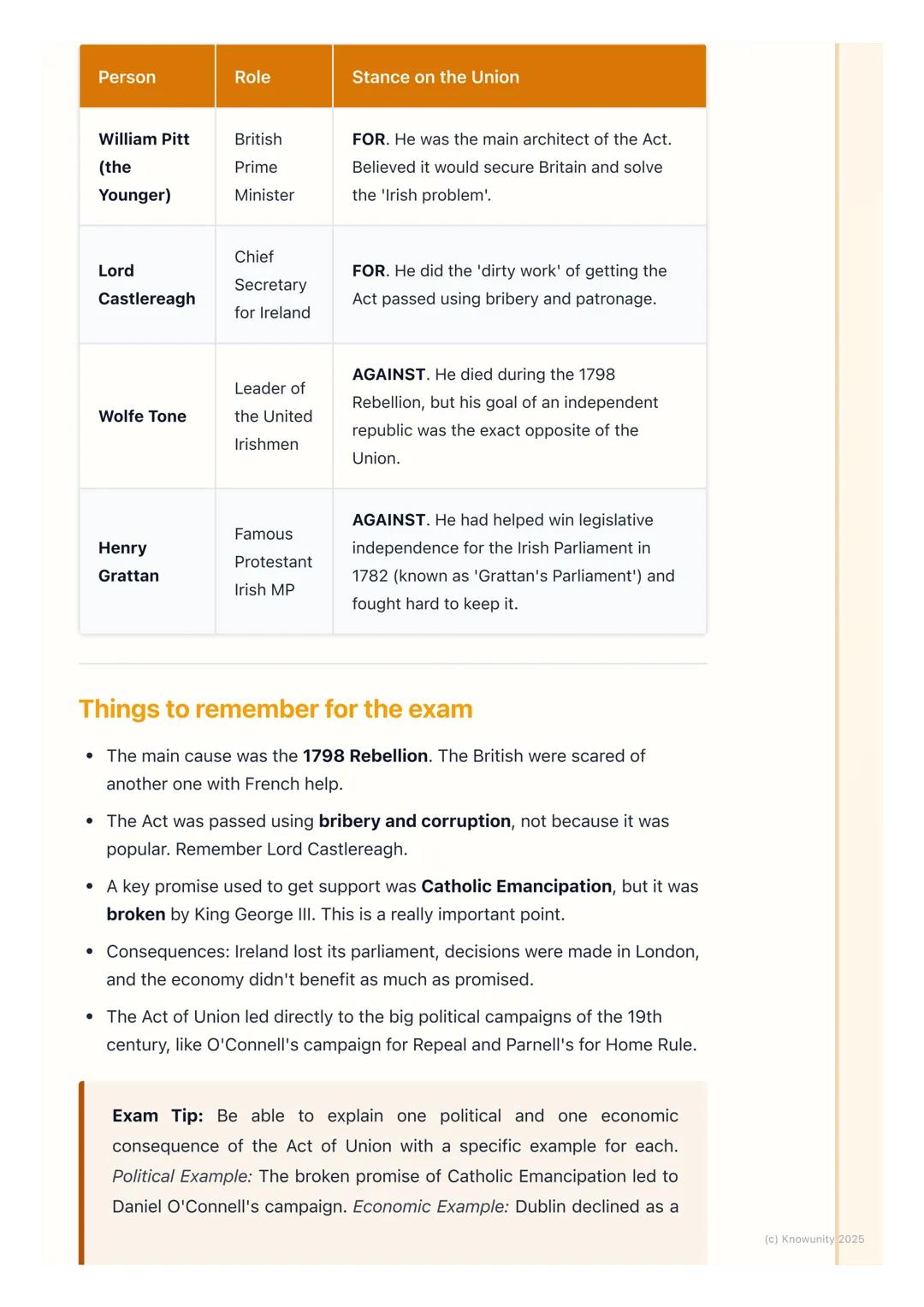
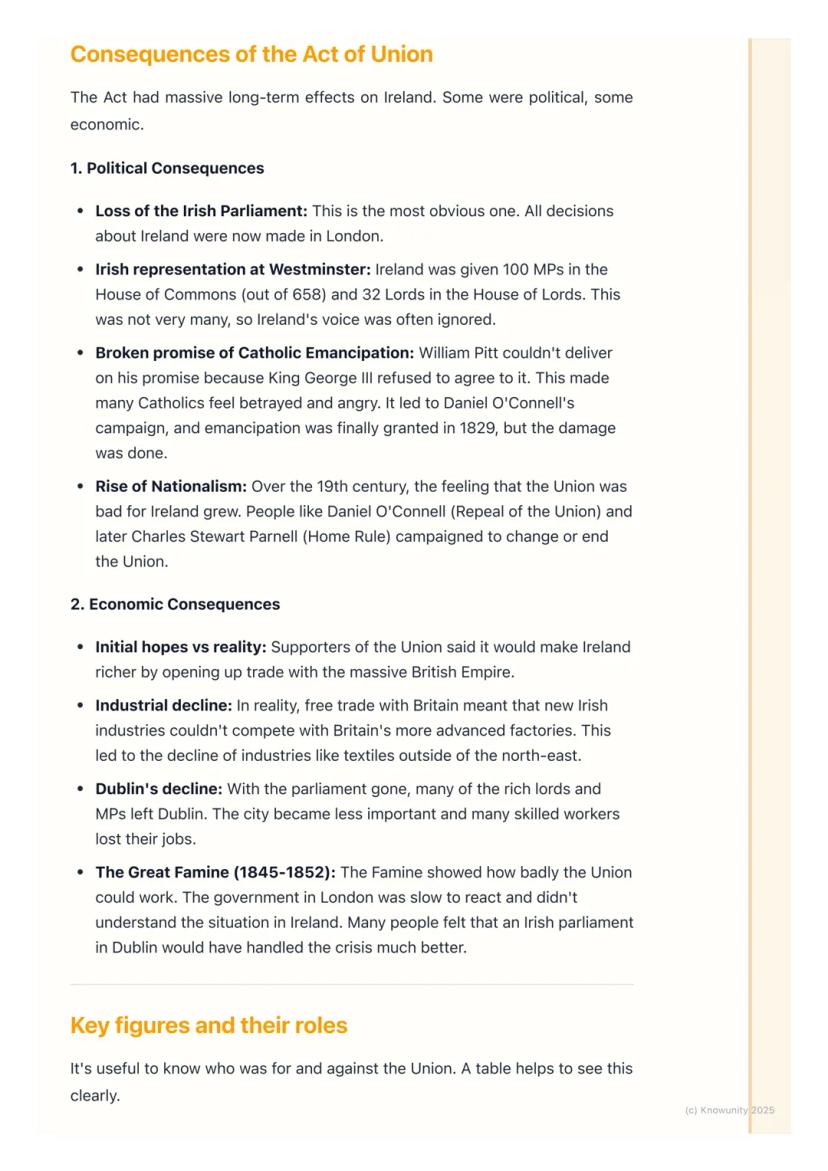
The Political Mess That Followed
The consequences of the Act of Union were absolutely massive and shaped Irish politics for the next century.
Ireland lost its parliament completely, and Irish voices were basically ignored at Westminster. Ireland only got 100 MPs out of 658 in the House of Commons - nowhere near enough to actually influence decisions about Ireland.
The broken promise of Catholic Emancipation was probably the biggest political disaster. When King George III refused to allow it, Irish Catholics felt completely betrayed. This led directly to Daniel O'Connell's campaign for Catholic rights, and emancipation wasn't granted until 1829.
Irish nationalism exploded as a result. Throughout the 19th century, people like O'Connell campaigned for Repeal of the Union, while later Charles Stewart Parnell fought for Home Rule. The Union became the central issue dividing Irish and British politics.
Remember This: The Act of Union didn't solve the 'Irish problem' - it created a much bigger one that lasted over a century.
5
of 5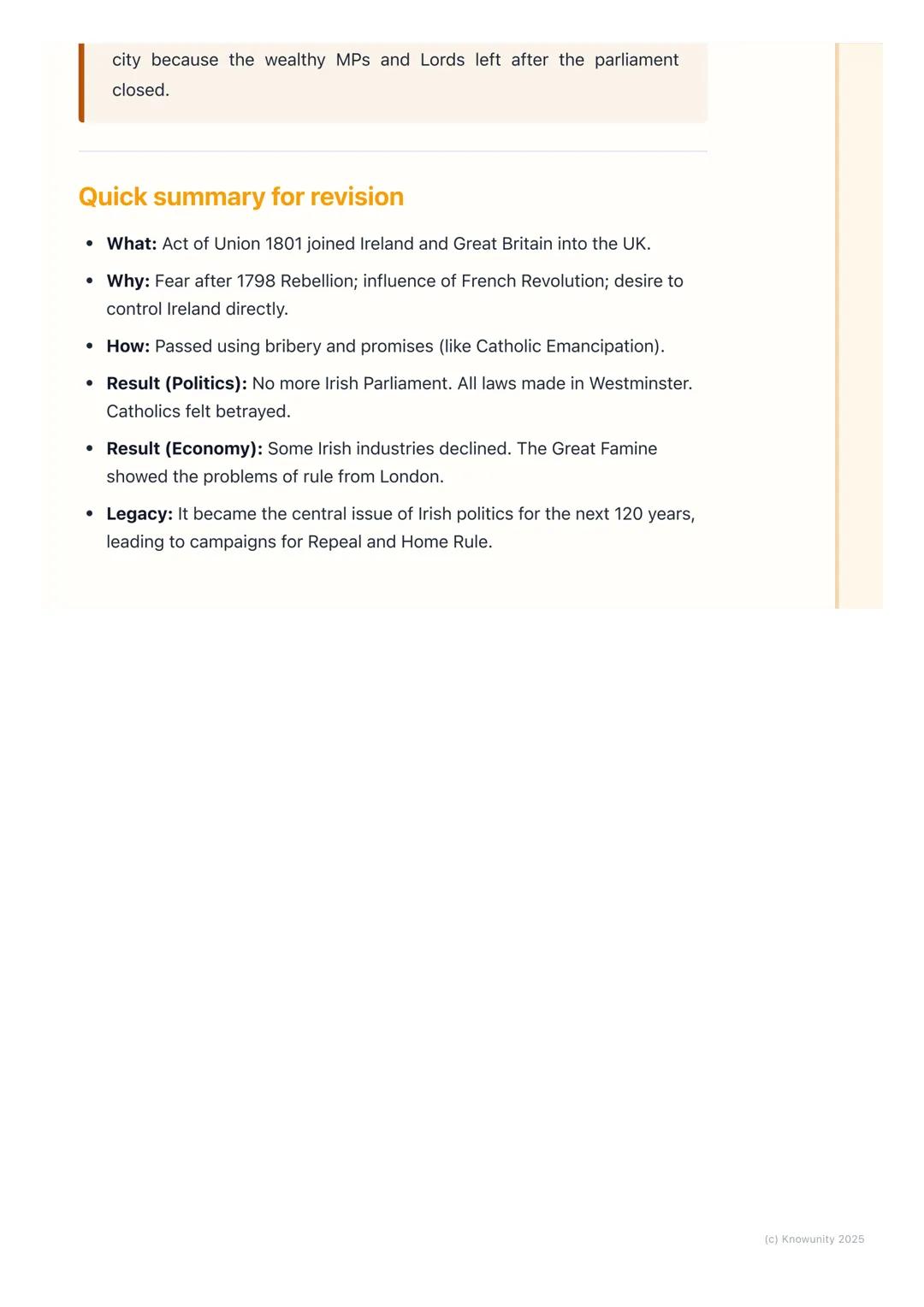
Economic Disaster and Long-term Impact
The economic consequences were just as bad as the political ones, despite promises that Ireland would benefit from free trade with the British Empire.
Dublin's decline was immediate and obvious. When the parliament closed, all the wealthy MPs and Lords left the city, taking their money and jobs with them. Dublin went from being an important political centre to a much less significant place.
Irish industries outside the north-east couldn't compete with Britain's more advanced factories. Free trade meant industrial decline for much of Ireland - the exact opposite of what Union supporters had promised.
The Great Famine (1845-1852) showed how disastrous rule from London could be. The government was slow to react and didn't understand the Irish situation. Many people believed an Irish parliament in Dublin would have handled the crisis much better and saved more lives.
Exam Tip: Be ready to explain one political consequence (broken promise of Catholic Emancipation leading to O'Connell's campaigns) and one economic consequence (Dublin's decline after wealthy politicians left).
The Act of Union became the defining issue of Irish politics until independence, proving that forcing political unions rarely works out well.
Pensamos que nunca lo preguntarías...
¿Qué es Knowunity AI companion?
Nuestro compañero de IA está específicamente adaptado a las necesidades de los estudiantes. Basándonos en los millones de contenidos que tenemos en la plataforma, podemos dar a los estudiantes respuestas realmente significativas y relevantes. Pero no se trata solo de respuestas, el compañero también guía a los estudiantes a través de sus retos de aprendizaje diarios, con planes de aprendizaje personalizados, cuestionarios o contenidos en el chat y una personalización del 100% basada en las habilidades y el desarrollo de los estudiantes.
¿Dónde puedo descargar la app Knowunity?
Puedes descargar la app en Google Play Store y Apple App Store.
¿Knowunity es totalmente gratuito?
Sí, tienes acceso gratuito a los contenidos de la aplicación y a nuestro compañero de IA. Para desbloquear determinadas funciones de la aplicación, puedes adquirir Knowunity Pro.
Contenidos más populares de History
9HistoryThe Great Famine (An Gorta Mór)
Students will learn about the causes, devastating impact, and long-term consequences of the potato famine on Irish population and society.
2nd Year282
HistoryThe renaissance
junior cert renaissance summary
1st Year361
HistoryCauses and Consequences of World War II
This subtopic covers the origins of the Second World War, its global scale, and its devastating human and political consequences, including the atomic bomb.
3rd Year152
HistoryThe 1798 Rebellion in Ireland
Learning about the causes, events, and aftermath of the United Irishmen's rebellion against British rule, inspired by revolutionary ideals.
3rd Year211
HistoryAmerican revolution
junior cert american revolution summary
1st Year442
HistoryThe Great Famine (An Gorta Mór)
This critical subtopic examines the causes, devastating impact, and long-term consequences of the potato famine on Irish society, population, and emigration.
3rd Year140
HistoryThe Renaissance
Students will learn about a time of 'rebirth' in Europe, where new ideas in art, science, and literature flourished.
1st Year140
History1916 Rising Revison Sheet
revision sheet
3rd Year211
HistoryThe Reformation in Europe
Students will learn about the causes and key figures of the Protestant Reformation and its impact on European society and politics.
3rd Year110
Contenidos más populares
9 Irish
IrishIrish oral questions and answers
Questions and answers for the leaving cert oral
5th Year4264
 English
Key Quotes : Sive
Key Quotes and explanations: Sive
6th Year2842
IrishIrish oral questions
Outline of oral questions
5th Year2055
IrishIníon- le hÁine Durkin
Aine Durkin’s poem, Iníon: Themes & summary
5th Year850
IrishIrish poetry 2027
Iníon + Dínit an Bhróin
5th Year1133
IrishLC HL notes- Iníon (poem)
Includes poem in English and Irish, theme, key words & phrases
5th Year2284
EnglishCultural Context : Shawshank Redemption : Sive : Small Things Like These
Comparative Study : Cultural Context : Shawshank Redemption, Sive and Small Things Like These
6th Year1430
IrishMo Ghrá-sa (Idir Lúibíní)
Notes on mo ghrá-sa
5th Year380
IrishAn Gaeilge Aiste
Irish Language essay
6th Year1320
¿No encuentras lo que buscas? Explora otros temas.
Mira lo que dicen nuestros usuarios. Les encanta - y a tí también.
4.6/5App Store
4.7/5Google Play
La app es muy fácil de usar y está muy bien diseñada. Hasta ahora he encontrado todo lo que estaba buscando y he podido aprender mucho de las presentaciones. Definitivamente utilizaré la aplicación para un examen de clase. Y, por supuesto, también me sirve mucho de inspiración.
Pablousuario de iOS
Esta app es realmente genial. Hay tantos apuntes de clase y ayuda [...]. Tengo problemas con matemáticas, por ejemplo, y la aplicación tiene muchas opciones de ayuda. Gracias a Knowunity, he mejorado en mates. Se la recomiendo a todo el mundo.
Elenausuaria de Android
Vaya, estoy realmente sorprendida. Acabo de probar la app porque la he visto anunciada muchas veces y me he quedado absolutamente alucinada. Esta app es LA AYUDA que quieres para el insti y, sobre todo, ofrece muchísimas cosas, como ejercicios y hojas informativas, que a mí personalmente me han sido MUY útiles.
Anausuaria de iOS
History3 visualizaciones·Actualizado Jun 3, 2026·5 páginasThe Union of Ireland and Britain in 1801
The Act of Union 1801 was one of the most important events in Irish history - it basically ended Ireland's independence and made it part of the United Kingdom. This wasn't a popular move with most Irish people, and it...
1
of 5
Inscríbete para ver los apuntes. ¡Es gratis!
- Acceso a todos los documentos
- Mejora tus notas
- Únete a millones de estudiantes
What Was the Act of Union?
Ever wondered why Ireland became part of the UK? The Act of Union in 1801 created the United Kingdom of Great Britain and Ireland by merging the Irish and British kingdoms.
The biggest change was shutting down Ireland's parliament in Dublin and moving all decision-making power to Westminster in London. Imagine if the Dáil was suddenly closed and all Irish laws were made in another country - that's exactly what happened.
You'll need to know some key players here. The United Irishmen, led by Wolfe Tone, wanted an independent Irish republic for all religions. The 1798 Rebellion was their failed attempt to kick out the British, but it absolutely terrified the British government.
Remember This: Before 1801, Ireland actually had its own parliament in Dublin. The Act of Union completely destroyed Irish political independence.
Catholic Emancipation was the big promise used to sell the Union - basically allowing Catholics to become MPs. This promise would later be broken, causing massive problems.
2
of 5Inscríbete para ver los apuntes. ¡Es gratis!
- Acceso a todos los documentos
- Mejora tus notas
- Únete a millones de estudiantes
Why Did the British Force the Union?
The British government had three main reasons for pushing through the Union, and none of them were really about helping Ireland.
The 1798 Rebellion was the biggest factor. The United Irishmen had received help from France (Britain's enemy), and this scared the British government senseless. They realised Ireland could be used as a 'back door' for French invasion attempts during the Napoleonic Wars.
The French Revolution's ideas about liberty and equality were spreading to Ireland, and the British were terrified of more revolutionary uprisings. They thought direct control from London would crush this revolutionary spirit.
William Pitt the Younger (the British Prime Minister) also argued that religious tensions between Protestants and Catholics were getting out of hand. His plan was to make these Irish divisions less important by absorbing Ireland into a much larger Protestant-majority UK.
Key Point: The promise of Catholic Emancipation was crucial for getting support, but this promise was broken by King George III - remember this betrayal!
3
of 5Inscríbete para ver los apuntes. ¡Es gratis!
- Acceso a todos los documentos
- Mejora tus notas
- Únete a millones de estudiantes
How They Actually Got It Passed
Here's where it gets properly dodgy - the Act of Union was massively unpopular in Ireland, so the British had to use bribery and corruption to get it through.
The first vote in 1799 actually failed! Lord Castlereagh (Chief Secretary for Ireland) then organised one of the most corrupt campaigns in political history. He offered Irish MPs money, fancy titles like becoming a Lord, and important government jobs in exchange for their 'Yes' votes.
They also used patronage - promising positions in the army, church, and government to anyone who supported the Union. People who owned 'rotten boroughs' (basically controlled elections) were paid massive compensation for losing this power when the Irish Parliament closed.
Think about it - if your idea is so good, why do you need to bribe people to accept it? The British knew the Union wasn't popular, so they bought their way to victory.
Exam Tip: Remember Lord Castlereagh's name - he's the guy who organised all the bribery and corruption that got the Act passed.
4
of 5Inscríbete para ver los apuntes. ¡Es gratis!
- Acceso a todos los documentos
- Mejora tus notas
- Únete a millones de estudiantes
The Political Mess That Followed
The consequences of the Act of Union were absolutely massive and shaped Irish politics for the next century.
Ireland lost its parliament completely, and Irish voices were basically ignored at Westminster. Ireland only got 100 MPs out of 658 in the House of Commons - nowhere near enough to actually influence decisions about Ireland.
The broken promise of Catholic Emancipation was probably the biggest political disaster. When King George III refused to allow it, Irish Catholics felt completely betrayed. This led directly to Daniel O'Connell's campaign for Catholic rights, and emancipation wasn't granted until 1829.
Irish nationalism exploded as a result. Throughout the 19th century, people like O'Connell campaigned for Repeal of the Union, while later Charles Stewart Parnell fought for Home Rule. The Union became the central issue dividing Irish and British politics.
Remember This: The Act of Union didn't solve the 'Irish problem' - it created a much bigger one that lasted over a century.
5
of 5Inscríbete para ver los apuntes. ¡Es gratis!
- Acceso a todos los documentos
- Mejora tus notas
- Únete a millones de estudiantes
Economic Disaster and Long-term Impact
The economic consequences were just as bad as the political ones, despite promises that Ireland would benefit from free trade with the British Empire.
Dublin's decline was immediate and obvious. When the parliament closed, all the wealthy MPs and Lords left the city, taking their money and jobs with them. Dublin went from being an important political centre to a much less significant place.
Irish industries outside the north-east couldn't compete with Britain's more advanced factories. Free trade meant industrial decline for much of Ireland - the exact opposite of what Union supporters had promised.
The Great Famine (1845-1852) showed how disastrous rule from London could be. The government was slow to react and didn't understand the Irish situation. Many people believed an Irish parliament in Dublin would have handled the crisis much better and saved more lives.
Exam Tip: Be ready to explain one political consequence (broken promise of Catholic Emancipation leading to O'Connell's campaigns) and one economic consequence (Dublin's decline after wealthy politicians left).
The Act of Union became the defining issue of Irish politics until independence, proving that forcing political unions rarely works out well.
Pensamos que nunca lo preguntarías...
¿Qué es Knowunity AI companion?
Nuestro compañero de IA está específicamente adaptado a las necesidades de los estudiantes. Basándonos en los millones de contenidos que tenemos en la plataforma, podemos dar a los estudiantes respuestas realmente significativas y relevantes. Pero no se trata solo de respuestas, el compañero también guía a los estudiantes a través de sus retos de aprendizaje diarios, con planes de aprendizaje personalizados, cuestionarios o contenidos en el chat y una personalización del 100% basada en las habilidades y el desarrollo de los estudiantes.
¿Dónde puedo descargar la app Knowunity?
Puedes descargar la app en Google Play Store y Apple App Store.
¿Knowunity es totalmente gratuito?
Sí, tienes acceso gratuito a los contenidos de la aplicación y a nuestro compañero de IA. Para desbloquear determinadas funciones de la aplicación, puedes adquirir Knowunity Pro.
Contenidos más populares de History
9HistoryThe Great Famine (An Gorta Mór)
Students will learn about the causes, devastating impact, and long-term consequences of the potato famine on Irish population and society.
2nd Year282
HistoryThe renaissance
junior cert renaissance summary
1st Year361
HistoryCauses and Consequences of World War II
This subtopic covers the origins of the Second World War, its global scale, and its devastating human and political consequences, including the atomic bomb.
3rd Year152
HistoryThe 1798 Rebellion in Ireland
Learning about the causes, events, and aftermath of the United Irishmen's rebellion against British rule, inspired by revolutionary ideals.
3rd Year211
HistoryAmerican revolution
junior cert american revolution summary
1st Year442
HistoryThe Great Famine (An Gorta Mór)
This critical subtopic examines the causes, devastating impact, and long-term consequences of the potato famine on Irish society, population, and emigration.
3rd Year140
HistoryThe Renaissance
Students will learn about a time of 'rebirth' in Europe, where new ideas in art, science, and literature flourished.
1st Year140
History1916 Rising Revison Sheet
revision sheet
3rd Year211
HistoryThe Reformation in Europe
Students will learn about the causes and key figures of the Protestant Reformation and its impact on European society and politics.
3rd Year110
Contenidos más populares
9IrishIrish oral questions and answers
Questions and answers for the leaving cert oral
5th Year4264
EnglishKey Quotes : Sive
Key Quotes and explanations: Sive
6th Year2842
IrishIrish oral questions
Outline of oral questions
5th Year2055
IrishIníon- le hÁine Durkin
Aine Durkin’s poem, Iníon: Themes & summary
5th Year850
IrishIrish poetry 2027
Iníon + Dínit an Bhróin
5th Year1133
IrishLC HL notes- Iníon (poem)
Includes poem in English and Irish, theme, key words & phrases
5th Year2284
EnglishCultural Context : Shawshank Redemption : Sive : Small Things Like These
Comparative Study : Cultural Context : Shawshank Redemption, Sive and Small Things Like These
6th Year1430
IrishMo Ghrá-sa (Idir Lúibíní)
Notes on mo ghrá-sa
5th Year380
IrishAn Gaeilge Aiste
Irish Language essay
6th Year1320
¿No encuentras lo que buscas? Explora otros temas.
Mira lo que dicen nuestros usuarios. Les encanta - y a tí también.
4.6/5App Store
4.7/5Google Play
La app es muy fácil de usar y está muy bien diseñada. Hasta ahora he encontrado todo lo que estaba buscando y he podido aprender mucho de las presentaciones. Definitivamente utilizaré la aplicación para un examen de clase. Y, por supuesto, también me sirve mucho de inspiración.
Pablousuario de iOS
Esta app es realmente genial. Hay tantos apuntes de clase y ayuda [...]. Tengo problemas con matemáticas, por ejemplo, y la aplicación tiene muchas opciones de ayuda. Gracias a Knowunity, he mejorado en mates. Se la recomiendo a todo el mundo.
Elenausuaria de Android
Vaya, estoy realmente sorprendida. Acabo de probar la app porque la he visto anunciada muchas veces y me he quedado absolutamente alucinada. Esta app es LA AYUDA que quieres para el insti y, sobre todo, ofrece muchísimas cosas, como ejercicios y hojas informativas, que a mí personalmente me han sido MUY útiles.
Anausuaria de iOS