
The 1916 Easter Rising was a turning point in Irish...
 History14 visualizaciones·Actualizado Jun 3, 2026·6 páginas
The 1916 Easter Rising: Ireland's Fight for Independence
1 / 6
1
of 6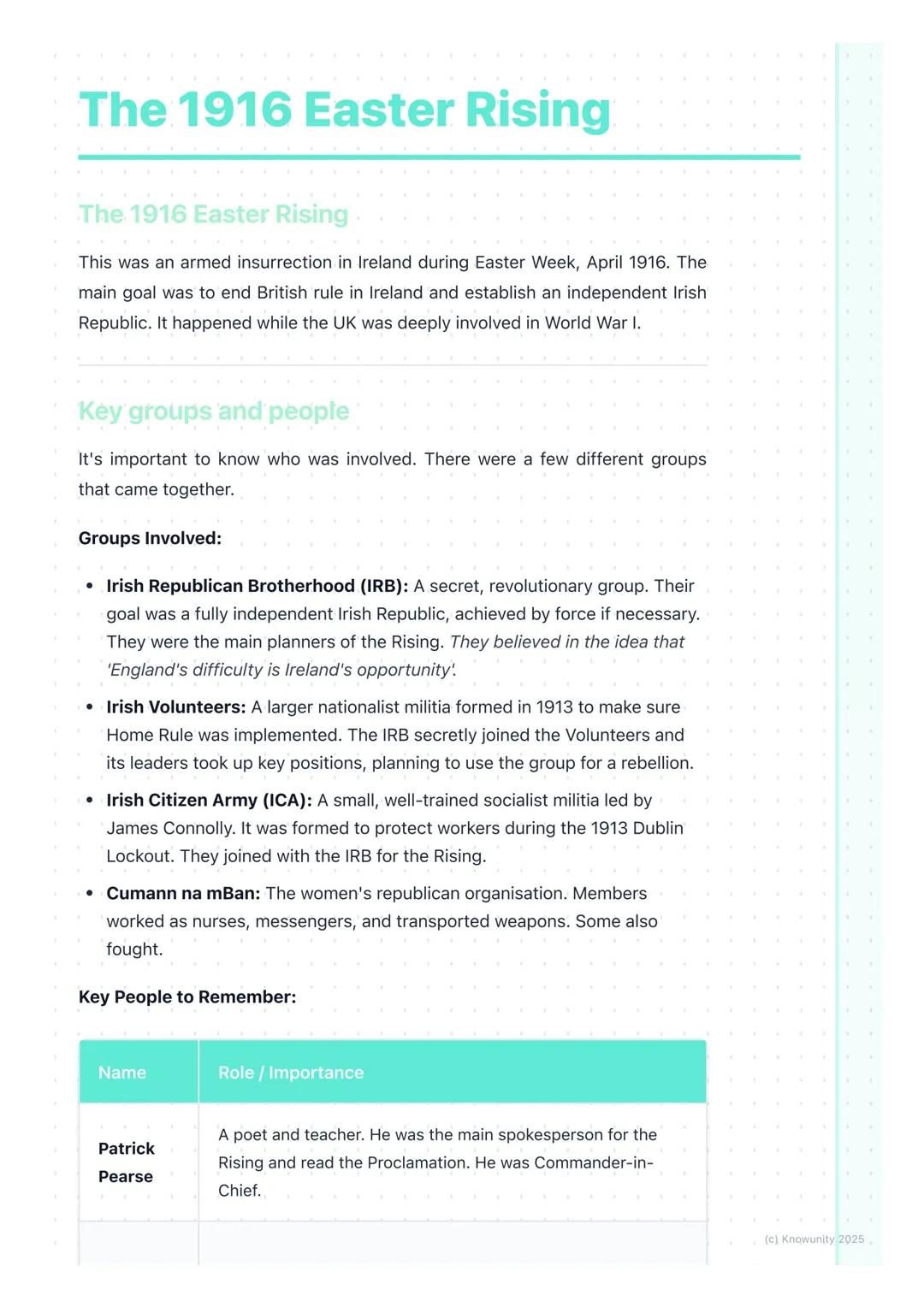
The 1916 Easter Rising
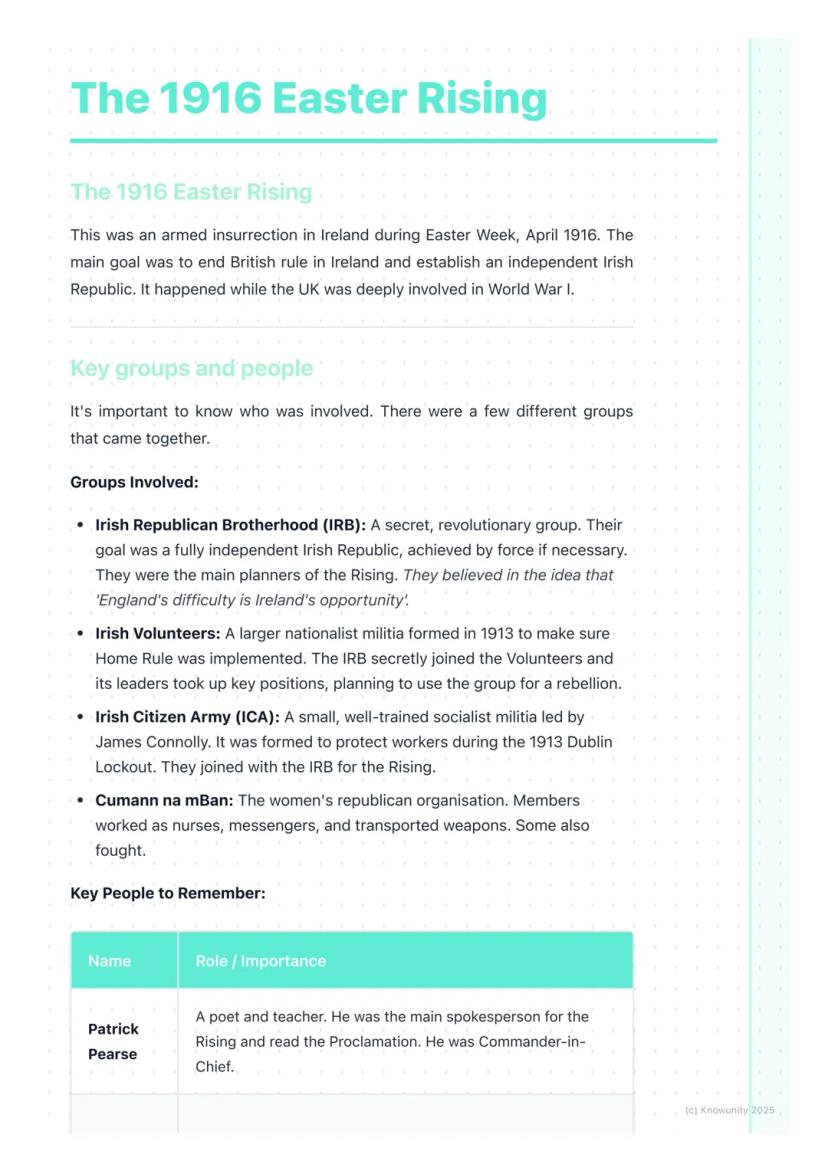
Ever wonder how a failed rebellion could actually change the course of a nation's history? The Easter Rising was exactly that - an armed rebellion during Easter Week 1916 that aimed to end British rule and create an independent Irish Republic.
The timing wasn't random. Britain was deep in World War I, and Irish revolutionaries believed in the old saying: 'England's difficulty is Ireland's opportunity'. Several groups joined forces for this massive gamble.
The Irish Republican Brotherhood (IRB) were the secret masterminds behind it all. They'd infiltrated the much larger Irish Volunteers (originally formed to support Home Rule) and planned to use them for revolution. The Irish Citizen Army, led by socialist James Connolly, brought their working-class militancy to the cause. Meanwhile, Cumann na mBan proved that women were just as committed - they served as nurses, messengers, weapon runners, and fighters.
Key Point: The IRB secretly controlled the Rising while keeping their plans hidden from moderate leaders like Eoin MacNeill, who opposed violence unless success was guaranteed.
2
of 6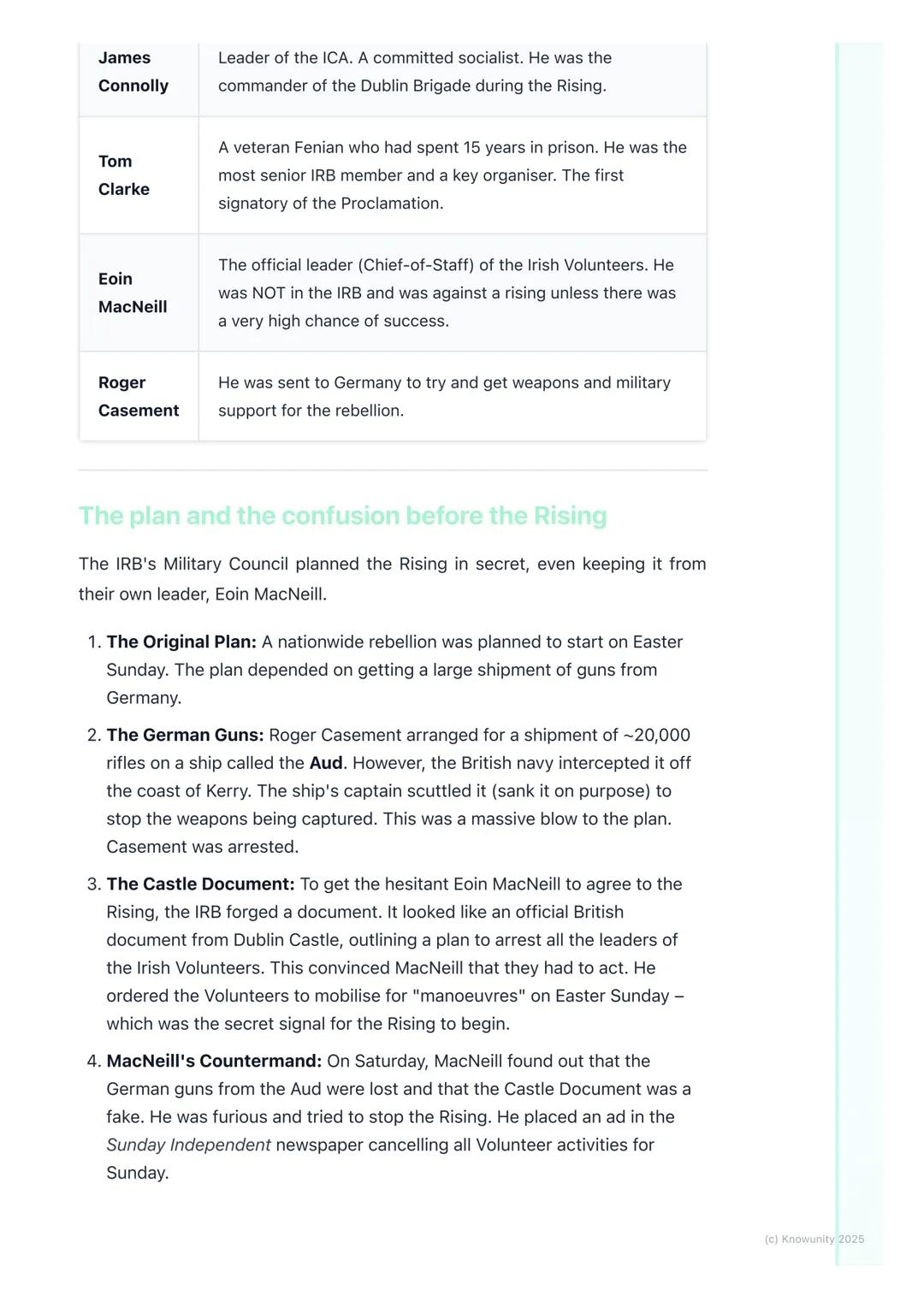
Key People and the Plan Gone Wrong
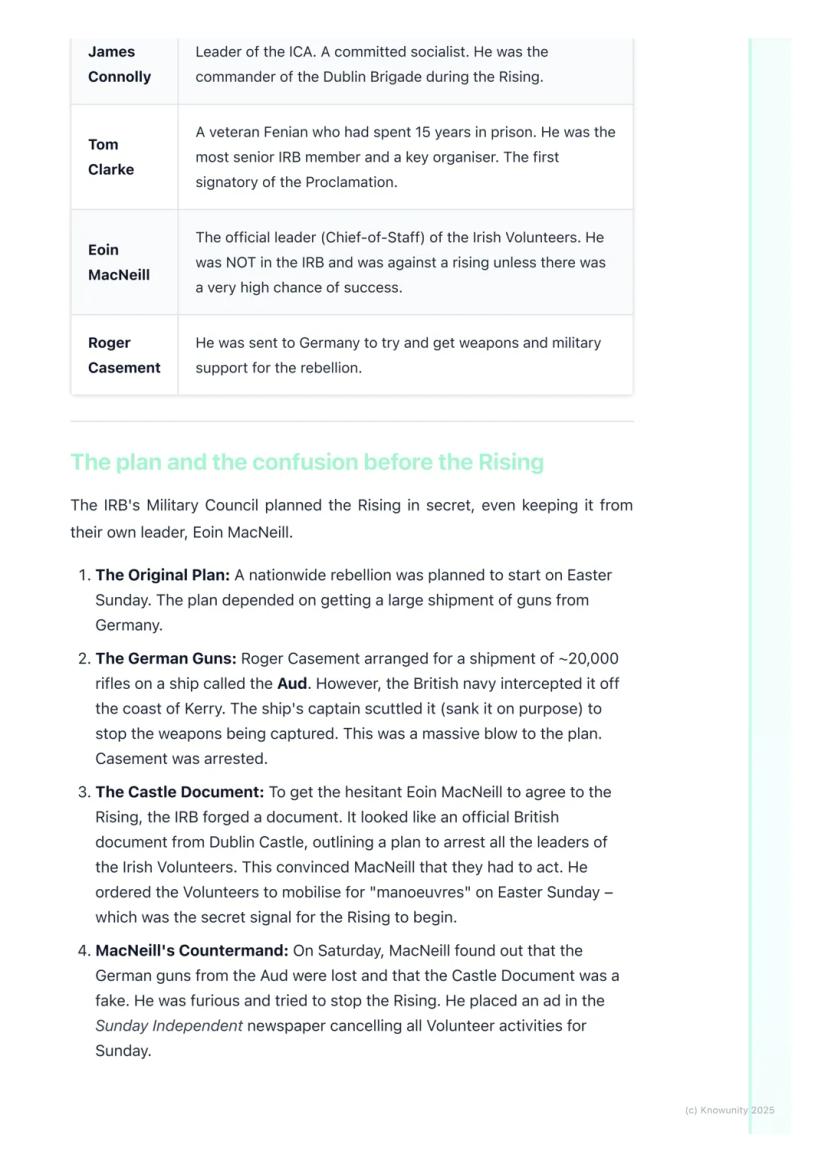
Tom Clarke was the veteran revolutionary who'd spent 15 years in British prisons - he was the driving force behind the Rising. James Connolly led the Citizen Army and brought socialist ideas to Irish nationalism. But Eoin MacNeill, the official leader of the Volunteers, wasn't in on the secret plot and nearly ruined everything.
The plan seemed solid at first. Roger Casement had arranged for 20,000 German rifles to arrive on a ship called the Aud. The IRB even forged a fake British document (the Castle Document) to convince MacNeill that the British were planning mass arrests, so he'd agree to mobilise the Volunteers.
Then everything went spectacularly wrong. The British navy intercepted the Aud, and its captain deliberately sank it rather than let the weapons fall into enemy hands. When MacNeill discovered both the lost weapons and the fake document, he was furious and placed a cancellation notice in the Sunday Independent newspaper.
Remember This: MacNeill's countermanding order caused chaos across Ireland - most Volunteers stayed home, confining the Rising almost entirely to Dublin with far fewer fighters than planned.
3
of 6
Easter Week: The Rising Begins
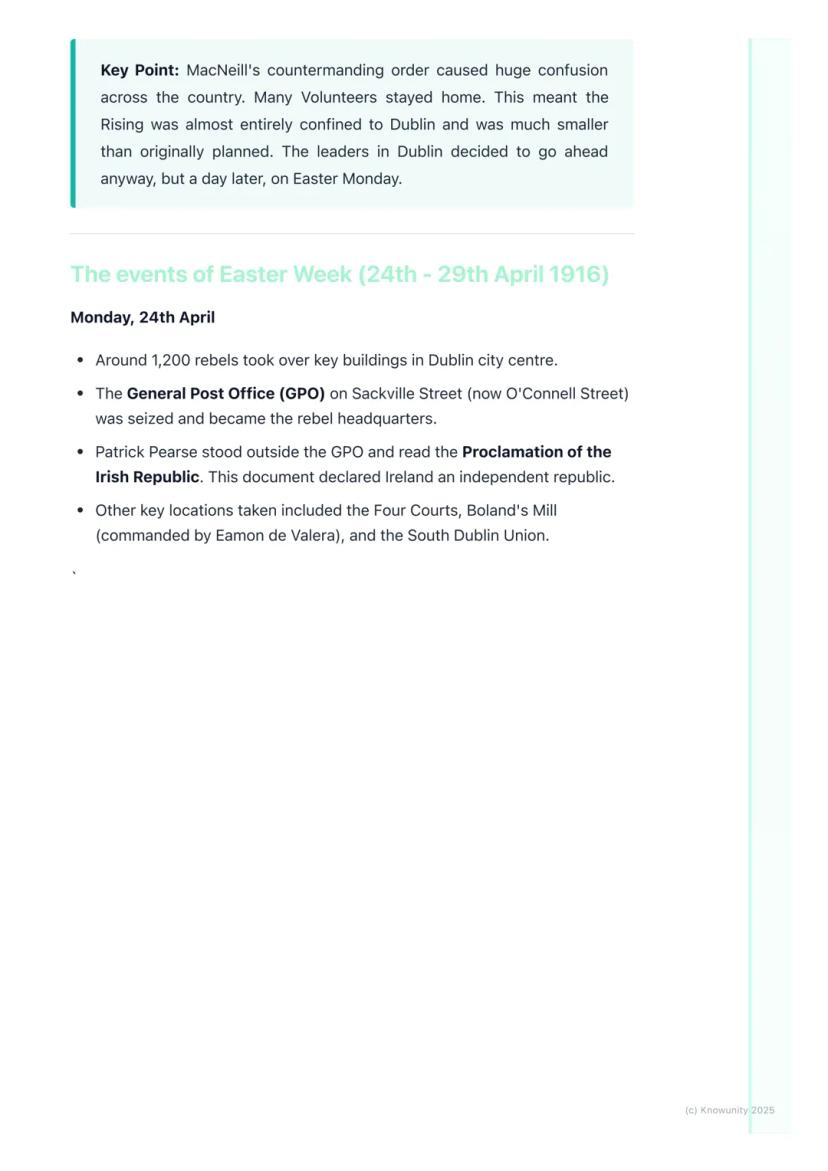
Despite all the setbacks, about 1,200 rebels decided to go ahead on Easter Monday, 24th April. They seized key buildings across Dublin city centre, with the General Post Office (GPO) becoming their headquarters and symbol of resistance.
Standing outside the GPO, Patrick Pearse read the Proclamation of the Irish Republic - essentially declaring Ireland independent. Other rebels took the Four Courts, Boland's Mill (where Eamon de Valera commanded), and the South Dublin Union.
The British were caught completely off guard initially. However, they quickly brought in thousands of reinforcements and heavy artillery. They even sailed a gunboat called the Helga up the River Liffey to shell rebel positions.
Turning Point: The battle at Mount Street Bridge showed how effectively a small group of determined Irish Volunteers could fight - they inflicted heavy casualties on British troops despite being vastly outnumbered.
4
of 6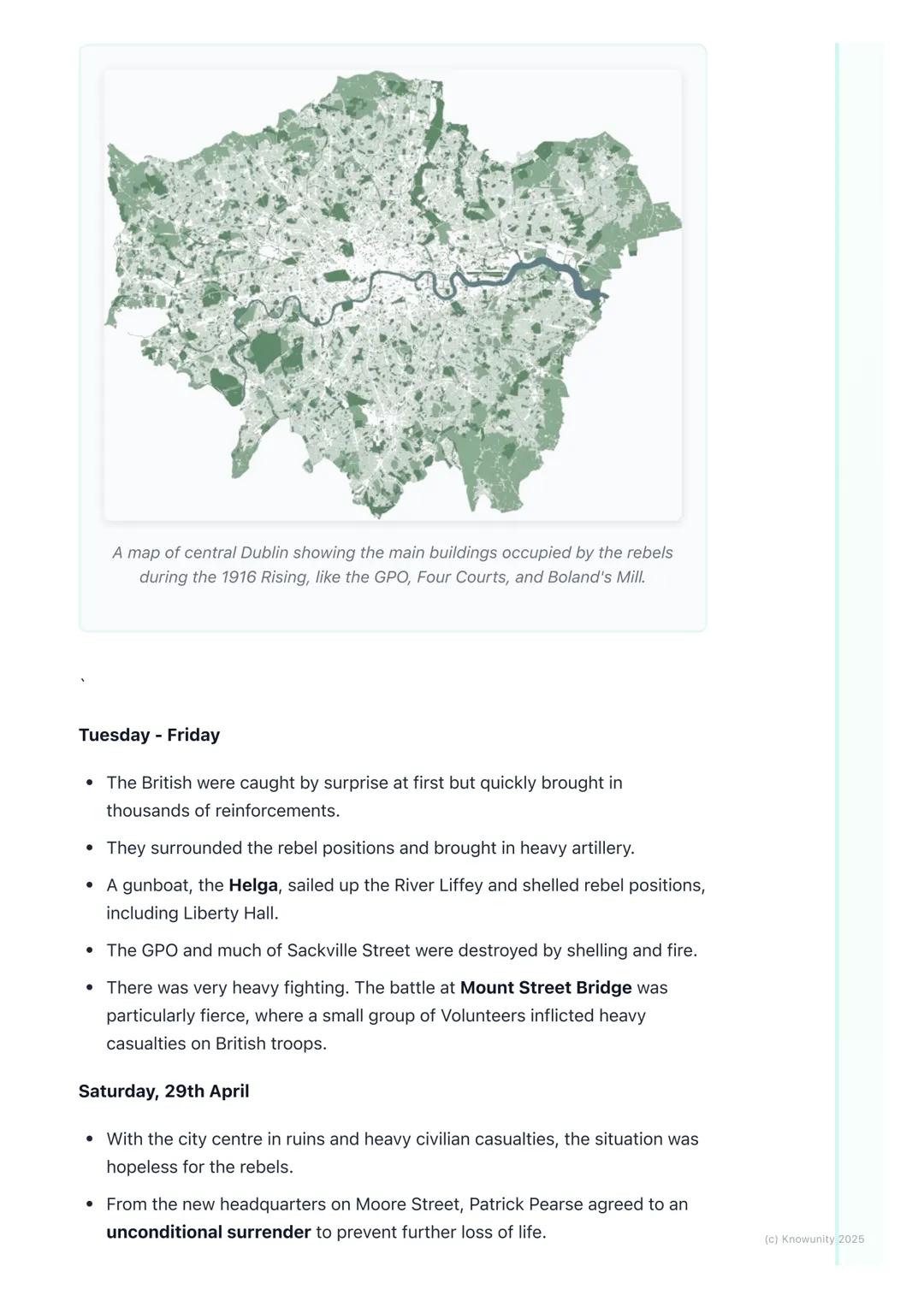
The Fighting Intensifies and Ends
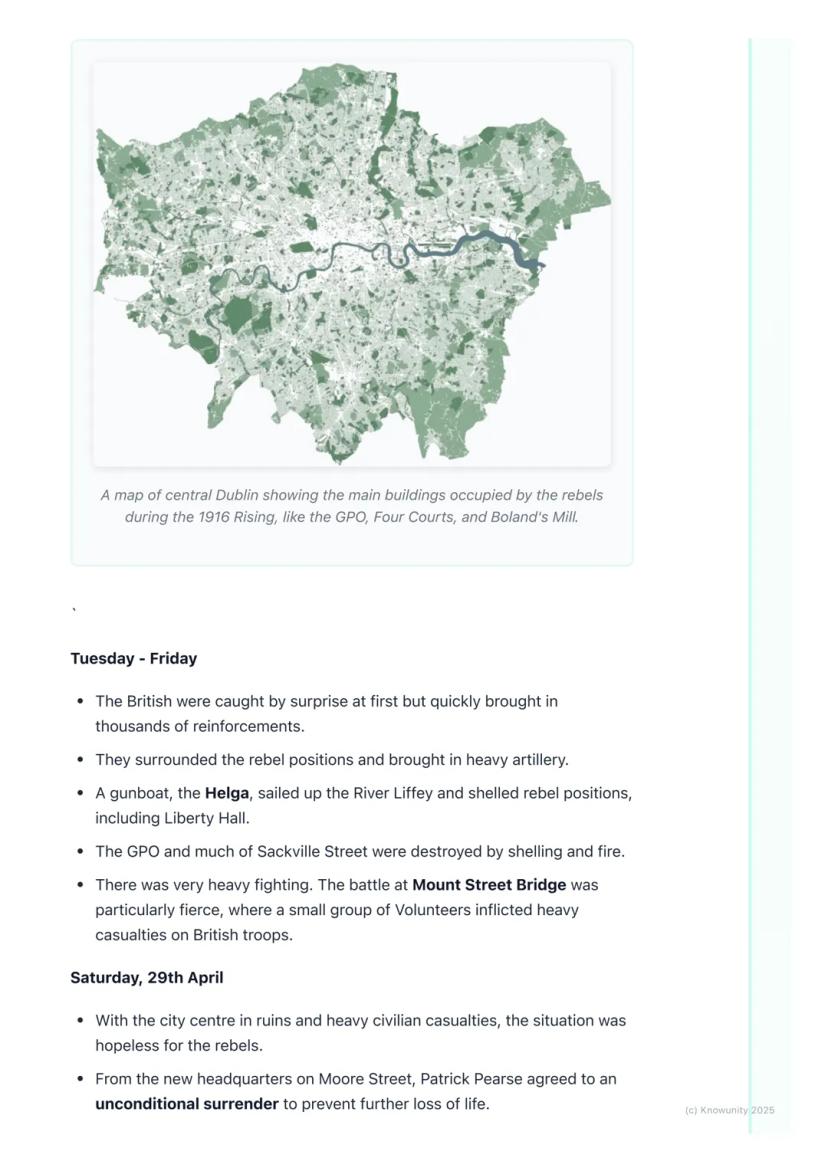
Tuesday through Friday saw brutal urban warfare. The British surrounded rebel positions and pounded them with artillery fire. The GPO and much of Sackville Street (now O'Connell Street) were destroyed by shelling and the resulting fires.
Heavy civilian casualties mounted as the city centre became a war zone. Ordinary Dubliners were caught in crossfire, and many blamed the rebels for bringing destruction to their city.
By Saturday, 29th April, the situation was hopeless. With the city in ruins and no chance of victory, Patrick Pearse made the difficult decision to surrender unconditionally from the rebels' final headquarters on Moore Street. His primary concern was preventing further civilian deaths.
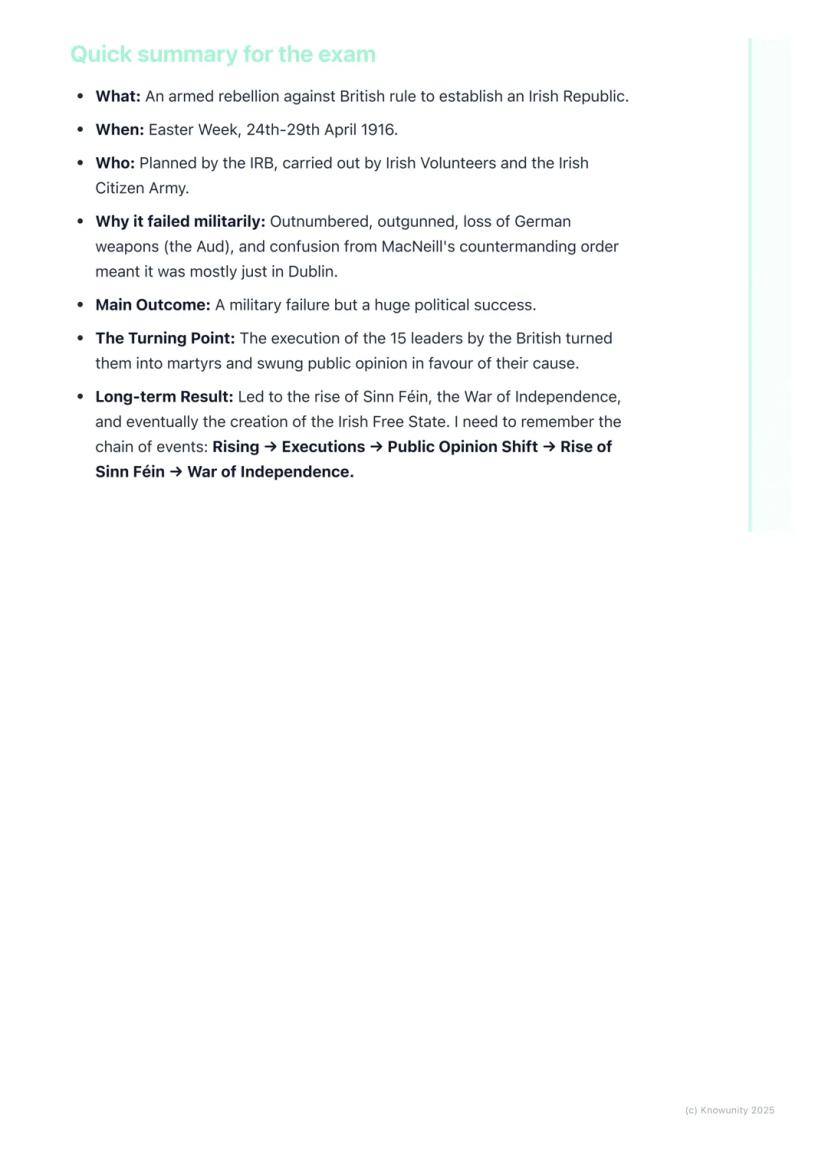
The Easter Rising had lasted just six days and was clearly a military failure. The rebels were vastly outnumbered and outgunned, and they'd lost control of most of their positions. But this defeat would soon transform into something much more powerful.
Critical Detail: The rebels' willingness to surrender to save civilian lives actually enhanced their moral authority and helped shift public opinion in their favour later.
5
of 6
The Aftermath That Changed Everything
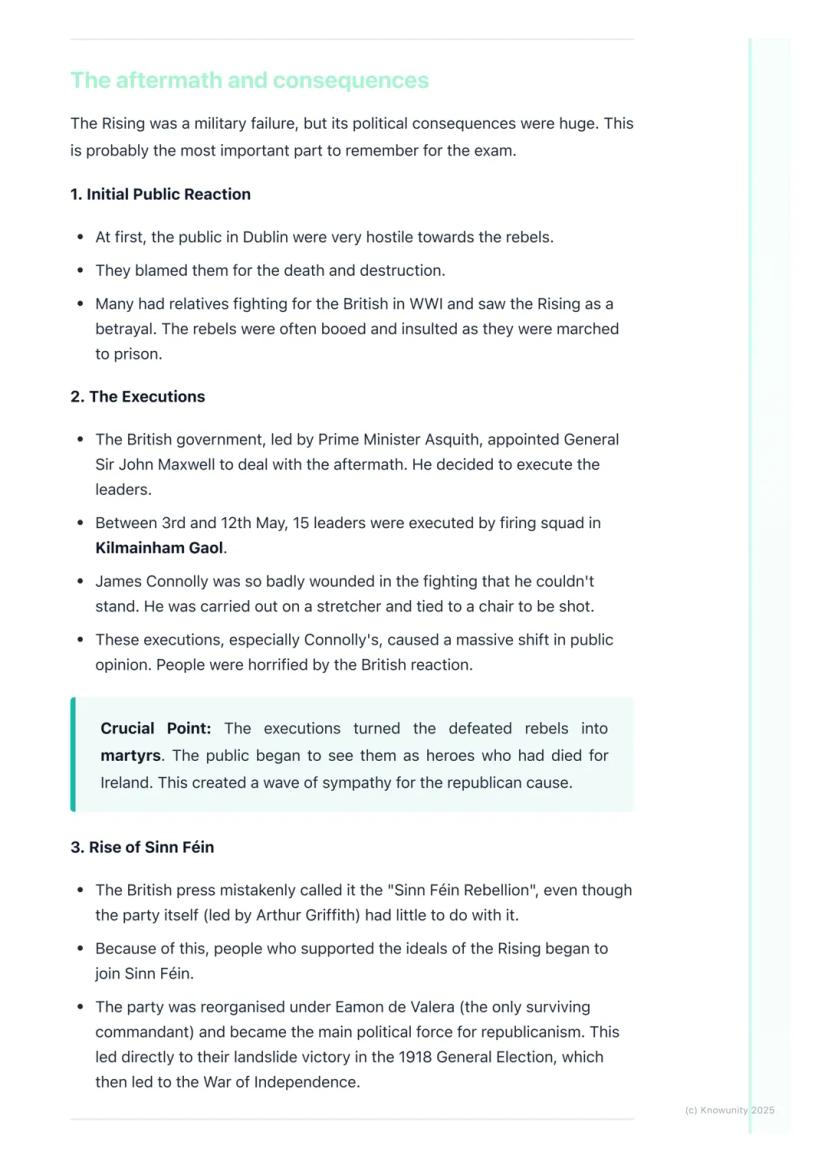
Here's where the story gets really important for understanding Irish history. The Rising's failure militarily became its greatest political success.
Initially, Dubliners were furious with the rebels. People booed and insulted them as they were marched to prison. Many had family fighting for Britain in WWI and saw the Rising as treachery.
Then the British made a catastrophic political mistake. General Sir John Maxwell decided to execute the leaders, and between 3rd-12th May, 15 men were shot by firing squad in Kilmainham Gaol. The execution of James Connolly was particularly shocking - he was so badly wounded he had to be tied to a chair to be shot.
These executions transformed the defeated rebels into martyrs. The Irish public was horrified by what seemed like cold-blooded revenge. Suddenly, the same people who'd condemned the Rising began seeing its leaders as heroes who'd died for Ireland.
Game Changer: The executions created a massive wave of sympathy for republicanism that completely altered Irish politics and made independence almost inevitable.
6
of 6
Long-term Consequences and Exam Essentials
The British press mistakenly called it the 'Sinn Féin Rebellion', even though that party had little involvement. This mistake actually helped Sinn Féin enormously - people who supported the Rising's ideals began joining the party.
Eamon de Valera, the only surviving commandant, reorganised Sinn Féin into a powerful republican party. They won a landslide victory in the 1918 General Election, which led directly to the War of Independence.
For your exams, remember this crucial chain of events: Easter Rising → Executions → Public Opinion Shift → Rise of Sinn Féin → War of Independence → Irish Independence. The Rising proved that sometimes losing a battle spectacularly can win the war for hearts and minds.
The rebels achieved in death what they couldn't in life - they made Irish independence not just desirable, but inevitable. Their sacrifice showed that some ideals are worth dying for, and their martyrdom inspired a generation to finish what they started.
Exam Success Tip: Focus on how the Rising's political consequences were far more important than its military failure - this transformation from defeat to victory is what examiners really want you to understand.
Pensamos que nunca lo preguntarías...
¿Qué es Knowunity AI companion?
Nuestro compañero de IA está específicamente adaptado a las necesidades de los estudiantes. Basándonos en los millones de contenidos que tenemos en la plataforma, podemos dar a los estudiantes respuestas realmente significativas y relevantes. Pero no se trata solo de respuestas, el compañero también guía a los estudiantes a través de sus retos de aprendizaje diarios, con planes de aprendizaje personalizados, cuestionarios o contenidos en el chat y una personalización del 100% basada en las habilidades y el desarrollo de los estudiantes.
¿Dónde puedo descargar la app Knowunity?
Puedes descargar la app en Google Play Store y Apple App Store.
¿Knowunity es totalmente gratuito?
Sí, tienes acceso gratuito a los contenidos de la aplicación y a nuestro compañero de IA. Para desbloquear determinadas funciones de la aplicación, puedes adquirir Knowunity Pro.
Contenidos más populares de History
9HistoryThe Great Famine (An Gorta Mór)
Students will learn about the causes, devastating impact, and long-term consequences of the potato famine on Irish population and society.
2nd Year282
HistoryThe renaissance
junior cert renaissance summary
1st Year361
HistoryCauses and Consequences of World War II
This subtopic covers the origins of the Second World War, its global scale, and its devastating human and political consequences, including the atomic bomb.
3rd Year152
HistoryThe 1798 Rebellion in Ireland
Learning about the causes, events, and aftermath of the United Irishmen's rebellion against British rule, inspired by revolutionary ideals.
3rd Year211
HistoryAmerican revolution
junior cert american revolution summary
1st Year442
HistoryThe Great Famine (An Gorta Mór)
This critical subtopic examines the causes, devastating impact, and long-term consequences of the potato famine on Irish society, population, and emigration.
3rd Year140
HistoryThe Renaissance
Students will learn about a time of 'rebirth' in Europe, where new ideas in art, science, and literature flourished.
1st Year140
History1916 Rising Revison Sheet
revision sheet
3rd Year211
HistoryThe Reformation in Europe
Students will learn about the causes and key figures of the Protestant Reformation and its impact on European society and politics.
3rd Year110
Contenidos más populares
9 Irish
IrishIrish oral questions and answers
Questions and answers for the leaving cert oral
5th Year4264
 English
Key Quotes : Sive
Key Quotes and explanations: Sive
6th Year2842
IrishIrish oral questions
Outline of oral questions
5th Year2055
IrishIníon- le hÁine Durkin
Aine Durkin’s poem, Iníon: Themes & summary
5th Year850
IrishIrish poetry 2027
Iníon + Dínit an Bhróin
5th Year1133
IrishLC HL notes- Iníon (poem)
Includes poem in English and Irish, theme, key words & phrases
5th Year2284
EnglishCultural Context : Shawshank Redemption : Sive : Small Things Like These
Comparative Study : Cultural Context : Shawshank Redemption, Sive and Small Things Like These
6th Year1430
IrishMo Ghrá-sa (Idir Lúibíní)
Notes on mo ghrá-sa
5th Year380
IrishAn Gaeilge Aiste
Irish Language essay
6th Year1320
¿No encuentras lo que buscas? Explora otros temas.
Mira lo que dicen nuestros usuarios. Les encanta - y a tí también.
4.6/5App Store
4.7/5Google Play
La app es muy fácil de usar y está muy bien diseñada. Hasta ahora he encontrado todo lo que estaba buscando y he podido aprender mucho de las presentaciones. Definitivamente utilizaré la aplicación para un examen de clase. Y, por supuesto, también me sirve mucho de inspiración.
Pablousuario de iOS
Esta app es realmente genial. Hay tantos apuntes de clase y ayuda [...]. Tengo problemas con matemáticas, por ejemplo, y la aplicación tiene muchas opciones de ayuda. Gracias a Knowunity, he mejorado en mates. Se la recomiendo a todo el mundo.
Elenausuaria de Android
Vaya, estoy realmente sorprendida. Acabo de probar la app porque la he visto anunciada muchas veces y me he quedado absolutamente alucinada. Esta app es LA AYUDA que quieres para el insti y, sobre todo, ofrece muchísimas cosas, como ejercicios y hojas informativas, que a mí personalmente me han sido MUY útiles.
Anausuaria de iOS
History14 visualizaciones·Actualizado Jun 3, 2026·6 páginasThe 1916 Easter Rising: Ireland's Fight for Independence
The 1916 Easter Rising was a turning point in Irish history that changed everything. What started as a military disaster became the spark that ignited Ireland's journey to independence, proving that sometimes losing a battle can win a war.
1
of 6
Inscríbete para ver los apuntes. ¡Es gratis!
- Acceso a todos los documentos
- Mejora tus notas
- Únete a millones de estudiantes
The 1916 Easter Rising
Ever wonder how a failed rebellion could actually change the course of a nation's history? The Easter Rising was exactly that - an armed rebellion during Easter Week 1916 that aimed to end British rule and create an independent Irish Republic.
The timing wasn't random. Britain was deep in World War I, and Irish revolutionaries believed in the old saying: 'England's difficulty is Ireland's opportunity'. Several groups joined forces for this massive gamble.
The Irish Republican Brotherhood (IRB) were the secret masterminds behind it all. They'd infiltrated the much larger Irish Volunteers (originally formed to support Home Rule) and planned to use them for revolution. The Irish Citizen Army, led by socialist James Connolly, brought their working-class militancy to the cause. Meanwhile, Cumann na mBan proved that women were just as committed - they served as nurses, messengers, weapon runners, and fighters.
Key Point: The IRB secretly controlled the Rising while keeping their plans hidden from moderate leaders like Eoin MacNeill, who opposed violence unless success was guaranteed.
2
of 6Inscríbete para ver los apuntes. ¡Es gratis!
- Acceso a todos los documentos
- Mejora tus notas
- Únete a millones de estudiantes
Key People and the Plan Gone Wrong
Tom Clarke was the veteran revolutionary who'd spent 15 years in British prisons - he was the driving force behind the Rising. James Connolly led the Citizen Army and brought socialist ideas to Irish nationalism. But Eoin MacNeill, the official leader of the Volunteers, wasn't in on the secret plot and nearly ruined everything.
The plan seemed solid at first. Roger Casement had arranged for 20,000 German rifles to arrive on a ship called the Aud. The IRB even forged a fake British document (the Castle Document) to convince MacNeill that the British were planning mass arrests, so he'd agree to mobilise the Volunteers.
Then everything went spectacularly wrong. The British navy intercepted the Aud, and its captain deliberately sank it rather than let the weapons fall into enemy hands. When MacNeill discovered both the lost weapons and the fake document, he was furious and placed a cancellation notice in the Sunday Independent newspaper.
Remember This: MacNeill's countermanding order caused chaos across Ireland - most Volunteers stayed home, confining the Rising almost entirely to Dublin with far fewer fighters than planned.
3
of 6Inscríbete para ver los apuntes. ¡Es gratis!
- Acceso a todos los documentos
- Mejora tus notas
- Únete a millones de estudiantes
Easter Week: The Rising Begins
Despite all the setbacks, about 1,200 rebels decided to go ahead on Easter Monday, 24th April. They seized key buildings across Dublin city centre, with the General Post Office (GPO) becoming their headquarters and symbol of resistance.
Standing outside the GPO, Patrick Pearse read the Proclamation of the Irish Republic - essentially declaring Ireland independent. Other rebels took the Four Courts, Boland's Mill (where Eamon de Valera commanded), and the South Dublin Union.
The British were caught completely off guard initially. However, they quickly brought in thousands of reinforcements and heavy artillery. They even sailed a gunboat called the Helga up the River Liffey to shell rebel positions.
Turning Point: The battle at Mount Street Bridge showed how effectively a small group of determined Irish Volunteers could fight - they inflicted heavy casualties on British troops despite being vastly outnumbered.
4
of 6Inscríbete para ver los apuntes. ¡Es gratis!
- Acceso a todos los documentos
- Mejora tus notas
- Únete a millones de estudiantes
The Fighting Intensifies and Ends
Tuesday through Friday saw brutal urban warfare. The British surrounded rebel positions and pounded them with artillery fire. The GPO and much of Sackville Street (now O'Connell Street) were destroyed by shelling and the resulting fires.
Heavy civilian casualties mounted as the city centre became a war zone. Ordinary Dubliners were caught in crossfire, and many blamed the rebels for bringing destruction to their city.
By Saturday, 29th April, the situation was hopeless. With the city in ruins and no chance of victory, Patrick Pearse made the difficult decision to surrender unconditionally from the rebels' final headquarters on Moore Street. His primary concern was preventing further civilian deaths.
The Easter Rising had lasted just six days and was clearly a military failure. The rebels were vastly outnumbered and outgunned, and they'd lost control of most of their positions. But this defeat would soon transform into something much more powerful.
Critical Detail: The rebels' willingness to surrender to save civilian lives actually enhanced their moral authority and helped shift public opinion in their favour later.
5
of 6Inscríbete para ver los apuntes. ¡Es gratis!
- Acceso a todos los documentos
- Mejora tus notas
- Únete a millones de estudiantes
The Aftermath That Changed Everything
Here's where the story gets really important for understanding Irish history. The Rising's failure militarily became its greatest political success.
Initially, Dubliners were furious with the rebels. People booed and insulted them as they were marched to prison. Many had family fighting for Britain in WWI and saw the Rising as treachery.
Then the British made a catastrophic political mistake. General Sir John Maxwell decided to execute the leaders, and between 3rd-12th May, 15 men were shot by firing squad in Kilmainham Gaol. The execution of James Connolly was particularly shocking - he was so badly wounded he had to be tied to a chair to be shot.
These executions transformed the defeated rebels into martyrs. The Irish public was horrified by what seemed like cold-blooded revenge. Suddenly, the same people who'd condemned the Rising began seeing its leaders as heroes who'd died for Ireland.
Game Changer: The executions created a massive wave of sympathy for republicanism that completely altered Irish politics and made independence almost inevitable.
6
of 6Inscríbete para ver los apuntes. ¡Es gratis!
- Acceso a todos los documentos
- Mejora tus notas
- Únete a millones de estudiantes
Long-term Consequences and Exam Essentials
The British press mistakenly called it the 'Sinn Féin Rebellion', even though that party had little involvement. This mistake actually helped Sinn Féin enormously - people who supported the Rising's ideals began joining the party.
Eamon de Valera, the only surviving commandant, reorganised Sinn Féin into a powerful republican party. They won a landslide victory in the 1918 General Election, which led directly to the War of Independence.
For your exams, remember this crucial chain of events: Easter Rising → Executions → Public Opinion Shift → Rise of Sinn Féin → War of Independence → Irish Independence. The Rising proved that sometimes losing a battle spectacularly can win the war for hearts and minds.
The rebels achieved in death what they couldn't in life - they made Irish independence not just desirable, but inevitable. Their sacrifice showed that some ideals are worth dying for, and their martyrdom inspired a generation to finish what they started.
Exam Success Tip: Focus on how the Rising's political consequences were far more important than its military failure - this transformation from defeat to victory is what examiners really want you to understand.
Pensamos que nunca lo preguntarías...
¿Qué es Knowunity AI companion?
Nuestro compañero de IA está específicamente adaptado a las necesidades de los estudiantes. Basándonos en los millones de contenidos que tenemos en la plataforma, podemos dar a los estudiantes respuestas realmente significativas y relevantes. Pero no se trata solo de respuestas, el compañero también guía a los estudiantes a través de sus retos de aprendizaje diarios, con planes de aprendizaje personalizados, cuestionarios o contenidos en el chat y una personalización del 100% basada en las habilidades y el desarrollo de los estudiantes.
¿Dónde puedo descargar la app Knowunity?
Puedes descargar la app en Google Play Store y Apple App Store.
¿Knowunity es totalmente gratuito?
Sí, tienes acceso gratuito a los contenidos de la aplicación y a nuestro compañero de IA. Para desbloquear determinadas funciones de la aplicación, puedes adquirir Knowunity Pro.
Contenidos más populares de History
9HistoryThe Great Famine (An Gorta Mór)
Students will learn about the causes, devastating impact, and long-term consequences of the potato famine on Irish population and society.
2nd Year282
HistoryThe renaissance
junior cert renaissance summary
1st Year361
HistoryCauses and Consequences of World War II
This subtopic covers the origins of the Second World War, its global scale, and its devastating human and political consequences, including the atomic bomb.
3rd Year152
HistoryThe 1798 Rebellion in Ireland
Learning about the causes, events, and aftermath of the United Irishmen's rebellion against British rule, inspired by revolutionary ideals.
3rd Year211
HistoryAmerican revolution
junior cert american revolution summary
1st Year442
HistoryThe Great Famine (An Gorta Mór)
This critical subtopic examines the causes, devastating impact, and long-term consequences of the potato famine on Irish society, population, and emigration.
3rd Year140
HistoryThe Renaissance
Students will learn about a time of 'rebirth' in Europe, where new ideas in art, science, and literature flourished.
1st Year140
History1916 Rising Revison Sheet
revision sheet
3rd Year211
HistoryThe Reformation in Europe
Students will learn about the causes and key figures of the Protestant Reformation and its impact on European society and politics.
3rd Year110
Contenidos más populares
9IrishIrish oral questions and answers
Questions and answers for the leaving cert oral
5th Year4264
EnglishKey Quotes : Sive
Key Quotes and explanations: Sive
6th Year2842
IrishIrish oral questions
Outline of oral questions
5th Year2055
IrishIníon- le hÁine Durkin
Aine Durkin’s poem, Iníon: Themes & summary
5th Year850
IrishIrish poetry 2027
Iníon + Dínit an Bhróin
5th Year1133
IrishLC HL notes- Iníon (poem)
Includes poem in English and Irish, theme, key words & phrases
5th Year2284
EnglishCultural Context : Shawshank Redemption : Sive : Small Things Like These
Comparative Study : Cultural Context : Shawshank Redemption, Sive and Small Things Like These
6th Year1430
IrishMo Ghrá-sa (Idir Lúibíní)
Notes on mo ghrá-sa
5th Year380
IrishAn Gaeilge Aiste
Irish Language essay
6th Year1320
¿No encuentras lo que buscas? Explora otros temas.
Mira lo que dicen nuestros usuarios. Les encanta - y a tí también.
4.6/5App Store
4.7/5Google Play
La app es muy fácil de usar y está muy bien diseñada. Hasta ahora he encontrado todo lo que estaba buscando y he podido aprender mucho de las presentaciones. Definitivamente utilizaré la aplicación para un examen de clase. Y, por supuesto, también me sirve mucho de inspiración.
Pablousuario de iOS
Esta app es realmente genial. Hay tantos apuntes de clase y ayuda [...]. Tengo problemas con matemáticas, por ejemplo, y la aplicación tiene muchas opciones de ayuda. Gracias a Knowunity, he mejorado en mates. Se la recomiendo a todo el mundo.
Elenausuaria de Android
Vaya, estoy realmente sorprendida. Acabo de probar la app porque la he visto anunciada muchas veces y me he quedado absolutamente alucinada. Esta app es LA AYUDA que quieres para el insti y, sobre todo, ofrece muchísimas cosas, como ejercicios y hojas informativas, que a mí personalmente me han sido MUY útiles.
Anausuaria de iOS