
Ever wonder how a small Italian city became one of... Mostrar más
 History21 visualizaciones·Actualizado Jun 6, 2026·6 páginas
The Fascinating World of Ancient Rome
1 / 6
1
of 6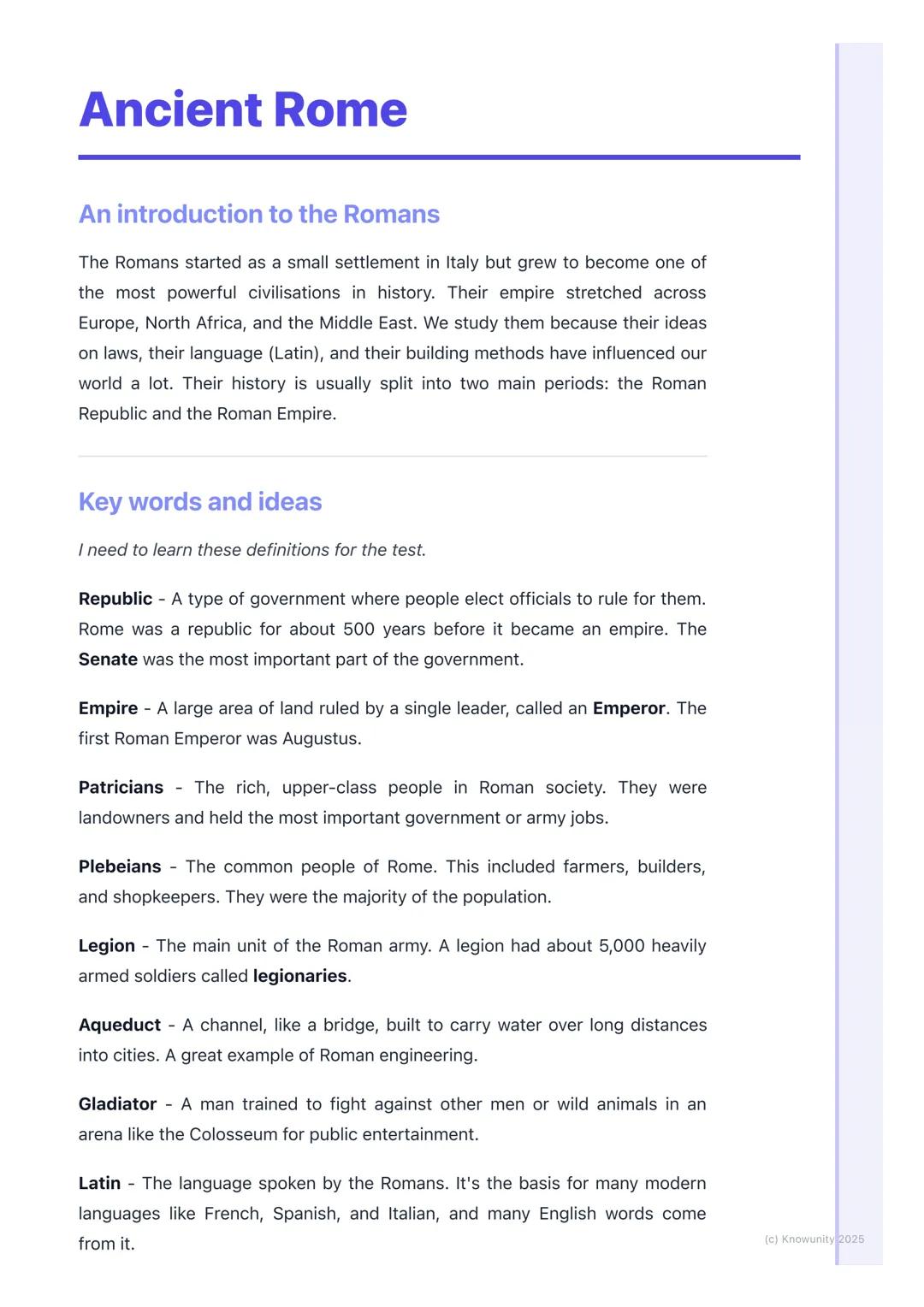
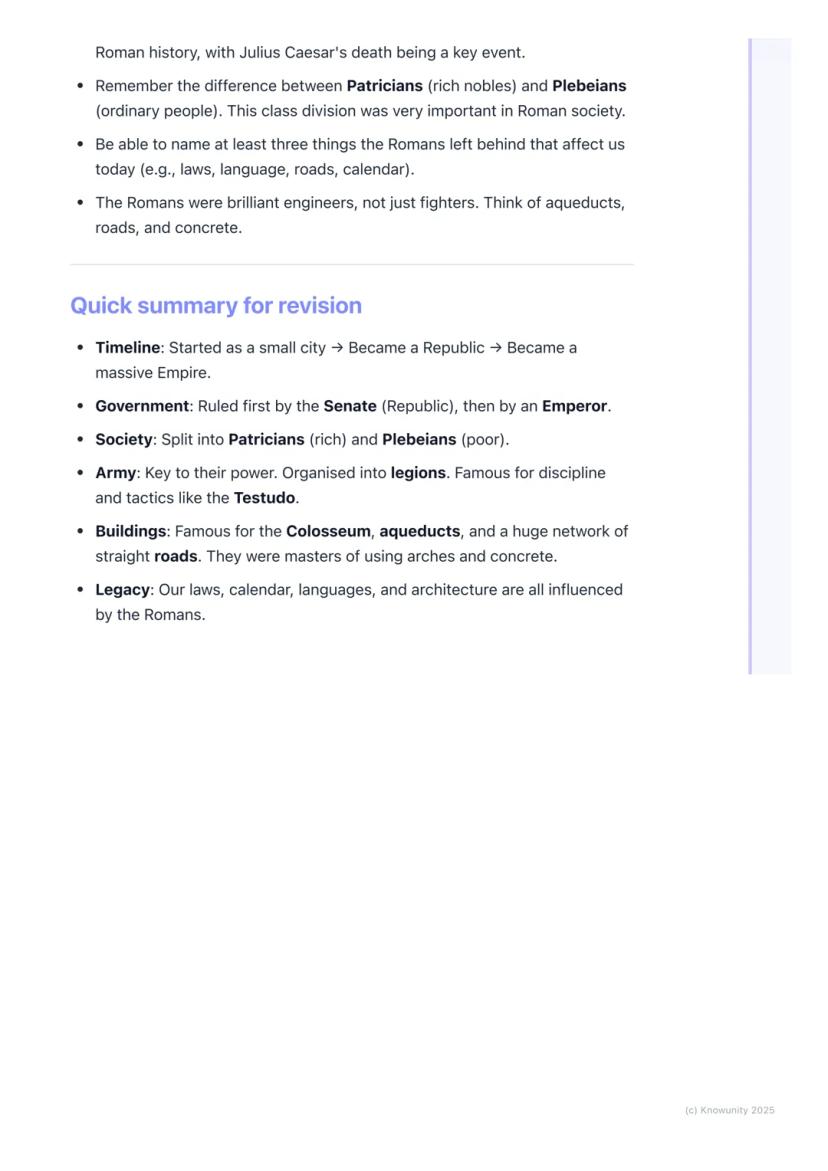
An Introduction to the Romans
Think about this: almost every major European language, our legal system, and even our calendar all have Roman roots! The Romans weren't just ancient people from history books - they're the reason our world works the way it does today.
The Roman civilisation went through two major phases that you need to know. First came the Roman Republic, where elected officials and the Senate ran things for about 500 years. Then it transformed into the Roman Empire, ruled by powerful emperors like Augustus.
Roman society was divided into two main groups. The Patricians were the wealthy upper class who owned land and held important government positions. Meanwhile, the Plebeians made up most of the population - farmers, builders, shopkeepers, and ordinary working people. This class system shaped everything about Roman life.
Quick Test Tip: Remember that Latin, the Roman language, is why French, Spanish, and Italian sound similar - they all developed from it!
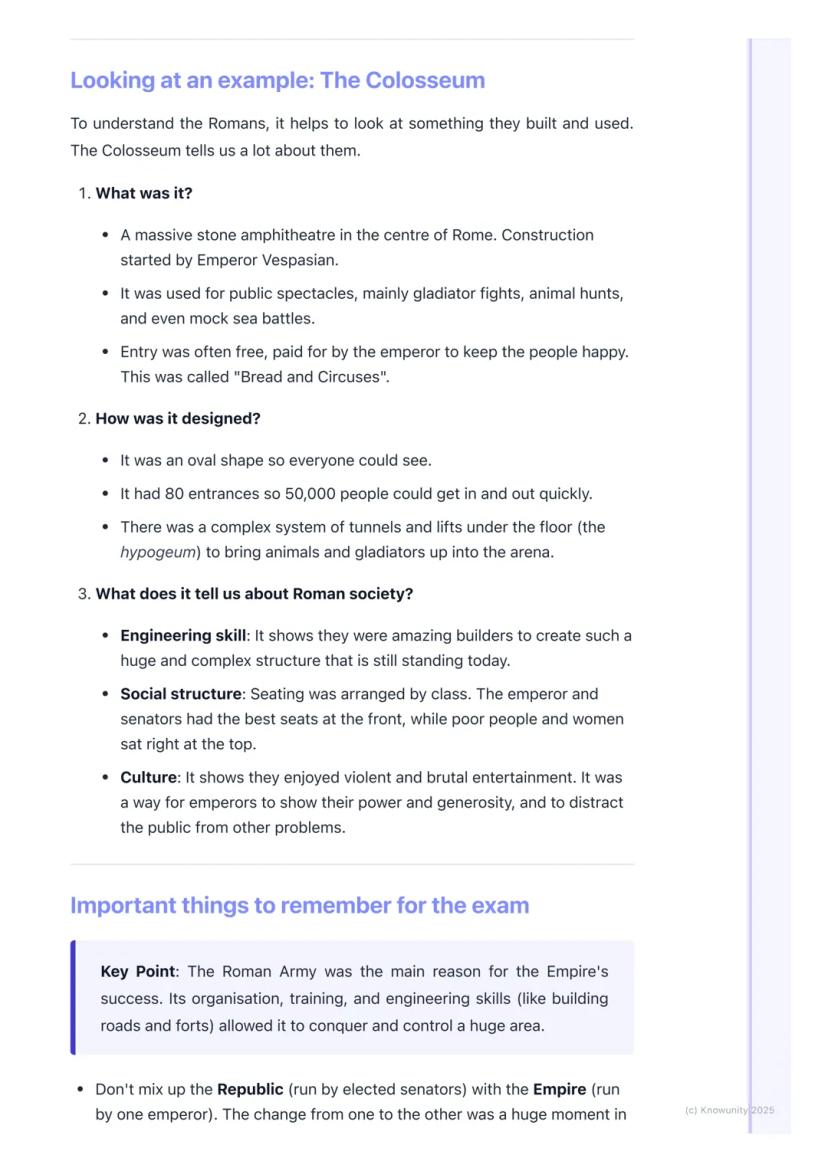
2
of 6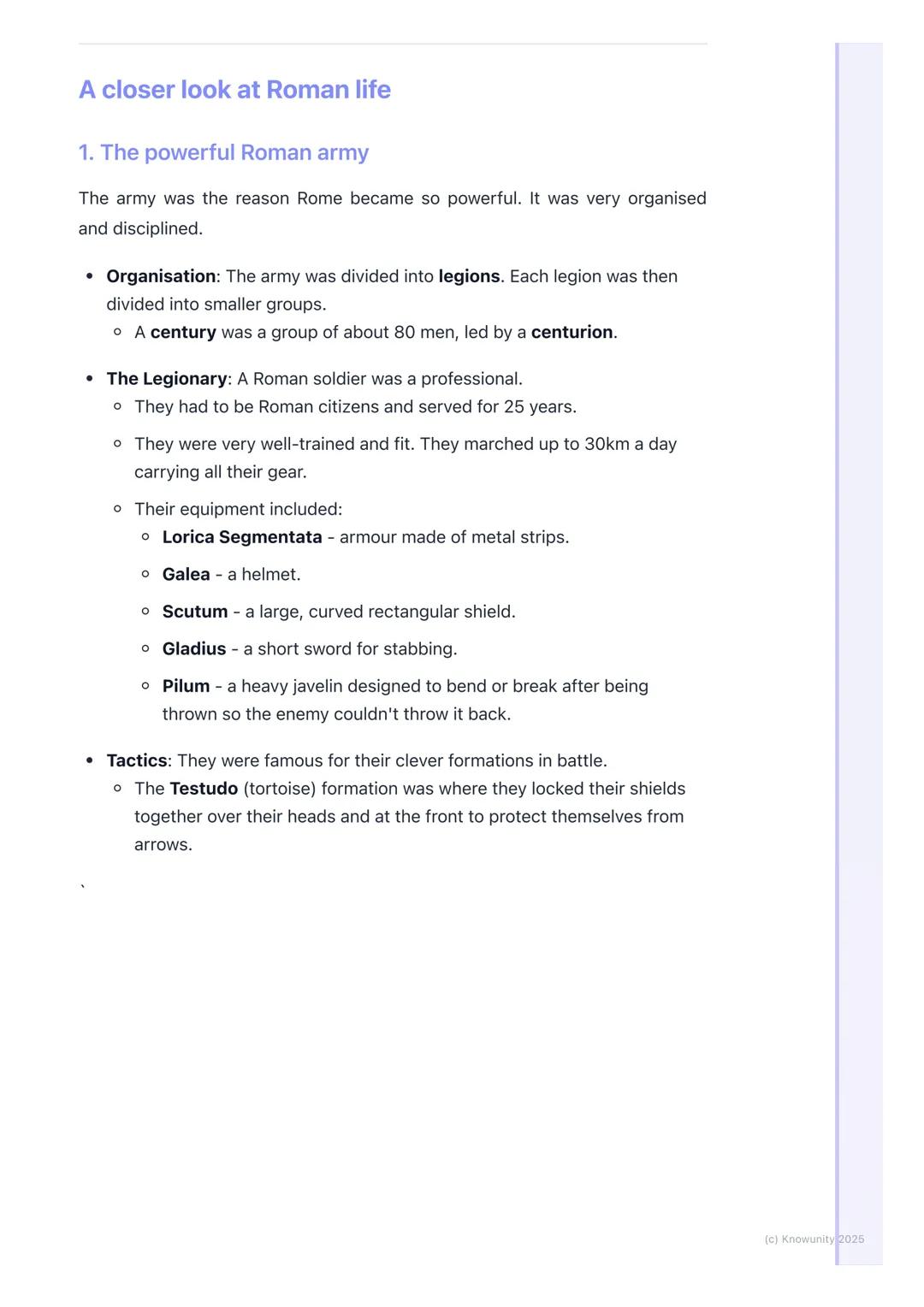
The Powerful Roman Army
Here's what made Rome unstoppable: their army was like a perfectly organised machine. Every Roman legion contained about 5,000 heavily armed professional soldiers called legionaries.
These weren't just random fighters thrown together. Roman soldiers had to be citizens and served for 25 years! They marched up to 30km daily carrying all their gear, including their lorica segmentata (metal strip armour), gladius (short stabbing sword), and scutum (large curved shield).
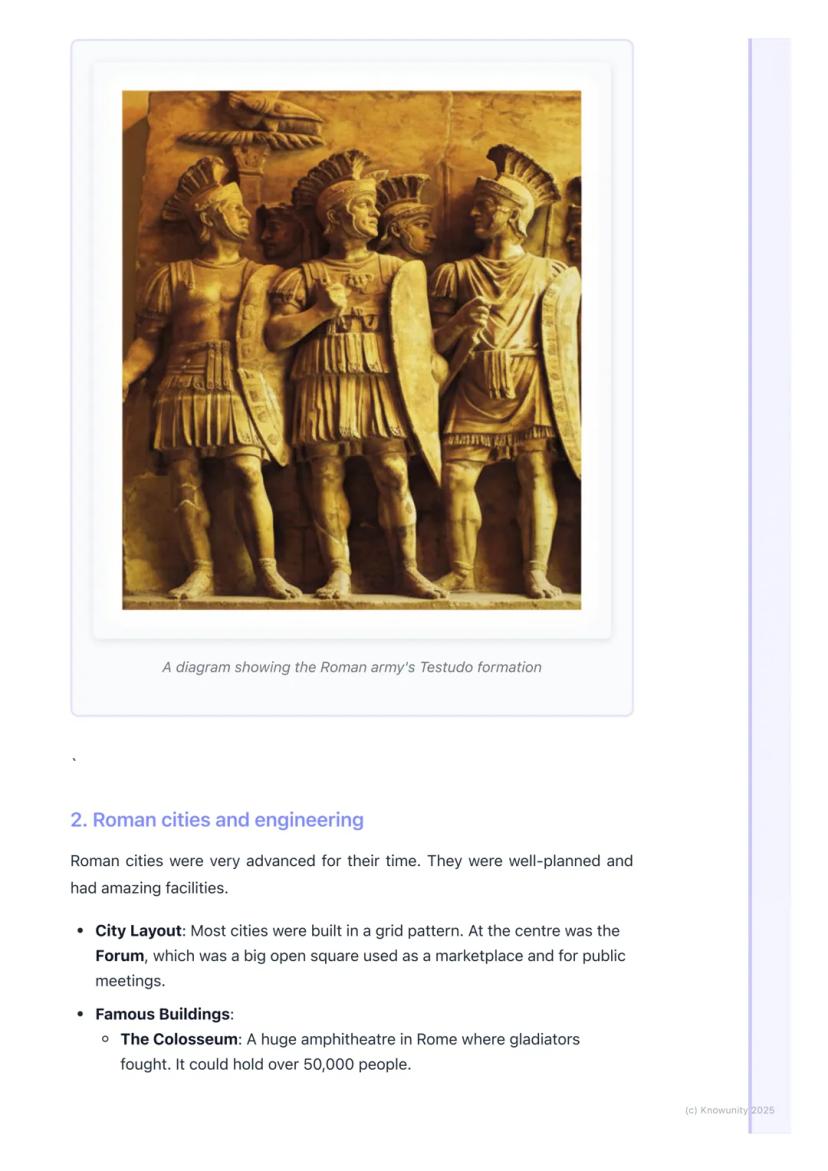
The army's secret weapon was organisation and tactics. Each legion split into smaller groups called centuries, led by tough officers called centurions. Their most famous battle formation was the testudo (tortoise), where soldiers locked shields above their heads and in front to create an armoured shell that arrows couldn't penetrate.
Roman soldiers also used a clever weapon called the pilum - a heavy javelin designed to bend after hitting something, so enemies couldn't throw it back at them.
Remember: The Roman army wasn't just about fighting - they built roads, forts, and aqueducts wherever they went!
3
of 6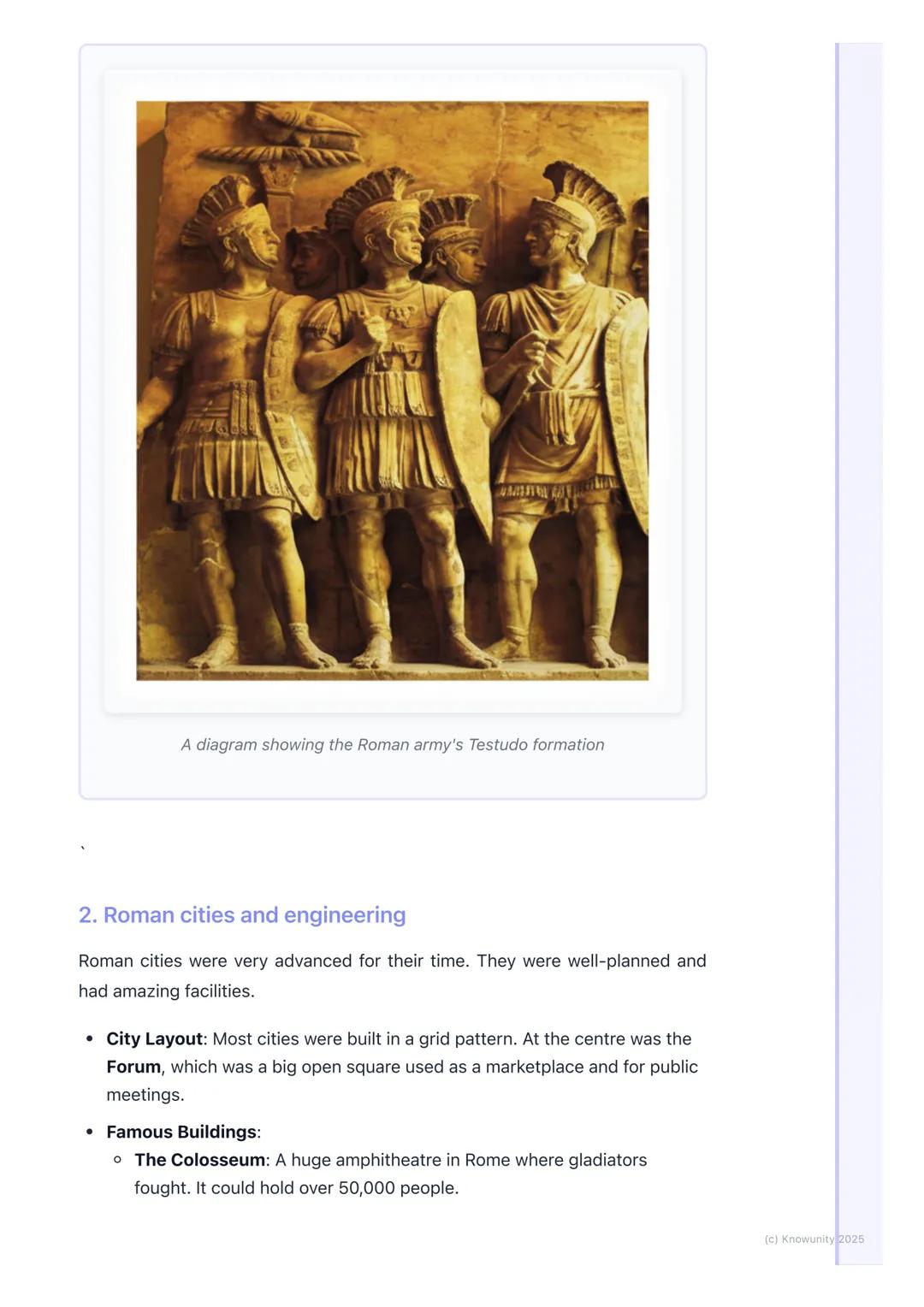
Roman Cities and Engineering
Roman cities weren't chaotic medieval towns - they were planned like modern cities with proper sewers, running water, and organised layouts! Most followed a grid pattern with the Forum (a large marketplace and meeting area) right at the centre.
The Romans created some of history's most impressive buildings. The Colosseum could pack in over 50,000 spectators to watch gladiator fights and animal hunts. The Pantheon, a temple for all Roman gods, still amazes engineers today with its massive concrete dome.
But their real genius showed in practical engineering. Roman aqueducts carried fresh water across huge distances using gravity - no pumps needed! They built over 80,000km of straight, paved roads that helped their army move quickly. That's where "all roads lead to Rome" comes from.
Public baths weren't just for washing - they were like ancient community centres where Romans exercised, socialised, and did business. These facilities show how advanced Roman cities were compared to anywhere else in the world at that time.
Cool Fact: Roman concrete was so good that many of their buildings are still standing 2,000 years later!
4
of 6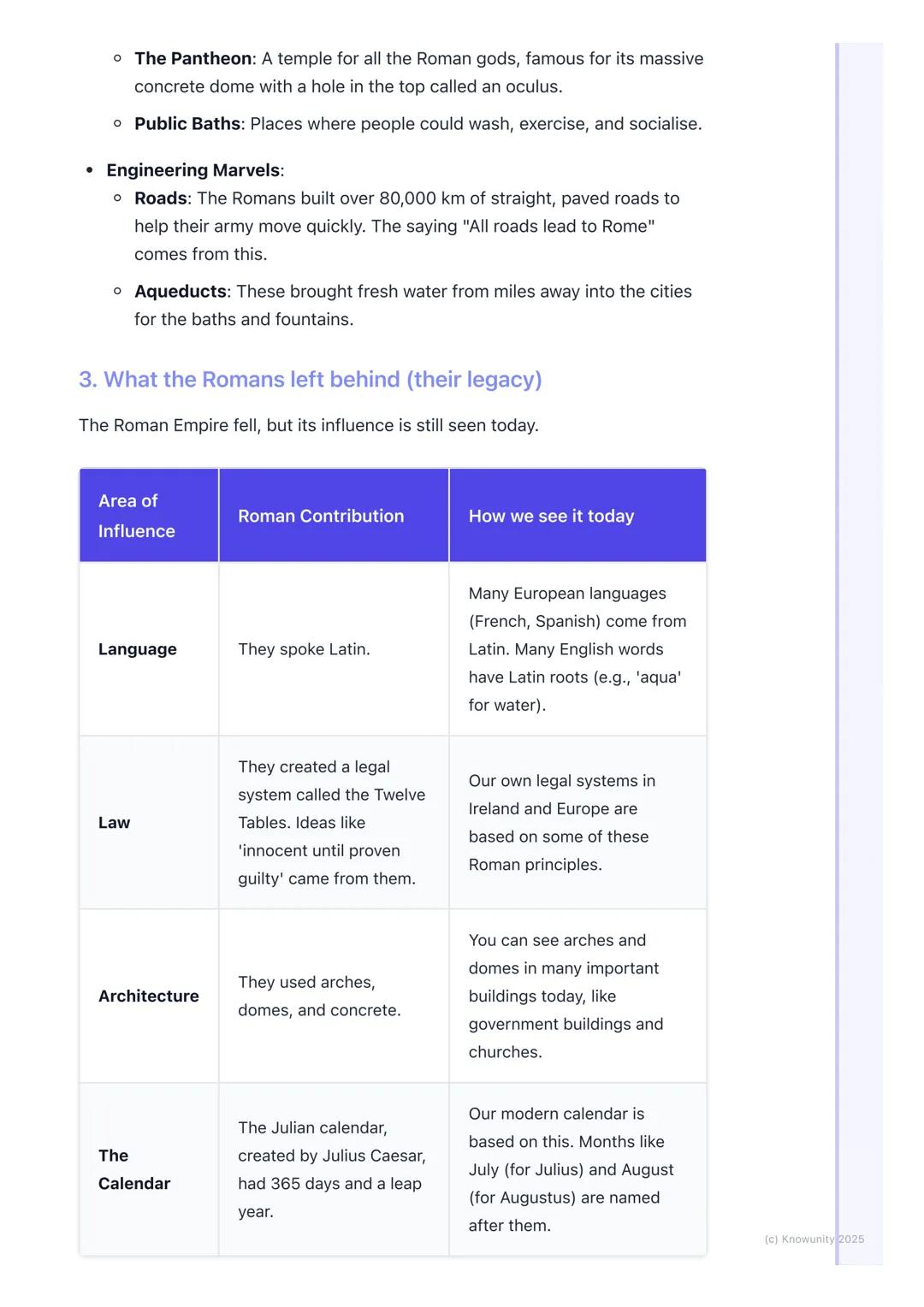
What the Romans Left Behind
Even though the Roman Empire collapsed over 1,500 years ago, you encounter Roman influence almost every day without realising it! Our legal systems still use Roman principles like "innocent until proven guilty."
Your calendar is basically Roman too. Julius Caesar created the Julian calendar with 365 days and leap years - sound familiar? July and August are named after Julius Caesar and Emperor Augustus. Many English words come from Latin: "aqua" (water), "terra" (earth), "audio" (hear).
Roman architecture shapes our important buildings today. Government buildings, churches, and monuments use Roman arches, domes, and columns. The dome on many capitol buildings? That's inspired by the Pantheon.
Roman law created the Twelve Tables - written laws that applied to everyone. This idea of written, fair laws that protect citizens became the foundation for legal systems across Europe and Ireland. Before Romans, most places just had whatever the local ruler decided on the spot!
Exam Tip: Be ready to name at least three Roman contributions that affect us today - language, laws, architecture, and calendar are the big ones!
5
of 6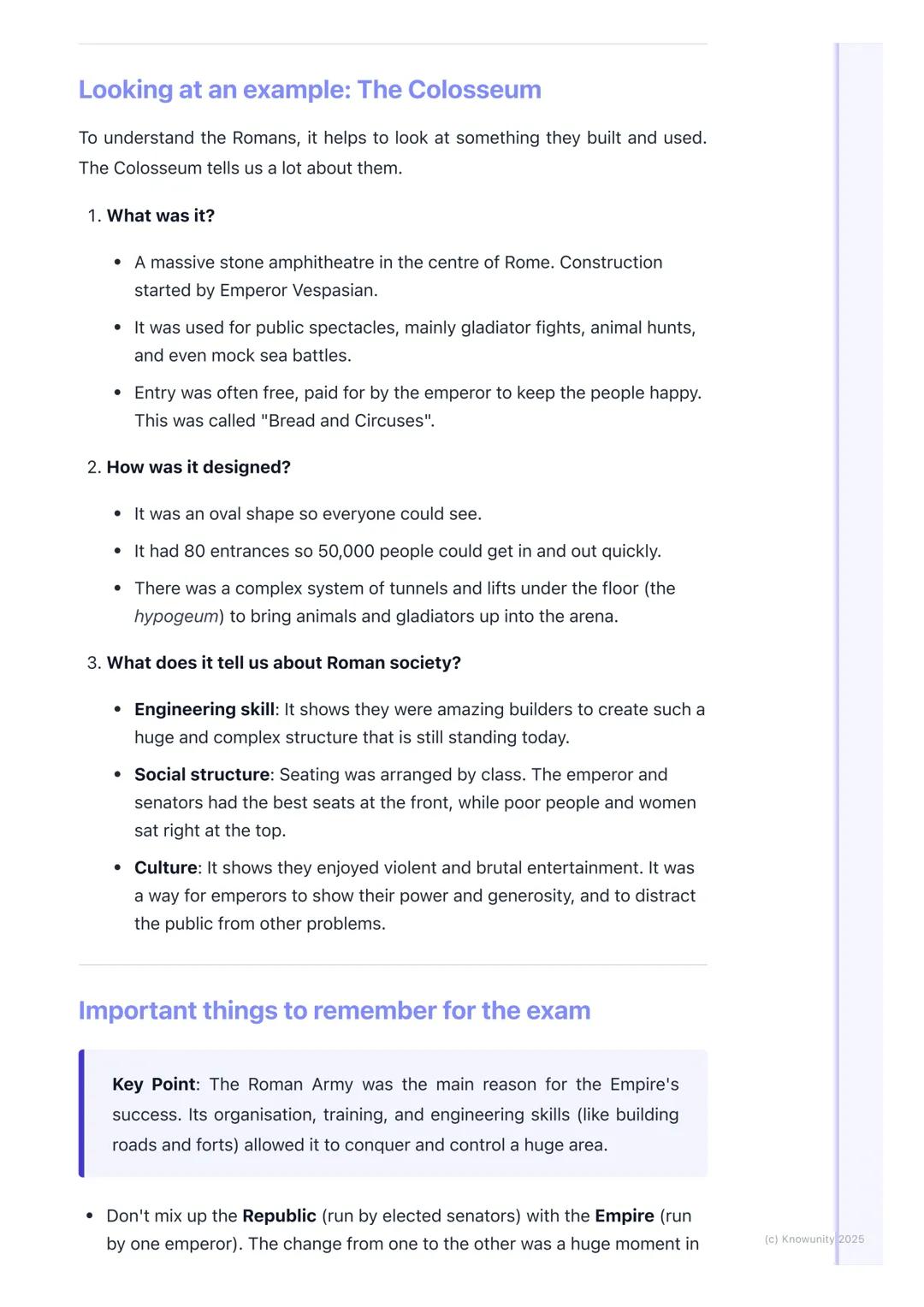
The Colosseum: A Window into Roman Life
The Colosseum is like a time machine that shows us exactly what Romans valued. This massive stone amphitheatre wasn't just entertainment - it was politics, engineering, and social control all rolled into one.
Emperors used "Bread and Circuses" - free food and spectacular shows - to keep ordinary Romans happy and distracted from problems. The Colosseum could hold 50,000 people and had 80 entrances so crowds could get in and out safely. Underneath the arena floor, the hypogeum was a complex system of tunnels, lifts, and cages that brought animals and gladiators up into the arena.
The seating arrangement told you everything about Roman society. The emperor and senators sat ringside with the best views. Patricians got good middle seats. Plebeians and women were stuck at the very top. Your seat literally showed your place in society.
What happened in the arena was brutal - gladiator fights, animal hunts, and even mock naval battles with real ships! This shows Romans enjoyed violent spectacles, but it also demonstrates how emperors used entertainment to display their power and wealth.
Think About It: The Colosseum still influences us - modern stadiums use similar designs for crowd flow and seating!
6
of 6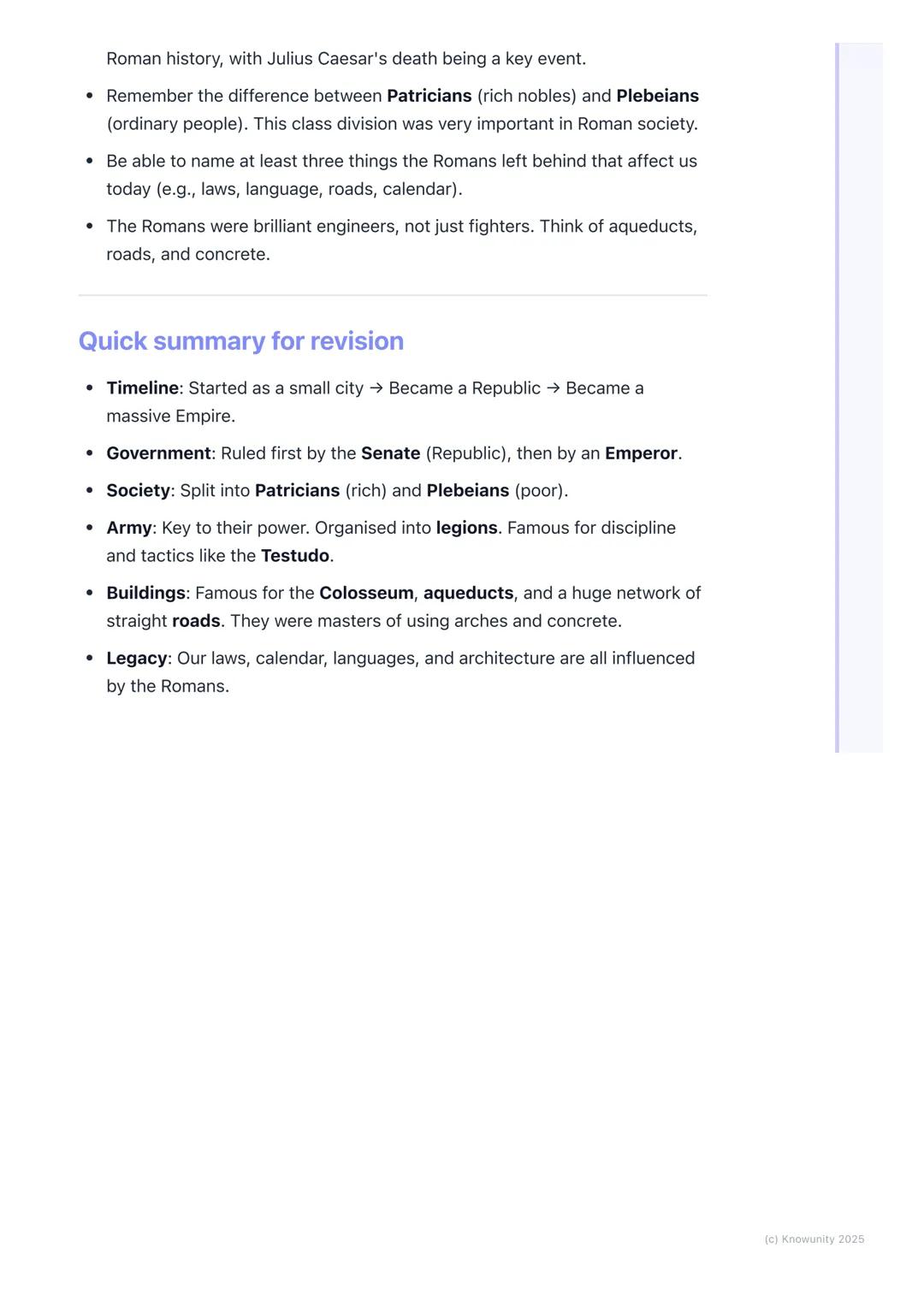
Key Points for Your Exam
Don't confuse the Republic (elected Senate) with the Empire (ruled by emperors) - this transition was massive in Roman history, especially around Julius Caesar's assassination. Understanding this change shows you grasp how Roman government evolved.
Remember that Roman success came from their army's organisation and discipline, plus their incredible engineering skills. They didn't just conquer places - they built roads, aqueducts, and cities that made their empire work efficiently.
The Patrician-Plebeian class system affected everything in Roman society, from where you sat in the Colosseum to what jobs you could have. This wasn't just rich versus poor - it was a legal and social framework that defined Roman life.
Roman legacy surrounds you daily. When you use words with Latin roots, follow our calendar, see government buildings with columns and domes, or rely on written laws that protect your rights - that's all Roman influence still working today.
Revision Reminder: Timeline = Small city → Republic → Massive Empire. Government = Senate → Emperor. Army = Legions with brilliant tactics. Buildings = Colosseum, aqueducts, roads everywhere!
Pensamos que nunca lo preguntarías...
¿Qué es Knowunity AI companion?
Nuestro compañero de IA está específicamente adaptado a las necesidades de los estudiantes. Basándonos en los millones de contenidos que tenemos en la plataforma, podemos dar a los estudiantes respuestas realmente significativas y relevantes. Pero no se trata solo de respuestas, el compañero también guía a los estudiantes a través de sus retos de aprendizaje diarios, con planes de aprendizaje personalizados, cuestionarios o contenidos en el chat y una personalización del 100% basada en las habilidades y el desarrollo de los estudiantes.
¿Dónde puedo descargar la app Knowunity?
Puedes descargar la app en Google Play Store y Apple App Store.
¿Knowunity es totalmente gratuito?
Sí, tienes acceso gratuito a los contenidos de la aplicación y a nuestro compañero de IA. Para desbloquear determinadas funciones de la aplicación, puedes adquirir Knowunity Pro.
Contenidos más populares de History
9Contenidos más populares
9¿No encuentras lo que buscas? Explora otros temas.
Mira lo que dicen nuestros usuarios. Les encanta - y a tí también.
4.6/5App Store
4.7/5Google Play
La app es muy fácil de usar y está muy bien diseñada. Hasta ahora he encontrado todo lo que estaba buscando y he podido aprender mucho de las presentaciones. Definitivamente utilizaré la aplicación para un examen de clase. Y, por supuesto, también me sirve mucho de inspiración.
Pablousuario de iOS
Esta app es realmente genial. Hay tantos apuntes de clase y ayuda [...]. Tengo problemas con matemáticas, por ejemplo, y la aplicación tiene muchas opciones de ayuda. Gracias a Knowunity, he mejorado en mates. Se la recomiendo a todo el mundo.
Elenausuaria de Android
Vaya, estoy realmente sorprendida. Acabo de probar la app porque la he visto anunciada muchas veces y me he quedado absolutamente alucinada. Esta app es LA AYUDA que quieres para el insti y, sobre todo, ofrece muchísimas cosas, como ejercicios y hojas informativas, que a mí personalmente me han sido MUY útiles.
Anausuaria de iOS
History21 visualizaciones·Actualizado Jun 6, 2026·6 páginasThe Fascinating World of Ancient Rome
Ever wonder how a small Italian city became one of history's most powerful civilisations? The Romans started as just another settlement but ended up ruling most of the known world for centuries. Their incredible army, amazing engineering skills, and clever... Mostrar más
1
of 6Inscríbete para ver los apuntes. ¡Es gratis!
- Acceso a todos los documentos
- Mejora tus notas
- Únete a millones de estudiantes
An Introduction to the Romans
Think about this: almost every major European language, our legal system, and even our calendar all have Roman roots! The Romans weren't just ancient people from history books - they're the reason our world works the way it does today.
The Roman civilisation went through two major phases that you need to know. First came the Roman Republic, where elected officials and the Senate ran things for about 500 years. Then it transformed into the Roman Empire, ruled by powerful emperors like Augustus.
Roman society was divided into two main groups. The Patricians were the wealthy upper class who owned land and held important government positions. Meanwhile, the Plebeians made up most of the population - farmers, builders, shopkeepers, and ordinary working people. This class system shaped everything about Roman life.
Quick Test Tip: Remember that Latin, the Roman language, is why French, Spanish, and Italian sound similar - they all developed from it!
2
of 6Inscríbete para ver los apuntes. ¡Es gratis!
- Acceso a todos los documentos
- Mejora tus notas
- Únete a millones de estudiantes
The Powerful Roman Army
Here's what made Rome unstoppable: their army was like a perfectly organised machine. Every Roman legion contained about 5,000 heavily armed professional soldiers called legionaries.
These weren't just random fighters thrown together. Roman soldiers had to be citizens and served for 25 years! They marched up to 30km daily carrying all their gear, including their lorica segmentata (metal strip armour), gladius (short stabbing sword), and scutum (large curved shield).
The army's secret weapon was organisation and tactics. Each legion split into smaller groups called centuries, led by tough officers called centurions. Their most famous battle formation was the testudo (tortoise), where soldiers locked shields above their heads and in front to create an armoured shell that arrows couldn't penetrate.
Roman soldiers also used a clever weapon called the pilum - a heavy javelin designed to bend after hitting something, so enemies couldn't throw it back at them.
Remember: The Roman army wasn't just about fighting - they built roads, forts, and aqueducts wherever they went!
3
of 6Inscríbete para ver los apuntes. ¡Es gratis!
- Acceso a todos los documentos
- Mejora tus notas
- Únete a millones de estudiantes
Roman Cities and Engineering
Roman cities weren't chaotic medieval towns - they were planned like modern cities with proper sewers, running water, and organised layouts! Most followed a grid pattern with the Forum (a large marketplace and meeting area) right at the centre.
The Romans created some of history's most impressive buildings. The Colosseum could pack in over 50,000 spectators to watch gladiator fights and animal hunts. The Pantheon, a temple for all Roman gods, still amazes engineers today with its massive concrete dome.
But their real genius showed in practical engineering. Roman aqueducts carried fresh water across huge distances using gravity - no pumps needed! They built over 80,000km of straight, paved roads that helped their army move quickly. That's where "all roads lead to Rome" comes from.
Public baths weren't just for washing - they were like ancient community centres where Romans exercised, socialised, and did business. These facilities show how advanced Roman cities were compared to anywhere else in the world at that time.
Cool Fact: Roman concrete was so good that many of their buildings are still standing 2,000 years later!
4
of 6Inscríbete para ver los apuntes. ¡Es gratis!
- Acceso a todos los documentos
- Mejora tus notas
- Únete a millones de estudiantes
What the Romans Left Behind
Even though the Roman Empire collapsed over 1,500 years ago, you encounter Roman influence almost every day without realising it! Our legal systems still use Roman principles like "innocent until proven guilty."
Your calendar is basically Roman too. Julius Caesar created the Julian calendar with 365 days and leap years - sound familiar? July and August are named after Julius Caesar and Emperor Augustus. Many English words come from Latin: "aqua" (water), "terra" (earth), "audio" (hear).
Roman architecture shapes our important buildings today. Government buildings, churches, and monuments use Roman arches, domes, and columns. The dome on many capitol buildings? That's inspired by the Pantheon.
Roman law created the Twelve Tables - written laws that applied to everyone. This idea of written, fair laws that protect citizens became the foundation for legal systems across Europe and Ireland. Before Romans, most places just had whatever the local ruler decided on the spot!
Exam Tip: Be ready to name at least three Roman contributions that affect us today - language, laws, architecture, and calendar are the big ones!
5
of 6Inscríbete para ver los apuntes. ¡Es gratis!
- Acceso a todos los documentos
- Mejora tus notas
- Únete a millones de estudiantes
The Colosseum: A Window into Roman Life
The Colosseum is like a time machine that shows us exactly what Romans valued. This massive stone amphitheatre wasn't just entertainment - it was politics, engineering, and social control all rolled into one.
Emperors used "Bread and Circuses" - free food and spectacular shows - to keep ordinary Romans happy and distracted from problems. The Colosseum could hold 50,000 people and had 80 entrances so crowds could get in and out safely. Underneath the arena floor, the hypogeum was a complex system of tunnels, lifts, and cages that brought animals and gladiators up into the arena.
The seating arrangement told you everything about Roman society. The emperor and senators sat ringside with the best views. Patricians got good middle seats. Plebeians and women were stuck at the very top. Your seat literally showed your place in society.
What happened in the arena was brutal - gladiator fights, animal hunts, and even mock naval battles with real ships! This shows Romans enjoyed violent spectacles, but it also demonstrates how emperors used entertainment to display their power and wealth.
Think About It: The Colosseum still influences us - modern stadiums use similar designs for crowd flow and seating!
6
of 6Inscríbete para ver los apuntes. ¡Es gratis!
- Acceso a todos los documentos
- Mejora tus notas
- Únete a millones de estudiantes
Key Points for Your Exam
Don't confuse the Republic (elected Senate) with the Empire (ruled by emperors) - this transition was massive in Roman history, especially around Julius Caesar's assassination. Understanding this change shows you grasp how Roman government evolved.
Remember that Roman success came from their army's organisation and discipline, plus their incredible engineering skills. They didn't just conquer places - they built roads, aqueducts, and cities that made their empire work efficiently.
The Patrician-Plebeian class system affected everything in Roman society, from where you sat in the Colosseum to what jobs you could have. This wasn't just rich versus poor - it was a legal and social framework that defined Roman life.
Roman legacy surrounds you daily. When you use words with Latin roots, follow our calendar, see government buildings with columns and domes, or rely on written laws that protect your rights - that's all Roman influence still working today.
Revision Reminder: Timeline = Small city → Republic → Massive Empire. Government = Senate → Emperor. Army = Legions with brilliant tactics. Buildings = Colosseum, aqueducts, roads everywhere!
Pensamos que nunca lo preguntarías...
¿Qué es Knowunity AI companion?
Nuestro compañero de IA está específicamente adaptado a las necesidades de los estudiantes. Basándonos en los millones de contenidos que tenemos en la plataforma, podemos dar a los estudiantes respuestas realmente significativas y relevantes. Pero no se trata solo de respuestas, el compañero también guía a los estudiantes a través de sus retos de aprendizaje diarios, con planes de aprendizaje personalizados, cuestionarios o contenidos en el chat y una personalización del 100% basada en las habilidades y el desarrollo de los estudiantes.
¿Dónde puedo descargar la app Knowunity?
Puedes descargar la app en Google Play Store y Apple App Store.
¿Knowunity es totalmente gratuito?
Sí, tienes acceso gratuito a los contenidos de la aplicación y a nuestro compañero de IA. Para desbloquear determinadas funciones de la aplicación, puedes adquirir Knowunity Pro.
Contenidos más populares de History
9Contenidos más populares
9¿No encuentras lo que buscas? Explora otros temas.
Mira lo que dicen nuestros usuarios. Les encanta - y a tí también.
4.6/5App Store
4.7/5Google Play
La app es muy fácil de usar y está muy bien diseñada. Hasta ahora he encontrado todo lo que estaba buscando y he podido aprender mucho de las presentaciones. Definitivamente utilizaré la aplicación para un examen de clase. Y, por supuesto, también me sirve mucho de inspiración.
Pablousuario de iOS
Esta app es realmente genial. Hay tantos apuntes de clase y ayuda [...]. Tengo problemas con matemáticas, por ejemplo, y la aplicación tiene muchas opciones de ayuda. Gracias a Knowunity, he mejorado en mates. Se la recomiendo a todo el mundo.
Elenausuaria de Android
Vaya, estoy realmente sorprendida. Acabo de probar la app porque la he visto anunciada muchas veces y me he quedado absolutamente alucinada. Esta app es LA AYUDA que quieres para el insti y, sobre todo, ofrece muchísimas cosas, como ejercicios y hojas informativas, que a mí personalmente me han sido MUY útiles.
Anausuaria de iOS