
Ever wonder why earthquakes happen or how mountains form? It...
 Geography17 visualizaciones·Actualizado Jun 12, 2026·6 páginas
Understanding Plate Tectonics and Earth's Dynamic Surface

1 / 6
1
of 6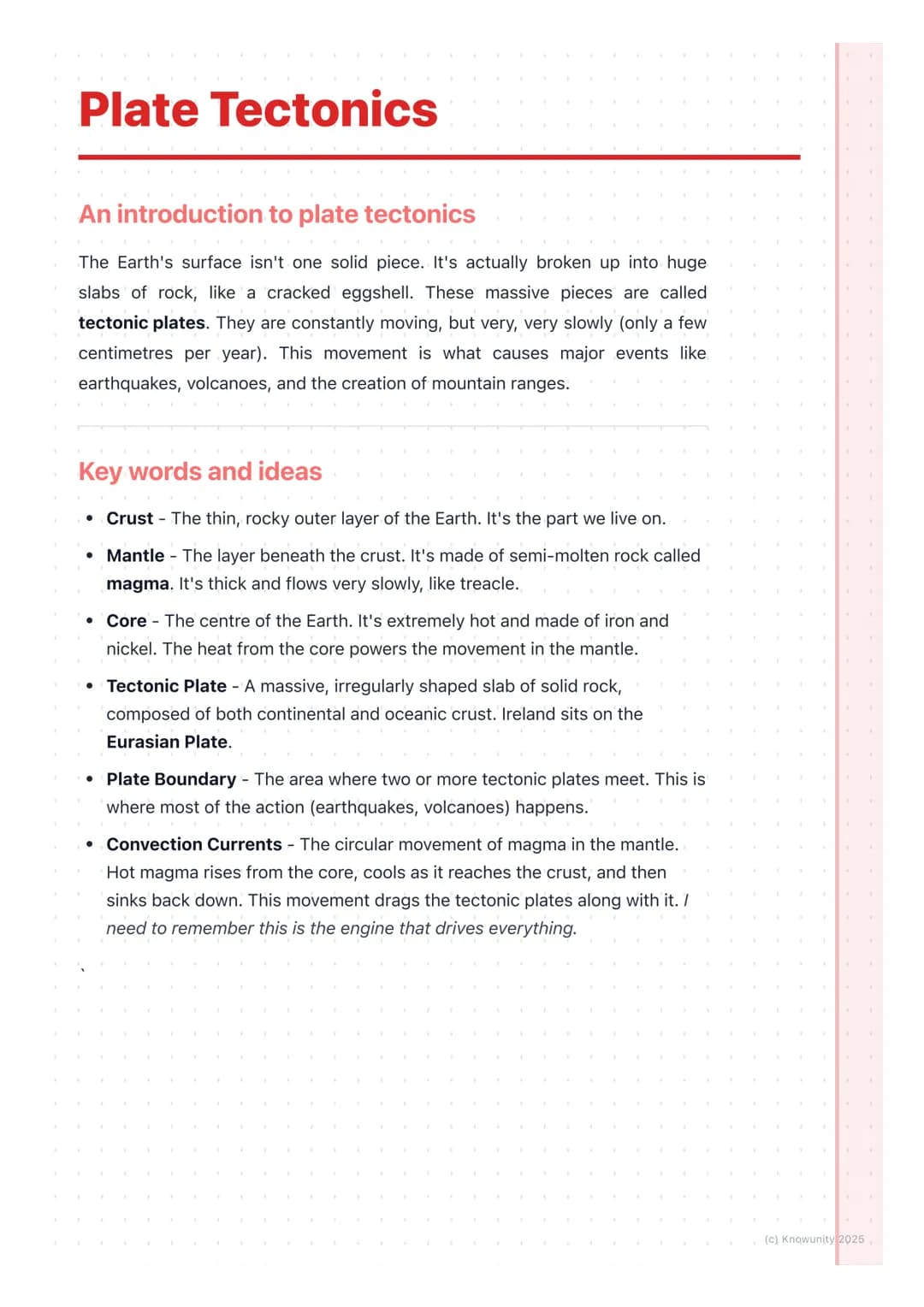
Understanding Earth's Structure and Plate Movement
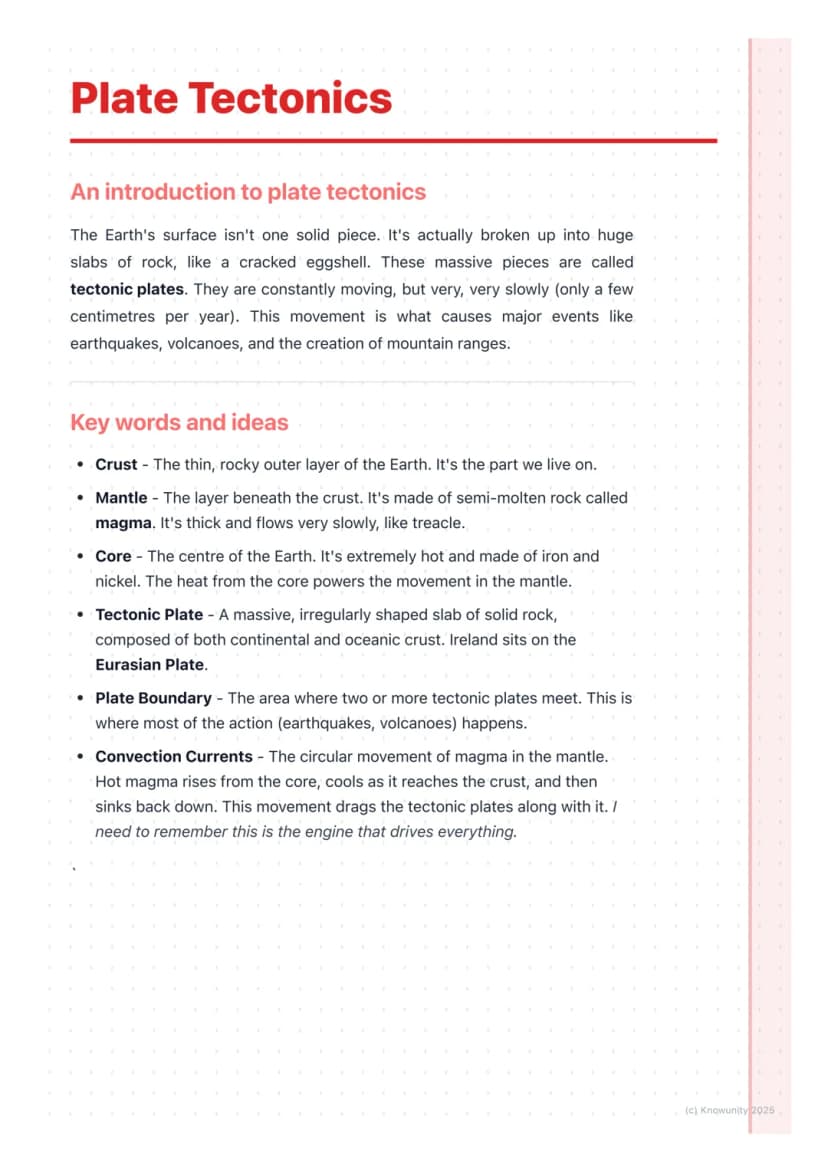
Think of Earth like a massive layered cake with a cracked outer shell. The crust is that thin, rocky outer layer where we live, whilst beneath it lies the mantle – a thick layer of semi-molten rock called magma that flows like treacle.
At Earth's centre is the incredibly hot core made of iron and nickel. This heat powers everything that happens above it! Tectonic plates are those massive, irregularly shaped slabs of solid rock that make up the crust – Ireland sits comfortably on the Eurasian Plate.
The real magic happens because of convection currents in the mantle. Picture a pot of water boiling – hot magma rises from the core, cools near the crust, then sinks back down, creating circular currents that drag the plates along with them. Plate boundaries are where two or more plates meet, and that's where all the exciting (and sometimes dangerous) action occurs!
Key Point: Convection currents are the engine that drives everything – always mention this in exam answers!
2
of 6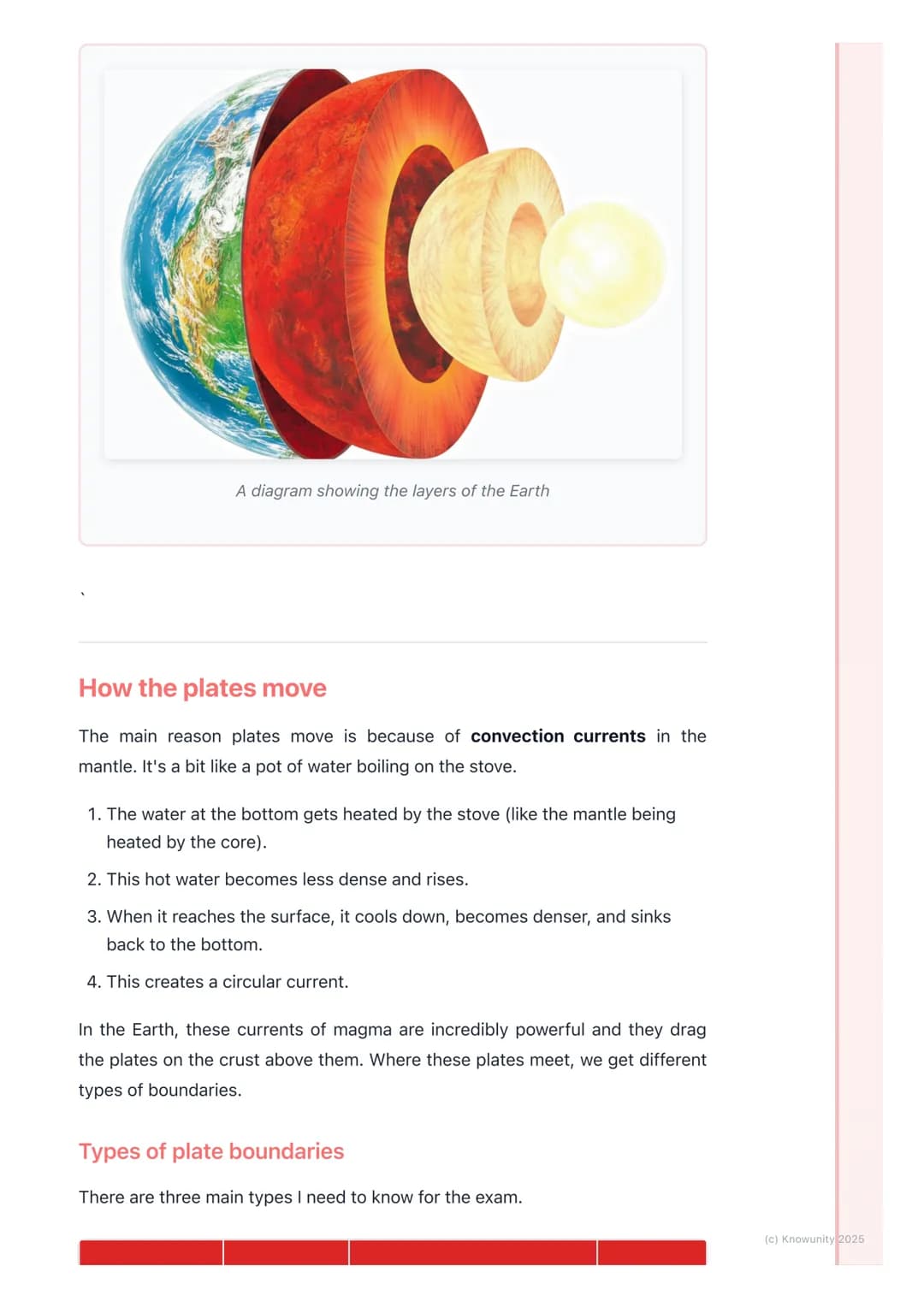
The Three Types of Plate Boundaries
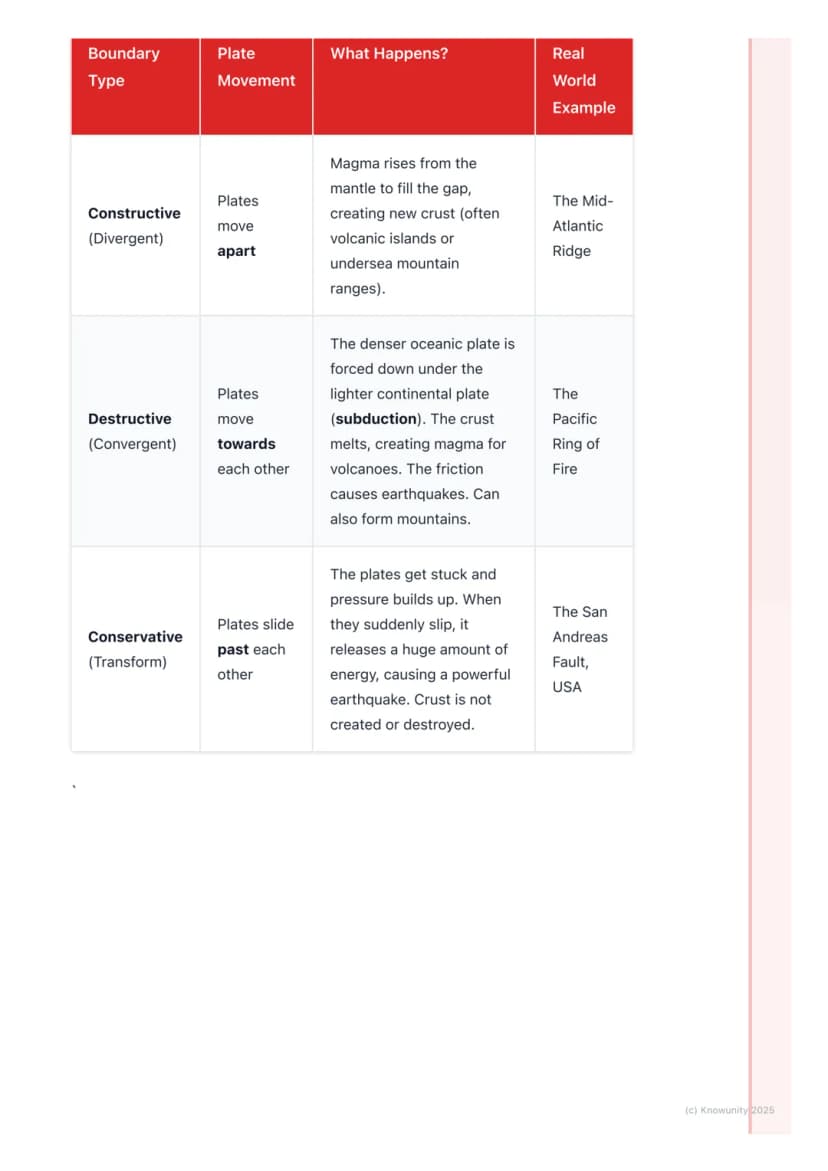
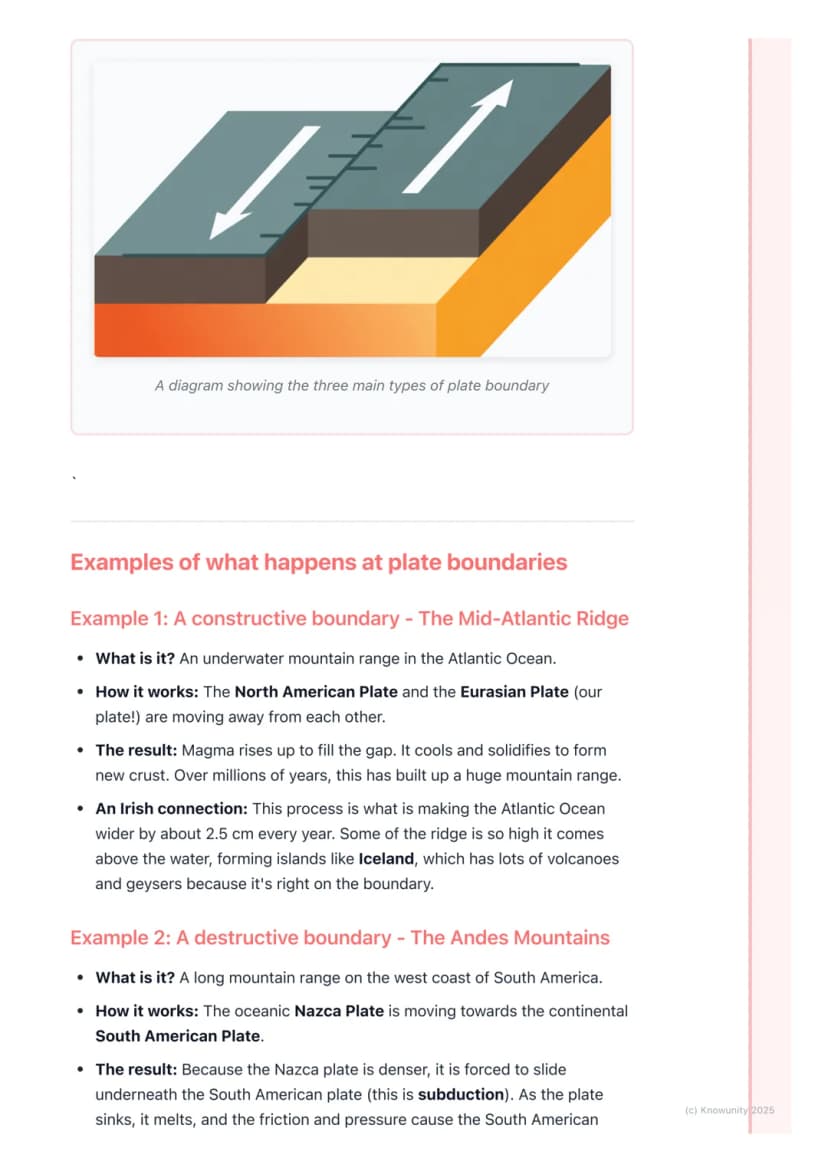
At constructive boundaries, plates move apart from each other. Magma rises to fill the gap, creating new crust and often forming volcanic islands or underwater mountain ranges. The Mid-Atlantic Ridge is a perfect example – it's making the Atlantic Ocean wider by 2.5 cm every year!
Destructive boundaries are where plates crash into each other. The denser oceanic plate gets forced down under the lighter continental plate in a process called subduction. This creates volcanoes, earthquakes, and mountain ranges like the Andes Mountains.
At conservative boundaries, plates slide past each other horizontally. They get stuck, pressure builds up, then suddenly slip, releasing massive energy as powerful earthquakes. The San Andreas Fault in California is the most famous example of this type.
Remember: Oceanic crust is always denser than continental crust, so it always sinks when they collide!
3
of 6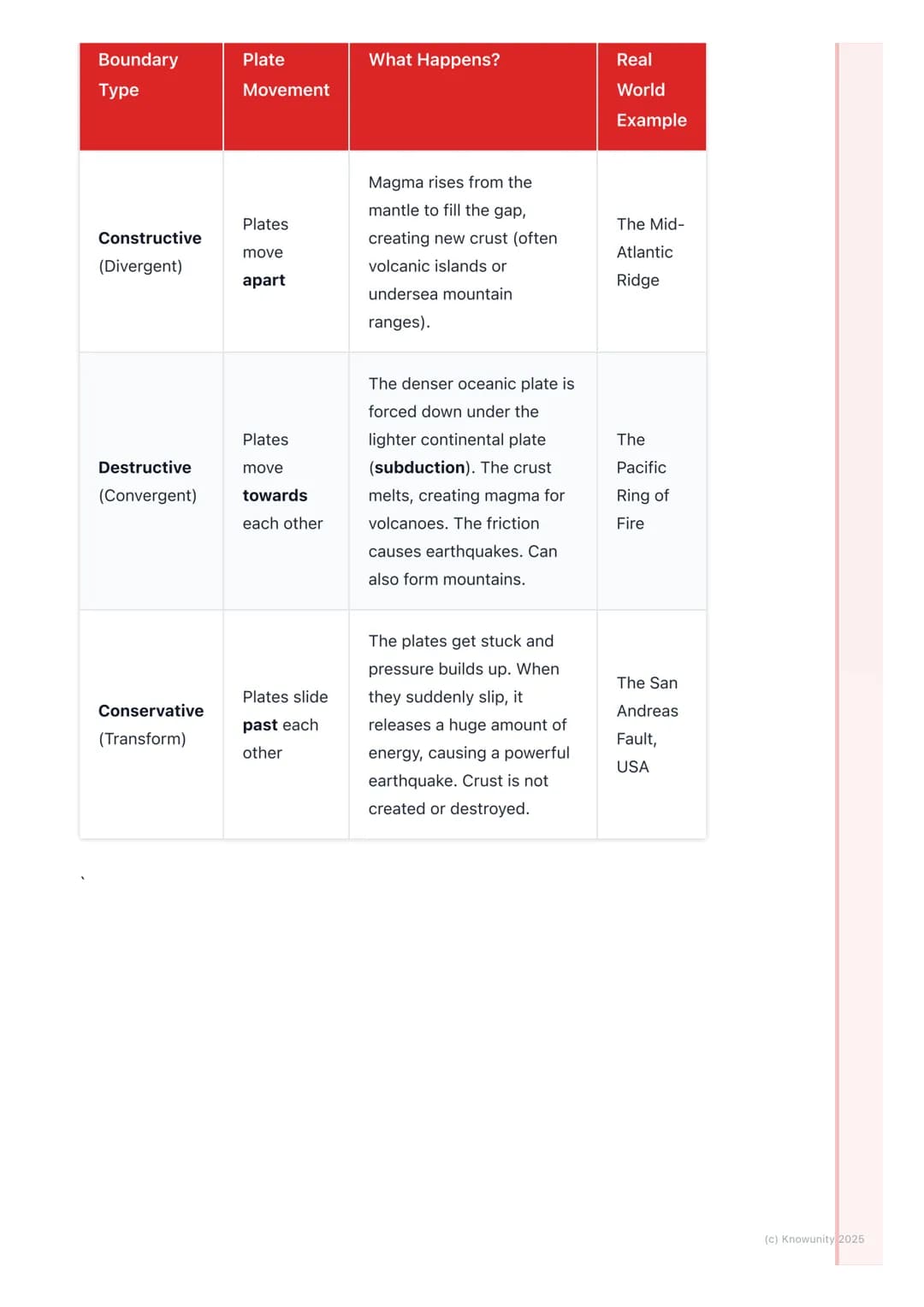
Real-World Examples You Need to Know
The Mid-Atlantic Ridge shows constructive boundaries in action. The North American Plate and our Eurasian Plate are moving apart underwater, and magma rises to fill the space. Over millions of years, this has built a massive underwater mountain range – some parts are so high they form islands like Iceland with its famous volcanoes and geysers!
The Andes Mountains demonstrate destructive boundaries perfectly. The oceanic Nazca Plate is sliding underneath the continental South American Plate through subduction. As the Nazca Plate melts, the friction and pressure cause the South American plate to buckle upwards, creating this enormous mountain range dotted with active volcanoes.
The Pacific Ring of Fire is a string of destructive plate boundaries around the Pacific Ocean where most of the world's earthquakes and volcanic eruptions happen. It's like a giant horseshoe of geological activity!
Fun Fact: Ireland is lucky to be far from any plate boundaries, which is why we don't have volcanoes or major earthquakes!
4
of 6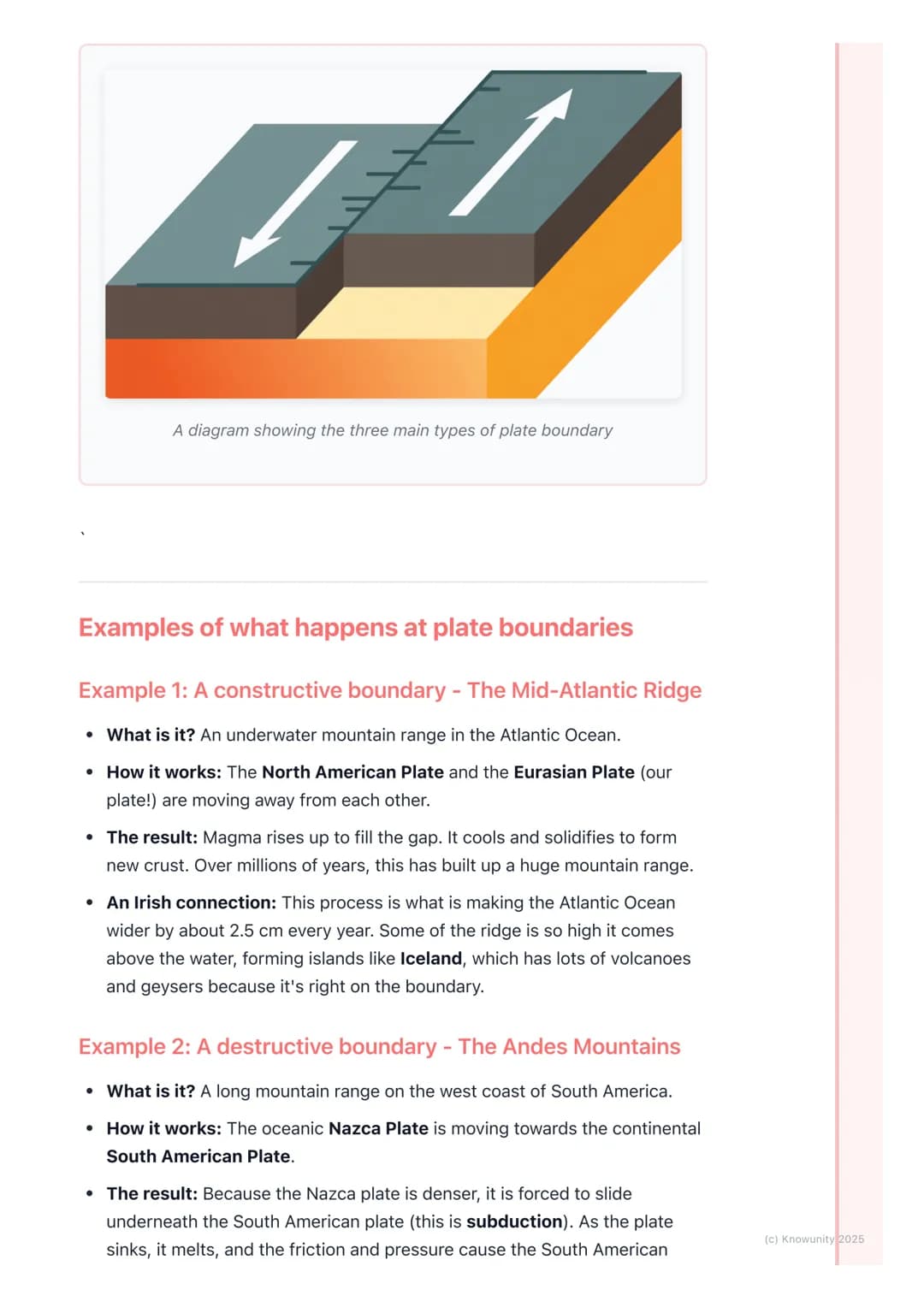
Key Concepts for Success
Remember that subduction is the crucial process at destructive boundaries where one plate is forced down into the mantle beneath another. This single process creates earthquakes, volcanoes, and mountain ranges all at once! The key difference between oceanic and continental crust is that oceanic crust is thinner but denser.
Don't make the common mistake of thinking plates float around randomly – their movement is a slow, predictable system entirely driven by heat from Earth's core. The plates affecting Ireland and Europe are the Eurasian Plate and the North American Plate, which are slowly moving apart.
For your exams, always explain that convection currents in the mantle are the main driving force behind plate tectonics. Think of the three boundary types as: constructive (building new crust), destructive (destroying old crust), and conservative (just sliding past without creating or destroying).
Exam Tip: Learn the real-world examples by heart – Mid-Atlantic Ridge, Andes Mountains, and San Andreas Fault are exam favourites!
5
of 6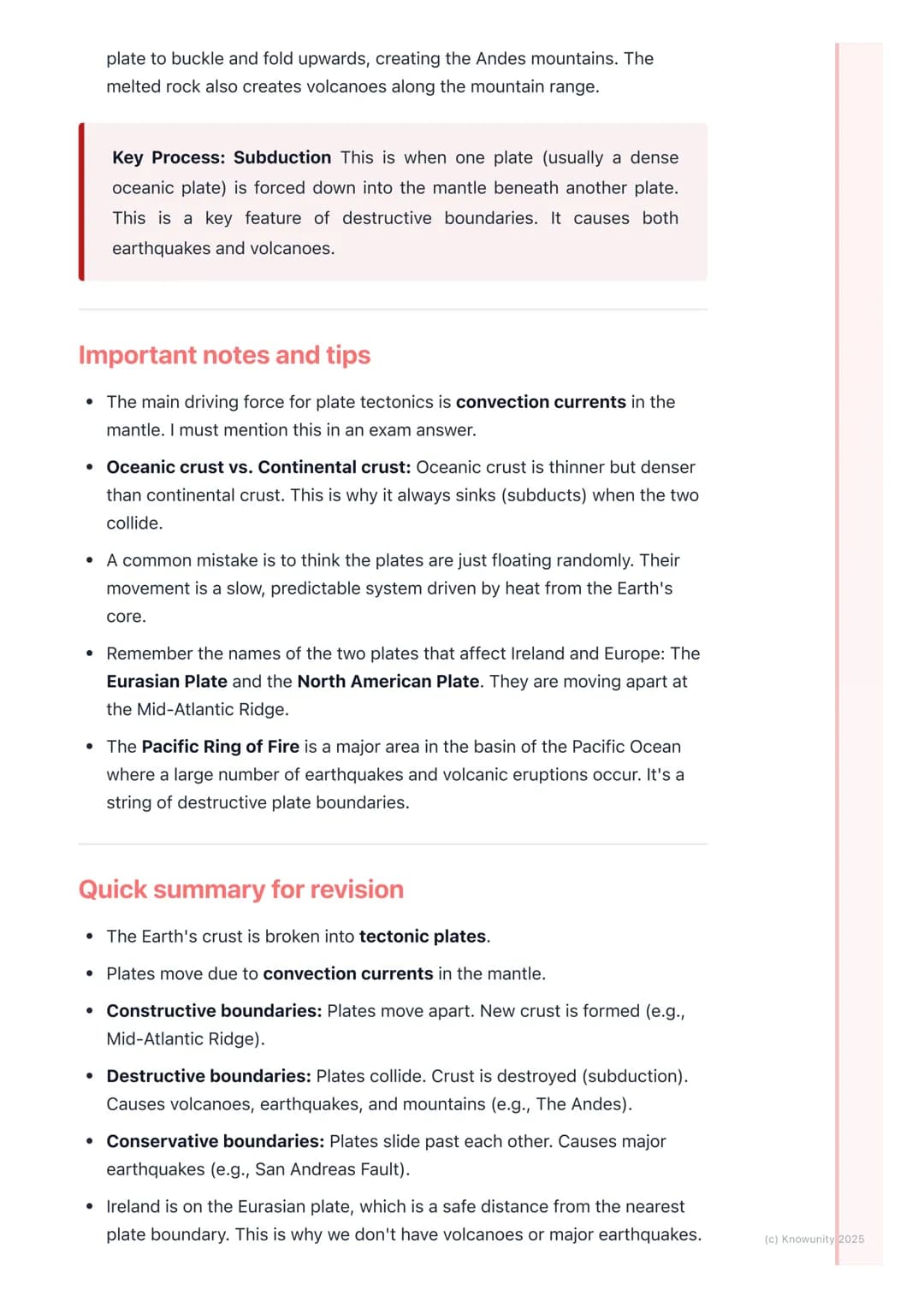
6
of 6
Pensamos que nunca lo preguntarías...
¿Qué es Knowunity AI companion?
Nuestro compañero de IA está específicamente adaptado a las necesidades de los estudiantes. Basándonos en los millones de contenidos que tenemos en la plataforma, podemos dar a los estudiantes respuestas realmente significativas y relevantes. Pero no se trata solo de respuestas, el compañero también guía a los estudiantes a través de sus retos de aprendizaje diarios, con planes de aprendizaje personalizados, cuestionarios o contenidos en el chat y una personalización del 100% basada en las habilidades y el desarrollo de los estudiantes.
¿Dónde puedo descargar la app Knowunity?
Puedes descargar la app en Google Play Store y Apple App Store.
¿Knowunity es totalmente gratuito?
Sí, tienes acceso gratuito a los contenidos de la aplicación y a nuestro compañero de IA. Para desbloquear determinadas funciones de la aplicación, puedes adquirir Knowunity Pro.
Contenidos más populares de Geography
9GeographyGeography notes on rocks
Includes types of rocks,uses of rocks, case studies
1st Year341
GeographyEarthquakes revision notes
Notes on earthquakes with diagrams
1st Year110
GeographyPopulation Change and Migration
This covers factors that cause populations to grow or shrink, including birth rates, death rates, and the reasons people migrate.
2nd Year90
GeographyRock notes geography
Geography
5th Year250
GeographyThe sea
Jc Geography
1st Year230
GeographyGeography notes On the sea
Includes costal erosion, sea cliffs, longshore drift etc.
1st Year160
GeographyInside the Earth
Students will learn about the basic layers of the Earth: the crust, mantle, and core, understanding that our planet is made up of different parts.
1st Year51
GeographyGeography notes on glaciation
Includes diagrams, erosion, deposition, transportation
1st Year210
GeographyGeography notes on weather
Includes instruments, diagrams, how to read weather
1st Year120
Contenidos más populares
9 Irish
IrishIrish oral questions and answers
Questions and answers for the leaving cert oral
5th Year4264
 English
Key Quotes : Sive
Key Quotes and explanations: Sive
6th Year2842
IrishIrish oral questions
Outline of oral questions
5th Year2055
IrishIníon- le hÁine Durkin
Aine Durkin’s poem, Iníon: Themes & summary
5th Year850
IrishIrish poetry 2027
Iníon + Dínit an Bhróin
5th Year1133
IrishLC HL notes- Iníon (poem)
Includes poem in English and Irish, theme, key words & phrases
5th Year2284
EnglishCultural Context : Shawshank Redemption : Sive : Small Things Like These
Comparative Study : Cultural Context : Shawshank Redemption, Sive and Small Things Like These
6th Year1430
IrishMo Ghrá-sa (Idir Lúibíní)
Notes on mo ghrá-sa
5th Year380
IrishAn Gaeilge Aiste
Irish Language essay
6th Year1320
¿No encuentras lo que buscas? Explora otros temas.
Mira lo que dicen nuestros usuarios. Les encanta - y a tí también.
4.6/5App Store
4.7/5Google Play
La app es muy fácil de usar y está muy bien diseñada. Hasta ahora he encontrado todo lo que estaba buscando y he podido aprender mucho de las presentaciones. Definitivamente utilizaré la aplicación para un examen de clase. Y, por supuesto, también me sirve mucho de inspiración.
Pablousuario de iOS
Esta app es realmente genial. Hay tantos apuntes de clase y ayuda [...]. Tengo problemas con matemáticas, por ejemplo, y la aplicación tiene muchas opciones de ayuda. Gracias a Knowunity, he mejorado en mates. Se la recomiendo a todo el mundo.
Elenausuaria de Android
Vaya, estoy realmente sorprendida. Acabo de probar la app porque la he visto anunciada muchas veces y me he quedado absolutamente alucinada. Esta app es LA AYUDA que quieres para el insti y, sobre todo, ofrece muchísimas cosas, como ejercicios y hojas informativas, que a mí personalmente me han sido MUY útiles.
Anausuaria de iOS
Geography17 visualizaciones·Actualizado Jun 12, 2026·6 páginasUnderstanding Plate Tectonics and Earth's Dynamic Surface
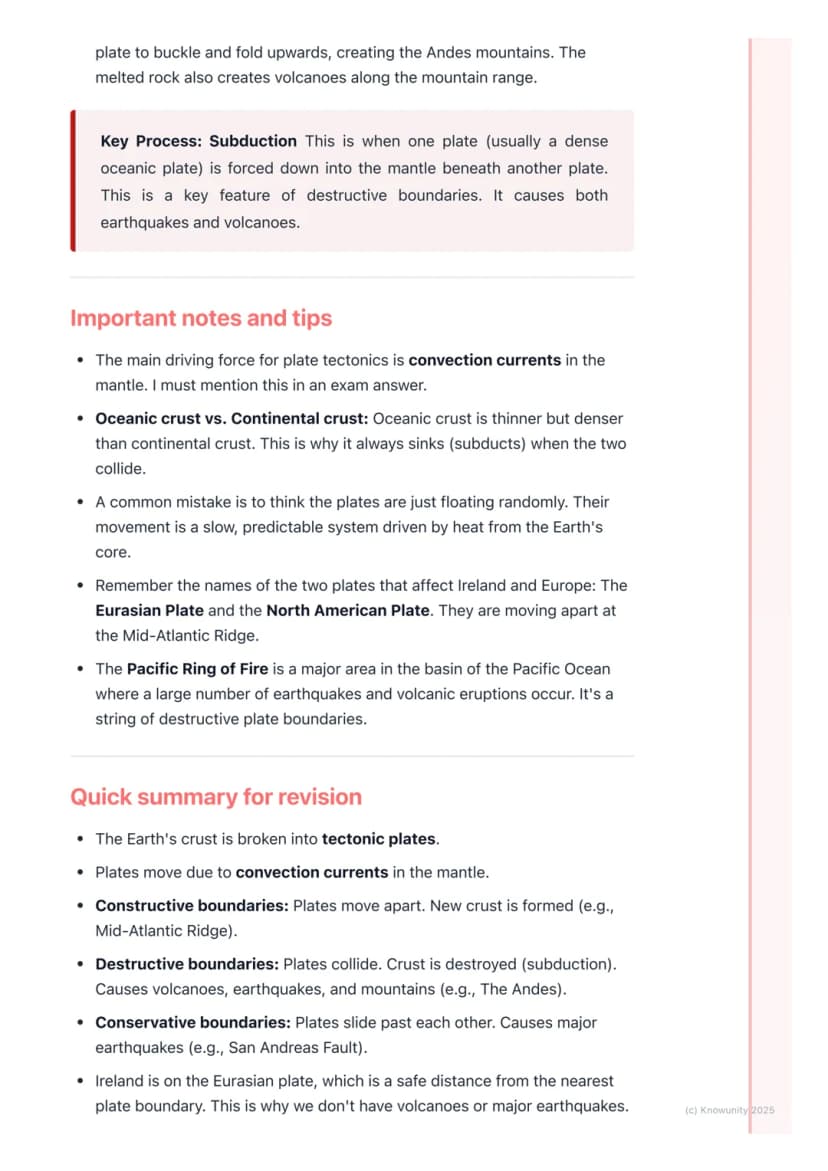
Ever wonder why earthquakes happen or how mountains form? It all comes down to the fact that Earth's surface isn't one solid piece – it's actually broken up into massive slabs of rock called tectonic plates that are constantly moving...
1
of 6
Inscríbete para ver los apuntes. ¡Es gratis!
- Acceso a todos los documentos
- Mejora tus notas
- Únete a millones de estudiantes
Understanding Earth's Structure and Plate Movement
Think of Earth like a massive layered cake with a cracked outer shell. The crust is that thin, rocky outer layer where we live, whilst beneath it lies the mantle – a thick layer of semi-molten rock called magma that flows like treacle.
At Earth's centre is the incredibly hot core made of iron and nickel. This heat powers everything that happens above it! Tectonic plates are those massive, irregularly shaped slabs of solid rock that make up the crust – Ireland sits comfortably on the Eurasian Plate.
The real magic happens because of convection currents in the mantle. Picture a pot of water boiling – hot magma rises from the core, cools near the crust, then sinks back down, creating circular currents that drag the plates along with them. Plate boundaries are where two or more plates meet, and that's where all the exciting (and sometimes dangerous) action occurs!
Key Point: Convection currents are the engine that drives everything – always mention this in exam answers!
2
of 6Inscríbete para ver los apuntes. ¡Es gratis!
- Acceso a todos los documentos
- Mejora tus notas
- Únete a millones de estudiantes
The Three Types of Plate Boundaries
At constructive boundaries, plates move apart from each other. Magma rises to fill the gap, creating new crust and often forming volcanic islands or underwater mountain ranges. The Mid-Atlantic Ridge is a perfect example – it's making the Atlantic Ocean wider by 2.5 cm every year!
Destructive boundaries are where plates crash into each other. The denser oceanic plate gets forced down under the lighter continental plate in a process called subduction. This creates volcanoes, earthquakes, and mountain ranges like the Andes Mountains.
At conservative boundaries, plates slide past each other horizontally. They get stuck, pressure builds up, then suddenly slip, releasing massive energy as powerful earthquakes. The San Andreas Fault in California is the most famous example of this type.
Remember: Oceanic crust is always denser than continental crust, so it always sinks when they collide!
3
of 6Inscríbete para ver los apuntes. ¡Es gratis!
- Acceso a todos los documentos
- Mejora tus notas
- Únete a millones de estudiantes
Real-World Examples You Need to Know
The Mid-Atlantic Ridge shows constructive boundaries in action. The North American Plate and our Eurasian Plate are moving apart underwater, and magma rises to fill the space. Over millions of years, this has built a massive underwater mountain range – some parts are so high they form islands like Iceland with its famous volcanoes and geysers!
The Andes Mountains demonstrate destructive boundaries perfectly. The oceanic Nazca Plate is sliding underneath the continental South American Plate through subduction. As the Nazca Plate melts, the friction and pressure cause the South American plate to buckle upwards, creating this enormous mountain range dotted with active volcanoes.
The Pacific Ring of Fire is a string of destructive plate boundaries around the Pacific Ocean where most of the world's earthquakes and volcanic eruptions happen. It's like a giant horseshoe of geological activity!
Fun Fact: Ireland is lucky to be far from any plate boundaries, which is why we don't have volcanoes or major earthquakes!
4
of 6Inscríbete para ver los apuntes. ¡Es gratis!
- Acceso a todos los documentos
- Mejora tus notas
- Únete a millones de estudiantes
Key Concepts for Success
Remember that subduction is the crucial process at destructive boundaries where one plate is forced down into the mantle beneath another. This single process creates earthquakes, volcanoes, and mountain ranges all at once! The key difference between oceanic and continental crust is that oceanic crust is thinner but denser.
Don't make the common mistake of thinking plates float around randomly – their movement is a slow, predictable system entirely driven by heat from Earth's core. The plates affecting Ireland and Europe are the Eurasian Plate and the North American Plate, which are slowly moving apart.
For your exams, always explain that convection currents in the mantle are the main driving force behind plate tectonics. Think of the three boundary types as: constructive (building new crust), destructive (destroying old crust), and conservative (just sliding past without creating or destroying).
Exam Tip: Learn the real-world examples by heart – Mid-Atlantic Ridge, Andes Mountains, and San Andreas Fault are exam favourites!
5
of 6Inscríbete para ver los apuntes. ¡Es gratis!
- Acceso a todos los documentos
- Mejora tus notas
- Únete a millones de estudiantes
6
of 6Inscríbete para ver los apuntes. ¡Es gratis!
- Acceso a todos los documentos
- Mejora tus notas
- Únete a millones de estudiantes
Pensamos que nunca lo preguntarías...
¿Qué es Knowunity AI companion?
Nuestro compañero de IA está específicamente adaptado a las necesidades de los estudiantes. Basándonos en los millones de contenidos que tenemos en la plataforma, podemos dar a los estudiantes respuestas realmente significativas y relevantes. Pero no se trata solo de respuestas, el compañero también guía a los estudiantes a través de sus retos de aprendizaje diarios, con planes de aprendizaje personalizados, cuestionarios o contenidos en el chat y una personalización del 100% basada en las habilidades y el desarrollo de los estudiantes.
¿Dónde puedo descargar la app Knowunity?
Puedes descargar la app en Google Play Store y Apple App Store.
¿Knowunity es totalmente gratuito?
Sí, tienes acceso gratuito a los contenidos de la aplicación y a nuestro compañero de IA. Para desbloquear determinadas funciones de la aplicación, puedes adquirir Knowunity Pro.
Contenidos más populares de Geography
9GeographyGeography notes on rocks
Includes types of rocks,uses of rocks, case studies
1st Year341
GeographyEarthquakes revision notes
Notes on earthquakes with diagrams
1st Year110
GeographyPopulation Change and Migration
This covers factors that cause populations to grow or shrink, including birth rates, death rates, and the reasons people migrate.
2nd Year90
GeographyRock notes geography
Geography
5th Year250
GeographyThe sea
Jc Geography
1st Year230
GeographyGeography notes On the sea
Includes costal erosion, sea cliffs, longshore drift etc.
1st Year160
GeographyInside the Earth
Students will learn about the basic layers of the Earth: the crust, mantle, and core, understanding that our planet is made up of different parts.
1st Year51
GeographyGeography notes on glaciation
Includes diagrams, erosion, deposition, transportation
1st Year210
GeographyGeography notes on weather
Includes instruments, diagrams, how to read weather
1st Year120
Contenidos más populares
9IrishIrish oral questions and answers
Questions and answers for the leaving cert oral
5th Year4264
EnglishKey Quotes : Sive
Key Quotes and explanations: Sive
6th Year2842
IrishIrish oral questions
Outline of oral questions
5th Year2055
IrishIníon- le hÁine Durkin
Aine Durkin’s poem, Iníon: Themes & summary
5th Year850
IrishIrish poetry 2027
Iníon + Dínit an Bhróin
5th Year1133
IrishLC HL notes- Iníon (poem)
Includes poem in English and Irish, theme, key words & phrases
5th Year2284
EnglishCultural Context : Shawshank Redemption : Sive : Small Things Like These
Comparative Study : Cultural Context : Shawshank Redemption, Sive and Small Things Like These
6th Year1430
IrishMo Ghrá-sa (Idir Lúibíní)
Notes on mo ghrá-sa
5th Year380
IrishAn Gaeilge Aiste
Irish Language essay
6th Year1320
¿No encuentras lo que buscas? Explora otros temas.
Mira lo que dicen nuestros usuarios. Les encanta - y a tí también.
4.6/5App Store
4.7/5Google Play
La app es muy fácil de usar y está muy bien diseñada. Hasta ahora he encontrado todo lo que estaba buscando y he podido aprender mucho de las presentaciones. Definitivamente utilizaré la aplicación para un examen de clase. Y, por supuesto, también me sirve mucho de inspiración.
Pablousuario de iOS
Esta app es realmente genial. Hay tantos apuntes de clase y ayuda [...]. Tengo problemas con matemáticas, por ejemplo, y la aplicación tiene muchas opciones de ayuda. Gracias a Knowunity, he mejorado en mates. Se la recomiendo a todo el mundo.
Elenausuaria de Android
Vaya, estoy realmente sorprendida. Acabo de probar la app porque la he visto anunciada muchas veces y me he quedado absolutamente alucinada. Esta app es LA AYUDA que quieres para el insti y, sobre todo, ofrece muchísimas cosas, como ejercicios y hojas informativas, que a mí personalmente me han sido MUY útiles.
Anausuaria de iOS