
Ever wonder why Ireland's weather is so different from other...
 Geography26 visualizaciones·Actualizado Jun 13, 2026·5 páginas
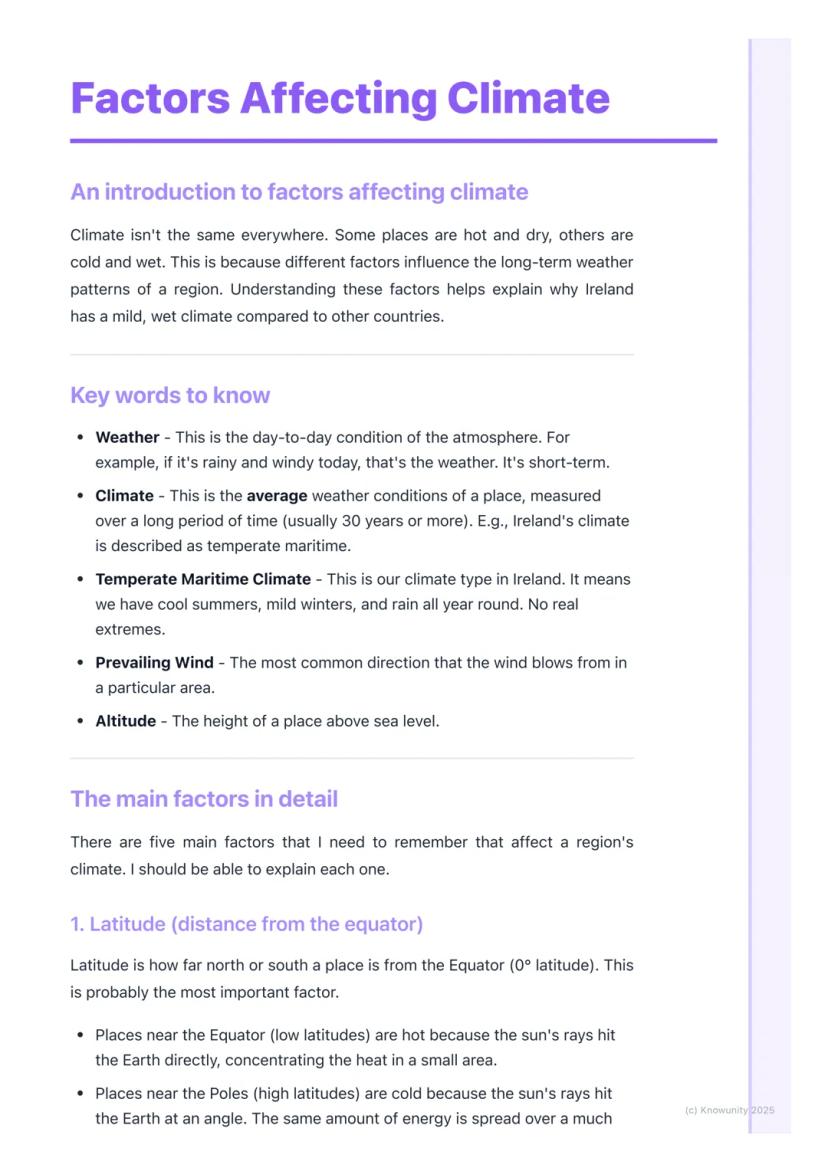
Key Factors That Influence Climate
1 / 5
1
of 5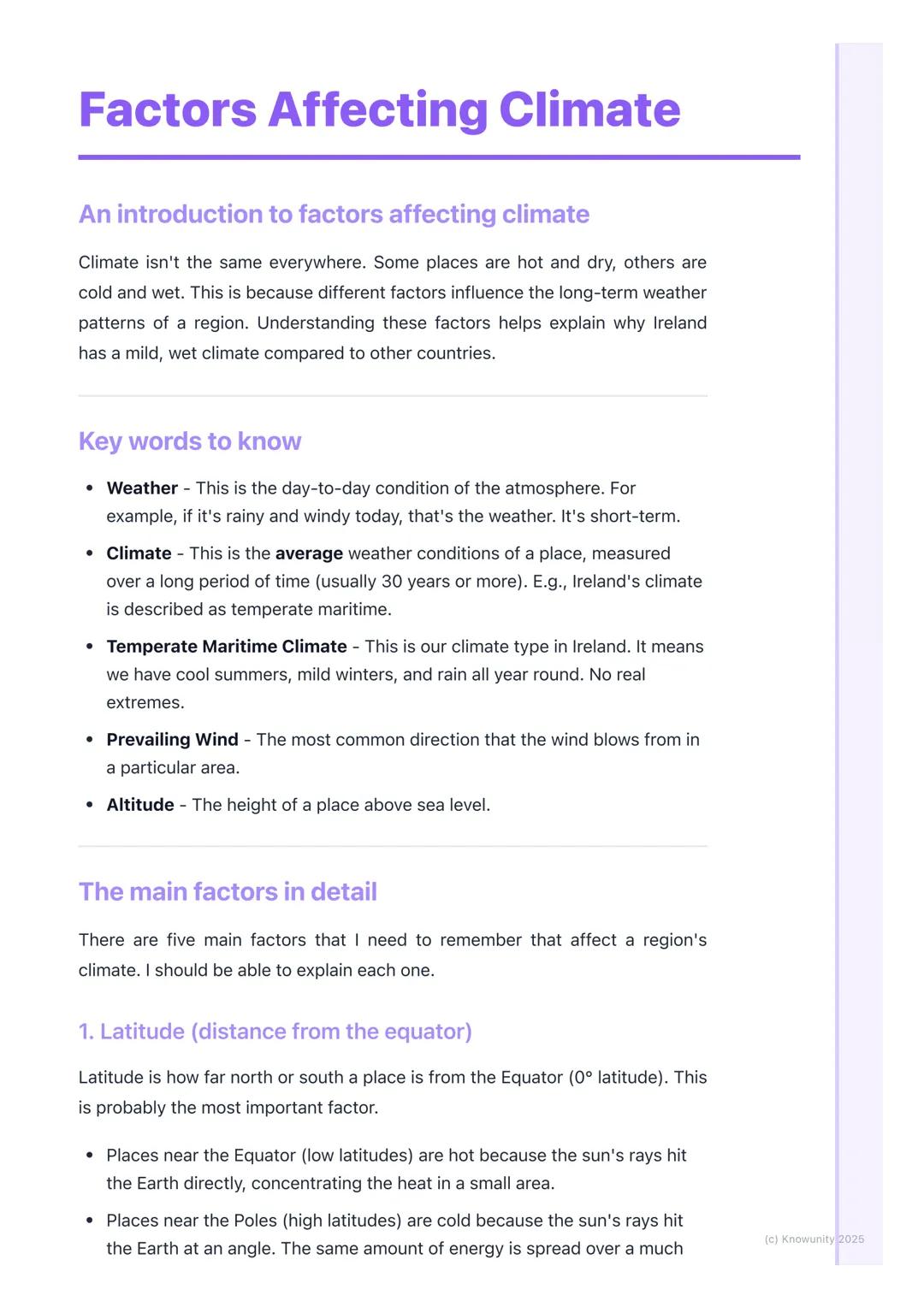
Understanding Climate vs Weather
You've probably heard people mix up weather and climate loads of times, but they're actually quite different. Weather is what's happening outside your window right now - whether it's lashing rain or surprisingly sunny. Climate, on the other hand, is the average weather patterns over 30 years or more.
Ireland has what we call a temperate maritime climate. This fancy term basically means we get cool summers, mild winters, and rain pretty much all year round - no real extremes either way.
There are five main factors that determine why our climate is the way it is. Each one plays a crucial role, and they all work together to give us our distinctive Irish weather patterns.
Remember: Climate is the long-term average - it's what you expect. Weather is what you actually get on any given day!
2
of 5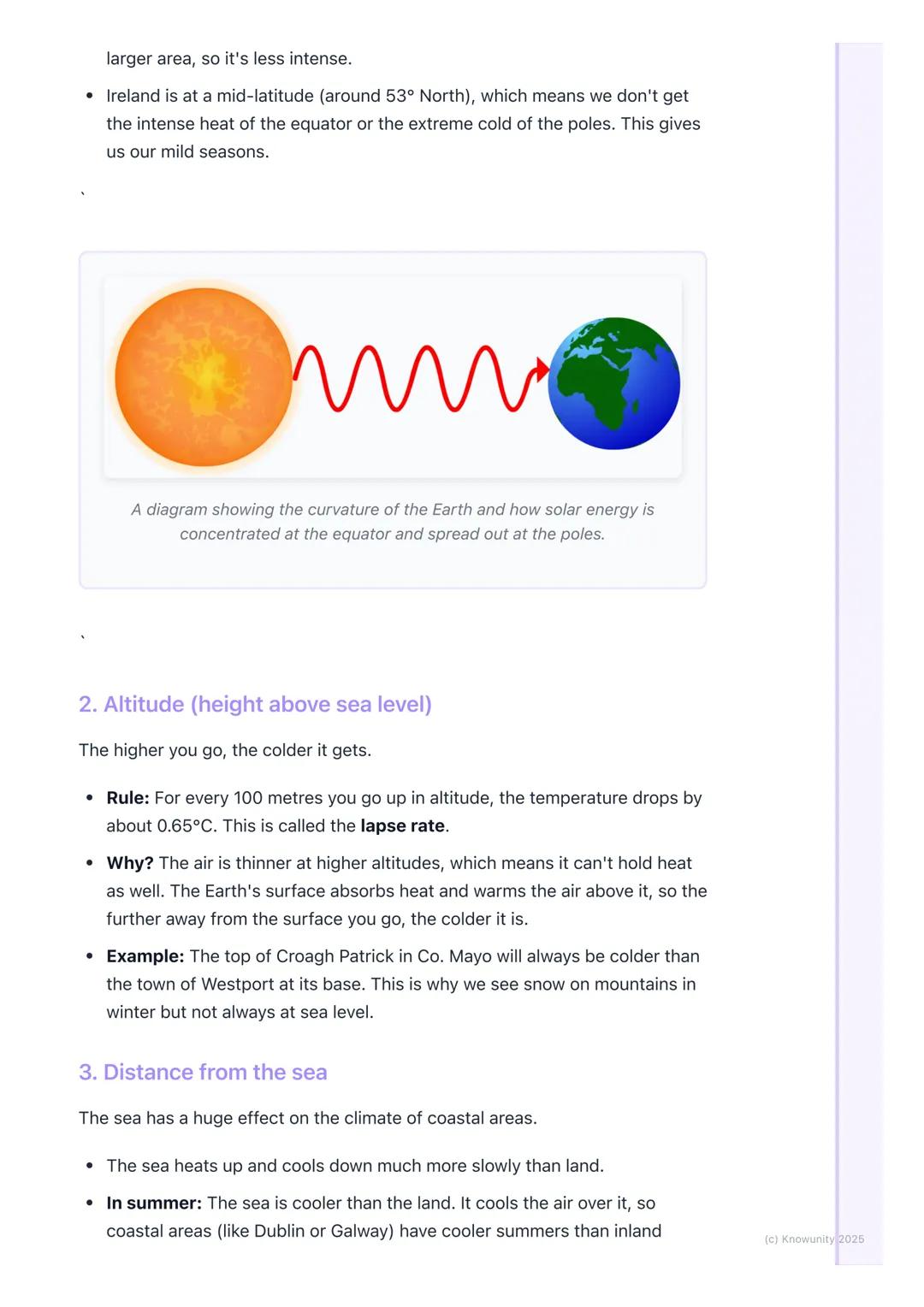
Latitude: Your Distance from the Equator
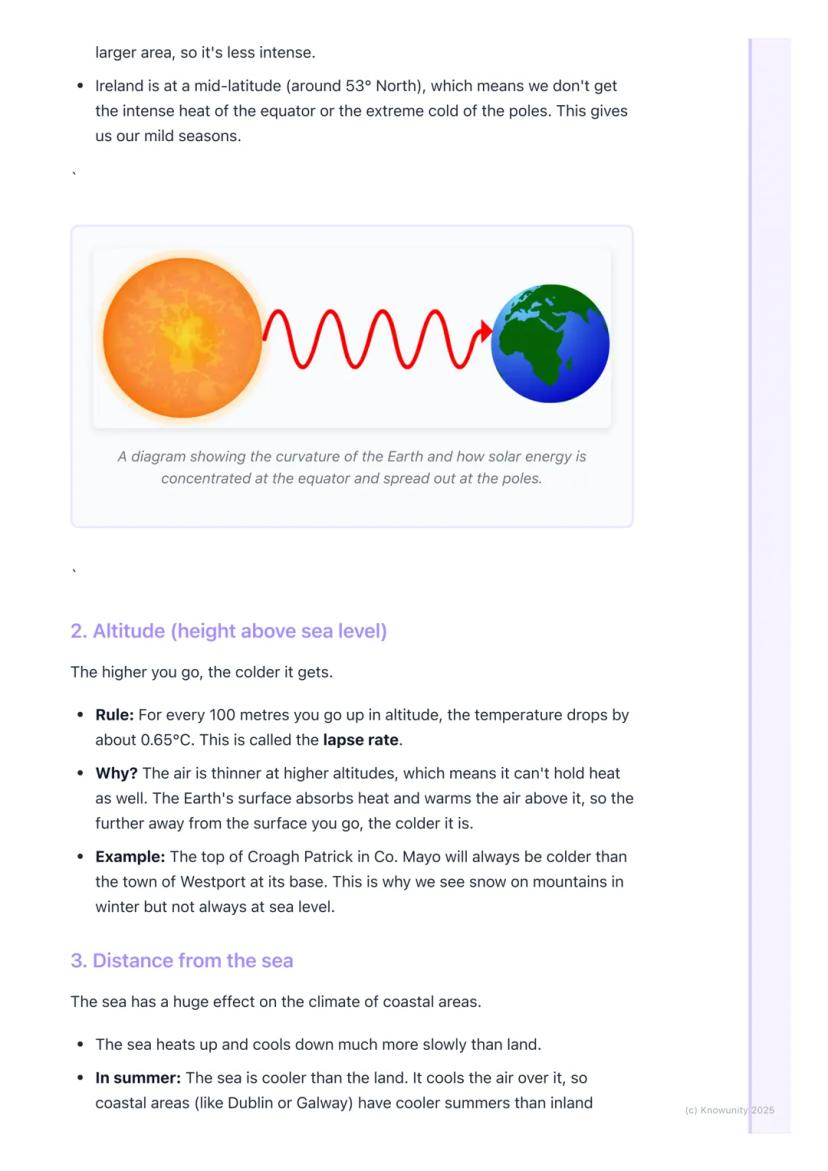
Latitude is probably the most important factor affecting climate, and it's all about how far you are from the equator. Think of it like this: the closer you are to the equator, the more direct sunlight you get.
Places near the equator get the sun's rays hitting them straight on, concentrating all that heat in a small area. Meanwhile, places near the poles get the same amount of energy spread over a much larger area because the Earth is curved.
Ireland sits at about 53° North latitude, which puts us right in the middle - not getting the scorching heat of the equator or the bitter cold of the Arctic. This is why our seasons are generally mild compared to other parts of the world.
Quick Tip: Remember that latitude explains why countries like Spain are warmer than Ireland - they're simply closer to the equator!
3
of 5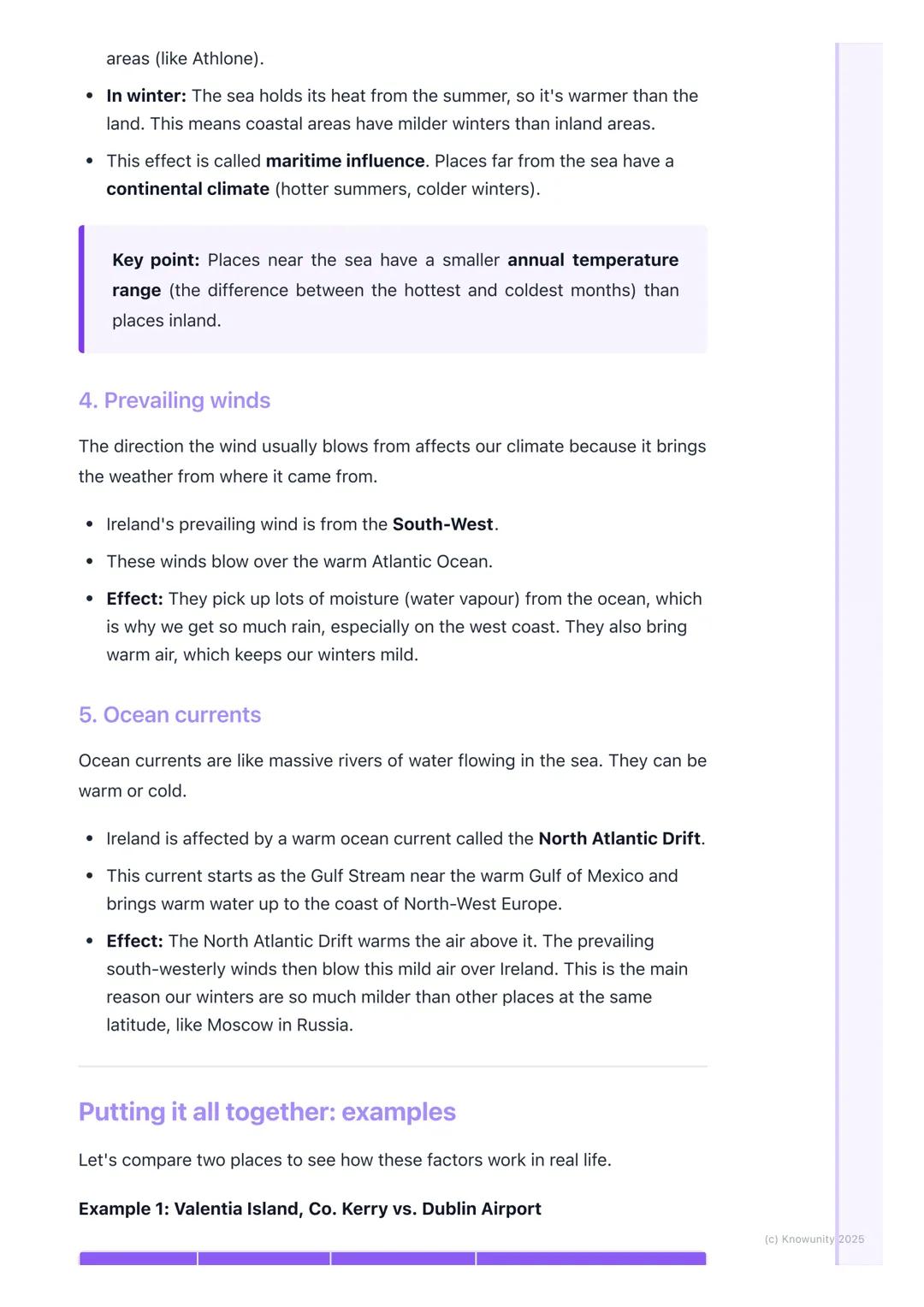
Altitude and Distance from the Sea
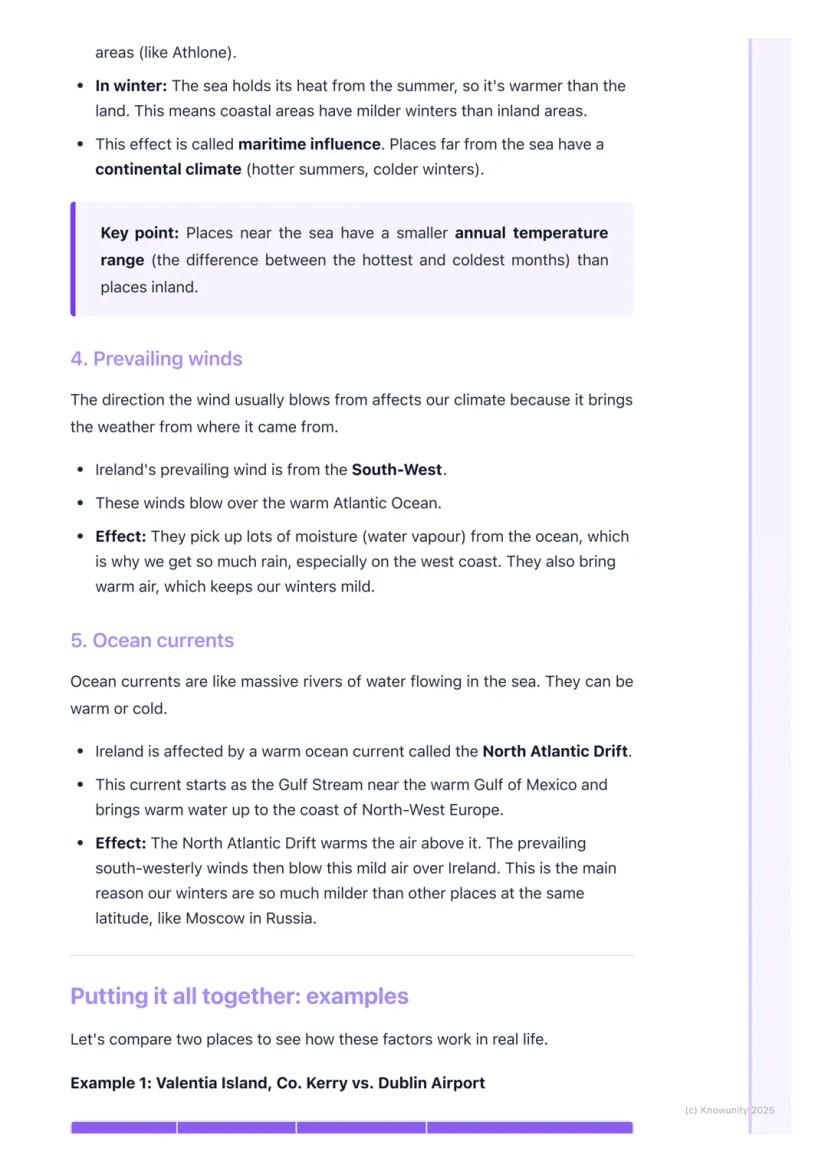
Altitude follows a simple rule that's dead useful to remember: for every 100 metres you climb, the temperature drops by about 0.65°C. This happens because the air gets thinner as you go higher, and thin air can't hold heat as well.
That's why the top of Croagh Patrick is always colder than Westport town below it. The Earth's surface absorbs heat and warms the air directly above it, so the further you get from the surface, the chillier it becomes.
Distance from the sea is massive for Ireland's climate. The sea heats up and cools down much more slowly than land, which creates what we call maritime influence. In summer, the sea keeps coastal areas like Dublin cooler than inland spots like Athlone. In winter, it's the opposite - the sea holds onto its summer warmth and keeps coastal areas milder.
Key Point: Places near the sea have smaller temperature ranges between their hottest and coldest months than inland areas.
4
of 5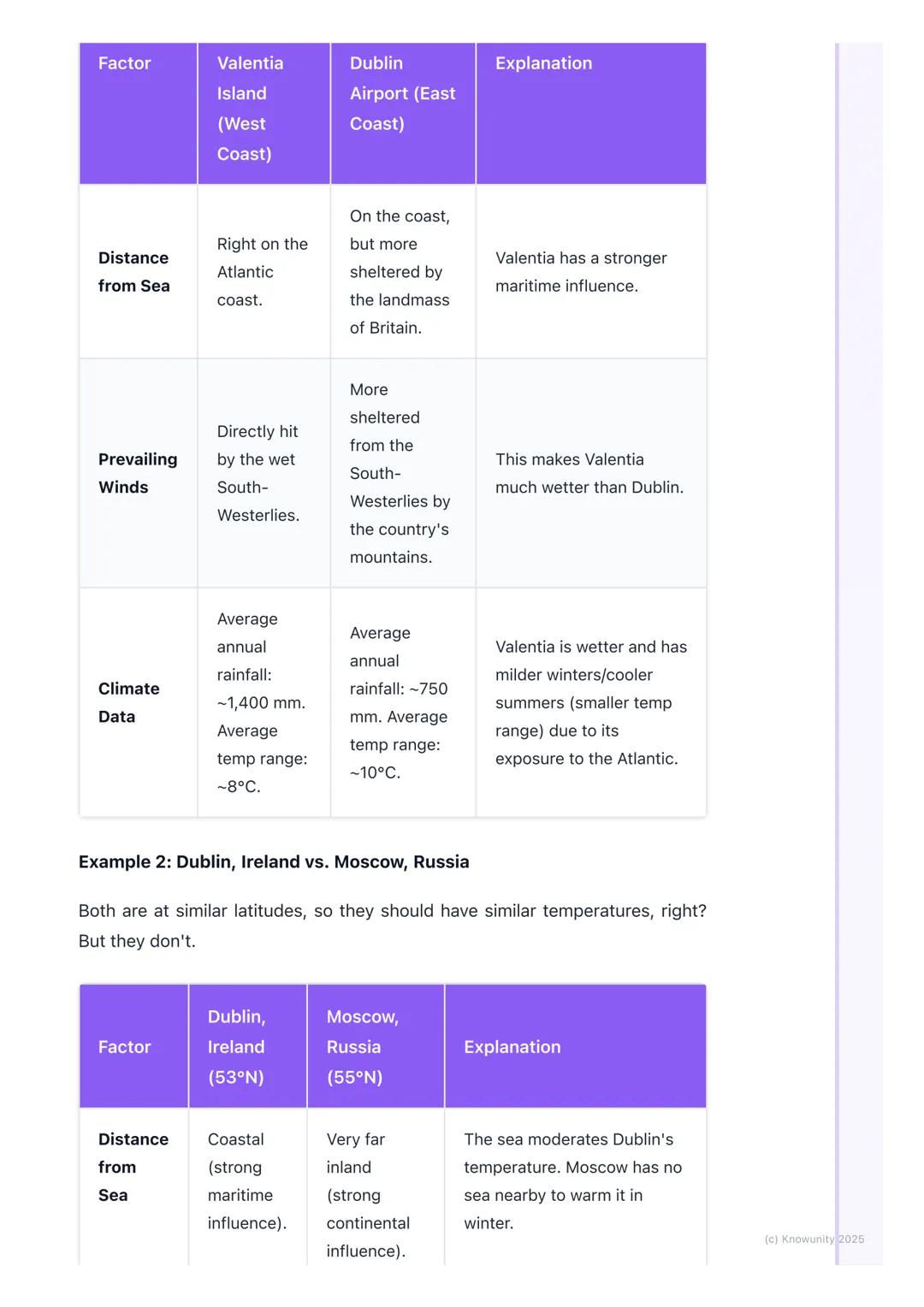
Prevailing Winds and Ocean Currents
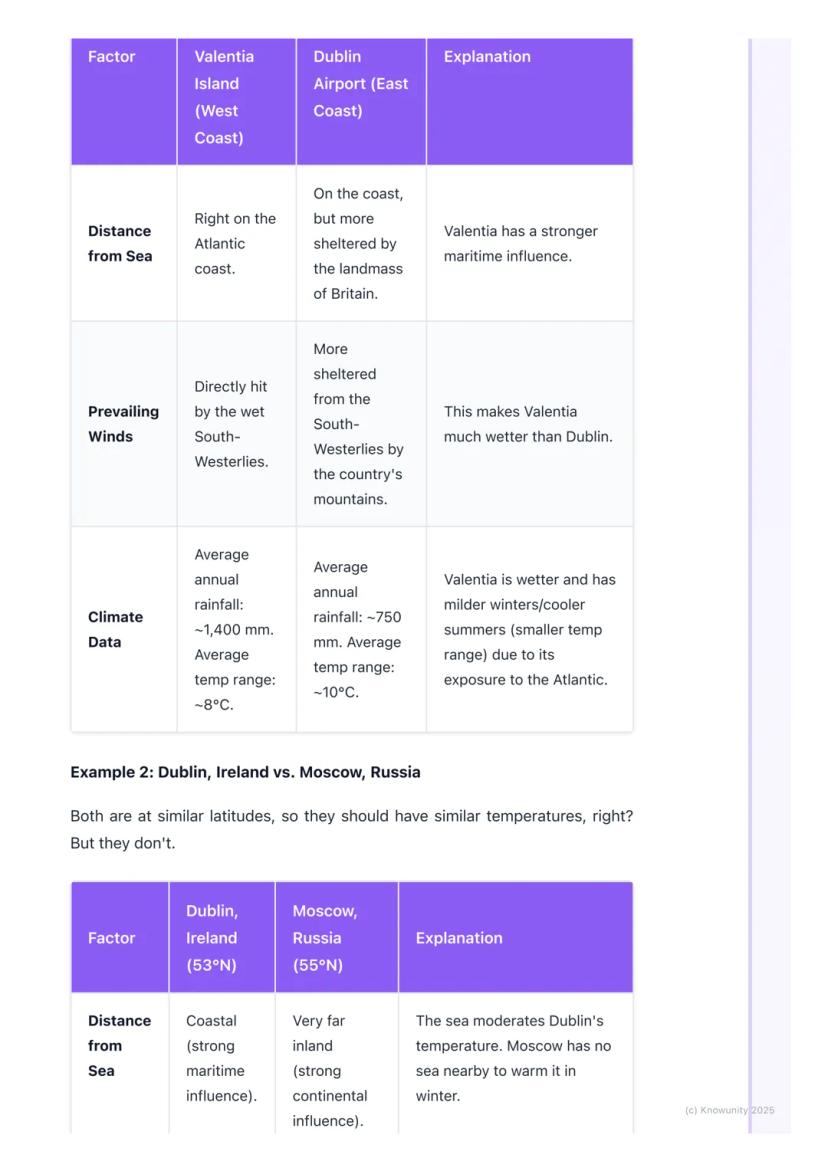
Ireland's prevailing winds blow from the south-west, and they're absolutely crucial to our climate. These winds travel over the warm Atlantic Ocean before reaching us, picking up loads of moisture along the way - which explains why we get so much rain, especially on the west coast!
The North Atlantic Drift is like a massive river of warm water flowing through the ocean. It starts as the Gulf Stream near Mexico and brings warm water right up to our shores. This warm current heats the air above it, and then our south-westerly winds blow that mild air over Ireland.
This is the main reason our winters are so much milder than places like Moscow in Russia, even though we're at similar distances from the equator. Without the North Atlantic Drift, Irish winters would be absolutely freezing!
Exam Tip: Always use the full name "North Atlantic Drift" - it's a key term that examiners love to see!
5
of 5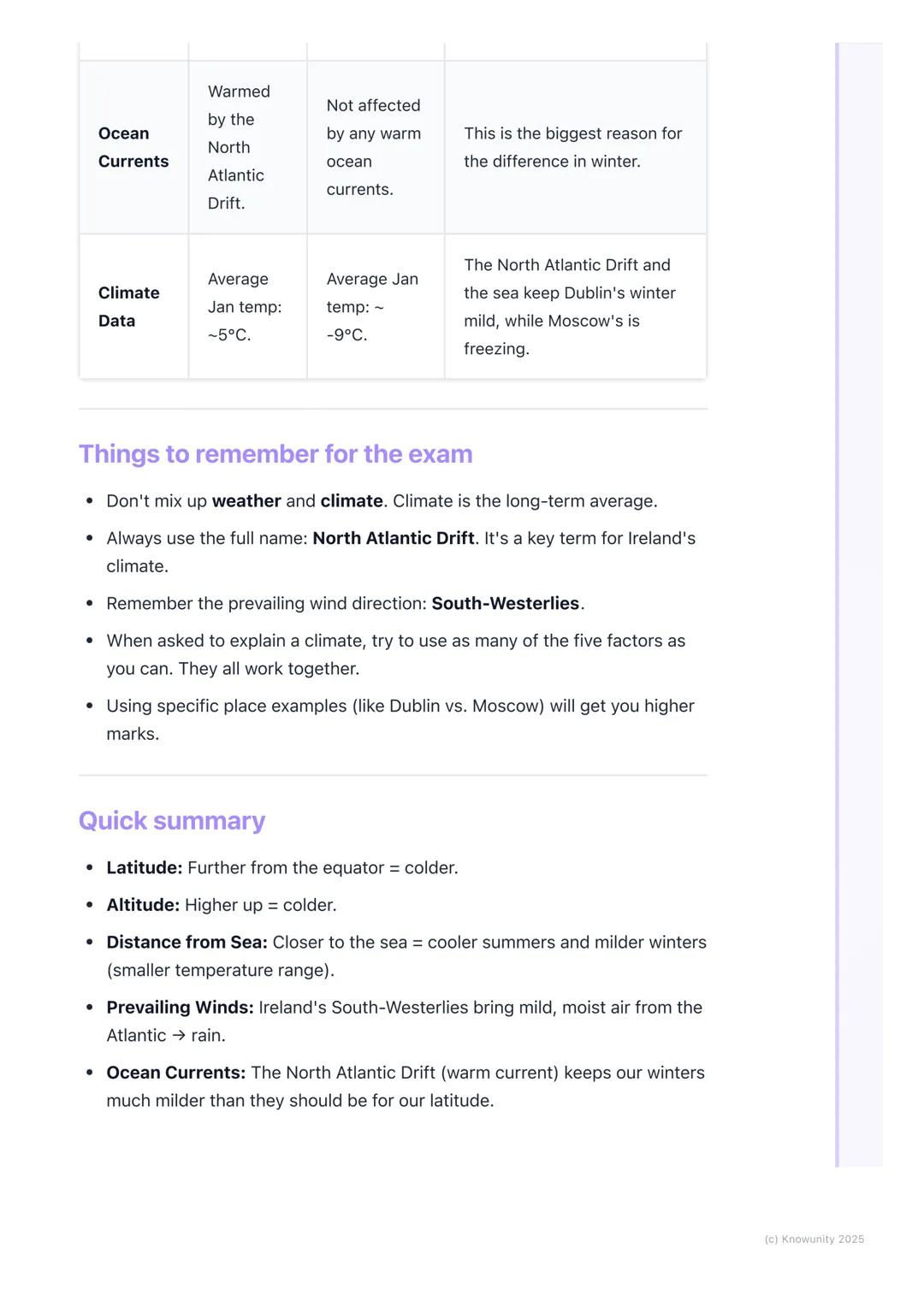
Real-World Examples and Exam Success
Let's look at how these factors work together in real life. Valentia Island in Kerry gets about 1,400mm of rain annually because it's directly hit by those wet south-westerly winds. Compare that to Dublin Airport, which only gets about 750mm because it's more sheltered by Ireland's mountains.
Even more dramatic is comparing Dublin to Moscow. Both cities are at roughly the same latitude, but Dublin's average January temperature is around 5°C while Moscow's is -9°C. The difference? Dublin benefits from maritime influence and the North Atlantic Drift, while Moscow is stuck inland with no warm ocean currents nearby.
For your exams, remember these key points: don't mix up weather and climate, always mention Ireland's south-westerly prevailing winds, and use specific examples like Dublin vs Moscow to show you really understand how these factors work together.
Success Strategy: Try to mention as many of the five factors as possible when explaining any climate - they all interact with each other!
Pensamos que nunca lo preguntarías...
¿Qué es Knowunity AI companion?
Nuestro compañero de IA está específicamente adaptado a las necesidades de los estudiantes. Basándonos en los millones de contenidos que tenemos en la plataforma, podemos dar a los estudiantes respuestas realmente significativas y relevantes. Pero no se trata solo de respuestas, el compañero también guía a los estudiantes a través de sus retos de aprendizaje diarios, con planes de aprendizaje personalizados, cuestionarios o contenidos en el chat y una personalización del 100% basada en las habilidades y el desarrollo de los estudiantes.
¿Dónde puedo descargar la app Knowunity?
Puedes descargar la app en Google Play Store y Apple App Store.
¿Knowunity es totalmente gratuito?
Sí, tienes acceso gratuito a los contenidos de la aplicación y a nuestro compañero de IA. Para desbloquear determinadas funciones de la aplicación, puedes adquirir Knowunity Pro.
Contenidos más populares de Geography
9GeographyGeography notes on rocks
Includes types of rocks,uses of rocks, case studies
1st Year341
GeographyEarthquakes revision notes
Notes on earthquakes with diagrams
1st Year110
GeographyPopulation Change and Migration
This covers factors that cause populations to grow or shrink, including birth rates, death rates, and the reasons people migrate.
2nd Year90
GeographyRock notes geography
Geography
5th Year250
GeographyThe sea
Jc Geography
1st Year230
GeographyGeography notes On the sea
Includes costal erosion, sea cliffs, longshore drift etc.
1st Year160
GeographyInside the Earth
Students will learn about the basic layers of the Earth: the crust, mantle, and core, understanding that our planet is made up of different parts.
1st Year51
GeographyGeography notes on glaciation
Includes diagrams, erosion, deposition, transportation
1st Year210
GeographyGeography notes on weather
Includes instruments, diagrams, how to read weather
1st Year120
Contenidos más populares
9 Irish
IrishIrish oral questions and answers
Questions and answers for the leaving cert oral
5th Year4264
 English
Key Quotes : Sive
Key Quotes and explanations: Sive
6th Year2842
IrishIrish oral questions
Outline of oral questions
5th Year2055
IrishIníon- le hÁine Durkin
Aine Durkin’s poem, Iníon: Themes & summary
5th Year850
IrishIrish poetry 2027
Iníon + Dínit an Bhróin
5th Year1133
IrishLC HL notes- Iníon (poem)
Includes poem in English and Irish, theme, key words & phrases
5th Year2284
EnglishCultural Context : Shawshank Redemption : Sive : Small Things Like These
Comparative Study : Cultural Context : Shawshank Redemption, Sive and Small Things Like These
6th Year1430
IrishMo Ghrá-sa (Idir Lúibíní)
Notes on mo ghrá-sa
5th Year380
IrishAn Gaeilge Aiste
Irish Language essay
6th Year1320
¿No encuentras lo que buscas? Explora otros temas.
Mira lo que dicen nuestros usuarios. Les encanta - y a tí también.
4.6/5App Store
4.7/5Google Play
La app es muy fácil de usar y está muy bien diseñada. Hasta ahora he encontrado todo lo que estaba buscando y he podido aprender mucho de las presentaciones. Definitivamente utilizaré la aplicación para un examen de clase. Y, por supuesto, también me sirve mucho de inspiración.
Pablousuario de iOS
Esta app es realmente genial. Hay tantos apuntes de clase y ayuda [...]. Tengo problemas con matemáticas, por ejemplo, y la aplicación tiene muchas opciones de ayuda. Gracias a Knowunity, he mejorado en mates. Se la recomiendo a todo el mundo.
Elenausuaria de Android
Vaya, estoy realmente sorprendida. Acabo de probar la app porque la he visto anunciada muchas veces y me he quedado absolutamente alucinada. Esta app es LA AYUDA que quieres para el insti y, sobre todo, ofrece muchísimas cosas, como ejercicios y hojas informativas, que a mí personalmente me han sido MUY útiles.
Anausuaria de iOS
Geography26 visualizaciones·Actualizado Jun 13, 2026·5 páginasKey Factors That Influence Climate
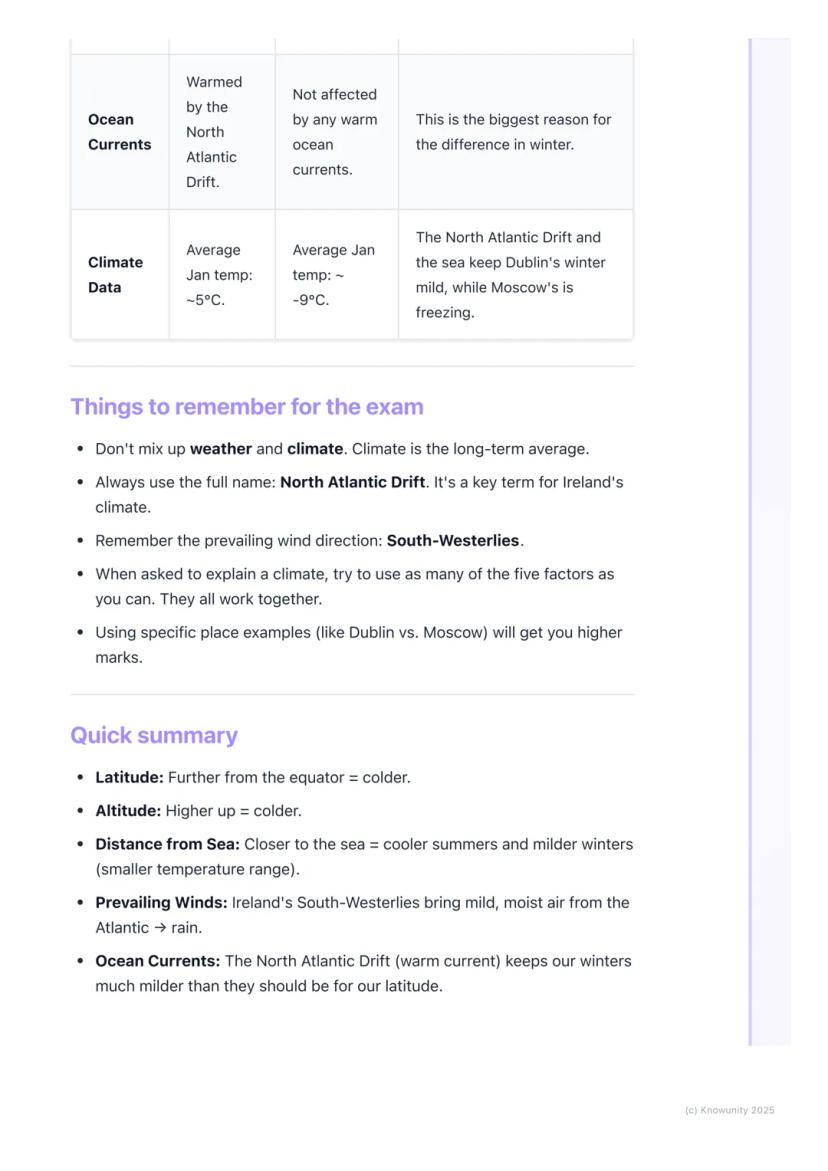
Ever wonder why Ireland's weather is so different from other countries at similar distances from the equator? Five key factors work together to create our famously mild, wet climate - and understanding them will help you ace your geography exams!
1
of 5
Inscríbete para ver los apuntes. ¡Es gratis!
- Acceso a todos los documentos
- Mejora tus notas
- Únete a millones de estudiantes
Understanding Climate vs Weather
You've probably heard people mix up weather and climate loads of times, but they're actually quite different. Weather is what's happening outside your window right now - whether it's lashing rain or surprisingly sunny. Climate, on the other hand, is the average weather patterns over 30 years or more.
Ireland has what we call a temperate maritime climate. This fancy term basically means we get cool summers, mild winters, and rain pretty much all year round - no real extremes either way.
There are five main factors that determine why our climate is the way it is. Each one plays a crucial role, and they all work together to give us our distinctive Irish weather patterns.
Remember: Climate is the long-term average - it's what you expect. Weather is what you actually get on any given day!
2
of 5Inscríbete para ver los apuntes. ¡Es gratis!
- Acceso a todos los documentos
- Mejora tus notas
- Únete a millones de estudiantes
Latitude: Your Distance from the Equator
Latitude is probably the most important factor affecting climate, and it's all about how far you are from the equator. Think of it like this: the closer you are to the equator, the more direct sunlight you get.
Places near the equator get the sun's rays hitting them straight on, concentrating all that heat in a small area. Meanwhile, places near the poles get the same amount of energy spread over a much larger area because the Earth is curved.
Ireland sits at about 53° North latitude, which puts us right in the middle - not getting the scorching heat of the equator or the bitter cold of the Arctic. This is why our seasons are generally mild compared to other parts of the world.
Quick Tip: Remember that latitude explains why countries like Spain are warmer than Ireland - they're simply closer to the equator!
3
of 5Inscríbete para ver los apuntes. ¡Es gratis!
- Acceso a todos los documentos
- Mejora tus notas
- Únete a millones de estudiantes
Altitude and Distance from the Sea
Altitude follows a simple rule that's dead useful to remember: for every 100 metres you climb, the temperature drops by about 0.65°C. This happens because the air gets thinner as you go higher, and thin air can't hold heat as well.
That's why the top of Croagh Patrick is always colder than Westport town below it. The Earth's surface absorbs heat and warms the air directly above it, so the further you get from the surface, the chillier it becomes.
Distance from the sea is massive for Ireland's climate. The sea heats up and cools down much more slowly than land, which creates what we call maritime influence. In summer, the sea keeps coastal areas like Dublin cooler than inland spots like Athlone. In winter, it's the opposite - the sea holds onto its summer warmth and keeps coastal areas milder.
Key Point: Places near the sea have smaller temperature ranges between their hottest and coldest months than inland areas.
4
of 5Inscríbete para ver los apuntes. ¡Es gratis!
- Acceso a todos los documentos
- Mejora tus notas
- Únete a millones de estudiantes
Prevailing Winds and Ocean Currents
Ireland's prevailing winds blow from the south-west, and they're absolutely crucial to our climate. These winds travel over the warm Atlantic Ocean before reaching us, picking up loads of moisture along the way - which explains why we get so much rain, especially on the west coast!
The North Atlantic Drift is like a massive river of warm water flowing through the ocean. It starts as the Gulf Stream near Mexico and brings warm water right up to our shores. This warm current heats the air above it, and then our south-westerly winds blow that mild air over Ireland.
This is the main reason our winters are so much milder than places like Moscow in Russia, even though we're at similar distances from the equator. Without the North Atlantic Drift, Irish winters would be absolutely freezing!
Exam Tip: Always use the full name "North Atlantic Drift" - it's a key term that examiners love to see!
5
of 5Inscríbete para ver los apuntes. ¡Es gratis!
- Acceso a todos los documentos
- Mejora tus notas
- Únete a millones de estudiantes
Real-World Examples and Exam Success
Let's look at how these factors work together in real life. Valentia Island in Kerry gets about 1,400mm of rain annually because it's directly hit by those wet south-westerly winds. Compare that to Dublin Airport, which only gets about 750mm because it's more sheltered by Ireland's mountains.
Even more dramatic is comparing Dublin to Moscow. Both cities are at roughly the same latitude, but Dublin's average January temperature is around 5°C while Moscow's is -9°C. The difference? Dublin benefits from maritime influence and the North Atlantic Drift, while Moscow is stuck inland with no warm ocean currents nearby.
For your exams, remember these key points: don't mix up weather and climate, always mention Ireland's south-westerly prevailing winds, and use specific examples like Dublin vs Moscow to show you really understand how these factors work together.
Success Strategy: Try to mention as many of the five factors as possible when explaining any climate - they all interact with each other!
Pensamos que nunca lo preguntarías...
¿Qué es Knowunity AI companion?
Nuestro compañero de IA está específicamente adaptado a las necesidades de los estudiantes. Basándonos en los millones de contenidos que tenemos en la plataforma, podemos dar a los estudiantes respuestas realmente significativas y relevantes. Pero no se trata solo de respuestas, el compañero también guía a los estudiantes a través de sus retos de aprendizaje diarios, con planes de aprendizaje personalizados, cuestionarios o contenidos en el chat y una personalización del 100% basada en las habilidades y el desarrollo de los estudiantes.
¿Dónde puedo descargar la app Knowunity?
Puedes descargar la app en Google Play Store y Apple App Store.
¿Knowunity es totalmente gratuito?
Sí, tienes acceso gratuito a los contenidos de la aplicación y a nuestro compañero de IA. Para desbloquear determinadas funciones de la aplicación, puedes adquirir Knowunity Pro.
Contenidos más populares de Geography
9GeographyGeography notes on rocks
Includes types of rocks,uses of rocks, case studies
1st Year341
GeographyEarthquakes revision notes
Notes on earthquakes with diagrams
1st Year110
GeographyPopulation Change and Migration
This covers factors that cause populations to grow or shrink, including birth rates, death rates, and the reasons people migrate.
2nd Year90
GeographyRock notes geography
Geography
5th Year250
GeographyThe sea
Jc Geography
1st Year230
GeographyGeography notes On the sea
Includes costal erosion, sea cliffs, longshore drift etc.
1st Year160
GeographyInside the Earth
Students will learn about the basic layers of the Earth: the crust, mantle, and core, understanding that our planet is made up of different parts.
1st Year51
GeographyGeography notes on glaciation
Includes diagrams, erosion, deposition, transportation
1st Year210
GeographyGeography notes on weather
Includes instruments, diagrams, how to read weather
1st Year120
Contenidos más populares
9IrishIrish oral questions and answers
Questions and answers for the leaving cert oral
5th Year4264
EnglishKey Quotes : Sive
Key Quotes and explanations: Sive
6th Year2842
IrishIrish oral questions
Outline of oral questions
5th Year2055
IrishIníon- le hÁine Durkin
Aine Durkin’s poem, Iníon: Themes & summary
5th Year850
IrishIrish poetry 2027
Iníon + Dínit an Bhróin
5th Year1133
IrishLC HL notes- Iníon (poem)
Includes poem in English and Irish, theme, key words & phrases
5th Year2284
EnglishCultural Context : Shawshank Redemption : Sive : Small Things Like These
Comparative Study : Cultural Context : Shawshank Redemption, Sive and Small Things Like These
6th Year1430
IrishMo Ghrá-sa (Idir Lúibíní)
Notes on mo ghrá-sa
5th Year380
IrishAn Gaeilge Aiste
Irish Language essay
6th Year1320
¿No encuentras lo que buscas? Explora otros temas.
Mira lo que dicen nuestros usuarios. Les encanta - y a tí también.
4.6/5App Store
4.7/5Google Play
La app es muy fácil de usar y está muy bien diseñada. Hasta ahora he encontrado todo lo que estaba buscando y he podido aprender mucho de las presentaciones. Definitivamente utilizaré la aplicación para un examen de clase. Y, por supuesto, también me sirve mucho de inspiración.
Pablousuario de iOS
Esta app es realmente genial. Hay tantos apuntes de clase y ayuda [...]. Tengo problemas con matemáticas, por ejemplo, y la aplicación tiene muchas opciones de ayuda. Gracias a Knowunity, he mejorado en mates. Se la recomiendo a todo el mundo.
Elenausuaria de Android
Vaya, estoy realmente sorprendida. Acabo de probar la app porque la he visto anunciada muchas veces y me he quedado absolutamente alucinada. Esta app es LA AYUDA que quieres para el insti y, sobre todo, ofrece muchísimas cosas, como ejercicios y hojas informativas, que a mí personalmente me han sido MUY útiles.
Anausuaria de iOS