
Ever wondered why some texts feel chatty while others sound...
 English3 visualizaciones·Actualizado Jun 4, 2026·6 páginas
Decoding Author's Purpose and Target Audience
1 / 6
1
of 6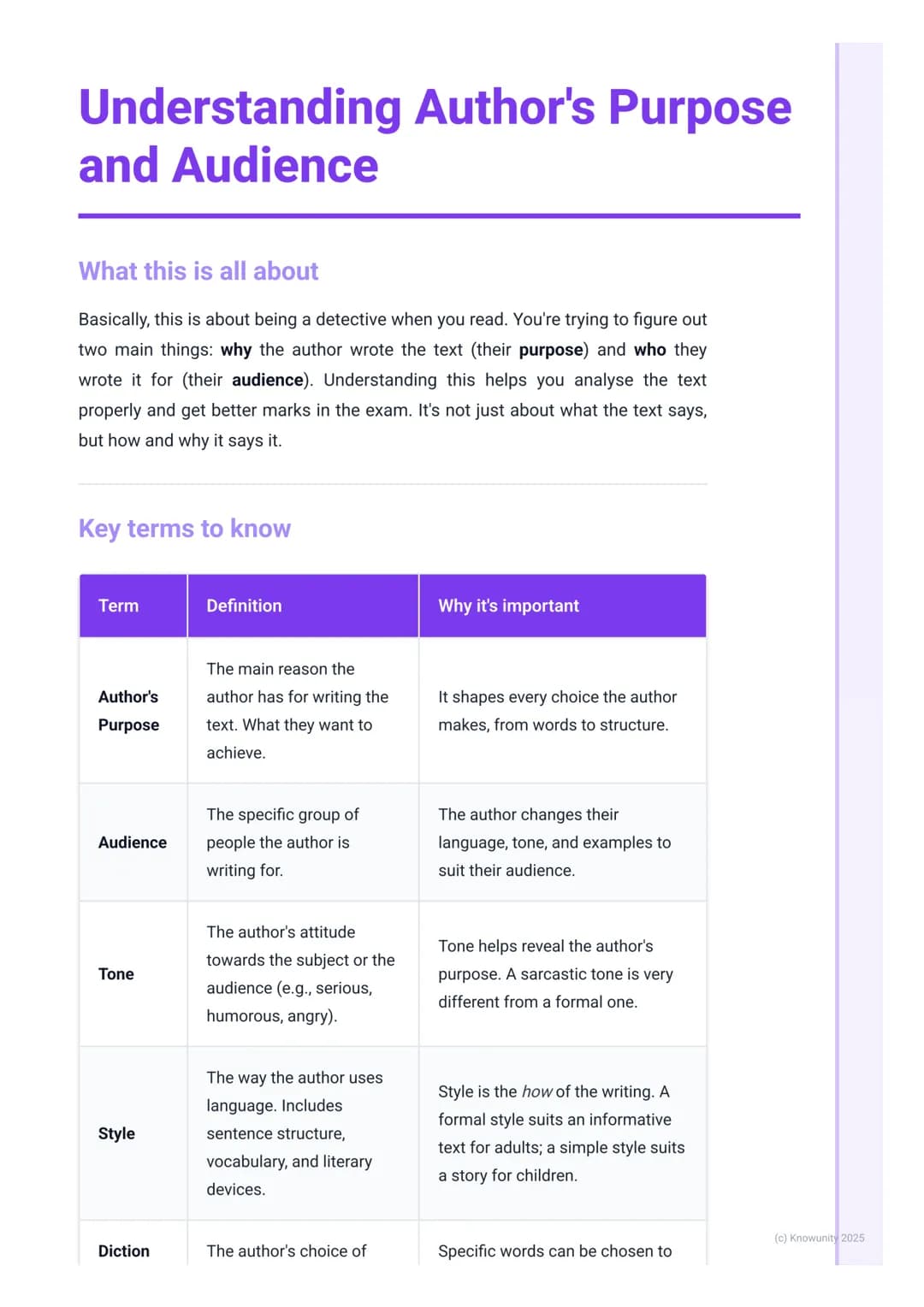
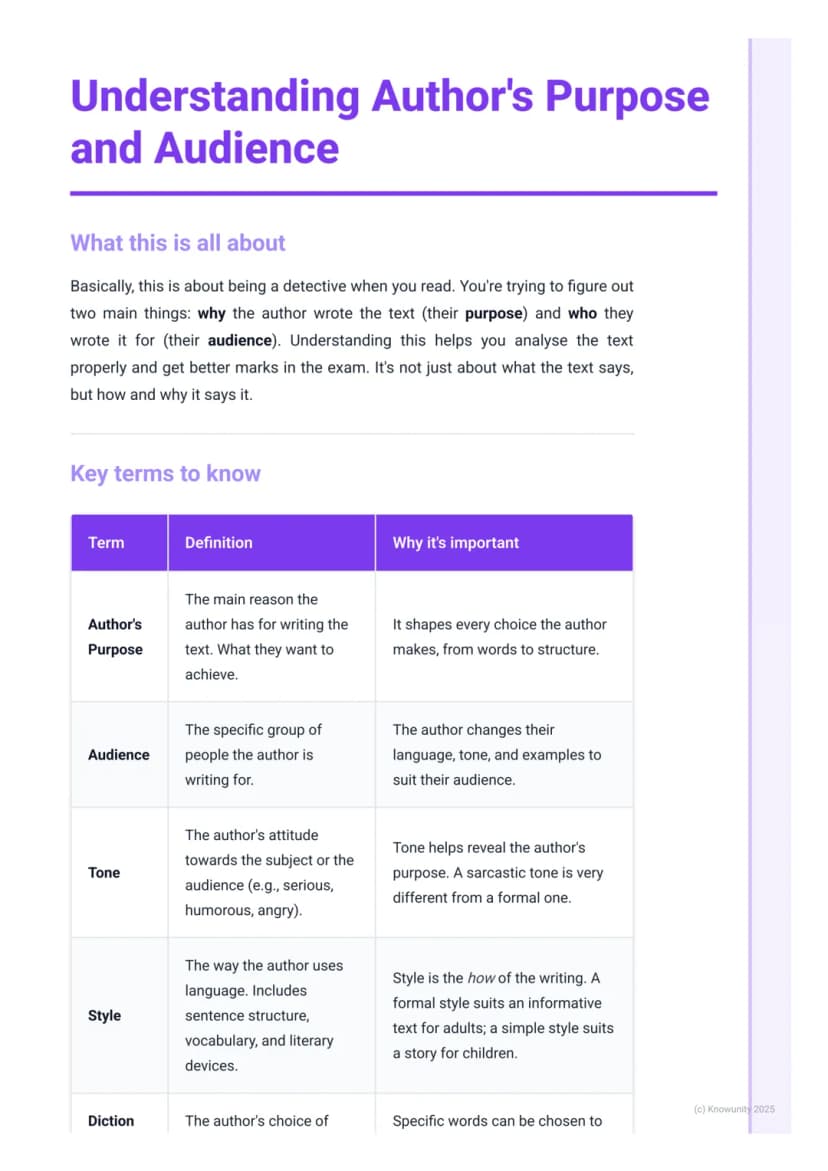
What's This All About?
Think of reading as detective work - you're hunting for two crucial clues. First, you need to work out why the author wrote the text (their purpose), and second, who they wrote it for (their audience). Once you crack this code, everything else falls into place.
Understanding these elements isn't just about getting better exam marks (though it definitely helps!). It's about becoming a smarter reader who can see through the author's techniques and spot when someone's trying to influence you.
The author's purpose shapes every single choice they make - from the words they pick to how they structure their sentences. Meanwhile, the audience determines whether they'll use simple language for kids or technical jargon for experts.
Quick Tip: Always look for evidence in the text to back up your analysis. Examiners love quotes that prove your points!
2
of 6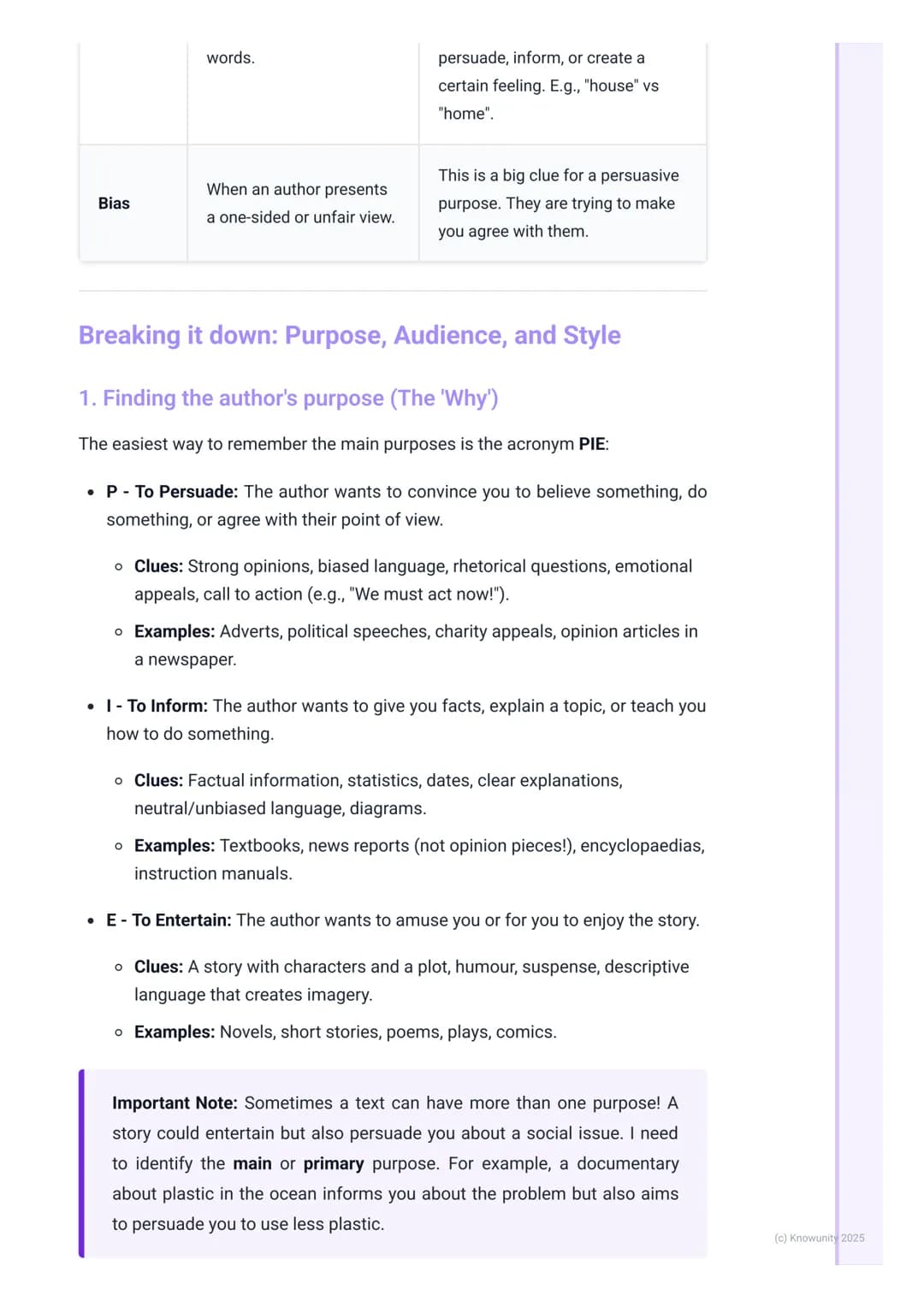
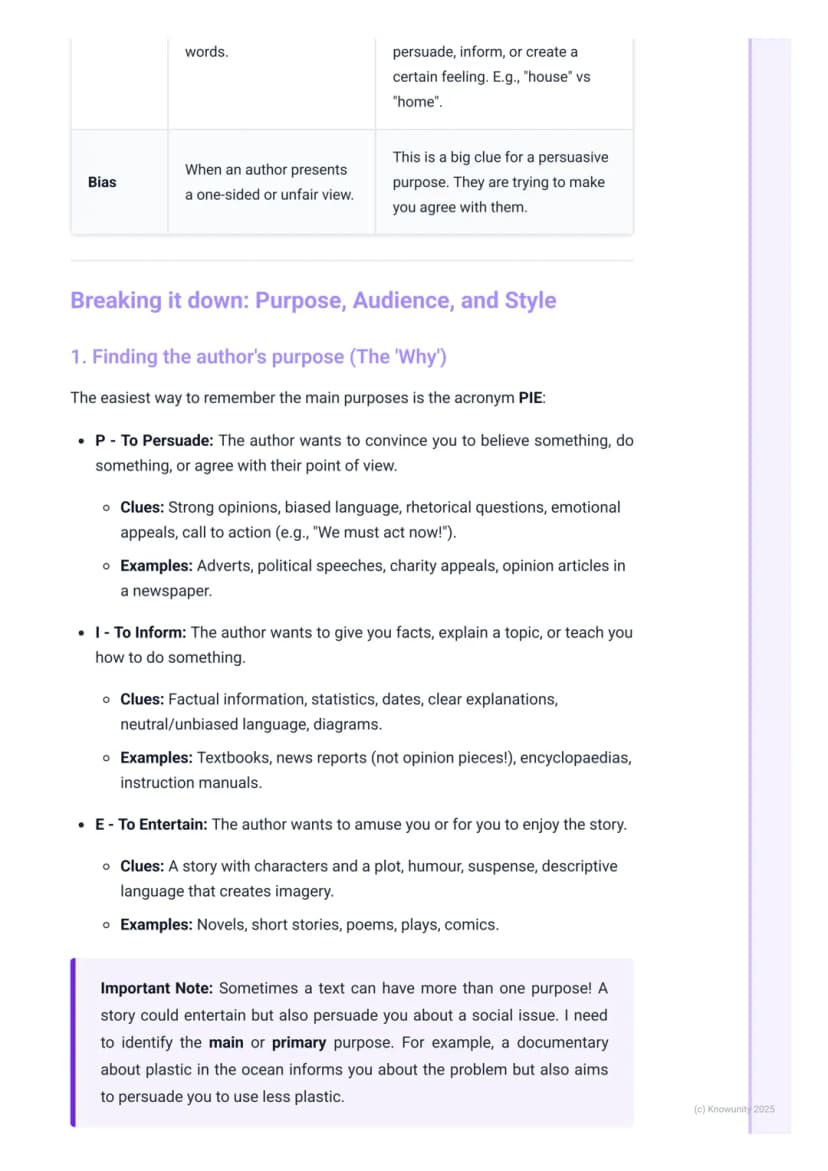
Finding the Author's Purpose - Remember PIE
The easiest way to identify purpose is using PIE - Persuade, Inform, Entertain. Each purpose leaves different fingerprints in the text, so you just need to know what to look for.
Persuade texts want to change your mind or make you do something. Watch out for strong opinions, emotional language, rhetorical questions, and calls to action like "We must act now!" You'll find this in adverts, political speeches, and opinion articles.
Inform texts stick to facts and explanations without trying to sway you. They use neutral language, statistics, dates, and clear explanations. Think textbooks, proper news reports, and instruction manuals.
Entertain texts want you to enjoy the experience. They'll have stories, characters, humour, or descriptive language that creates vivid images. Novels, poems, and comics fit here perfectly.
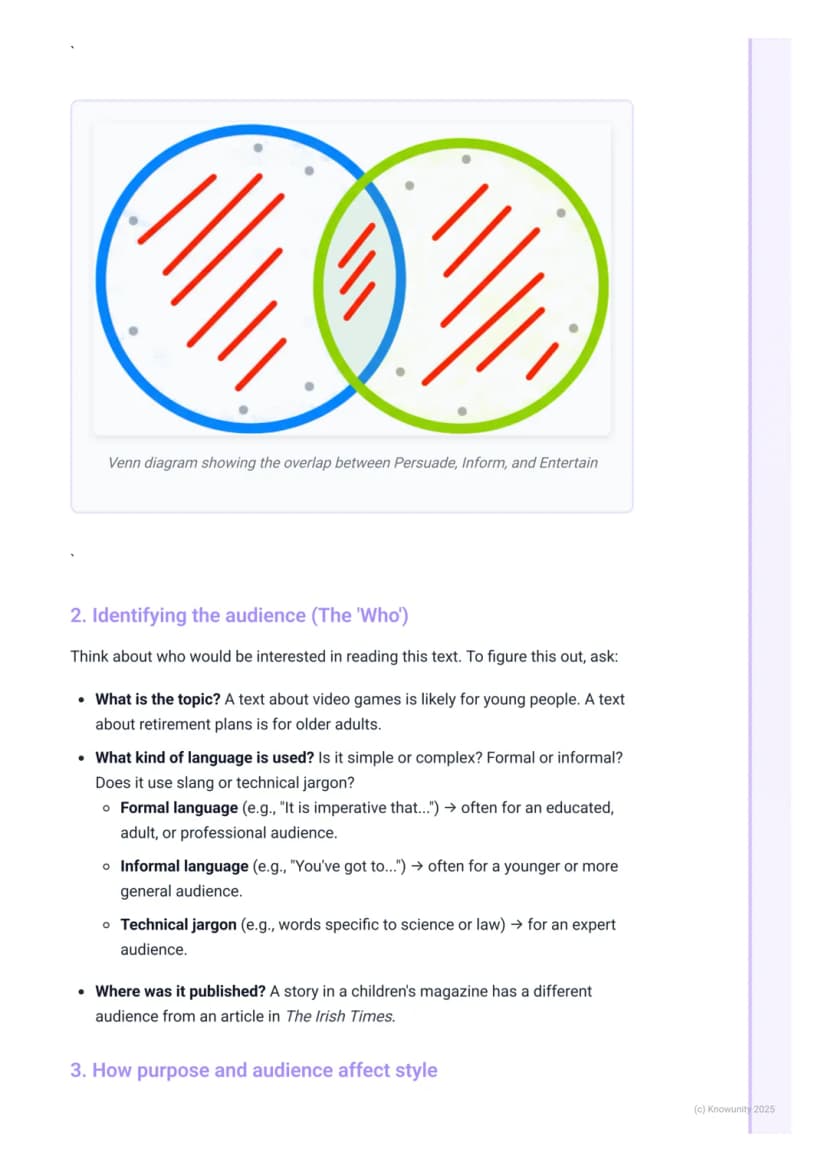
Remember: Some texts mix purposes! A documentary might inform you about climate change but also persuade you to recycle more.
3
of 6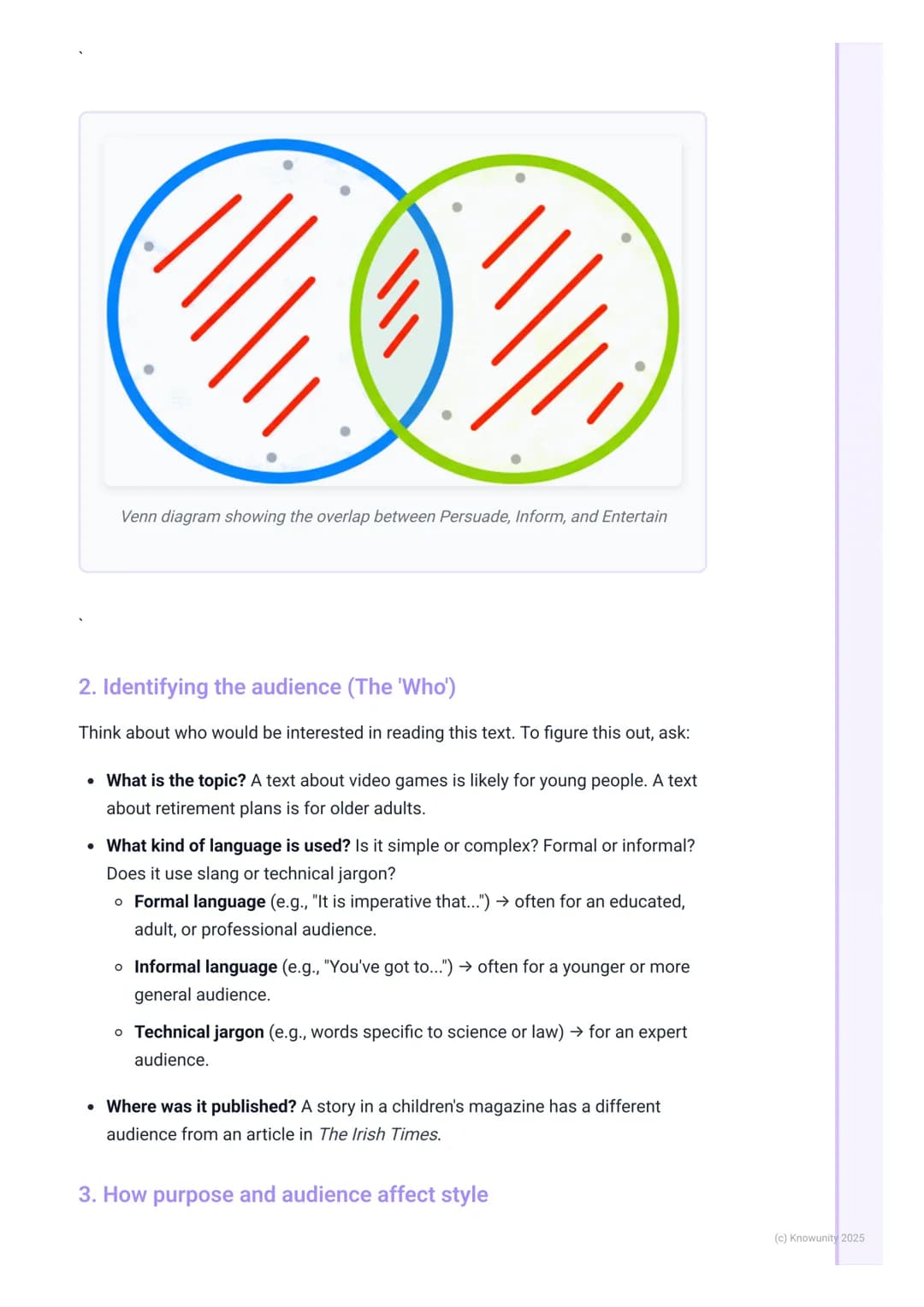
Working Out the Audience
Figuring out the audience is like being a people-watcher - you're looking for clues about who would actually want to read this stuff. The topic gives you the first hint: a text about TikTok trends is probably aimed at teenagers, while retirement planning advice targets older adults.
Language choice tells you loads about the intended audience. Formal language like "It is imperative that..." usually targets educated adults or professionals. Informal chat like "You've got to..." suggests a younger or general audience.
Technical jargon is a dead giveaway for expert audiences. If a text is full of scientific terms or legal language, it's written for people who already know that field.
Don't forget to consider where it was published. A story in a children's magazine has a completely different audience from an article in The Irish Times - the publication choice isn't random!
Pro Tip: The audience and purpose work together like a team - they both influence how the author writes.
4
of 6
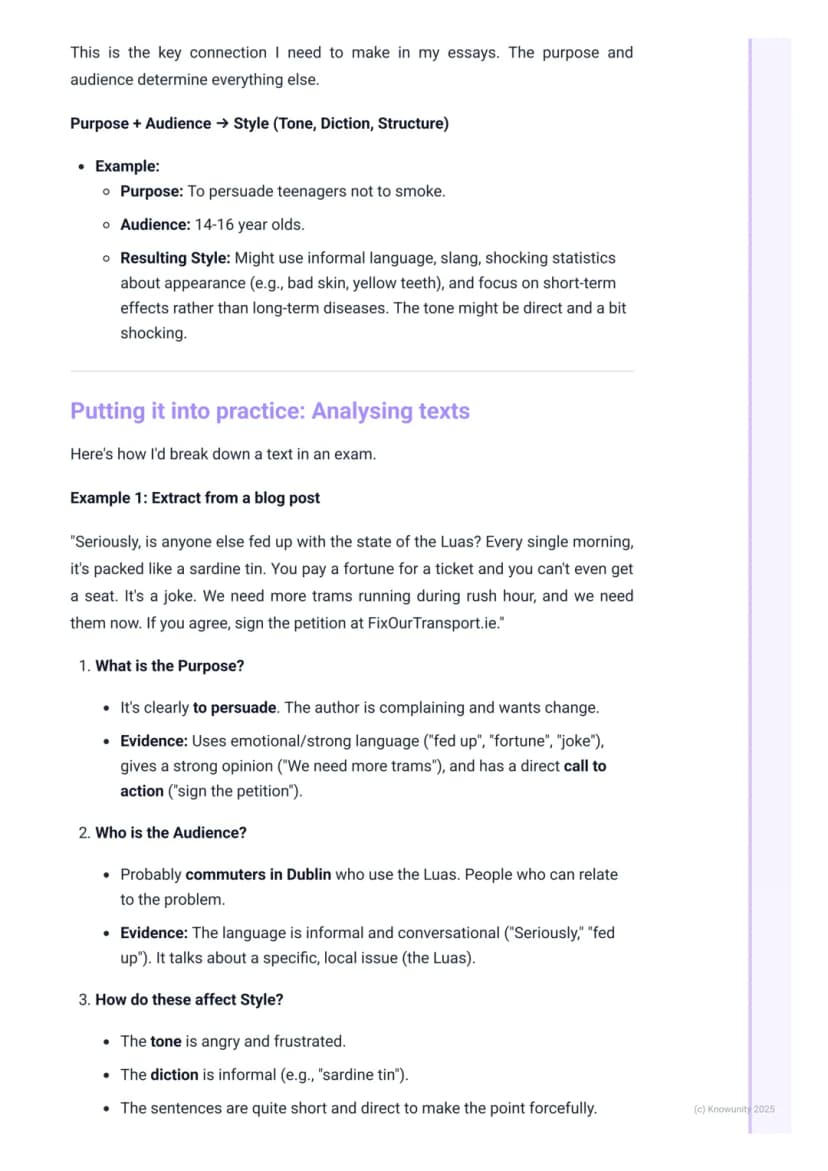
How Purpose and Audience Shape Style
Here's where it gets interesting - purpose plus audience equals style. This connection is what examiners want to see in your essays, so nail this concept and you're golden.
Think about it logically: if you want to persuade teenagers not to smoke, you won't use the same approach as persuading adults. You'd probably use informal language, maybe some slang, and focus on things teens actually care about - like how smoking affects your appearance or social life.
The tone (author's attitude) changes completely depending on these factors. A charity appeal might use an urgent, emotional tone, while a science textbook stays calm and educational.
Word choice gets carefully tailored too. Authors pick specific words to create certain effects - "house" feels neutral, but "home" creates warmth and emotion. Every choice is deliberate when you know your purpose and audience.
Key Point: In exams, always explain how the author's language choices help them achieve their specific purpose for their target audience.
5
of 6
Putting It Into Practice
Let's crack the code on some real examples. Take this blog post: "Seriously, is anyone else fed up with the state of the Luas? Every single morning, it's packed like a sardine tin. We need more trams running during rush hour, and we need them now."
The purpose is clearly persuasive - the author wants change. The evidence? Emotional language like "fed up" and "joke", plus a direct demand for action. The audience is Dublin commuters who'll relate to the problem, shown by the informal tone and local reference.
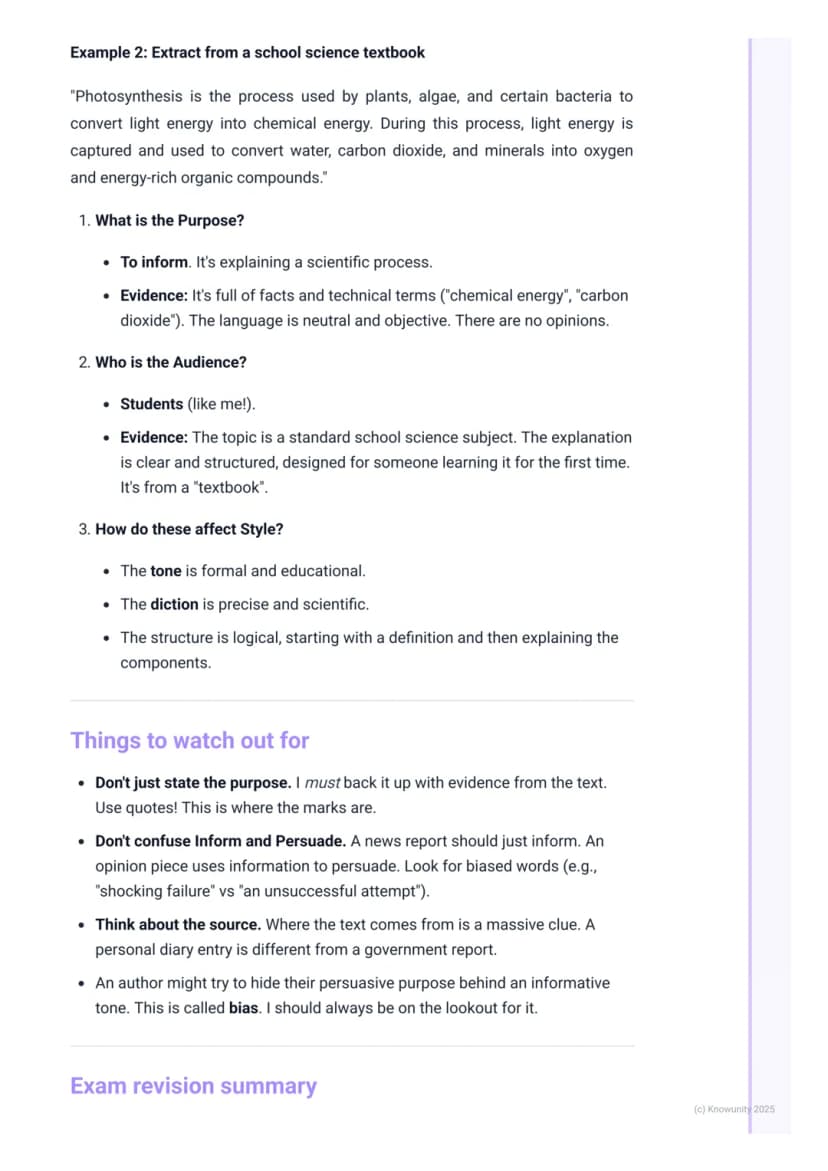
Now compare that to a textbook: "Photosynthesis is the process used by plants to convert light energy into chemical energy." This informs students using neutral, factual language and technical terms. No opinions, just clear explanations.
See how different purposes and audiences create completely different writing styles? The blog post sounds angry and conversational, while the textbook stays formal and educational.
Exam Success: Always use quotes from the text as evidence - this is where the marks come from!
6
of 6
Pensamos que nunca lo preguntarías...
¿Qué es Knowunity AI companion?
Nuestro compañero de IA está específicamente adaptado a las necesidades de los estudiantes. Basándonos en los millones de contenidos que tenemos en la plataforma, podemos dar a los estudiantes respuestas realmente significativas y relevantes. Pero no se trata solo de respuestas, el compañero también guía a los estudiantes a través de sus retos de aprendizaje diarios, con planes de aprendizaje personalizados, cuestionarios o contenidos en el chat y una personalización del 100% basada en las habilidades y el desarrollo de los estudiantes.
¿Dónde puedo descargar la app Knowunity?
Puedes descargar la app en Google Play Store y Apple App Store.
¿Knowunity es totalmente gratuito?
Sí, tienes acceso gratuito a los contenidos de la aplicación y a nuestro compañero de IA. Para desbloquear determinadas funciones de la aplicación, puedes adquirir Knowunity Pro.
Contenidos más populares de English
9EnglishKey Quotes : Sive
Key Quotes and explanations: Sive
6th Year2842
EnglishCultural Context : Shawshank Redemption : Sive : Small Things Like These
Comparative Study : Cultural Context : Shawshank Redemption, Sive and Small Things Like These
6th Year1430
EnglishElizabeth Bishop notes
Elizabeth Bishop notes
6th Year1271
EnglishPoetry
Paula Meehan - the statue of the virgin at granard speaks, the exact moment i became a poet, prayer for the children of longing, the pattern notes. Seamus Heaney, the forge notes.
6th Year300
EnglishKey Moments of Macbeth
This is a one page summary for key moments of Macbeth including quotes and act numbers
6th Year320
EnglishMud term break
Jc poem english
1st Year141
EnglishBanquo Study Notes
Macbeth
6th Year280
EnglishNotes on Macbeth, poetry and comparative
Notes on Macbeth, dive and comparative
5th Year291
EnglishThe fish-Elizabeth bishop
Overview of Elizabeth bishops poem the fish written in 1940 ,include a summary,tone and mood,key quotes,imagery examples and theme examples
6th Year370
Contenidos más populares
9 Irish
IrishIrish oral questions and answers
Questions and answers for the leaving cert oral
5th Year4264
EnglishKey Quotes : Sive
Key Quotes and explanations: Sive
6th Year2842
IrishIrish oral questions
Outline of oral questions
5th Year2055
IrishIníon- le hÁine Durkin
Aine Durkin’s poem, Iníon: Themes & summary
5th Year850
IrishIrish poetry 2027
Iníon + Dínit an Bhróin
5th Year1133
IrishLC HL notes- Iníon (poem)
Includes poem in English and Irish, theme, key words & phrases
5th Year2284
EnglishCultural Context : Shawshank Redemption : Sive : Small Things Like These
Comparative Study : Cultural Context : Shawshank Redemption, Sive and Small Things Like These
6th Year1430
IrishMo Ghrá-sa (Idir Lúibíní)
Notes on mo ghrá-sa
5th Year380
IrishAn Gaeilge Aiste
Irish Language essay
6th Year1320
¿No encuentras lo que buscas? Explora otros temas.
Mira lo que dicen nuestros usuarios. Les encanta - y a tí también.
4.6/5App Store
4.7/5Google Play
La app es muy fácil de usar y está muy bien diseñada. Hasta ahora he encontrado todo lo que estaba buscando y he podido aprender mucho de las presentaciones. Definitivamente utilizaré la aplicación para un examen de clase. Y, por supuesto, también me sirve mucho de inspiración.
Pablousuario de iOS
Esta app es realmente genial. Hay tantos apuntes de clase y ayuda [...]. Tengo problemas con matemáticas, por ejemplo, y la aplicación tiene muchas opciones de ayuda. Gracias a Knowunity, he mejorado en mates. Se la recomiendo a todo el mundo.
Elenausuaria de Android
Vaya, estoy realmente sorprendida. Acabo de probar la app porque la he visto anunciada muchas veces y me he quedado absolutamente alucinada. Esta app es LA AYUDA que quieres para el insti y, sobre todo, ofrece muchísimas cosas, como ejercicios y hojas informativas, que a mí personalmente me han sido MUY útiles.
Anausuaria de iOS
English3 visualizaciones·Actualizado Jun 4, 2026·6 páginasDecoding Author's Purpose and Target Audience
Ever wondered why some texts feel chatty while others sound super formal? It's all about understanding why authors write and who they're writing for. Mastering author's purpose and audience is like being a detective - you'll spot the clues that...
1
of 6
Inscríbete para ver los apuntes. ¡Es gratis!
- Acceso a todos los documentos
- Mejora tus notas
- Únete a millones de estudiantes
What's This All About?
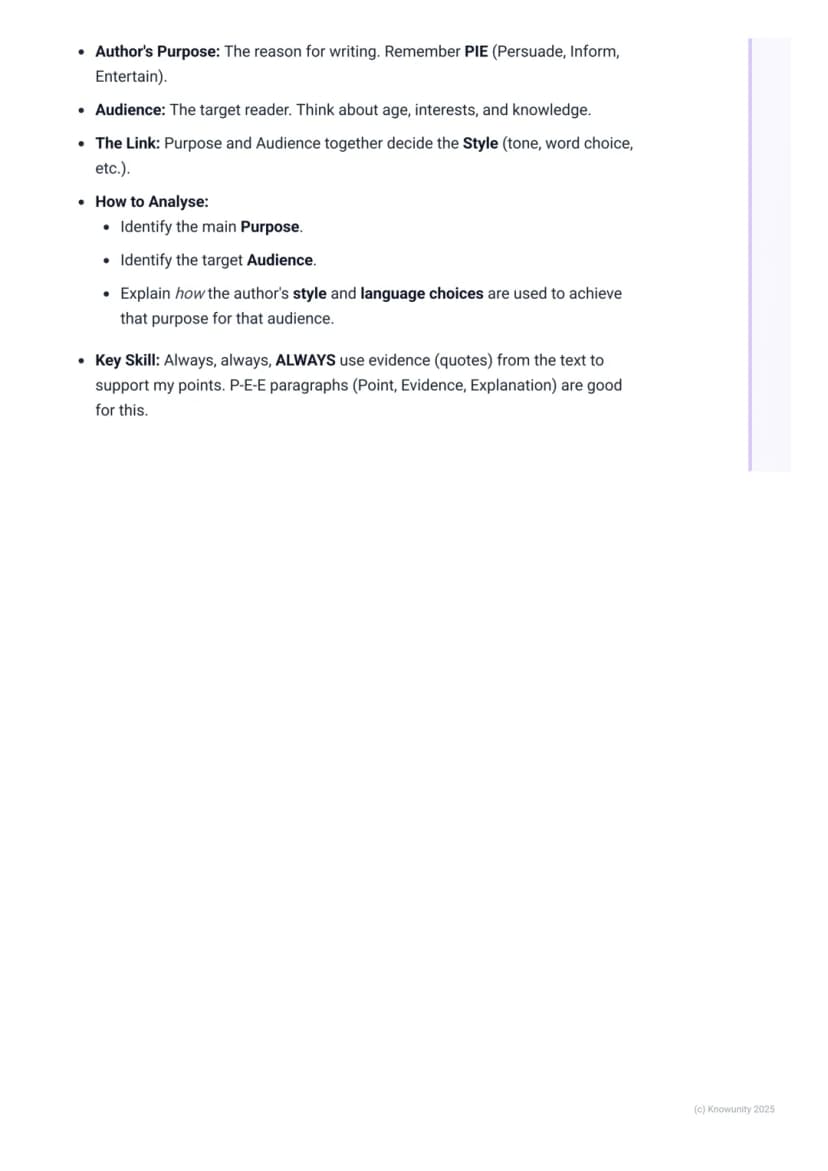
Think of reading as detective work - you're hunting for two crucial clues. First, you need to work out why the author wrote the text (their purpose), and second, who they wrote it for (their audience). Once you crack this code, everything else falls into place.
Understanding these elements isn't just about getting better exam marks (though it definitely helps!). It's about becoming a smarter reader who can see through the author's techniques and spot when someone's trying to influence you.
The author's purpose shapes every single choice they make - from the words they pick to how they structure their sentences. Meanwhile, the audience determines whether they'll use simple language for kids or technical jargon for experts.
Quick Tip: Always look for evidence in the text to back up your analysis. Examiners love quotes that prove your points!
2
of 6Inscríbete para ver los apuntes. ¡Es gratis!
- Acceso a todos los documentos
- Mejora tus notas
- Únete a millones de estudiantes
Finding the Author's Purpose - Remember PIE
The easiest way to identify purpose is using PIE - Persuade, Inform, Entertain. Each purpose leaves different fingerprints in the text, so you just need to know what to look for.
Persuade texts want to change your mind or make you do something. Watch out for strong opinions, emotional language, rhetorical questions, and calls to action like "We must act now!" You'll find this in adverts, political speeches, and opinion articles.
Inform texts stick to facts and explanations without trying to sway you. They use neutral language, statistics, dates, and clear explanations. Think textbooks, proper news reports, and instruction manuals.
Entertain texts want you to enjoy the experience. They'll have stories, characters, humour, or descriptive language that creates vivid images. Novels, poems, and comics fit here perfectly.
Remember: Some texts mix purposes! A documentary might inform you about climate change but also persuade you to recycle more.
3
of 6Inscríbete para ver los apuntes. ¡Es gratis!
- Acceso a todos los documentos
- Mejora tus notas
- Únete a millones de estudiantes
Working Out the Audience
Figuring out the audience is like being a people-watcher - you're looking for clues about who would actually want to read this stuff. The topic gives you the first hint: a text about TikTok trends is probably aimed at teenagers, while retirement planning advice targets older adults.
Language choice tells you loads about the intended audience. Formal language like "It is imperative that..." usually targets educated adults or professionals. Informal chat like "You've got to..." suggests a younger or general audience.
Technical jargon is a dead giveaway for expert audiences. If a text is full of scientific terms or legal language, it's written for people who already know that field.
Don't forget to consider where it was published. A story in a children's magazine has a completely different audience from an article in The Irish Times - the publication choice isn't random!
Pro Tip: The audience and purpose work together like a team - they both influence how the author writes.
4
of 6Inscríbete para ver los apuntes. ¡Es gratis!
- Acceso a todos los documentos
- Mejora tus notas
- Únete a millones de estudiantes
How Purpose and Audience Shape Style
Here's where it gets interesting - purpose plus audience equals style. This connection is what examiners want to see in your essays, so nail this concept and you're golden.
Think about it logically: if you want to persuade teenagers not to smoke, you won't use the same approach as persuading adults. You'd probably use informal language, maybe some slang, and focus on things teens actually care about - like how smoking affects your appearance or social life.
The tone (author's attitude) changes completely depending on these factors. A charity appeal might use an urgent, emotional tone, while a science textbook stays calm and educational.
Word choice gets carefully tailored too. Authors pick specific words to create certain effects - "house" feels neutral, but "home" creates warmth and emotion. Every choice is deliberate when you know your purpose and audience.
Key Point: In exams, always explain how the author's language choices help them achieve their specific purpose for their target audience.
5
of 6Inscríbete para ver los apuntes. ¡Es gratis!
- Acceso a todos los documentos
- Mejora tus notas
- Únete a millones de estudiantes
Putting It Into Practice
Let's crack the code on some real examples. Take this blog post: "Seriously, is anyone else fed up with the state of the Luas? Every single morning, it's packed like a sardine tin. We need more trams running during rush hour, and we need them now."
The purpose is clearly persuasive - the author wants change. The evidence? Emotional language like "fed up" and "joke", plus a direct demand for action. The audience is Dublin commuters who'll relate to the problem, shown by the informal tone and local reference.
Now compare that to a textbook: "Photosynthesis is the process used by plants to convert light energy into chemical energy." This informs students using neutral, factual language and technical terms. No opinions, just clear explanations.
See how different purposes and audiences create completely different writing styles? The blog post sounds angry and conversational, while the textbook stays formal and educational.
Exam Success: Always use quotes from the text as evidence - this is where the marks come from!
6
of 6Inscríbete para ver los apuntes. ¡Es gratis!
- Acceso a todos los documentos
- Mejora tus notas
- Únete a millones de estudiantes
Pensamos que nunca lo preguntarías...
¿Qué es Knowunity AI companion?
Nuestro compañero de IA está específicamente adaptado a las necesidades de los estudiantes. Basándonos en los millones de contenidos que tenemos en la plataforma, podemos dar a los estudiantes respuestas realmente significativas y relevantes. Pero no se trata solo de respuestas, el compañero también guía a los estudiantes a través de sus retos de aprendizaje diarios, con planes de aprendizaje personalizados, cuestionarios o contenidos en el chat y una personalización del 100% basada en las habilidades y el desarrollo de los estudiantes.
¿Dónde puedo descargar la app Knowunity?
Puedes descargar la app en Google Play Store y Apple App Store.
¿Knowunity es totalmente gratuito?
Sí, tienes acceso gratuito a los contenidos de la aplicación y a nuestro compañero de IA. Para desbloquear determinadas funciones de la aplicación, puedes adquirir Knowunity Pro.
Contenidos más populares de English
9EnglishKey Quotes : Sive
Key Quotes and explanations: Sive
6th Year2842
EnglishCultural Context : Shawshank Redemption : Sive : Small Things Like These
Comparative Study : Cultural Context : Shawshank Redemption, Sive and Small Things Like These
6th Year1430
EnglishElizabeth Bishop notes
Elizabeth Bishop notes
6th Year1271
EnglishPoetry
Paula Meehan - the statue of the virgin at granard speaks, the exact moment i became a poet, prayer for the children of longing, the pattern notes. Seamus Heaney, the forge notes.
6th Year300
EnglishKey Moments of Macbeth
This is a one page summary for key moments of Macbeth including quotes and act numbers
6th Year320
EnglishMud term break
Jc poem english
1st Year141
EnglishBanquo Study Notes
Macbeth
6th Year280
EnglishNotes on Macbeth, poetry and comparative
Notes on Macbeth, dive and comparative
5th Year291
EnglishThe fish-Elizabeth bishop
Overview of Elizabeth bishops poem the fish written in 1940 ,include a summary,tone and mood,key quotes,imagery examples and theme examples
6th Year370
Contenidos más populares
9IrishIrish oral questions and answers
Questions and answers for the leaving cert oral
5th Year4264
EnglishKey Quotes : Sive
Key Quotes and explanations: Sive
6th Year2842
IrishIrish oral questions
Outline of oral questions
5th Year2055
IrishIníon- le hÁine Durkin
Aine Durkin’s poem, Iníon: Themes & summary
5th Year850
IrishIrish poetry 2027
Iníon + Dínit an Bhróin
5th Year1133
IrishLC HL notes- Iníon (poem)
Includes poem in English and Irish, theme, key words & phrases
5th Year2284
EnglishCultural Context : Shawshank Redemption : Sive : Small Things Like These
Comparative Study : Cultural Context : Shawshank Redemption, Sive and Small Things Like These
6th Year1430
IrishMo Ghrá-sa (Idir Lúibíní)
Notes on mo ghrá-sa
5th Year380
IrishAn Gaeilge Aiste
Irish Language essay
6th Year1320
¿No encuentras lo que buscas? Explora otros temas.
Mira lo que dicen nuestros usuarios. Les encanta - y a tí también.
4.6/5App Store
4.7/5Google Play
La app es muy fácil de usar y está muy bien diseñada. Hasta ahora he encontrado todo lo que estaba buscando y he podido aprender mucho de las presentaciones. Definitivamente utilizaré la aplicación para un examen de clase. Y, por supuesto, también me sirve mucho de inspiración.
Pablousuario de iOS
Esta app es realmente genial. Hay tantos apuntes de clase y ayuda [...]. Tengo problemas con matemáticas, por ejemplo, y la aplicación tiene muchas opciones de ayuda. Gracias a Knowunity, he mejorado en mates. Se la recomiendo a todo el mundo.
Elenausuaria de Android
Vaya, estoy realmente sorprendida. Acabo de probar la app porque la he visto anunciada muchas veces y me he quedado absolutamente alucinada. Esta app es LA AYUDA que quieres para el insti y, sobre todo, ofrece muchísimas cosas, como ejercicios y hojas informativas, que a mí personalmente me han sido MUY útiles.
Anausuaria de iOS