
Persuasive writing is a powerful skill that helps you convince...
 English1 visualizaciones·Actualizado Jun 10, 2026·6 páginas
Mastering Persuasive Writing Techniques

1 / 6
1
of 6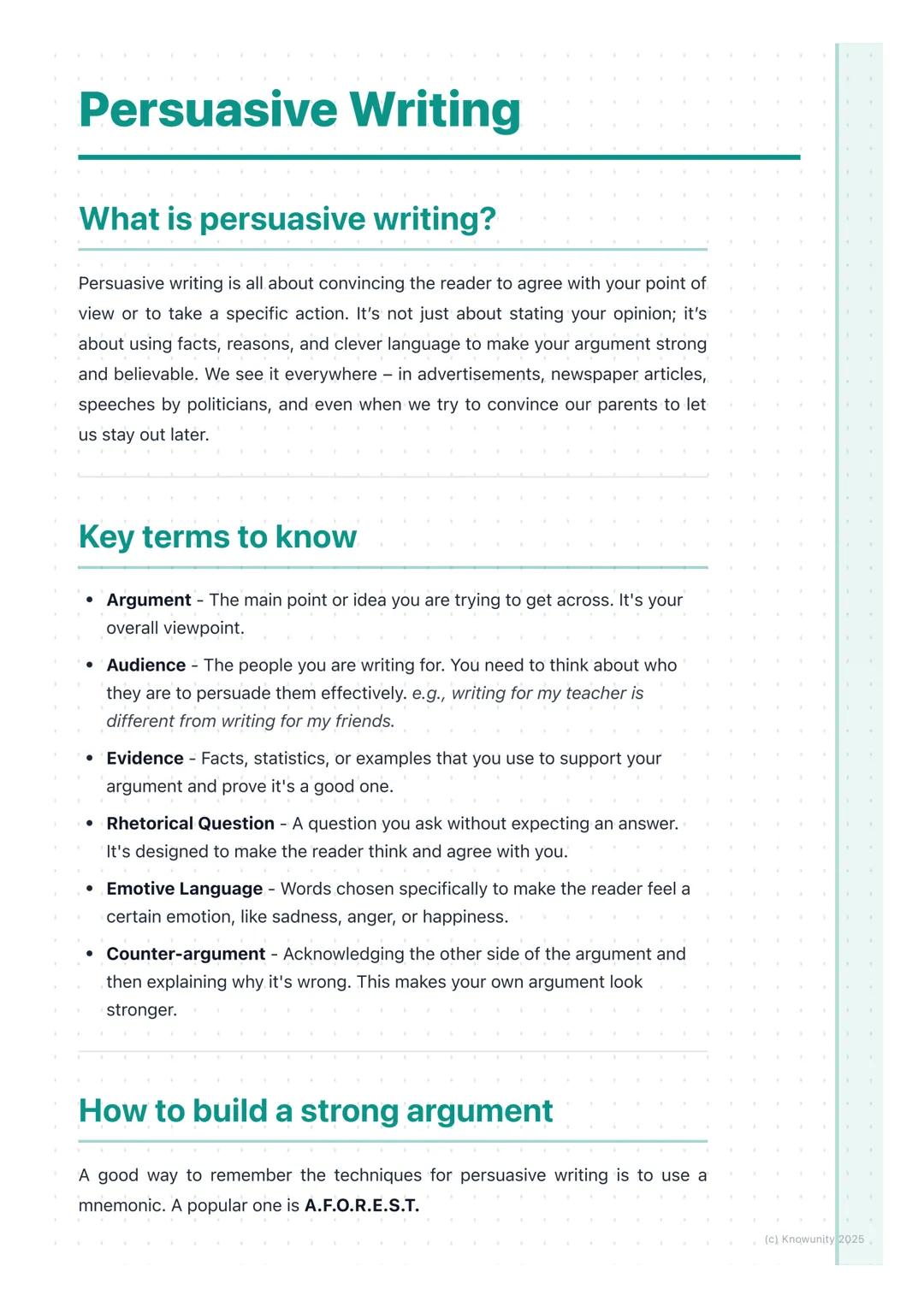
What is Persuasive Writing?
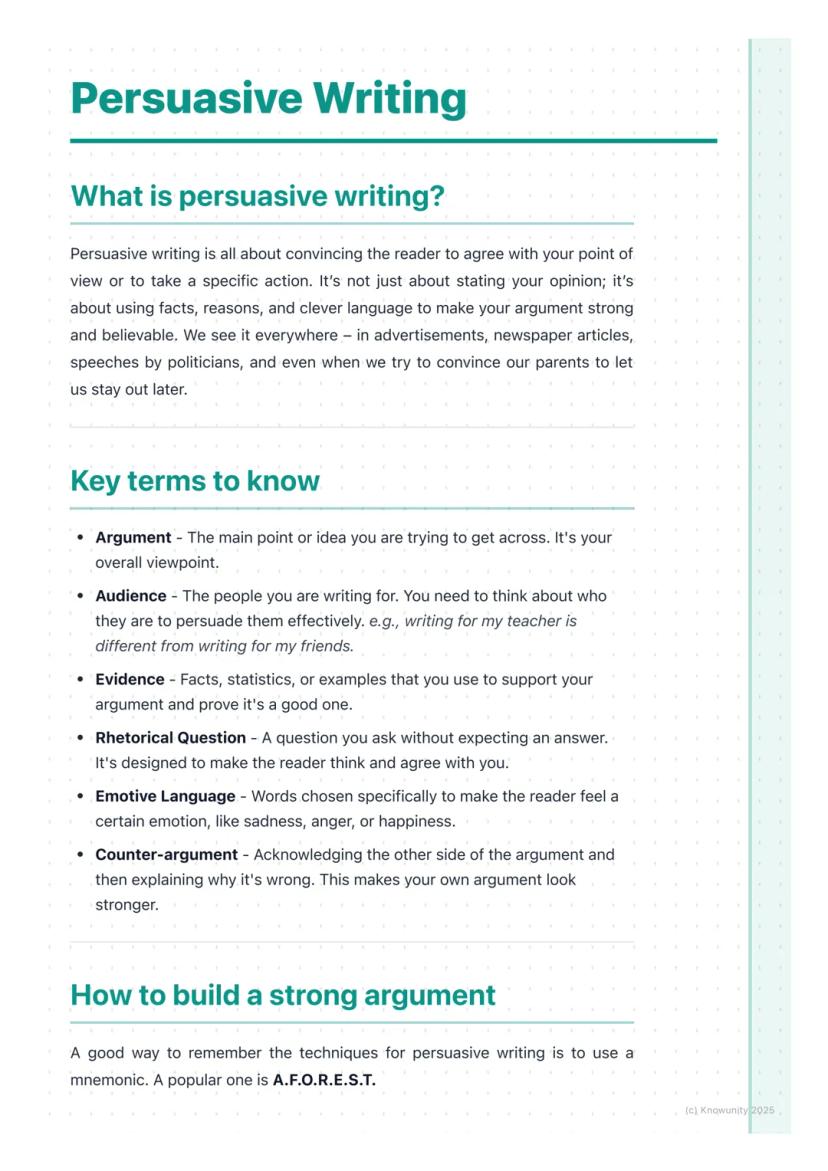
Persuasive writing isn't just about stating your opinion. It's about using facts, clever language and solid reasoning to make your argument believable and convincing. When you're writing persuasively, you need to understand some key terms that will help structure your arguments.
Key terms include your argument (the main point you're making), your audience (who you're writing for), and evidence (facts that support your point). You'll also use techniques like rhetorical questions to make readers think, emotive language to trigger feelings, and addressing counter-arguments to strengthen your position.
A strong persuasive piece requires careful planning and structure. One helpful way to remember persuasive techniques is the mnemonic A.F.O.R.E.S.T., which we'll explore next.
Remember this! Always think about who your audience is before you start writing. The way you'd persuade your teacher is completely different from how you'd persuade your friends!
2
of 6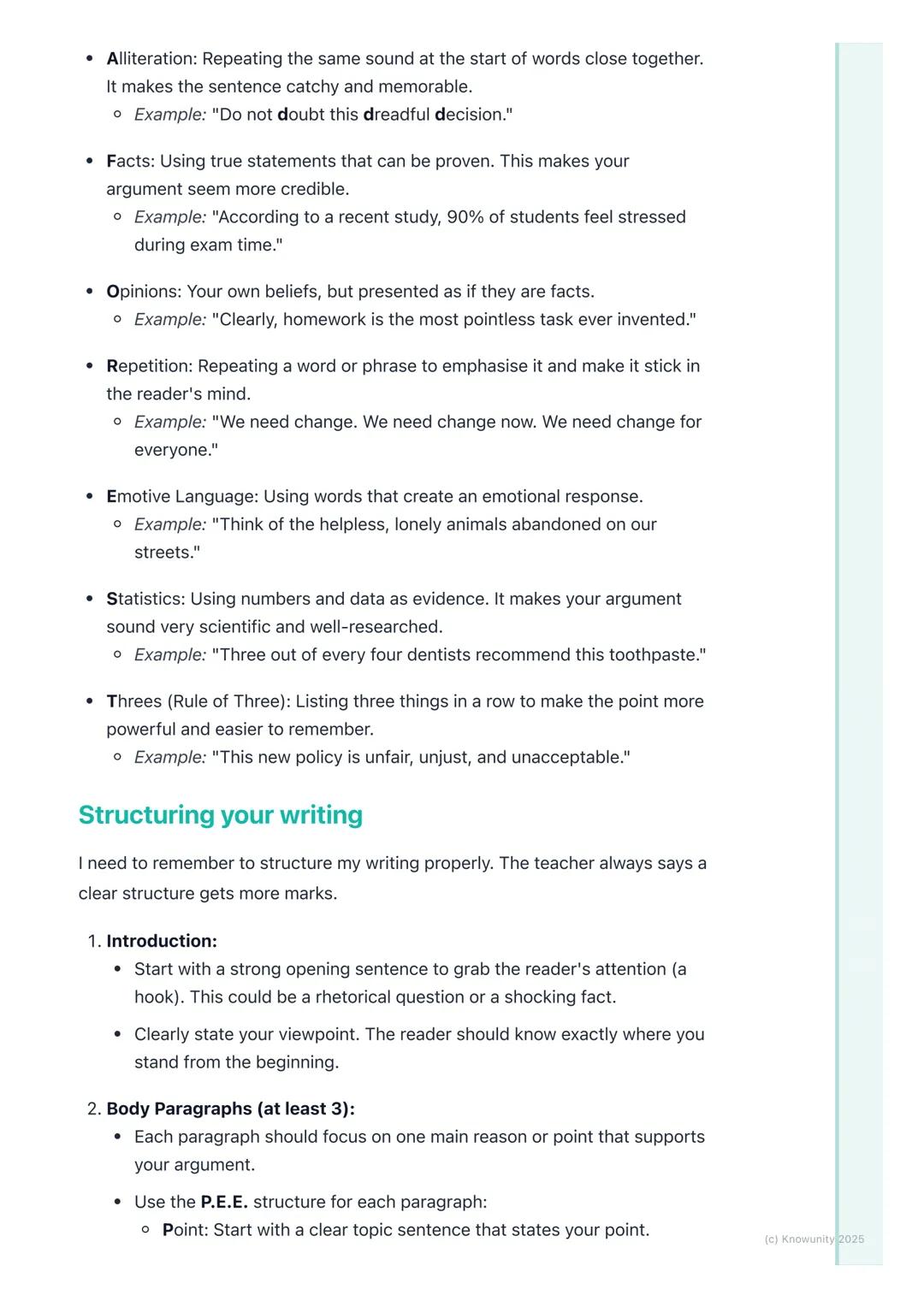
Persuasive Techniques: A.F.O.R.E.S.T.
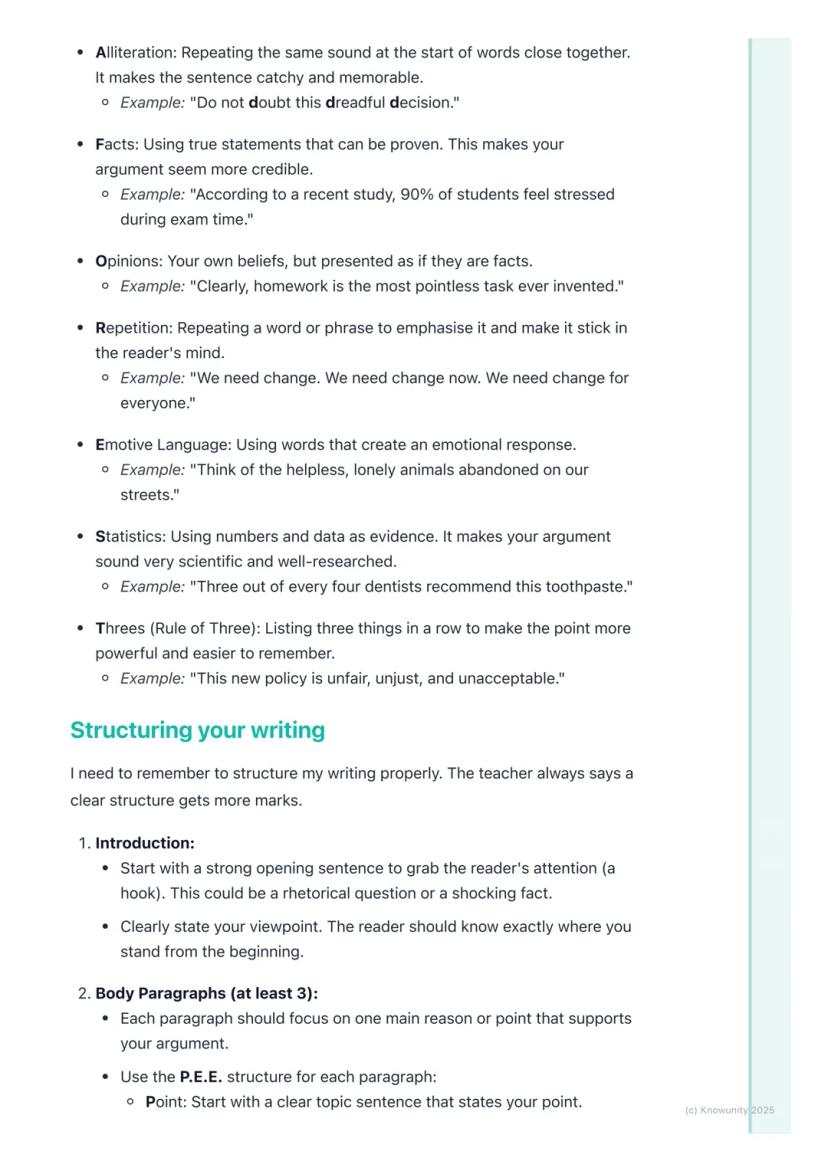
A.F.O.R.E.S.T. helps you remember seven powerful persuasive techniques that will make your writing more effective:
Alliteration makes your writing catchy and memorable by repeating the same sound in nearby words, like "Do not doubt this dreadful decision." Facts add credibility to your argument, while stating your opinions confidently makes them seem more authoritative.
Repetition of key phrases helps them stick in readers' minds, and emotive language creates feelings like sympathy or outrage. Statistics make your argument sound well-researched and scientific, while the Rule of Three (listing three things together) makes points more memorable and impactful.
Try combining these techniques in your writing. For example, you might use statistics alongside emotive language, or reinforce a fact with repetition to really drive your point home.
Top tip! Using the Rule of Three is incredibly powerful—it's simple, effective, and memorable (see what I did there?).
3
of 6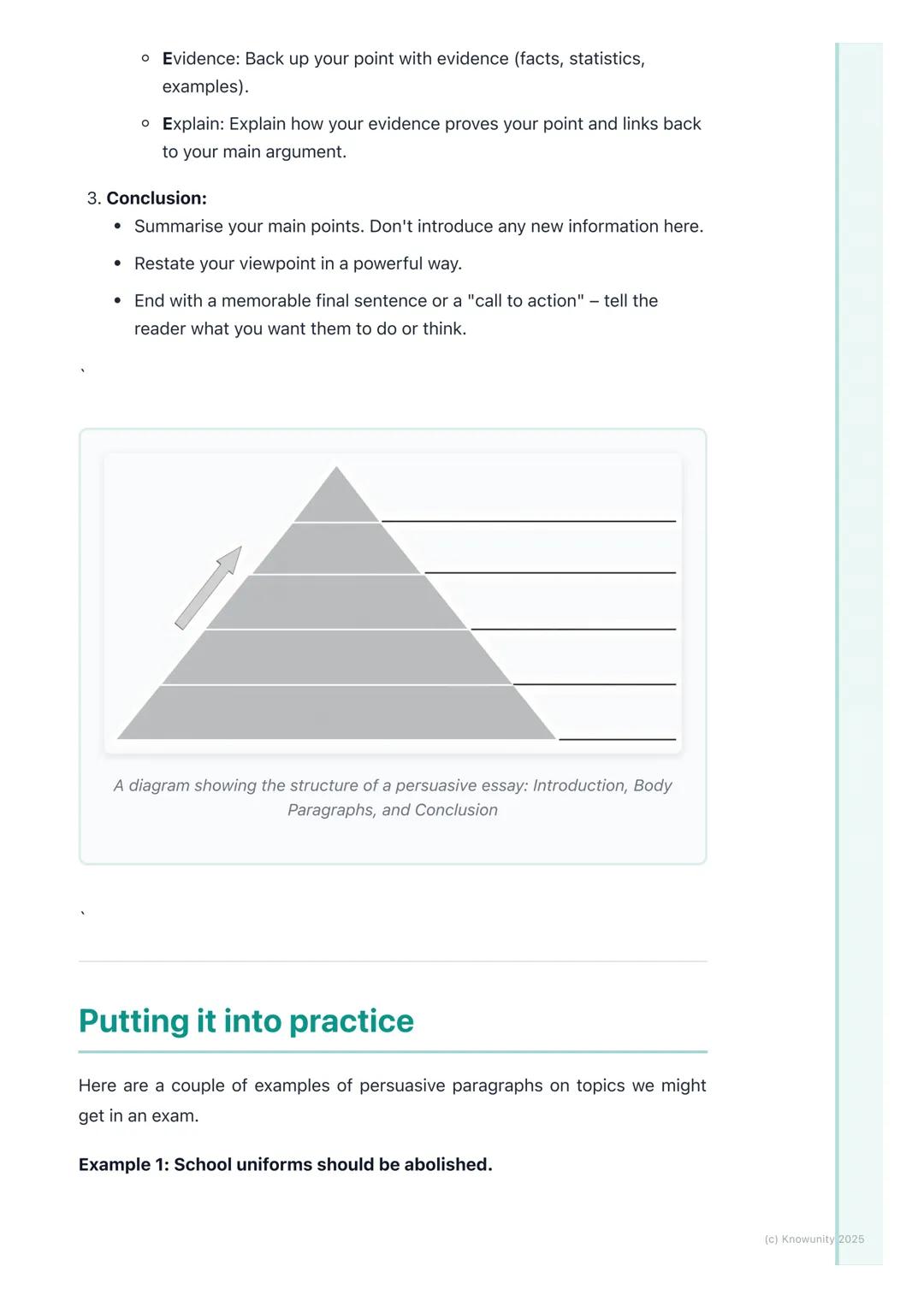
Structuring Your Persuasive Writing
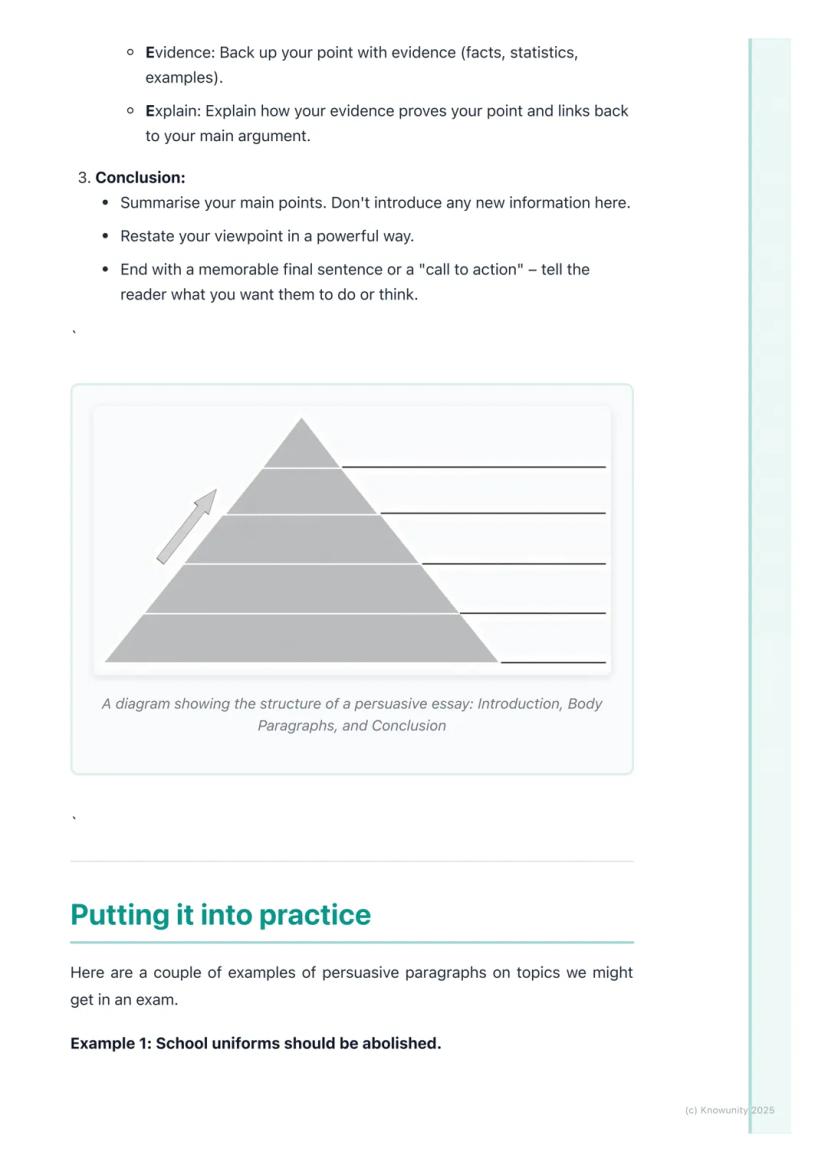
A clear structure is essential for persuasive writing and will help you earn higher marks. Your writing should have three main sections that flow logically from start to finish.
Begin with an introduction that grabs attention with a hook (like a shocking fact or rhetorical question) and clearly states your viewpoint. The reader should immediately understand your position on the issue.
Your body paragraphs (aim for at least three) should each focus on one main reason supporting your argument. Use the P.E.E. structure for each paragraph: make your Point, provide Evidence to support it, then Explain how this evidence proves your point and connects to your overall argument.
Finish with a strong conclusion that summarises your main points without introducing any new information. Restate your viewpoint powerfully and end with a memorable final sentence or call to action.
Examiner's favourite! Using P.E.E. (Point, Evidence, Explain) in each paragraph shows you can build and support arguments logically—a skill examiners love to see!
4
of 6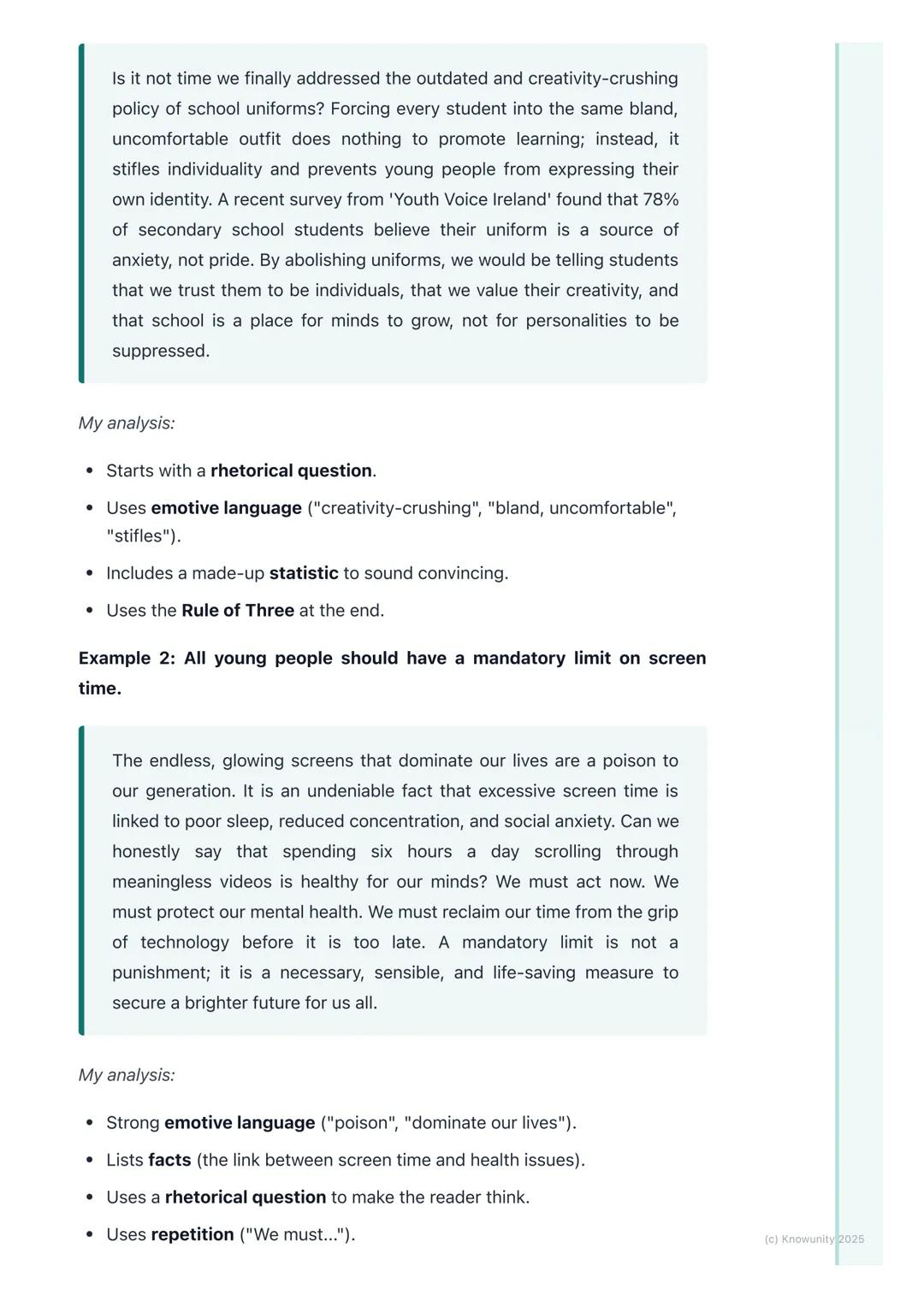
Persuasive Writing Examples
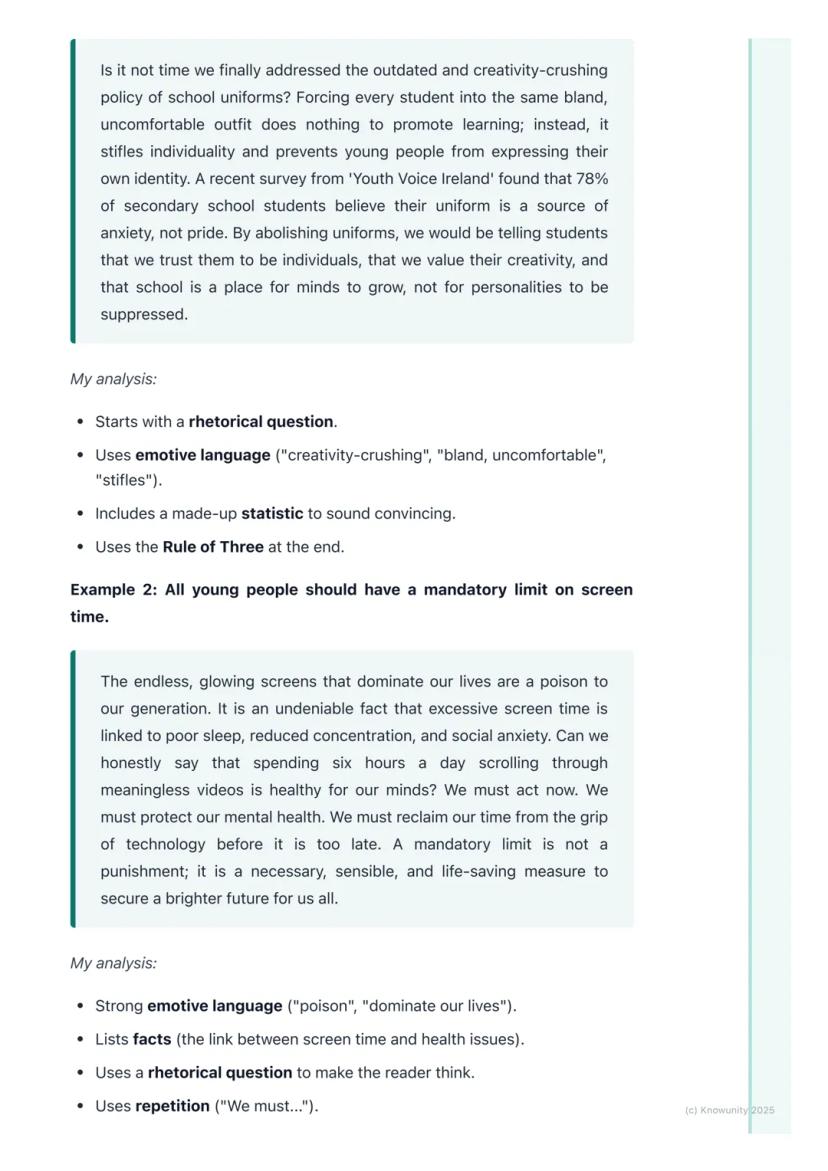
Looking at strong examples helps you understand what makes persuasive writing effective. Let's analyze two sample paragraphs that demonstrate different techniques.
The first example argues that school uniforms should be abolished. It starts with a rhetorical question and uses emotive language like "creativity-crushing" and "stifles individuality." Notice how it includes a statistic (78% of students) to sound more convincing and ends with the Rule of Three to emphasize the benefits of abolishing uniforms.
The second example argues for limiting screen time. It uses powerful emotive language by calling screens "poison" and lists health facts about screen time. The writer builds urgency through repetition ("We must...") and finishes with the Rule of Three, describing the limit as "necessary, sensible, and life-saving."
Both examples demonstrate how combining different persuasive techniques creates a powerful argument. They don't just state opinions—they use evidence and emotional appeals to convince the reader.
Build your skills! Try identifying the persuasive techniques used in advertisements you see every day—you'll be surprised how many use these same strategies!
5
of 6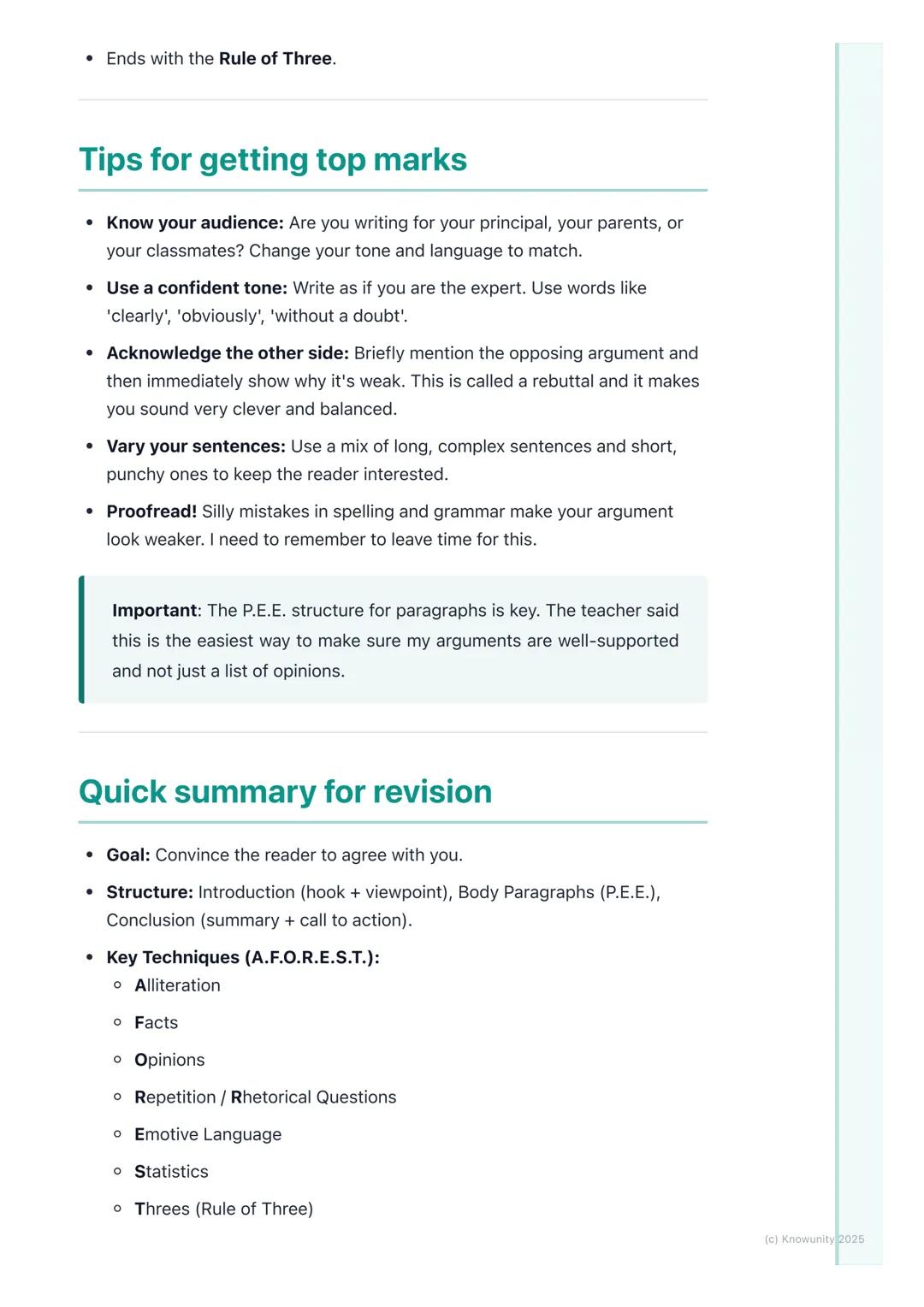
Tips for Getting Top Marks
To excel at persuasive writing, always know your audience and adjust your language accordingly—you'd write differently for your principal than for your classmates. Use a confident tone with phrases like "clearly" and "obviously" to sound authoritative.
A clever strategy is to briefly acknowledge the opposing view before showing why it's weak. This makes you sound balanced and thoughtful. Remember to vary your sentences between long, complex ones and short, punchy statements for better rhythm and impact.
Always leave time to proofread your work! Spelling and grammar errors make your arguments look weaker, no matter how good your points are. The P.E.E. structure (Point, Evidence, Explain) is essential for well-supported arguments that don't just list opinions.
When revising, remember your goal is to convince the reader to agree with you. Use the A.F.O.R.E.S.T. techniques throughout your writing.
Exam success strategy! In timed exams, quickly jot down your main points and supporting evidence before you start writing—this ensures your argument stays focused and well-structured.
6
of 6
Final Reminders for Persuasive Writing
As you prepare to write persuasively, keep these final tips in mind to make your writing stand out. Always back up your arguments with solid evidence—opinions alone won't convince your reader!
Write with confidence and authority, even if you're not 100% sure about your position. Confident language is more persuasive than hesitant statements. Consider your audience carefully and adapt your tone and examples to appeal to them specifically.
Never skip proofreading! Take a few minutes to check for errors and unclear sentences that could weaken your argument. Remember that a well-structured, error-free piece of writing instantly appears more credible.
With practice, you'll become more skilled at crafting arguments that not only express your opinion but also genuinely persuade others to see things your way—a valuable skill for school and life beyond!
You've got this! Persuasive writing is like learning to ride a bike—it might seem tricky at first, but once you master the techniques, you'll be zooming along confidently in no time!
Pensamos que nunca lo preguntarías...
¿Qué es Knowunity AI companion?
Nuestro compañero de IA está específicamente adaptado a las necesidades de los estudiantes. Basándonos en los millones de contenidos que tenemos en la plataforma, podemos dar a los estudiantes respuestas realmente significativas y relevantes. Pero no se trata solo de respuestas, el compañero también guía a los estudiantes a través de sus retos de aprendizaje diarios, con planes de aprendizaje personalizados, cuestionarios o contenidos en el chat y una personalización del 100% basada en las habilidades y el desarrollo de los estudiantes.
¿Dónde puedo descargar la app Knowunity?
Puedes descargar la app en Google Play Store y Apple App Store.
¿Knowunity es totalmente gratuito?
Sí, tienes acceso gratuito a los contenidos de la aplicación y a nuestro compañero de IA. Para desbloquear determinadas funciones de la aplicación, puedes adquirir Knowunity Pro.
Contenidos más populares de English
9EnglishKey Quotes : Sive
Key Quotes and explanations: Sive
6th Year2842
EnglishCultural Context : Shawshank Redemption : Sive : Small Things Like These
Comparative Study : Cultural Context : Shawshank Redemption, Sive and Small Things Like These
6th Year1430
EnglishElizabeth Bishop notes
Elizabeth Bishop notes
6th Year1271
EnglishPoetry
Paula Meehan - the statue of the virgin at granard speaks, the exact moment i became a poet, prayer for the children of longing, the pattern notes. Seamus Heaney, the forge notes.
6th Year300
EnglishKey Moments of Macbeth
This is a one page summary for key moments of Macbeth including quotes and act numbers
6th Year320
EnglishMud term break
Jc poem english
1st Year141
EnglishBanquo Study Notes
Macbeth
6th Year280
EnglishNotes on Macbeth, poetry and comparative
Notes on Macbeth, dive and comparative
5th Year291
EnglishThe fish-Elizabeth bishop
Overview of Elizabeth bishops poem the fish written in 1940 ,include a summary,tone and mood,key quotes,imagery examples and theme examples
6th Year370
Contenidos más populares
9 Irish
IrishIrish oral questions and answers
Questions and answers for the leaving cert oral
5th Year4264
EnglishKey Quotes : Sive
Key Quotes and explanations: Sive
6th Year2842
IrishIrish oral questions
Outline of oral questions
5th Year2055
IrishIníon- le hÁine Durkin
Aine Durkin’s poem, Iníon: Themes & summary
5th Year890
IrishIrish poetry 2027
Iníon + Dínit an Bhróin
5th Year1153
IrishLC HL notes- Iníon (poem)
Includes poem in English and Irish, theme, key words & phrases
5th Year2304
EnglishCultural Context : Shawshank Redemption : Sive : Small Things Like These
Comparative Study : Cultural Context : Shawshank Redemption, Sive and Small Things Like These
6th Year1430
IrishMo Ghrá-sa (Idir Lúibíní)
Notes on mo ghrá-sa
5th Year380
IrishAn Gaeilge Aiste
Irish Language essay
6th Year1320
¿No encuentras lo que buscas? Explora otros temas.
Mira lo que dicen nuestros usuarios. Les encanta - y a tí también.
4.6/5App Store
4.7/5Google Play
La app es muy fácil de usar y está muy bien diseñada. Hasta ahora he encontrado todo lo que estaba buscando y he podido aprender mucho de las presentaciones. Definitivamente utilizaré la aplicación para un examen de clase. Y, por supuesto, también me sirve mucho de inspiración.
Pablousuario de iOS
Esta app es realmente genial. Hay tantos apuntes de clase y ayuda [...]. Tengo problemas con matemáticas, por ejemplo, y la aplicación tiene muchas opciones de ayuda. Gracias a Knowunity, he mejorado en mates. Se la recomiendo a todo el mundo.
Elenausuaria de Android
Vaya, estoy realmente sorprendida. Acabo de probar la app porque la he visto anunciada muchas veces y me he quedado absolutamente alucinada. Esta app es LA AYUDA que quieres para el insti y, sobre todo, ofrece muchísimas cosas, como ejercicios y hojas informativas, que a mí personalmente me han sido MUY útiles.
Anausuaria de iOS
English1 visualizaciones·Actualizado Jun 10, 2026·6 páginasMastering Persuasive Writing Techniques
Persuasive writing is a powerful skill that helps you convince others to agree with your viewpoint or take a specific action. You'll find persuasive techniques everywhere—from advertisements to political speeches to convincing your parents to extend your curfew. Mastering this...
1
of 6
Inscríbete para ver los apuntes. ¡Es gratis!
- Acceso a todos los documentos
- Mejora tus notas
- Únete a millones de estudiantes
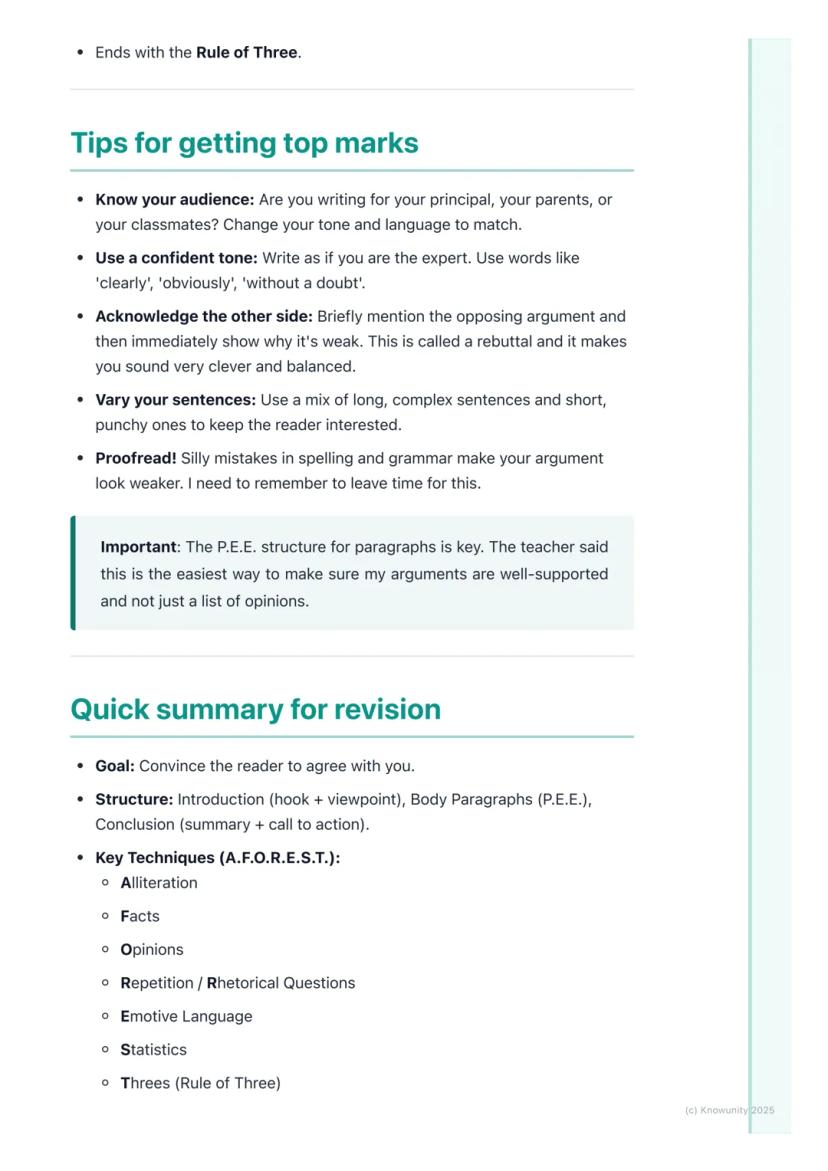
What is Persuasive Writing?
Persuasive writing isn't just about stating your opinion. It's about using facts, clever language and solid reasoning to make your argument believable and convincing. When you're writing persuasively, you need to understand some key terms that will help structure your arguments.
Key terms include your argument (the main point you're making), your audience (who you're writing for), and evidence (facts that support your point). You'll also use techniques like rhetorical questions to make readers think, emotive language to trigger feelings, and addressing counter-arguments to strengthen your position.
A strong persuasive piece requires careful planning and structure. One helpful way to remember persuasive techniques is the mnemonic A.F.O.R.E.S.T., which we'll explore next.
Remember this! Always think about who your audience is before you start writing. The way you'd persuade your teacher is completely different from how you'd persuade your friends!
2
of 6Inscríbete para ver los apuntes. ¡Es gratis!
- Acceso a todos los documentos
- Mejora tus notas
- Únete a millones de estudiantes
Persuasive Techniques: A.F.O.R.E.S.T.
A.F.O.R.E.S.T. helps you remember seven powerful persuasive techniques that will make your writing more effective:
Alliteration makes your writing catchy and memorable by repeating the same sound in nearby words, like "Do not doubt this dreadful decision." Facts add credibility to your argument, while stating your opinions confidently makes them seem more authoritative.
Repetition of key phrases helps them stick in readers' minds, and emotive language creates feelings like sympathy or outrage. Statistics make your argument sound well-researched and scientific, while the Rule of Three (listing three things together) makes points more memorable and impactful.
Try combining these techniques in your writing. For example, you might use statistics alongside emotive language, or reinforce a fact with repetition to really drive your point home.
Top tip! Using the Rule of Three is incredibly powerful—it's simple, effective, and memorable (see what I did there?).
3
of 6Inscríbete para ver los apuntes. ¡Es gratis!
- Acceso a todos los documentos
- Mejora tus notas
- Únete a millones de estudiantes
Structuring Your Persuasive Writing
A clear structure is essential for persuasive writing and will help you earn higher marks. Your writing should have three main sections that flow logically from start to finish.
Begin with an introduction that grabs attention with a hook (like a shocking fact or rhetorical question) and clearly states your viewpoint. The reader should immediately understand your position on the issue.
Your body paragraphs (aim for at least three) should each focus on one main reason supporting your argument. Use the P.E.E. structure for each paragraph: make your Point, provide Evidence to support it, then Explain how this evidence proves your point and connects to your overall argument.
Finish with a strong conclusion that summarises your main points without introducing any new information. Restate your viewpoint powerfully and end with a memorable final sentence or call to action.
Examiner's favourite! Using P.E.E. (Point, Evidence, Explain) in each paragraph shows you can build and support arguments logically—a skill examiners love to see!
4
of 6Inscríbete para ver los apuntes. ¡Es gratis!
- Acceso a todos los documentos
- Mejora tus notas
- Únete a millones de estudiantes
Persuasive Writing Examples
Looking at strong examples helps you understand what makes persuasive writing effective. Let's analyze two sample paragraphs that demonstrate different techniques.
The first example argues that school uniforms should be abolished. It starts with a rhetorical question and uses emotive language like "creativity-crushing" and "stifles individuality." Notice how it includes a statistic (78% of students) to sound more convincing and ends with the Rule of Three to emphasize the benefits of abolishing uniforms.
The second example argues for limiting screen time. It uses powerful emotive language by calling screens "poison" and lists health facts about screen time. The writer builds urgency through repetition ("We must...") and finishes with the Rule of Three, describing the limit as "necessary, sensible, and life-saving."
Both examples demonstrate how combining different persuasive techniques creates a powerful argument. They don't just state opinions—they use evidence and emotional appeals to convince the reader.
Build your skills! Try identifying the persuasive techniques used in advertisements you see every day—you'll be surprised how many use these same strategies!
5
of 6Inscríbete para ver los apuntes. ¡Es gratis!
- Acceso a todos los documentos
- Mejora tus notas
- Únete a millones de estudiantes
Tips for Getting Top Marks
To excel at persuasive writing, always know your audience and adjust your language accordingly—you'd write differently for your principal than for your classmates. Use a confident tone with phrases like "clearly" and "obviously" to sound authoritative.
A clever strategy is to briefly acknowledge the opposing view before showing why it's weak. This makes you sound balanced and thoughtful. Remember to vary your sentences between long, complex ones and short, punchy statements for better rhythm and impact.
Always leave time to proofread your work! Spelling and grammar errors make your arguments look weaker, no matter how good your points are. The P.E.E. structure (Point, Evidence, Explain) is essential for well-supported arguments that don't just list opinions.
When revising, remember your goal is to convince the reader to agree with you. Use the A.F.O.R.E.S.T. techniques throughout your writing.
Exam success strategy! In timed exams, quickly jot down your main points and supporting evidence before you start writing—this ensures your argument stays focused and well-structured.
6
of 6Inscríbete para ver los apuntes. ¡Es gratis!
- Acceso a todos los documentos
- Mejora tus notas
- Únete a millones de estudiantes
Final Reminders for Persuasive Writing
As you prepare to write persuasively, keep these final tips in mind to make your writing stand out. Always back up your arguments with solid evidence—opinions alone won't convince your reader!
Write with confidence and authority, even if you're not 100% sure about your position. Confident language is more persuasive than hesitant statements. Consider your audience carefully and adapt your tone and examples to appeal to them specifically.
Never skip proofreading! Take a few minutes to check for errors and unclear sentences that could weaken your argument. Remember that a well-structured, error-free piece of writing instantly appears more credible.
With practice, you'll become more skilled at crafting arguments that not only express your opinion but also genuinely persuade others to see things your way—a valuable skill for school and life beyond!
You've got this! Persuasive writing is like learning to ride a bike—it might seem tricky at first, but once you master the techniques, you'll be zooming along confidently in no time!
Pensamos que nunca lo preguntarías...
¿Qué es Knowunity AI companion?
Nuestro compañero de IA está específicamente adaptado a las necesidades de los estudiantes. Basándonos en los millones de contenidos que tenemos en la plataforma, podemos dar a los estudiantes respuestas realmente significativas y relevantes. Pero no se trata solo de respuestas, el compañero también guía a los estudiantes a través de sus retos de aprendizaje diarios, con planes de aprendizaje personalizados, cuestionarios o contenidos en el chat y una personalización del 100% basada en las habilidades y el desarrollo de los estudiantes.
¿Dónde puedo descargar la app Knowunity?
Puedes descargar la app en Google Play Store y Apple App Store.
¿Knowunity es totalmente gratuito?
Sí, tienes acceso gratuito a los contenidos de la aplicación y a nuestro compañero de IA. Para desbloquear determinadas funciones de la aplicación, puedes adquirir Knowunity Pro.
Contenidos más populares de English
9EnglishKey Quotes : Sive
Key Quotes and explanations: Sive
6th Year2842
EnglishCultural Context : Shawshank Redemption : Sive : Small Things Like These
Comparative Study : Cultural Context : Shawshank Redemption, Sive and Small Things Like These
6th Year1430
EnglishElizabeth Bishop notes
Elizabeth Bishop notes
6th Year1271
EnglishPoetry
Paula Meehan - the statue of the virgin at granard speaks, the exact moment i became a poet, prayer for the children of longing, the pattern notes. Seamus Heaney, the forge notes.
6th Year300
EnglishKey Moments of Macbeth
This is a one page summary for key moments of Macbeth including quotes and act numbers
6th Year320
EnglishMud term break
Jc poem english
1st Year141
EnglishBanquo Study Notes
Macbeth
6th Year280
EnglishNotes on Macbeth, poetry and comparative
Notes on Macbeth, dive and comparative
5th Year291
EnglishThe fish-Elizabeth bishop
Overview of Elizabeth bishops poem the fish written in 1940 ,include a summary,tone and mood,key quotes,imagery examples and theme examples
6th Year370
Contenidos más populares
9IrishIrish oral questions and answers
Questions and answers for the leaving cert oral
5th Year4264
EnglishKey Quotes : Sive
Key Quotes and explanations: Sive
6th Year2842
IrishIrish oral questions
Outline of oral questions
5th Year2055
IrishIníon- le hÁine Durkin
Aine Durkin’s poem, Iníon: Themes & summary
5th Year890
IrishIrish poetry 2027
Iníon + Dínit an Bhróin
5th Year1153
IrishLC HL notes- Iníon (poem)
Includes poem in English and Irish, theme, key words & phrases
5th Year2304
EnglishCultural Context : Shawshank Redemption : Sive : Small Things Like These
Comparative Study : Cultural Context : Shawshank Redemption, Sive and Small Things Like These
6th Year1430
IrishMo Ghrá-sa (Idir Lúibíní)
Notes on mo ghrá-sa
5th Year380
IrishAn Gaeilge Aiste
Irish Language essay
6th Year1320
¿No encuentras lo que buscas? Explora otros temas.
Mira lo que dicen nuestros usuarios. Les encanta - y a tí también.
4.6/5App Store
4.7/5Google Play
La app es muy fácil de usar y está muy bien diseñada. Hasta ahora he encontrado todo lo que estaba buscando y he podido aprender mucho de las presentaciones. Definitivamente utilizaré la aplicación para un examen de clase. Y, por supuesto, también me sirve mucho de inspiración.
Pablousuario de iOS
Esta app es realmente genial. Hay tantos apuntes de clase y ayuda [...]. Tengo problemas con matemáticas, por ejemplo, y la aplicación tiene muchas opciones de ayuda. Gracias a Knowunity, he mejorado en mates. Se la recomiendo a todo el mundo.
Elenausuaria de Android
Vaya, estoy realmente sorprendida. Acabo de probar la app porque la he visto anunciada muchas veces y me he quedado absolutamente alucinada. Esta app es LA AYUDA que quieres para el insti y, sobre todo, ofrece muchísimas cosas, como ejercicios y hojas informativas, que a mí personalmente me han sido MUY útiles.
Anausuaria de iOS