
Ever wondered why your phone isn't made of wood or...
 Engineering2 visualizaciones·Actualizado Jun 12, 2026·6 páginas
Common Types of Engineering Materials and Characteristics
1 / 6
1
of 6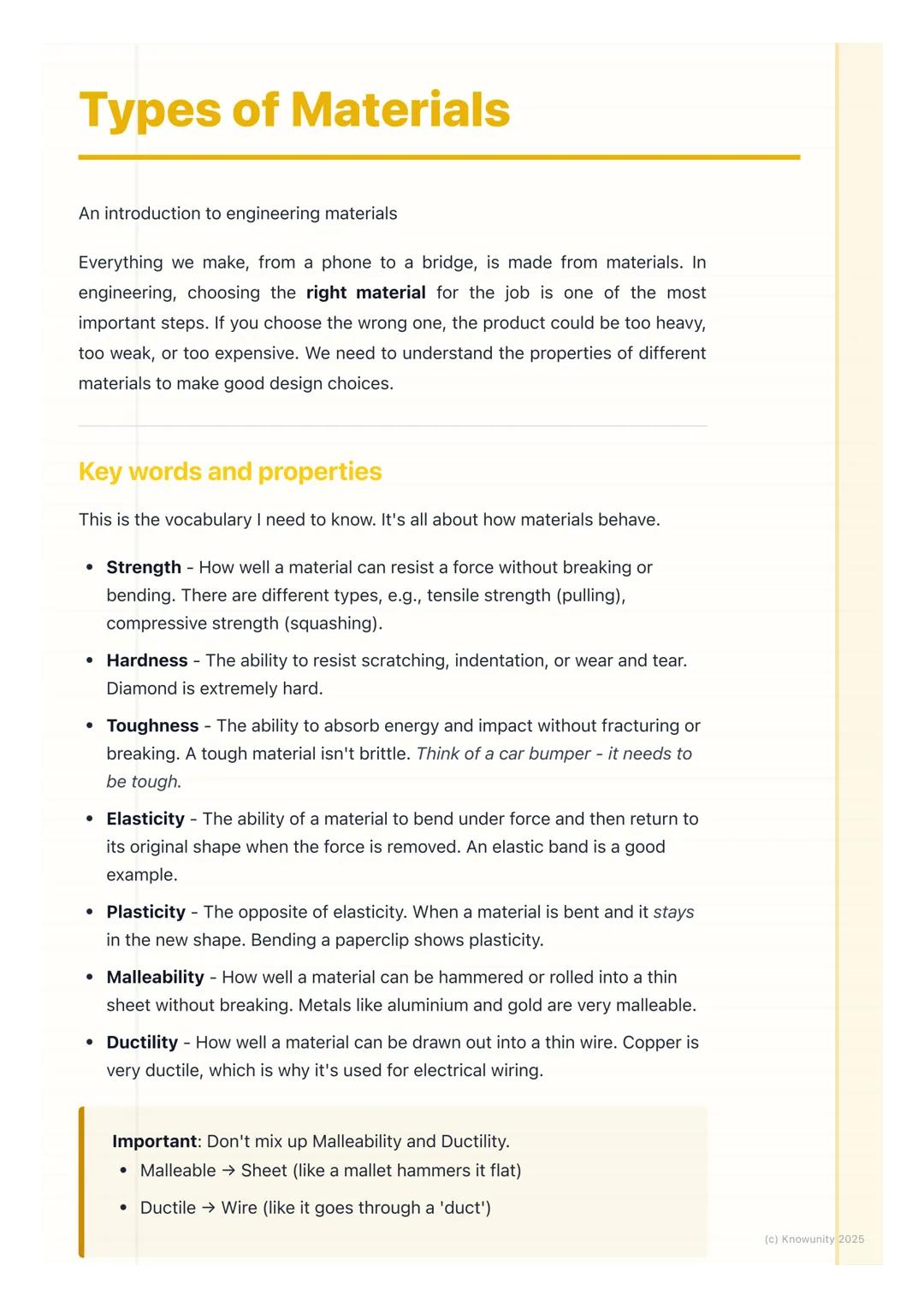
Material Properties and Vocabulary
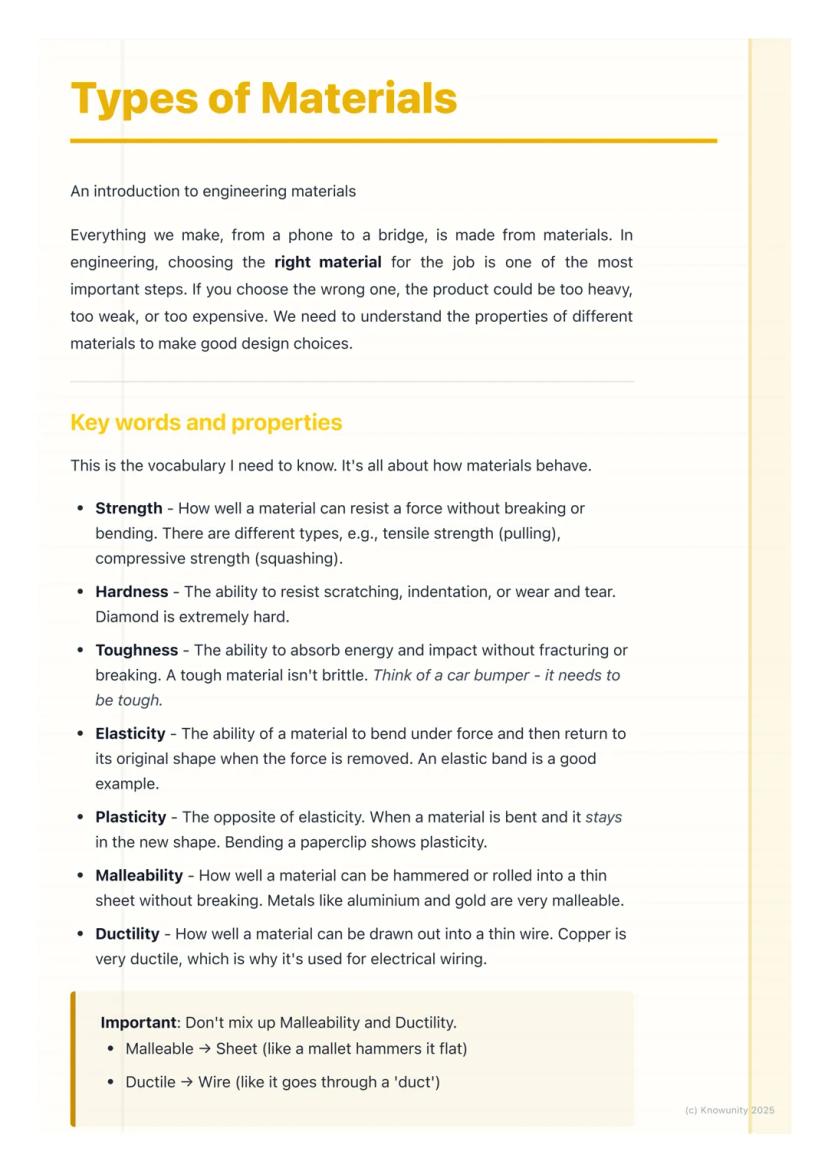
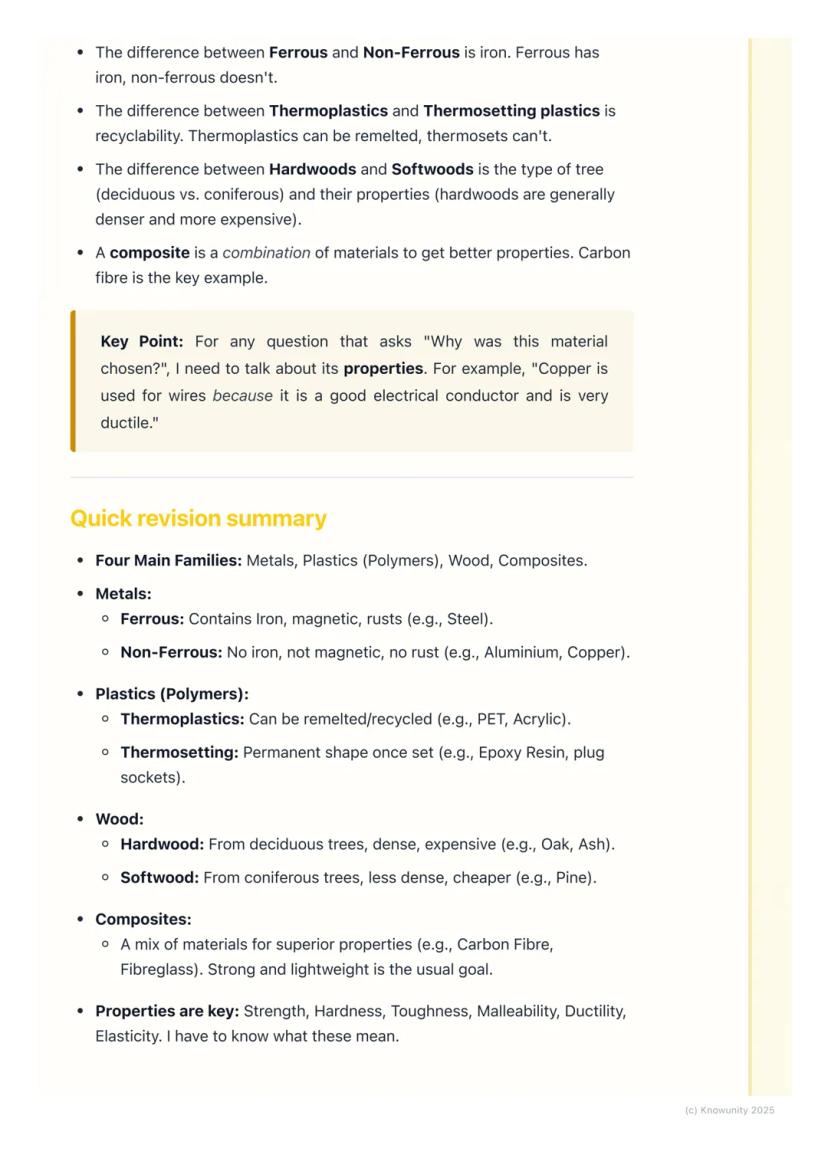
Understanding how materials behave is your first step to becoming an engineering expert. These properties determine whether a material is perfect for the job or completely useless.
Strength is how well a material resists force without breaking. There's tensile strength (pulling forces) and compressive strength (squashing forces). Hardness measures resistance to scratching - think of diamond being incredibly hard.
Toughness is different from strength - it's about absorbing impact without breaking. Car bumpers need to be tough, not just strong. Elasticity means bouncing back to original shape (like elastic bands), while plasticity is the opposite - staying bent like a paperclip.
Here's a brilliant memory trick: Malleable materials can be hammered into sheets (like a mallet flattens things), whilst ductile materials can be drawn into wires (like going through a duct). Don't mix these up in your exams!
Quick Test: Try bending a paperclip - first it's elastic (springs back), then becomes plastic (stays bent). This shows both properties in action!
2
of 6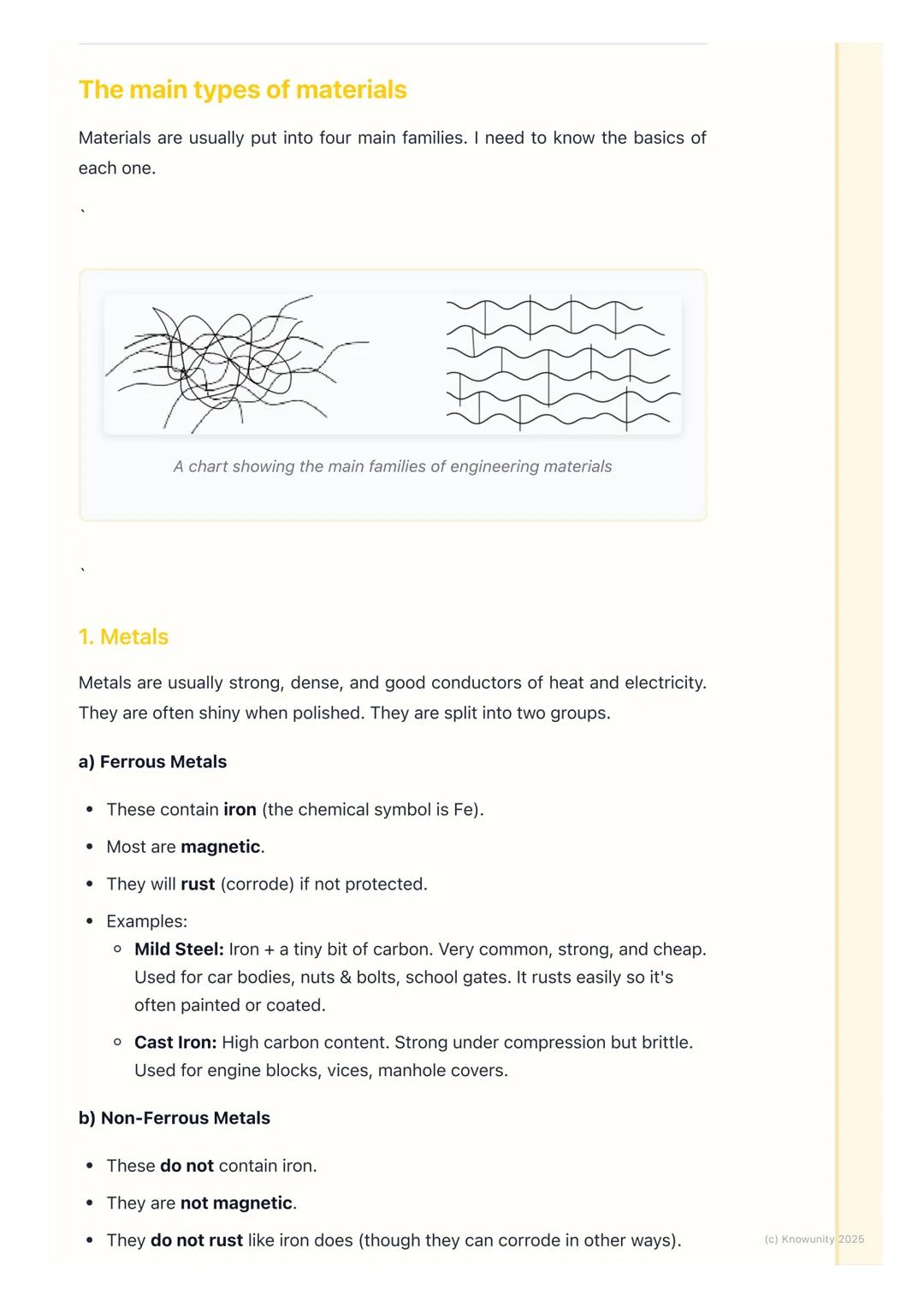
Metals: Ferrous vs Non-Ferrous
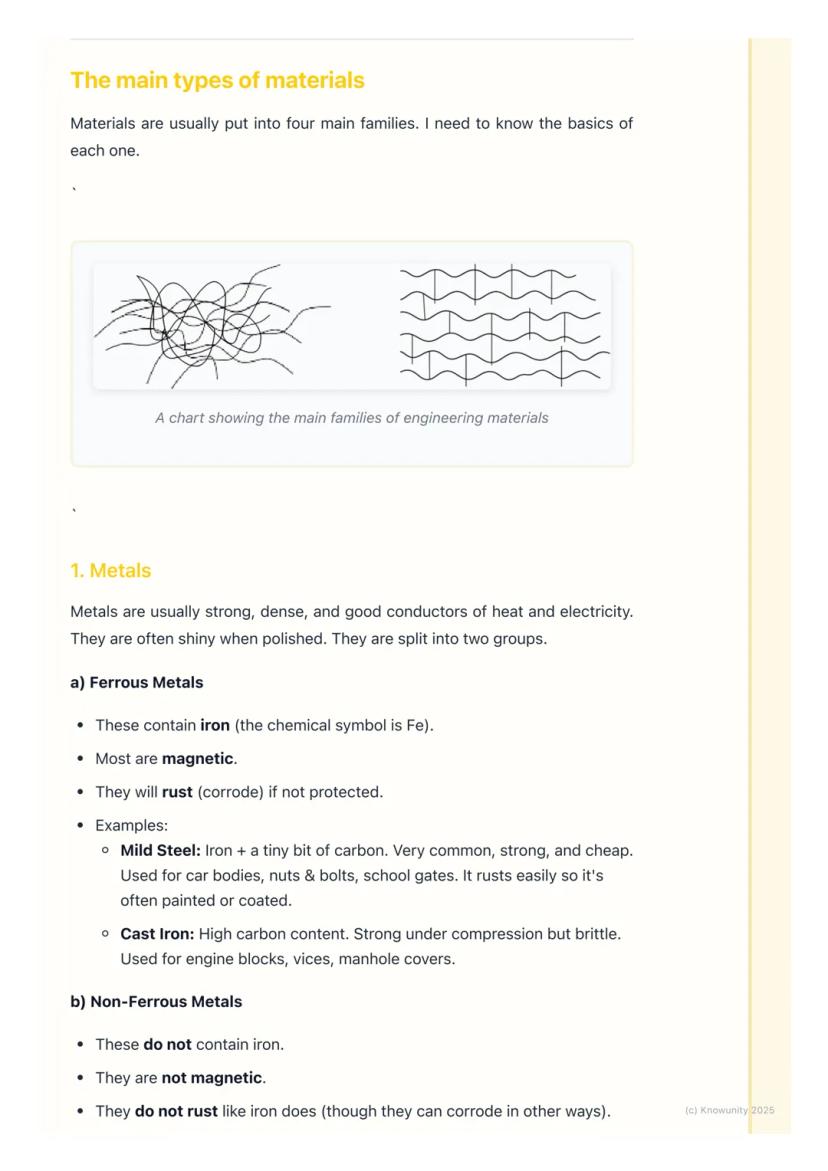
Metals are brilliant conductors and usually strong, but they're split into two main camps based on one simple thing: iron content.
Ferrous metals contain iron (Fe on the periodic table). They're magnetic and will rust if you don't protect them. Mild steel is everywhere - car bodies, school gates, nuts and bolts. It's cheap and strong but rusts easily, so it needs paint or coating. Cast iron has loads of carbon, making it strong under compression but brittle - perfect for engine blocks.
Non-ferrous metals have no iron, so they're not magnetic and don't rust the same way. Aluminium is your lightweight champion - drink cans, window frames, and aeroplanes all use it because it's light and corrosion-resistant. Copper is the electrical superstar because it conducts electricity brilliantly and is super ductile for wire-making.
The key difference is simple: ferrous has iron and rusts, non-ferrous doesn't have iron and won't rust in the traditional way.
Memory Tip: Ferrous contains Fe (iron) - if it sticks to a magnet and can rust, it's ferrous!
3
of 6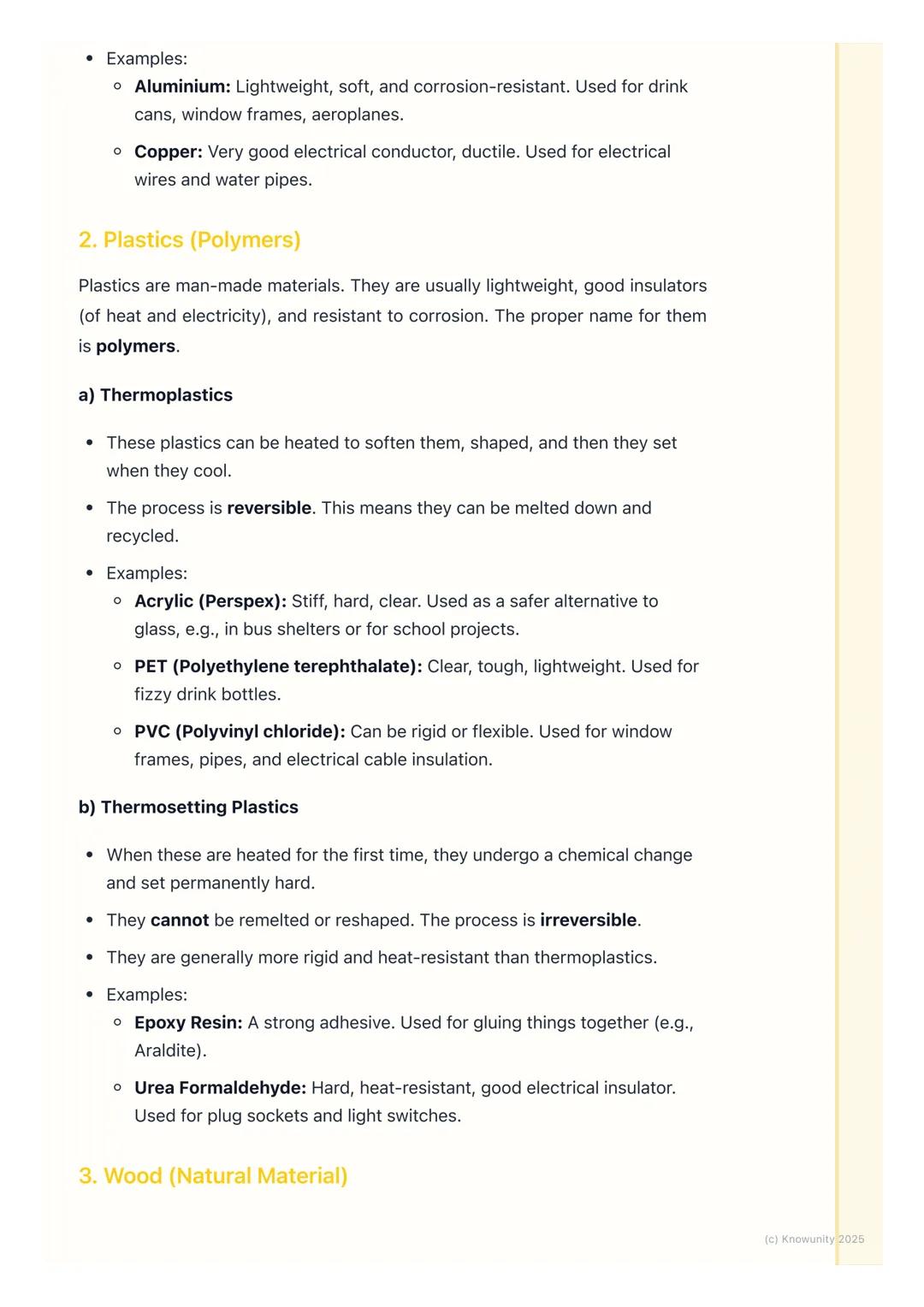
Plastics: Thermoplastics vs Thermosetting
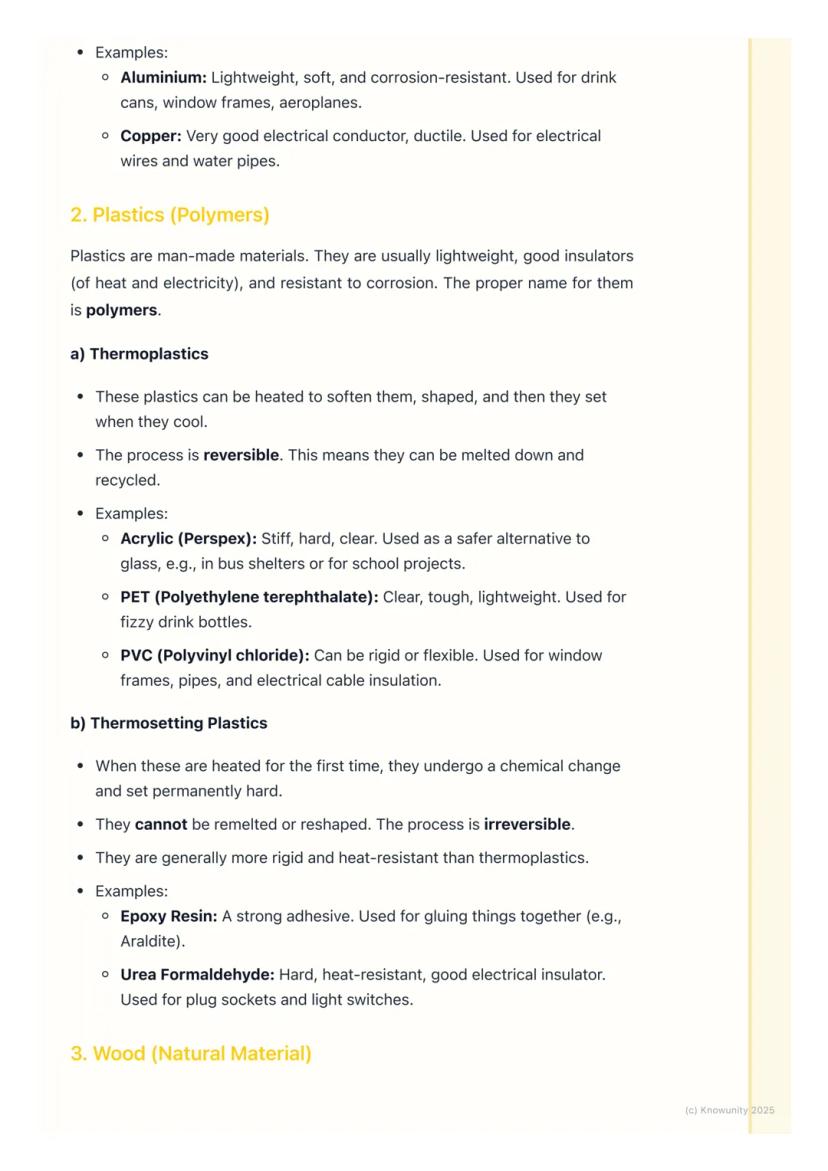
Plastics (properly called polymers) are man-made materials that are lightweight, great insulators, and resist corrosion. The big difference is what happens when you heat them up.
Thermoplastics can be reheated, reshaped, and recycled - the process is reversible. Acrylic (like Perspex) is clear and hard, perfect for bus shelters where glass might be dangerous. PET makes your fizzy drink bottles - it's clear, tough, and lightweight. PVC is versatile, used for everything from window frames to pipe insulation.
Thermosetting plastics undergo a permanent chemical change when first heated - once set, they can never be remelted or recycled. Epoxy resin creates super-strong glues like Araldite. Urea formaldehyde is hard and heat-resistant, making it perfect for plug sockets and light switches that need to handle electricity safely.
Think of it like cooking: thermoplastics are like chocolate (melt and reset repeatedly), whilst thermosets are like cake (once baked, there's no going back).
Exam Gold: Remember - thermoplastics can be recycled, thermosetting plastics cannot!
4
of 6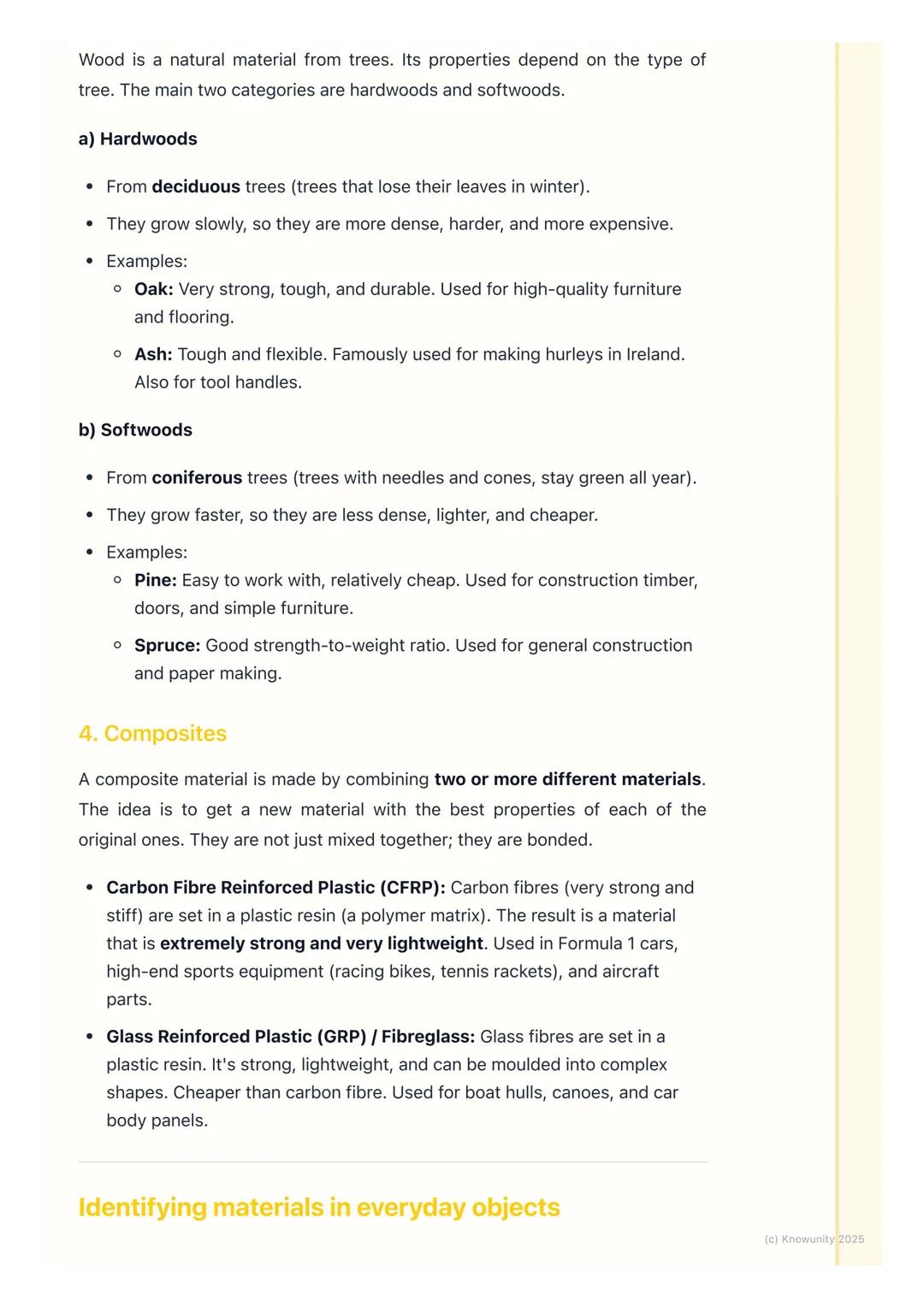
Wood and Composites
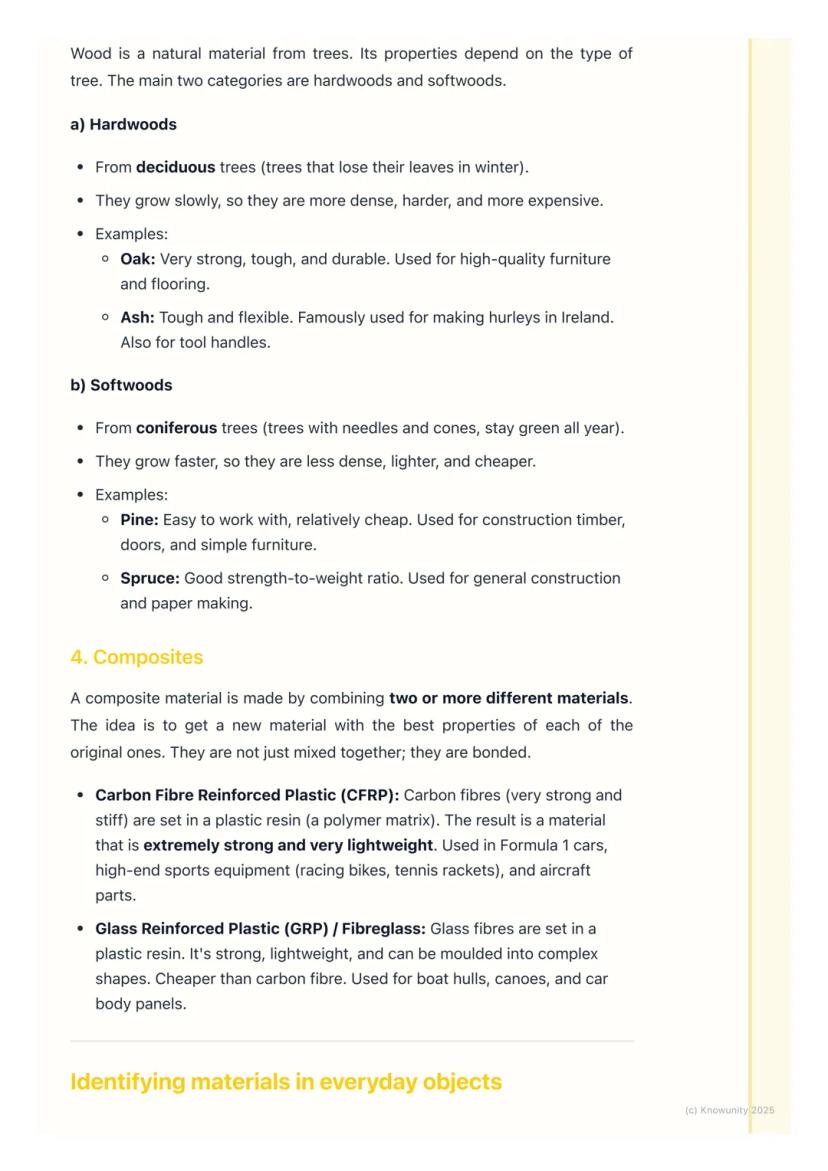
Wood comes in two main types based on tree species. Hardwoods come from deciduous trees (ones that lose leaves in winter) like oak and ash. They grow slowly, making them dense, strong, and expensive. Oak makes brilliant furniture, whilst ash is famously used for hurleys in Ireland because it's tough and flexible.
Softwoods come from coniferous trees (evergreens with needles and cones). They grow faster, so they're less dense and cheaper. Pine is easy to work with and perfect for construction timber, whilst spruce has a great strength-to-weight ratio.
Composites are the superstars of modern engineering - they combine different materials to get the best properties of each. Carbon fibre reinforced plastic puts incredibly strong carbon fibres in plastic resin, creating something stronger than steel but lighter than aluminium. Formula 1 cars and high-end bikes use this.
Glass reinforced plastic (fibreglass) is cheaper but still strong and lightweight, perfect for boat hulls and car panels.
Real World: Next time you see a racing bike or sports car, you're probably looking at composite materials designed for maximum strength with minimum weight!
5
of 6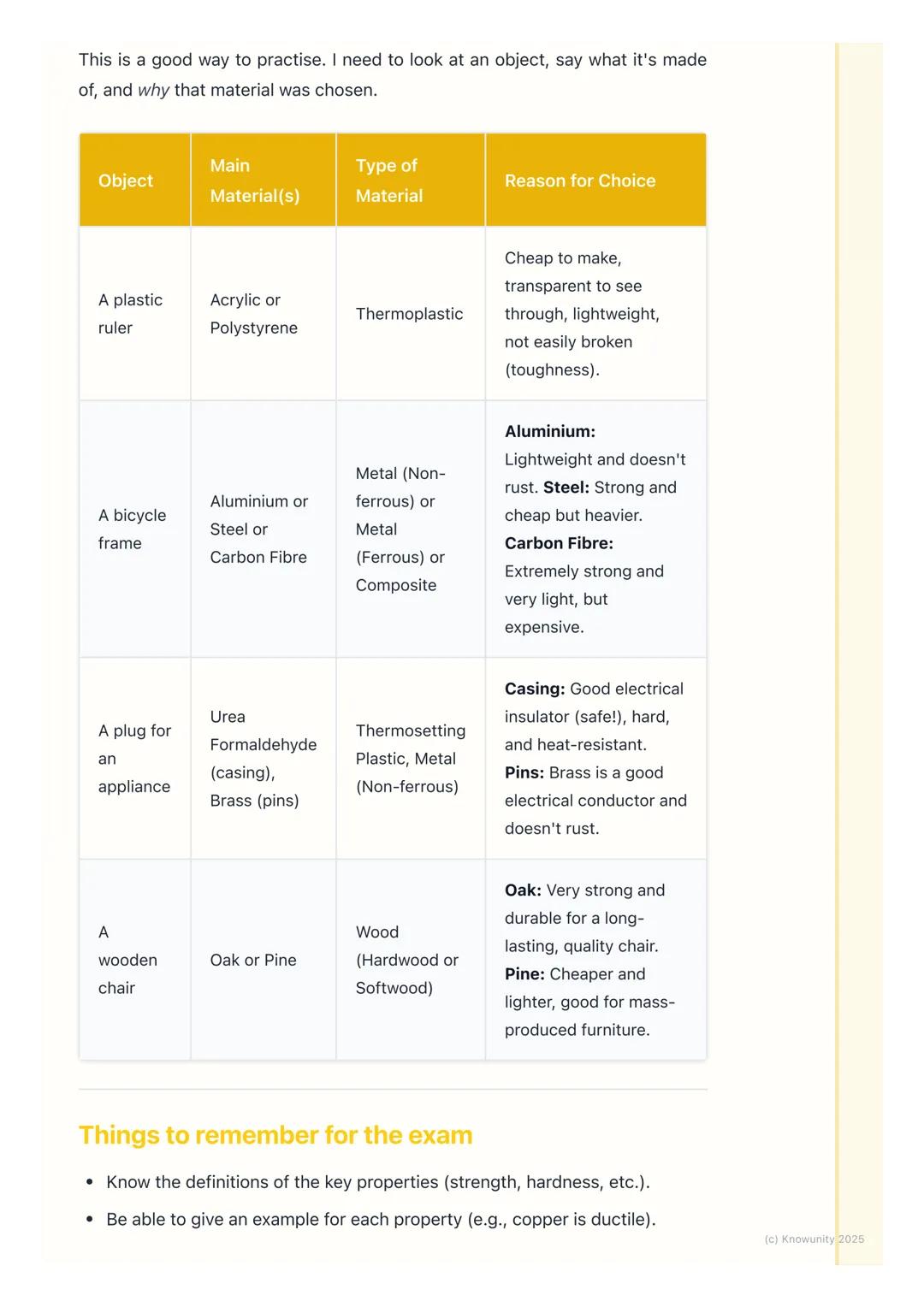
Material Selection in Practice
The secret to engineering success is matching material properties to job requirements. When you see any object, ask yourself: what material is this, and why was it chosen?
A copper wire works because copper is an excellent electrical conductor and highly ductile - it can be drawn into thin wires without breaking. Aluminium drink cans make sense because aluminium is lightweight, corrosion-resistant, and can be formed into complex shapes.
Steel car bodies use mild steel because it's strong, relatively cheap, and can be shaped easily (it's both malleable and ductile). The paint protects it from rusting. Plastic bottles use PET because it's clear, tough, lightweight, and can be recycled.
Understanding the 'why' behind material choices will make you think like an engineer. Every material selection is a careful balance of properties, cost, and performance requirements.
Exam Strategy: For any "Why was this material chosen?" question, always link back to specific properties - strength, conductivity, weight, cost, or durability!
6
of 6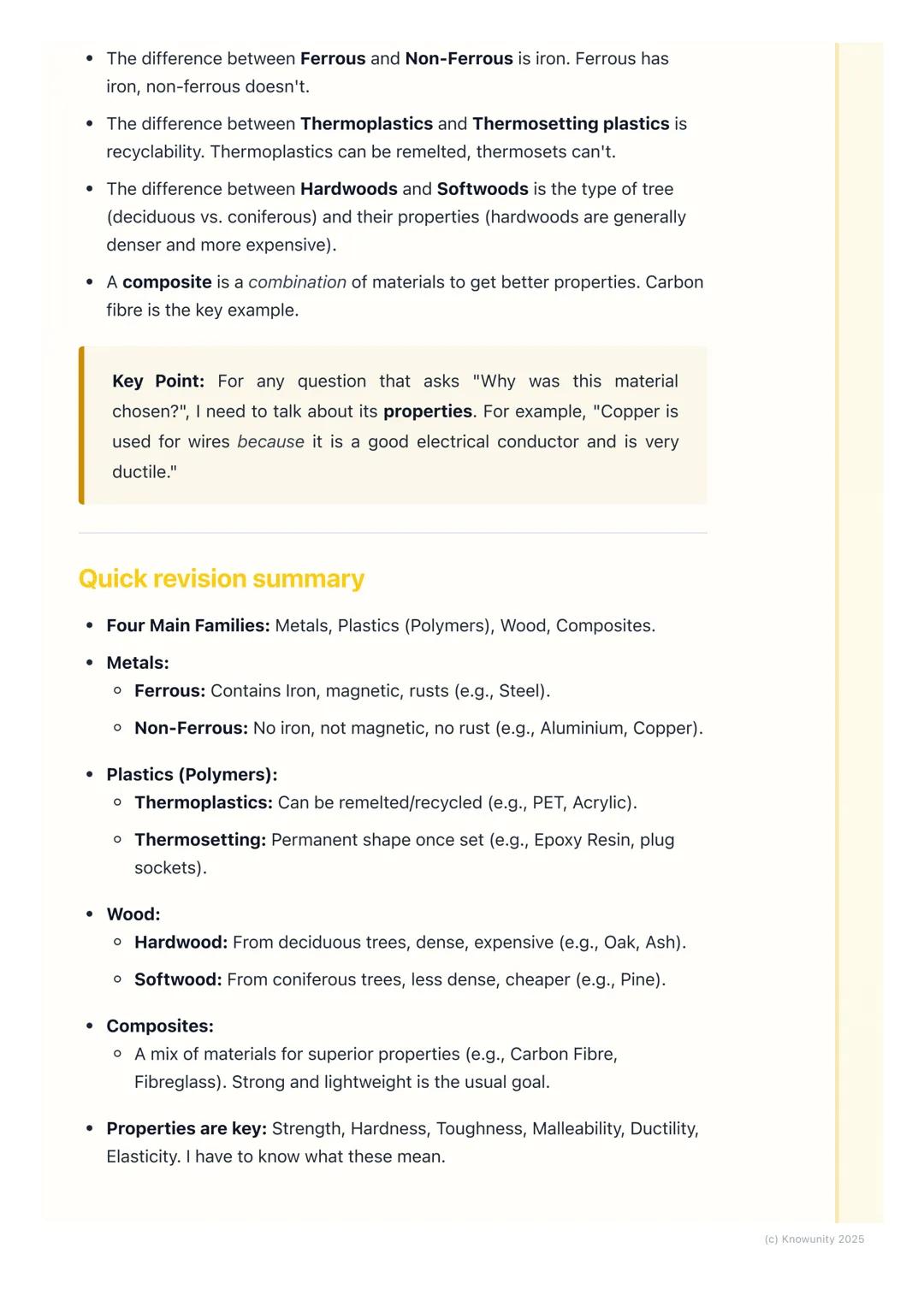
Quick Revision Summary
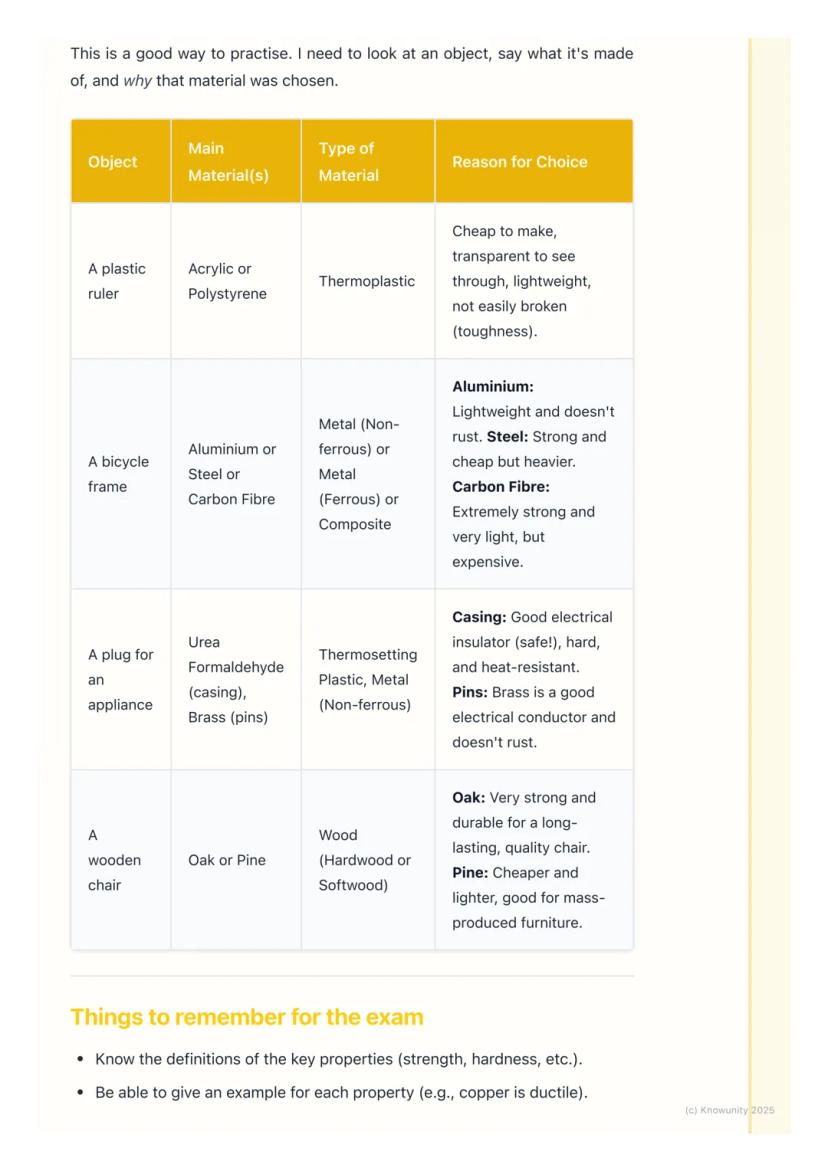
Here are the essential facts you need to nail any materials test. Four main families: Metals, Plastics (Polymers), Wood, and Composites.
Key differences: Ferrous metals contain iron (magnetic, rust), non-ferrous don't. Thermoplastics can be remelted and recycled, thermosetting plastics set permanently. Hardwoods come from deciduous trees (expensive, dense), softwoods from coniferous trees (cheaper, less dense).
Composites combine materials for superior properties - carbon fibre and fibreglass are your main examples, both aiming for strong yet lightweight results.
Properties vocabulary: Strength (resisting force), hardness (resisting scratching), toughness (absorbing impact), malleability (hammering into sheets), ductility (drawing into wires), elasticity (returning to shape), plasticity (staying deformed).
Remember the memory tricks: malleable = mallet = sheets, ductile = duct = wires, ferrous = Fe = iron content.
Final Tip: Master the properties and you'll ace any materials question - they're the foundation of everything in engineering!
Pensamos que nunca lo preguntarías...
¿Qué es Knowunity AI companion?
Nuestro compañero de IA está específicamente adaptado a las necesidades de los estudiantes. Basándonos en los millones de contenidos que tenemos en la plataforma, podemos dar a los estudiantes respuestas realmente significativas y relevantes. Pero no se trata solo de respuestas, el compañero también guía a los estudiantes a través de sus retos de aprendizaje diarios, con planes de aprendizaje personalizados, cuestionarios o contenidos en el chat y una personalización del 100% basada en las habilidades y el desarrollo de los estudiantes.
¿Dónde puedo descargar la app Knowunity?
Puedes descargar la app en Google Play Store y Apple App Store.
¿Knowunity es totalmente gratuito?
Sí, tienes acceso gratuito a los contenidos de la aplicación y a nuestro compañero de IA. Para desbloquear determinadas funciones de la aplicación, puedes adquirir Knowunity Pro.
Contenidos más populares de Engineering
1Contenidos más populares
9 Irish
IrishIrish oral questions and answers
Questions and answers for the leaving cert oral
5th Year4264
 English
Key Quotes : Sive
Key Quotes and explanations: Sive
6th Year2842
IrishIrish oral questions
Outline of oral questions
5th Year2055
IrishIníon- le hÁine Durkin
Aine Durkin’s poem, Iníon: Themes & summary
5th Year850
IrishIrish poetry 2027
Iníon + Dínit an Bhróin
5th Year1133
IrishLC HL notes- Iníon (poem)
Includes poem in English and Irish, theme, key words & phrases
5th Year2284
EnglishCultural Context : Shawshank Redemption : Sive : Small Things Like These
Comparative Study : Cultural Context : Shawshank Redemption, Sive and Small Things Like These
6th Year1430
IrishMo Ghrá-sa (Idir Lúibíní)
Notes on mo ghrá-sa
5th Year380
IrishAn Gaeilge Aiste
Irish Language essay
6th Year1320
¿No encuentras lo que buscas? Explora otros temas.
Mira lo que dicen nuestros usuarios. Les encanta - y a tí también.
4.6/5App Store
4.7/5Google Play
La app es muy fácil de usar y está muy bien diseñada. Hasta ahora he encontrado todo lo que estaba buscando y he podido aprender mucho de las presentaciones. Definitivamente utilizaré la aplicación para un examen de clase. Y, por supuesto, también me sirve mucho de inspiración.
Pablousuario de iOS
Esta app es realmente genial. Hay tantos apuntes de clase y ayuda [...]. Tengo problemas con matemáticas, por ejemplo, y la aplicación tiene muchas opciones de ayuda. Gracias a Knowunity, he mejorado en mates. Se la recomiendo a todo el mundo.
Elenausuaria de Android
Vaya, estoy realmente sorprendida. Acabo de probar la app porque la he visto anunciada muchas veces y me he quedado absolutamente alucinada. Esta app es LA AYUDA que quieres para el insti y, sobre todo, ofrece muchísimas cosas, como ejercicios y hojas informativas, que a mí personalmente me han sido MUY útiles.
Anausuaria de iOS
Engineering2 visualizaciones·Actualizado Jun 12, 2026·6 páginasCommon Types of Engineering Materials and Characteristics
Ever wondered why your phone isn't made of wood or why bridges aren't built from plastic? Choosing the right material for a job is absolutely crucial in engineering - get it wrong and your product could be too heavy, weak,...
1
of 6
Inscríbete para ver los apuntes. ¡Es gratis!
- Acceso a todos los documentos
- Mejora tus notas
- Únete a millones de estudiantes
Material Properties and Vocabulary
Understanding how materials behave is your first step to becoming an engineering expert. These properties determine whether a material is perfect for the job or completely useless.
Strength is how well a material resists force without breaking. There's tensile strength (pulling forces) and compressive strength (squashing forces). Hardness measures resistance to scratching - think of diamond being incredibly hard.
Toughness is different from strength - it's about absorbing impact without breaking. Car bumpers need to be tough, not just strong. Elasticity means bouncing back to original shape (like elastic bands), while plasticity is the opposite - staying bent like a paperclip.
Here's a brilliant memory trick: Malleable materials can be hammered into sheets (like a mallet flattens things), whilst ductile materials can be drawn into wires (like going through a duct). Don't mix these up in your exams!
Quick Test: Try bending a paperclip - first it's elastic (springs back), then becomes plastic (stays bent). This shows both properties in action!
2
of 6Inscríbete para ver los apuntes. ¡Es gratis!
- Acceso a todos los documentos
- Mejora tus notas
- Únete a millones de estudiantes
Metals: Ferrous vs Non-Ferrous
Metals are brilliant conductors and usually strong, but they're split into two main camps based on one simple thing: iron content.
Ferrous metals contain iron (Fe on the periodic table). They're magnetic and will rust if you don't protect them. Mild steel is everywhere - car bodies, school gates, nuts and bolts. It's cheap and strong but rusts easily, so it needs paint or coating. Cast iron has loads of carbon, making it strong under compression but brittle - perfect for engine blocks.
Non-ferrous metals have no iron, so they're not magnetic and don't rust the same way. Aluminium is your lightweight champion - drink cans, window frames, and aeroplanes all use it because it's light and corrosion-resistant. Copper is the electrical superstar because it conducts electricity brilliantly and is super ductile for wire-making.
The key difference is simple: ferrous has iron and rusts, non-ferrous doesn't have iron and won't rust in the traditional way.
Memory Tip: Ferrous contains Fe (iron) - if it sticks to a magnet and can rust, it's ferrous!
3
of 6Inscríbete para ver los apuntes. ¡Es gratis!
- Acceso a todos los documentos
- Mejora tus notas
- Únete a millones de estudiantes
Plastics: Thermoplastics vs Thermosetting
Plastics (properly called polymers) are man-made materials that are lightweight, great insulators, and resist corrosion. The big difference is what happens when you heat them up.
Thermoplastics can be reheated, reshaped, and recycled - the process is reversible. Acrylic (like Perspex) is clear and hard, perfect for bus shelters where glass might be dangerous. PET makes your fizzy drink bottles - it's clear, tough, and lightweight. PVC is versatile, used for everything from window frames to pipe insulation.
Thermosetting plastics undergo a permanent chemical change when first heated - once set, they can never be remelted or recycled. Epoxy resin creates super-strong glues like Araldite. Urea formaldehyde is hard and heat-resistant, making it perfect for plug sockets and light switches that need to handle electricity safely.
Think of it like cooking: thermoplastics are like chocolate (melt and reset repeatedly), whilst thermosets are like cake (once baked, there's no going back).
Exam Gold: Remember - thermoplastics can be recycled, thermosetting plastics cannot!
4
of 6Inscríbete para ver los apuntes. ¡Es gratis!
- Acceso a todos los documentos
- Mejora tus notas
- Únete a millones de estudiantes
Wood and Composites
Wood comes in two main types based on tree species. Hardwoods come from deciduous trees (ones that lose leaves in winter) like oak and ash. They grow slowly, making them dense, strong, and expensive. Oak makes brilliant furniture, whilst ash is famously used for hurleys in Ireland because it's tough and flexible.
Softwoods come from coniferous trees (evergreens with needles and cones). They grow faster, so they're less dense and cheaper. Pine is easy to work with and perfect for construction timber, whilst spruce has a great strength-to-weight ratio.
Composites are the superstars of modern engineering - they combine different materials to get the best properties of each. Carbon fibre reinforced plastic puts incredibly strong carbon fibres in plastic resin, creating something stronger than steel but lighter than aluminium. Formula 1 cars and high-end bikes use this.
Glass reinforced plastic (fibreglass) is cheaper but still strong and lightweight, perfect for boat hulls and car panels.
Real World: Next time you see a racing bike or sports car, you're probably looking at composite materials designed for maximum strength with minimum weight!
5
of 6Inscríbete para ver los apuntes. ¡Es gratis!
- Acceso a todos los documentos
- Mejora tus notas
- Únete a millones de estudiantes
Material Selection in Practice
The secret to engineering success is matching material properties to job requirements. When you see any object, ask yourself: what material is this, and why was it chosen?
A copper wire works because copper is an excellent electrical conductor and highly ductile - it can be drawn into thin wires without breaking. Aluminium drink cans make sense because aluminium is lightweight, corrosion-resistant, and can be formed into complex shapes.
Steel car bodies use mild steel because it's strong, relatively cheap, and can be shaped easily (it's both malleable and ductile). The paint protects it from rusting. Plastic bottles use PET because it's clear, tough, lightweight, and can be recycled.
Understanding the 'why' behind material choices will make you think like an engineer. Every material selection is a careful balance of properties, cost, and performance requirements.
Exam Strategy: For any "Why was this material chosen?" question, always link back to specific properties - strength, conductivity, weight, cost, or durability!
6
of 6Inscríbete para ver los apuntes. ¡Es gratis!
- Acceso a todos los documentos
- Mejora tus notas
- Únete a millones de estudiantes
Quick Revision Summary
Here are the essential facts you need to nail any materials test. Four main families: Metals, Plastics (Polymers), Wood, and Composites.
Key differences: Ferrous metals contain iron (magnetic, rust), non-ferrous don't. Thermoplastics can be remelted and recycled, thermosetting plastics set permanently. Hardwoods come from deciduous trees (expensive, dense), softwoods from coniferous trees (cheaper, less dense).
Composites combine materials for superior properties - carbon fibre and fibreglass are your main examples, both aiming for strong yet lightweight results.
Properties vocabulary: Strength (resisting force), hardness (resisting scratching), toughness (absorbing impact), malleability (hammering into sheets), ductility (drawing into wires), elasticity (returning to shape), plasticity (staying deformed).
Remember the memory tricks: malleable = mallet = sheets, ductile = duct = wires, ferrous = Fe = iron content.
Final Tip: Master the properties and you'll ace any materials question - they're the foundation of everything in engineering!
Pensamos que nunca lo preguntarías...
¿Qué es Knowunity AI companion?
Nuestro compañero de IA está específicamente adaptado a las necesidades de los estudiantes. Basándonos en los millones de contenidos que tenemos en la plataforma, podemos dar a los estudiantes respuestas realmente significativas y relevantes. Pero no se trata solo de respuestas, el compañero también guía a los estudiantes a través de sus retos de aprendizaje diarios, con planes de aprendizaje personalizados, cuestionarios o contenidos en el chat y una personalización del 100% basada en las habilidades y el desarrollo de los estudiantes.
¿Dónde puedo descargar la app Knowunity?
Puedes descargar la app en Google Play Store y Apple App Store.
¿Knowunity es totalmente gratuito?
Sí, tienes acceso gratuito a los contenidos de la aplicación y a nuestro compañero de IA. Para desbloquear determinadas funciones de la aplicación, puedes adquirir Knowunity Pro.
Contenidos más populares de Engineering
1Contenidos más populares
9IrishIrish oral questions and answers
Questions and answers for the leaving cert oral
5th Year4264
EnglishKey Quotes : Sive
Key Quotes and explanations: Sive
6th Year2842
IrishIrish oral questions
Outline of oral questions
5th Year2055
IrishIníon- le hÁine Durkin
Aine Durkin’s poem, Iníon: Themes & summary
5th Year850
IrishIrish poetry 2027
Iníon + Dínit an Bhróin
5th Year1133
IrishLC HL notes- Iníon (poem)
Includes poem in English and Irish, theme, key words & phrases
5th Year2284
EnglishCultural Context : Shawshank Redemption : Sive : Small Things Like These
Comparative Study : Cultural Context : Shawshank Redemption, Sive and Small Things Like These
6th Year1430
IrishMo Ghrá-sa (Idir Lúibíní)
Notes on mo ghrá-sa
5th Year380
IrishAn Gaeilge Aiste
Irish Language essay
6th Year1320
¿No encuentras lo que buscas? Explora otros temas.
Mira lo que dicen nuestros usuarios. Les encanta - y a tí también.
4.6/5App Store
4.7/5Google Play
La app es muy fácil de usar y está muy bien diseñada. Hasta ahora he encontrado todo lo que estaba buscando y he podido aprender mucho de las presentaciones. Definitivamente utilizaré la aplicación para un examen de clase. Y, por supuesto, también me sirve mucho de inspiración.
Pablousuario de iOS
Esta app es realmente genial. Hay tantos apuntes de clase y ayuda [...]. Tengo problemas con matemáticas, por ejemplo, y la aplicación tiene muchas opciones de ayuda. Gracias a Knowunity, he mejorado en mates. Se la recomiendo a todo el mundo.
Elenausuaria de Android
Vaya, estoy realmente sorprendida. Acabo de probar la app porque la he visto anunciada muchas veces y me he quedado absolutamente alucinada. Esta app es LA AYUDA que quieres para el insti y, sobre todo, ofrece muchísimas cosas, como ejercicios y hojas informativas, que a mí personalmente me han sido MUY útiles.
Anausuaria de iOS