
Ever wondered how plants are organised to survive and thrive?...
 Biology6 visualizaciones·Actualizado Jun 12, 2026·7 páginas
Understanding Plant Structures and Functions
1 / 7
1
of 7
Plant Organisation Basics
Think of plants as multicellular organisms with a smart three-part structure. The roots anchor and absorb, stems support and transport, whilst leaves make food through photosynthesis.
Every plant organ contains three main tissue systems working together. Dermal tissue acts like the plant's skin - it's the protective outer layer that prevents water loss and, in roots, absorbs water through root hairs. Ground tissue fills the middle spaces and handles photosynthesis in leaves or storage in stems and roots (think potato starch). Vascular tissue is the plant's transport system, bundled into veins that carry substances around.
The vascular system has two parts you need to master. Xylem transports water and minerals upward from roots - these are dead, hollow cells strengthened with lignin for support. Phloem moves food (sugars) both up and down the plant through living cells called sieve tubes and companion cells.
Memory trick: "Xylem to the sky, phloem to the floor" - though remember phloem can actually go both ways!
2
of 7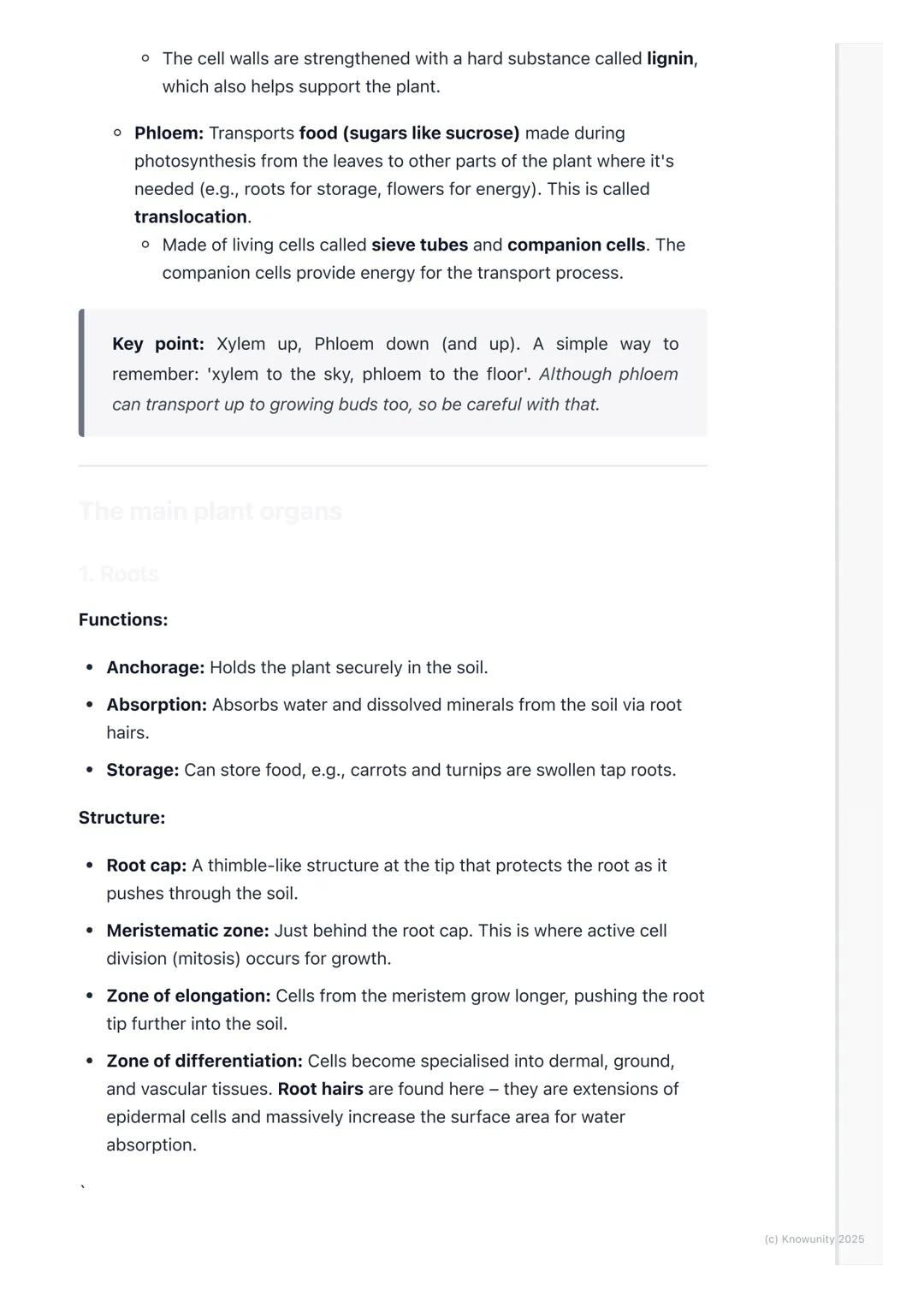
Roots: The Foundation System
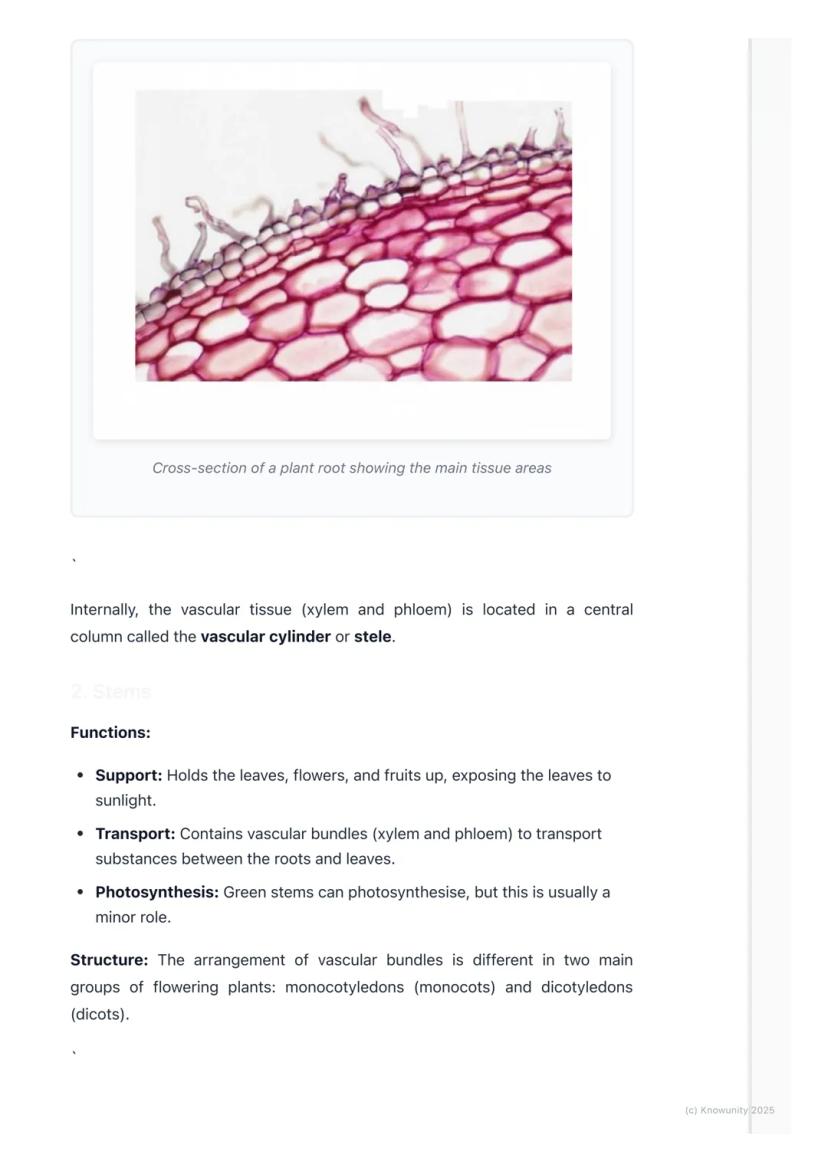
Root structure is all about getting water and staying put. The root cap protects the growing tip as it pushes through soil, whilst the meristematic zone just behind it is where active cell division happens for growth.
The clever bit is the zone of differentiation where cells specialise into different tissues. This is where you'll find root hairs - tiny extensions of skin cells that massively increase surface area for water absorption. Don't get confused - these aren't mini roots, they're single elongated cells!
Inside the root, the vascular cylinder (or stele) contains all the transport tissues in a central column. This arrangement makes perfect sense - water absorbed by root hairs can quickly reach the xylem for transport upward.
Roots have three main jobs that'll definitely appear on your exam: anchorage (holding the plant steady), absorption (taking in water and minerals), and storage (like carrots storing food in swollen tap roots).
Exam tip: Root hairs are single cells, not tiny roots - this distinction often catches students out!
3
of 7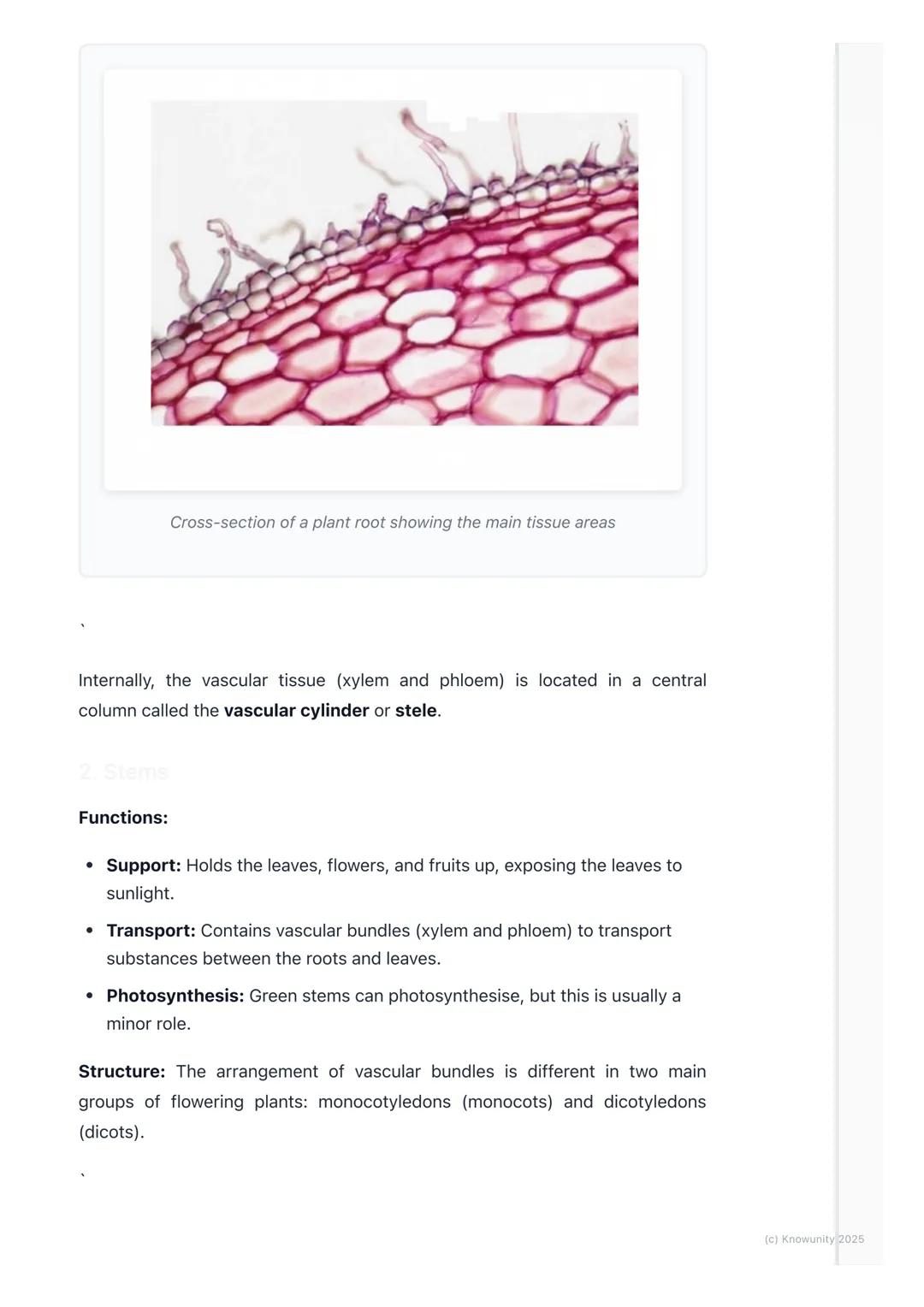
Stems: Support and Transport Central
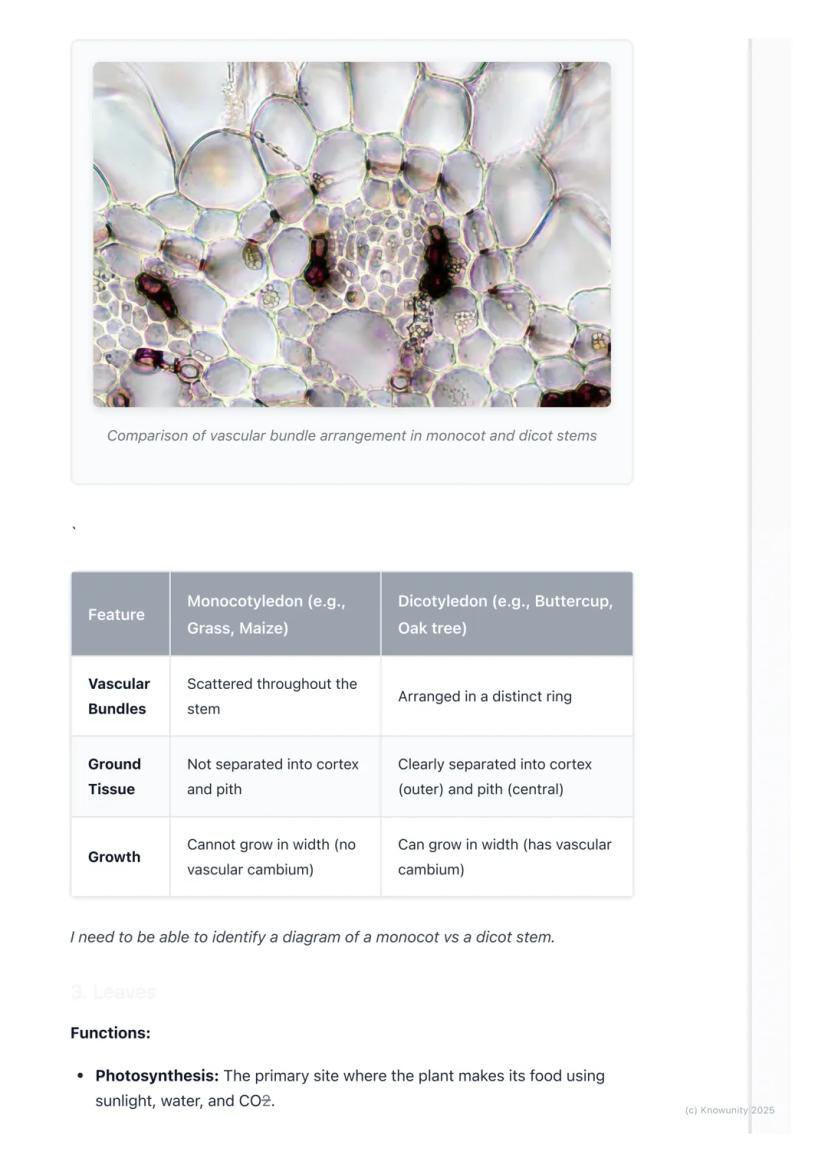
Stem structure varies dramatically between plant types, and you need to spot the difference. Monocotyledons (like grass and maize) scatter their vascular bundles randomly throughout the stem. Dicotyledons (like buttercups and oak trees) arrange them in a neat ring.
This arrangement affects how plants grow. Monocots can't grow wider because they lack vascular cambium - the growth tissue that adds thickness. Dicots can bulk up over time, which is why trees get thicker each year.
The ground tissue organisation also differs between these plant types. Dicots clearly separate their ground tissue into cortex (outer region) and pith (central region), whilst monocots don't make this distinction.
Stems handle three key functions: support (holding leaves up to catch sunlight), transport (moving substances between roots and leaves), and sometimes minor photosynthesis in green stems.
Quick ID: Scattered bundles = monocot, ring arrangement = dicot - learn to recognise these patterns in diagrams!
4
of 7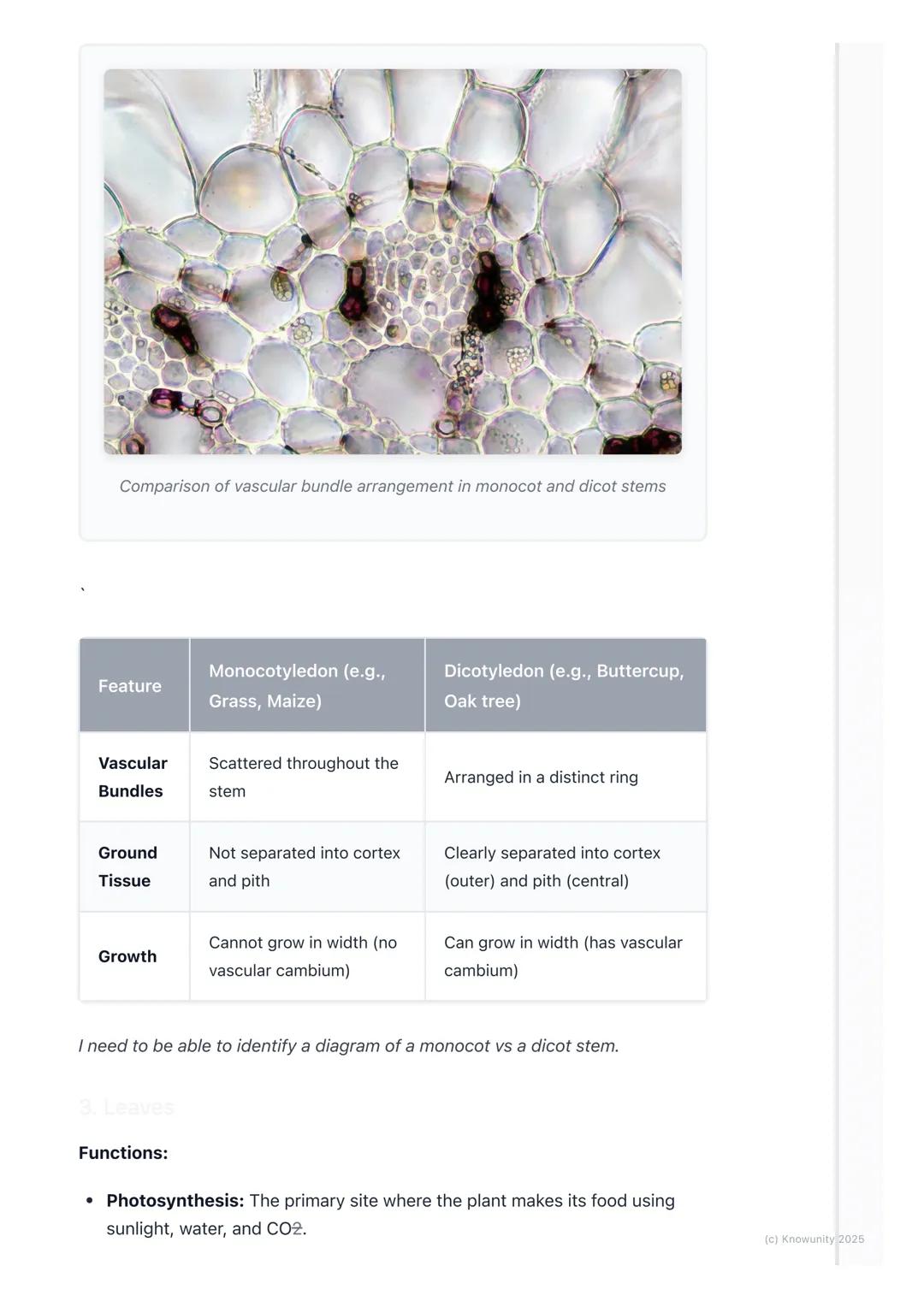
Leaves: The Food Factories
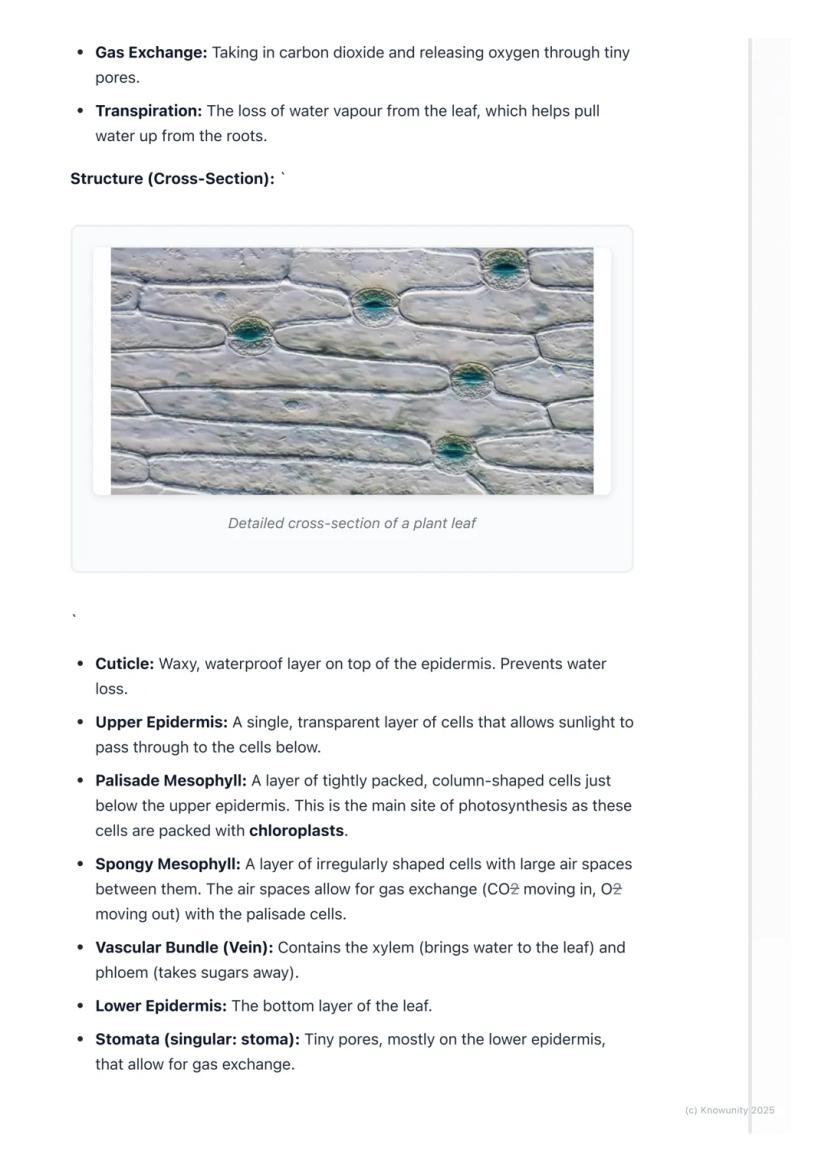
Leaf structure is perfectly designed for photosynthesis, and understanding this will help you nail those "explain the adaptation" questions. The cuticle and upper epidermis let light through whilst preventing water loss.
Palisade mesophyll cells are the photosynthesis superstars - packed with chloroplasts and arranged in tight columns just below the surface to capture maximum sunlight. Below them, spongy mesophyll has a completely different job with its loose arrangement and large air spaces.
Stomata (controlled by guard cells) are tiny pores mainly on the leaf's underside that regulate gas exchange. Carbon dioxide enters here, oxygen exits, and water vapour escapes during transpiration. The vascular bundles (veins) bring water via xylem and remove sugars via phloem.
This whole system works together brilliantly - veins supply raw materials, palisade cells capture light energy, air spaces allow gas movement, and stomata control the whole process.
Exam success: Be able to draw and label a leaf cross-section - this diagram appears frequently and is easy marks if you know it!
5
of 7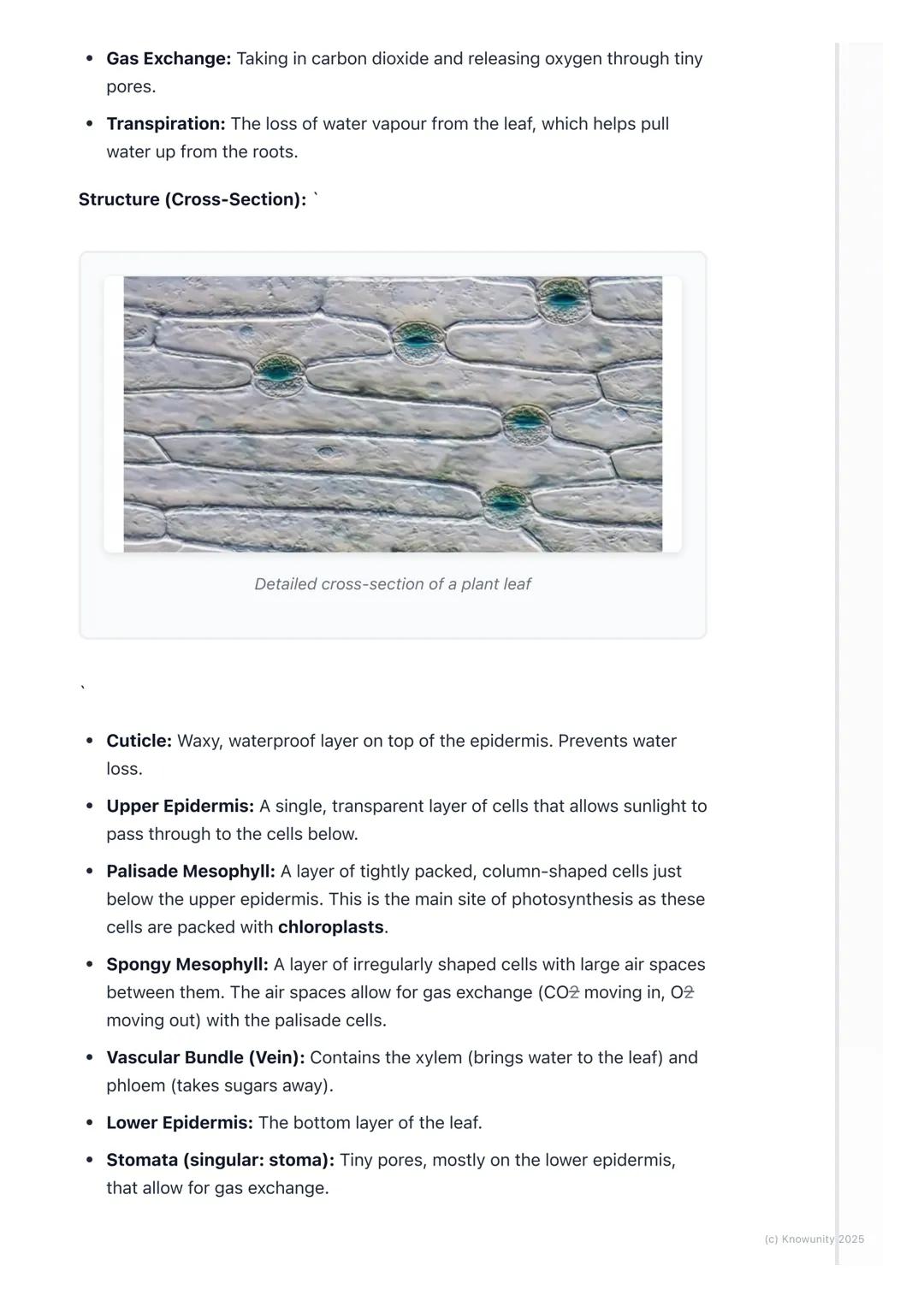
Leaf Adaptations for Photosynthesis
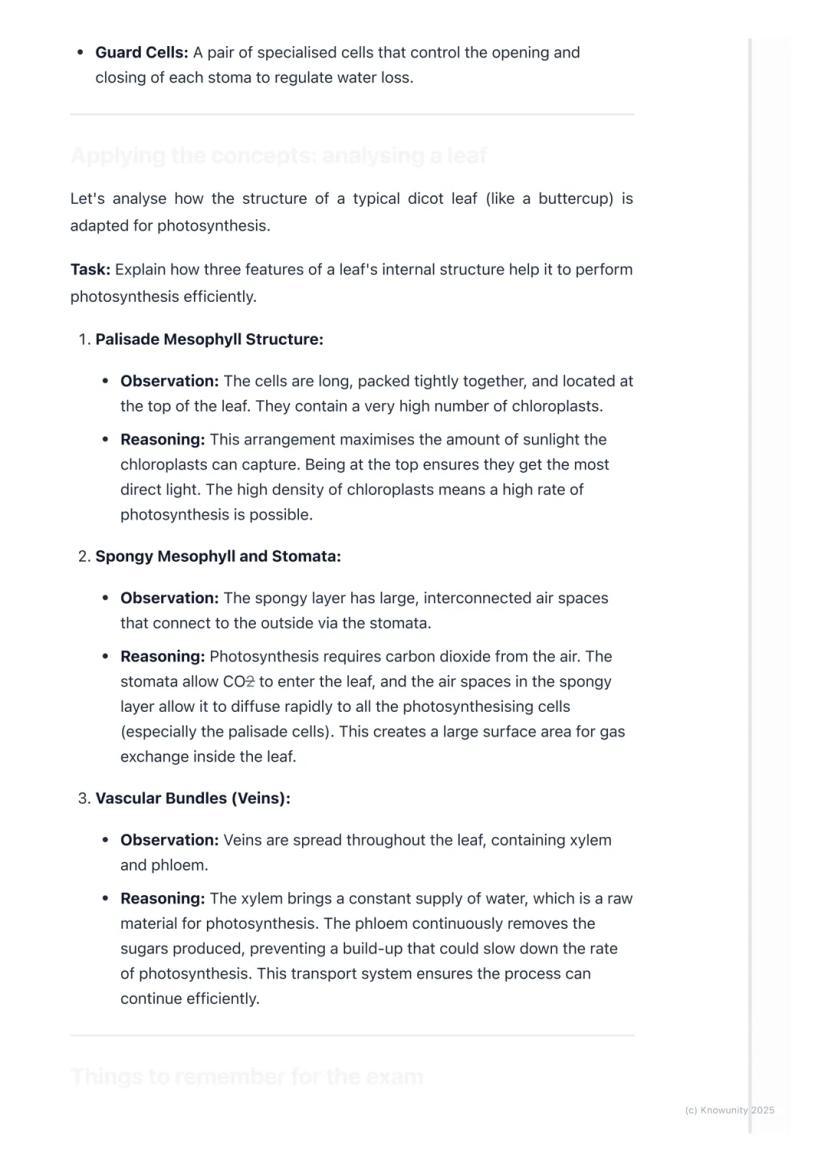
When exam questions ask how leaf structure supports photosynthesis, focus on three key adaptations. Palisade mesophyll structure maximises light capture - these column-shaped cells packed with chloroplasts sit at the top where light is strongest.
The spongy mesophyll and stomata system ensures efficient gas exchange. Those interconnected air spaces create a massive internal surface area, allowing carbon dioxide to diffuse rapidly from stomata to photosynthesising cells.
Vascular bundles spread throughout the leaf maintain the supply chain. Xylem delivers water (a raw material), whilst phloem removes sugars (the products), preventing build-up that could slow the process.
Remember the two transport processes that sound similar but are completely different: transpiration is water loss from leaves, whilst translocation is sugar movement in phloem. Don't mix these up!
Warning: Transpiration ≠ translocation - these sound similar but mean totally different things. Keep them straight!
6
of 7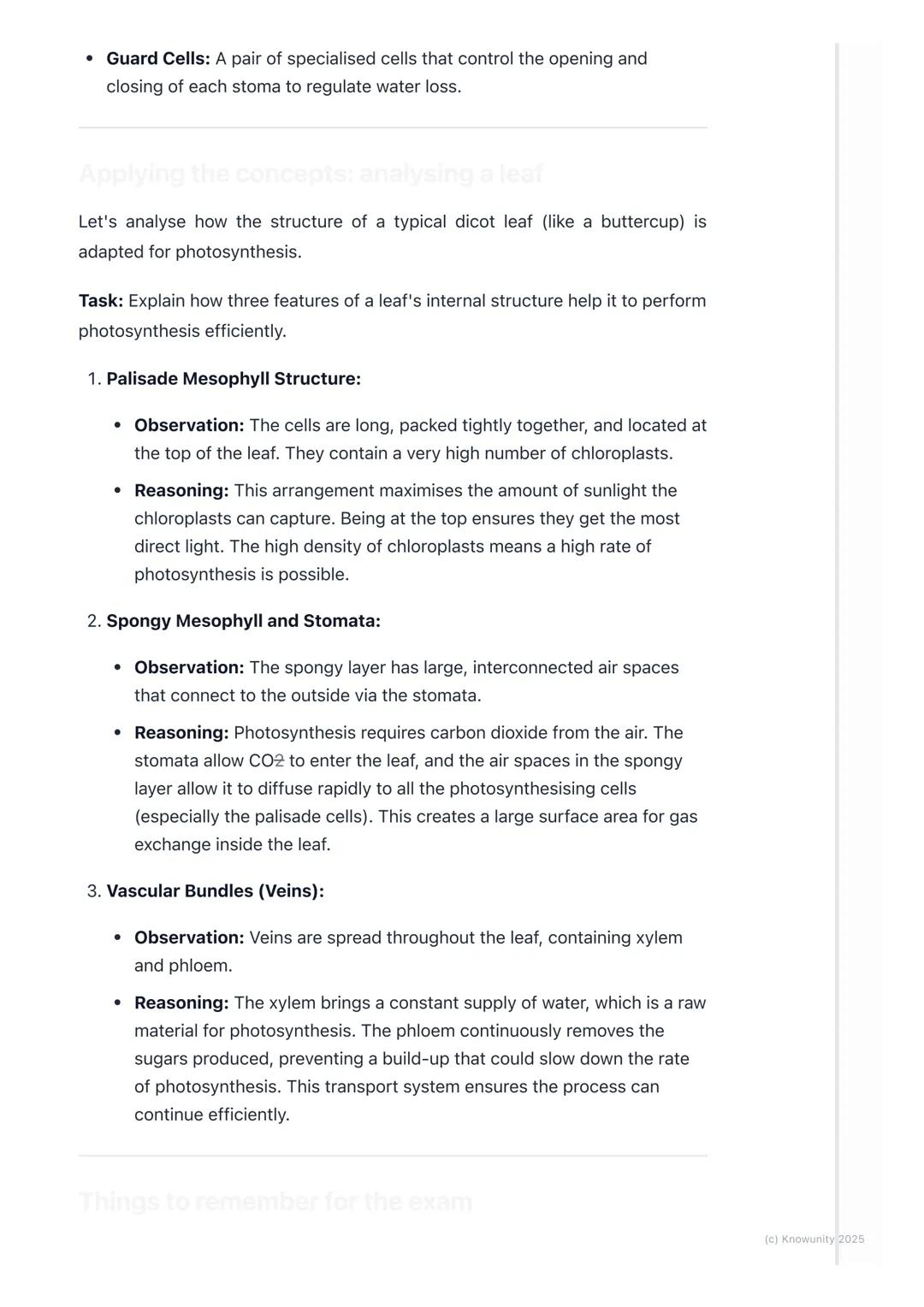
Monocots vs Dicots: Key Differences
Understanding monocot and dicot stem differences is crucial for plant identification. Monocotyledons scatter their vascular bundles randomly throughout the stem cross-section, like dots on a dice.
Dicotyledons arrange their vascular bundles in a clear ring pattern, creating distinct regions. Their ground tissue separates into cortex (outer) and pith (inner), whilst monocots don't make this separation.
The growth implications are significant. Dicots possess vascular cambium tissue that allows width increase over time - this is why trees can grow thicker. Monocots lack this cambium, so they can only grow taller, not wider.
This knowledge helps you identify plant types from stem diagrams and explains why bamboo (a monocot) grows so differently from oak trees (dicots). The structural differences reflect different evolutionary strategies.
Pattern recognition: In diagrams, if you see bundles in a ring, it's a dicot; if they're scattered randomly, it's a monocot!
7
of 7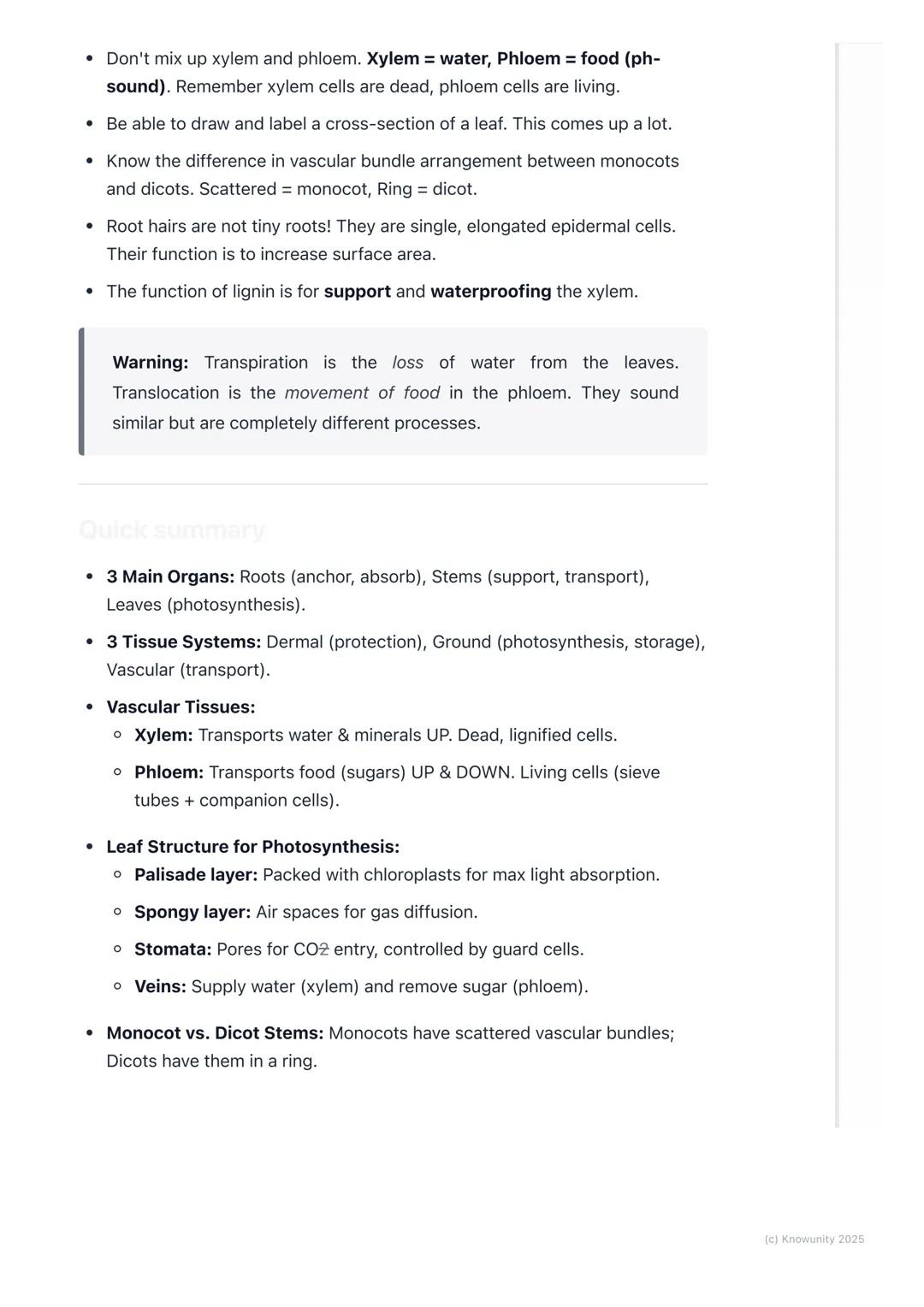
Exam Success Guide
Master these key distinctions to avoid common mistakes. Xylem transports water upward through dead, lignin-strengthened cells, whilst phloem moves sugars through living sieve tubes and companion cells in both directions.
Root hairs are single elongated cells, not tiny roots - they increase surface area for absorption. Lignin strengthens xylem walls and provides structural support to the whole plant.
For leaf diagrams, remember the layers from top to bottom: cuticle, upper epidermis, palisade mesophyll, spongy mesophyll, lower epidermis with stomata and guard cells. The vascular bundles (veins) run through the middle layers.
Plant organisation follows a logical pattern: three main organs (roots, stems, leaves), three tissue systems (dermal, ground, vascular), and two transport tissues (xylem up, phloem both ways). Understanding this hierarchy will help you tackle any plant structure question confidently.
Final tip: Practice drawing leaf cross-sections until you can do them from memory - it's guaranteed easy marks on your exam!
Pensamos que nunca lo preguntarías...
¿Qué es Knowunity AI companion?
Nuestro compañero de IA está específicamente adaptado a las necesidades de los estudiantes. Basándonos en los millones de contenidos que tenemos en la plataforma, podemos dar a los estudiantes respuestas realmente significativas y relevantes. Pero no se trata solo de respuestas, el compañero también guía a los estudiantes a través de sus retos de aprendizaje diarios, con planes de aprendizaje personalizados, cuestionarios o contenidos en el chat y una personalización del 100% basada en las habilidades y el desarrollo de los estudiantes.
¿Dónde puedo descargar la app Knowunity?
Puedes descargar la app en Google Play Store y Apple App Store.
¿Knowunity es totalmente gratuito?
Sí, tienes acceso gratuito a los contenidos de la aplicación y a nuestro compañero de IA. Para desbloquear determinadas funciones de la aplicación, puedes adquirir Knowunity Pro.
Contenidos más populares de Biology
8Contenidos más populares
9¿No encuentras lo que buscas? Explora otros temas.
Mira lo que dicen nuestros usuarios. Les encanta - y a tí también.
4.6/5App Store
4.7/5Google Play
La app es muy fácil de usar y está muy bien diseñada. Hasta ahora he encontrado todo lo que estaba buscando y he podido aprender mucho de las presentaciones. Definitivamente utilizaré la aplicación para un examen de clase. Y, por supuesto, también me sirve mucho de inspiración.
Pablousuario de iOS
Esta app es realmente genial. Hay tantos apuntes de clase y ayuda [...]. Tengo problemas con matemáticas, por ejemplo, y la aplicación tiene muchas opciones de ayuda. Gracias a Knowunity, he mejorado en mates. Se la recomiendo a todo el mundo.
Elenausuaria de Android
Vaya, estoy realmente sorprendida. Acabo de probar la app porque la he visto anunciada muchas veces y me he quedado absolutamente alucinada. Esta app es LA AYUDA que quieres para el insti y, sobre todo, ofrece muchísimas cosas, como ejercicios y hojas informativas, que a mí personalmente me han sido MUY útiles.
Anausuaria de iOS
Biology6 visualizaciones·Actualizado Jun 12, 2026·7 páginasUnderstanding Plant Structures and Functions
Ever wondered how plants are organised to survive and thrive? Just like humans have organs that do specific jobs, plants have three main organs - roots, stems, and leaves - that work together brilliantly. Understanding how these are structured will...
1
of 7
Inscríbete para ver los apuntes. ¡Es gratis!
- Acceso a todos los documentos
- Mejora tus notas
- Únete a millones de estudiantes
Plant Organisation Basics
Think of plants as multicellular organisms with a smart three-part structure. The roots anchor and absorb, stems support and transport, whilst leaves make food through photosynthesis.
Every plant organ contains three main tissue systems working together. Dermal tissue acts like the plant's skin - it's the protective outer layer that prevents water loss and, in roots, absorbs water through root hairs. Ground tissue fills the middle spaces and handles photosynthesis in leaves or storage in stems and roots (think potato starch). Vascular tissue is the plant's transport system, bundled into veins that carry substances around.
The vascular system has two parts you need to master. Xylem transports water and minerals upward from roots - these are dead, hollow cells strengthened with lignin for support. Phloem moves food (sugars) both up and down the plant through living cells called sieve tubes and companion cells.
Memory trick: "Xylem to the sky, phloem to the floor" - though remember phloem can actually go both ways!
2
of 7Inscríbete para ver los apuntes. ¡Es gratis!
- Acceso a todos los documentos
- Mejora tus notas
- Únete a millones de estudiantes
Roots: The Foundation System
Root structure is all about getting water and staying put. The root cap protects the growing tip as it pushes through soil, whilst the meristematic zone just behind it is where active cell division happens for growth.
The clever bit is the zone of differentiation where cells specialise into different tissues. This is where you'll find root hairs - tiny extensions of skin cells that massively increase surface area for water absorption. Don't get confused - these aren't mini roots, they're single elongated cells!
Inside the root, the vascular cylinder (or stele) contains all the transport tissues in a central column. This arrangement makes perfect sense - water absorbed by root hairs can quickly reach the xylem for transport upward.
Roots have three main jobs that'll definitely appear on your exam: anchorage (holding the plant steady), absorption (taking in water and minerals), and storage (like carrots storing food in swollen tap roots).
Exam tip: Root hairs are single cells, not tiny roots - this distinction often catches students out!
3
of 7Inscríbete para ver los apuntes. ¡Es gratis!
- Acceso a todos los documentos
- Mejora tus notas
- Únete a millones de estudiantes
Stems: Support and Transport Central
Stem structure varies dramatically between plant types, and you need to spot the difference. Monocotyledons (like grass and maize) scatter their vascular bundles randomly throughout the stem. Dicotyledons (like buttercups and oak trees) arrange them in a neat ring.
This arrangement affects how plants grow. Monocots can't grow wider because they lack vascular cambium - the growth tissue that adds thickness. Dicots can bulk up over time, which is why trees get thicker each year.
The ground tissue organisation also differs between these plant types. Dicots clearly separate their ground tissue into cortex (outer region) and pith (central region), whilst monocots don't make this distinction.
Stems handle three key functions: support (holding leaves up to catch sunlight), transport (moving substances between roots and leaves), and sometimes minor photosynthesis in green stems.
Quick ID: Scattered bundles = monocot, ring arrangement = dicot - learn to recognise these patterns in diagrams!
4
of 7Inscríbete para ver los apuntes. ¡Es gratis!
- Acceso a todos los documentos
- Mejora tus notas
- Únete a millones de estudiantes
Leaves: The Food Factories
Leaf structure is perfectly designed for photosynthesis, and understanding this will help you nail those "explain the adaptation" questions. The cuticle and upper epidermis let light through whilst preventing water loss.
Palisade mesophyll cells are the photosynthesis superstars - packed with chloroplasts and arranged in tight columns just below the surface to capture maximum sunlight. Below them, spongy mesophyll has a completely different job with its loose arrangement and large air spaces.
Stomata (controlled by guard cells) are tiny pores mainly on the leaf's underside that regulate gas exchange. Carbon dioxide enters here, oxygen exits, and water vapour escapes during transpiration. The vascular bundles (veins) bring water via xylem and remove sugars via phloem.
This whole system works together brilliantly - veins supply raw materials, palisade cells capture light energy, air spaces allow gas movement, and stomata control the whole process.
Exam success: Be able to draw and label a leaf cross-section - this diagram appears frequently and is easy marks if you know it!
5
of 7Inscríbete para ver los apuntes. ¡Es gratis!
- Acceso a todos los documentos
- Mejora tus notas
- Únete a millones de estudiantes
Leaf Adaptations for Photosynthesis
When exam questions ask how leaf structure supports photosynthesis, focus on three key adaptations. Palisade mesophyll structure maximises light capture - these column-shaped cells packed with chloroplasts sit at the top where light is strongest.
The spongy mesophyll and stomata system ensures efficient gas exchange. Those interconnected air spaces create a massive internal surface area, allowing carbon dioxide to diffuse rapidly from stomata to photosynthesising cells.
Vascular bundles spread throughout the leaf maintain the supply chain. Xylem delivers water (a raw material), whilst phloem removes sugars (the products), preventing build-up that could slow the process.
Remember the two transport processes that sound similar but are completely different: transpiration is water loss from leaves, whilst translocation is sugar movement in phloem. Don't mix these up!
Warning: Transpiration ≠ translocation - these sound similar but mean totally different things. Keep them straight!
6
of 7Inscríbete para ver los apuntes. ¡Es gratis!
- Acceso a todos los documentos
- Mejora tus notas
- Únete a millones de estudiantes
Monocots vs Dicots: Key Differences
Understanding monocot and dicot stem differences is crucial for plant identification. Monocotyledons scatter their vascular bundles randomly throughout the stem cross-section, like dots on a dice.
Dicotyledons arrange their vascular bundles in a clear ring pattern, creating distinct regions. Their ground tissue separates into cortex (outer) and pith (inner), whilst monocots don't make this separation.
The growth implications are significant. Dicots possess vascular cambium tissue that allows width increase over time - this is why trees can grow thicker. Monocots lack this cambium, so they can only grow taller, not wider.
This knowledge helps you identify plant types from stem diagrams and explains why bamboo (a monocot) grows so differently from oak trees (dicots). The structural differences reflect different evolutionary strategies.
Pattern recognition: In diagrams, if you see bundles in a ring, it's a dicot; if they're scattered randomly, it's a monocot!
7
of 7Inscríbete para ver los apuntes. ¡Es gratis!
- Acceso a todos los documentos
- Mejora tus notas
- Únete a millones de estudiantes
Exam Success Guide
Master these key distinctions to avoid common mistakes. Xylem transports water upward through dead, lignin-strengthened cells, whilst phloem moves sugars through living sieve tubes and companion cells in both directions.
Root hairs are single elongated cells, not tiny roots - they increase surface area for absorption. Lignin strengthens xylem walls and provides structural support to the whole plant.
For leaf diagrams, remember the layers from top to bottom: cuticle, upper epidermis, palisade mesophyll, spongy mesophyll, lower epidermis with stomata and guard cells. The vascular bundles (veins) run through the middle layers.
Plant organisation follows a logical pattern: three main organs (roots, stems, leaves), three tissue systems (dermal, ground, vascular), and two transport tissues (xylem up, phloem both ways). Understanding this hierarchy will help you tackle any plant structure question confidently.
Final tip: Practice drawing leaf cross-sections until you can do them from memory - it's guaranteed easy marks on your exam!
Pensamos que nunca lo preguntarías...
¿Qué es Knowunity AI companion?
Nuestro compañero de IA está específicamente adaptado a las necesidades de los estudiantes. Basándonos en los millones de contenidos que tenemos en la plataforma, podemos dar a los estudiantes respuestas realmente significativas y relevantes. Pero no se trata solo de respuestas, el compañero también guía a los estudiantes a través de sus retos de aprendizaje diarios, con planes de aprendizaje personalizados, cuestionarios o contenidos en el chat y una personalización del 100% basada en las habilidades y el desarrollo de los estudiantes.
¿Dónde puedo descargar la app Knowunity?
Puedes descargar la app en Google Play Store y Apple App Store.
¿Knowunity es totalmente gratuito?
Sí, tienes acceso gratuito a los contenidos de la aplicación y a nuestro compañero de IA. Para desbloquear determinadas funciones de la aplicación, puedes adquirir Knowunity Pro.
Contenidos más populares de Biology
8Contenidos más populares
9¿No encuentras lo que buscas? Explora otros temas.
Mira lo que dicen nuestros usuarios. Les encanta - y a tí también.
4.6/5App Store
4.7/5Google Play
La app es muy fácil de usar y está muy bien diseñada. Hasta ahora he encontrado todo lo que estaba buscando y he podido aprender mucho de las presentaciones. Definitivamente utilizaré la aplicación para un examen de clase. Y, por supuesto, también me sirve mucho de inspiración.
Pablousuario de iOS
Esta app es realmente genial. Hay tantos apuntes de clase y ayuda [...]. Tengo problemas con matemáticas, por ejemplo, y la aplicación tiene muchas opciones de ayuda. Gracias a Knowunity, he mejorado en mates. Se la recomiendo a todo el mundo.
Elenausuaria de Android
Vaya, estoy realmente sorprendida. Acabo de probar la app porque la he visto anunciada muchas veces y me he quedado absolutamente alucinada. Esta app es LA AYUDA que quieres para el insti y, sobre todo, ofrece muchísimas cosas, como ejercicios y hojas informativas, que a mí personalmente me han sido MUY útiles.
Anausuaria de iOS