
Plant tropisms are the fascinating ways plants respond to their...
 Biology2 visualizaciones·Actualizado Jun 16, 2026·6 páginas
How Plants React to Light, Gravity, and Touch

1 / 6
1
of 6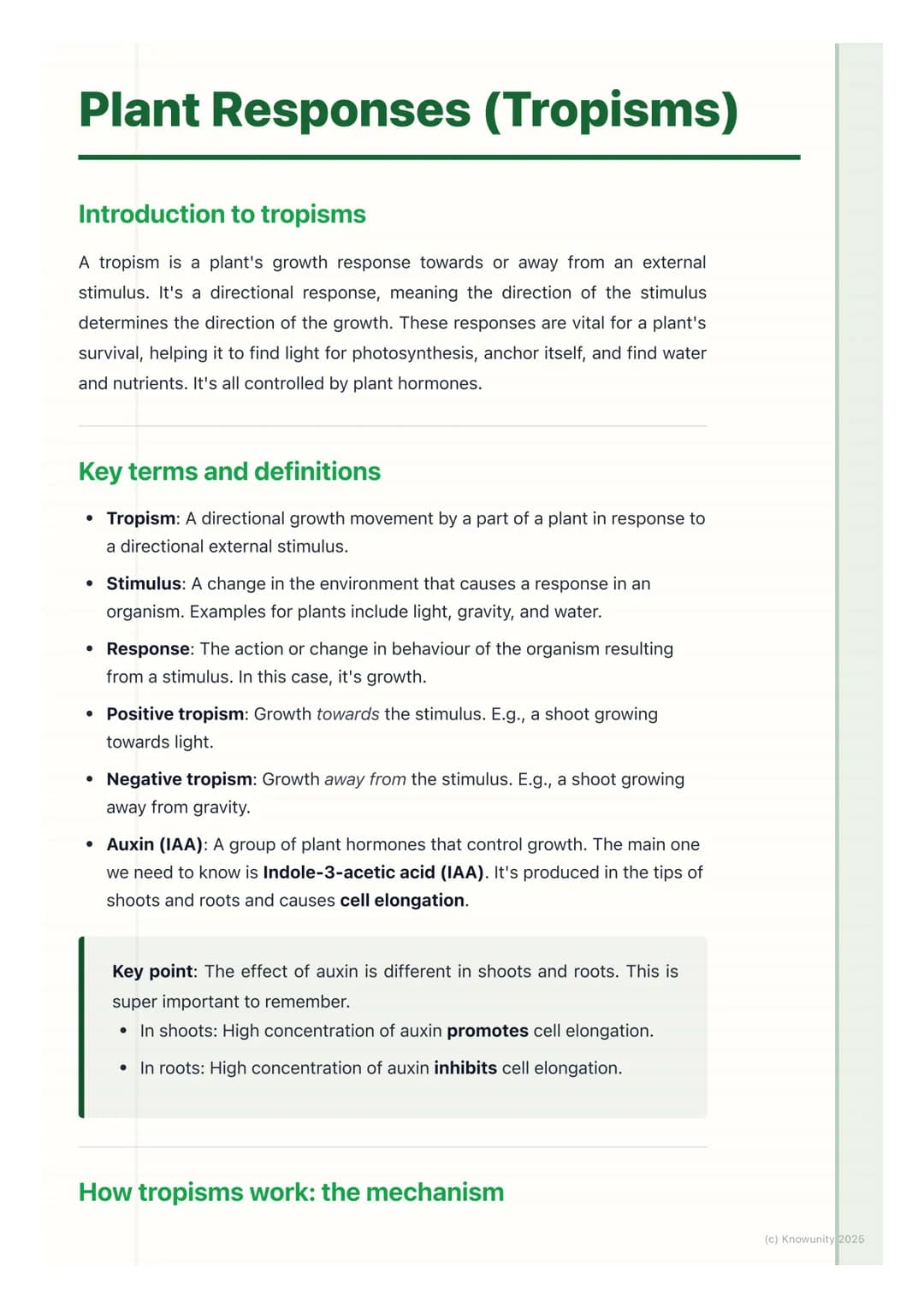
Plant Responses: Introduction to Tropisms
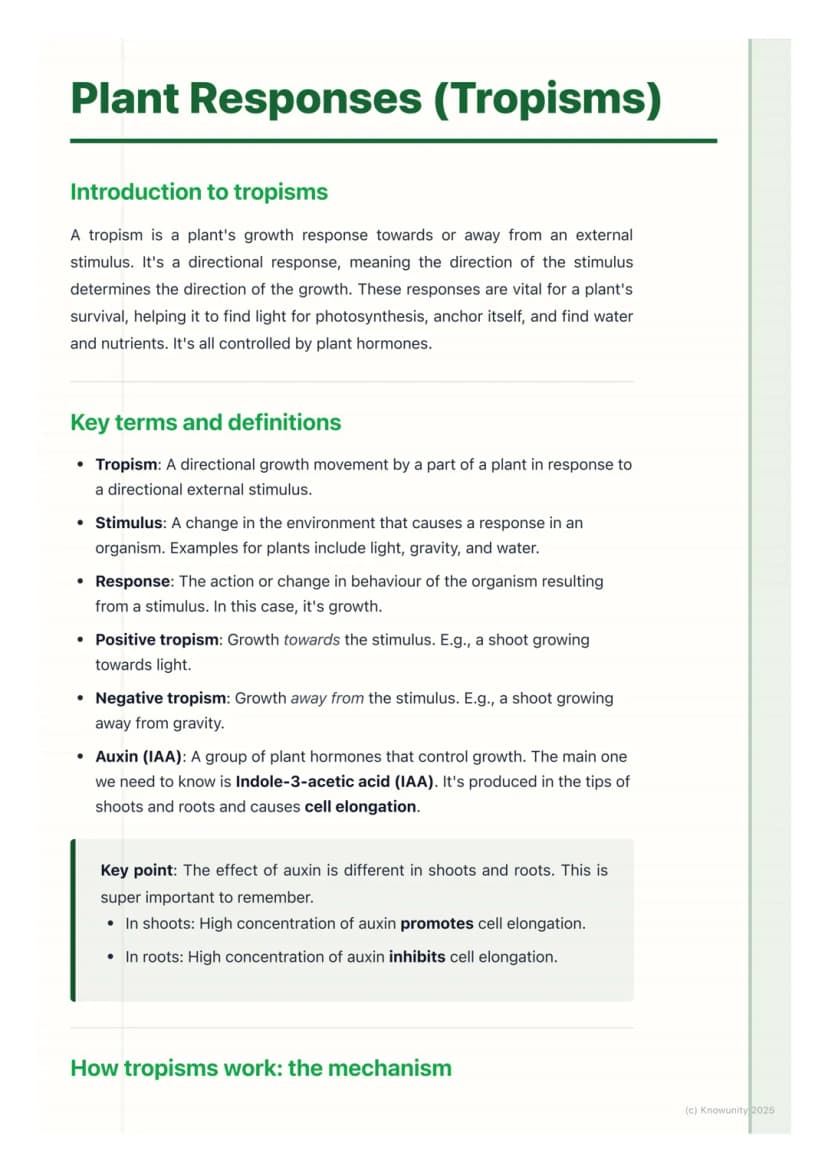
Ever wondered why plants seem to 'reach' towards windows? This is a tropism—a directional growth response to an external stimulus like light or gravity. These responses aren't random; they're survival strategies that help plants thrive in their environment.
A tropism can be either positive (growth towards the stimulus) or negative (growth away from it). For example, shoots growing towards light show positive phototropism, while shoots growing away from gravity show negative geotropism.
The key to understanding tropisms is auxin (IAA), a plant hormone produced in the tips of shoots and roots. Auxin causes cells to elongate, but with an important twist: in shoots, high auxin concentration promotes cell elongation, while in roots, high auxin concentration inhibits it. This difference explains why roots and shoots respond differently to the same stimulus!
Remember this! The different effects of auxin in shoots versus roots is one of the most commonly tested concepts in plant biology exams. Make sure you understand this dual role.
2
of 6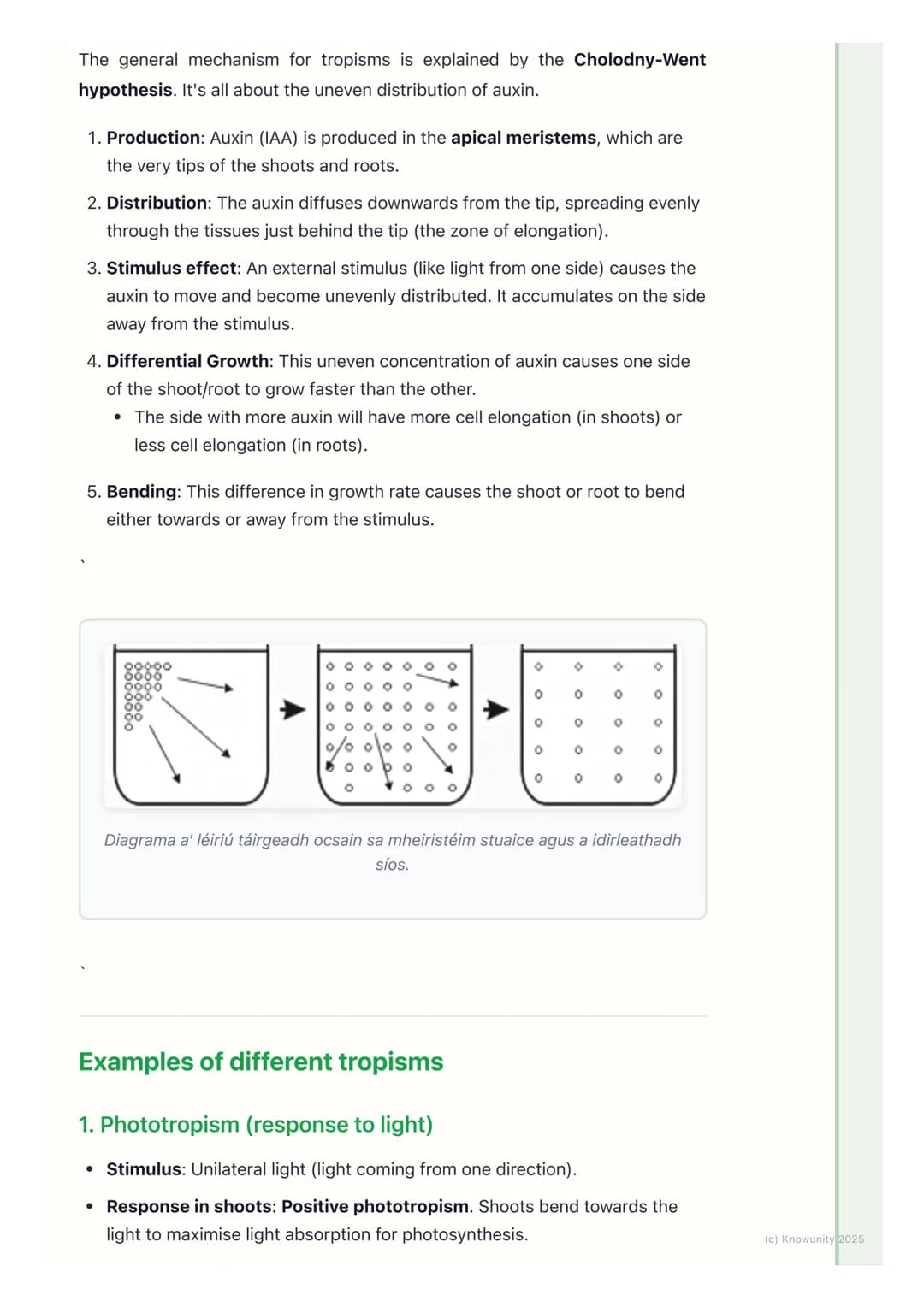
How Tropisms Work: The Mechanism
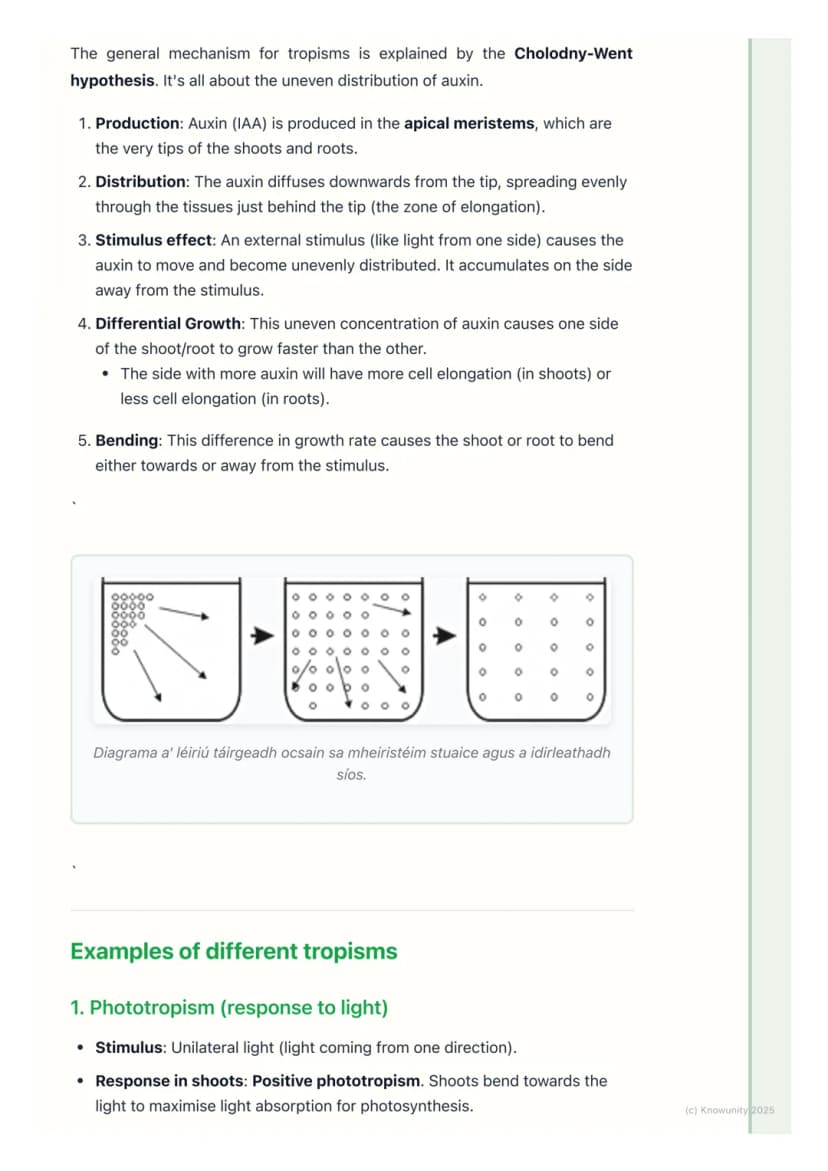
The Cholodny-Went hypothesis explains how tropisms function, and it all revolves around the uneven distribution of auxin. This clever mechanism allows plants to respond to their environment without having a brain!
Here's how it works: Auxin is produced in the tips of shoots and roots (the apical meristems) and normally diffuses downward evenly. However, when a stimulus like light comes from one direction, the auxin distribution becomes uneven. For example, in phototropism, auxin moves to the shaded side of the shoot.
This uneven distribution causes differential growth. In shoots, the side with more auxin grows faster (cells elongate more), causing the shoot to bend toward the light. In roots, the side with more auxin grows slower, causing the root to bend in the opposite direction.
Pro tip: Think of auxin as a growth accelerator in shoots but a growth brake in roots. This explains why shoots and roots respond differently to the same stimulus!
3
of 6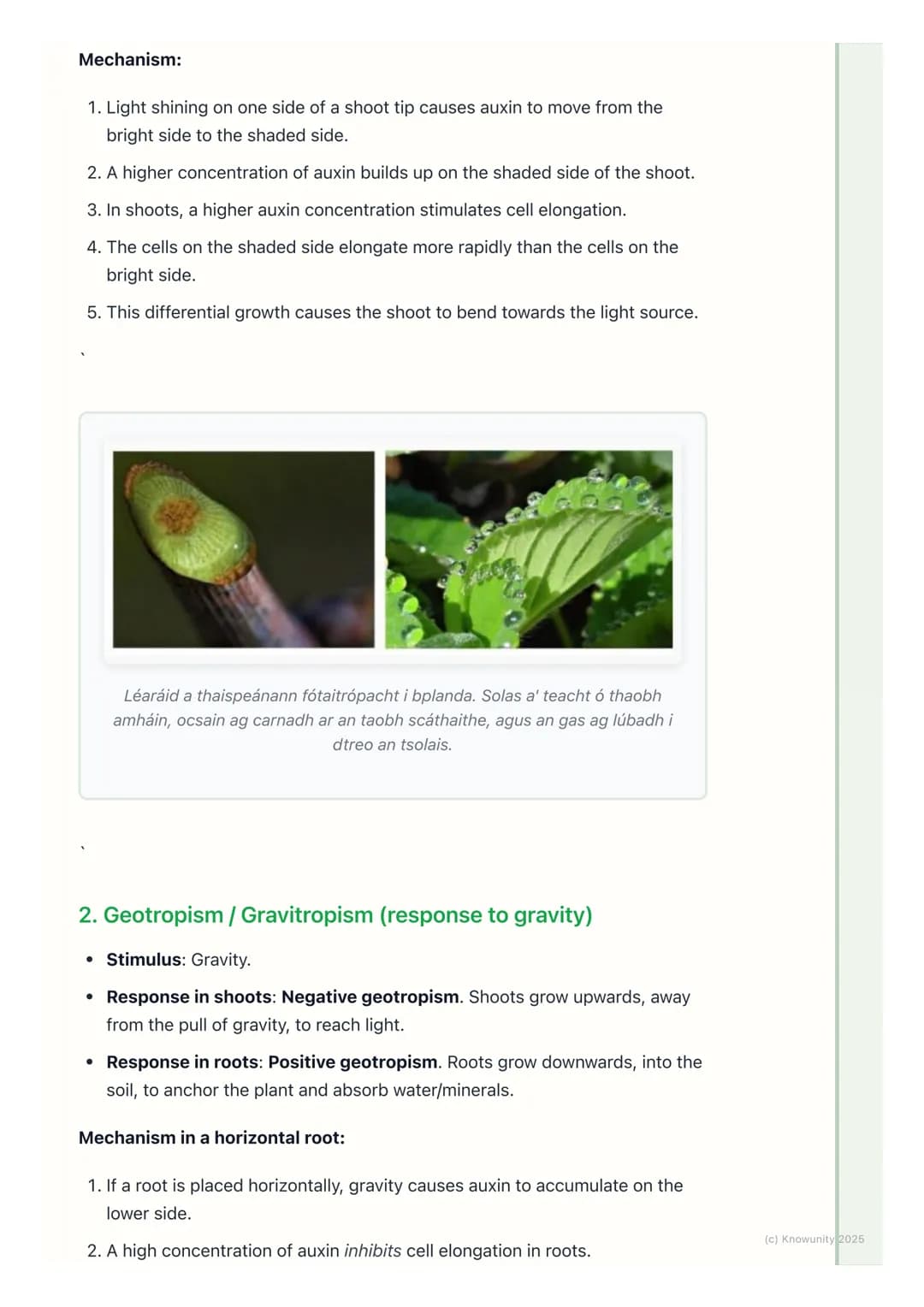
Phototropism & Geotropism
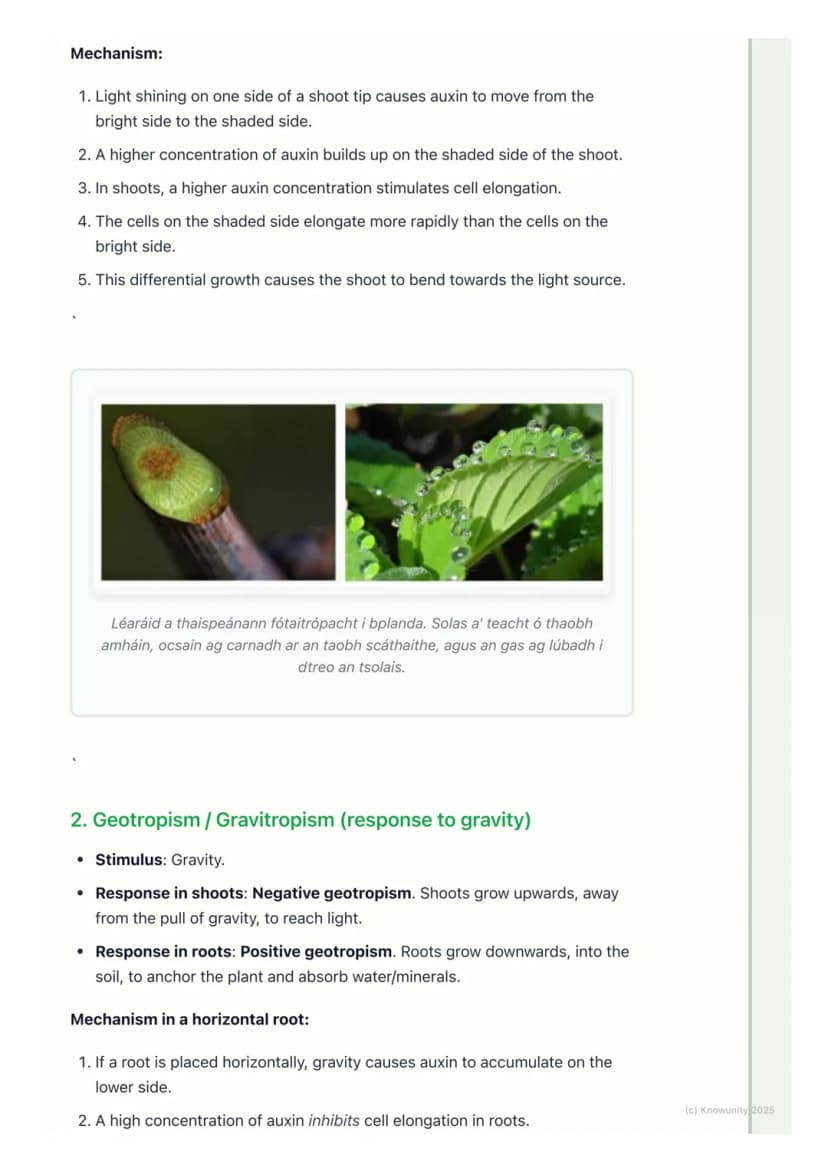
Phototropism (response to light) is critical for plants to maximise photosynthesis. When light hits a shoot from one side, auxin migrates to the shaded side. Since auxin promotes cell elongation in shoots, the shaded side grows faster, bending the shoot towards the light—a perfect example of positive phototropism.
Geotropism (or gravitropism) is the plant's response to gravity. Shoots display negative geotropism (growing upward, away from gravity), while roots show positive geotropism (growing downward, with gravity). This ensures shoots reach sunlight while roots anchor the plant and access soil resources.
When a root is placed horizontally, gravity causes auxin to accumulate on the lower side. Since high auxin levels inhibit cell elongation in roots, the upper side (with less auxin) grows faster, causing the root to bend downward. In shoots, the opposite happens—the lower side (with more auxin) elongates faster, causing upward growth.
Visual tip: Imagine auxin as tiny balls rolling to the bottom side of a horizontal plant part due to gravity. Where these balls accumulate determines which side grows differently!
4
of 6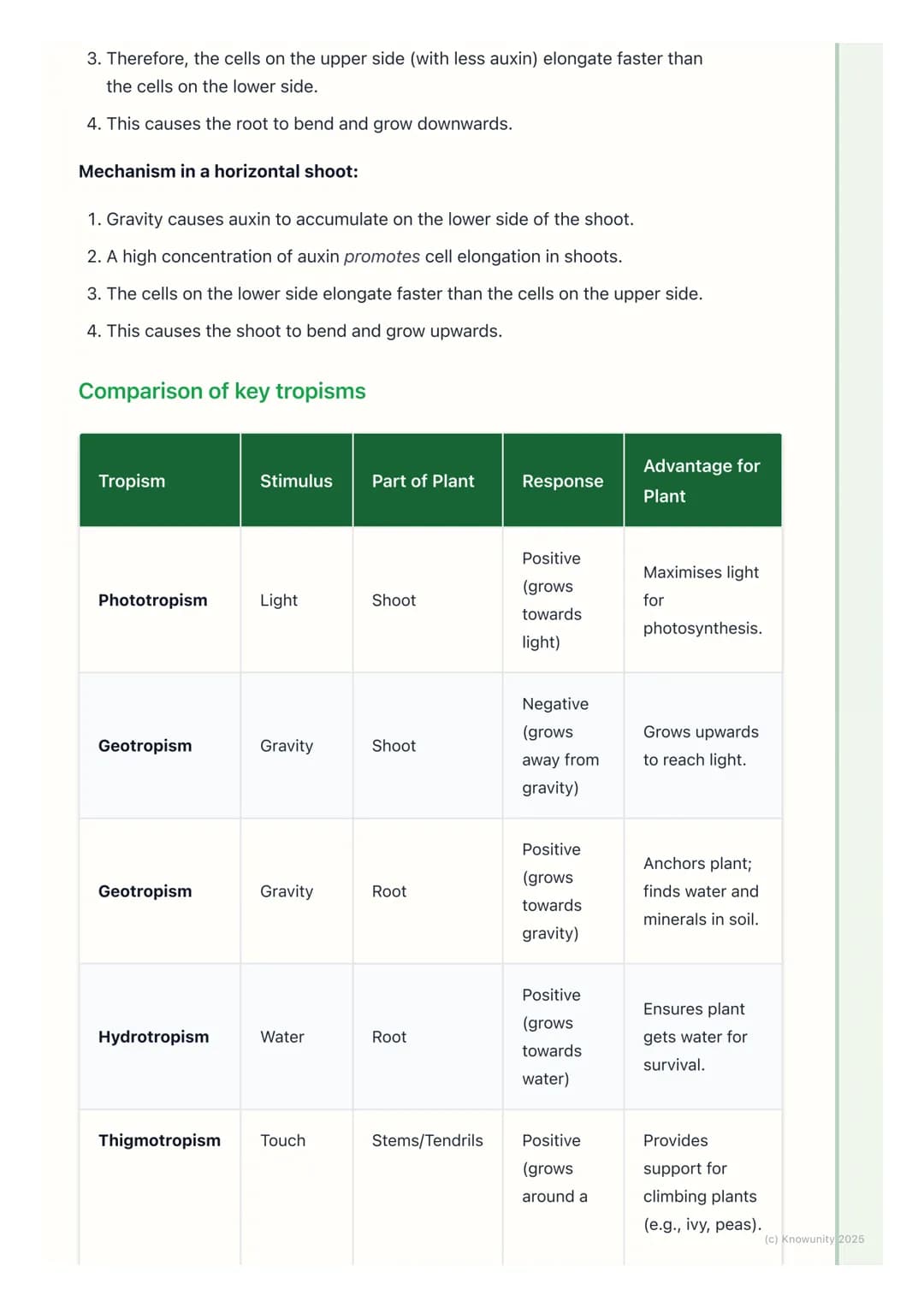
Comparing Plant Tropisms
Plants have evolved several different tropisms to help them survive in their environments. Each type serves a specific purpose in the plant's life.
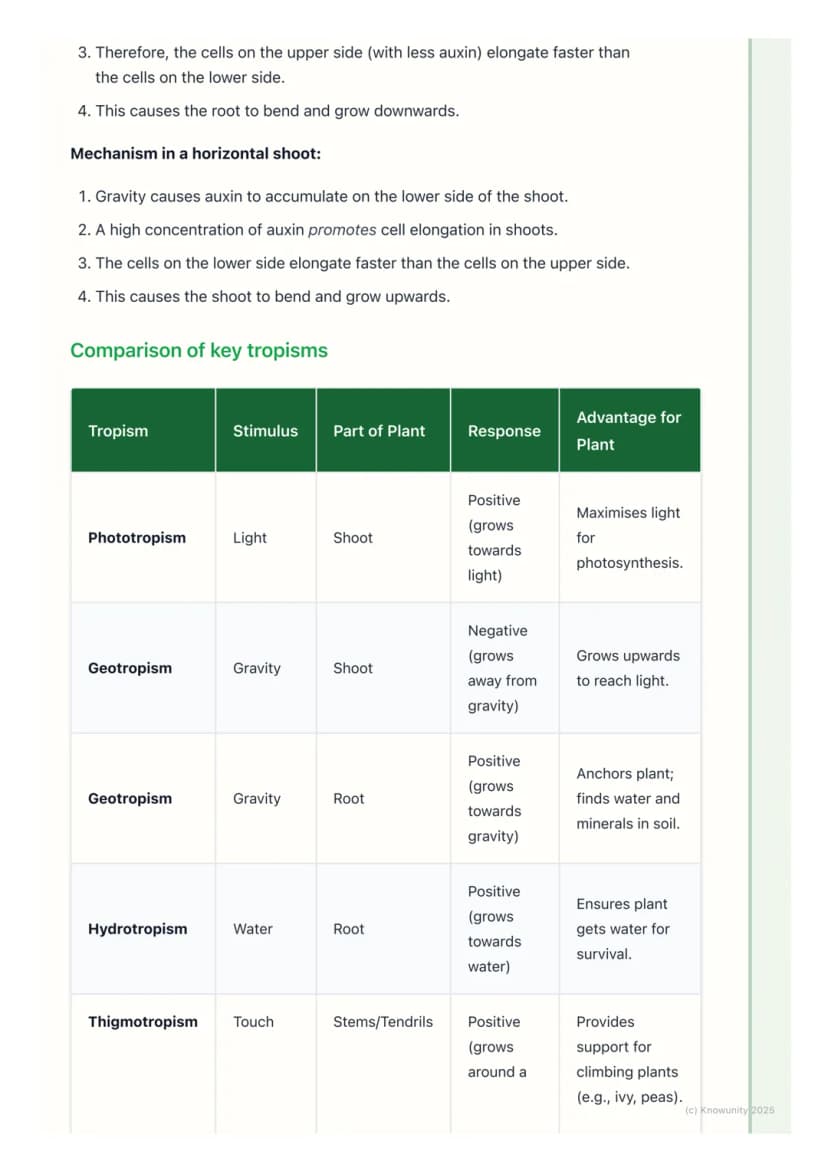
Phototropism helps shoots grow towards light, maximising photosynthesis and energy production. Meanwhile, geotropism ensures shoots grow upward and roots grow downward, creating the plant's basic structure and ensuring roots access soil resources.
Hydrotropism (response to water) causes roots to grow towards water sources, helping plants survive dry conditions. Thigmotropism (response to touch) allows tendrils and climbing stems to grow around solid objects, providing support for climbing plants like ivy and peas.
All these tropisms work through the same basic mechanism—uneven auxin distribution leading to differential growth rates on opposite sides of the plant organ. However, the direction of the response varies depending on the plant part and the specific survival advantage.
Exam alert: Always connect tropisms to their survival advantage for the plant. Examiners love questions that ask you to explain how tropisms benefit the plant!
5
of 6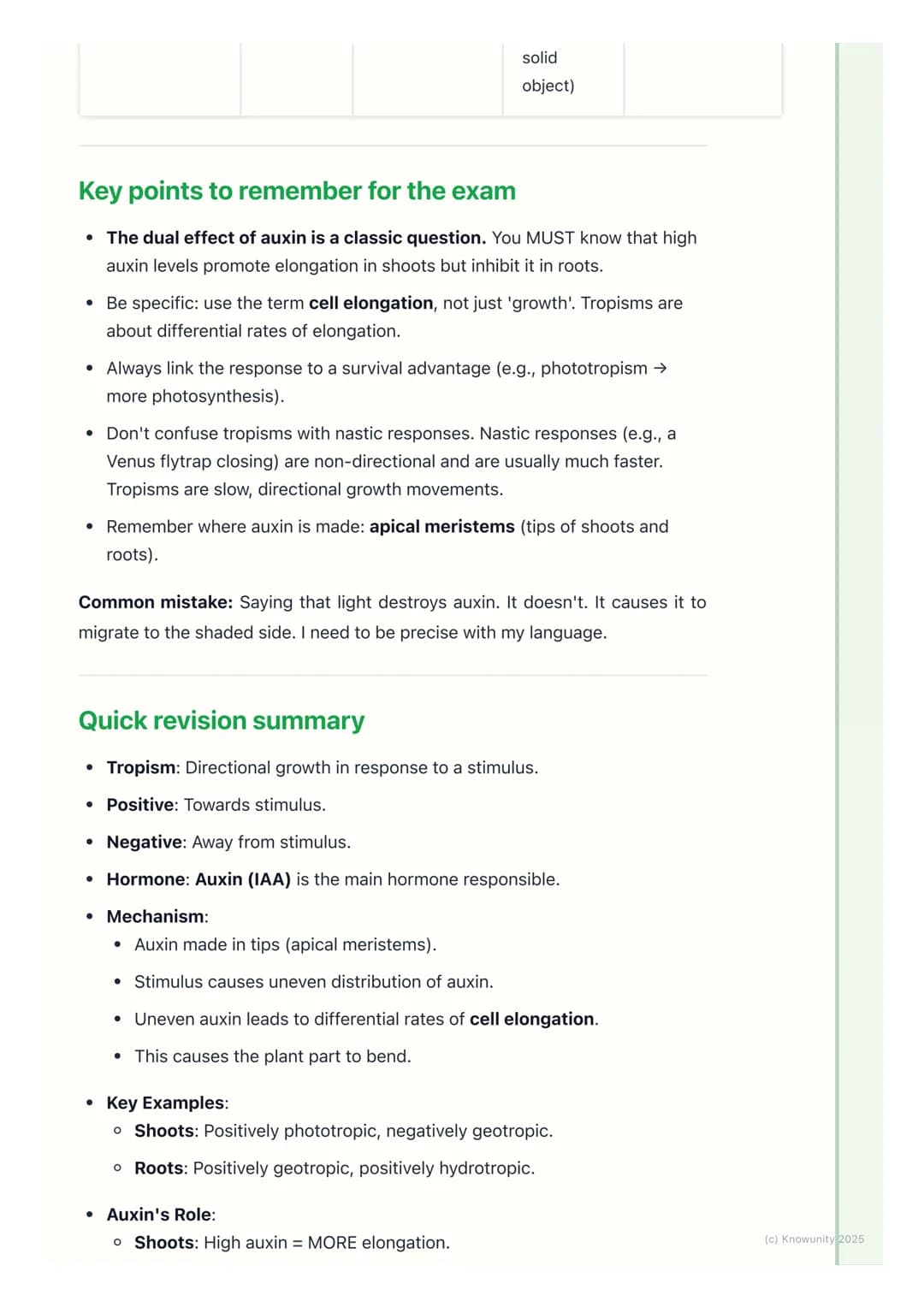
Key Points for Exam Success
Understanding the dual effect of auxin is crucial for exam success. Remember: high auxin promotes cell elongation in shoots but inhibits it in roots. This single fact explains why shoots and roots respond differently to the same stimuli.
Be precise in your language—always specify "cell elongation" rather than just "growth" when explaining tropisms. Also, remember to connect each tropism to its survival advantage (e.g., phototropism allows more efficient photosynthesis).
Don't confuse tropisms with nastic responses. Tropisms are slow, directional growth movements determined by the direction of the stimulus. Nastic responses (like Venus flytraps closing) are non-directional and usually much faster.
A common mistake is saying light destroys auxin—it doesn't! Light causes auxin to migrate to the shaded side. Being precise with your terminology will earn you marks in exams.
Quick recall: Auxin is produced in apical meristems (tips of shoots and roots), and its uneven distribution causes differential growth rates, resulting in bending. In shoots: high auxin = MORE elongation. In roots: high auxin = LESS elongation.
6
of 6
Pensamos que nunca lo preguntarías...
¿Qué es Knowunity AI companion?
Nuestro compañero de IA está específicamente adaptado a las necesidades de los estudiantes. Basándonos en los millones de contenidos que tenemos en la plataforma, podemos dar a los estudiantes respuestas realmente significativas y relevantes. Pero no se trata solo de respuestas, el compañero también guía a los estudiantes a través de sus retos de aprendizaje diarios, con planes de aprendizaje personalizados, cuestionarios o contenidos en el chat y una personalización del 100% basada en las habilidades y el desarrollo de los estudiantes.
¿Dónde puedo descargar la app Knowunity?
Puedes descargar la app en Google Play Store y Apple App Store.
¿Knowunity es totalmente gratuito?
Sí, tienes acceso gratuito a los contenidos de la aplicación y a nuestro compañero de IA. Para desbloquear determinadas funciones de la aplicación, puedes adquirir Knowunity Pro.
Contenidos más populares de Biology
8BiologyEcology introduction notes!
Start of the leaving cert ecology chapter
6th Year131
BiologyDNA & RNA
All notes on DNA & RNA including protein synthesis which is a HL topic
5th Year250
BiologyVertebrates and Invertebrates
Students will distinguish between animals that have a backbone (vertebrates) and those that do not (invertebrates), identifying examples of each.
2nd Year240
BiologyBiomolecules: chapter 8
Summary and easily understandable notes to revise chapter 8 biomolecules. Includes good labelled diagrams for visual learners
5th Year210
BiologyCirculatory System
Students will learn about the heart, blood, and blood vessels, and how this system transports oxygen, nutrients, and waste products around the body.
3rd Year140
BiologyRespiration
All respiration notes including simple diagrams and glycolysis and the Krebs cycle
5th Year120
BiologyPhotosynthesis : Biology
Photosynthesis
6th Year371
BiologyPlant Cells
Learning about the unique structures found in plant cells, such as the cell wall, chloroplasts, and large vacuole, and how they differ from animal cells.
1st Year80
Contenidos más populares
9 Irish
IrishIrish oral questions and answers
Questions and answers for the leaving cert oral
5th Year4264
 English
Key Quotes : Sive
Key Quotes and explanations: Sive
6th Year2842
IrishIrish oral questions
Outline of oral questions
5th Year2055
IrishIníon- le hÁine Durkin
Aine Durkin’s poem, Iníon: Themes & summary
5th Year850
IrishIrish poetry 2027
Iníon + Dínit an Bhróin
5th Year1133
IrishLC HL notes- Iníon (poem)
Includes poem in English and Irish, theme, key words & phrases
5th Year2284
EnglishCultural Context : Shawshank Redemption : Sive : Small Things Like These
Comparative Study : Cultural Context : Shawshank Redemption, Sive and Small Things Like These
6th Year1430
IrishMo Ghrá-sa (Idir Lúibíní)
Notes on mo ghrá-sa
5th Year380
IrishAn Gaeilge Aiste
Irish Language essay
6th Year1320
¿No encuentras lo que buscas? Explora otros temas.
Mira lo que dicen nuestros usuarios. Les encanta - y a tí también.
4.6/5App Store
4.7/5Google Play
La app es muy fácil de usar y está muy bien diseñada. Hasta ahora he encontrado todo lo que estaba buscando y he podido aprender mucho de las presentaciones. Definitivamente utilizaré la aplicación para un examen de clase. Y, por supuesto, también me sirve mucho de inspiración.
Pablousuario de iOS
Esta app es realmente genial. Hay tantos apuntes de clase y ayuda [...]. Tengo problemas con matemáticas, por ejemplo, y la aplicación tiene muchas opciones de ayuda. Gracias a Knowunity, he mejorado en mates. Se la recomiendo a todo el mundo.
Elenausuaria de Android
Vaya, estoy realmente sorprendida. Acabo de probar la app porque la he visto anunciada muchas veces y me he quedado absolutamente alucinada. Esta app es LA AYUDA que quieres para el insti y, sobre todo, ofrece muchísimas cosas, como ejercicios y hojas informativas, que a mí personalmente me han sido MUY útiles.
Anausuaria de iOS
Biology2 visualizaciones·Actualizado Jun 16, 2026·6 páginasHow Plants React to Light, Gravity, and Touch
Plant tropisms are the fascinating ways plants respond to their environment through directional growth. These growth movements help plants find light for photosynthesis, anchor themselves in soil, and access water and nutrients—all controlled by plant hormones called auxins.
1
of 6
Inscríbete para ver los apuntes. ¡Es gratis!
- Acceso a todos los documentos
- Mejora tus notas
- Únete a millones de estudiantes
Plant Responses: Introduction to Tropisms
Ever wondered why plants seem to 'reach' towards windows? This is a tropism—a directional growth response to an external stimulus like light or gravity. These responses aren't random; they're survival strategies that help plants thrive in their environment.
A tropism can be either positive (growth towards the stimulus) or negative (growth away from it). For example, shoots growing towards light show positive phototropism, while shoots growing away from gravity show negative geotropism.
The key to understanding tropisms is auxin (IAA), a plant hormone produced in the tips of shoots and roots. Auxin causes cells to elongate, but with an important twist: in shoots, high auxin concentration promotes cell elongation, while in roots, high auxin concentration inhibits it. This difference explains why roots and shoots respond differently to the same stimulus!
Remember this! The different effects of auxin in shoots versus roots is one of the most commonly tested concepts in plant biology exams. Make sure you understand this dual role.
2
of 6Inscríbete para ver los apuntes. ¡Es gratis!
- Acceso a todos los documentos
- Mejora tus notas
- Únete a millones de estudiantes
How Tropisms Work: The Mechanism
The Cholodny-Went hypothesis explains how tropisms function, and it all revolves around the uneven distribution of auxin. This clever mechanism allows plants to respond to their environment without having a brain!
Here's how it works: Auxin is produced in the tips of shoots and roots (the apical meristems) and normally diffuses downward evenly. However, when a stimulus like light comes from one direction, the auxin distribution becomes uneven. For example, in phototropism, auxin moves to the shaded side of the shoot.
This uneven distribution causes differential growth. In shoots, the side with more auxin grows faster (cells elongate more), causing the shoot to bend toward the light. In roots, the side with more auxin grows slower, causing the root to bend in the opposite direction.
Pro tip: Think of auxin as a growth accelerator in shoots but a growth brake in roots. This explains why shoots and roots respond differently to the same stimulus!
3
of 6Inscríbete para ver los apuntes. ¡Es gratis!
- Acceso a todos los documentos
- Mejora tus notas
- Únete a millones de estudiantes
Phototropism & Geotropism
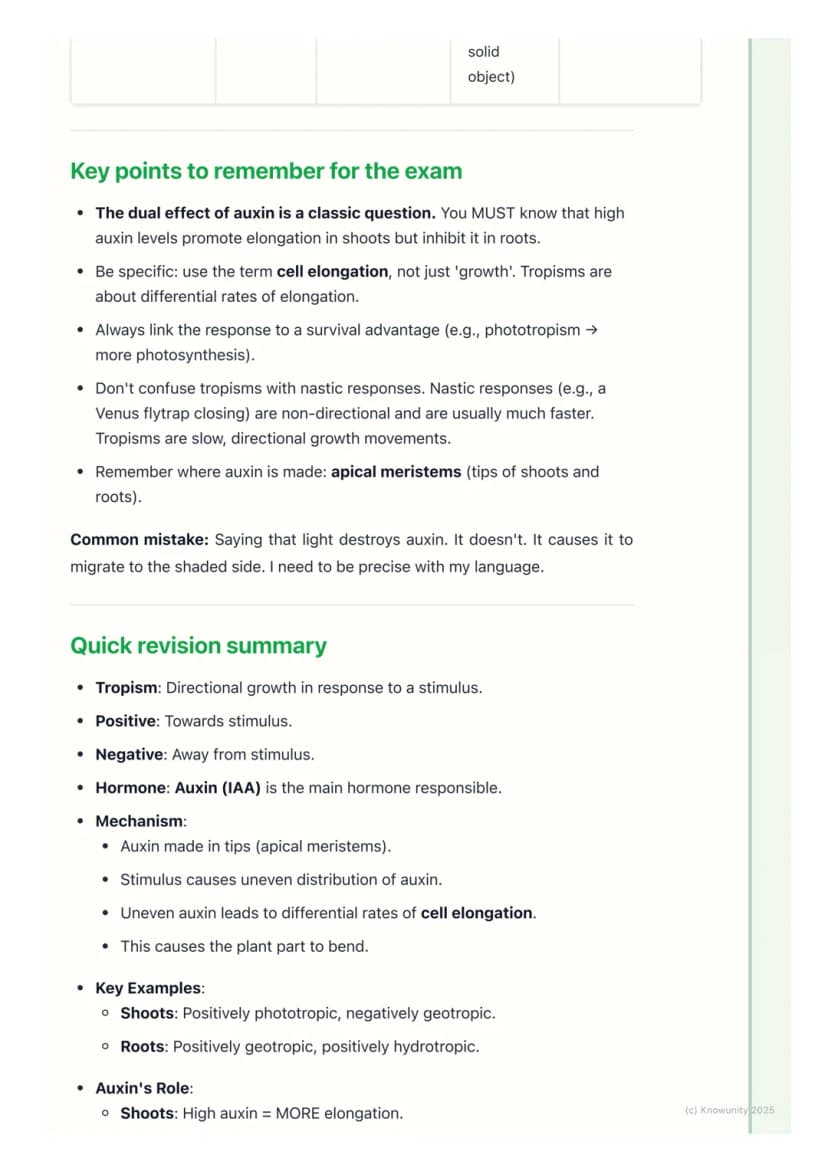
Phototropism (response to light) is critical for plants to maximise photosynthesis. When light hits a shoot from one side, auxin migrates to the shaded side. Since auxin promotes cell elongation in shoots, the shaded side grows faster, bending the shoot towards the light—a perfect example of positive phototropism.
Geotropism (or gravitropism) is the plant's response to gravity. Shoots display negative geotropism (growing upward, away from gravity), while roots show positive geotropism (growing downward, with gravity). This ensures shoots reach sunlight while roots anchor the plant and access soil resources.
When a root is placed horizontally, gravity causes auxin to accumulate on the lower side. Since high auxin levels inhibit cell elongation in roots, the upper side (with less auxin) grows faster, causing the root to bend downward. In shoots, the opposite happens—the lower side (with more auxin) elongates faster, causing upward growth.
Visual tip: Imagine auxin as tiny balls rolling to the bottom side of a horizontal plant part due to gravity. Where these balls accumulate determines which side grows differently!
4
of 6Inscríbete para ver los apuntes. ¡Es gratis!
- Acceso a todos los documentos
- Mejora tus notas
- Únete a millones de estudiantes
Comparing Plant Tropisms
Plants have evolved several different tropisms to help them survive in their environments. Each type serves a specific purpose in the plant's life.
Phototropism helps shoots grow towards light, maximising photosynthesis and energy production. Meanwhile, geotropism ensures shoots grow upward and roots grow downward, creating the plant's basic structure and ensuring roots access soil resources.
Hydrotropism (response to water) causes roots to grow towards water sources, helping plants survive dry conditions. Thigmotropism (response to touch) allows tendrils and climbing stems to grow around solid objects, providing support for climbing plants like ivy and peas.
All these tropisms work through the same basic mechanism—uneven auxin distribution leading to differential growth rates on opposite sides of the plant organ. However, the direction of the response varies depending on the plant part and the specific survival advantage.
Exam alert: Always connect tropisms to their survival advantage for the plant. Examiners love questions that ask you to explain how tropisms benefit the plant!
5
of 6Inscríbete para ver los apuntes. ¡Es gratis!
- Acceso a todos los documentos
- Mejora tus notas
- Únete a millones de estudiantes
Key Points for Exam Success
Understanding the dual effect of auxin is crucial for exam success. Remember: high auxin promotes cell elongation in shoots but inhibits it in roots. This single fact explains why shoots and roots respond differently to the same stimuli.
Be precise in your language—always specify "cell elongation" rather than just "growth" when explaining tropisms. Also, remember to connect each tropism to its survival advantage (e.g., phototropism allows more efficient photosynthesis).
Don't confuse tropisms with nastic responses. Tropisms are slow, directional growth movements determined by the direction of the stimulus. Nastic responses (like Venus flytraps closing) are non-directional and usually much faster.
A common mistake is saying light destroys auxin—it doesn't! Light causes auxin to migrate to the shaded side. Being precise with your terminology will earn you marks in exams.
Quick recall: Auxin is produced in apical meristems (tips of shoots and roots), and its uneven distribution causes differential growth rates, resulting in bending. In shoots: high auxin = MORE elongation. In roots: high auxin = LESS elongation.
6
of 6Inscríbete para ver los apuntes. ¡Es gratis!
- Acceso a todos los documentos
- Mejora tus notas
- Únete a millones de estudiantes
Pensamos que nunca lo preguntarías...
¿Qué es Knowunity AI companion?
Nuestro compañero de IA está específicamente adaptado a las necesidades de los estudiantes. Basándonos en los millones de contenidos que tenemos en la plataforma, podemos dar a los estudiantes respuestas realmente significativas y relevantes. Pero no se trata solo de respuestas, el compañero también guía a los estudiantes a través de sus retos de aprendizaje diarios, con planes de aprendizaje personalizados, cuestionarios o contenidos en el chat y una personalización del 100% basada en las habilidades y el desarrollo de los estudiantes.
¿Dónde puedo descargar la app Knowunity?
Puedes descargar la app en Google Play Store y Apple App Store.
¿Knowunity es totalmente gratuito?
Sí, tienes acceso gratuito a los contenidos de la aplicación y a nuestro compañero de IA. Para desbloquear determinadas funciones de la aplicación, puedes adquirir Knowunity Pro.
Contenidos más populares de Biology
8BiologyEcology introduction notes!
Start of the leaving cert ecology chapter
6th Year131
BiologyDNA & RNA
All notes on DNA & RNA including protein synthesis which is a HL topic
5th Year250
BiologyVertebrates and Invertebrates
Students will distinguish between animals that have a backbone (vertebrates) and those that do not (invertebrates), identifying examples of each.
2nd Year240
BiologyBiomolecules: chapter 8
Summary and easily understandable notes to revise chapter 8 biomolecules. Includes good labelled diagrams for visual learners
5th Year210
BiologyCirculatory System
Students will learn about the heart, blood, and blood vessels, and how this system transports oxygen, nutrients, and waste products around the body.
3rd Year140
BiologyRespiration
All respiration notes including simple diagrams and glycolysis and the Krebs cycle
5th Year120
BiologyPhotosynthesis : Biology
Photosynthesis
6th Year371
BiologyPlant Cells
Learning about the unique structures found in plant cells, such as the cell wall, chloroplasts, and large vacuole, and how they differ from animal cells.
1st Year80
Contenidos más populares
9IrishIrish oral questions and answers
Questions and answers for the leaving cert oral
5th Year4264
EnglishKey Quotes : Sive
Key Quotes and explanations: Sive
6th Year2842
IrishIrish oral questions
Outline of oral questions
5th Year2055
IrishIníon- le hÁine Durkin
Aine Durkin’s poem, Iníon: Themes & summary
5th Year850
IrishIrish poetry 2027
Iníon + Dínit an Bhróin
5th Year1133
IrishLC HL notes- Iníon (poem)
Includes poem in English and Irish, theme, key words & phrases
5th Year2284
EnglishCultural Context : Shawshank Redemption : Sive : Small Things Like These
Comparative Study : Cultural Context : Shawshank Redemption, Sive and Small Things Like These
6th Year1430
IrishMo Ghrá-sa (Idir Lúibíní)
Notes on mo ghrá-sa
5th Year380
IrishAn Gaeilge Aiste
Irish Language essay
6th Year1320
¿No encuentras lo que buscas? Explora otros temas.
Mira lo que dicen nuestros usuarios. Les encanta - y a tí también.
4.6/5App Store
4.7/5Google Play
La app es muy fácil de usar y está muy bien diseñada. Hasta ahora he encontrado todo lo que estaba buscando y he podido aprender mucho de las presentaciones. Definitivamente utilizaré la aplicación para un examen de clase. Y, por supuesto, también me sirve mucho de inspiración.
Pablousuario de iOS
Esta app es realmente genial. Hay tantos apuntes de clase y ayuda [...]. Tengo problemas con matemáticas, por ejemplo, y la aplicación tiene muchas opciones de ayuda. Gracias a Knowunity, he mejorado en mates. Se la recomiendo a todo el mundo.
Elenausuaria de Android
Vaya, estoy realmente sorprendida. Acabo de probar la app porque la he visto anunciada muchas veces y me he quedado absolutamente alucinada. Esta app es LA AYUDA que quieres para el insti y, sobre todo, ofrece muchísimas cosas, como ejercicios y hojas informativas, que a mí personalmente me han sido MUY útiles.
Anausuaria de iOS