
Ever wondered why you have your mum's eyes or your... Mostrar más
 Biology
 Irish
Irish English
 Geography
Inscríbete para ver los apuntes¡Es gratis!
Acceso a todos los documentos
Mejora tus notas
Únete a millones de estudiantes
Knowunity AI
Asignaturas
Triangle Congruence and Similarity Theorems
Triangle Properties and Classification
Linear Equations and Graphs
Geometric Angle Relationships
Trigonometric Functions and Identities
Equation Solving Techniques
Circle Geometry Fundamentals
Division Operations and Methods
Basic Differentiation Rules
Exponent and Logarithm Properties
Mostrar todos los temas
Human Organ Systems
Reproductive Cell Cycles
Biological Sciences Subdisciplines
Cellular Energy Metabolism
Autotrophic Energy Processes
Inheritance Patterns and Principles
Biomolecular Structure and Organization
Cell Cycle and Division Mechanics
Cellular Organization and Development
Biological Structural Organization
Mostrar todos los temas
Chemical Sciences and Applications
Atomic Structure and Composition
Molecular Electron Structure Representation
Atomic Electron Behavior
Matter Properties and Water
Mole Concept and Calculations
Gas Laws and Behavior
Periodic Table Organization
Chemical Thermodynamics Fundamentals
Chemical Bond Types and Properties
Mostrar todos los temas
European Renaissance and Enlightenment
European Cultural Movements 800-1920
American Revolution Era 1763-1797
American Civil War 1861-1865
Global Imperial Systems
Mongol and Chinese Dynasties
U.S. Presidents and World Leaders
Historical Sources and Documentation
World Wars Era and Impact
World Religious Systems
Mostrar todos los temas
Classic and Contemporary Novels
Literary Character Analysis
Rhetorical Theory and Practice
Classic Literary Narratives
Reading Analysis and Interpretation
Narrative Structure and Techniques
English Language Components
Influential English-Language Authors
Basic Sentence Structure
Narrative Voice and Perspective
Mostrar todos los temas
44
•
Actualizado May 10, 2026
•
Ever wondered why you have your mum's eyes or your... Mostrar más
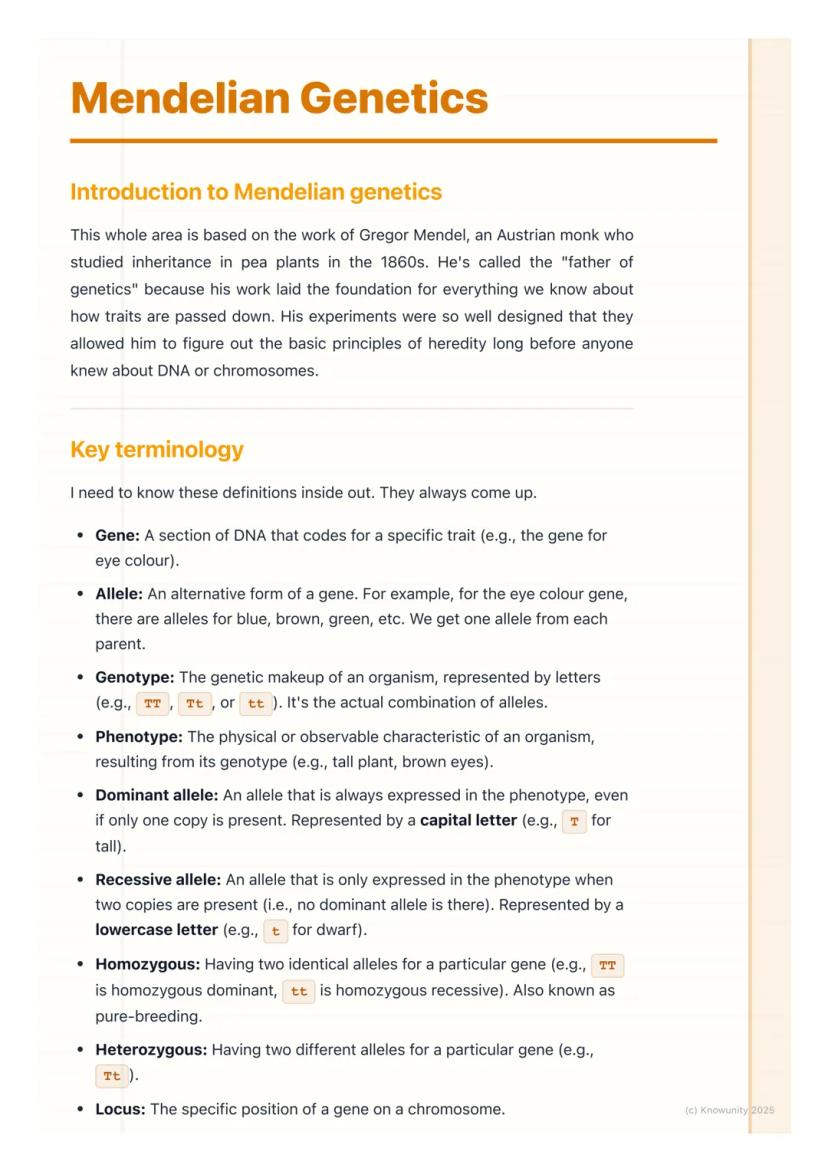
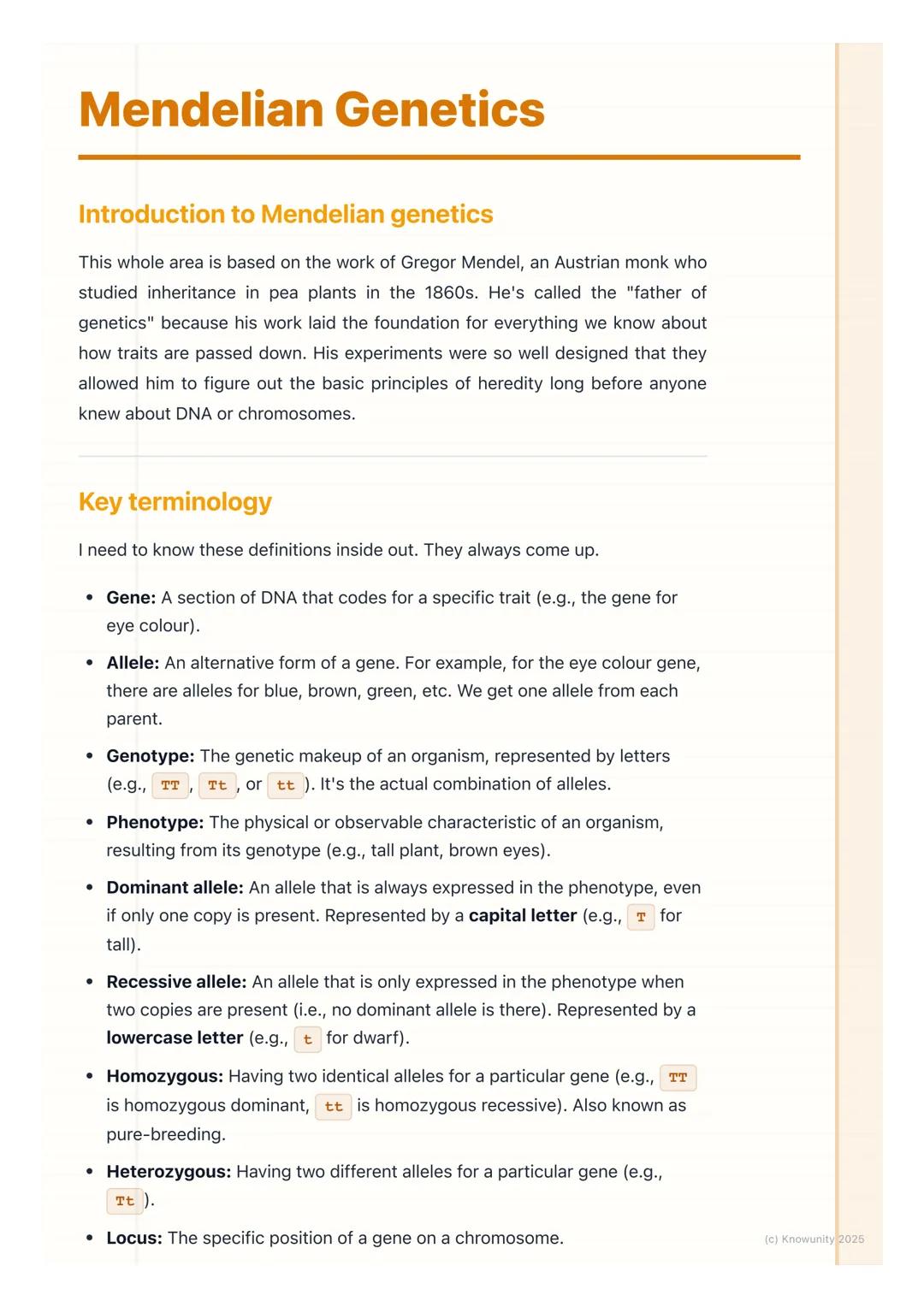
You'll need to nail the key terms first - they're the building blocks for everything else in genetics. A gene is basically a section of DNA that controls a specific trait, like eye colour. Alleles are different versions of the same gene (think blue eyes vs brown eyes).
Your genotype is the actual genetic code you carry (written as letters like TT or Tt), whilst your phenotype is what you actually look like. Dominant alleles (capital letters) always show up in your appearance, even if you only have one copy. Recessive alleles (lowercase letters) only appear when you have two copies.
Homozygous means having two identical alleles (like TT or tt), whilst heterozygous means having two different ones (like Tt). The generations have special names too: P generation (parents), F1 (first offspring), and F2 (second generation offspring).
Quick Tip: Think of alleles like different flavours of the same ice cream - same product, different varieties!
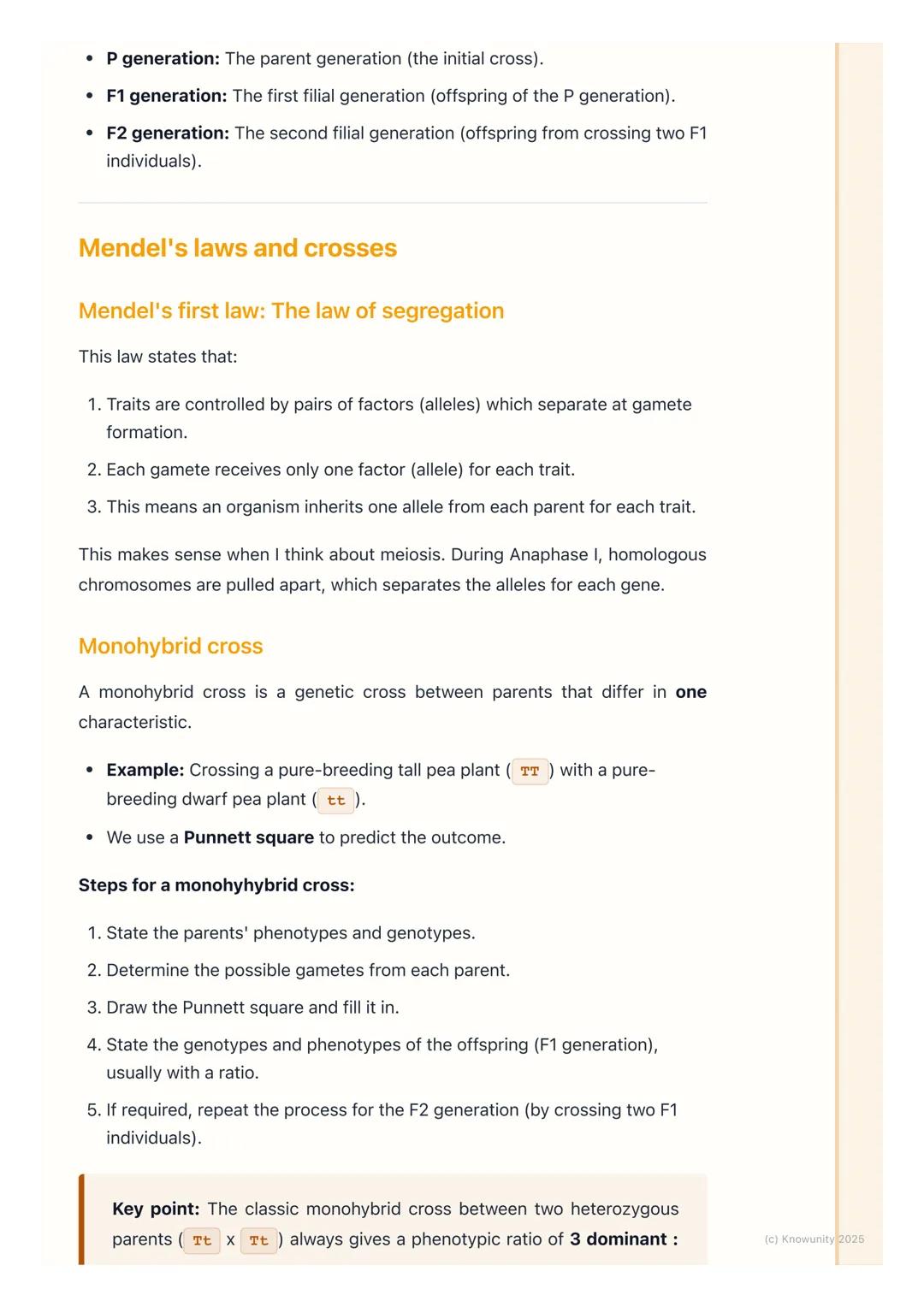
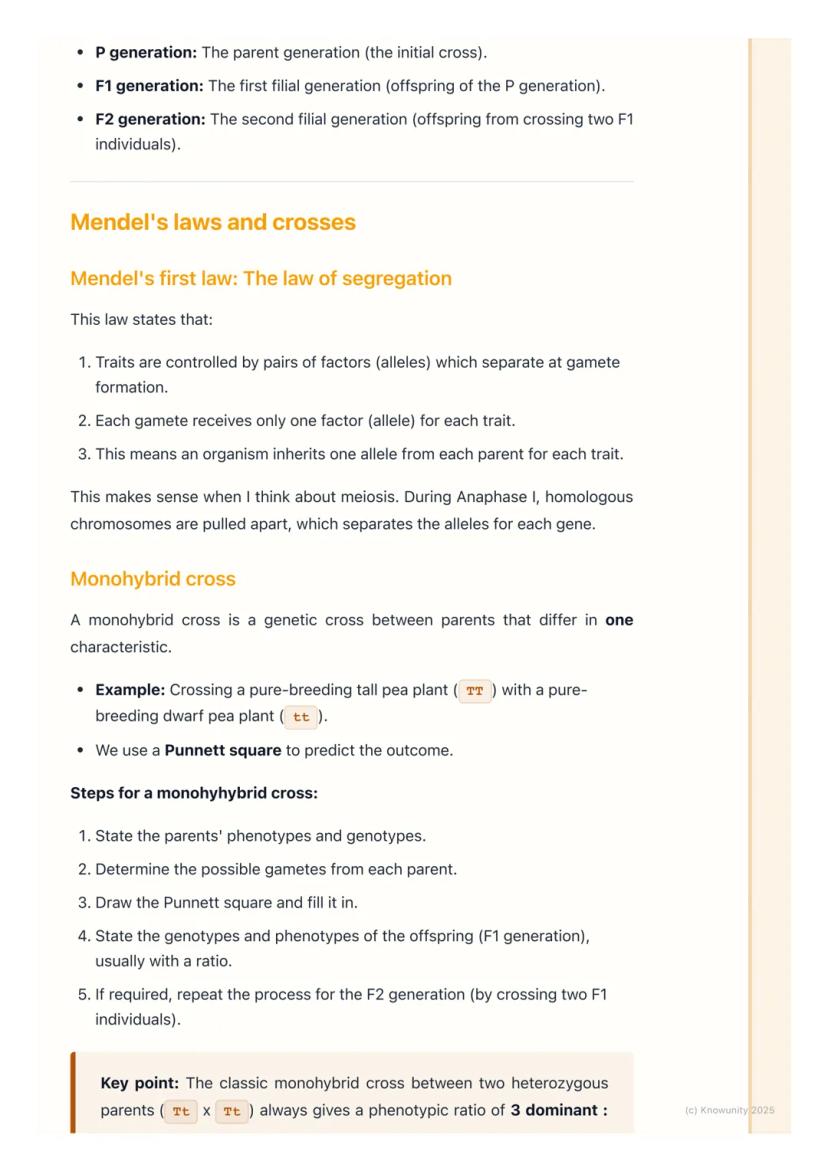
Mendel's first law (segregation) tells us that trait-controlling factors separate during gamete formation, so each parent only passes on one allele for each trait. This happens during meiosis when chromosomes get pulled apart.
A monohybrid cross tracks just one characteristic at a time. You'll use Punnett squares to predict outcomes - they're like genetic calculators! The classic example is crossing two heterozygous parents (Tt × Tt).
Here's your step-by-step process: state parent phenotypes and genotypes, work out possible gametes, draw your Punnett square, fill it in, then state the offspring ratios. The magic ratio you'll see constantly is 3:1 for phenotypes (3 dominant : 1 recessive) and 1:2:1 for genotypes.
Exam Gold: That 3:1 ratio from Tt × Tt crosses appears in loads of questions - memorise it!
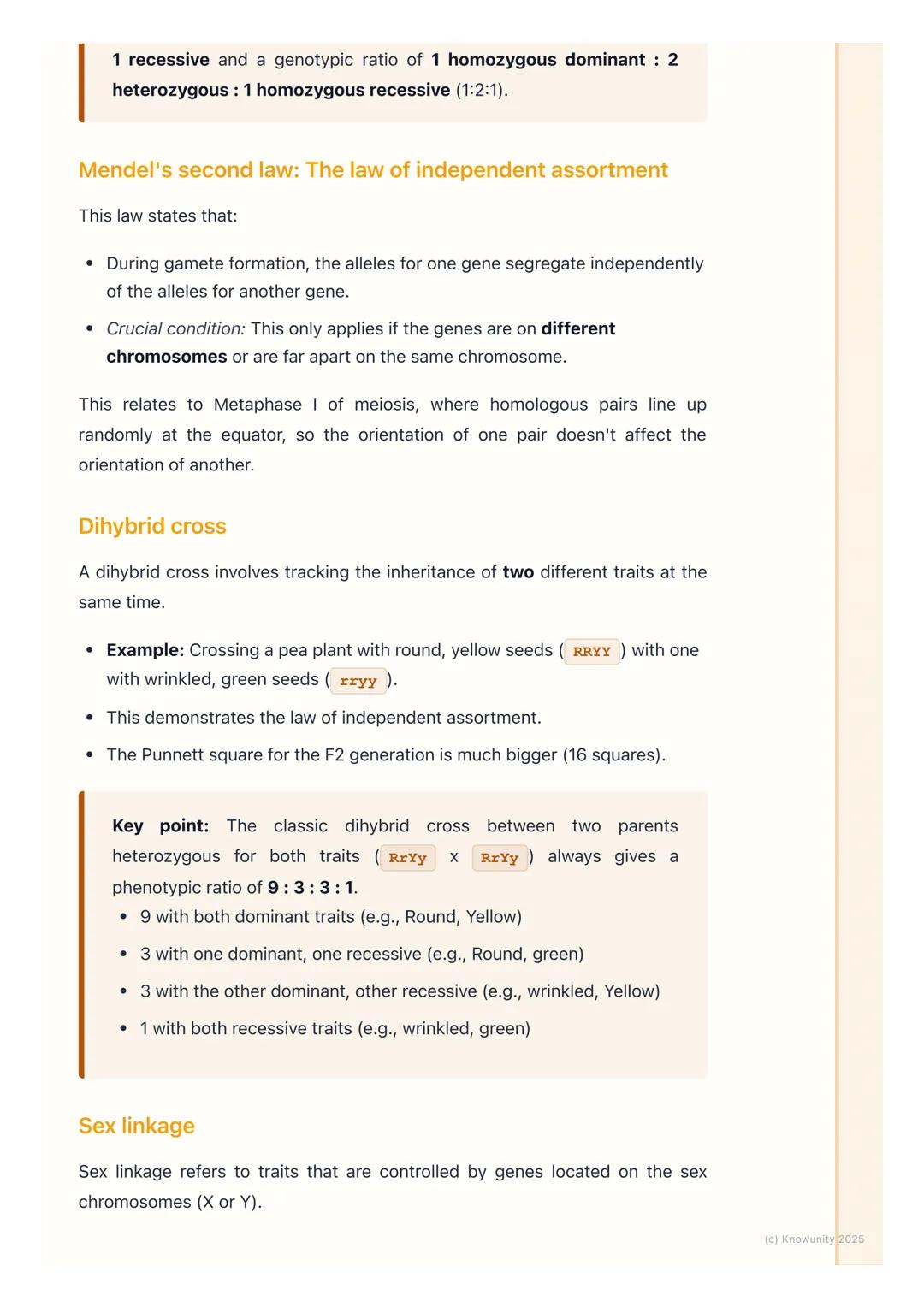
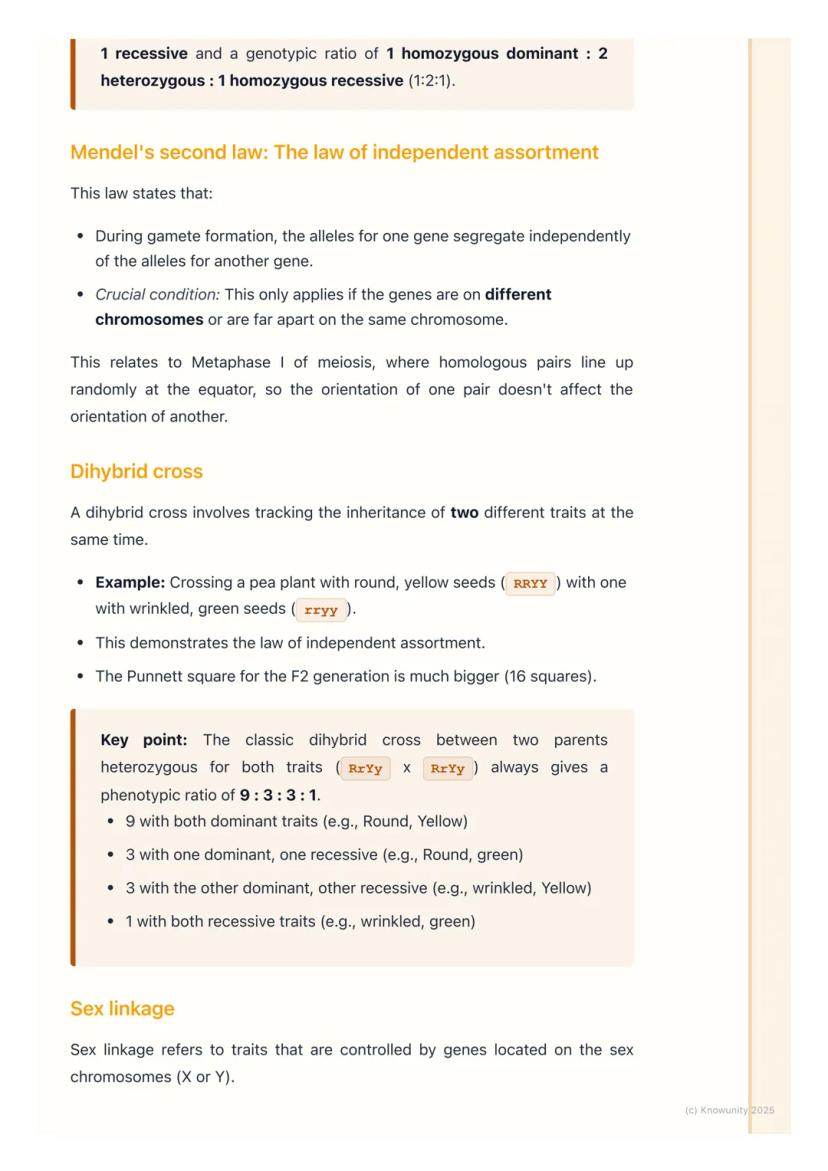
Mendel's second law (independent assortment) shows that different genes get inherited independently - but only if they're on different chromosomes or far apart on the same one. This relates to how chromosomes line up randomly during meiosis.
Dihybrid crosses track two traits simultaneously, like seed shape and colour. The Punnett square becomes much bigger (16 squares instead of 4), but don't panic - the process is the same.
When you cross two parents who are heterozygous for both traits (like RrYy × RrYy), you get the famous 9:3:3:1 ratio. That's 9 with both dominant traits, 3 with each mixed combination, and 1 with both recessive traits.
Sex linkage happens when genes sit on sex chromosomes. Most sex-linked traits are X-linked, which means males are more likely to show recessive traits since they only have one X chromosome.
Memory Trick: For dihybrid crosses, remember "9-3-3-1" - it's the genetic equivalent of a phone number!
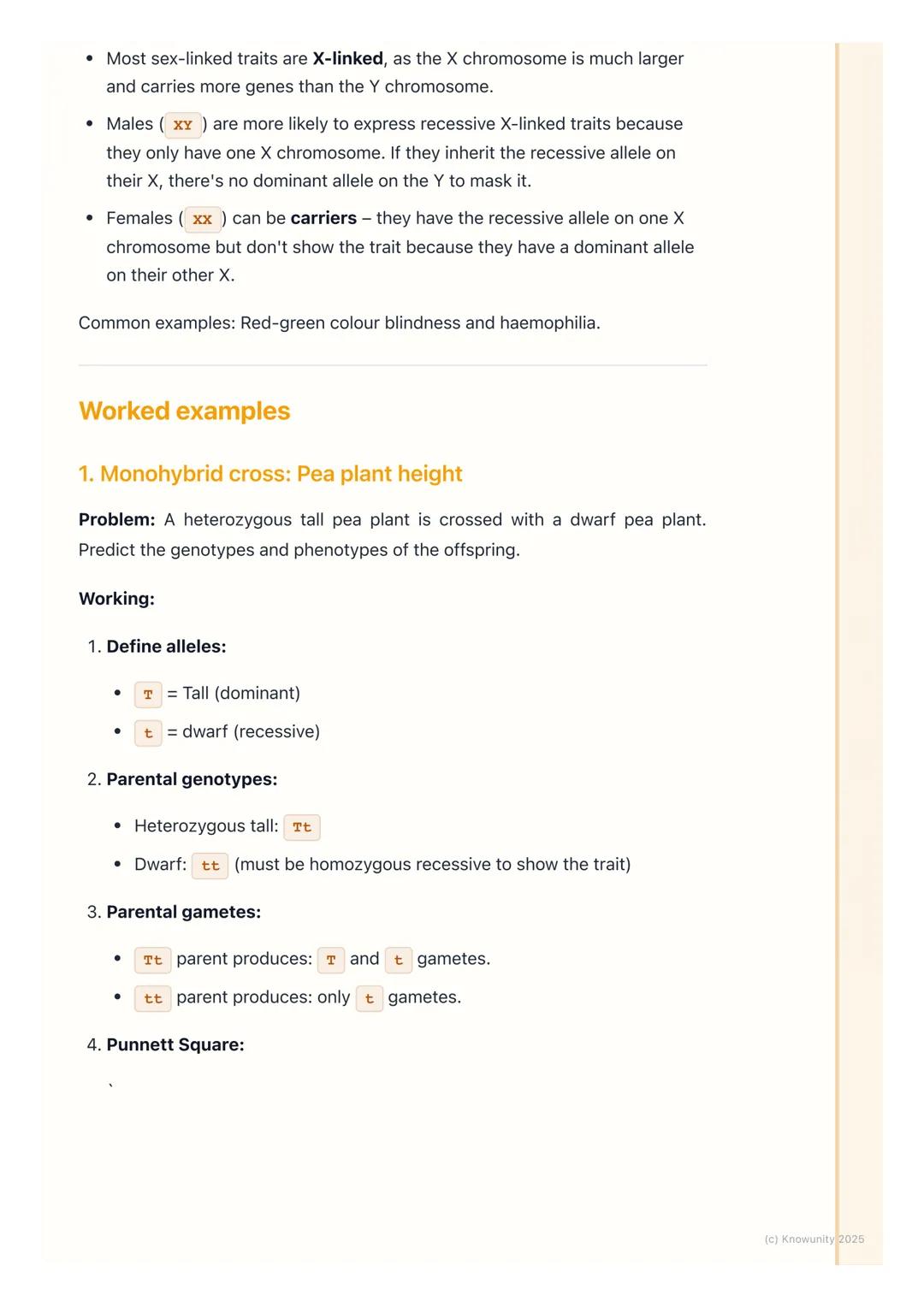
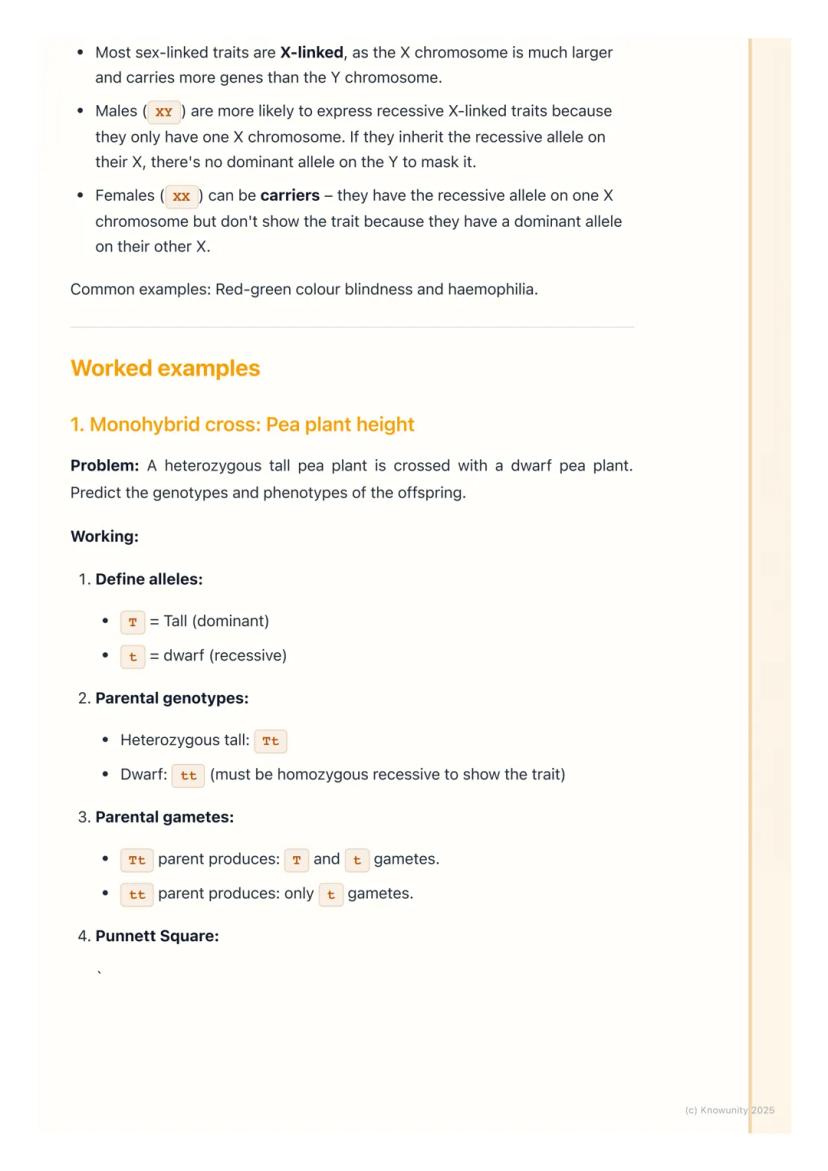
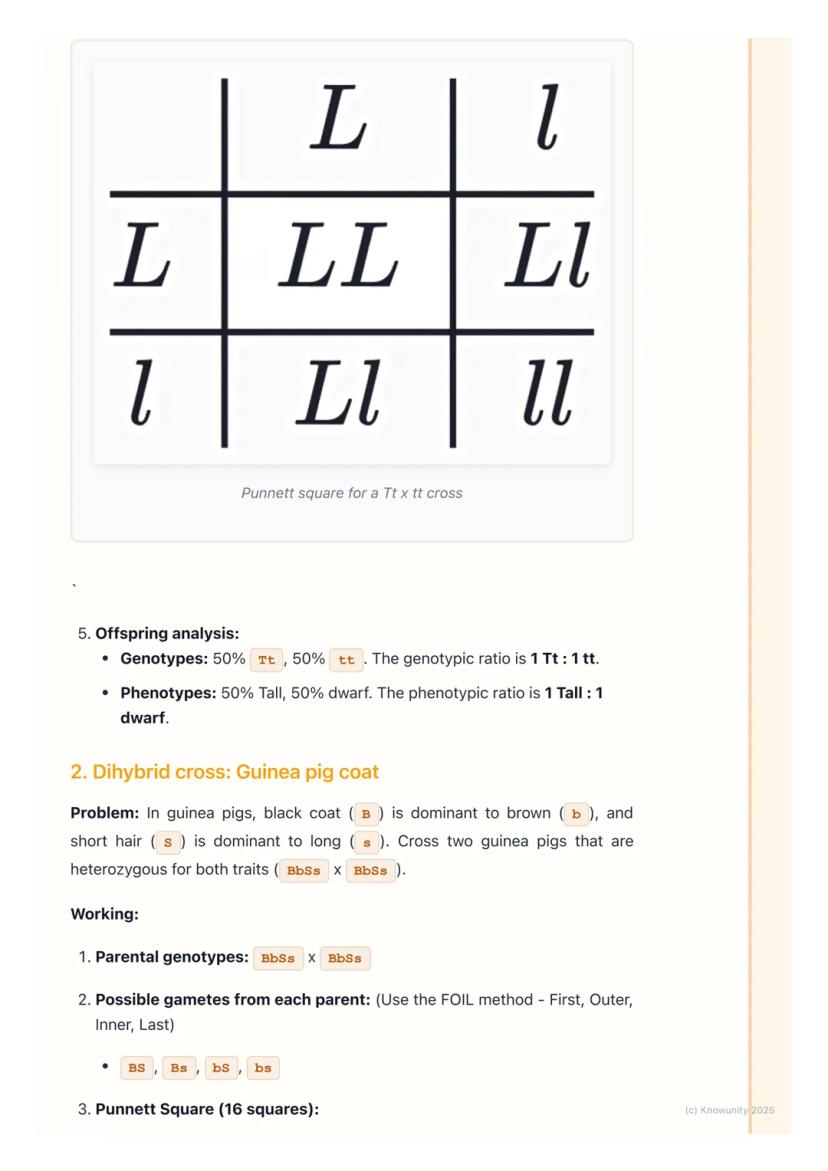
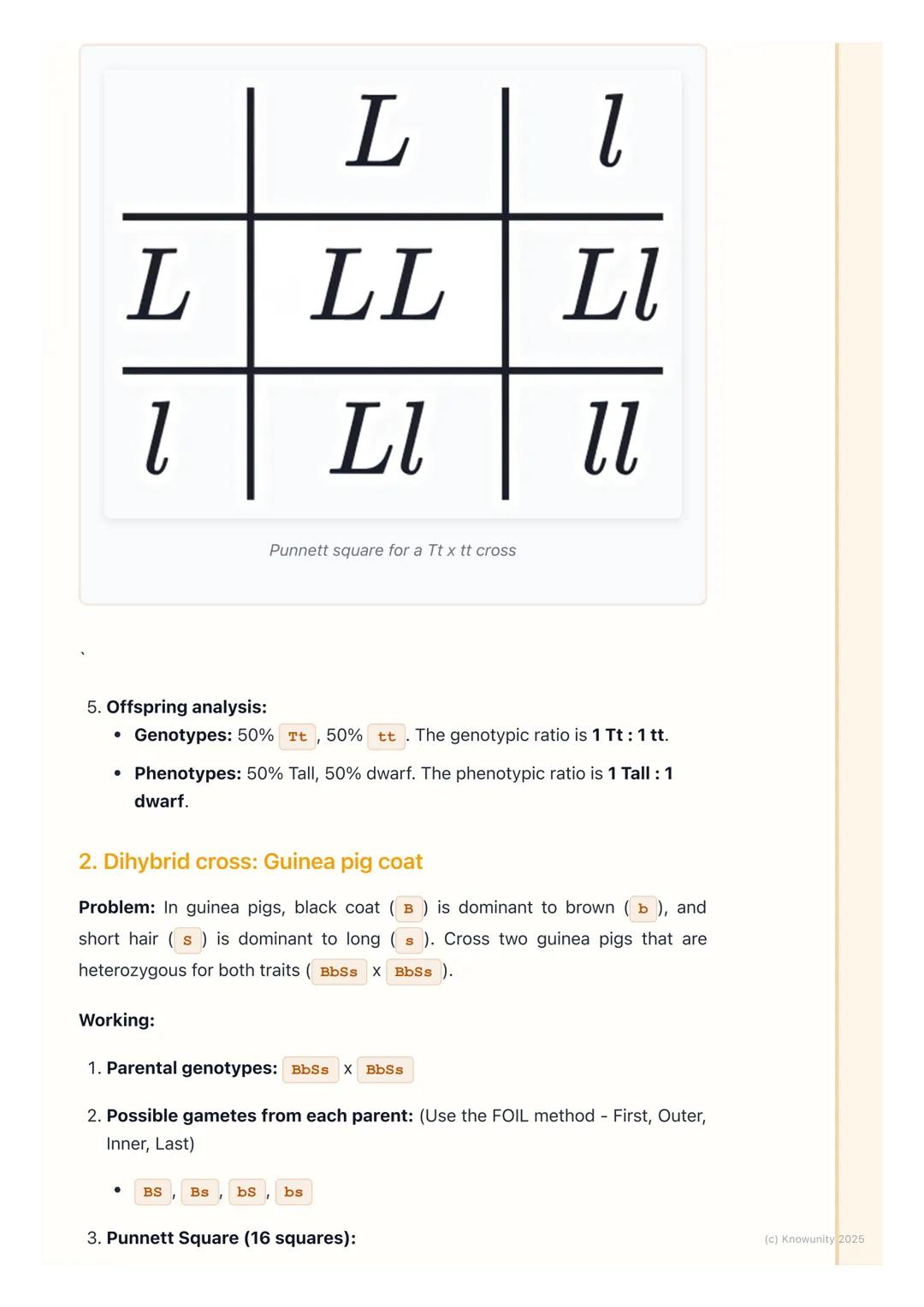
Let's tackle a monohybrid cross step by step. Say you're crossing a heterozygous tall plant (Tt) with a dwarf plant (tt). The tall plant produces T and t gametes, whilst the dwarf only produces t gametes.
Your Punnett square gives you 50% Tt (tall) and 50% tt (dwarf) offspring. Notice how this gives a 1:1 ratio instead of 3:1 - that's because one parent is homozygous recessive.
For sex-linked problems, always write alleles as superscripts on the X chromosome . Remember that the Y chromosome carries no allele for most X-linked traits.
The key is reading questions carefully - are they asking for the probability of any child having a trait, or specifically a son or daughter? Your answer format matters too (percentage, fraction, or ratio).
Pro Tip: Always show your working - even if you get the final answer wrong, you can still pick up marks for correct method!
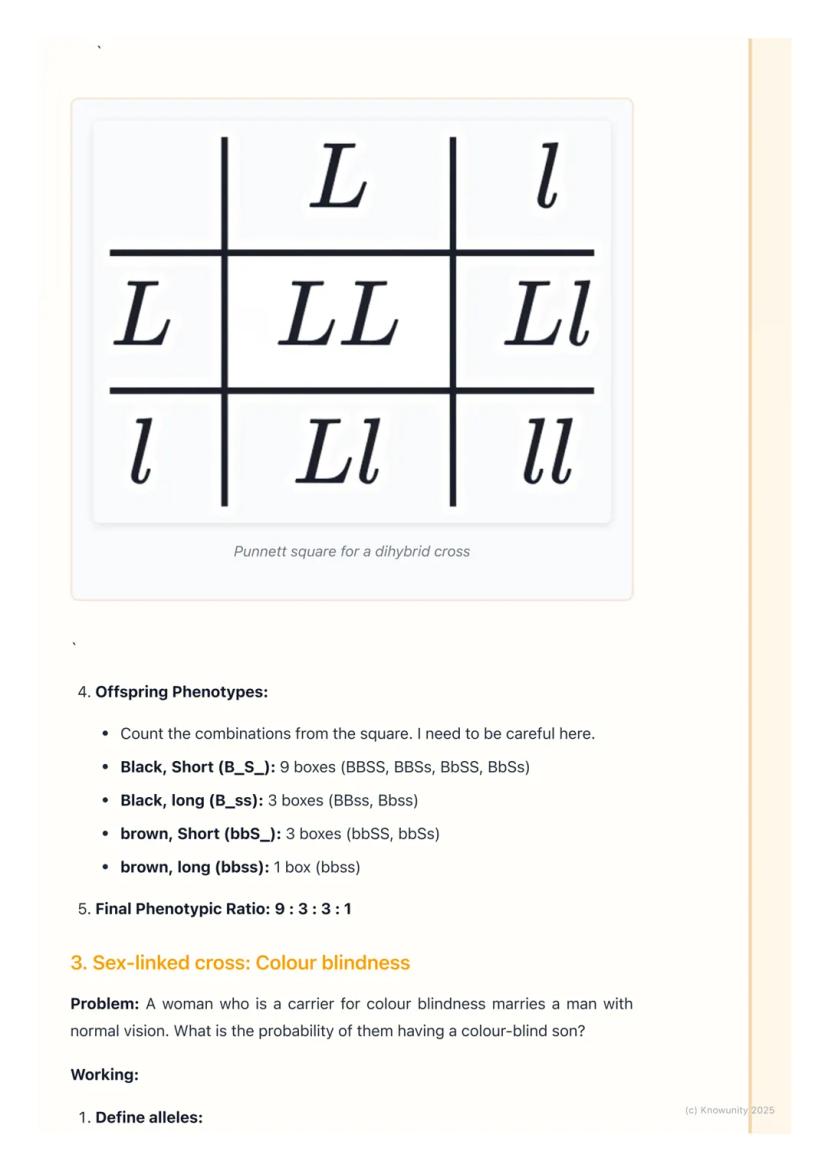
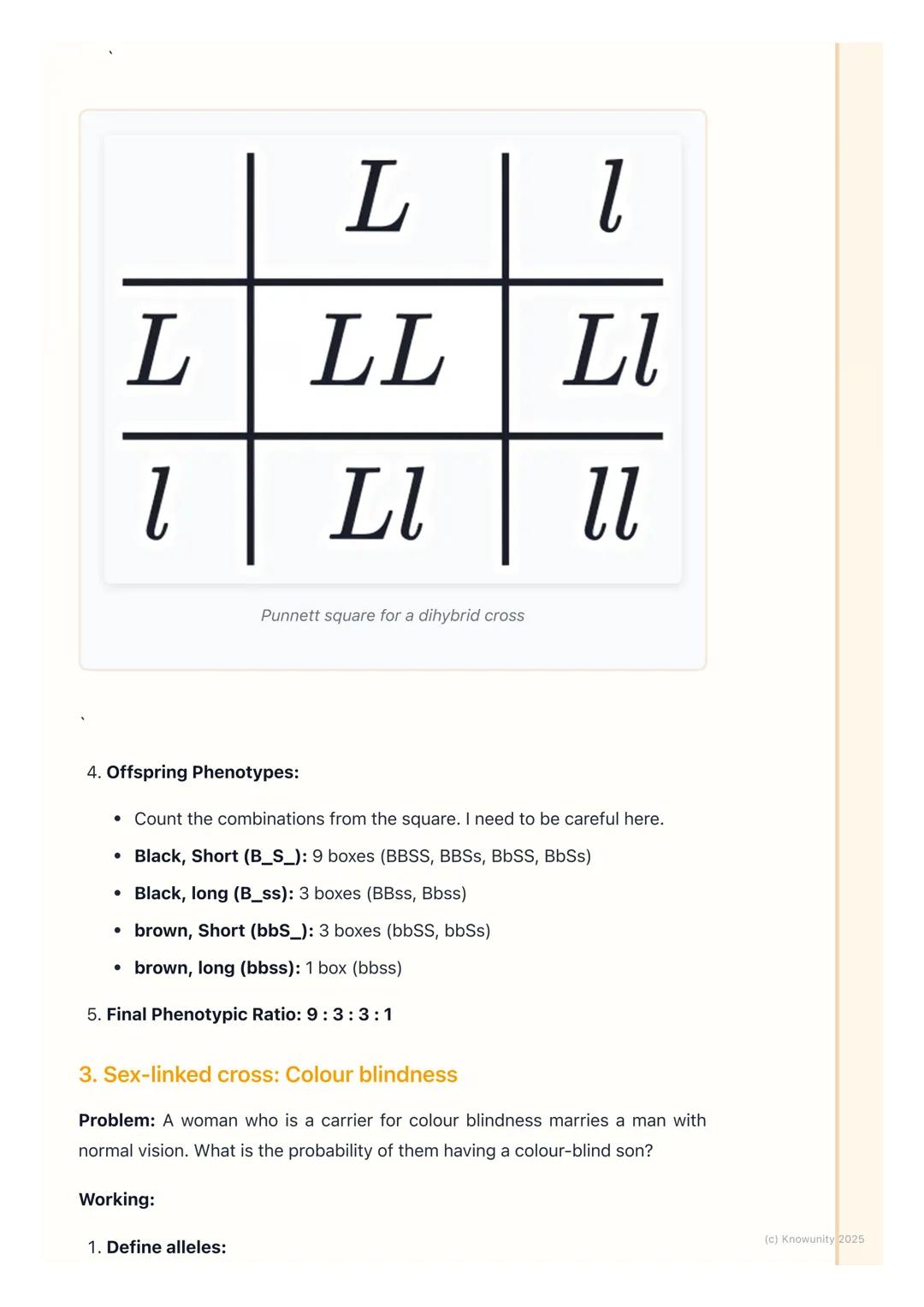
Guinea pig genetics makes a perfect dihybrid example! With black coat (B) dominant over brown (b), and short hair (S) dominant over long (s), let's cross two heterozygous parents (BbSs × BbSs).
Each parent can produce four different gamete types: BS, Bs, bS, and bs. Use the FOIL method (First, Outer, Inner, Last) to work these out systematically.
Your 16-square Punnett square will show the classic 9:3:3:1 phenotypic ratio. Count carefully: 9 black short-haired, 3 black long-haired, 3 brown short-haired, and 1 brown long-haired guinea pig.
This ratio appears whenever you cross two individuals who are heterozygous for both traits. It's one of the most important patterns in genetics, so make sure you can recognise and reproduce it.
Study Hack: Practice drawing 16-square Punnett squares until you can do them quickly - they're exam favourites!
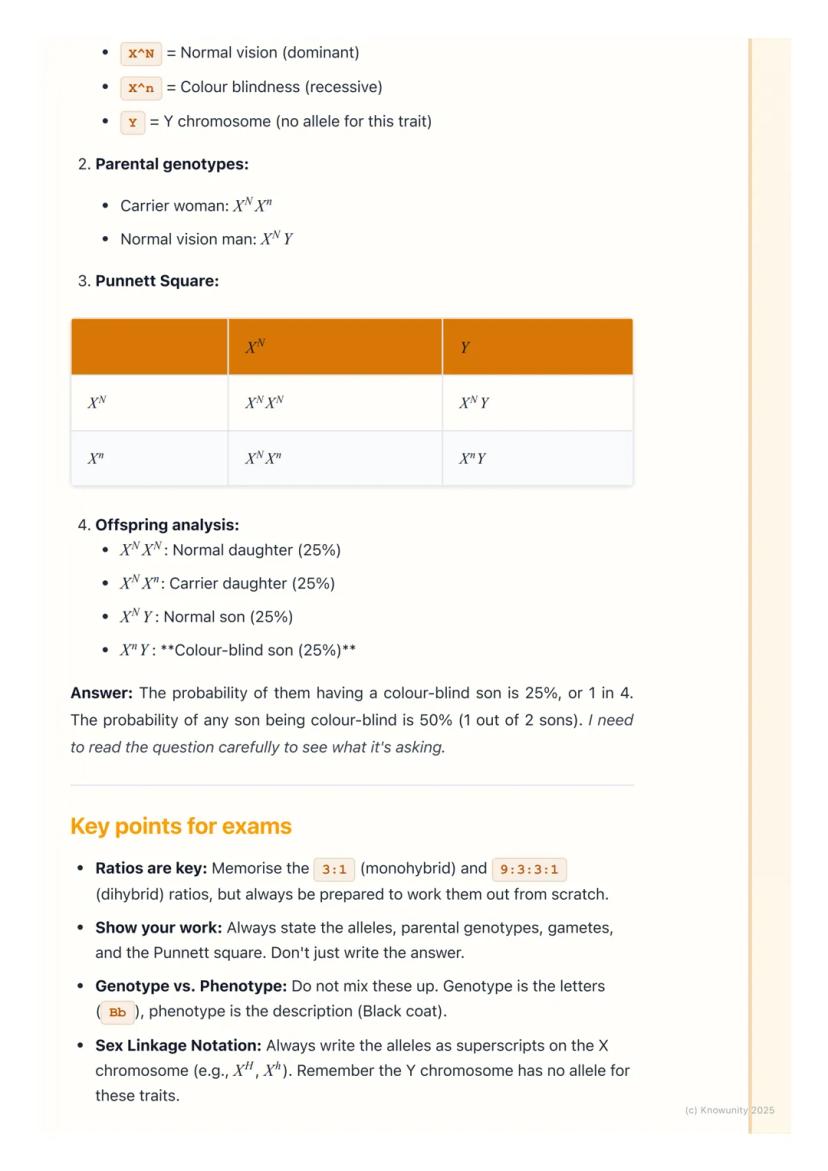
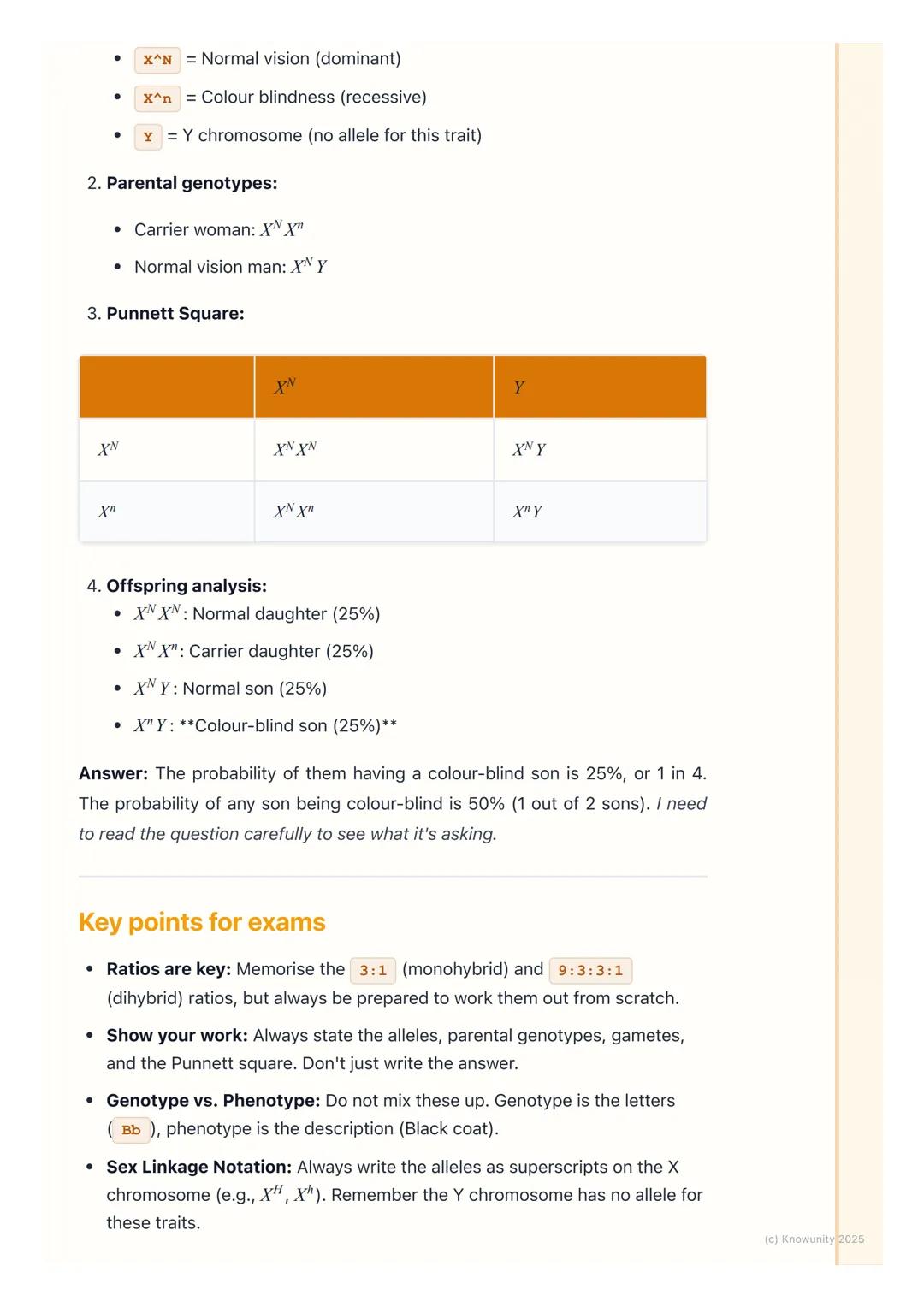
Sex-linked crosses work differently because the inheritance pattern depends on whether you're male or female. Let's look at colour blindness: a carrier woman married to a normal-vision man .
Their Punnett square shows four possible outcomes. Daughters can be normal or carriers , whilst sons can be normal or colour-blind .
The probability of having a colour-blind son is 25% of all children, but 50% of all sons. Always check what the question is actually asking for!
Males show X-linked recessive traits more often because they only need one copy of the recessive allele. Females need two copies, which is much less likely.
Remember: In sex-linkage, it's all about that X chromosome - males get their only copy from mum!
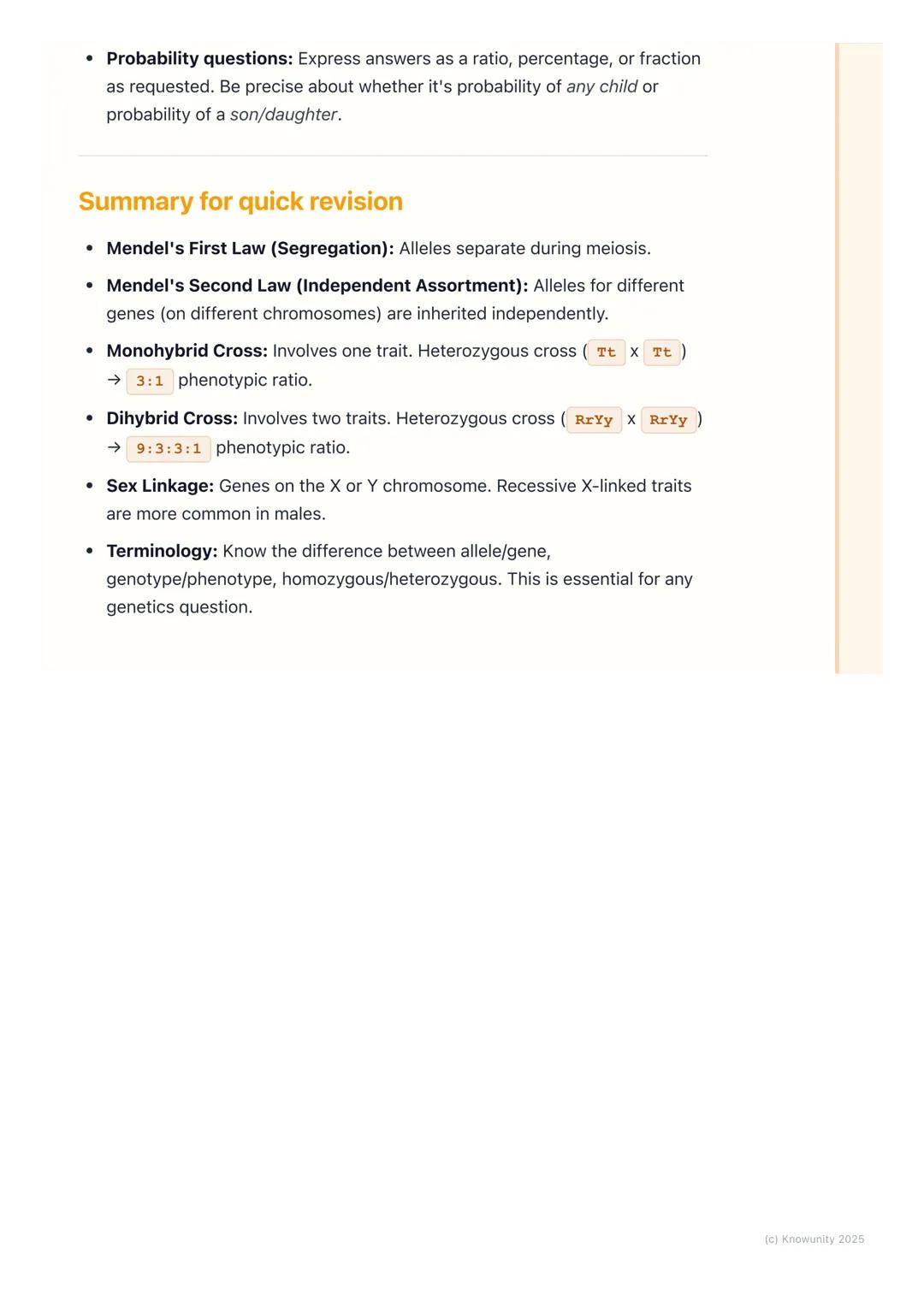
Your exam toolkit needs these essential ratios: 3:1 for monohybrid crosses and 9:3:3:1 for dihybrid crosses. But don't just memorise them - understand where they come from so you can work them out from scratch.
Always show your complete working: state your alleles, write parental genotypes, list possible gametes, draw your Punnett square, and calculate ratios. Even if you make an error early on, you can still earn marks for correct method.
Never mix up genotype (the letters like Bb) with phenotype (the description like "black coat"). This is a classic mistake that costs easy marks.
For probability questions, express answers exactly as requested - ratio, percentage, or fraction. Be precise about whether it's probability of any child or specifically a son or daughter having the trait.
Final Tip: Practice past paper questions until genetic crosses become second nature - repetition builds confidence!
Mendel's laws form the foundation: segregation (alleles separate during meiosis) and independent assortment (different genes inherit independently if on different chromosomes).
Cross types you must know: monohybrid (one trait, gives 3:1 ratio when both parents heterozygous) and dihybrid (two traits, gives 9:3:3:1 ratio when both parents heterozygous for both traits).
Sex-linkage means genes on sex chromosomes, with X-linked recessive traits more common in males since they only have one X chromosome.
Master your terminology: the difference between allele/gene, genotype/phenotype, and homozygous/heterozygous. These distinctions appear in every genetics question, so getting them right is non-negotiable for success.
Revision Gold: Create flashcards for all key terms - you'll need instant recall under exam pressure!
Nuestro compañero de IA está específicamente adaptado a las necesidades de los estudiantes. Basándonos en los millones de contenidos que tenemos en la plataforma, podemos dar a los estudiantes respuestas realmente significativas y relevantes. Pero no se trata solo de respuestas, el compañero también guía a los estudiantes a través de sus retos de aprendizaje diarios, con planes de aprendizaje personalizados, cuestionarios o contenidos en el chat y una personalización del 100% basada en las habilidades y el desarrollo de los estudiantes.
Puedes descargar la app en Google Play Store y Apple App Store.
Sí, tienes acceso gratuito a los contenidos de la aplicación y a nuestro compañero de IA. Para desbloquear determinadas funciones de la aplicación, puedes adquirir Knowunity Pro.
App Store
Google Play
La app es muy fácil de usar y está muy bien diseñada. Hasta ahora he encontrado todo lo que estaba buscando y he podido aprender mucho de las presentaciones. Definitivamente utilizaré la aplicación para un examen de clase. Y, por supuesto, también me sirve mucho de inspiración.
Pablo
usuario de iOS
Esta app es realmente genial. Hay tantos apuntes de clase y ayuda [...]. Tengo problemas con matemáticas, por ejemplo, y la aplicación tiene muchas opciones de ayuda. Gracias a Knowunity, he mejorado en mates. Se la recomiendo a todo el mundo.
Elena
usuaria de Android
Vaya, estoy realmente sorprendida. Acabo de probar la app porque la he visto anunciada muchas veces y me he quedado absolutamente alucinada. Esta app es LA AYUDA que quieres para el insti y, sobre todo, ofrece muchísimas cosas, como ejercicios y hojas informativas, que a mí personalmente me han sido MUY útiles.
Ana
usuaria de iOS
Está app es muy buena, tiene apuntes que son de mucha ayuda y su IA es fantástica, te explica a la perfección y muy fácil de entender lo que necesites, te ayuda con los deberes, te hace esquemas... en definitiva es una muy buena opción!
Sophia
usuario de Android
Me encanta!!! Me resuelve todo con detalle y me da la explicación correcta. Tiene un montón de funciones, ami me ha ido genial!! Os la recomiendo!!!
Marta
usuaria de Android
La uso casi diariamente, sirve para todas las asignaturas. Yo, por ejemplo la utilizo más en inglés porque se me da bastante mal, ¡Todas las respuestas están correctas! Consta con personas reales que suben sus apuntes y IA para que puedas hacer los deberes muchísimo más fácil, la recomiendo.
Izan
usuario de iOS
¡La app es buenísima! Sólo tengo que introducir el tema en la barra de búsqueda y recibo la respuesta muy rápido. No tengo que ver 10 vídeos de YouTube para entender algo, así que me ahorro tiempo. ¡Muy recomendable!
Sara
usuaria de Android
En el instituto era muy malo en matemáticas, pero gracias a la app, ahora saco mejores notas. Os agradezco mucho que hayáis creado la aplicación.
Roberto
usuario de Android
Esto no es como Chatgpt, es MUCHISMO MEJOR, te hace unos resúmenes espectaculares y gracias a esta app pase de sacar 5-6 a sacar 8-9.
Julyana
usuaria de Android
Es la mejor aplicación del mundo, la uso para revisar los deberes a mi hijo.
Javier
usuario de Android
LOS QUIZ Y FLASHCARDS SON SÚPER ÚTILES Y ME ENCANTA Knowunity IA. ADEMÁS ES LITERALMENTE COMO CHATGPT PERO MÁS LISTO!! ME AYUDÓ TAMBIÉN CON MIS PROBLEMAS DE MÁSCARA!! Y CON MIS ASIGNATURAS DE VERDAD! OBVIO 😍😁😲🤑💗✨🎀😮
Erick
usuario de Android
Me me encanta esta app, todo lo que tiene es de calidad ya que antes de ser publicado es revisado por un equipo de profesionales. Me ha ido genial esta aplicación ya que gracias a ella puedo estudiar mucho mejor, sin tener que agobiarme porque mi profesor no ha hecho teoría o porque no entiendo su teoría. Le doy un 10 de 10!
Mar
usuaria de iOS
La app es muy fácil de usar y está muy bien diseñada. Hasta ahora he encontrado todo lo que estaba buscando y he podido aprender mucho de las presentaciones. Definitivamente utilizaré la aplicación para un examen de clase. Y, por supuesto, también me sirve mucho de inspiración.
Pablo
usuario de iOS
Esta app es realmente genial. Hay tantos apuntes de clase y ayuda [...]. Tengo problemas con matemáticas, por ejemplo, y la aplicación tiene muchas opciones de ayuda. Gracias a Knowunity, he mejorado en mates. Se la recomiendo a todo el mundo.
Elena
usuaria de Android
Vaya, estoy realmente sorprendida. Acabo de probar la app porque la he visto anunciada muchas veces y me he quedado absolutamente alucinada. Esta app es LA AYUDA que quieres para el insti y, sobre todo, ofrece muchísimas cosas, como ejercicios y hojas informativas, que a mí personalmente me han sido MUY útiles.
Ana
usuaria de iOS
Está app es muy buena, tiene apuntes que son de mucha ayuda y su IA es fantástica, te explica a la perfección y muy fácil de entender lo que necesites, te ayuda con los deberes, te hace esquemas... en definitiva es una muy buena opción!
Sophia
usuario de Android
Me encanta!!! Me resuelve todo con detalle y me da la explicación correcta. Tiene un montón de funciones, ami me ha ido genial!! Os la recomiendo!!!
Marta
usuaria de Android
La uso casi diariamente, sirve para todas las asignaturas. Yo, por ejemplo la utilizo más en inglés porque se me da bastante mal, ¡Todas las respuestas están correctas! Consta con personas reales que suben sus apuntes y IA para que puedas hacer los deberes muchísimo más fácil, la recomiendo.
Izan
usuario de iOS
¡La app es buenísima! Sólo tengo que introducir el tema en la barra de búsqueda y recibo la respuesta muy rápido. No tengo que ver 10 vídeos de YouTube para entender algo, así que me ahorro tiempo. ¡Muy recomendable!
Sara
usuaria de Android
En el instituto era muy malo en matemáticas, pero gracias a la app, ahora saco mejores notas. Os agradezco mucho que hayáis creado la aplicación.
Roberto
usuario de Android
Esto no es como Chatgpt, es MUCHISMO MEJOR, te hace unos resúmenes espectaculares y gracias a esta app pase de sacar 5-6 a sacar 8-9.
Julyana
usuaria de Android
Es la mejor aplicación del mundo, la uso para revisar los deberes a mi hijo.
Javier
usuario de Android
LOS QUIZ Y FLASHCARDS SON SÚPER ÚTILES Y ME ENCANTA Knowunity IA. ADEMÁS ES LITERALMENTE COMO CHATGPT PERO MÁS LISTO!! ME AYUDÓ TAMBIÉN CON MIS PROBLEMAS DE MÁSCARA!! Y CON MIS ASIGNATURAS DE VERDAD! OBVIO 😍😁😲🤑💗✨🎀😮
Erick
usuario de Android
Me me encanta esta app, todo lo que tiene es de calidad ya que antes de ser publicado es revisado por un equipo de profesionales. Me ha ido genial esta aplicación ya que gracias a ella puedo estudiar mucho mejor, sin tener que agobiarme porque mi profesor no ha hecho teoría o porque no entiendo su teoría. Le doy un 10 de 10!
Mar
usuaria de iOS
Ever wondered why you have your mum's eyes or your dad's height? It all comes down to genetics! Gregor Mendel, an Austrian monk from the 1860s, figured out the basic rules of inheritance by studying pea plants, and his discoveries... Mostrar más
Acceso a todos los documentos
Mejora tus notas
Únete a millones de estudiantes
You'll need to nail the key terms first - they're the building blocks for everything else in genetics. A gene is basically a section of DNA that controls a specific trait, like eye colour. Alleles are different versions of the same gene (think blue eyes vs brown eyes).
Your genotype is the actual genetic code you carry (written as letters like TT or Tt), whilst your phenotype is what you actually look like. Dominant alleles (capital letters) always show up in your appearance, even if you only have one copy. Recessive alleles (lowercase letters) only appear when you have two copies.
Homozygous means having two identical alleles (like TT or tt), whilst heterozygous means having two different ones (like Tt). The generations have special names too: P generation (parents), F1 (first offspring), and F2 (second generation offspring).
Quick Tip: Think of alleles like different flavours of the same ice cream - same product, different varieties!
Acceso a todos los documentos
Mejora tus notas
Únete a millones de estudiantes
Mendel's first law (segregation) tells us that trait-controlling factors separate during gamete formation, so each parent only passes on one allele for each trait. This happens during meiosis when chromosomes get pulled apart.
A monohybrid cross tracks just one characteristic at a time. You'll use Punnett squares to predict outcomes - they're like genetic calculators! The classic example is crossing two heterozygous parents (Tt × Tt).
Here's your step-by-step process: state parent phenotypes and genotypes, work out possible gametes, draw your Punnett square, fill it in, then state the offspring ratios. The magic ratio you'll see constantly is 3:1 for phenotypes (3 dominant : 1 recessive) and 1:2:1 for genotypes.
Exam Gold: That 3:1 ratio from Tt × Tt crosses appears in loads of questions - memorise it!
Acceso a todos los documentos
Mejora tus notas
Únete a millones de estudiantes
Mendel's second law (independent assortment) shows that different genes get inherited independently - but only if they're on different chromosomes or far apart on the same one. This relates to how chromosomes line up randomly during meiosis.
Dihybrid crosses track two traits simultaneously, like seed shape and colour. The Punnett square becomes much bigger (16 squares instead of 4), but don't panic - the process is the same.
When you cross two parents who are heterozygous for both traits (like RrYy × RrYy), you get the famous 9:3:3:1 ratio. That's 9 with both dominant traits, 3 with each mixed combination, and 1 with both recessive traits.
Sex linkage happens when genes sit on sex chromosomes. Most sex-linked traits are X-linked, which means males are more likely to show recessive traits since they only have one X chromosome.
Memory Trick: For dihybrid crosses, remember "9-3-3-1" - it's the genetic equivalent of a phone number!
Acceso a todos los documentos
Mejora tus notas
Únete a millones de estudiantes
Let's tackle a monohybrid cross step by step. Say you're crossing a heterozygous tall plant (Tt) with a dwarf plant (tt). The tall plant produces T and t gametes, whilst the dwarf only produces t gametes.
Your Punnett square gives you 50% Tt (tall) and 50% tt (dwarf) offspring. Notice how this gives a 1:1 ratio instead of 3:1 - that's because one parent is homozygous recessive.
For sex-linked problems, always write alleles as superscripts on the X chromosome . Remember that the Y chromosome carries no allele for most X-linked traits.
The key is reading questions carefully - are they asking for the probability of any child having a trait, or specifically a son or daughter? Your answer format matters too (percentage, fraction, or ratio).
Pro Tip: Always show your working - even if you get the final answer wrong, you can still pick up marks for correct method!
Acceso a todos los documentos
Mejora tus notas
Únete a millones de estudiantes
Guinea pig genetics makes a perfect dihybrid example! With black coat (B) dominant over brown (b), and short hair (S) dominant over long (s), let's cross two heterozygous parents (BbSs × BbSs).
Each parent can produce four different gamete types: BS, Bs, bS, and bs. Use the FOIL method (First, Outer, Inner, Last) to work these out systematically.
Your 16-square Punnett square will show the classic 9:3:3:1 phenotypic ratio. Count carefully: 9 black short-haired, 3 black long-haired, 3 brown short-haired, and 1 brown long-haired guinea pig.
This ratio appears whenever you cross two individuals who are heterozygous for both traits. It's one of the most important patterns in genetics, so make sure you can recognise and reproduce it.
Study Hack: Practice drawing 16-square Punnett squares until you can do them quickly - they're exam favourites!
Acceso a todos los documentos
Mejora tus notas
Únete a millones de estudiantes
Sex-linked crosses work differently because the inheritance pattern depends on whether you're male or female. Let's look at colour blindness: a carrier woman married to a normal-vision man .
Their Punnett square shows four possible outcomes. Daughters can be normal or carriers , whilst sons can be normal or colour-blind .
The probability of having a colour-blind son is 25% of all children, but 50% of all sons. Always check what the question is actually asking for!
Males show X-linked recessive traits more often because they only need one copy of the recessive allele. Females need two copies, which is much less likely.
Remember: In sex-linkage, it's all about that X chromosome - males get their only copy from mum!
Acceso a todos los documentos
Mejora tus notas
Únete a millones de estudiantes
Your exam toolkit needs these essential ratios: 3:1 for monohybrid crosses and 9:3:3:1 for dihybrid crosses. But don't just memorise them - understand where they come from so you can work them out from scratch.
Always show your complete working: state your alleles, write parental genotypes, list possible gametes, draw your Punnett square, and calculate ratios. Even if you make an error early on, you can still earn marks for correct method.
Never mix up genotype (the letters like Bb) with phenotype (the description like "black coat"). This is a classic mistake that costs easy marks.
For probability questions, express answers exactly as requested - ratio, percentage, or fraction. Be precise about whether it's probability of any child or specifically a son or daughter having the trait.
Final Tip: Practice past paper questions until genetic crosses become second nature - repetition builds confidence!
Acceso a todos los documentos
Mejora tus notas
Únete a millones de estudiantes
Mendel's laws form the foundation: segregation (alleles separate during meiosis) and independent assortment (different genes inherit independently if on different chromosomes).
Cross types you must know: monohybrid (one trait, gives 3:1 ratio when both parents heterozygous) and dihybrid (two traits, gives 9:3:3:1 ratio when both parents heterozygous for both traits).
Sex-linkage means genes on sex chromosomes, with X-linked recessive traits more common in males since they only have one X chromosome.
Master your terminology: the difference between allele/gene, genotype/phenotype, and homozygous/heterozygous. These distinctions appear in every genetics question, so getting them right is non-negotiable for success.
Revision Gold: Create flashcards for all key terms - you'll need instant recall under exam pressure!
Nuestro compañero de IA está específicamente adaptado a las necesidades de los estudiantes. Basándonos en los millones de contenidos que tenemos en la plataforma, podemos dar a los estudiantes respuestas realmente significativas y relevantes. Pero no se trata solo de respuestas, el compañero también guía a los estudiantes a través de sus retos de aprendizaje diarios, con planes de aprendizaje personalizados, cuestionarios o contenidos en el chat y una personalización del 100% basada en las habilidades y el desarrollo de los estudiantes.
Puedes descargar la app en Google Play Store y Apple App Store.
Sí, tienes acceso gratuito a los contenidos de la aplicación y a nuestro compañero de IA. Para desbloquear determinadas funciones de la aplicación, puedes adquirir Knowunity Pro.
0
Herramientas Inteligentes NUEVO
Transforma estos apuntes en: ✓ 50+ Preguntas de Práctica ✓ Flashcards Interactivas ✓ Examen Completo de Práctica ✓ Esquemas de Ensayo
App Store
Google Play
La app es muy fácil de usar y está muy bien diseñada. Hasta ahora he encontrado todo lo que estaba buscando y he podido aprender mucho de las presentaciones. Definitivamente utilizaré la aplicación para un examen de clase. Y, por supuesto, también me sirve mucho de inspiración.
Pablo
usuario de iOS
Esta app es realmente genial. Hay tantos apuntes de clase y ayuda [...]. Tengo problemas con matemáticas, por ejemplo, y la aplicación tiene muchas opciones de ayuda. Gracias a Knowunity, he mejorado en mates. Se la recomiendo a todo el mundo.
Elena
usuaria de Android
Vaya, estoy realmente sorprendida. Acabo de probar la app porque la he visto anunciada muchas veces y me he quedado absolutamente alucinada. Esta app es LA AYUDA que quieres para el insti y, sobre todo, ofrece muchísimas cosas, como ejercicios y hojas informativas, que a mí personalmente me han sido MUY útiles.
Ana
usuaria de iOS
Está app es muy buena, tiene apuntes que son de mucha ayuda y su IA es fantástica, te explica a la perfección y muy fácil de entender lo que necesites, te ayuda con los deberes, te hace esquemas... en definitiva es una muy buena opción!
Sophia
usuario de Android
Me encanta!!! Me resuelve todo con detalle y me da la explicación correcta. Tiene un montón de funciones, ami me ha ido genial!! Os la recomiendo!!!
Marta
usuaria de Android
La uso casi diariamente, sirve para todas las asignaturas. Yo, por ejemplo la utilizo más en inglés porque se me da bastante mal, ¡Todas las respuestas están correctas! Consta con personas reales que suben sus apuntes y IA para que puedas hacer los deberes muchísimo más fácil, la recomiendo.
Izan
usuario de iOS
¡La app es buenísima! Sólo tengo que introducir el tema en la barra de búsqueda y recibo la respuesta muy rápido. No tengo que ver 10 vídeos de YouTube para entender algo, así que me ahorro tiempo. ¡Muy recomendable!
Sara
usuaria de Android
En el instituto era muy malo en matemáticas, pero gracias a la app, ahora saco mejores notas. Os agradezco mucho que hayáis creado la aplicación.
Roberto
usuario de Android
Esto no es como Chatgpt, es MUCHISMO MEJOR, te hace unos resúmenes espectaculares y gracias a esta app pase de sacar 5-6 a sacar 8-9.
Julyana
usuaria de Android
Es la mejor aplicación del mundo, la uso para revisar los deberes a mi hijo.
Javier
usuario de Android
LOS QUIZ Y FLASHCARDS SON SÚPER ÚTILES Y ME ENCANTA Knowunity IA. ADEMÁS ES LITERALMENTE COMO CHATGPT PERO MÁS LISTO!! ME AYUDÓ TAMBIÉN CON MIS PROBLEMAS DE MÁSCARA!! Y CON MIS ASIGNATURAS DE VERDAD! OBVIO 😍😁😲🤑💗✨🎀😮
Erick
usuario de Android
Me me encanta esta app, todo lo que tiene es de calidad ya que antes de ser publicado es revisado por un equipo de profesionales. Me ha ido genial esta aplicación ya que gracias a ella puedo estudiar mucho mejor, sin tener que agobiarme porque mi profesor no ha hecho teoría o porque no entiendo su teoría. Le doy un 10 de 10!
Mar
usuaria de iOS
La app es muy fácil de usar y está muy bien diseñada. Hasta ahora he encontrado todo lo que estaba buscando y he podido aprender mucho de las presentaciones. Definitivamente utilizaré la aplicación para un examen de clase. Y, por supuesto, también me sirve mucho de inspiración.
Pablo
usuario de iOS
Esta app es realmente genial. Hay tantos apuntes de clase y ayuda [...]. Tengo problemas con matemáticas, por ejemplo, y la aplicación tiene muchas opciones de ayuda. Gracias a Knowunity, he mejorado en mates. Se la recomiendo a todo el mundo.
Elena
usuaria de Android
Vaya, estoy realmente sorprendida. Acabo de probar la app porque la he visto anunciada muchas veces y me he quedado absolutamente alucinada. Esta app es LA AYUDA que quieres para el insti y, sobre todo, ofrece muchísimas cosas, como ejercicios y hojas informativas, que a mí personalmente me han sido MUY útiles.
Ana
usuaria de iOS
Está app es muy buena, tiene apuntes que son de mucha ayuda y su IA es fantástica, te explica a la perfección y muy fácil de entender lo que necesites, te ayuda con los deberes, te hace esquemas... en definitiva es una muy buena opción!
Sophia
usuario de Android
Me encanta!!! Me resuelve todo con detalle y me da la explicación correcta. Tiene un montón de funciones, ami me ha ido genial!! Os la recomiendo!!!
Marta
usuaria de Android
La uso casi diariamente, sirve para todas las asignaturas. Yo, por ejemplo la utilizo más en inglés porque se me da bastante mal, ¡Todas las respuestas están correctas! Consta con personas reales que suben sus apuntes y IA para que puedas hacer los deberes muchísimo más fácil, la recomiendo.
Izan
usuario de iOS
¡La app es buenísima! Sólo tengo que introducir el tema en la barra de búsqueda y recibo la respuesta muy rápido. No tengo que ver 10 vídeos de YouTube para entender algo, así que me ahorro tiempo. ¡Muy recomendable!
Sara
usuaria de Android
En el instituto era muy malo en matemáticas, pero gracias a la app, ahora saco mejores notas. Os agradezco mucho que hayáis creado la aplicación.
Roberto
usuario de Android
Esto no es como Chatgpt, es MUCHISMO MEJOR, te hace unos resúmenes espectaculares y gracias a esta app pase de sacar 5-6 a sacar 8-9.
Julyana
usuaria de Android
Es la mejor aplicación del mundo, la uso para revisar los deberes a mi hijo.
Javier
usuario de Android
LOS QUIZ Y FLASHCARDS SON SÚPER ÚTILES Y ME ENCANTA Knowunity IA. ADEMÁS ES LITERALMENTE COMO CHATGPT PERO MÁS LISTO!! ME AYUDÓ TAMBIÉN CON MIS PROBLEMAS DE MÁSCARA!! Y CON MIS ASIGNATURAS DE VERDAD! OBVIO 😍😁😲🤑💗✨🎀😮
Erick
usuario de Android
Me me encanta esta app, todo lo que tiene es de calidad ya que antes de ser publicado es revisado por un equipo de profesionales. Me ha ido genial esta aplicación ya que gracias a ella puedo estudiar mucho mejor, sin tener que agobiarme porque mi profesor no ha hecho teoría o porque no entiendo su teoría. Le doy un 10 de 10!
Mar
usuaria de iOS