
Ever wonder how energy moves through nature and keeps everything...
 Biology7 visualizaciones·Actualizado Jun 13, 2026·7 páginas
Understanding Ecosystems: Food Chains and Webs
1 / 7
1
of 7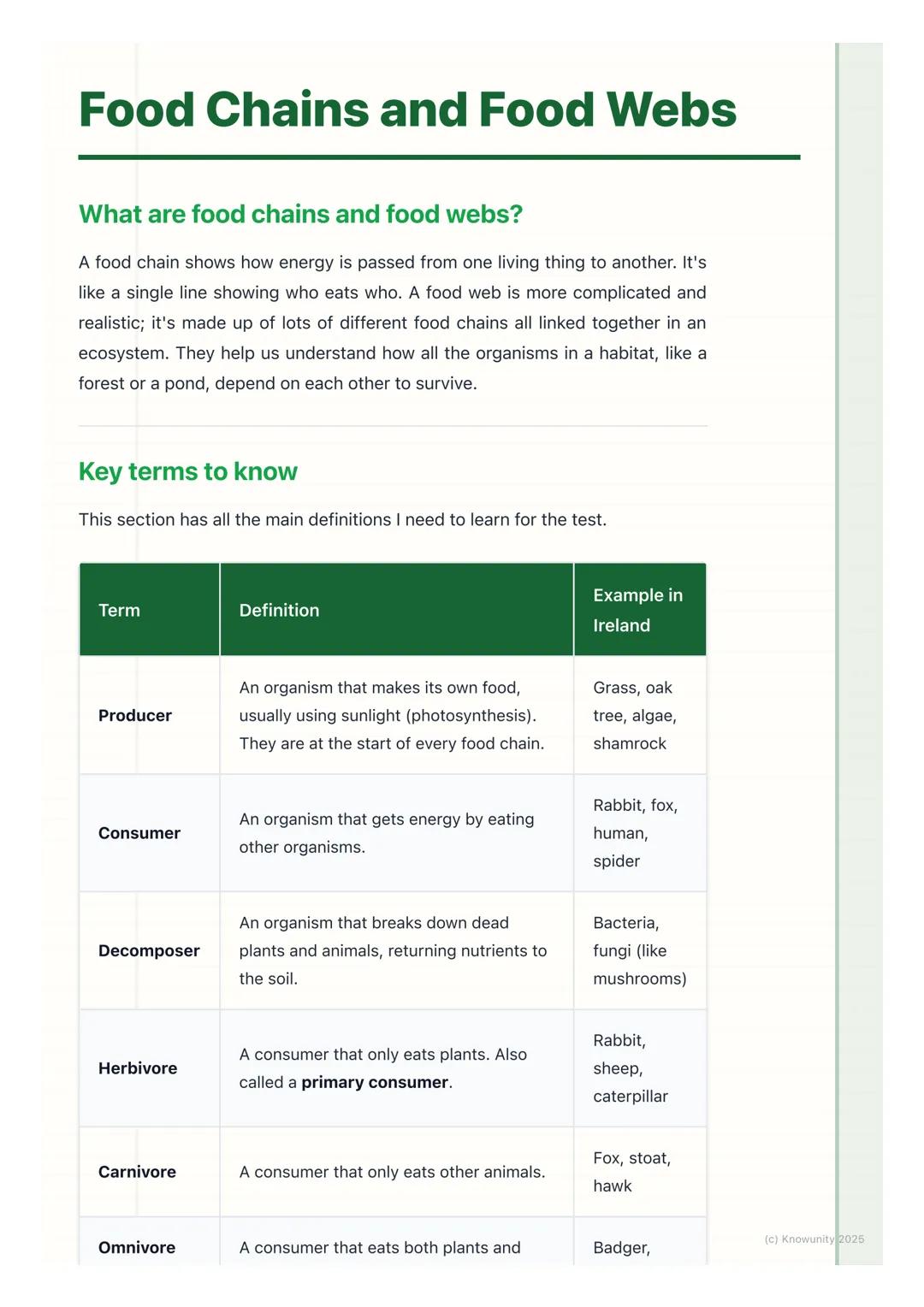
Food Chains and Food Webs Basics
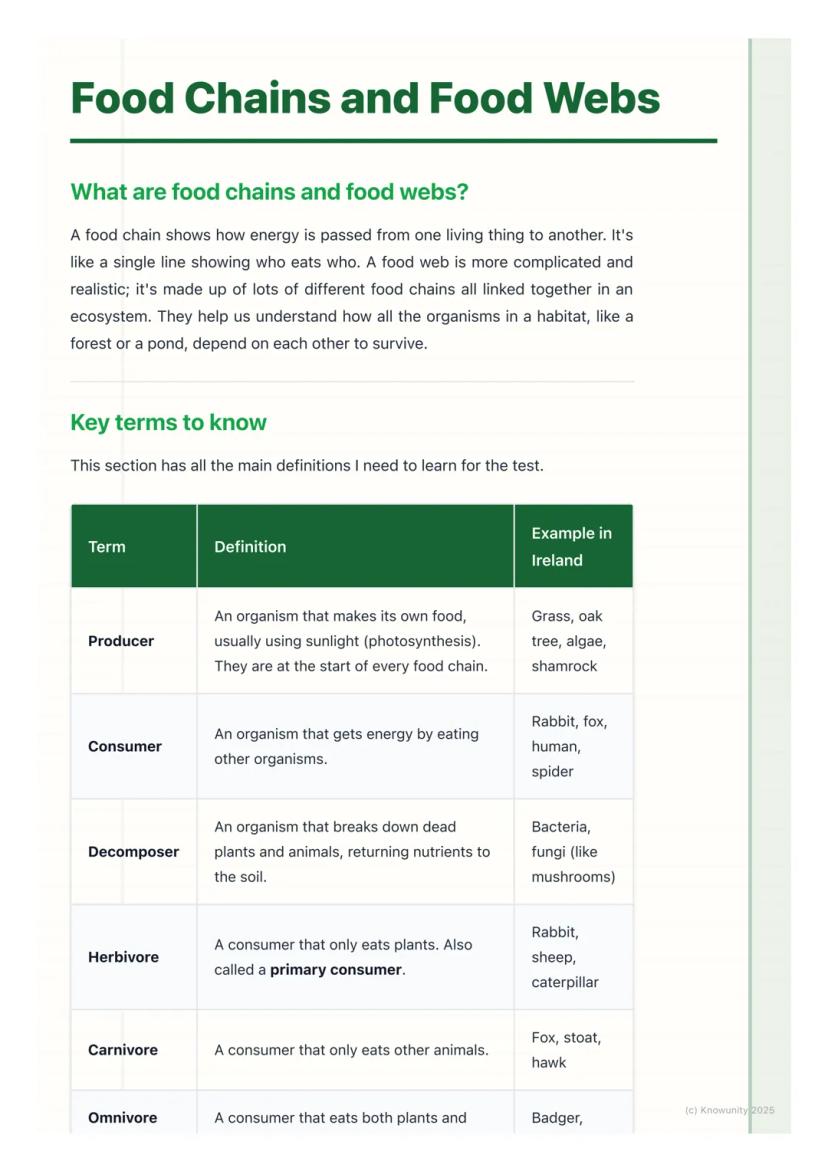
Think of a food chain as nature's conveyor belt - it's a simple line showing who eats who. Energy passes from one living thing to another in a straight path. A food web is like having loads of these conveyor belts all tangled together, which is much closer to what actually happens in real ecosystems.
These diagrams help us understand how every creature in a habitat - whether it's the Wicklow Mountains or a Dublin park - relies on others to stay alive. It's all about survival and energy flow.
Key Point: Food webs are more realistic than food chains because animals usually have multiple food sources, making ecosystems more stable.
2
of 7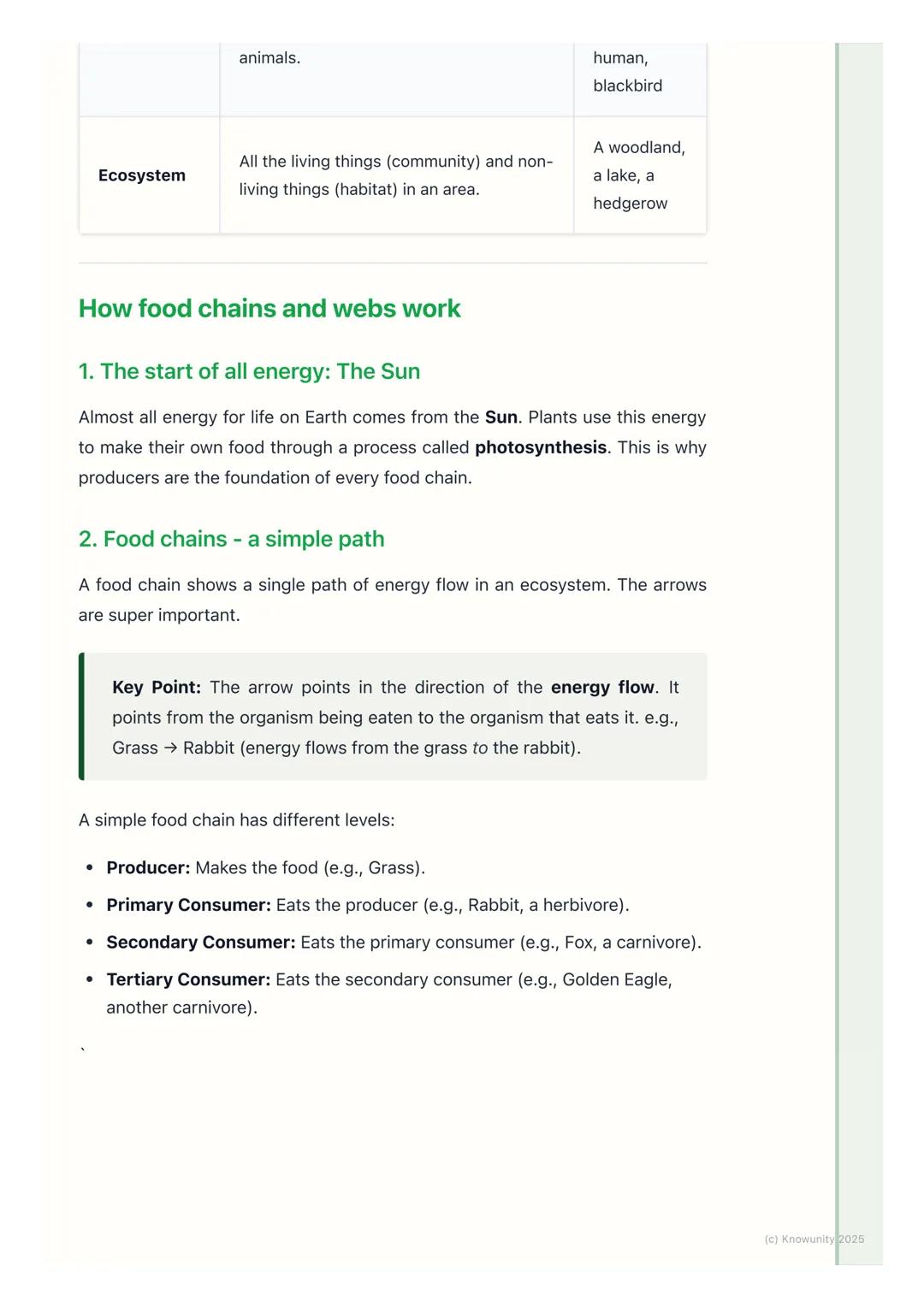
Essential Terms You Need to Know
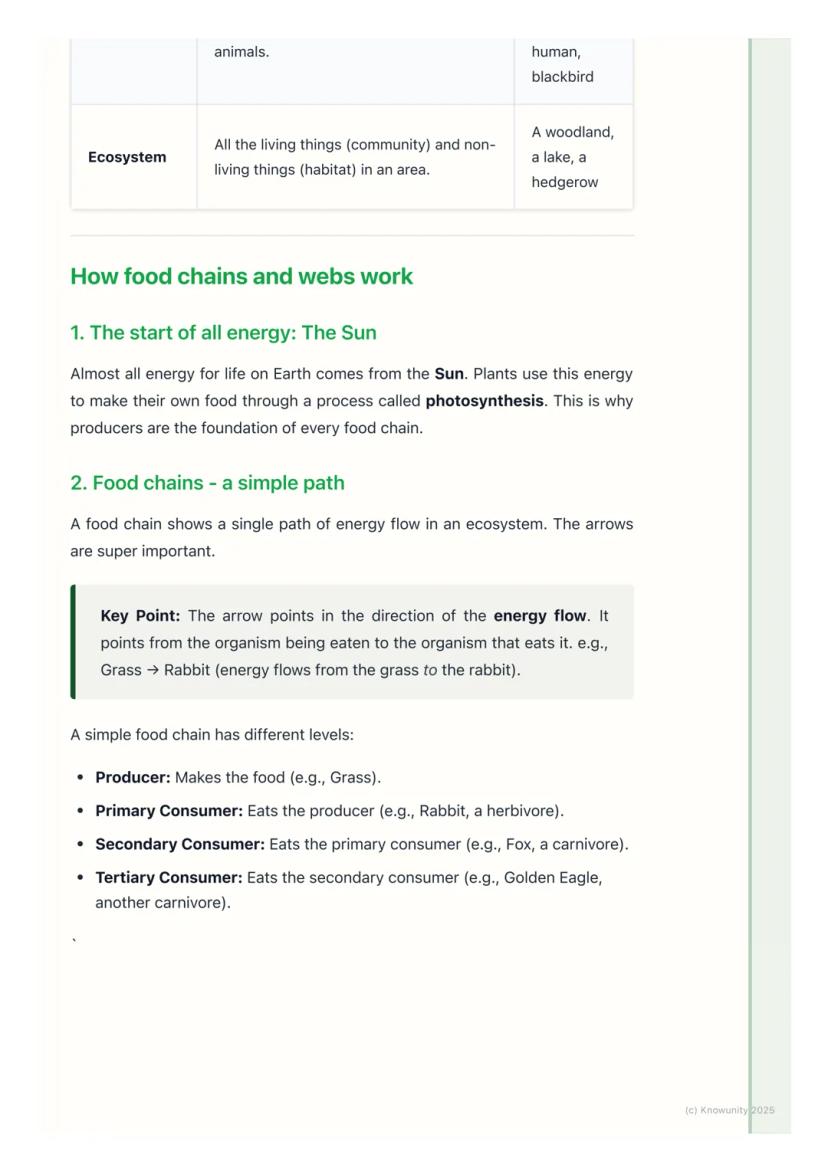
Producers are the superstars that kick off every food chain by making their own food through photosynthesis. Think grass, oak trees, or algae in Irish ponds. Consumers can't make their own grub, so they eat other organisms instead.
There are different types of consumers: herbivores (like rabbits) only munch plants, carnivores (like foxes) only eat meat, and omnivores (like badgers and humans) eat both. Decomposers are nature's recycling crew - bacteria and fungi that break down dead stuff and return nutrients to the soil.
An ecosystem includes all the living things and their environment in one area. Whether it's a woodland, lake, or hedgerow, everything's connected in this complex web of life.
Remember: Every organism fits into one of these categories, and each plays a crucial role in keeping the ecosystem balanced.
3
of 7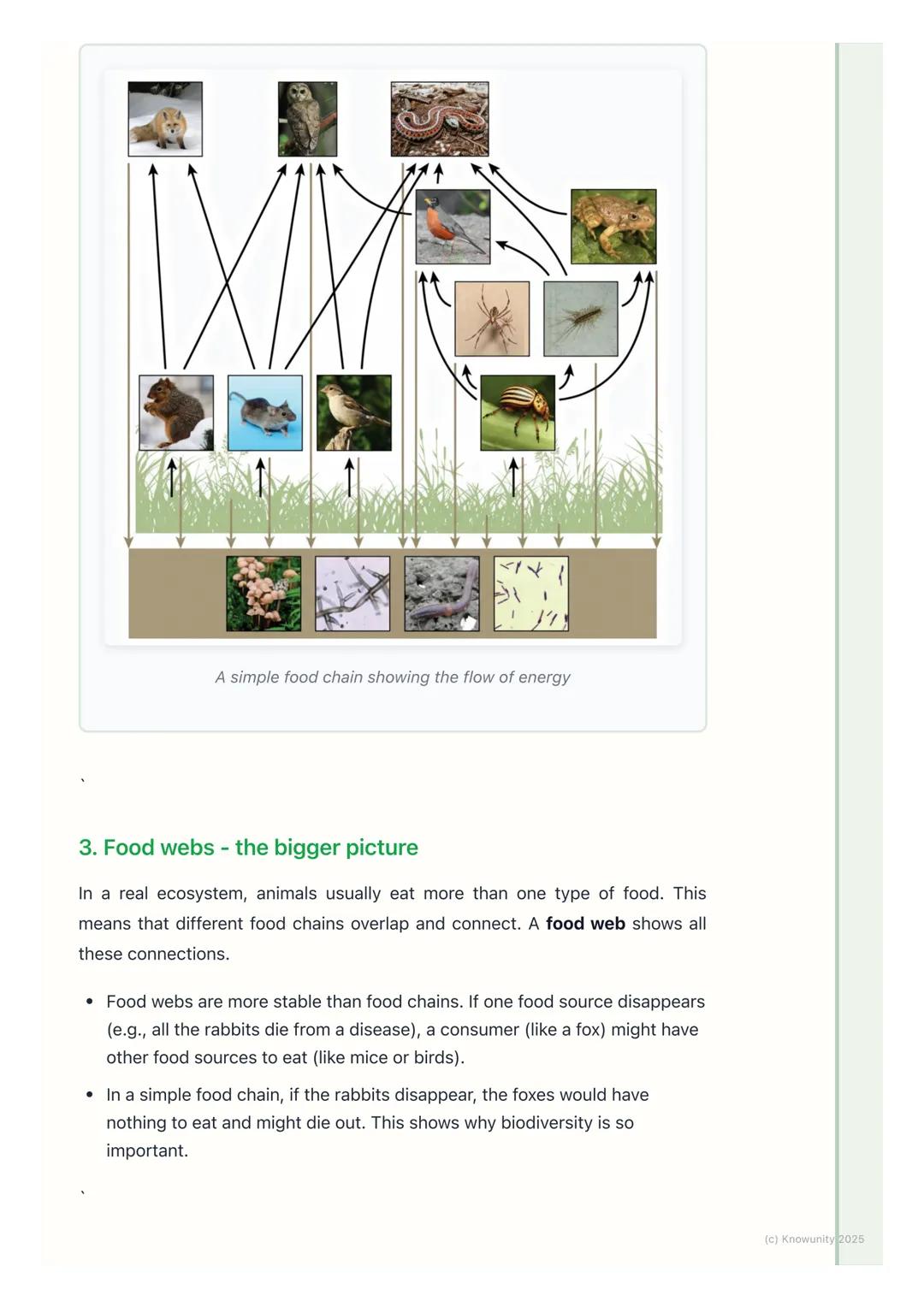
How Energy Flows Through Nature
The Sun powers almost everything on Earth by giving plants energy for photosynthesis. This makes producers the foundation of every food chain - without them, everything else would collapse.
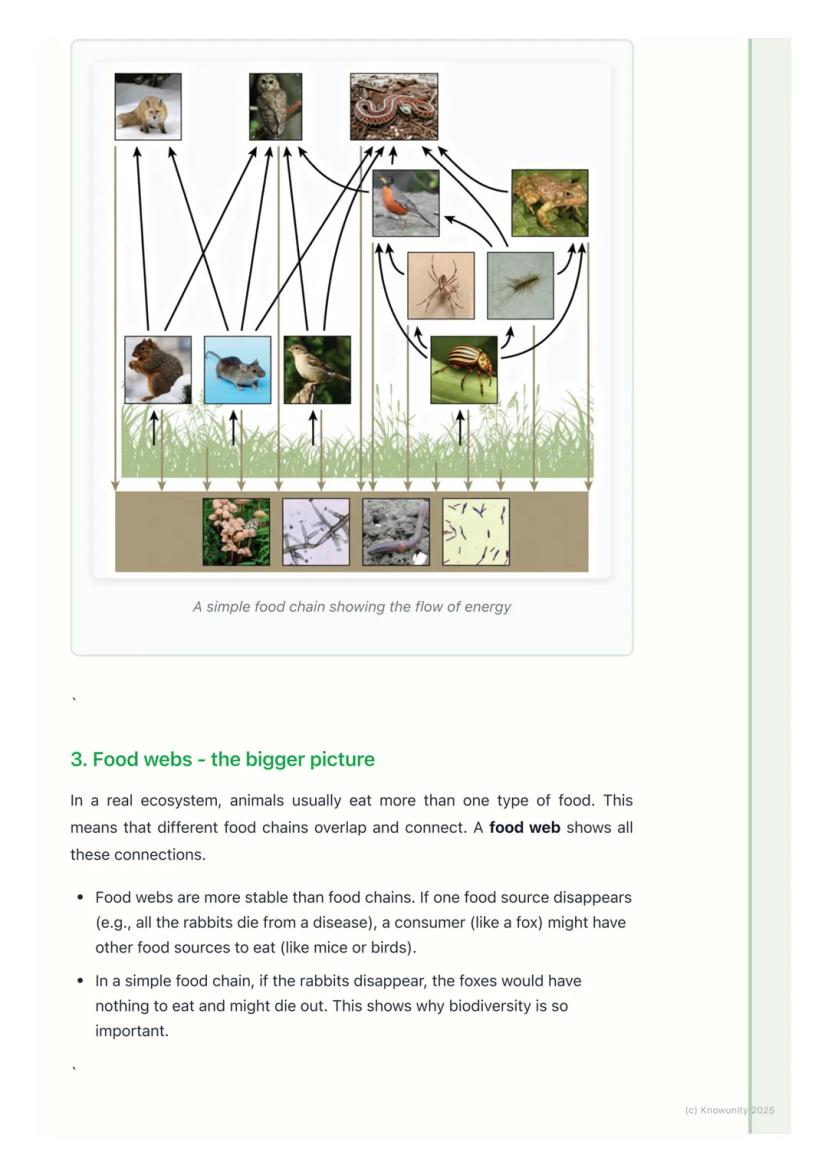
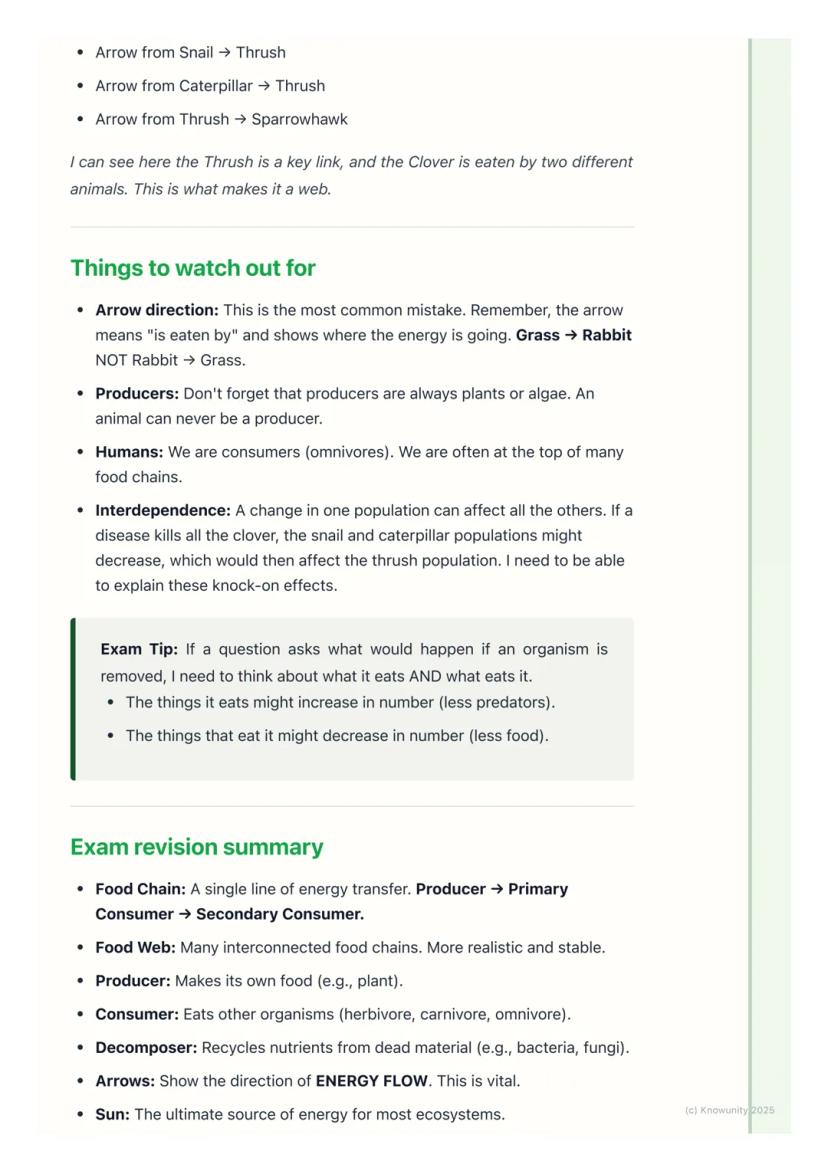
Food chains show energy moving in levels: producers → primary consumers (herbivores) → secondary consumers (carnivores) → tertiary consumers (top predators). The arrows are absolutely crucial - they point in the direction energy flows, from what's being eaten to what's doing the eating.
So "Grass → Rabbit" means energy flows from the grass into the rabbit when it gets eaten. Getting arrow direction wrong is the easiest way to lose marks in exams, so practice this loads.
Exam Tip: Always remember arrows show energy flow direction - "is eaten by" - not who does the eating!
4
of 7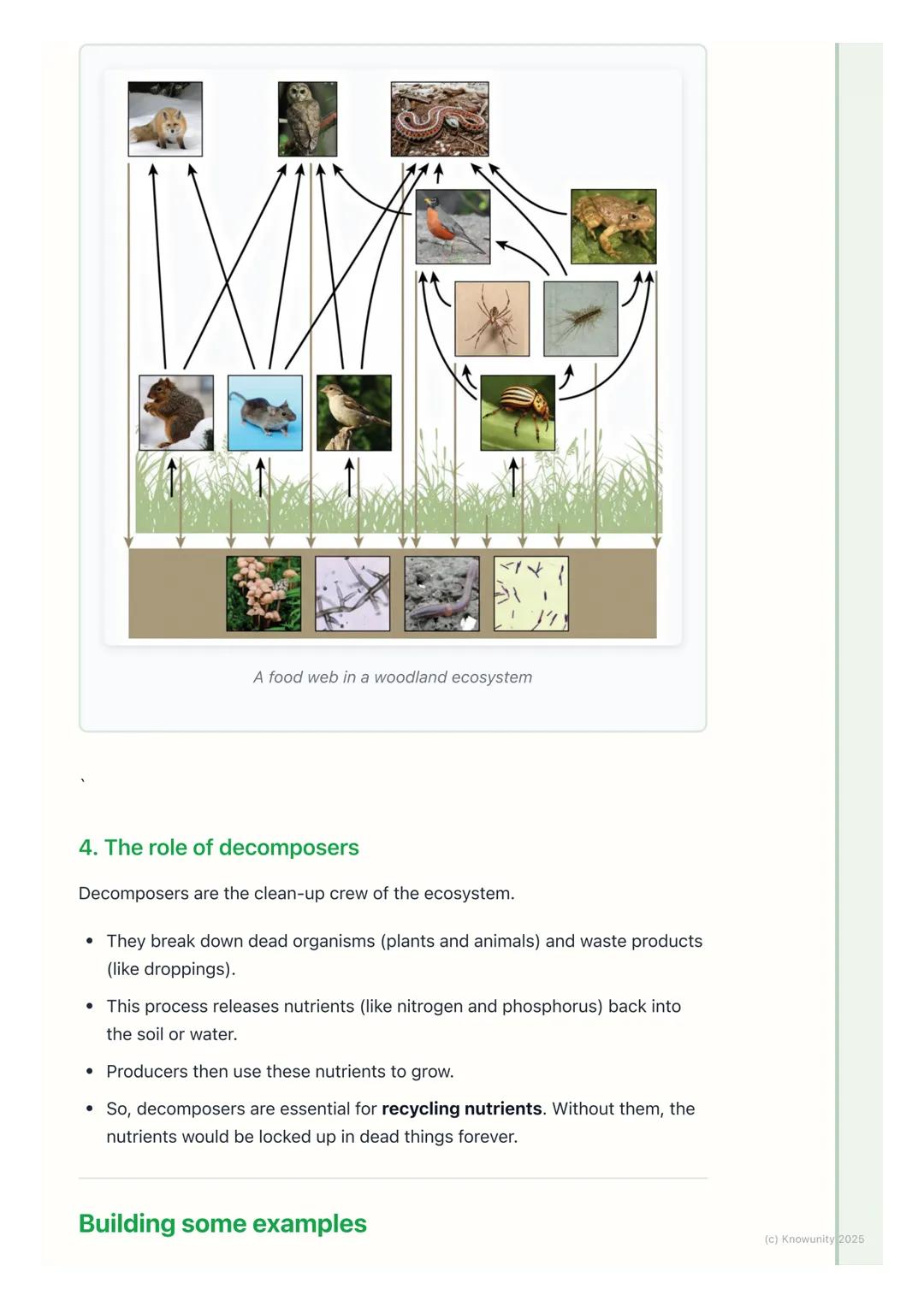
Food Webs and Decomposers
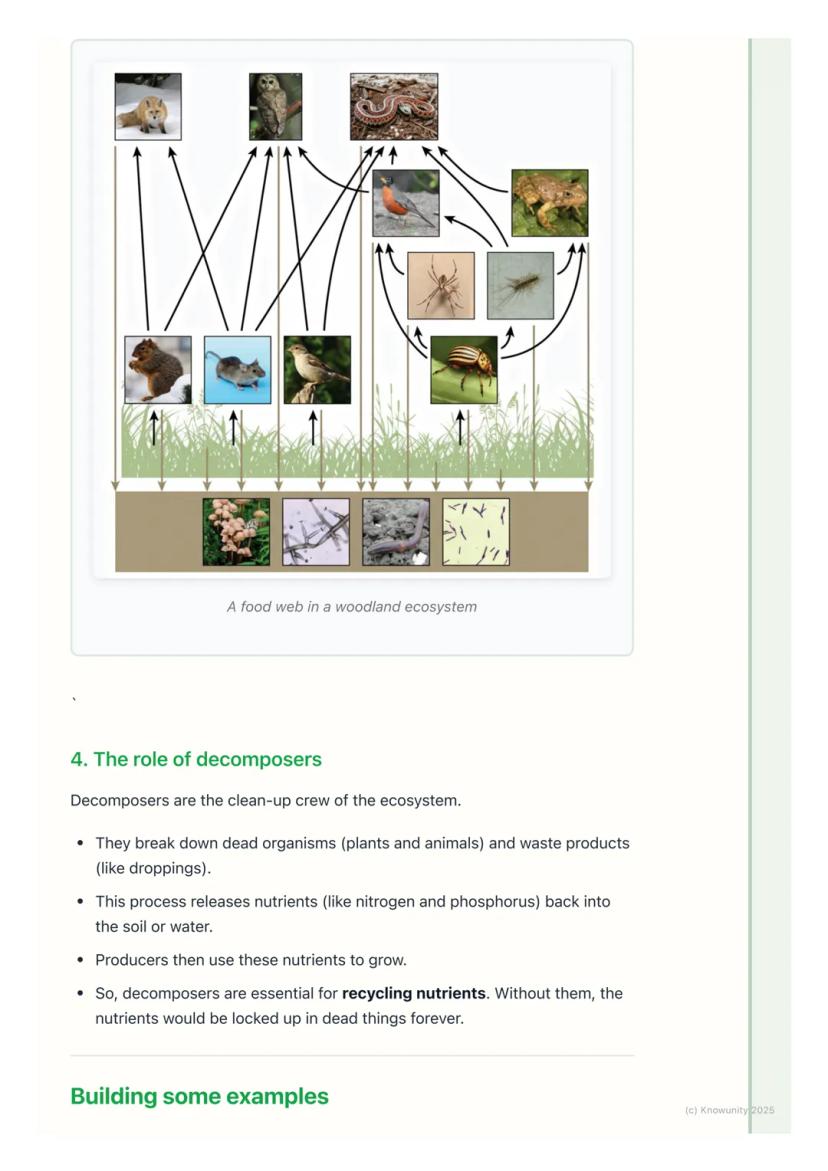
Food webs show the bigger picture because most animals eat several different things. If rabbits disappear from disease, foxes might survive by eating mice or birds instead. This makes food webs much more stable than simple food chains.
Decomposers are the unsung heroes that break down dead plants, animals, and waste. They release essential nutrients like nitrogen back into the soil, which producers then use to grow. Without decomposers, nutrients would stay locked up in dead material forever.
This creates a perfect cycle: decomposers feed the soil, producers use those nutrients to grow, consumers eat the producers, and when they die, decomposers start the process again.
Think About It: Decomposers are why forests aren't knee-deep in dead leaves and animal bodies!
5
of 7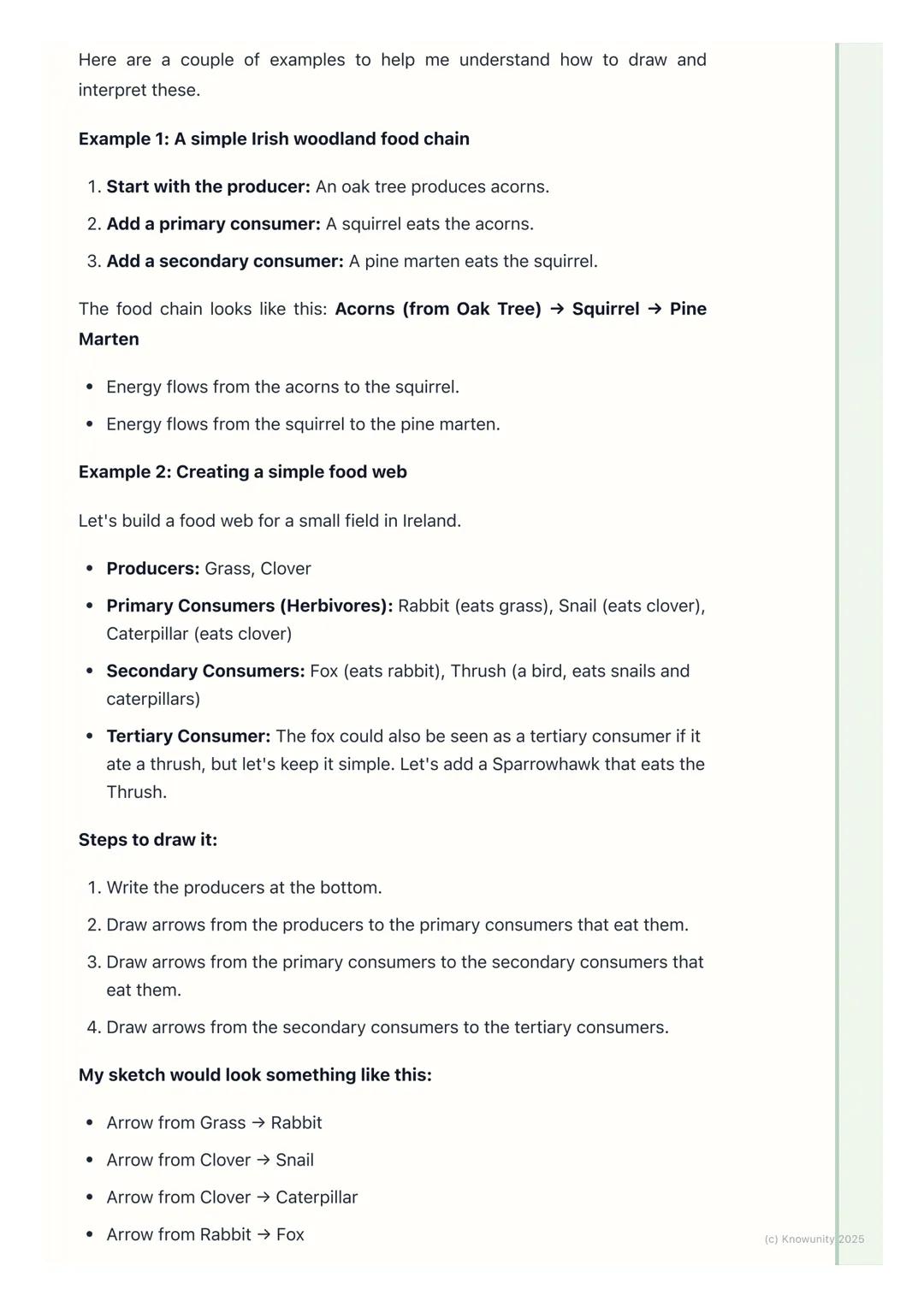
Irish Ecosystem Examples
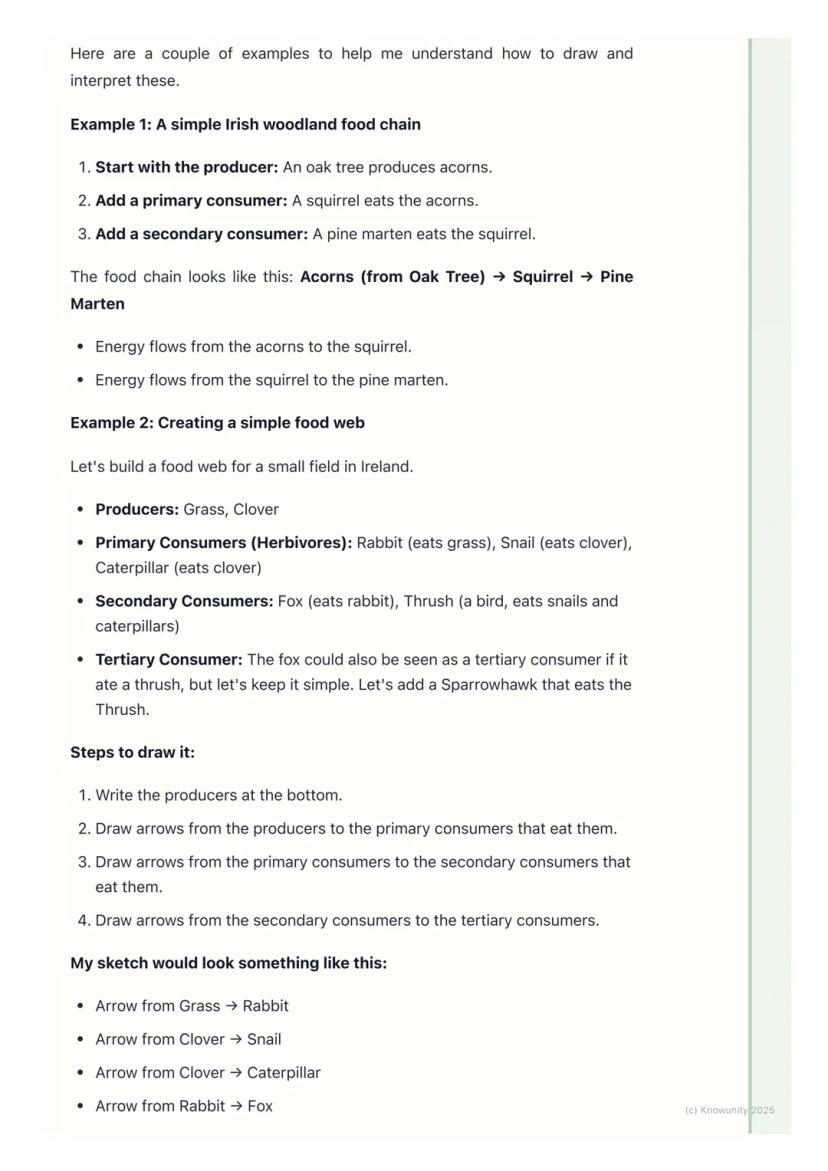
Let's build a simple Irish woodland food chain: Oak tree produces acorns → Squirrel eats acorns → Pine marten eats squirrel. The energy flows from acorns to squirrel to pine marten, following the arrows.
For a food web in an Irish field, you might have grass and clover as producers. Rabbits eat grass while snails and caterpillars munch clover. A fox hunts rabbits, and thrushes eat both snails and caterpillars. Finally, a sparrowhawk might prey on the thrush.
Notice how the thrush and clover connect to multiple organisms - this is what creates the "web" structure. Multiple connections mean if one food source disappears, others might still be available.
Drawing Tip: Start with producers at the bottom, then work your way up through primary, secondary, and tertiary consumers.
6
of 7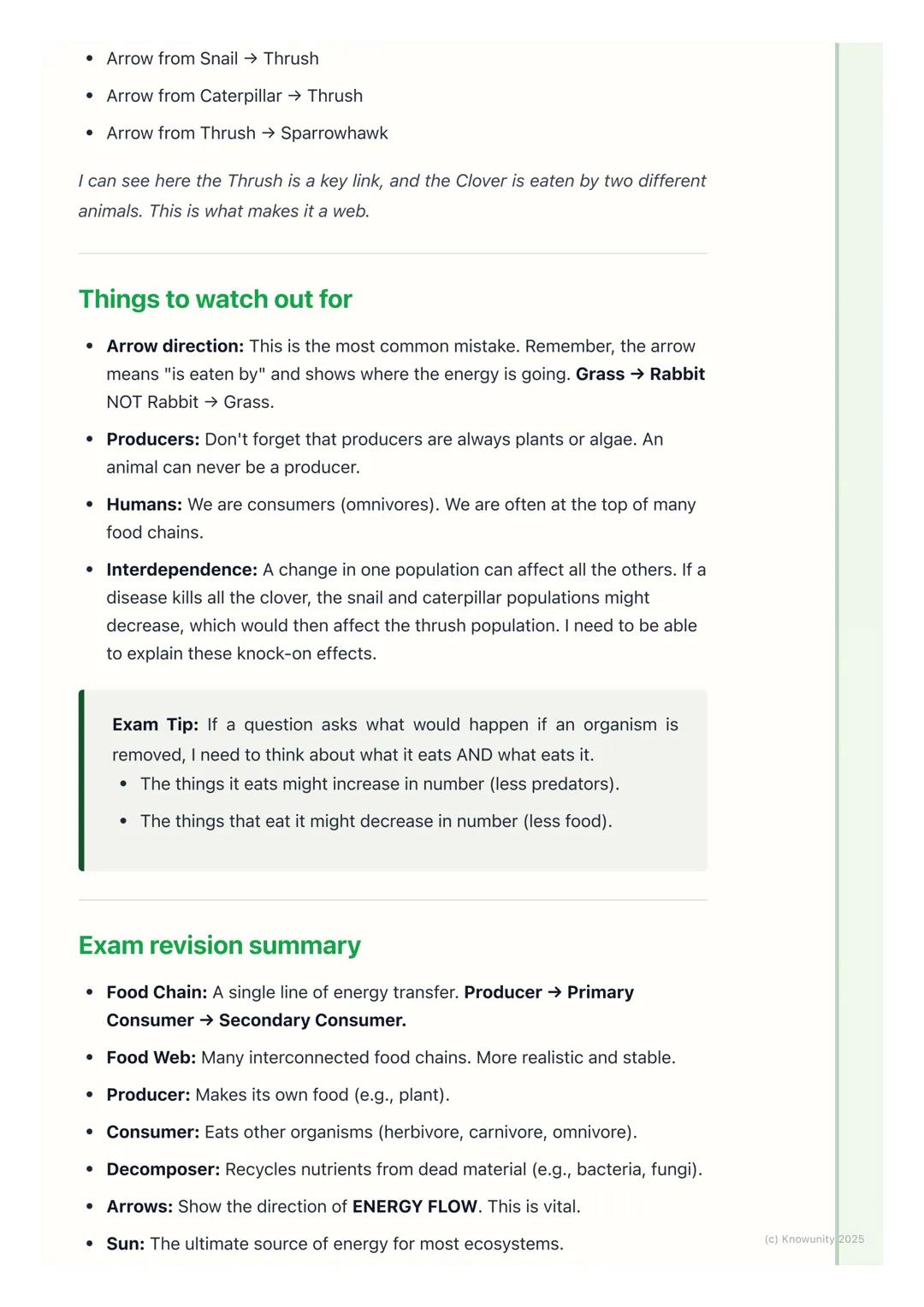
What Happens When Things Go Wrong?
Interdependence means every organism affects others in the food web. If you remove one species, it creates a ripple effect throughout the entire system. When something disappears, what it normally eats might increase in number (fewer predators), while what normally eats it might decrease (less food available).
Common exam mistakes include getting arrow directions backwards and forgetting that only plants and algae can be producers. Humans are always consumers (omnivores) and often sit at the top of food chains.
The key to exam success is understanding these knock-on effects. If clover dies from disease, snails and caterpillars lose food and their numbers drop, which then affects thrush populations that rely on them.
Exam Strategy: When asked about removing an organism, always consider what it eats AND what eats it - both will be affected!
7
of 7
Pensamos que nunca lo preguntarías...
¿Qué es Knowunity AI companion?
Nuestro compañero de IA está específicamente adaptado a las necesidades de los estudiantes. Basándonos en los millones de contenidos que tenemos en la plataforma, podemos dar a los estudiantes respuestas realmente significativas y relevantes. Pero no se trata solo de respuestas, el compañero también guía a los estudiantes a través de sus retos de aprendizaje diarios, con planes de aprendizaje personalizados, cuestionarios o contenidos en el chat y una personalización del 100% basada en las habilidades y el desarrollo de los estudiantes.
¿Dónde puedo descargar la app Knowunity?
Puedes descargar la app en Google Play Store y Apple App Store.
¿Knowunity es totalmente gratuito?
Sí, tienes acceso gratuito a los contenidos de la aplicación y a nuestro compañero de IA. Para desbloquear determinadas funciones de la aplicación, puedes adquirir Knowunity Pro.
Contenidos más populares de Biology
8BiologyEcology introduction notes!
Start of the leaving cert ecology chapter
6th Year131
BiologyDNA & RNA
All notes on DNA & RNA including protein synthesis which is a HL topic
5th Year250
BiologyVertebrates and Invertebrates
Students will distinguish between animals that have a backbone (vertebrates) and those that do not (invertebrates), identifying examples of each.
2nd Year240
BiologyBiomolecules: chapter 8
Summary and easily understandable notes to revise chapter 8 biomolecules. Includes good labelled diagrams for visual learners
5th Year210
BiologyCirculatory System
Students will learn about the heart, blood, and blood vessels, and how this system transports oxygen, nutrients, and waste products around the body.
3rd Year140
BiologyRespiration
All respiration notes including simple diagrams and glycolysis and the Krebs cycle
5th Year120
BiologyPhotosynthesis : Biology
Photosynthesis
6th Year371
BiologyPlant Cells
Learning about the unique structures found in plant cells, such as the cell wall, chloroplasts, and large vacuole, and how they differ from animal cells.
1st Year80
Contenidos más populares
9 Irish
IrishIrish oral questions and answers
Questions and answers for the leaving cert oral
5th Year4264
 English
Key Quotes : Sive
Key Quotes and explanations: Sive
6th Year2842
IrishIrish oral questions
Outline of oral questions
5th Year2055
IrishIníon- le hÁine Durkin
Aine Durkin’s poem, Iníon: Themes & summary
5th Year850
IrishIrish poetry 2027
Iníon + Dínit an Bhróin
5th Year1133
IrishLC HL notes- Iníon (poem)
Includes poem in English and Irish, theme, key words & phrases
5th Year2284
EnglishCultural Context : Shawshank Redemption : Sive : Small Things Like These
Comparative Study : Cultural Context : Shawshank Redemption, Sive and Small Things Like These
6th Year1430
IrishMo Ghrá-sa (Idir Lúibíní)
Notes on mo ghrá-sa
5th Year380
IrishAn Gaeilge Aiste
Irish Language essay
6th Year1320
¿No encuentras lo que buscas? Explora otros temas.
Mira lo que dicen nuestros usuarios. Les encanta - y a tí también.
4.6/5App Store
4.7/5Google Play
La app es muy fácil de usar y está muy bien diseñada. Hasta ahora he encontrado todo lo que estaba buscando y he podido aprender mucho de las presentaciones. Definitivamente utilizaré la aplicación para un examen de clase. Y, por supuesto, también me sirve mucho de inspiración.
Pablousuario de iOS
Esta app es realmente genial. Hay tantos apuntes de clase y ayuda [...]. Tengo problemas con matemáticas, por ejemplo, y la aplicación tiene muchas opciones de ayuda. Gracias a Knowunity, he mejorado en mates. Se la recomiendo a todo el mundo.
Elenausuaria de Android
Vaya, estoy realmente sorprendida. Acabo de probar la app porque la he visto anunciada muchas veces y me he quedado absolutamente alucinada. Esta app es LA AYUDA que quieres para el insti y, sobre todo, ofrece muchísimas cosas, como ejercicios y hojas informativas, que a mí personalmente me han sido MUY útiles.
Anausuaria de iOS
Biology7 visualizaciones·Actualizado Jun 13, 2026·7 páginasUnderstanding Ecosystems: Food Chains and Webs
Ever wonder how energy moves through nature and keeps everything alive? Food chains and food webs show us exactly how organisms depend on each other for survival, from the tiniest bacteria to the largest predators.
1
of 7
Inscríbete para ver los apuntes. ¡Es gratis!
- Acceso a todos los documentos
- Mejora tus notas
- Únete a millones de estudiantes
Food Chains and Food Webs Basics
Think of a food chain as nature's conveyor belt - it's a simple line showing who eats who. Energy passes from one living thing to another in a straight path. A food web is like having loads of these conveyor belts all tangled together, which is much closer to what actually happens in real ecosystems.
These diagrams help us understand how every creature in a habitat - whether it's the Wicklow Mountains or a Dublin park - relies on others to stay alive. It's all about survival and energy flow.
Key Point: Food webs are more realistic than food chains because animals usually have multiple food sources, making ecosystems more stable.
2
of 7Inscríbete para ver los apuntes. ¡Es gratis!
- Acceso a todos los documentos
- Mejora tus notas
- Únete a millones de estudiantes
Essential Terms You Need to Know
Producers are the superstars that kick off every food chain by making their own food through photosynthesis. Think grass, oak trees, or algae in Irish ponds. Consumers can't make their own grub, so they eat other organisms instead.
There are different types of consumers: herbivores (like rabbits) only munch plants, carnivores (like foxes) only eat meat, and omnivores (like badgers and humans) eat both. Decomposers are nature's recycling crew - bacteria and fungi that break down dead stuff and return nutrients to the soil.
An ecosystem includes all the living things and their environment in one area. Whether it's a woodland, lake, or hedgerow, everything's connected in this complex web of life.
Remember: Every organism fits into one of these categories, and each plays a crucial role in keeping the ecosystem balanced.
3
of 7Inscríbete para ver los apuntes. ¡Es gratis!
- Acceso a todos los documentos
- Mejora tus notas
- Únete a millones de estudiantes
How Energy Flows Through Nature
The Sun powers almost everything on Earth by giving plants energy for photosynthesis. This makes producers the foundation of every food chain - without them, everything else would collapse.
Food chains show energy moving in levels: producers → primary consumers (herbivores) → secondary consumers (carnivores) → tertiary consumers (top predators). The arrows are absolutely crucial - they point in the direction energy flows, from what's being eaten to what's doing the eating.
So "Grass → Rabbit" means energy flows from the grass into the rabbit when it gets eaten. Getting arrow direction wrong is the easiest way to lose marks in exams, so practice this loads.
Exam Tip: Always remember arrows show energy flow direction - "is eaten by" - not who does the eating!
4
of 7Inscríbete para ver los apuntes. ¡Es gratis!
- Acceso a todos los documentos
- Mejora tus notas
- Únete a millones de estudiantes
Food Webs and Decomposers
Food webs show the bigger picture because most animals eat several different things. If rabbits disappear from disease, foxes might survive by eating mice or birds instead. This makes food webs much more stable than simple food chains.
Decomposers are the unsung heroes that break down dead plants, animals, and waste. They release essential nutrients like nitrogen back into the soil, which producers then use to grow. Without decomposers, nutrients would stay locked up in dead material forever.
This creates a perfect cycle: decomposers feed the soil, producers use those nutrients to grow, consumers eat the producers, and when they die, decomposers start the process again.
Think About It: Decomposers are why forests aren't knee-deep in dead leaves and animal bodies!
5
of 7Inscríbete para ver los apuntes. ¡Es gratis!
- Acceso a todos los documentos
- Mejora tus notas
- Únete a millones de estudiantes
Irish Ecosystem Examples
Let's build a simple Irish woodland food chain: Oak tree produces acorns → Squirrel eats acorns → Pine marten eats squirrel. The energy flows from acorns to squirrel to pine marten, following the arrows.
For a food web in an Irish field, you might have grass and clover as producers. Rabbits eat grass while snails and caterpillars munch clover. A fox hunts rabbits, and thrushes eat both snails and caterpillars. Finally, a sparrowhawk might prey on the thrush.
Notice how the thrush and clover connect to multiple organisms - this is what creates the "web" structure. Multiple connections mean if one food source disappears, others might still be available.
Drawing Tip: Start with producers at the bottom, then work your way up through primary, secondary, and tertiary consumers.
6
of 7Inscríbete para ver los apuntes. ¡Es gratis!
- Acceso a todos los documentos
- Mejora tus notas
- Únete a millones de estudiantes
What Happens When Things Go Wrong?
Interdependence means every organism affects others in the food web. If you remove one species, it creates a ripple effect throughout the entire system. When something disappears, what it normally eats might increase in number (fewer predators), while what normally eats it might decrease (less food available).
Common exam mistakes include getting arrow directions backwards and forgetting that only plants and algae can be producers. Humans are always consumers (omnivores) and often sit at the top of food chains.
The key to exam success is understanding these knock-on effects. If clover dies from disease, snails and caterpillars lose food and their numbers drop, which then affects thrush populations that rely on them.
Exam Strategy: When asked about removing an organism, always consider what it eats AND what eats it - both will be affected!
7
of 7Inscríbete para ver los apuntes. ¡Es gratis!
- Acceso a todos los documentos
- Mejora tus notas
- Únete a millones de estudiantes
Pensamos que nunca lo preguntarías...
¿Qué es Knowunity AI companion?
Nuestro compañero de IA está específicamente adaptado a las necesidades de los estudiantes. Basándonos en los millones de contenidos que tenemos en la plataforma, podemos dar a los estudiantes respuestas realmente significativas y relevantes. Pero no se trata solo de respuestas, el compañero también guía a los estudiantes a través de sus retos de aprendizaje diarios, con planes de aprendizaje personalizados, cuestionarios o contenidos en el chat y una personalización del 100% basada en las habilidades y el desarrollo de los estudiantes.
¿Dónde puedo descargar la app Knowunity?
Puedes descargar la app en Google Play Store y Apple App Store.
¿Knowunity es totalmente gratuito?
Sí, tienes acceso gratuito a los contenidos de la aplicación y a nuestro compañero de IA. Para desbloquear determinadas funciones de la aplicación, puedes adquirir Knowunity Pro.
Contenidos más populares de Biology
8BiologyEcology introduction notes!
Start of the leaving cert ecology chapter
6th Year131
BiologyDNA & RNA
All notes on DNA & RNA including protein synthesis which is a HL topic
5th Year250
BiologyVertebrates and Invertebrates
Students will distinguish between animals that have a backbone (vertebrates) and those that do not (invertebrates), identifying examples of each.
2nd Year240
BiologyBiomolecules: chapter 8
Summary and easily understandable notes to revise chapter 8 biomolecules. Includes good labelled diagrams for visual learners
5th Year210
BiologyCirculatory System
Students will learn about the heart, blood, and blood vessels, and how this system transports oxygen, nutrients, and waste products around the body.
3rd Year140
BiologyRespiration
All respiration notes including simple diagrams and glycolysis and the Krebs cycle
5th Year120
BiologyPhotosynthesis : Biology
Photosynthesis
6th Year371
BiologyPlant Cells
Learning about the unique structures found in plant cells, such as the cell wall, chloroplasts, and large vacuole, and how they differ from animal cells.
1st Year80
Contenidos más populares
9IrishIrish oral questions and answers
Questions and answers for the leaving cert oral
5th Year4264
EnglishKey Quotes : Sive
Key Quotes and explanations: Sive
6th Year2842
IrishIrish oral questions
Outline of oral questions
5th Year2055
IrishIníon- le hÁine Durkin
Aine Durkin’s poem, Iníon: Themes & summary
5th Year850
IrishIrish poetry 2027
Iníon + Dínit an Bhróin
5th Year1133
IrishLC HL notes- Iníon (poem)
Includes poem in English and Irish, theme, key words & phrases
5th Year2284
EnglishCultural Context : Shawshank Redemption : Sive : Small Things Like These
Comparative Study : Cultural Context : Shawshank Redemption, Sive and Small Things Like These
6th Year1430
IrishMo Ghrá-sa (Idir Lúibíní)
Notes on mo ghrá-sa
5th Year380
IrishAn Gaeilge Aiste
Irish Language essay
6th Year1320
¿No encuentras lo que buscas? Explora otros temas.
Mira lo que dicen nuestros usuarios. Les encanta - y a tí también.
4.6/5App Store
4.7/5Google Play
La app es muy fácil de usar y está muy bien diseñada. Hasta ahora he encontrado todo lo que estaba buscando y he podido aprender mucho de las presentaciones. Definitivamente utilizaré la aplicación para un examen de clase. Y, por supuesto, también me sirve mucho de inspiración.
Pablousuario de iOS
Esta app es realmente genial. Hay tantos apuntes de clase y ayuda [...]. Tengo problemas con matemáticas, por ejemplo, y la aplicación tiene muchas opciones de ayuda. Gracias a Knowunity, he mejorado en mates. Se la recomiendo a todo el mundo.
Elenausuaria de Android
Vaya, estoy realmente sorprendida. Acabo de probar la app porque la he visto anunciada muchas veces y me he quedado absolutamente alucinada. Esta app es LA AYUDA que quieres para el insti y, sobre todo, ofrece muchísimas cosas, como ejercicios y hojas informativas, que a mí personalmente me han sido MUY útiles.
Anausuaria de iOS