
Ever wondered what happens when accountants make mistakes? You can't...
 Accounting3 visualizaciones·Actualizado Jun 16, 2026·5 páginas
Fixing Mistakes in Accounting Using the Journal
1 / 5
1
of 5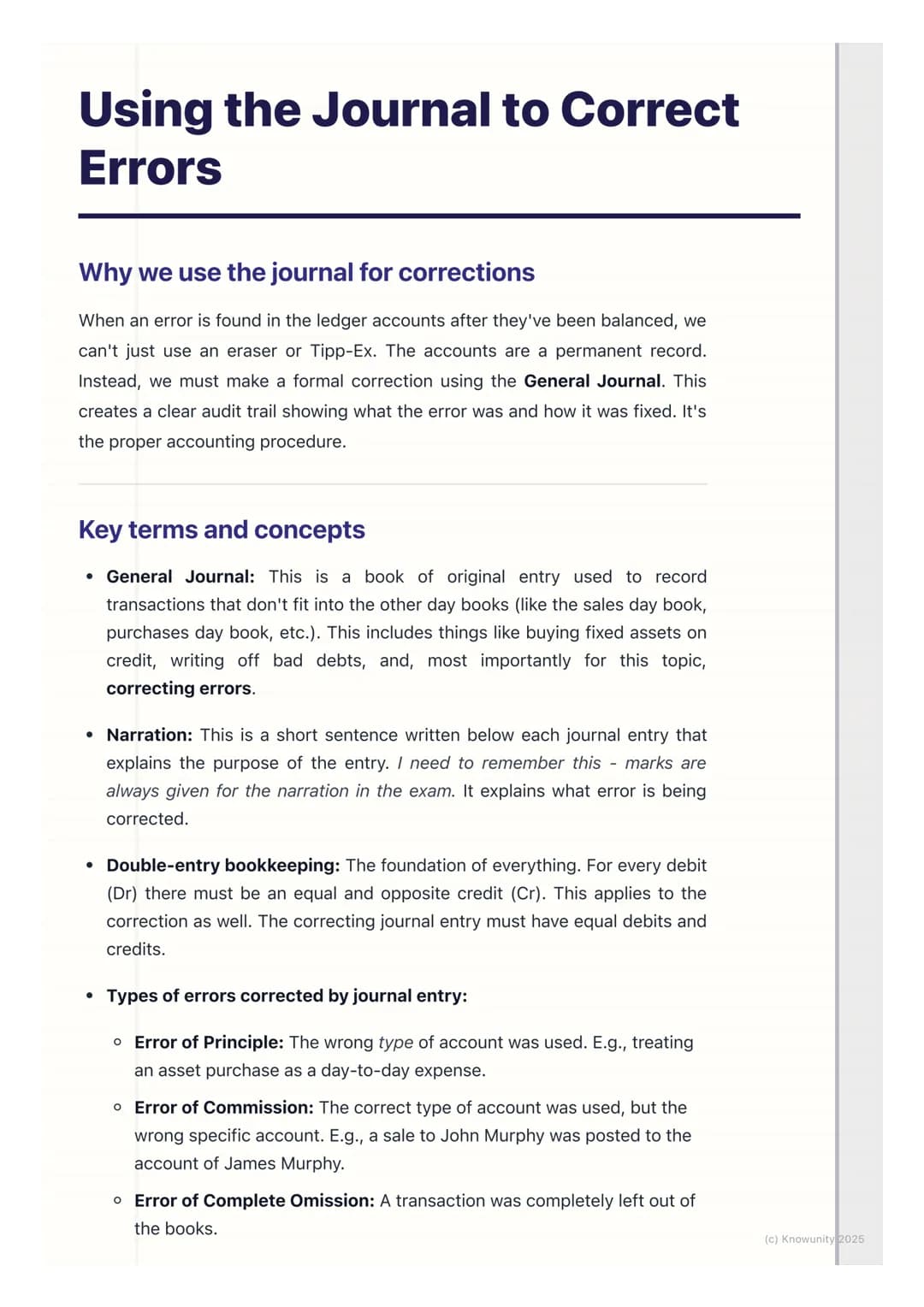
Using the Journal to Correct Errors
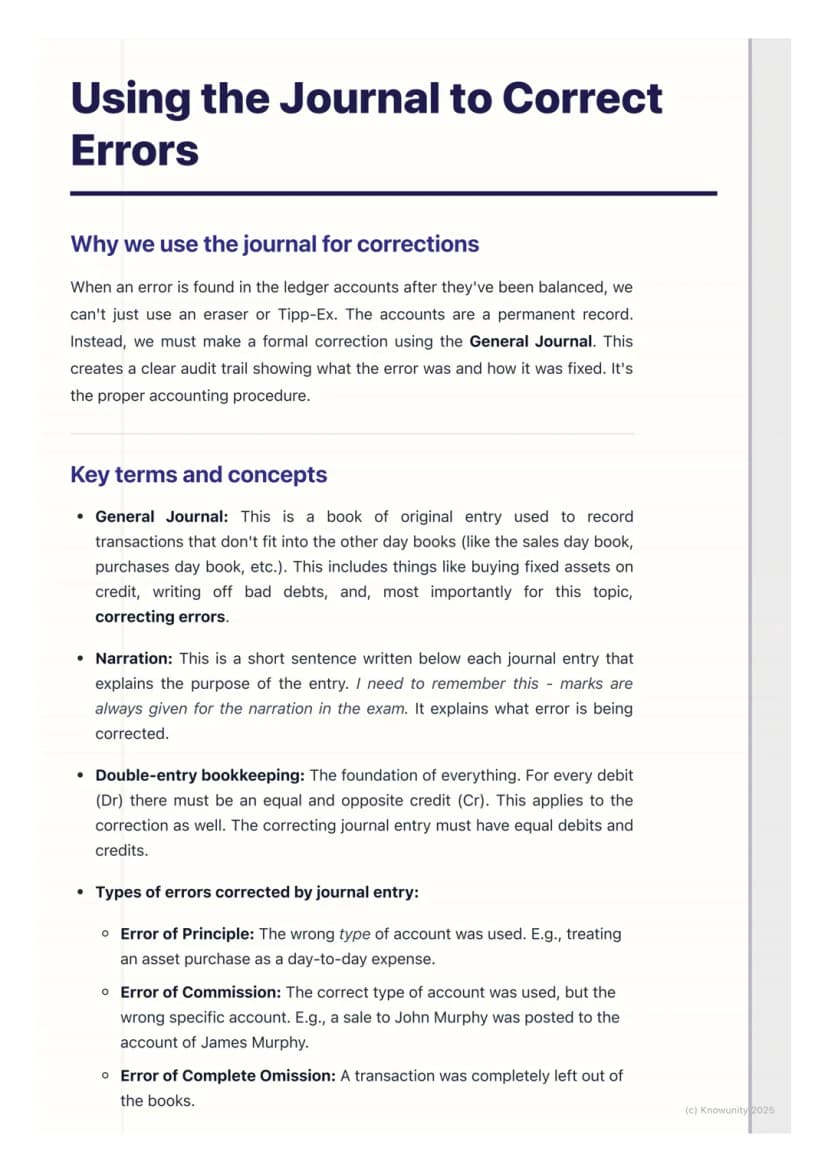
Think of accounting records like a permanent diary - once something's written, you can't just rub it out. When errors pop up in ledger accounts after they've been balanced, accountants must use the General Journal to make formal corrections.
The General Journal is your go-to book for recording transactions that don't fit into other day books. It's perfect for buying fixed assets on credit, writing off bad debts, and most importantly for you - correcting errors. Every journal entry needs a narration underneath - that's the short explanation of what you're doing and why.
Remember that double-entry bookkeeping rules still apply. For every debit there must be an equal credit, even when fixing mistakes. The key types of errors you'll encounter include errors of principle (wrong type of account used), errors of commission (right type, wrong specific account), and errors of complete omission (transaction completely forgotten).
Quick Tip: Always include the narration in your journal entries - it's easy exam marks and shows you understand what you're doing!
2
of 5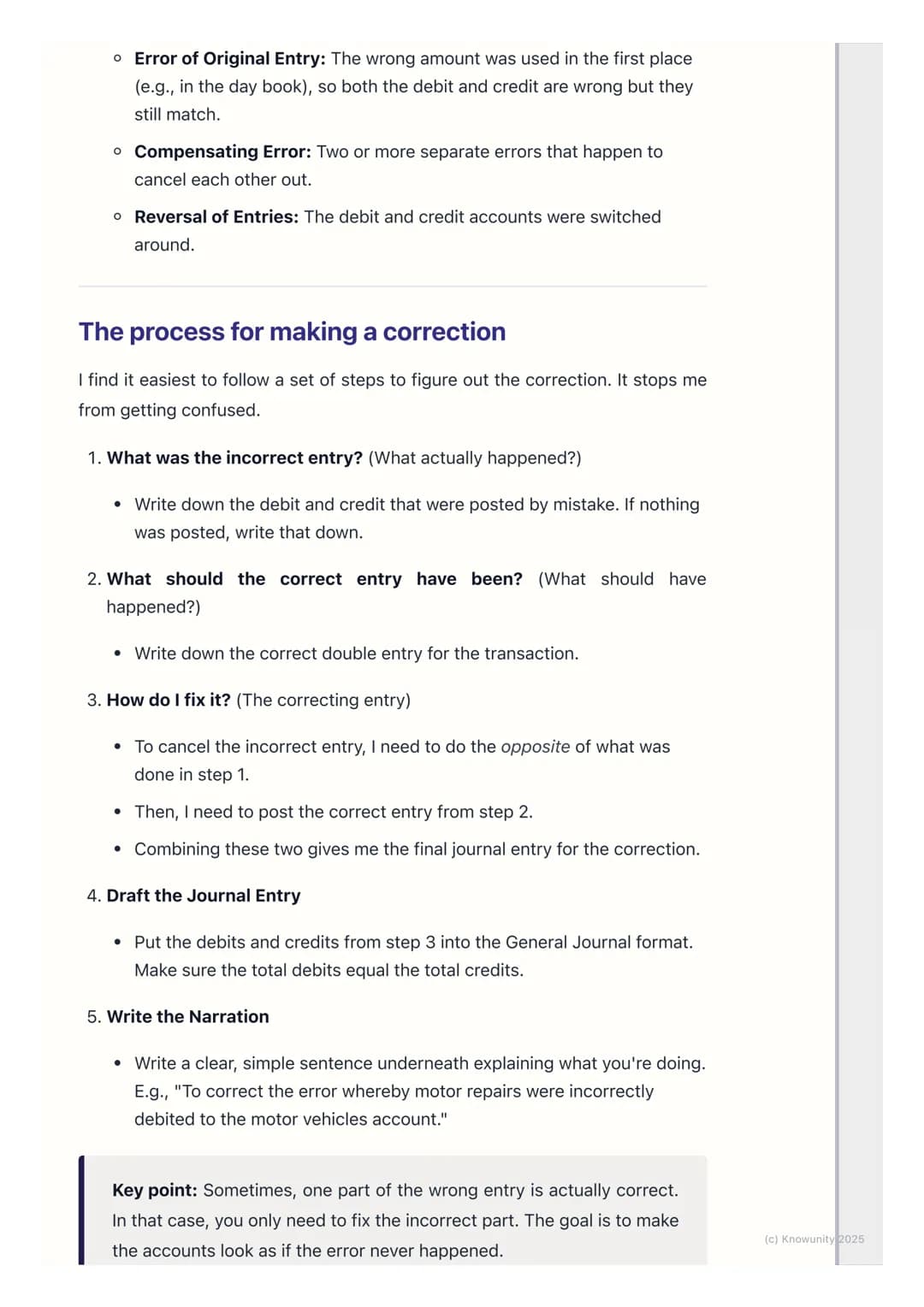
Types of Errors and The Correction Process
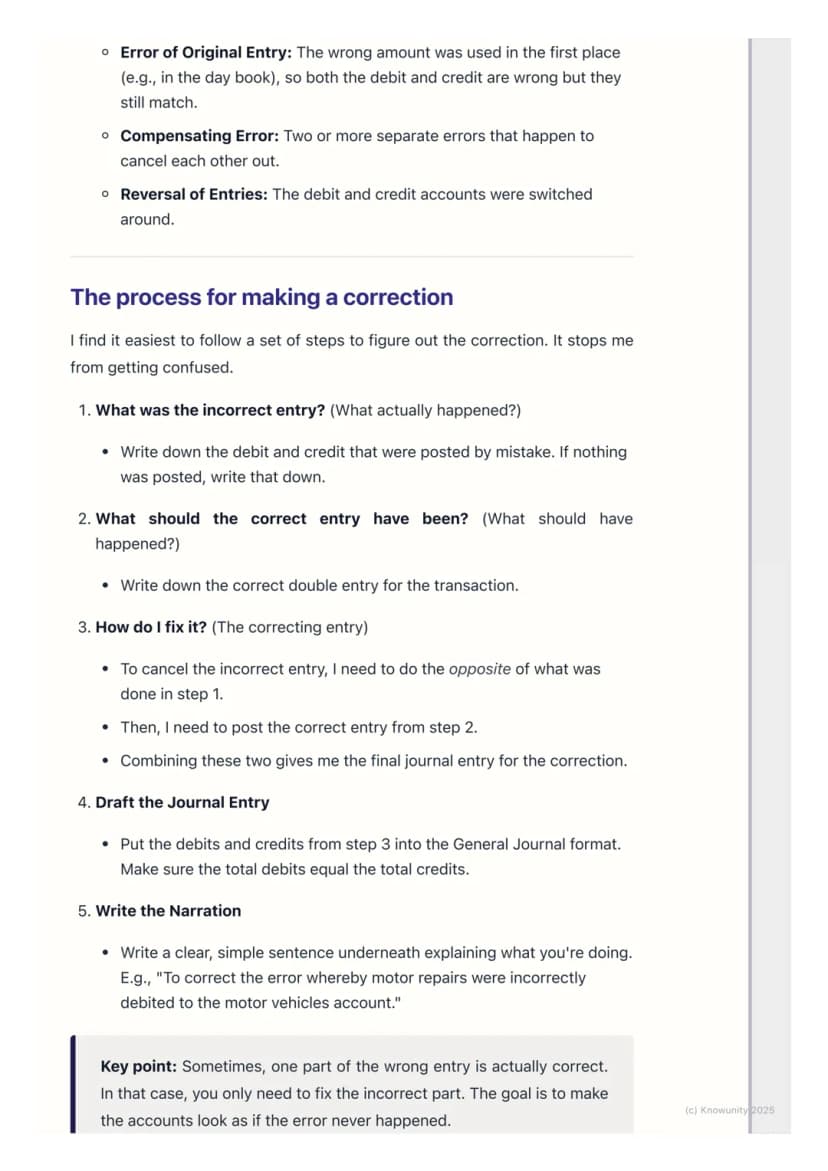
You'll also see errors of original entry (wrong amount used from the start), compensating errors (multiple mistakes that cancel out), and reversal of entries (debits and credits switched around). Each type needs a different approach to fix.
Here's your foolproof five-step process for making corrections: First, identify what actually happened (the incorrect entry). Next, work out what should have happened (the correct entry). Then figure out how to fix it by reversing the wrong entry and posting the right one.
Step four involves drafting your journal entry with equal debits and credits. Finally, write a clear narration explaining your correction. This systematic approach prevents confusion and ensures you don't make additional mistakes whilst fixing the original one.
Remember: Sometimes part of the wrong entry is actually correct - you only need to fix the incorrect bit!
3
of 5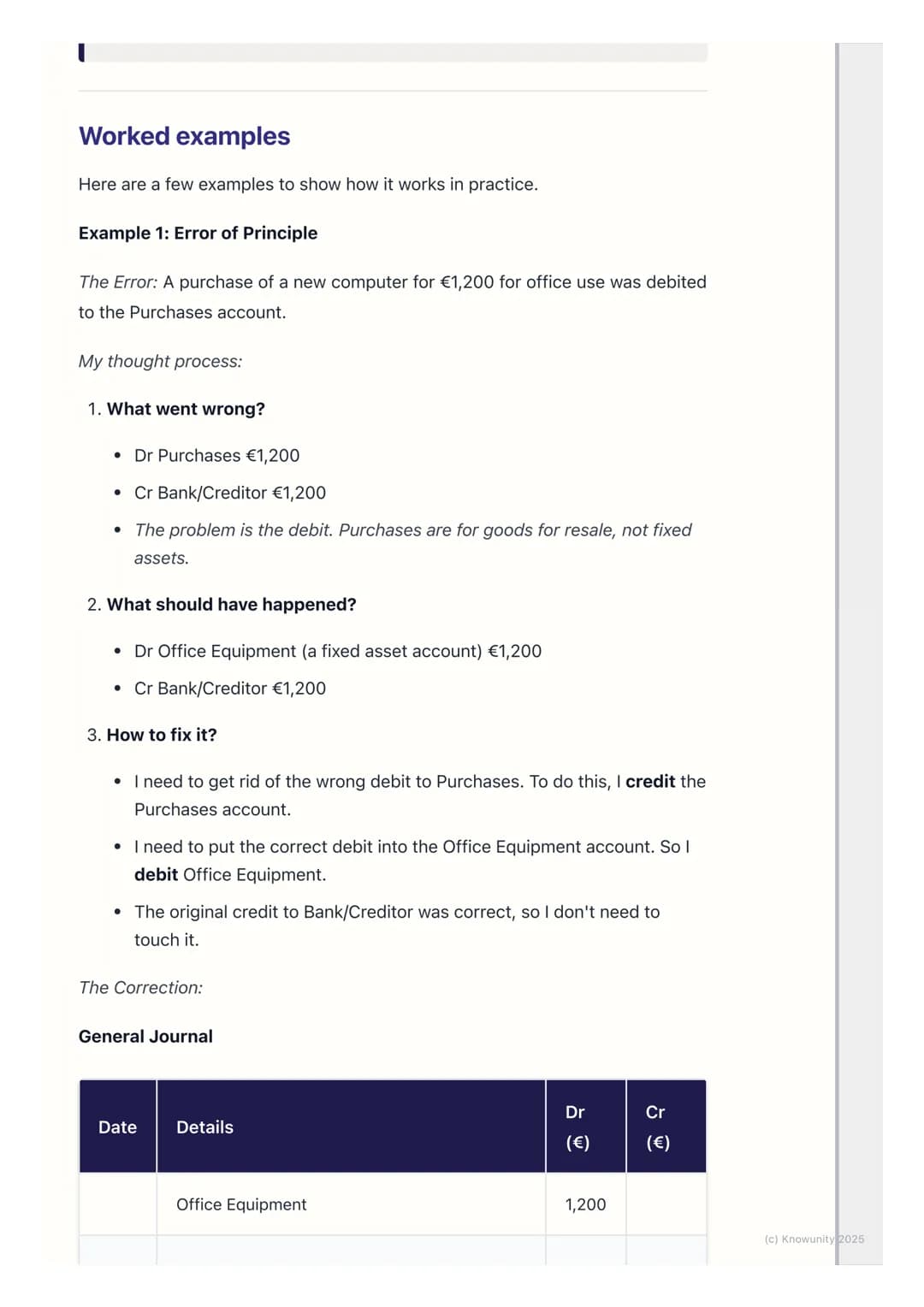
Worked Example - Error of Principle
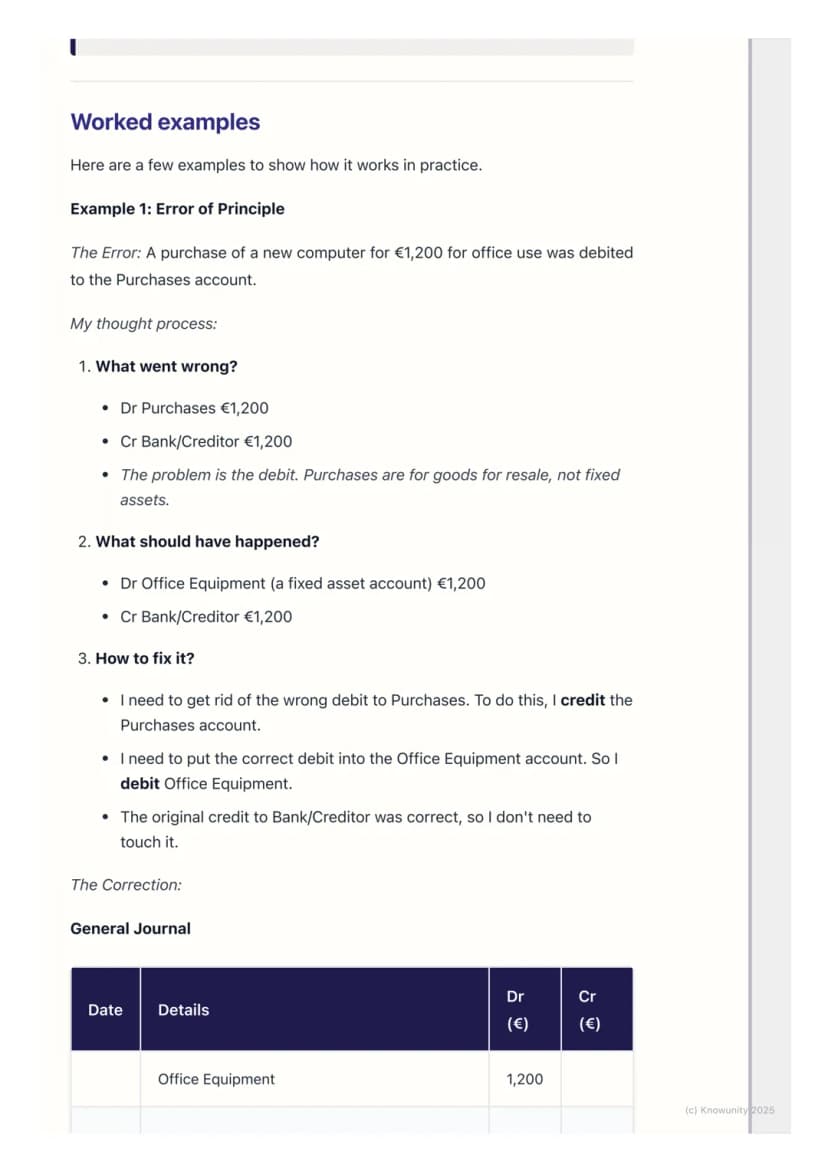
Let's say someone bought a €1,200 computer for office use but mistakenly debited it to the Purchases account. This is an error of principle because purchases are for goods you're going to resell, not fixed assets you'll keep.
The wrong entry showed: Dr Purchases €1,200, Cr Bank €1,200. What should have happened: Dr Office Equipment €1,200, Cr Bank €1,200. The credit to Bank was actually correct - only the debit needs fixing.
To correct this, you need to remove the wrong debit from Purchases (so credit Purchases €1,200) and put the correct debit into Office Equipment (so debit Office Equipment €1,200). Your narration might read: "Being the correction of an error where the purchase of a fixed asset was incorrectly treated as a purchase of goods for resale."
Think About Profit: Moving €1,200 out of Purchases (an expense) means expenses are lower, so profit increases by €1,200!
4
of 5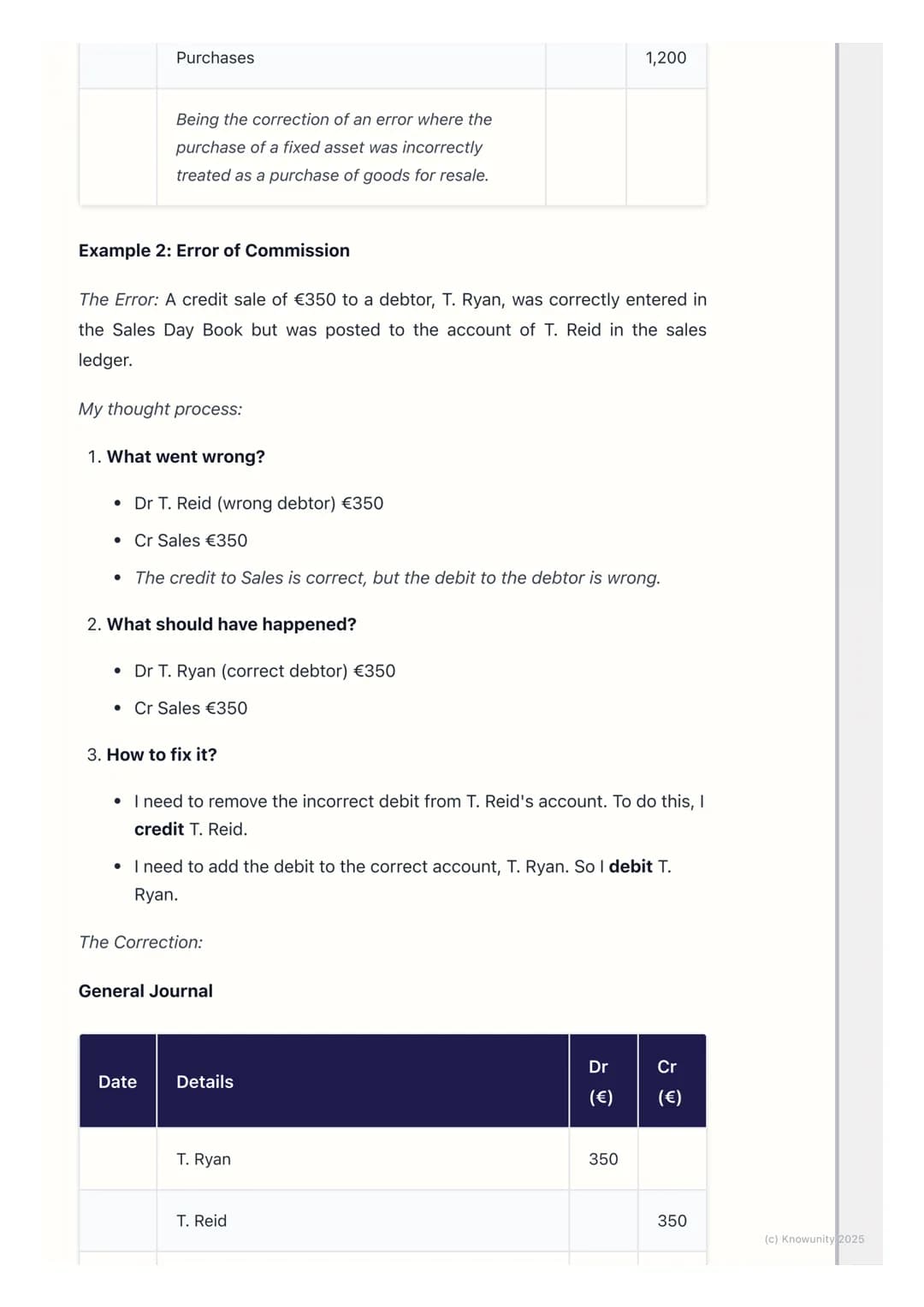
Worked Example - Error of Commission
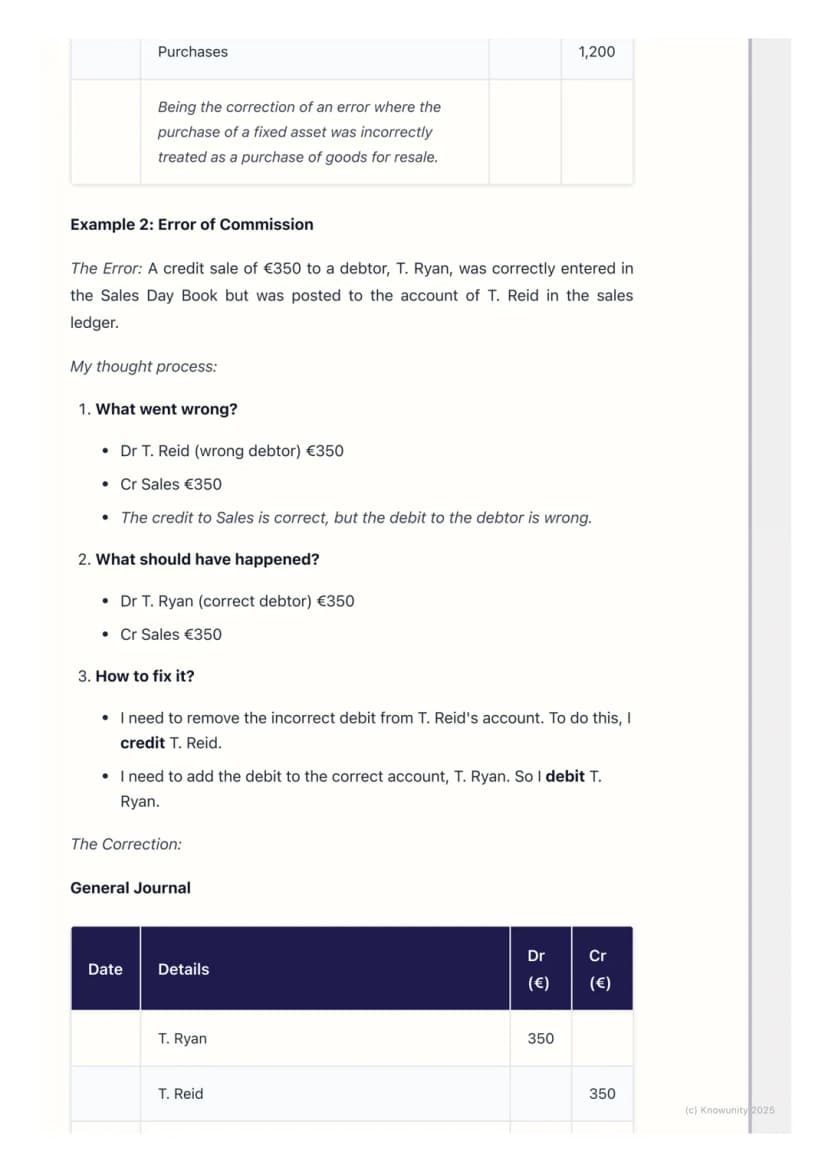
Here's another common mistake: a €350 credit sale to T. Ryan was correctly entered in the Sales Day Book but posted to T. Reid's account instead. This is an error of commission - right type of account (debtor), wrong specific person.
The incorrect entry was: Dr T. Reid €350, Cr Sales €350. The correct entry should be: Dr T. Ryan €350, Cr Sales €350. Notice the credit to Sales was spot on - no need to touch that.
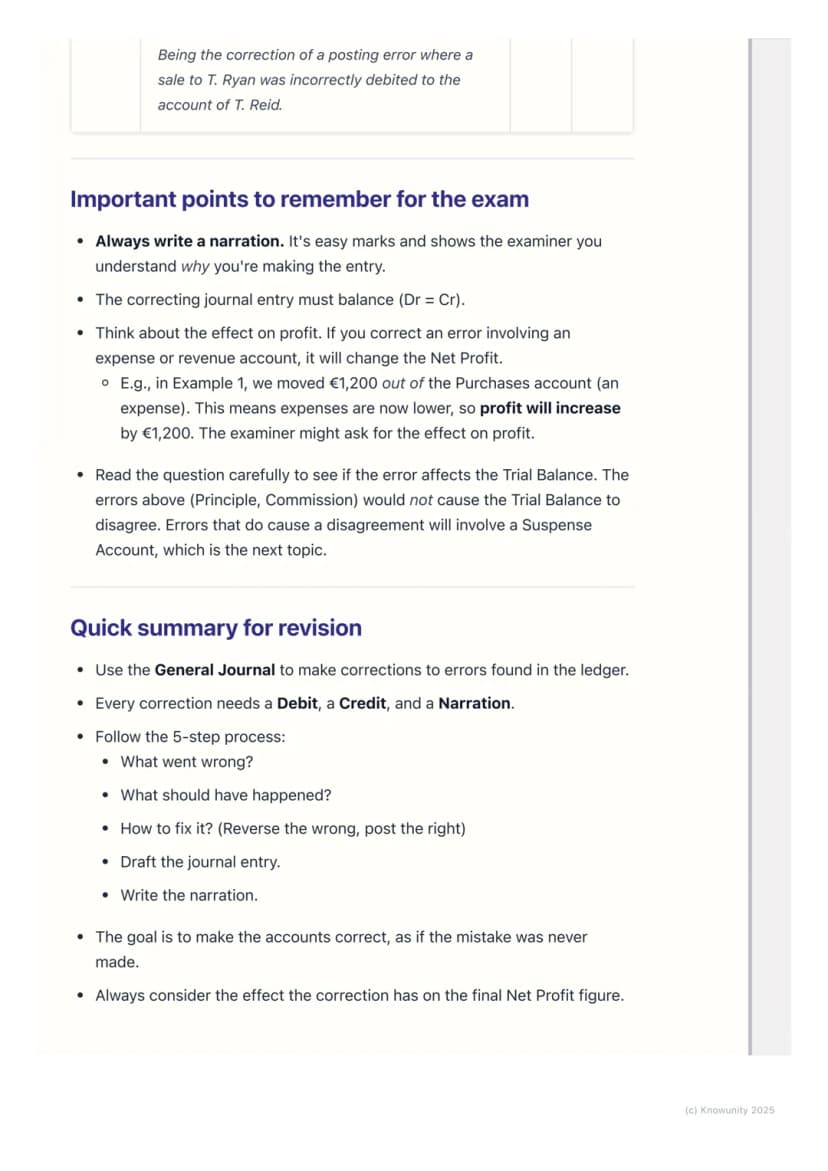
Your correction removes the wrong debit from T. Reid (credit T. Reid €350) and adds the debit to the right person (debit T. Ryan €350). The narration could be: "Being the correction of a posting error where a sale to T. Ryan was incorrectly debited to the account of T. Reid."
Exam Tip: These types of errors don't affect the Trial Balance total - both sides were still equal, just in the wrong places!
5
of 5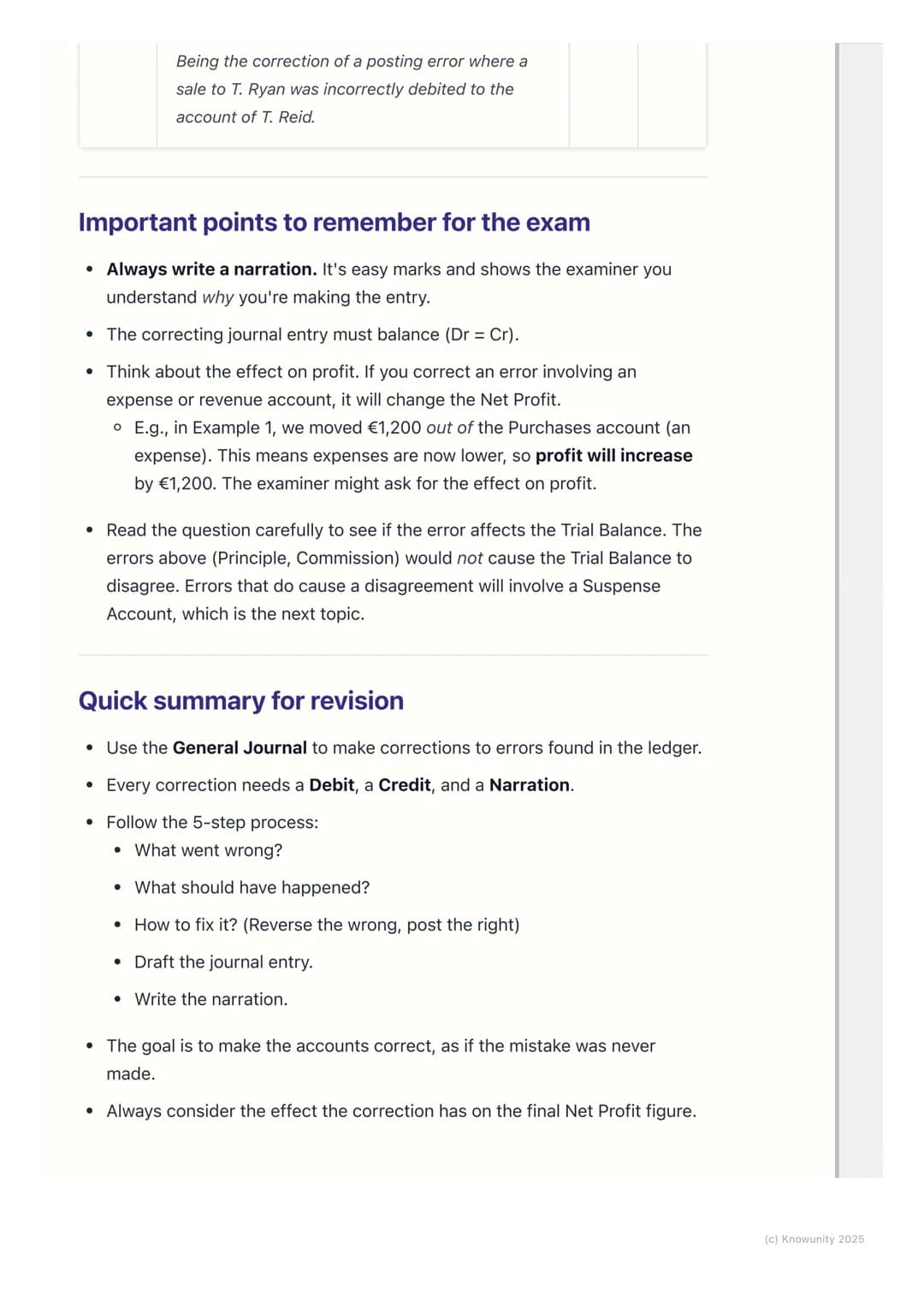
Important Points for Success
Always include your narration - it's guaranteed marks and demonstrates you understand the correction process. Your journal entry must balance with equal debits and credits, just like any other accounting entry.
Pay attention to how corrections affect Net Profit. When you move amounts in or out of expense or revenue accounts, you're changing the profit figure. Examiners love asking about this, so always consider the impact on your final profit calculation.
Some errors make the Trial Balance disagree (you'll learn about Suspense Accounts next), whilst others like the examples above keep it balanced. Read questions carefully to spot which type you're dealing with.
Your revision mantra should be: identify what went wrong, work out what should have happened, reverse the mistake and post the correction, draft your balanced journal entry, and write a clear narration. Master this process and you'll handle any error correction question with confidence.
Success Strategy: Practice the five-step method until it becomes second nature - it works for every type of error correction!
Pensamos que nunca lo preguntarías...
¿Qué es Knowunity AI companion?
Nuestro compañero de IA está específicamente adaptado a las necesidades de los estudiantes. Basándonos en los millones de contenidos que tenemos en la plataforma, podemos dar a los estudiantes respuestas realmente significativas y relevantes. Pero no se trata solo de respuestas, el compañero también guía a los estudiantes a través de sus retos de aprendizaje diarios, con planes de aprendizaje personalizados, cuestionarios o contenidos en el chat y una personalización del 100% basada en las habilidades y el desarrollo de los estudiantes.
¿Dónde puedo descargar la app Knowunity?
Puedes descargar la app en Google Play Store y Apple App Store.
¿Knowunity es totalmente gratuito?
Sí, tienes acceso gratuito a los contenidos de la aplicación y a nuestro compañero de IA. Para desbloquear determinadas funciones de la aplicación, puedes adquirir Knowunity Pro.
Contenidos más populares
9 Irish
IrishIrish oral questions and answers
Questions and answers for the leaving cert oral
5th Year4264
 English
Key Quotes : Sive
Key Quotes and explanations: Sive
6th Year2842
IrishIrish oral questions
Outline of oral questions
5th Year2055
IrishIníon- le hÁine Durkin
Aine Durkin’s poem, Iníon: Themes & summary
5th Year850
IrishIrish poetry 2027
Iníon + Dínit an Bhróin
5th Year1133
IrishLC HL notes- Iníon (poem)
Includes poem in English and Irish, theme, key words & phrases
5th Year2284
EnglishCultural Context : Shawshank Redemption : Sive : Small Things Like These
Comparative Study : Cultural Context : Shawshank Redemption, Sive and Small Things Like These
6th Year1430
IrishMo Ghrá-sa (Idir Lúibíní)
Notes on mo ghrá-sa
5th Year380
IrishAn Gaeilge Aiste
Irish Language essay
6th Year1320
¿No encuentras lo que buscas? Explora otros temas.
Mira lo que dicen nuestros usuarios. Les encanta - y a tí también.
4.6/5App Store
4.7/5Google Play
La app es muy fácil de usar y está muy bien diseñada. Hasta ahora he encontrado todo lo que estaba buscando y he podido aprender mucho de las presentaciones. Definitivamente utilizaré la aplicación para un examen de clase. Y, por supuesto, también me sirve mucho de inspiración.
Pablousuario de iOS
Esta app es realmente genial. Hay tantos apuntes de clase y ayuda [...]. Tengo problemas con matemáticas, por ejemplo, y la aplicación tiene muchas opciones de ayuda. Gracias a Knowunity, he mejorado en mates. Se la recomiendo a todo el mundo.
Elenausuaria de Android
Vaya, estoy realmente sorprendida. Acabo de probar la app porque la he visto anunciada muchas veces y me he quedado absolutamente alucinada. Esta app es LA AYUDA que quieres para el insti y, sobre todo, ofrece muchísimas cosas, como ejercicios y hojas informativas, que a mí personalmente me han sido MUY útiles.
Anausuaria de iOS
Accounting3 visualizaciones·Actualizado Jun 16, 2026·5 páginasFixing Mistakes in Accounting Using the Journal
Ever wondered what happens when accountants make mistakes? You can't just grab an eraser - there's a proper way to fix errors in accounting records. This topic shows you how to use the General Journal to correct mistakes whilst maintaining...
1
of 5
Inscríbete para ver los apuntes. ¡Es gratis!
- Acceso a todos los documentos
- Mejora tus notas
- Únete a millones de estudiantes
Using the Journal to Correct Errors
Think of accounting records like a permanent diary - once something's written, you can't just rub it out. When errors pop up in ledger accounts after they've been balanced, accountants must use the General Journal to make formal corrections.
The General Journal is your go-to book for recording transactions that don't fit into other day books. It's perfect for buying fixed assets on credit, writing off bad debts, and most importantly for you - correcting errors. Every journal entry needs a narration underneath - that's the short explanation of what you're doing and why.
Remember that double-entry bookkeeping rules still apply. For every debit there must be an equal credit, even when fixing mistakes. The key types of errors you'll encounter include errors of principle (wrong type of account used), errors of commission (right type, wrong specific account), and errors of complete omission (transaction completely forgotten).
Quick Tip: Always include the narration in your journal entries - it's easy exam marks and shows you understand what you're doing!
2
of 5Inscríbete para ver los apuntes. ¡Es gratis!
- Acceso a todos los documentos
- Mejora tus notas
- Únete a millones de estudiantes
Types of Errors and The Correction Process
You'll also see errors of original entry (wrong amount used from the start), compensating errors (multiple mistakes that cancel out), and reversal of entries (debits and credits switched around). Each type needs a different approach to fix.
Here's your foolproof five-step process for making corrections: First, identify what actually happened (the incorrect entry). Next, work out what should have happened (the correct entry). Then figure out how to fix it by reversing the wrong entry and posting the right one.
Step four involves drafting your journal entry with equal debits and credits. Finally, write a clear narration explaining your correction. This systematic approach prevents confusion and ensures you don't make additional mistakes whilst fixing the original one.
Remember: Sometimes part of the wrong entry is actually correct - you only need to fix the incorrect bit!
3
of 5Inscríbete para ver los apuntes. ¡Es gratis!
- Acceso a todos los documentos
- Mejora tus notas
- Únete a millones de estudiantes
Worked Example - Error of Principle
Let's say someone bought a €1,200 computer for office use but mistakenly debited it to the Purchases account. This is an error of principle because purchases are for goods you're going to resell, not fixed assets you'll keep.
The wrong entry showed: Dr Purchases €1,200, Cr Bank €1,200. What should have happened: Dr Office Equipment €1,200, Cr Bank €1,200. The credit to Bank was actually correct - only the debit needs fixing.
To correct this, you need to remove the wrong debit from Purchases (so credit Purchases €1,200) and put the correct debit into Office Equipment (so debit Office Equipment €1,200). Your narration might read: "Being the correction of an error where the purchase of a fixed asset was incorrectly treated as a purchase of goods for resale."
Think About Profit: Moving €1,200 out of Purchases (an expense) means expenses are lower, so profit increases by €1,200!
4
of 5Inscríbete para ver los apuntes. ¡Es gratis!
- Acceso a todos los documentos
- Mejora tus notas
- Únete a millones de estudiantes
Worked Example - Error of Commission
Here's another common mistake: a €350 credit sale to T. Ryan was correctly entered in the Sales Day Book but posted to T. Reid's account instead. This is an error of commission - right type of account (debtor), wrong specific person.
The incorrect entry was: Dr T. Reid €350, Cr Sales €350. The correct entry should be: Dr T. Ryan €350, Cr Sales €350. Notice the credit to Sales was spot on - no need to touch that.
Your correction removes the wrong debit from T. Reid (credit T. Reid €350) and adds the debit to the right person (debit T. Ryan €350). The narration could be: "Being the correction of a posting error where a sale to T. Ryan was incorrectly debited to the account of T. Reid."
Exam Tip: These types of errors don't affect the Trial Balance total - both sides were still equal, just in the wrong places!
5
of 5Inscríbete para ver los apuntes. ¡Es gratis!
- Acceso a todos los documentos
- Mejora tus notas
- Únete a millones de estudiantes
Important Points for Success
Always include your narration - it's guaranteed marks and demonstrates you understand the correction process. Your journal entry must balance with equal debits and credits, just like any other accounting entry.
Pay attention to how corrections affect Net Profit. When you move amounts in or out of expense or revenue accounts, you're changing the profit figure. Examiners love asking about this, so always consider the impact on your final profit calculation.
Some errors make the Trial Balance disagree (you'll learn about Suspense Accounts next), whilst others like the examples above keep it balanced. Read questions carefully to spot which type you're dealing with.
Your revision mantra should be: identify what went wrong, work out what should have happened, reverse the mistake and post the correction, draft your balanced journal entry, and write a clear narration. Master this process and you'll handle any error correction question with confidence.
Success Strategy: Practice the five-step method until it becomes second nature - it works for every type of error correction!
Pensamos que nunca lo preguntarías...
¿Qué es Knowunity AI companion?
Nuestro compañero de IA está específicamente adaptado a las necesidades de los estudiantes. Basándonos en los millones de contenidos que tenemos en la plataforma, podemos dar a los estudiantes respuestas realmente significativas y relevantes. Pero no se trata solo de respuestas, el compañero también guía a los estudiantes a través de sus retos de aprendizaje diarios, con planes de aprendizaje personalizados, cuestionarios o contenidos en el chat y una personalización del 100% basada en las habilidades y el desarrollo de los estudiantes.
¿Dónde puedo descargar la app Knowunity?
Puedes descargar la app en Google Play Store y Apple App Store.
¿Knowunity es totalmente gratuito?
Sí, tienes acceso gratuito a los contenidos de la aplicación y a nuestro compañero de IA. Para desbloquear determinadas funciones de la aplicación, puedes adquirir Knowunity Pro.
Contenidos más populares
9IrishIrish oral questions and answers
Questions and answers for the leaving cert oral
5th Year4264
EnglishKey Quotes : Sive
Key Quotes and explanations: Sive
6th Year2842
IrishIrish oral questions
Outline of oral questions
5th Year2055
IrishIníon- le hÁine Durkin
Aine Durkin’s poem, Iníon: Themes & summary
5th Year850
IrishIrish poetry 2027
Iníon + Dínit an Bhróin
5th Year1133
IrishLC HL notes- Iníon (poem)
Includes poem in English and Irish, theme, key words & phrases
5th Year2284
EnglishCultural Context : Shawshank Redemption : Sive : Small Things Like These
Comparative Study : Cultural Context : Shawshank Redemption, Sive and Small Things Like These
6th Year1430
IrishMo Ghrá-sa (Idir Lúibíní)
Notes on mo ghrá-sa
5th Year380
IrishAn Gaeilge Aiste
Irish Language essay
6th Year1320
¿No encuentras lo que buscas? Explora otros temas.
Mira lo que dicen nuestros usuarios. Les encanta - y a tí también.
4.6/5App Store
4.7/5Google Play
La app es muy fácil de usar y está muy bien diseñada. Hasta ahora he encontrado todo lo que estaba buscando y he podido aprender mucho de las presentaciones. Definitivamente utilizaré la aplicación para un examen de clase. Y, por supuesto, también me sirve mucho de inspiración.
Pablousuario de iOS
Esta app es realmente genial. Hay tantos apuntes de clase y ayuda [...]. Tengo problemas con matemáticas, por ejemplo, y la aplicación tiene muchas opciones de ayuda. Gracias a Knowunity, he mejorado en mates. Se la recomiendo a todo el mundo.
Elenausuaria de Android
Vaya, estoy realmente sorprendida. Acabo de probar la app porque la he visto anunciada muchas veces y me he quedado absolutamente alucinada. Esta app es LA AYUDA que quieres para el insti y, sobre todo, ofrece muchísimas cosas, como ejercicios y hojas informativas, que a mí personalmente me han sido MUY útiles.
Anausuaria de iOS